


EN 1568-3:2018
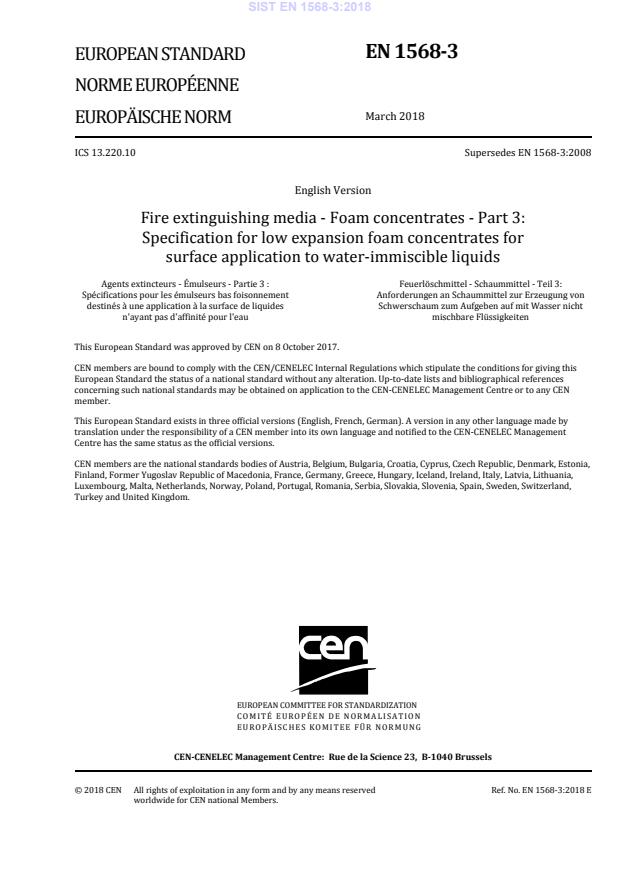
(Main)Fire extinguishing media - Foam concentrates - Part 3: Specification for low expansion foam concentrates for surface application to water-immiscible liquids
Fire extinguishing media - Foam concentrates - Part 3: Specification for low expansion foam concentrates for surface application to water-immiscible liquids
This European Standard specifies requirements for chemical and physical properties, and minimum performance requirements of low expansion foams suitable for surface application to water-immiscible liquids. Requirements are also given for marking.
WARNING - Any type approval according to this standard is invalidated by any change in composition of the approved product.
Some concentrates conforming to this part of EN 1568 can also conform to other parts and therefore can also be suitable for application as medium and/or high expansion foams, and for application at low expansion to water-miscible liquids.
Feuerlöschmittel - Schaummittel - Teil 3: Anforderungen an Schaummittel zur Erzeugung von Schwerschaum zum Aufgeben auf mit Wasser nicht mischbare Flüssigkeiten
Diese Europäische Norm legt Anforderungen an chemische und physikalische Eigenschaften und Mindestanforderungen an die Leistungsfähigkeit von Schwerschäumen fest, die für die Oberflächenanwendung bei mit Wasser nicht mischbaren Flüssigkeiten geeignet sind. Anforderungen an die Kennzeichnung sind ebenfalls festgelegt.
WARNUNG - JEDER TYP-PRÜFBESCHEID NACH DIESER NORM WIRD BEI ÄNDERUNG DER ZUSAMMENSETZUNG DES GEPRÜFTEN PRODUKTES UNGÜLTIG.
Einige diesem Teil von EN 1568 entsprechende Schaummittel können auch mit den anderen Teilen übereinstimmen und deshalb auch für die Anwendung als Leicht und/oder Mittelschäume sowie als Schwerschäume zur Anwendung bei wassermischbaren Flüssigkeiten, geeignet sein.
Agents extincteurs - Émulseurs - Partie 3 : Spécifications pour les émulseurs bas foisonnement destinés à une application à la surface de liquides n’ayant pas d’affinité pour l’eau
La présente Norme européenne spécifie les exigences en matière de propriétés chimiques, physiques et de performances minimales des émulseurs bas foisonnement convenant à une application à la surface de liquides n’ayant pas d’affinité pour l’eau. Des exigences concernant les marquages sont également fournies.
AVERTISSEMENT - Toute homologation de type conforme à la présente norme est invalidée dès lors qu’une modification est apportée à la composition du produit homologué.
Il se peut que certains émulseurs conformes à la présente partie de l’EN 1568 soient également conformes à d’autres parties de cette même norme et qu’ils conviennent donc à une application comme émulseurs moyen et/ou haut foisonnement ainsi qu’à une application comme émulseurs bas foisonnement pour des liquides ayant une affinité pour l’eau.
Gasila - Penila - 3. del: Specifikacija za penila za težko peno za površinsko uporabo pri tekočinah, netopnih v vodi
V tem osnutku evropskega standarda so določene zahteve glede kemijskih in fizikalnih lastnosti ter minimalne zahteve glede delovanja nizkoekspanzijskih pen, primernih za površinsko uporabo pri tekočinah, ki se ne mešajo z vodo. Navedene so tudi zahteve za označevanje.
Tipsko odobritev bodo izvedli neodvisni laboratoriji tretjih oseb, ki so akreditirani v skladu s standardom EN ISO/IEC 17025.
OPOZORILO: Vsakršna tipska odobritev v skladu s tem standardom je neveljavna, če pride do kakršne koli spremembe v sestavi odobrenega izdelka.
OPOMBA Nekateri koncentrati, ki so skladni s tem delom standarda EN 1568, so lahko skladni tudi z drugimi deli in so zato lahko primerni za uporabo kot srednje- in/ali visokoekspanzijske pene ter za uporabo pri nizki ekspanziji pri tekočinah, ki se mešajo z vodo.
General Information
Relations

Standards Content (Sample)
2003-01.Slovenski inštitut za standardizacijo. Razmnoževanje celote ali delov tega standarda ni dovoljeno.Feuerlöschmittel - Schaummittel - Teil 3: Anforderungen an Schaummittel zur Erzeugung von Schwerschaum zum Aufgeben auf mit Wasser nicht mischbare FlüssigkeitenAgents extincteurs - Émulseurs - Partie 3: Spécifications pour les émulseurs bas foisonnement destinés à une application à la surface de liquides n’ayant pas d’affinité pour l’eauFire extinguishing media - Foam concentrates - Part 3: Specification for low expansion foam concentrates for surface application to water-immiscible liquids13.220.10Gašenje požaraFire-fightingICS:Ta slovenski standard je istoveten z:EN 1568-3:2018SIST EN 1568-3:2018en,fr,de01-maj-2018SIST EN 1568-3:2018SLOVENSKI
STANDARDSIST EN 1568-3:2008/AC:2010SIST EN 1568-3:20081DGRPHãþD
EUROPEAN STANDARD NORME EUROPÉENNE EUROPÄISCHE NORM
EN 1568-3
March
t r s z ICS
s uä t t rä s r Supersedes EN
s w x zæ uã t r r zEnglish Version
Fire extinguishing media æ Foam concentrates æ Part
uã Specification for low expansion foam concentrates for surface application to wateræimmiscible liquids Agents extincteurs æ Émulseurs æ Partie
u ã Spécifications pour les émulseurs bas foisonnement destinés à une application à la surface de liquides n 5ayant pas d 5affinité pour l 5eau
Feuerlöschmittel æ Schaummittel æ Teil
uã Anforderungen an Schaummittel zur Erzeugung von Schwerschaum zum Aufgeben auf mit Wasser nicht mischbare Flüssigkeiten This European Standard was approved by CEN on
z October
t r s yä
egulations which stipulate the conditions for giving this European Standard the status of a national standard without any alterationä Upætoædate lists and bibliographical references concerning such national standards may be obtained on application to the CENæCENELEC Management Centre or to any CEN memberä
translation under the responsibility of a CEN member into its own language and notified to the CENæCENELEC Management Centre has the same status as the official versionsä
CEN members are the national standards bodies of Austriaá Belgiumá Bulgariaá Croatiaá Cyprusá Czech Republicá Denmarká Estoniaá Finlandá Former Yugoslav Republic of Macedoniaá Franceá Germanyá Greeceá Hungaryá Icelandá Irelandá Italyá Latviaá Lithuaniaá Luxembourgá Maltaá Netherlandsá Norwayá Polandá Portugalá Romaniaá Serbiaá Slovakiaá Sloveniaá Spainá Swedená Switzerlandá Turkey and United Kingdomä
EUROPEAN COMMITTEE FOR STANDARDIZATION COMITÉ EUROPÉEN DE NORMALISATION EUROPÄISCHES KOMITEE FÜR NORMUNG
CEN-CENELEC Management Centre:
Rue de la Science 23,
B-1040 Brussels
t r s z CEN All rights of exploitation in any form and by any means reserved worldwide for CEN national Membersä Refä Noä EN
s w x zæ uã t r s z ESIST EN 1568-3:2018
Grades of foam concentrate and performance . 15 A.1 Grades. 15 A.2 Typical performance . 15 Annex B (normative)
Sampling of foam concentrates . 17 Annex C (normative)
Determination of percentage sediment . 18 C.1 Sampling . 18 C.2 Apparatus . 18 C.3 Procedure. 18 Annex D (normative)
Determination of Viscosity for pseudo-plastic foam concentrates . 19 D.1 Pseudo-plastic foam concentrates . 19 D.2 Viscosity determination. 19 D.2.1 Apparatus . 19 SIST EN 1568-3:2018
Temperature conditioning of foam concentrates . 21 E.1 General . 21 E.2 Low temperature conditioning . 21 E.2.1 Apparatus . 21 E.2.2 Procedure . 21 E.3 High temperature conditioning . 21 E.3.1 Apparatus . 21 E.3.2 Procedure . 21 E.4 Division into top and bottom half-samples . 22 E.4.1 Apparatus . 22 E.4.1.1 Top half-sample container(s) . 22 E.4.1.2 Divider device . 22 E.4.2 Procedure . 23 Annex F (normative)
Determination of surface tension . 24 F.1 Solution of foam concentrate . 24 F.2 Procedure — Surface tension . 24 Annex G (normative)
Determination of expansion and drainage time . 25 G.1 Apparatus . 25 G.2 Temperature conditions . 25 G.3 Procedure . 25 G.4 Simulated fresh and sea water . 26 Annex H (normative)
Determination of test fire performance . 30 H.1 General . 30 H.2 General conditions . 30 H.2.1 Test series and criteria for success . 30 H.2.1.1 Foam concentrates not compatible with sea water. 30 H.2.1.2 Foam concentrates compatible with sea water . 30 H.2.2 Temperature and wind speed . 30 H.2.3 Records . 30 H.2.4 Foam solution. 31 H.2.5 Fuel . 31 H.3 Gentle application fire test . 32 H.3.1 Apparatus . 32 SIST EN 1568-3:2018
Small scale fire test . 35 I.1 Apparatus . 35 I.2 Test procedure . 35 I.2.1 Test conditions . 35 I.2.2 Set up . 36 I.2.3 Fire test . 36 Annex J (informative)
Description of a radiation measurement method . 45 J.1 Evaluation . 45 J.2 General arrangement of test . 45 J.3 Technical data for radiometers . 46 J.4 Procedure. 47 Annex K (normative)
Freezing point determination . 49 K.1 General . 49 K.2 Apparatus . 49 K.3 Procedure. 49 K.4 Example of a temperature against time curve for evaluation . 50 Annex L (normative)
Evaluation of film formation . 51 L.1 Sampling . 51 L.2 Apparatus . 51 L.3 Materials . 51 L.4 Procedure. 51 Annex M (normative)
Stability/Separation test of foam concentrate . 53 M.1 General . 53 M.2 Apparatus . 53 M.3 Procedure. 53 Annex N (normative)
Occupational health and ecotoxicological testing . 54 Annex O (informative)
Example for a technical data sheet . 55 Annex P (informative)
A-Deviations. 57 Bibliography . 59
Annex A gives information on grades of foam concentrate. 3.8 foam solution solution of foam concentrate in water SIST EN 1568-3:2018
This definition of gentle application relates to the fire test procedures used in EN 1568–3 and EN 1568–4. In practice fire-fighting systems foam can also be applied gently by fixed foam pourers or by indirect application via a tank wall or other surface. 3.10 forceful application application (of foam from the test nozzle) directly onto the surface of the fuel 3.11 sediment insoluble particles in the foam concentrate 3.12 Newtonian foam concentrate foam concentrate which has a viscosity which is independent of the shear rate 3.13 pseudo-plastic foam concentrate foam concentrate which has a viscosity which decreases with increasing shear rate 3.14 surface tension tension within the interface between a liquid and air 3.15 freezing point temperature at which the first ingredient of a mixture starts to solidify or freeze 3.16 designation identifying name name that corresponds to a chemical formulation and a specific production process Note 1 to entry: It guarantees consistency of the characteristics, performance and conditions of use of the foam concentrate. 3.17 demineralized water water conforming to EN ISO 3696 (Grade 3), the water having a surface tension greater than 70 mN m «1 when tested in accordance with F.2 and a conductiv «1 4 Sediment in the foam concentrate 4.1 Sediment before ageing Any sediment in the foam concentrate sampled in accordance with Annex B, but not aged in accordance with C.1, shall be dispersible through a 180 not more than 0,25 % when tested in accordance with Annex C. SIST EN 1568-3:2018
(see H.3) (see H.4)
Extinction time not more than 25 % burn-back time not less than Extinction time not more than 25 % burn-back time not less than I+ A
1,5 10 B
15 1,5
C
10 1,5
D
5 1,5
I A
3 10 B
15 3
C
10 3
D
5 3
II A
4 10 B
15 4
C
10 4
D
5 4
III B 5 15
C 5 10
D 5 5
NOTE 1 There is no burn-back resistance level A for class III. NOTE 2 Typical extinguishing performance classes and burn-back resistance levels for different types of foam concentrate are given in Annex A. 12 Evaluation of aqueous film formation For any foam concentrate claimed to be film forming or aqueous film forming, e.g. aqueous film forming foam (AFFF) and film forming fluoroprotein (FFFP), cyclohexane shall not catch fire when tested in accordance with Annex L before and after conditioning to Annex E. 13 Occupational health and ecotoxicological information The manufacturer shall provide information as specified in Annex N. 14 Technical data sheet The manufacturer should provide information for the foam concentrate. An example of the type of information provided in a manufacturers' technical data sheet is given in Annex O. SIST EN 1568-3:2018
lowest temperature for use and freezing point; f) if the manufacturer advises that the foam concentrate is adversely affected by low temperature storage according to Annex E the words 'Do not freeze'; g) the nominal quantity in the container; h) the supplier's name and address; i) the batch number and the date of manufacture; j) the words “Not suitable for use with sea water” or “Suitable for use with sea water” as appropriate; k) if the foam concentrate is Newtonian and the viscosity at the lowest temperature for use is more than 200 mm2 s-1 when measured in accordance with EN ISO 3104 the words “This concentrate can require special proportioning equipment”; l) if the foam concentrate is pseudo-plastic and the viscosity at the lowest temperature for use is greater than or equal to 120 mPa·s at 375 s-1 the words “Pseudo-plastic foam concentrate. This concentrate can require special proportioning equipment”; and m) the lowest extinguishing performance class and the lowest burn-back resistance level obtained with all fuels in simulated fresh water and sea water. NOTE The marking of shipping containers shipped to laboratories for testing are exempt from this requirement. SIST EN 1568-3:2018
Grades of foam concentrate and performance A.1 Grades Foam concentrates are graded as follows: a) protein foam concentrates (P): these are liquids derived from hydrolysed protein materials; b) fluoroprotein foam concentrates (FP): these are protein concentrates with added fluorinated surface active agents; c) synthetic foam concentrates (S): these are based upon mixtures of hydrocarbon surface-active agents and do not contain fluoro organic compounds; d) alcohol resistant foam concentrates (AR): these can be suitable for use on hydrocarbon fuels, and additionally are resistant to breakdown when applied to the surface of water-miscible liquid fuels. Some alcohol resistant foam concentrates can precipitate a polymeric membrane on the surface of alcohol; e) aqueous film-forming foam concentrates (AFFF): these are generally based on mixtures of hydrocarbon surfactants and fluorinated surface active agents and have the ability to form an aqueous film on the surface of some hydrocarbon fuels; f) film-forming fluoroprotein foam concentrates (FFFP): these are fluoroprotein foam concentrates which have the ability to form an aqueous film on the surface of some hydrocarbon fuels; g) fluorine free foam concentrates (F3): these foam concentrates are dedicated to meet fire performance ratings and are targeting applications similar to AFFF and/or AR-foams without using fluoroorganic compounds. These foam concentrates are based upon mixtures of hydrocarbon surface-active agents and non-fluorine containing stabilizers. A.2 Typical performance The correlation between performance and grade of concentrate is not perfect. The values given in Table A.1 are therefore only typical and particular foam of a given grade can have performance better or worse than that shown. SIST EN 1568-3:2018
I
C
Yes Forceful AFFF (AR)
I
A or B
Yes Forceful FFFP (not AR)
I
B
Yes Forceful FFFP (AR)
I
A or B
Yes Forceful FP (not AR)
II
A or B
No Forceful FP (AR)
II
A or B
No Forceful P (not AR)
III
B
No Gentle P (AR)
III
B
No Gentle S (not AR)
III
C
No Gentle S (AR)
III
C
No Gentle F3 (not AR) I or II C No Forceful F3 (AR) I or II B / C No Forceful SIST EN 1568-3:2018
Sampling of foam concentrates The samples for testing shall be delivered by the supplier in completely filled sealable containers. The samples for testing shall be taken and delivered by the supplier using a method which provides a representative sample of the foam concentrate to be tested. NOTE Nominal 25 l containers are convenient. SIST EN 1568-3:2018
Determination of percentage sediment C.1 Sampling NOTE See Clause 4. Use a sample prepared in accordance with Annex B. Place approximately 1 l of the sample in a suitable container of nominal capacity sufficient to provide an ullage of 5 % to 10 % of the container volume. Seal the container. Ensure that any sediment is dispersed by agitating the sample container. Take two samples, testing one immediately at a temperature of (20 ± 5) °C, the other after ageing for (24 ± 2) h at (60 ± 2) °C in a completely filled container without access to air. C.2 Apparatus C.2.1 Graduated centrifuge tubes. NOTE The centrifuge tubes described in ISO 3734 are suitable. C.2.2 Centrifuge, operating at (6 000 ± 600) m s «2. NOTE The centrifuge described in ISO 3734 is suitable. C.2.3 180
ISO 3310-1. C.2.4 Plastic wash bottle. C.3 Procedure C.3.1 Centrifuge each sample of the concentrate for 10 min. Determine the volume of the sediment and report it as a percentage of the volume of the centrifuged sample. C.3.2 Wash the contents of the centrifuge tube onto the sieve and check whether the sediment can be dispersed through the sieve by the jet from the plastic wash bottle. SIST EN 1568-3:2018
Determination of Viscosity for pseudo-plastic foam concentrates NOTE The procedure is described in EN ISO 3219:1994, Annex A or Annex B. D.1 Pseudo-plastic foam concentrates Pseudo-plastic foam concentrates have a viscosity which decreases with increasing shear rate at constant temperature. NOTE Pseudo-plastic foam concentrates are a particular class of non-Newtonian foam concentrate. D.2 Viscosity determination D.2.1 Apparatus D.2.1.1 Rotational viscometer in accordance with EN ISO 3219 with the following parameters: — maximum shear stress
· 75 Pa; — maximum shear rate
· 600 s «1. The viscometer shall be fitted with a temperature control unit which can maintain the sample temperature within ± 1 °C of the required temperature. D.2.2 Test temperatures The viscosity of the foam concentrate shall be measured from 20 °C, to and including the lowest temperature for use claimed by the manufacturer in steps of 10 °C. Use a fresh sample for each temperature. D.2.3 Viscosity measurement If the sample contains suspended air bubbles the sample shall be centrifuged for 10 min using the apparatus specified in C.2.1 and C.2.2 before the sample is applied in the apparatus. The test should be performed in accordance with the following test procedure: 1) adjustment of temperature control unit; 2) setting of the gap; 3) application of the sample; 4) minimum 10 min waiting period (no shear) to reach temperature equilibrium; 5) 1 min pre-shearing at 600 s «1; 6) 1 min waiting period without shearing; 7) measure the shear stress for 10 s at each shear rate starting at the lowest shear rate (preferable at 75 s «1). SIST EN 1568-3:2018
Temperature conditioning of foam concentrates E.1 General If the foam concentrate is claimed by the supplier not to be adversely affected by storage at
« u r °C, condition the sample in accordance with E.2 and then in accordance with E.3; otherwise, condition only in accordance with E.3. E.2 Low temperature conditioning E.2.1 Apparatus E.2.1.1 Freezing chamber ± 3) °C.
...
Questions, Comments and Discussion
Ask us and Technical Secretary will try to provide an answer. You can facilitate discussion about the standard in here.
Loading comments...