


FprCEN/TR 16931-11-1
(Main)Electronic invoicing - Part 11: e-Receipt syntaxes
Electronic invoicing - Part 11: e-Receipt syntaxes
This document describes:
- business processes and the technical environments in which simplified invoices and e-receipts are exchanged; and
- the needed syntax bindings of electronic simplified invoices and e-receipts.
Elektronische Rechnungsstellung - Teil 11: Syntax für elektronische Belege
Facturation électronique - Partie 11 : Syntaxes des reçus électroniques
Elektronsko izdajanje računov - 11. del: Sintakse e-računov
General Information
- Status
- Not Published
- Publication Date
- 10-Feb-2026
- Technical Committee
- CEN/TC 434 - Project Committee - Electronic Invoicing
- Drafting Committee
- CEN/TC 434/WG 5 - Syntax bindings
- Current Stage
- 5060 - Closure of Vote - Formal Approval
- Start Date
- 01-Jan-2026
- Due Date
- 06-Jul-2026
- Completion Date
- 01-Jan-2026
Overview
The FprCEN/TR 16931-11-1 standard, titled Electronic invoicing - Part 11: e-Receipt syntaxes, is developed by the European Committee for Standardization (CEN) Technical Committee CEN/TC 434. This document focuses on the syntax bindings and business environments for exchanging simplified electronic invoices and e-receipts. It details how e-receipt and simplified invoice data models can be represented in machine-readable formats to support automated processing in various IT environments.
E-receipts-digital counterparts to traditional paper receipts-are crucial in the digital economy for both consumers and businesses. This standard complements previous parts in the EN 16931 series, building on semantic data models by defining how information is syntactically structured for smooth interoperability.
Key Topics
e-Receipt Definition: A digital version of a paper receipt used to confirm payment, validate purchases, or provide access to goods and services. It may function as an invoice or simplified invoice depending on legal requirements.
Simplified Invoices: Streamlined electronic invoices intended for smaller or specific transactions, containing essential data without exhaustive buyer details, facilitating faster processing in retail and certain B2B transactions.
Business Processes and Use Cases: Diverse scenarios including B2C retail purchases, taxi services, dental care, restaurants, concert tickets, pharmaceuticals, hotels, and train tickets are covered. The standard analyzes how e-receipts are utilized in each case.
Syntax Bindings: Mapping the semantic data models of e-receipts and simplified invoices into syntaxes such as JSON and XML for automated electronic processing. It establishes the required machine-readable formats suitable for mobile devices, Point of Sale (POS) systems, and back-office ERP software.
Applications for Different Stakeholders:
- Consumers benefit from improved expense tracking, budgeting, tax preparation, returns handling, and digital record-keeping.
- Businesses gain enhanced invoicing automation, fraud detection, and customer service efficiency through digital receipt data.
- Financial Institutions utilize e-receipts for verifying transactions, fraud prevention, and to provide personalized financial services.
- Third-Party Developers can integrate e-Receipt data into apps for expense management, personal finance, and automated reimbursements.
Technical Environment: Examines RESTful APIs and open API protocols used for e-receipt exchange, including considerations for interoperability, security, and practical deployment.
Comparison of Syntaxes: Discusses merits of JSON versus XML for representing e-receipt data, outlining semantic structures and syntax candidates to support robust, scalable e-invoicing ecosystems.
Applications
The standard facilitates the adoption and implementation of e-receipts and simplified electronic invoices across multiple industries and markets:
Retail and Hospitality: Enables seamless digital receipts for purchases in shops, restaurants, hotels, and entertainment, improving customer convenience and operational efficiency.
Transport Services: Standardizes digital ticketing and receipt issuance for taxi, train, and other transit systems, supporting easy validation and record-keeping.
Healthcare and Pharmaceuticals: Supports simplified billing and receipt generation for dental care and pharmacies, ensuring compliance and ease of use.
Financial Management Solutions: Integrates with consumer finance apps and business accounting systems, fostering automation in financial reporting, VAT compliance, and expense reimbursement.
Legal Compliance and Cross-Border Trade: Ensures that e-receipts meet EU legislative requirements and support interoperability between national and international business systems.
Related Standards
FprCEN/TR 16931-11-1 is part of the EN 16931 series on electronic invoicing, which includes:
- EN 16931-1: Semantic data model of the core elements of an electronic invoice.
- CEN/TS 16931-2: List of compliant syntaxes for electronic invoices.
- CEN/TS 16931-8: Semantic data model for e-receipts and simplified invoices.
- CEN/TS 16931-3-x: Syntax bindings for various invoice and credit note message formats including ISO/IEC 19845 (UBL), UN/CEFACT XML, and UN/EDIFACT.
- CEN/TR 16931-4: Guidelines on interoperability at the message transmission level.
- CEN/TR 16931-9 / 10: Extensions related to VAT reporting, B2B transactions, and additional requirements.
These related documents ensure a comprehensive framework for standardizing electronic invoicing and receipts across Europe, promoting uniformity and efficiency in digital business communications.
Keywords: electronic invoicing, e-receipt syntaxes, simplified invoice, digital receipt, electronic invoice standard, CEN 16931, syntax bindings, semantic data model, B2C e-receipts, digital receipt applications, electronic receipt standard, machine-readable invoice, e-invoice interoperability.

Frequently Asked Questions
FprCEN/TR 16931-11-1 is a draft published by the European Committee for Standardization (CEN). Its full title is "Electronic invoicing - Part 11: e-Receipt syntaxes". This standard covers: This document describes: - business processes and the technical environments in which simplified invoices and e-receipts are exchanged; and - the needed syntax bindings of electronic simplified invoices and e-receipts.
This document describes: - business processes and the technical environments in which simplified invoices and e-receipts are exchanged; and - the needed syntax bindings of electronic simplified invoices and e-receipts.
FprCEN/TR 16931-11-1 is classified under the following ICS (International Classification for Standards) categories: 35.240.20 - IT applications in office work; 35.240.63 - IT applications in trade. The ICS classification helps identify the subject area and facilitates finding related standards.
FprCEN/TR 16931-11-1 is available in PDF format for immediate download after purchase. The document can be added to your cart and obtained through the secure checkout process. Digital delivery ensures instant access to the complete standard document.
Standards Content (Sample)
SLOVENSKI STANDARD
01-december-2025
Elektronsko izdajanje računov - 11. del: Sintakse e-računov
Electronic invoicing - Part 11: e-Receipt syntaxes
Elektronische Rechnungsstellung - Teil 11: Syntax für elektronische Belege
Facturation électronique - Partie 11 : Syntaxes des reçus électroniques
Ta slovenski standard je istoveten z: FprCEN/TR 16931-11-1
ICS:
35.240.20 Uporabniške rešitve IT pri IT applications in office work
pisarniškem delu
35.240.63 Uporabniške rešitve IT v IT applications in trade
trgovini
2003-01.Slovenski inštitut za standardizacijo. Razmnoževanje celote ali delov tega standarda ni dovoljeno.
FINAL DRAFT
TECHNICAL REPORT
RAPPORT TECHNIQUE
TECHNISCHER REPORT
October 2025
ICS 35.240.63; 35.240.20
English Version
Electronic invoicing - Part 11: e-Receipt syntaxes
Elektronische Rechnungsstellung - Teil 11: Syntax für
elektronische Belege
This draft Technical Report is submitted to CEN members for Vote. It has been drawn up by the Technical Committee CEN/TC
434.
CEN members are the national standards bodies of Austria, Belgium, Bulgaria, Croatia, Cyprus, Czech Republic, Denmark, Estonia,
Finland, France, Germany, Greece, Hungary, Iceland, Ireland, Italy, Latvia, Lithuania, Luxembourg, Malta, Netherlands, Norway,
Poland, Portugal, Republic of North Macedonia, Romania, Serbia, Slovakia, Slovenia, Spain, Sweden, Switzerland, Türkiye and
United Kingdom.
Recipients of this draft are invited to submit, with their comments, notification of any relevant patent rights of which they are
aware and to provide supporting documentation.
Warning : This document is not a Technical Report. It is distributed for review and comments. It is subject to change without
notice and shall not be referred to as a Technical Report.
EUROPEAN COMMITTEE FOR STANDARDIZATION
COMITÉ EUROPÉEN DE NORMALISATION
EUROPÄISCHES KOMITEE FÜR NORMUNG
CEN-CENELEC Management Centre: Rue de la Science 23, B-1040 Brussels
© 2025 CEN All rights of exploitation in any form and by any means reserved Ref. No. FprCEN/TR 16931-11-1:2025 E
worldwide for CEN national Members.
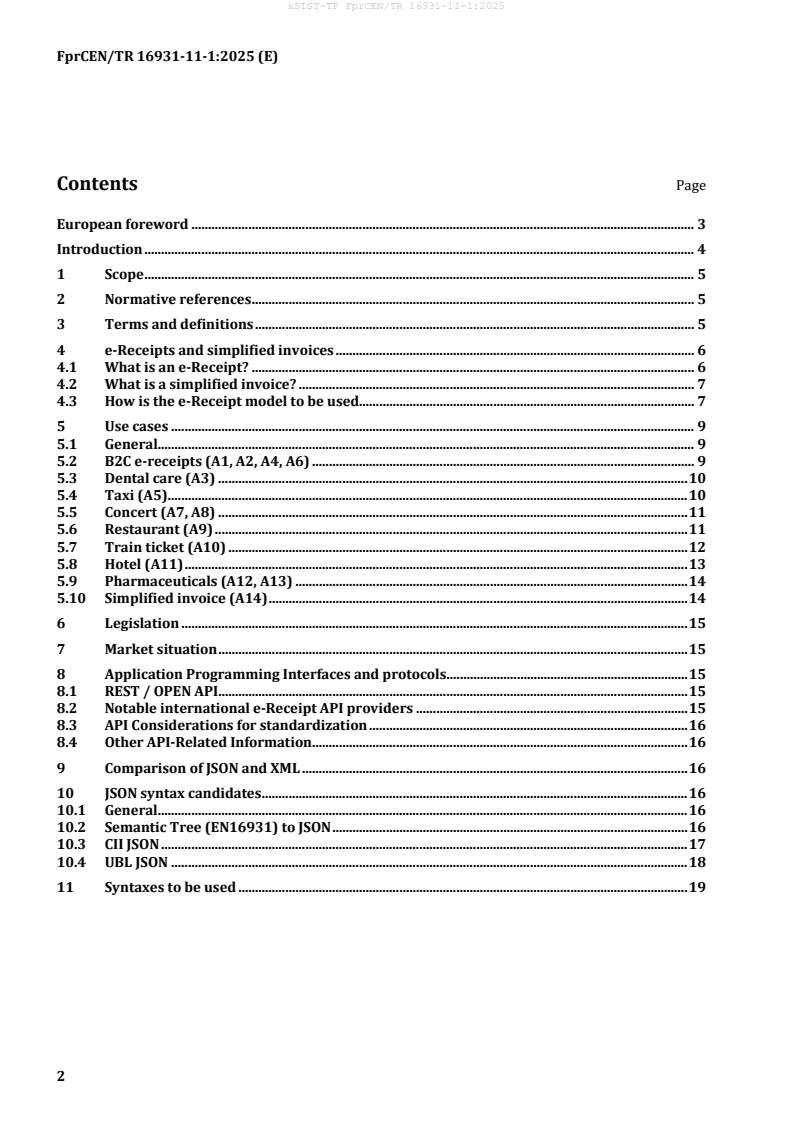
Contents Page
European foreword . 3
Introduction . 4
1 Scope . 5
2 Normative references . 5
3 Terms and definitions . 5
4 e-Receipts and simplified invoices . 6
4.1 What is an e-Receipt? . 6
4.2 What is a simplified invoice? . 7
4.3 How is the e-Receipt model to be used. 7
5 Use cases . 9
5.1 General. 9
5.2 B2C e-receipts (A1, A2, A4, A6) . 9
5.3 Dental care (A3) . 10
5.4 Taxi (A5) . 10
5.5 Concert (A7, A8) . 11
5.6 Restaurant (A9) . 11
5.7 Train ticket (A10) . 12
5.8 Hotel (A11) . 13
5.9 Pharmaceuticals (A12, A13) . 14
5.10 Simplified invoice (A14) . 14
6 Legislation . 15
7 Market situation . 15
8 Application Programming Interfaces and protocols . 15
8.1 REST / OPEN API . 15
8.2 Notable international e-Receipt API providers . 15
8.3 API Considerations for standardization . 16
8.4 Other API-Related Information . 16
9 Comparison of JSON and XML . 16
10 JSON syntax candidates . 16
10.1 General. 16
10.2 Semantic Tree (EN16931) to JSON . 16
10.3 CII JSON . 17
10.4 UBL JSON . 18
11 Syntaxes to be used . 19
European foreword
This document (FprCEN/TR 16931-11-1:2025) has been prepared by Technical Committee CEN/TC 434
“Electronic invoicing”, the secretariat of which is held by NEN.
This document is currently submitted to the Vote on TR.
This document is part of a series of documents, consisting of:
— EN 16931-1, Electronic invoicing - Part 1: Semantic data model of the core elements of an electronic
invoice
— CEN/TS 16931-2, Electronic invoicing - Part 2: List of syntaxes that comply with EN 16931-1
— CEN/TS 16931-3-1, Electronic invoicing - Part 3-1: Methodology for syntax bindings of the Core
Elements of an Electronic Invoice
— CEN/TS 16931-3-2, Electronic invoicing - Part 3-2: Syntax binding for ISO/IEC 19845 (UBL 2.1) invoice
and credit note
— CEN/TS 16931-3-3, Electronic invoicing - Part 3-3: Syntax binding for UN/CEFACT XML Industry
Invoice D16B
— CEN/TS 16931-3-4, Electronic invoicing - Part 3-4: Syntax binding for UN/EDIFACT INVOIC D16B
— CEN/TR 16931-4, Electronic invoicing - Part 4: Guidelines on interoperability of Electronic Invoices at
the transmission level
— CEN/TS 16931-5, Electronic invoicing - Part 5: Guidelines on the use of sector or country extensions in
conjunction with EN 16931-1, methodology to be applied in the real environment
— CEN/TR 16931-6, Electronic invoicing - Part 6: Result of the test of EN 16931-1 with respect to its
practical application for an end user
— CEN/TS 16931-7, Electronic invoicing - Part 7: Methodology for the development and use of EN 16931-
1 compliant structured Core Invoice Usage Specifications
— CEN/TS 16931-8, Electronic invoicing - Part 8: Semantic data model of the elements of an e-receipt or
a simplified electronic invoice
— CEN/TR 16931-9, Electronic invoicing - Part 9: VAT reporting and gap analysis with current e-
invoicing standardization deliverables
— CEN/TR 16931-10, Electronic invoicing – Part 10: Additional requirements to extend to B2B
Introduction
In CEN/TS 16931-8, Electronic invoicing – Part 8: Semantic data model of the elements of an e-receipt or a
simplified electronic invoice, the semantic model of an e-receipt or of a simplified electronic invoice is
defined. To be able to be used, a semantic model needs to be mapped to a syntax. A syntax defines how
the information elements in the model are mapped to machine readable text and ultimately to binary
structures. For the electronic invoice (EN 16931-1), mapping is available to syntaxes that are widely used
by businesses and governments. The syntaxes are fit for the exchange of electronic messages between
back-office systems, such as ERP software. E-receipts are also used by consumers who use mobile devices
and personal computers. Therefore, in this document, use cases of the e-receipt are analysed to determine
which syntaxes will be used in those use cases. In subsequent deliverables, the mappings can be produced
from the e-receipt model to those syntaxes.
1 Scope
This document describes:
— business processes and the technical environments in which simplified invoices and e-receipts are
exchanged; and
— the needed syntax bindings of electronic simplified invoices and e-receipts.
2 Normative references
EN 16931-1, Electronic invoicing — Part 1: Semantic data model of the core elements of an electronic
invoice
3 Terms and definitions
For the purposes of this document, the terms and definitions given in EN 16931-1 and the following apply.
ISO and IEC maintain terminology databases for use in standardization at the following addresses:
— ISO Online browsing platform: available at https://www.iso.org/obp/
— IEC Electropedia: available at https://www.electropedia.org/
3.1
B2B
business to business
transactions between businesses
3.2
B2C
business to consumer
transactions between private businesses and non-taxable persons
3.3
e-Invoice
electronic invoice
invoice that has been issued, transmitted and received in a structured electronic format which allows for
its automatic and electronic processing
3.4
e-Receipt
receipt that has been issued in a structured electronic format (electronic receipt) which allows for its
automatic and electronic processing to be transmitted and received by the customer
3.5
simplified invoice
invoice with a total amount below a certain threshold that may contain fewer data elements than a normal
invoice
[SOURCE: Directive 2006/112/EC]
3.6
semantic data model
structured set of logically interrelated information elements
3.7
information element
semantic concept that can be defined independently of any particular representation in a syntax
3.8
structured information element
information element that can be processed automatically
3.9
syntax
machine-readable language or dialect used to represent the information elements contained in an
electronic document (e.g. an electronic receipt)
3.10
business term
label assigned to a given information element which is used as a primary reference
3.11
receipt model
semantic data model of the elements of an electronic receipt
3.12
elements of an e-receipt
set of essential information elements that an electronic receipt may contain in order to enable domestic
and cross-border interoperability, including the necessary information to ensure legal compliance
3.13
POS
point of sale system
cash register or cash register system that allows communication between different components and
systems
Note 1 to entry: A POS system is designed to facilitate user-friendly administration of sales for employees. The
system also helps with the management of a business.
4 e-Receipts and simplified invoices
4.1 What is an e-Receipt?
An e-Receipt, short for electronic receipt, is a digital version of a traditional paper receipt. It serves the
same purpose as a physical receipt but is delivered and stored electronically. In some cases, an e-receipt
is legally the same as an invoice or a simplified invoice. In other cases, the e-receipt is handed over to the
Buyer in addition to the invoice, after the payment has been made. In the latter case, the e-receipt serves
as a proof of payment and can be used to collect the goods or services acquired. An example is a theatre
performance that can only be attended on presentation of the receipt.
4.2 What is a simplified invoice?
A simplified invoice is a streamlined, less detailed version of a standard invoice. It's primarily designed
for smaller transactions or specific scenarios where a full invoice is unnecessary. In contrast to regular
invoices, which contain comprehensive information about both the buyer and the seller, simplified
invoices focus on the essentials, making them particularly useful in retail environments or situations
where the buyer's identity is not required. According to EU legislation, electronic receipts must be
provided in the form of an electronic invoice once a specific monetary threshold is reached, with this
threshold varying between individual EU member states.
The primary goal of a simplified invoice is to make the invoicing process more efficient for certain types
of transactions. Instead of compiling a detailed invoice, businesses can issue a simplified version that still
provides the necessary legal and financial information but without excess details, saving time.
Simplified invoices are commonly used in the following situations:
— Small-value transactions: Many countries set a threshold for the value of transactions that qualify for
simplified invoices, allowing businesses to issue them for sales under that amount.
— Retail environments: For consumer purchases in shops, simplified invoices, often similar to receipts,
are widely accepted.
— Business-to-business (B2B) transactions: In certain cases, where allowed by law, simplified invoices
can be used between businesses for small transactions.
Simplified invoices are accepted for VAT return purposes in many countries, though there are limitations.
They might not always be sufficient for businesses looking to reclaim input VAT, as some jurisdictions
require more detailed documentation for tax deductions or other accounting needs.
4.3 How is the e-Receipt model to be used
4.3.1 General
E-Receipt data is used in various ways by different stakeholders in different contexts. In each context (e.g.
hotels in Europe using a specific booking system, pharmacies in a specific country or taxi services in a
specific region), the data to be included in the e-receipt is selected from the e-receipt model. It is defined
what applications (e.g. a mobile app, a cash register, a back office or a lap top application) use the data
and how they exchange it. This can include syntax conversions.
Generic consumer side applications can be developed that collect e-receipt data from different contexts
and provide an overview and assist the consumer with their budgeting. Such applications can be provided
by financial institutions or by independent software developers.
4.3.2 Use by consumers
— Expense tracking and budgeting: Consumers can easily track their spending and allocate budgets
more effectively.
— Easy retrieval for returns or warranty claims: Quick access to e-Receipts simplifies returns and
warranty claims without the hassle of keeping physical receipts.
— Tax preparation and documentation: Organizing receipts for tax filing becomes straightforward,
reducing the time and effort for preparation.
— Organizing purchases and financial records: A digital archive of receipts helps consumers keep clear
records of their purchases and overall financial health.
— Access to acquired services, such as hotel rooms, theatre performances and public transport.
4.3.3 Use by businesses
— Accounting and bookkeeping: Businesses can automate and streamline their financial records with
digital receipts, improving accuracy in accounting.
—
...
Questions, Comments and Discussion
Ask us and Technical Secretary will try to provide an answer. You can facilitate discussion about the standard in here.
Loading comments...