


CEN ISO/TS 17251:2023
(Main)Health informatics - Business requirements for a syntax to exchange structured dose information for medicinal products (ISO/TS 17251:2023)
Health informatics - Business requirements for a syntax to exchange structured dose information for medicinal products (ISO/TS 17251:2023)
This document specifies the business requirements for the structured content of structured or semi-
structured dose instructions for recording dose instructions in the electronic health record (EHR),
supporting clinical decision support, and in exchanging medication orders, as applicable to primary,
secondary and tertiary care.
This document is focused on the dose instructions as will be presented to the individual subject of care
or caregiver. Comprehension of dose instructions by the subject of care or caregiver is an overarching
consideration for subject of care safety and the best outcomes. Related factors are discussed but are not
part of the primary scope.
This document does not define an information model, except to the extent that those information model
concepts are necessary to define business requirements.
Outside the scope of this document are:
— The implementation of dose instructions, i.e. assembling the structured elements into a form
appropriate for the patient or caregiver;
— The content of a medication order (see ISO 17523) beyond content related to dose instructions;
— The content of a record of dispense of a medicinal product (see ISO/TS 19293);
— The functionality of health, clinical and/or pharmacy systems;
— Other kinds of content of health, clinical or pharmacy systems that are needed to support the whole
process of health care providers, such as:
— A drug knowledge database (see ISO/TS 22756);
— A decision support system (see ISO/TS 22756 and ISO/TS 22703);
— A complete medical record (EHR);
— A medicinal product dictionary (see ISO/TS 19256);
— Verification of the medicinal product and dose being administered.
— Some concepts from Identification of Medicinal Products are referenced, but not defined, in this
document. See Clause 4 for discussion of the relationship of this document with IDMP.
Medizinische Informatik - Geschäftsanforderungen an eine Syntax zum Austausch von Dosierungsinformationen für Arzneimittel (ISO/TS 17251:2023)
Informatique de santé - Exigences d'affaire pour une syntaxe d'échange d'informations de dose structurée pour les produits médicaux (ISO/TS 17251:2023)
Zdravstvena informatika - Poslovne zahteve za sintakso za izmenjavo strukturiranih podatkov o odmerkih za zdravila (ISO/TS 17251:2023)
Ta dokument določa poslovne zahteve za strukturirano vsebino strukturiranih ali polstrukturiranih navodil za odmerke za shranjevanje navodil za odmerke v elektronski zdravstveni zapis (EHR), zagotavljanje podpore za klinično odločanje ter uporabo v izmenjavi naročil zdravil, kot se uporabljajo v primarni, sekundarni in terciarni oskrbi.
Ta dokument se osredotoča na navodila za odmerke in bo predstavljen posameznemu oskrbovancu ali negovalcu. Oskrbovančevo oziroma negovalčevo razumevanje navodil za odmerke je najpomembnejši vidik za zagotavljanje oskrbovančeve varnosti in najboljših rezultatov zdravljenja. Obravnavani so povezani dejavniki, ki pa niso del primarnega področja uporabe.
Ta dokument ne določa informacijskega modela, razen v obsegu, v katerem so ti koncepti informacijskega modela potrebni za opredelitev poslovnih zahtev.
Področje uporabe tega dokumenta ne vključuje:
– Izvajanje navodil za odmerke, tj. sestavljanje strukturiranih elementov v obliki, ki ustreza bolniku ali negovalcu;
– Vsebina naročila zdravila (glej standard ISO 17523) zunaj vsebine v zvezi z navodili za odmerke;
– Vsebina zapisov o izdaji zdravila (glej standard ISO/TS 19293);
– Funkcionalnost zdravstvenih, kliničnih in/ali lekarniških sistemov;
– Druge vrste vsebin zdravstvenih, kliničnih ali lekarniških sistemov, ki so potrebne za zagotavljanje podpore za celoten postopek ponudnikov zdravstvenih storitev, kot so:
– Podatkovna zbirka znanja o zdravilih (glej standard ISO/TS 22756);
– Sistem za zagotavljanje podpore za sprejemanje odločitev (glej standarda ISO/TS 22756 in ISO/TS 22703);
– Celovit elektronski zdravstveni zapis;
– Slovar zdravil (glej ISO/TS 19256);
– Preverjanje količine uporabljenega zdravila in odmerka.
– V tem dokumentu so referenčno navedeni nekateri koncepti iz identifikacije medicinskih izdelkov, vendar niso opredeljeni. Glej točko 4 za obravnavo razmerja med tem dokumentom in standardom za identifikacijo medicinskih izdelkov.
General Information
Relations
Overview
CEN ISO/TS 17251:2023 (ISO/TS 17251:2023) defines business requirements for a syntax to exchange structured dose information for medicinal products. It focuses on the precise, unambiguous representation of dose instructions used in electronic health records (EHRs), medication orders and clinical decision support (CDS). The Technical Specification is technology-agnostic - it specifies what structured dose data must contain rather than how to implement it - and is primarily intended for software developers and vendors in health informatics.
Key Topics
- Dose syntax and structured dose instructions: Requirements for representing dose instructions in a consistent, computable format to support automated processing, dose checking and CDS.
- Elements of a dose instruction: Business requirements for amount, administration method, route/site, timing/frequency, conditional administration and ancillary information.
- Information requirements:
- Terminologies and code systems - guidance on using codified values where appropriate.
- Information model concepts - high-level model concepts included only as needed to define requirements.
- Text representation - human-readable representations to accompany structured data for patients and caregivers.
- Administration amount and units - discussion of unit of measurement vs. unit of presentation and handling ranges (e.g., min/max).
- Timing and frequency - support for complex schedules, interval/period representations, and multi-term frequency expressions (2-term/3-term).
- Conditional administration - requirements for instructions that depend on clinical conditions or observations.
- Subject-of-care specifics - optional patient attributes (e.g., weight, laboratory observations) relevant to dosing.
- Conformance and relationship to other deliverables: Clarifies how this TS relates to IDMP and other ISO standards without redefining those standards.
Applications
- EHR and prescribing systems: enables precise capture and exchange of medication dose instructions for safer prescribing.
- Pharmacy and dispensing systems: supports accurate interpretation of structured dose data for dispensing and verification.
- Clinical decision support (CDS): allows CDS engines to leverage codified dose instructions for checks, alerts and dosing calculations.
- Interoperability and health data exchange: promotes consistent, computable dose data across care settings (primary, secondary and tertiary care).
Who Should Use It
- Health IT software developers and architects
- EHR, pharmacy and medication management vendors
- Clinical informaticians and CDS designers
- Standards implementers and integrators working on medication interoperability
Related Standards
- ISO 17523 (medication order content)
- ISO/TS 19293 (record of dispense)
- ISO/TS 22756, ISO/TS 22703 (decision support and drug knowledge)
- ISO/TS 19256 (medicinal product dictionary)
- IDMP (Identification of Medicinal Products) - referenced for term alignment
This Technical Specification helps organizations deliver safer, more interoperable medication information by standardizing the business requirements for exchanging structured dose information. Keywords: health informatics, structured dose information, dose syntax, medication orders, clinical decision support, EHR interoperability, ISO/TS 17251:2023.
Frequently Asked Questions
CEN ISO/TS 17251:2023 is a technical specification published by the European Committee for Standardization (CEN). Its full title is "Health informatics - Business requirements for a syntax to exchange structured dose information for medicinal products (ISO/TS 17251:2023)". This standard covers: This document specifies the business requirements for the structured content of structured or semi- structured dose instructions for recording dose instructions in the electronic health record (EHR), supporting clinical decision support, and in exchanging medication orders, as applicable to primary, secondary and tertiary care. This document is focused on the dose instructions as will be presented to the individual subject of care or caregiver. Comprehension of dose instructions by the subject of care or caregiver is an overarching consideration for subject of care safety and the best outcomes. Related factors are discussed but are not part of the primary scope. This document does not define an information model, except to the extent that those information model concepts are necessary to define business requirements. Outside the scope of this document are: — The implementation of dose instructions, i.e. assembling the structured elements into a form appropriate for the patient or caregiver; — The content of a medication order (see ISO 17523) beyond content related to dose instructions; — The content of a record of dispense of a medicinal product (see ISO/TS 19293); — The functionality of health, clinical and/or pharmacy systems; — Other kinds of content of health, clinical or pharmacy systems that are needed to support the whole process of health care providers, such as: — A drug knowledge database (see ISO/TS 22756); — A decision support system (see ISO/TS 22756 and ISO/TS 22703); — A complete medical record (EHR); — A medicinal product dictionary (see ISO/TS 19256); — Verification of the medicinal product and dose being administered. — Some concepts from Identification of Medicinal Products are referenced, but not defined, in this document. See Clause 4 for discussion of the relationship of this document with IDMP.
This document specifies the business requirements for the structured content of structured or semi- structured dose instructions for recording dose instructions in the electronic health record (EHR), supporting clinical decision support, and in exchanging medication orders, as applicable to primary, secondary and tertiary care. This document is focused on the dose instructions as will be presented to the individual subject of care or caregiver. Comprehension of dose instructions by the subject of care or caregiver is an overarching consideration for subject of care safety and the best outcomes. Related factors are discussed but are not part of the primary scope. This document does not define an information model, except to the extent that those information model concepts are necessary to define business requirements. Outside the scope of this document are: — The implementation of dose instructions, i.e. assembling the structured elements into a form appropriate for the patient or caregiver; — The content of a medication order (see ISO 17523) beyond content related to dose instructions; — The content of a record of dispense of a medicinal product (see ISO/TS 19293); — The functionality of health, clinical and/or pharmacy systems; — Other kinds of content of health, clinical or pharmacy systems that are needed to support the whole process of health care providers, such as: — A drug knowledge database (see ISO/TS 22756); — A decision support system (see ISO/TS 22756 and ISO/TS 22703); — A complete medical record (EHR); — A medicinal product dictionary (see ISO/TS 19256); — Verification of the medicinal product and dose being administered. — Some concepts from Identification of Medicinal Products are referenced, but not defined, in this document. See Clause 4 for discussion of the relationship of this document with IDMP.
CEN ISO/TS 17251:2023 is classified under the following ICS (International Classification for Standards) categories: 35.240.80 - IT applications in health care technology. The ICS classification helps identify the subject area and facilitates finding related standards.
CEN ISO/TS 17251:2023 has the following relationships with other standards: It is inter standard links to CEN ISO/TS 17251:2016. Understanding these relationships helps ensure you are using the most current and applicable version of the standard.
You can purchase CEN ISO/TS 17251:2023 directly from iTeh Standards. The document is available in PDF format and is delivered instantly after payment. Add the standard to your cart and complete the secure checkout process. iTeh Standards is an authorized distributor of CEN standards.
Standards Content (Sample)
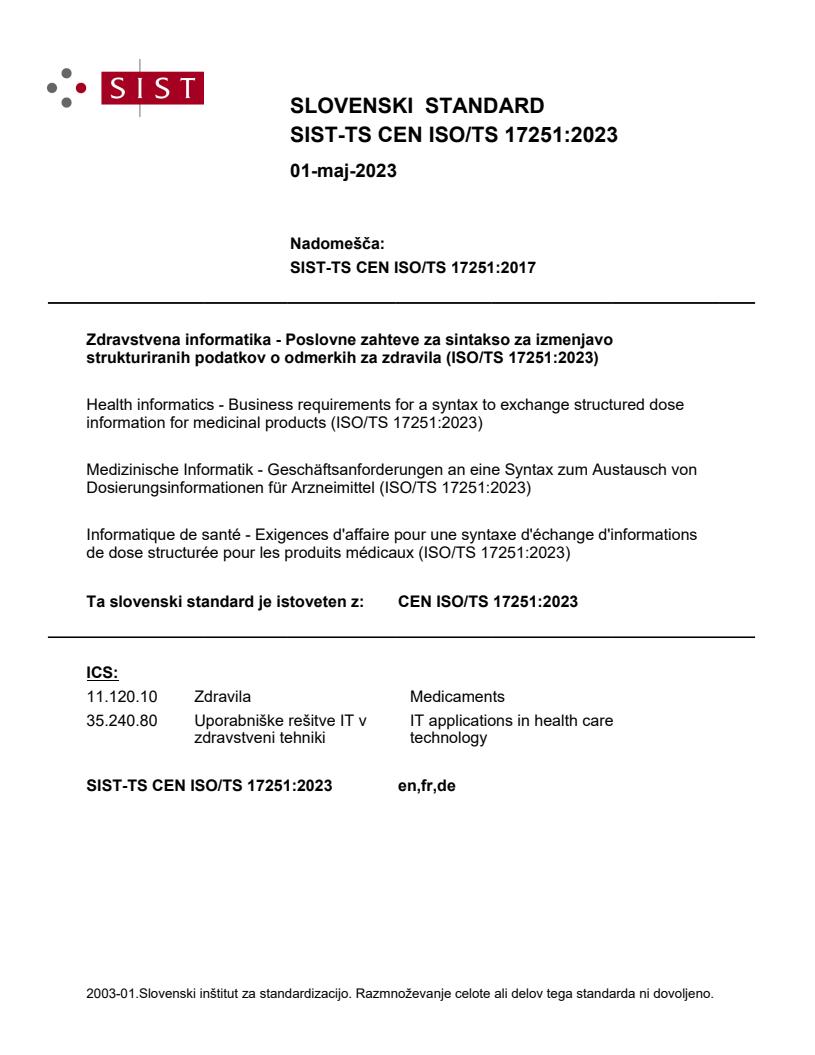
SLOVENSKI STANDARD
01-maj-2023
Nadomešča:
SIST-TS CEN ISO/TS 17251:2017
Zdravstvena informatika - Poslovne zahteve za sintakso za izmenjavo
strukturiranih podatkov o odmerkih za zdravila (ISO/TS 17251:2023)
Health informatics - Business requirements for a syntax to exchange structured dose
information for medicinal products (ISO/TS 17251:2023)
Medizinische Informatik - Geschäftsanforderungen an eine Syntax zum Austausch von
Dosierungsinformationen für Arzneimittel (ISO/TS 17251:2023)
Informatique de santé - Exigences d'affaire pour une syntaxe d'échange d'informations
de dose structurée pour les produits médicaux (ISO/TS 17251:2023)
Ta slovenski standard je istoveten z: CEN ISO/TS 17251:2023
ICS:
11.120.10 Zdravila Medicaments
35.240.80 Uporabniške rešitve IT v IT applications in health care
zdravstveni tehniki technology
2003-01.Slovenski inštitut za standardizacijo. Razmnoževanje celote ali delov tega standarda ni dovoljeno.
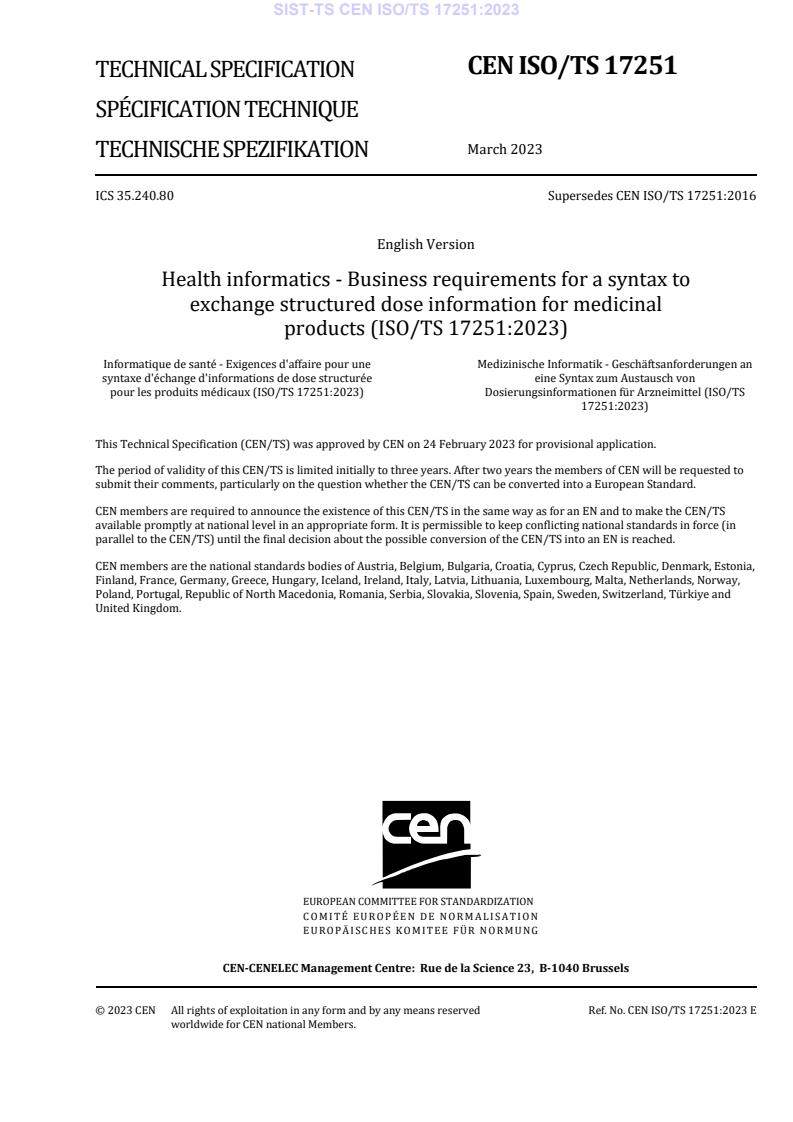
CEN ISO/TS 17251
TECHNICAL SPECIFICATION
SPÉCIFICATION TECHNIQUE
March 2023
TECHNISCHE SPEZIFIKATION
ICS 35.240.80 Supersedes CEN ISO/TS 17251:2016
English Version
Health informatics - Business requirements for a syntax to
exchange structured dose information for medicinal
products (ISO/TS 17251:2023)
Informatique de santé - Exigences d'affaire pour une Medizinische Informatik - Geschäftsanforderungen an
syntaxe d'échange d'informations de dose structurée eine Syntax zum Austausch von
pour les produits médicaux (ISO/TS 17251:2023) Dosierungsinformationen für Arzneimittel (ISO/TS
17251:2023)
This Technical Specification (CEN/TS) was approved by CEN on 24 February 2023 for provisional application.
The period of validity of this CEN/TS is limited initially to three years. After two years the members of CEN will be requested to
submit their comments, particularly on the question whether the CEN/TS can be converted into a European Standard.
CEN members are required to announce the existence of this CEN/TS in the same way as for an EN and to make the CEN/TS
available promptly at national level in an appropriate form. It is permissible to keep conflicting national standards in force (in
parallel to the CEN/TS) until the final decision about the possible conversion of the CEN/TS into an EN is reached.
CEN members are the national standards bodies of Austria, Belgium, Bulgaria, Croatia, Cyprus, Czech Republic, Denmark, Estonia,
Finland, France, Germany, Greece, Hungary, Iceland, Ireland, Italy, Latvia, Lithuania, Luxembourg, Malta, Netherlands, Norway,
Poland, Portugal, Republic of North Macedonia, Romania, Serbia, Slovakia, Slovenia, Spain, Sweden, Switzerland, Türkiye and
United Kingdom.
EUROPEAN COMMITTEE FOR STANDARDIZATION
COMITÉ EUROPÉEN DE NORMALISATION
EUROPÄISCHES KOMITEE FÜR NORMUNG
CEN-CENELEC Management Centre: Rue de la Science 23, B-1040 Brussels
© 2023 CEN All rights of exploitation in any form and by any means reserved Ref. No. CEN ISO/TS 17251:2023 E
worldwide for CEN national Members.
Contents Page
European foreword . 3
European foreword
This document (CEN ISO/TS 17251:2023) has been prepared by Technical Committee ISO/TC 215
"Health informatics" in collaboration with Technical Committee CEN/TC 251 “Health informatics” the
secretariat of which is held by NEN.
Attention is drawn to the possibility that some of the elements of this document may be the subject of
patent rights. CEN shall not be held responsible for identifying any or all such patent rights.
This document supersedes CEN ISO/TS 17251:2016.
Any feedback and questions on this document should be directed to the users’ national standards
body/national committee. A complete listing of these bodies can be found on the CEN website.
According to the CEN-CENELEC Internal Regulations, the national standards organizations of the
following countries are bound to announce this Technical Specification: Austria, Belgium, Bulgaria,
Croatia, Cyprus, Czech Republic, Denmark, Estonia, Finland, France, Germany, Greece, Hungary, Iceland,
Ireland, Italy, Latvia, Lithuania, Luxembourg, Malta, Netherlands, Norway, Poland, Portugal, Republic of
North Macedonia, Romania, Serbia, Slovakia, Slovenia, Spain, Sweden, Switzerland, Türkiye and the
United Kingdom.
Endorsement notice
The text of ISO/TS 17251:2023 has been approved by CEN as CEN ISO/TS 17251:2023 without any
modification.
TECHNICAL ISO/TS
SPECIFICATION 17251
Second edition
2023-02
Health informatics — Business
requirements for a syntax to exchange
structured dose information for
medicinal products
Informatique de santé — Exigences d'affaire pour une syntaxe
d'échange d'informations de dose structurée pour les produits
médicaux
Reference number
ISO/TS 17251:2023(E)
ISO/TS 17251:2023(E)
© ISO 2023
All rights reserved. Unless otherwise specified, or required in the context of its implementation, no part of this publication may
be reproduced or utilized otherwise in any form or by any means, electronic or mechanical, including photocopying, or posting on
the internet or an intranet, without prior written permission. Permission can be requested from either ISO at the address below
or ISO’s member body in the country of the requester.
ISO copyright office
CP 401 • Ch. de Blandonnet 8
CH-1214 Vernier, Geneva
Phone: +41 22 749 01 11
Email: copyright@iso.org
Website: www.iso.org
Published in Switzerland
ii
ISO/TS 17251:2023(E)
Contents Page
Foreword .iv
Introduction . vi
1 Scope . 1
2 Normative references . 1
3 Terms and definitions . 2
4 Relationship to other ISO deliverables . 4
5 Conformance . 5
6 Business requirements for structured dose instructions . 5
6.1 General . 5
6.2 Use cases . 5
6.3 Elements of a dose instruction . 5
6.4 Information requirements . 7
6.4.1 General . 7
6.4.2 Terminologies and Code Systems . 7
6.4.3 Information model . 7
6.4.4 Text representation. 8
6.4.5 Administration amount . 8
6.4.6 Route/site of administration . 9
6.4.7 Timing of dose event(s). 9
6.4.8 Conditional administration . 11
6.4.9 Subject of care-specific information . 11
6.4.10 Ancillary information .12
Bibliography .14
iii
ISO/TS 17251:2023(E)
Foreword
ISO (the International Organization for Standardization) is a worldwide federation of national standards
bodies (ISO member bodies). The work of preparing International Standards is normally carried out
through ISO technical committees. Each member body interested in a subject for which a technical
committee has been established has the right to be represented on that committee. International
organizations, governmental and non-governmental, in liaison with ISO, also take part in the work.
ISO collaborates closely with the International Electrotechnical Commission (IEC) on all matters of
electrotechnical standardization.
The procedures used to develop this document and those intended for its further maintenance are
described in the ISO/IEC Directives, Part 1. In particular, the different approval criteria needed for the
different types of ISO documents should be noted. This document was drafted in accordance with the
editorial rules of the ISO/IEC Directives, Part 2 (see www.iso.org/directives).
Attention is drawn to the possibility that some of the elements of this document may be the subject of
patent rights. ISO shall not be held responsible for identifying any or all such patent rights. Details of
any patent rights identified during the development of the document will be in the Introduction and/or
on the ISO list of patent declarations received (see www.iso.org/patents).
Any trade name used in this document is information given for the convenience of users and does not
constitute an endorsement.
For an explanation of the voluntary nature of standards, the meaning of ISO specific terms and
expressions related to conformity assessment, as well as information about ISO's adherence to
the World Trade Organization (WTO) principles in the Technical Barriers to Trade (TBT), see
www.iso.org/iso/foreword.html.
This document was prepared by Technical Committee ISO/TC 215, Health informatics, in collaboration
with the European Committee for Standardization (CEN) Technical Committee CEN/TC 251, Health
informatics, in accordance with the Agreement on technical cooperation between ISO and CEN (Vienna
Agreement).
This second edition cancels and replaces the first edition (ISO/TS 17251:2016), which has been
technically revised.
The main changes are as follows:
— editorial corrections and clarifications;
— added Clause 4 on the relationship to other standards;
— updated Clause 3;
— Clause 4 includes discussion on the relationship to the IDMP standards and clarifies the use of IDMP
terms;
— Subclause 6.4.9: removed height, added optional laboratory observations;
— Subclause 6.4.5 and 6.4.7.1 for elements described as a range (e.g. max/min dose, range for interval
or frequency) added discussion of 2-term and 3-term representations;
— Subclause 6.4.1: added discussion on complex instructions (e.g. multiple schedules, multiple dose
amounts);
— Subclause 6.4.5: clarified language around selection of unit of measurement versus unit of
presentation;
— Subclause 6.4.8: clarified that conditional administration is not necessarily the indication for the
medication order;
iv
ISO/TS 17251:2023(E)
— Subclause 6.4.9.4: added capability to provide date and/or time for subject of care characteristics;
— Subclause 6.4.4.1: added description and conformance for administration method;
— Subclause 6.4.7.1: added the option to have frequency based upon a period of time, such as “2 times
over 3 days”.
Any feedback or questions on this document should be directed to the user’s national standards body. A
complete listing of these bodies can be found at www.iso.org/members.html.
v
ISO/TS 17251:2023(E)
Introduction
The requirements for the exchange of structured dose instructions are intended to be independent of
any technology standard or software platform and have been developed with the aim of specifying the
necessary clinical and business requirements precisely and unambiguously. Precise, unambiguous,
structured, and codified dose instructions permit the prescriber, pharmacy, and other clinical systems
to utilize that information for dose checking and other clinical decision support. Ultimately, precise and
unambiguous dose instructions are essential for the subject of care or caregiver to appropriately use
the medication for optimal benefit.
The primary audiences for this document are software developers building IT systems in the healthcare
sector.
The intent of this document is that all prescribing and dispensing systems can build and recognized
unambiguous dose instructions, preferably with structured and codified content which can enable
additional system capabilities (e.g. Clinical Decision Support).
vi
TECHNICAL SPECIFICATION ISO/TS 17251:2023(E)
Health informatics — Business requirements for a syntax
to exchange structured dose information for medicinal
products
1 Scope
This document specifies the business requirements for the structured content of structured or semi-
structured dose instructions for recording dose instructions in the electronic health record (EHR),
supporting clinical decision support, and in exchanging medication orders, as applicable to primary,
secondary and tertiary care.
This document is focused on the dose instructions as will be presented to the individual subject of care
or caregiver. Comprehension of dose instructions by the subject of care or caregiver is an overarching
consideration for subject of care safety and the best outcomes. Related factors are discussed but are not
part of the primary scope.
This document does not define an information model, except to the extent that those information model
concepts are necessary to define business requirements.
Outside the scope of this document are:
— The implementation of dose instructions, i.e. assembling the structured elements into a form
appropriate for the patient or caregiver;
— The content of a medication order (see ISO 17523) beyond content related to dose instructions;
— The content of a record of dispense of a medicinal product (see ISO/TS 19293);
— The functionality of health, clinical and/or pharmacy systems;
— Other kinds of content of health, clinical or pharmacy systems that are needed to support the whole
process of health care providers, such as:
— A drug knowledge database (see ISO/TS 22756);
— A decision support system (see ISO/TS 22756 and ISO/TS 22703);
— A complete medical record (EHR);
— A medicinal product dictionary (see ISO/TS 19256);
— Verification of the medicinal product and dose being administered.
— Some concepts from Identification of Medicinal Products are referenced, but not defined, in this
document. See Clause 4 for discussion of the relationship of this document with IDMP.
2 Normative references
There are no normative references in this document.
ISO/TS 17251:2023(E)
3 Terms and definitions
For the purposes of this document, the following terms and definitions apply.
ISO and IEC maintain terminology databases for use in standardization at the following addresses:
— ISO Online browsing platform: available at https:// www .iso .org/ obp
— IEC Electropedia: available at https:// www .electropedia .org/
3.1
administration method
action taken by the subject of care (3.14) or caregiver (3.2) for the administration of a medication
EXAMPLE Take, apply, inject.
3.2
caregiver
carer
person who provides care
Note 1 to entry: A carer can be a healthcare professional or an informal caregiver.
[SOURCE: ISO 13131:2021, 3.2.1]
3.3
dose event
dosing event
administration of a medication to a subject of care (3.14) based upon specified dose instructions (3.4)
3.4
dose instructions
instructions pertaining to the medication, which describe the amount of medication per administration,
method of administration, the frequency or interval of administration, associated instructions for
dosing or skipped administrations, and other associated parameters necessary for appropriate
administration of the medication
Note 1 to entry: Dose instructions can apply to a specific subject of care (3.14) or can be general statements, for
example, as the set of appropriate dose instructions for a given medication or dose instructions in a treatment
protocol.
3.5
dose syntax
structured information (3.13), which represents the dose instructions (3.4) in a consistent, computable
format
3.6
medication order
documented instruction on intended therapy for an individual person with a medicinal product issued
by an authorized health professional
Note 1 to entry: A medication order contains information on the medicinal product(s), the intended dosage
instruction and the period of time during which the medication was intended to be given.
Note 2 to entry: There is no inherent limitation on the setting for the medication order (inpatient, ambulatory,
etc.)
3.7
message syntax
structured information (3.13), which represents the medication order in a consistent computable format
ISO/TS 17251:2023(E)
3.8
prescription
direction created by an authorized health professional to instruct a dispensing agent regarding the
preparation and use of a medicinal product or medicinal appliance to be taken or used by a subject of
care
Note 1 to entry: The term “prescription” alone is best avoided as it is colloquially used at random for the following:
"new prescription message", "prescription set" and "prescription item". It is also used to describe a prescription
form. The use of "new prescription message", "prescription set" and "prescription item" where appropriate is
recommended.
Note 2 to entry: In the context of this document, “prescription” or “medication order” could be used. This
document uses “medication order”. In this sense, it is implied that “medication order” is inclusive of “prescription.”
[SOURCE: ISO/TS 19256:2016, 3.34, modified — Note 2 to entry added.]
3.9
semantic interoperability
ability for data shared by systems to be understood at the level of fully defined domain concepts
[SOURCE: ISO 18308:2011, 3.45]
3.10
semi-structured dose instructions
dose instructions containing both structured information (3.13) and unstructured information (3.18)
3.11
sig
directions written on a package or label for the use of the subject of care (3.14) or caregiver (3.2)
Note 1 to entry: Sig (sometimes written as SIG) appears to be an acronym but is an abbreviation of the Latin term
“signā”.
Note 2 to entry: In the context of this document, “sig” had the same meaning as “dose instructions” (3.4)
3.12
storage and handling information
information provided to the subject of care (3.14)/caregiver (3.2) regarding the appropriate conditions
to maximize the shelf life of the medicinal product
3.13
structured information
information assembled from predefined concepts (vocabulary or code set) using an organizational
scheme (information model)
3.14
subject of care
person who uses, or is a potential user of, a health care service
Note 1 to entry: Subjects of care may also be referred to as patients, health care consumers or subjects of care.
[SOURCE: ISO/TS 22220:2011, 3.2]
3.15
syntactic interoperability
capability of two or more systems to communicate and exchange data through specified data formats
and communication protocols
[SOURCE: ISO 18308:2011, 3.48]
ISO/TS 17251:2023(E)
3.16
unit of measurement
measurement unit
real scalar quantity, defined and adopted by convention, with which any other quantity of the same
kind can be compared to express the ratio of the two quantities as a number
Note 1 to entry: Depending on the nature of the reference scale, the unit of measurement expression may stand
either for a physical unit of measurement that is related to a system of quantities (e.g. SI units) or for an arbitrarily
defined unit of measurement, which may refer to a certain reference material, a standard measurement
procedure, a material measure or even to a combination of those.
[SOURCE: ISO 11240:2012, 3.1.33]
3.17
unit of presentation
qualitative term describing the discrete countable entity in which a pharmaceutical product or
manufactured item is presented, in cases where strength or quantity is expressed referring to one
instance of this countable entity
EXAMPLE 1 To describe strength: puff, spray, tablet “contains 100 mcg per spray” (unit of presentation =
spray).
EXAMPLE 2 To describe quantity: bottle, box, vial “contains 100 ml per bottle” (unit of presentation = bottle).
Note 1 to entry: A unit of presentation can have the same name as another controlled vocabulary, such as a basic
dose form or a container, but the two concepts are not equivalent, and each has a unique controlled vocabulary
term identifier.
[SOURCE: ISO 11240:2012, 3.1.34]
3.18
unstructured information
information assembled from narrative words and word fragments, following either casual conventions
or language-specific grammatical rules
4 Relationship to other ISO deliverables
There are several International Standards, Technical Specifications, and Technical Reports addressing
elements of medications and prescribing. Figure 1 illustrates some of the relationships between
relevant ISO deliverables.
Figure 1 — Relationships between ISO deliverables
ISO/TS 17251:2023(E)
5 Conformance
Systems that create or consume electronic medication orders can claim conformance to this document
when they fulfil all requirements in Clause 6. Each requirement or recommendation is labelled with an
identifier in the form of “[DOSESYN-NNN]” (where NNN is a sequential, zero left-filled, number).
6 Business requirements for structured dose instructions
6.1 General
The goal of this document includes
— that structured information will be available for clinical decisions support and other system
functions, to ensure that dose and administration information is appropriate for the subject of care,
and
— that the dose instructions provided to subject of care or caregiver are clear and understandable.
In addition to requirements related to the dose instructions specifically, there are subject of care
information elements as well. The following requirements address both subject of care and information
aspects.
The following conformance statements refer to either, or both, the message syntax and the dose
syntax. Requirements which are not unique to the dose instructions, or useful in other components of a
medication order, are described as part of the “message syntax”. Requirements which are specific to the
dose instructions are described as part of the “dose syntax”.
6.2 Use cases
Dose instructions serve the following use cases.
— Indicating the intended dosage during prescribing.
— Recording the indicated dosage in the EHR:
— to be used in clinical decision support systems, e.g. dose checking;
— exchange of information between health care providers.
— To provide instructions for administration by a healthcare professional.
— Indicating comprehensible dose instructions on the label to make clear how to use the medicine.
Comprehension may not be a component of the dose instructions specifically, but comprehension
does influence the presentation of the dose instructions to the subject of care or caregiver. Subject of
care/caregiver comprehension information shall be present in the medication order in some manner
such that the dispenser can create appropriate instructions for the subject of care/caregiver.
6.3 Elements of a dose instruction
Based on the use cases, the elements of a dose instruction include the following.
— Text representation. The purpose of this document is to specify requirements for structured
dose instructions. However, some parts of a dose instruction cannot be captured in structured
information. To support a human readable text of the whole dose instruction of a certain medicine, a
textual representation of the whole dose instructions will remain an important element. This textual
representation includes both the structured and the unstructured parts of the dose instruction.
Also, if a scenario occurs which prevents the structured content from being produced, the textual
representatio
...
The article discusses the CEN ISO/TS 17251:2023 standard, which provides business requirements for the structured content of dose instructions for medicinal products. The standard focuses on recording dose instructions in electronic health records (EHR) and for exchanging medication orders in primary, secondary, and tertiary care. The comprehension of dose instructions by the individual receiving care or their caregiver is emphasized for safety and optimal outcomes. The article clarifies that the document does not define an information model but includes necessary concepts related to business requirements. It also specifies that other aspects, such as the implementation of dose instructions, medication order content, record of dispense, system functionality, and additional content needed to support healthcare providers, are outside the scope of this document. References to concepts from the Identification of Medicinal Products (IDMP) are made but not defined in detail.
기사 제목: CEN ISO/TS 17251:2023 - 의료 정보학 - 의약품용 구조화된 투약 정보를 교환하기 위한 언어 규칙에 대한 비즈니스 요구사항 (ISO/TS 17251:2023) 기사 내용: 이 문서는 전자 건강 기록(EHR)에서 투약 지시를 기록하고 임상 결정 지원을 지원하며, 의약품 주문 교환이 가능한 구조화된 또는 준구조화된 투약 지시의 구조화된 내용을 위한 비즈니스 요구사항을 명시합니다. 기사는 투약 지시를 개인 환자나 간병인에게 제시할 때의 이해력이 환자의 안전과 최상의 결과에 중요하다고 강조합니다. 관련 요소들은 논의되지만 주요 범위는 아닙니다. 이 문서는 비즈니스 요구사항을 정의하기 위해 필요한 정보 모델을 정의하지 않습니다. 이 문서의 범위를 벗어나는 것은 다음과 같습니다: 환자나 간병인에게 맞는 형태로 구조화 요소들을 조립하는 투약 지시의 구현, 투약 지시와 관련된 내용을 초과하는 의약품 주문 내용(ISO 17523), 의약품 분배 기록(ISO/TS 19293), 건강, 임상 또는 약학 시스템의 기능, 건강 제공자의 전체 과정을 지원하기 위해 필요한 기타 건강, 임상 또는 약학 시스템의 콘텐츠들(의약품 지식 데이터베이스, 의사 결정 지원 시스템, 전체 의료 기록(EHR), 의약품 사전, 투여되는 의약품과 용량의 확인). 이 문서에서는 의약품 식별에 대한 몇 가지 개념이 언급되지만 정의되지는 않습니다. IDMP와의 관계에 대한 논의는 제 4조에서 확인할 수 있습니다.
記事タイトル:CEN ISO/TS 17251:2023 - 医療情報学 - 医薬品の構造化投与情報を交換するためのビジネス要件(ISO/TS 17251:2023) 記事内容:この文書は、電子健康記録(EHR)における投与指示の構造化コンテンツ、臨床的な意思決定支援、および医薬品オーダーの交換に関連する、構造化または準構造化の投与指示のビジネス要求を指定しています。この文書では、被介護対象者または介護者に提示される投与指示の理解力が、被介護対象者の安全性と最良の結果に重要であることが強調されています。関連する要素については議論されますが、これらは主要な範囲には含まれません。この文書では、ビジネス要求を定義するために必要な範囲で情報モデルを定義していません。 この文書の範囲外には以下が含まれます: - 投与指示の実装、つまり構造化要素を患者または介護者に適した形式に組み立てること。 - 投薬オーダーに関連する内容(ISO 17523)のうち、投与指示に関連する内容を超えるもの。 - 医薬品の分配記録(ISO/TS 19293)の内容。 - 健康、臨床および/または薬局システムの機能。 - 医療提供者の全体的なプロセスをサポートするために必要な、医療、臨床、または薬局システムの他の種類のコンテンツ。例えば、医薬品知識データベース(ISO/TS 22756)、意思決定支援システム(ISO/TS 22756およびISO/TS 22703)、完全な医療記録(EHR)、医薬品辞書(ISO/TS 19256)、投与される医薬品と投与量の検証。 - この文書では、医薬品の識別に関するいくつかの概念が言及されていますが、詳細には定義されていません。この文書とIDMPの関係についての議論は、第4条で説明されています。
Questions, Comments and Discussion
Ask us and Technical Secretary will try to provide an answer. You can facilitate discussion about the standard in here.
Loading comments...