

EN 747-2:2012+A1:2015
(Main + Amendment)Furniture - Bunk beds and high beds - Part 2: Test methods
General Information
- Abstract
This European Standard specifies test methods for the safety, strength and durability of bunk beds and high beds for domestic and non-domestic use. The loads and forces in the strength and durability tests apply to beds with an internal length greater than 140 cm and a maximum bed base width of 120 cm.
The tests are designed to be applied to a bed that is fully assembled and ready for use.
The applicable safety requirements are given in EN 747-1.
- Status
- Withdrawn
- Publication Date
- 26-May-2015
- Withdrawal Date
- 29-Sep-2026
- Technical Committee
- CEN/TC 207 - Furniture
- Drafting Committee
- CEN/TC 207 - Furniture
- Current Stage
- 9960 - Withdrawal effective - Withdrawal
- Start Date
- 13-Mar-2024
- Completion Date
- 30-Sep-2026

Relations
- Effective Date
- 19-Jan-2023
- Effective Date
- 18-Jan-2023
- Effective Date
- 09-Feb-2022
- Effective Date
- 28-Jan-2026
- Effective Date
- 28-Jan-2026
Frequently Asked Questions
EN 747-2:2012+A1:2015 is a standard published by the European Committee for Standardization (CEN). Its full title is "Furniture - Bunk beds and high beds - Part 2: Test methods". This standard covers: This European Standard specifies test methods for the safety, strength and durability of bunk beds and high beds for domestic and non-domestic use. The loads and forces in the strength and durability tests apply to beds with an internal length greater than 140 cm and a maximum bed base width of 120 cm. The tests are designed to be applied to a bed that is fully assembled and ready for use. The applicable safety requirements are given in EN 747-1.
This European Standard specifies test methods for the safety, strength and durability of bunk beds and high beds for domestic and non-domestic use. The loads and forces in the strength and durability tests apply to beds with an internal length greater than 140 cm and a maximum bed base width of 120 cm. The tests are designed to be applied to a bed that is fully assembled and ready for use. The applicable safety requirements are given in EN 747-1.
EN 747-2:2012+A1:2015 is classified under the following ICS (International Classification for Standards) categories: 97.140 - Furniture. The ICS classification helps identify the subject area and facilitates finding related standards.
EN 747-2:2012+A1:2015 has the following relationships with other standards: It is inter standard links to EN 747-2:2012/FprA1, EN 747-2:2012, EN 747-2:2024, EN ISO 2439:2008, EN 747-1:2012+A1:2015. Understanding these relationships helps ensure you are using the most current and applicable version of the standard.
EN 747-2:2012+A1:2015 is available in PDF format for immediate download after purchase. The document can be added to your cart and obtained through the secure checkout process. Digital delivery ensures instant access to the complete standard document.
Standards Content (Sample)
SLOVENSKI STANDARD
01-september-2015
Pohištvo - Pogradi in visoke postelje - 2. del: Preskusne metode
Furniture - Bunk beds and high beds - Part 2: Test methods
Möbel - Etagenbetten und Hochbetten - Teil 2: Prüfverfahren
Meubles - Lits superposés et lits surélevés - Partie 2: Méthodes d'essai
Ta slovenski standard je istoveten z: EN 747-2:2012+A1:2015
ICS:
97.140 Pohištvo Furniture
2003-01.Slovenski inštitut za standardizacijo. Razmnoževanje celote ali delov tega standarda ni dovoljeno.
EUROPEAN STANDARD
EN 747-2:2012+A1
NORME EUROPÉENNE
EUROPÄISCHE NORM
May 2015
ICS 97.140 Supersedes EN 747-2:2012
English Version
Furniture - Bunk beds and high beds - Part 2: Test methods
Meubles - Lits superposés et lits surélevés - Partie 2: Möbel - Etagenbetten und Hochbetten - Teil 2:
Méthodes d'essai Prüfverfahren
This European Standard was approved by CEN on 8 March 2012 and includes Amendment 1 approved by CEN on 16 April 2015.
CEN members are bound to comply with the CEN/CENELEC Internal Regulations which stipulate the conditions for giving this European
Standard the status of a national standard without any alteration. Up-to-date lists and bibliographical references concerning such national
standards may be obtained on application to the CEN-CENELEC Management Centre or to any CEN member.
This European Standard exists in three official versions (English, French, German). A version in any other language made by translation
under the responsibility of a CEN member into its own language and notified to the CEN-CENELEC Management Centre has the same
status as the official versions.
CEN members are the national standards bodies of Austria, Belgium, Bulgaria, Croatia, Cyprus, Czech Republic, Denmark, Estonia,
Finland, Former Yugoslav Republic of Macedonia, France, Germany, Greece, Hungary, Iceland, Ireland, Italy, Latvia, Lithuania,
Luxembourg, Malta, Netherlands, Norway, Poland, Portugal, Romania, Slovakia, Slovenia, Spain, Sweden, Switzerland, Turkey and United
Kingdom.
EUROPEAN COMMITTEE FOR STANDARDIZATION
COMITÉ EUROPÉEN DE NORMALISATION
EUROPÄISCHES KOMITEE FÜR NORMUNG
CEN-CENELEC Management Centre: Avenue Marnix 17, B-1000 Brussels
© 2015 CEN All rights of exploitation in any form and by any means reserved Ref. No. EN 747-2:2012+A1:2015 E
worldwide for CEN national Members.
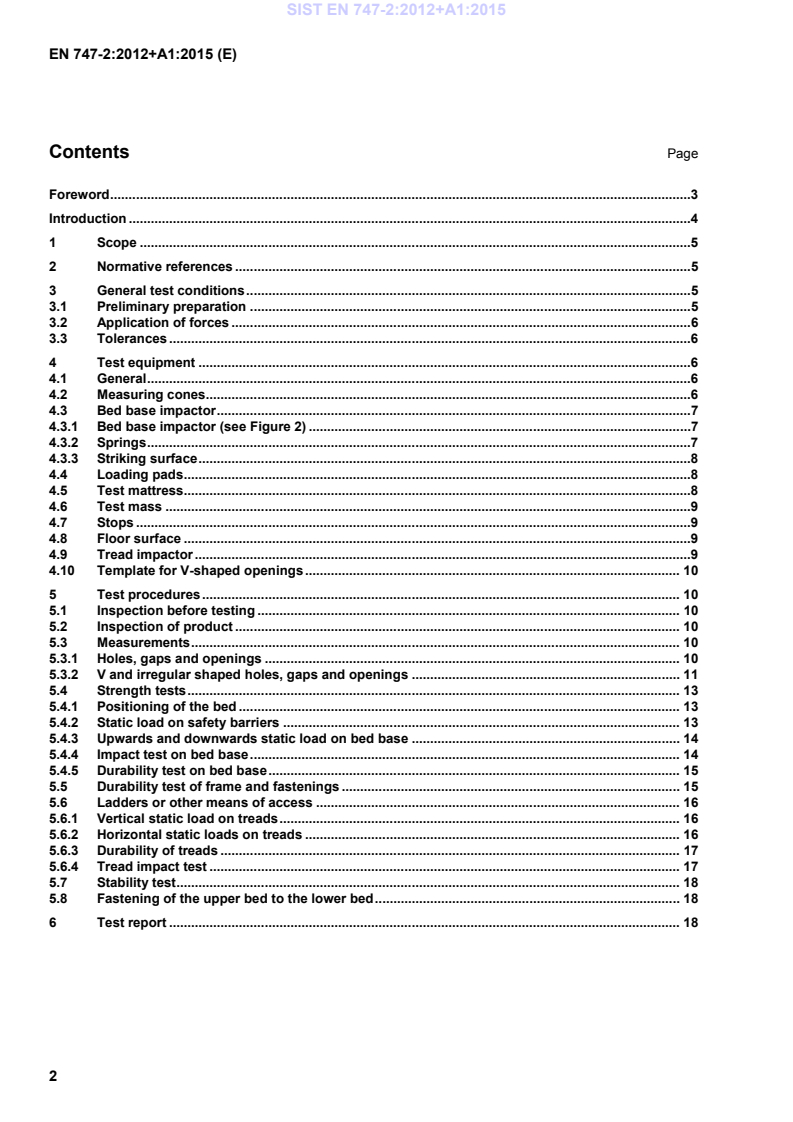
Contents Page
Foreword .3
Introduction .4
1 Scope .5
2 Normative references .5
3 General test conditions .5
3.1 Preliminary preparation .5
3.2 Application of forces .6
3.3 Tolerances .6
4 Test equipment .6
4.1 General .6
4.2 Measuring cones.6
4.3 Bed base impactor .7
4.3.1 Bed base impactor (see Figure 2) .7
4.3.2 Springs .7
4.3.3 Striking surface .8
4.4 Loading pads .8
4.5 Test mattress .8
4.6 Test mass .9
4.7 Stops .9
4.8 Floor surface .9
4.9 Tread impactor .9
4.10 Template for V-shaped openings . 10
5 Test procedures . 10
5.1 Inspection before testing . 10
5.2 Inspection of product . 10
5.3 Measurements . 10
5.3.1 Holes, gaps and openings . 10
5.3.2 V and irregular shaped holes, gaps and openings . 11
5.4 Strength tests . 13
5.4.1 Positioning of the bed . 13
5.4.2 Static load on safety barriers . 13
5.4.3 Upwards and downwards static load on bed base . 14
5.4.4 Impact test on bed base . 14
5.4.5 Durability test on bed base . 15
5.5 Durability test of frame and fastenings . 15
5.6 Ladders or other means of access . 16
5.6.1 Vertical static load on treads . 16
5.6.2 Horizontal static loads on treads . 16
5.6.3 Durability of treads . 17
5.6.4 Tread impact test . 17
5.7 Stability test . 18
5.8 Fastening of the upper bed to the lower bed . 18
6 Test report . 18
Foreword
This document (EN 747-2:2012+A1:2015) has been prepared by Technical Committee CEN/TC 207
“Furniture”, the secretariat of which is held by UNI.
This European Standard shall be given the status of a national standard, either by publication of an identical
text or by endorsement, at the latest by November 2015, and conflicting national standards shall be withdrawn
at the latest by November 2015.
Attention is drawn to the possibility that some of the elements of this document may be the subject of patent
rights. CEN [and/or CENELEC] shall not be held responsible for identifying any or all such patent rights.
This document includes Amendment 1, approved by CEN on 2015-04-16.
The start and finish of text introduced or altered by amendment is indicated in the text by tags ! ".
This document supersedes !EN 747-2:2012".
!deleted text"
EN 747 is divided into the following parts:
— EN 747-1, Furniture — Bunk beds and high beds — Part 1: Safety, strength and durability requirements;
— EN 747-2, Furniture — Bunk beds and high beds — Part 2: Test methods.
According to the CEN-CENELEC Internal Regulations, the national standards organisations of the following
countries are bound to implement this European Standard: Austria, Belgium, Bulgaria, Croatia, Cyprus, Czech
Republic, Denmark, Estonia, Finland, Former Yugoslav Republic of Macedonia, France, Germany, Greece,
Hungary, Iceland, Ireland, Italy, Latvia, Lithuania, Luxembourg, Malta, Netherlands, Norway, Poland, Portugal,
Romania, Slovakia, Slovenia, Spain, Sweden, Switzerland, Turkey and the United Kingdom.
Introduction
This part of EN 747 describes a number of tests consisting of the application, to various parts of bunk beds
and high beds, of loads or forces applied by one adult occupant per bed during normal functional use. It also
deals with misuses that can be reasonably expected to occur.
The tests are designed to evaluate properties without regard for materials, design/construction or
manufacturing processes.
1 Scope
This European Standard specifies test methods for the safety, strength and durability of bunk beds and high
beds for domestic and non-domestic use. The loads and forces in the strength and durability tests apply to
beds with an internal length greater than 140 cm and a maximum bed base width of 120 cm.
The tests are designed to be applied to a bed that is fully assembled and ready for use.
The applicable safety requirements are given in EN 747-1.
2 Normative references
The following documents, in whole or in part, are normatively referenced in this document and are
indispensable for its application. For dated references, only the edition cited applies. For undated references,
the latest edition of the referenced document (including any amendments) applies.
!EN 747-1:2012+A1:2015", Furniture — Bunk beds and high beds — Part 1: Safety, strength and
durability requirements
EN ISO 2439:2008, Flexible cellular polymeric materials - Determination of hardness (indentation technique)
(ISO 2439:2008)
3 General test conditions
3.1 Preliminary preparation
For furniture that includes hygroscopic materials, at least one week in normal indoor conditions shall have
elapsed between manufacturing (or assembly) and testing.
For all other furniture, at least 48 hours in normal indoor conditions shall have elapsed prior to testing.
The sample shall be tested as delivered. If the sample is a knock-down type, it shall be assembled according
to the instructions supplied with it. If the instructions allow for different combinations, the most adverse
combination shall be used for each test.
Samples intended to be fastened together in pairs or attached to the structure of a building shall be tested as
single, free-standing samples unless the instructions specifically require attachment to another sample or the
building structure.
The test shall be carried out in indoor ambient conditions at a temperature between 15 °C and 25 °C. If, during
a test, the temperature falls outside of the range of 15 °C to 25 °C, the maximum and/or minimum temperature
shall be recorded in the test report.
Knock-down fittings shall be tightened before testing and shall not be re-tightened throughout the testing
procedures.
The tests shall be carried out on the same sample and following the order of the clauses of EN 747-1. If a test
cannot be carried out as specified in this standard, e.g. because a loading pad cannot be used for the
application of a force due to the design of the product, the test shall be carried out as closely as possible to
the specified procedure.
3.2 Application of forces
The test forces in durability and static load tests shall be applied sufficiently slowly to ensure that negligible
dynamic load is applied.
The forces in durability tests shall be applied sufficiently slowly to ensure that kinetic heating does not occur.
Unless otherwise specified, static loads shall be maintained for (10 ± 2) s. Unless otherwise specified,
durability loads shall be applied for (2 ± 1) s.
3.3 Tolerances
Unless otherwise stated, the following tolerances are applicable to the test equipment:
— all forces shall have an accuracy of ± 5 % of the nominal force;
— all masses shall have an accuracy of ± 1 % of the nominal mass;
— all dimensions shall have an accuracy of ± 1 mm of the nominal dimension;
— all angles shall have an accuracy of ± 2 ° of the nominal angle.
The tolerance for the positioning of loading pads shall be ± 5 mm.
The forces may be replaced by masses. The relationship of 10 N = 1 kg shall be used.
NOTE For the purposes of uncertain measurements, test results are not considered to be adversely affected when
the above tolerances ar
...