

EN ISO 19168-1:2025
(Main)Geographic information - Geospatial API for features - Part 1: Core (ISO 19168-1:2025)
- Abstract
This document specifies the behaviour of Web APIs that provide access to features in a dataset independently of the underlying data store. This document defines discovery and query operations.
Discovery operations enable clients to interrogate the API, including the API definition and metadata about the feature collections provided by the API, to determine the capabilities of the API and retrieve information about available distributions of the dataset.
Query operations enable clients to retrieve features from the underlying data store based upon simple selection criteria, defined by the client.
- Status
- Published
- Publication Date
- 21-Jan-2025
- Technical Committee
- CEN/TC 287 - Geographic Information
- Current Stage
- 6060 - Definitive text made available (DAV) - Publishing
- Start Date
- 22-Jan-2025
- Completion Date
- 22-Jan-2025


Overview
EN ISO 19168-1:2025 - Geographic information: Geospatial API for features - Part 1: Core defines a standardized approach to providing access to geospatial feature data via Web APIs. Developed by CEN and aligned with global standards through ISO and the Open Geospatial Consortium (OGC), this document specifies both discovery and query operations that enable seamless, interoperable interaction with geospatial datasets.
This standard is fundamental for organizations managing geographic information, enabling clients to interrogate Web APIs for metadata and dataset capabilities, as well as to retrieve geographic features based on user-specified criteria. By focusing on standardized interfaces that are independent of underlying data stores, EN ISO 19168-1:2025 ensures interoperability and ease of integration for geospatial applications across Europe and worldwide.
Key Topics
API Discovery Operations
- Enables clients to explore available API endpoints and understand metadata about the geospatial data and its feature collections.
- Includes access to API definitions, landing pages, and conformance declarations.
Query Operations
- Allows clients to retrieve feature data using selection criteria such as filters, bounding boxes, and feature properties.
- Supports access to individual features, collections, and the core metadata associated with these resources.
Standardized API Behaviour
- Defines behaviour for HTTP methods, error handling, and response structures.
- Specifies the use of OpenAPI 3.0 for API definitions to foster interoperability.
- Ensures consistent implementation across different data providers.
Media Types and Encodings
- Supports multiple standard output formats, including GeoJSON, GML, and HTML.
- Provides guidelines for media type negotiation and encoding requirements.
Security Considerations
- Addresses API security, access routes, and multi-server environments to facilitate robust, reliable deployments.
Applications
EN ISO 19168-1:2025 offers practical value across a wide range of geospatial workflows and industries where standardized data access and discoverability are essential.
Public Sector Geographic Information Systems (GIS)
- Enables government agencies to share authoritative geospatial datasets through open, standards-compliant APIs.
- Supports transparency, data reuse, and efficient information dissemination.
Environmental Monitoring
- Facilitates retrieval of up-to-date geospatial features such as ecological zones, weather stations, or monitoring locations through robust API endpoints.
Urban Planning and Smart Cities
- Allows city planners and technology developers to access and visualize spatial datasets (e.g., infrastructure, zoning, transport networks) efficiently.
Disaster Management and Emergency Response
- Ensures rapid access to real-time geospatial data, such as affected areas, resource locations, and response units, directly from standardized APIs.
Research and Academia
- Fosters data integration, reproducibility, and collaboration by providing open, interoperable access to a variety of geospatial datasets.
Related Standards
- OGC API - Features: The original multipart standard that forms the basis of ISO 19168-1, ensuring consistency with global geospatial API practices.
- OpenAPI Specification 3.0: The required framework for defining and documenting Web APIs in this standard.
- IETF RFC 8288 (Web Linking), RFC 7946 (GeoJSON Format), and OGC GML (Geography Markup Language) Simple Features Profile: Key references for web resource linking and standard data encodings.
- EN ISO 19101-1:2014 and DCAT: Referenced for definitions and best practices on datasets, features, and distributions in the geospatial domain.
By adhering to EN ISO 19168-1:2025, organizations ensure their geospatial APIs are discoverable, interoperable, and suitable for integration into diverse geospatial information systems and workflows. This standard is an essential resource for any project requiring reliable, standards-based access to geographic feature data over the web.
Relations
- Effective Date
- 20-Feb-2023
- Consolidated By
ISO 19168-1:2025 - Geographic information — Geospatial API for features — Part 1: Core - Effective Date
- 12-Feb-2026
Get Certified
Connect with accredited certification bodies for this standard

BSI Group
BSI (British Standards Institution) is the business standards company that helps organizations make excellence a habit.

NYCE
Mexican standards and certification body.
Sponsored listings
Frequently Asked Questions
EN ISO 19168-1:2025 is a standard published by the European Committee for Standardization (CEN). Its full title is "Geographic information - Geospatial API for features - Part 1: Core (ISO 19168-1:2025)". This standard covers: This document specifies the behaviour of Web APIs that provide access to features in a dataset independently of the underlying data store. This document defines discovery and query operations. Discovery operations enable clients to interrogate the API, including the API definition and metadata about the feature collections provided by the API, to determine the capabilities of the API and retrieve information about available distributions of the dataset. Query operations enable clients to retrieve features from the underlying data store based upon simple selection criteria, defined by the client.
This document specifies the behaviour of Web APIs that provide access to features in a dataset independently of the underlying data store. This document defines discovery and query operations. Discovery operations enable clients to interrogate the API, including the API definition and metadata about the feature collections provided by the API, to determine the capabilities of the API and retrieve information about available distributions of the dataset. Query operations enable clients to retrieve features from the underlying data store based upon simple selection criteria, defined by the client.
EN ISO 19168-1:2025 is classified under the following ICS (International Classification for Standards) categories: 35.240.70 - IT applications in science. The ICS classification helps identify the subject area and facilitates finding related standards.
EN ISO 19168-1:2025 has the following relationships with other standards: It is inter standard links to EN ISO 19168-1:2021, ISO 19168-1:2025. Understanding these relationships helps ensure you are using the most current and applicable version of the standard.
EN ISO 19168-1:2025 is available in PDF format for immediate download after purchase. The document can be added to your cart and obtained through the secure checkout process. Digital delivery ensures instant access to the complete standard document.
Standards Content (Sample)
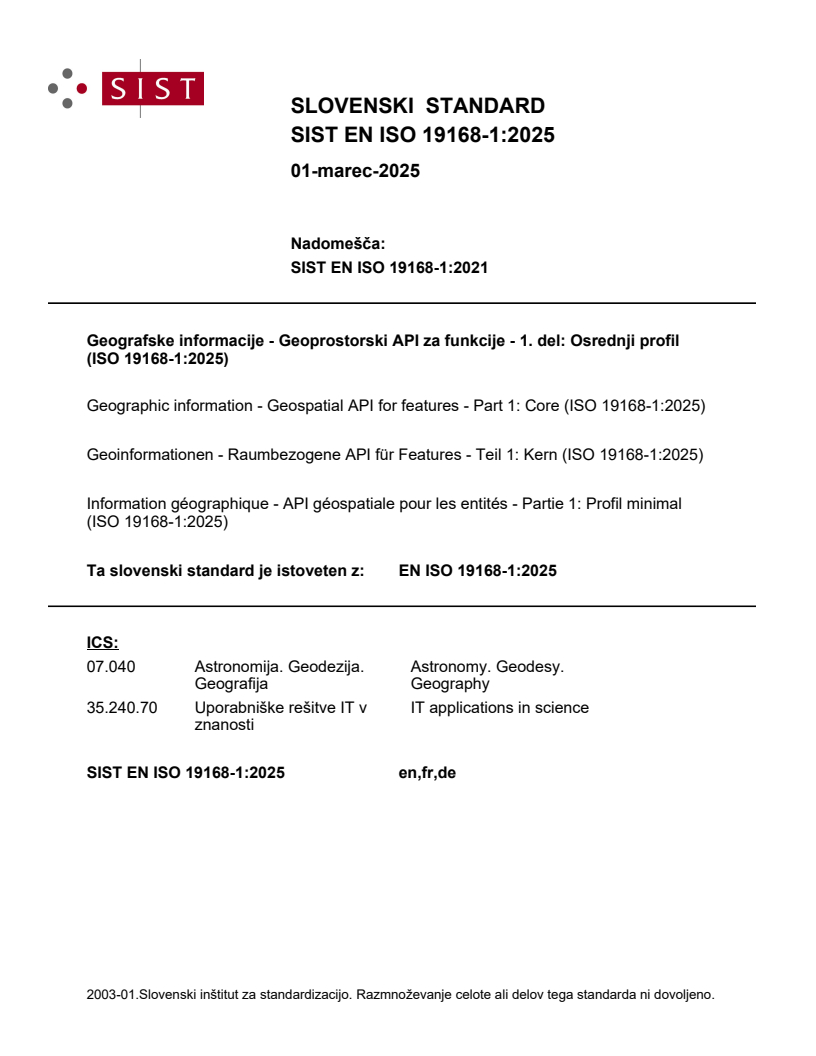
SLOVENSKI STANDARD
01-marec-2025
Nadomešča:
SIST EN ISO 19168-1:2021
Geografske informacije - Geoprostorski API za funkcije - 1. del: Osrednji profil
(ISO 19168-1:2025)
Geographic information - Geospatial API for features - Part 1: Core (ISO 19168-1:2025)
Geoinformationen - Raumbezogene API für Features - Teil 1: Kern (ISO 19168-1:2025)
Information géographique - API géospatiale pour les entités - Partie 1: Profil minimal
(ISO 19168-1:2025)
Ta slovenski standard je istoveten z: EN ISO 19168-1:2025
ICS:
07.040 Astronomija. Geodezija. Astronomy. Geodesy.
Geografija Geography
35.240.70 Uporabniške rešitve IT v IT applications in science
znanosti
2003-01.Slovenski inštitut za standardizacijo. Razmnoževanje celote ali delov tega standarda ni dovoljeno.
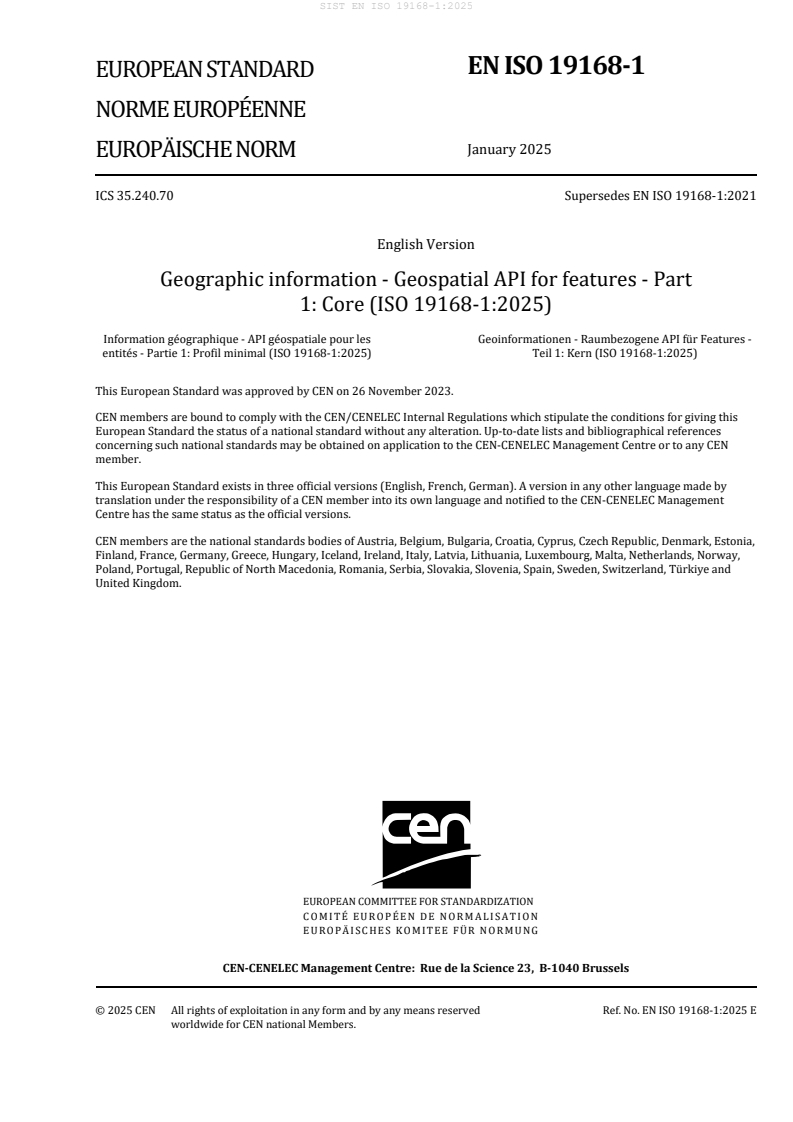
EN ISO 19168-1
EUROPEAN STANDARD
NORME EUROPÉENNE
January 2025
EUROPÄISCHE NORM
ICS 35.240.70 Supersedes EN ISO 19168-1:2021
English Version
Geographic information - Geospatial API for features - Part
1: Core (ISO 19168-1:2025)
Information géographique - API géospatiale pour les Geoinformationen - Raumbezogene API für Features -
entités - Partie 1: Profil minimal (ISO 19168-1:2025) Teil 1: Kern (ISO 19168-1:2025)
This European Standard was approved by CEN on 26 November 2023.
CEN members are bound to comply with the CEN/CENELEC Internal Regulations which stipulate the conditions for giving this
European Standard the status of a national standard without any alteration. Up-to-date lists and bibliographical references
concerning such national standards may be obtained on application to the CEN-CENELEC Management Centre or to any CEN
member.
This European Standard exists in three official versions (English, French, German). A version in any other language made by
translation under the responsibility of a CEN member into its own language and notified to the CEN-CENELEC Management
Centre has the same status as the official versions.
CEN members are the national standards bodies of Austria, Belgium, Bulgaria, Croatia, Cyprus, Czech Republic, Denmark, Estonia,
Finland, France, Germany, Greece, Hungary, Iceland, Ireland, Italy, Latvia, Lithuania, Luxembourg, Malta, Netherlands, Norway,
Poland, Portugal, Republic of North Macedonia, Romania, Serbia, Slovakia, Slovenia, Spain, Sweden, Switzerland, Türkiye and
United Kingdom.
EUROPEAN COMMITTEE FOR STANDARDIZATION
COMITÉ EUROPÉEN DE NORMALISATION
EUROPÄISCHES KOMITEE FÜR NORMUNG
CEN-CENELEC Management Centre: Rue de la Science 23, B-1040 Brussels
© 2025 CEN All rights of exploitation in any form and by any means reserved Ref. No. EN ISO 19168-1:2025 E
worldwide for CEN national Members.
Contents Page
European foreword . 3
European foreword
This document (EN ISO 19168-1:2025) has been prepared by Technical Committee ISO/TC 211
"Geographic information/Geomatics" in collaboration with Technical Committee CEN/TC 287
“Geographic Information” the secretariat of which is held by BSI.
This European Standard shall be given the status of a national standard, either by publication of an
identical text or by endorsement, at the latest by July 2025, and conflicting national standards shall be
withdrawn at the latest by July 2025.
Attention is drawn to the possibility that some of the elements of this document may be the subject of
patent rights. CEN shall not be held responsible for identifying any or all such patent rights.
This document supersedes EN ISO 19168-1:2021.
Any feedback and questions on this document should be directed to the users’ national standards
body/national committee. A complete listing of these bodies can be found on the CEN website.
According to the CEN-CENELEC Internal Regulations, the national standards organizations of the
following countries are bound to implement this European Standard: Austria, Belgium, Bulgaria,
Croatia, Cyprus, Czech Republic, Denmark, Estonia, Finland, France, Germany, Greece, Hungary, Iceland,
Ireland, Italy, Latvia, Lithuania, Luxembourg, Malta, Netherlands, Norway, Poland, Portugal, Republic of
North Macedonia, Romania, Serbia, Slovakia, Slovenia, Spain, Sweden, Switzerland, Türkiye and the
United Kingdom.
Endorsement notice
The text of ISO 19168-1:2025 has been approved by CEN as EN ISO 19168-1:2025 without any
modification.
International
Standard
ISO 19168-1
Second edition
Geographic information —
2025-01
Geospatial API for features —
Part 1:
Core
Information géographique — API géospatiale pour les entités —
Partie 1: Profil minimal
Reference number
ISO 19168-1:2025(en) © ISO 2025
ISO 19168-1:2025(en)
© ISO 2025
All rights reserved. Unless otherwise specified, or required in the context of its implementation, no part of this publication may
be reproduced or utilized otherwise in any form or by any means, electronic or mechanical, including photocopying, or posting on
the internet or an intranet, without prior written permission. Permission can be requested from either ISO at the address below
or ISO’s member body in the country of the requester.
ISO copyright office
CP 401 • Ch. de Blandonnet 8
CH-1214 Vernier, Geneva
Phone: +41 22 749 01 11
Email: copyright@iso.org
Website: www.iso.org
Published in Switzerland
ii
ISO 19168-1:2025(en)
Contents Page
Foreword .v
Introduction .vii
1 Scope . 1
2 Normative references . 1
3 Terms and definitions . 2
3.1 Terms and definitions .2
3.2 Abbreviated terms .3
4 Conformance . 3
5 Conventions . 4
5.1 Identifiers .4
5.2 Link relations .4
5.3 Use of HTTPS .5
5.4 HTTP URIs .5
5.5 API definition .5
5.5.1 General remarks .5
5.5.2 Role of OpenAPI .5
5.5.3 References to OpenAPI components in normative statements .6
5.5.4 Paths in OpenAPI definitions .6
5.5.5 Reusable OpenAPI components .6
6 Overview . 7
6.1 Design considerations .7
6.2 Encodings .7
6.3 Examples .8
7 Requirements class "Core" . 9
7.1 Overview .9
7.2 API landing page .10
7.2.1 Operation .10
7.2.2 Response . .10
7.2.3 Error situations .11
7.3 API definition .11
7.3.1 Operation .11
7.3.2 Response . . 12
7.3.3 Error situations . 12
7.4 Declaration of conformance classes . 12
7.4.1 Operation . 12
7.4.2 Response . . 13
7.4.3 Error situations . 13
7.5 HTTP 1.1 . 13
7.5.1 HTTP status codes . 13
7.6 Unknown or invalid query parameters .14
7.7 Web caching . 15
7.8 Support for cross-origin requests . 15
7.9 Encodings . 15
7.10 String internationalization .16
7.11 Coordinate reference systems .16
7.12 Link headers .17
7.13 Feature collections .17
7.13.1 Operation .17
7.13.2 Response . .17
7.13.3 Error situations . 23
7.14 Feature collection .24
7.14.1 Operation .24
iii
ISO 19168-1:2025(en)
7.14.2 Response . .24
7.14.3 Error situations .24
7.15 Features .24
7.15.1 Operation .24
7.15.2 Parameter limit. 25
7.15.3 Parameter bbox . 26
7.15.4 Parameter datetime.27
7.15.5 Parameters for filtering on feature properties . 29
7.15.6 Combinations of filter parameters . 29
7.15.7 Response . . 30
7.15.8 Error situations .32
7.16 Feature .32
7.16.1 Operation .32
7.16.2 Response . . 33
7.16.3 Error situations . 33
8 Requirements classes for encodings .33
8.1 Overview . 33
8.2 Requirements class "HTML" . 34
8.3 Requirements class "GeoJSON" . 34
8.4 Requirements class "Geography Markup Language (GML), Simple Features Profile,
Level 0" . 36
8.5 Requirements class "Geography Markup Language (GML), Simple Features Profile,
Level 2" . 38
9 Requirements class "OpenAPI 3.0" .39
9.1 Basic requirements . 39
9.2 Complete definition . 40
9.3 Exceptions. 40
9.4 Security . 40
9.5 Features . 40
10 Media types. 41
11 Security Considerations . 41
11.1 General .41
11.2 Multiple access routes .42
11.3 Multiple servers .42
11.4 Path manipulation on GET .42
11.5 Path manipulation on PUT and POST .42
Annex A (normative) Abstract test suite .43
Bibliography .59
iv
ISO 19168-1:2025(en)
Foreword
ISO (the International Organization for Standardization) is a worldwide federation of national standards
bodies (ISO member bodies). The work of preparing International Standards is normally carried out through
ISO technical committees. Each member body interested in a subject for which a technical committee
has been established has the right to be represented on that committee. International organizations,
governmental and non-governmental, in liaison with ISO, also take part in the work. ISO collaborates closely
with the International Electrotechnical Commission (IEC) on all matters of electrotechnical standardization.
The procedures used to develop this document and those intended for its further maintenance are described
in the ISO/IEC Directives, Part 1. In particular, the different approval criteria needed for the different types
of ISO document should be noted. This document was drafted in accordance with the editorial rules of the
ISO/IEC Directives, Part 2 (see www.iso.org/directives).
ISO draws attention to the possibility that the implementation of this document may involve the use of (a)
patent(s). ISO takes no position concerning the evidence, validity or applicability of any claimed patent
rights in respect thereof. As of the date of publication of this document, ISO had not received notice of (a)
patent(s) which may be required to implement this document. However, implementers are cautioned that
this may not represent the latest information, which may be obtained from the patent database available at
www.iso.org/patents. ISO shall not be held responsible for identifying any or all such patent rights.
Any trade name used in this document is information given for the convenience of users and does not
constitute an endorsement.
For an explanation of the voluntary nature of standards, the meaning of ISO specific terms and expressions
related to conformity assessment, as well as information about ISO's adherence to the World Trade
Organization (WTO) principles in the Technical Barriers to Trade (TBT), see www.iso.org/iso/foreword.html.
This document was prepared by Technical Committee ISO/TC 211, Geographic information/geomatics, in
collaboration with the European Committee for Standardization (CEN) Technical Committee CEN/TC 287
Geographic Information, in accordance with the Agreement on technical cooperation between ISO and CEN
(Vienna Agreement), and in collaboration with the Open Geospatial Consortium (OGC).
This second edition cancels and replaces the first edition (ISO 19168-1:2020), which has been technically
revised.
The main changes are as follows:
— the link schema has been updated to make the "rel" attribute required to align with IETF RFC 8288;
— the bounding box schemas have been updated to require 4 or 6 numbers (2D or 3D);
— the XML Schema core.xsd has been aligned with the corresponding schema for the JSON representation;
— normative references have been updated to reference newer editions (HTTP and OpenAPI);
— the definition of "dataset" has been updated;
— the definitions of the terms "landing page" and "OGC Web API" have been added;
— the IANA link relation type has been corrected to "describedby", rather than "describedBy";
— requirement /req/core/fc-limit-response-1 has been updated to clarify the behaviour if the value of the
"limit" parameter is higher than the maximum value;
— recommendation /rec/core/fc-extent has been added to clarify that the bounding box of a feature collection
response should be the bounding box of a matched feature, not only the features in the current page;
— recommendations /rec/core/fc-md-self-links and /rec/core/sfc-md-links have been added to clarify that
"self" links should be added;
— the value of the "profile" attribute in the GML media type has been modified to be in quotation marks;
v
ISO 19168-1:2025(en)
— a new requirement /req/core/fc-md-extent-multi has been added to clarify that the first bounding box in
a collection extent array contains all other bounding boxes in the array;
— the use of the attributes "spatial"/"temporal" in a collection extent has been clarified;
— it has been clarified that the "itemType" attribute should be included for each collection;
— the interpretation of a degenerated bounding box in the "bbox" parameter has been clarified;
— it has been clarified that a "next" link can return no additional features;
— it has been clarified that the feature identifier is mapped to the "id" attribute in GeoJSON and
"@gml:id" in GML;
— missing test cases have been added;
— some specification URIs have been updated;
— various editorial corrections and updates have been applied in the document.
[13]
NOTE For more details on the changes listed, see the OGC release notes.
A list of all parts in the ISO 19168 series can be found on the ISO website.
Any feedback or questions on this document should be directed to the user’s national standards body. A
complete listing of these bodies can be found at www.iso.org/members.html.
vi
ISO 19168-1:2025(en)
Introduction
[10]
OGC API standards define modular API building blocks to spatially enable Web APIs in a consistent way.
The OpenAPI specification is used to define the API building blocks.
ISO has published a subset of the OGC API family of standards. To reflect that only a subset of the OGC API
standards will be published by ISO and to avoid using organization names in the titles of ISO standards,
standards from the "OGC API" series are published by ISO as "Geospatial API." For example, the title of
this document in OGC is "OGC API - Features - Part 1:Core" and the title in ISO is "Geographic Information
— Geospatial API for Features — Part 1: Core."
For simplicity, this document consistently uses:
— "OGC API" to refer to the family of standards for geospatial Web APIs that in ISO is published as
"Geospatial API";
— "OGC API - Features" to refer to the multipart standard for features of which certain parts are published
by ISO as the ISO 19168 series/"Geographic Information — Geospatial API for Features"; and
— "this document" to refer to "OGC API - Features - Part 1: Core", which is published by ISO as
ISO 19168-1/"Geographic Information — Geospatial API for Features — Part 1: Core".
OGC API is organized by resource type. OGC API - Features specifies the fundamental API building blocks for
interacting with features. The spatial data community uses the term "feature" for things in the real world
that are of interest.
NOTE For those not familiar with the term "feature," the explanations on Spatial Things, Features and Geometry in
[7]
the W3C/OGC Spatial Data on the Web Best Practice document provide more detail.
OGC API - Features provides API building blocks to create, modify and query features on the Web. The
series is comprised of multiple parts, each of them a separate standard. This document (ISO 19168-1), which
corresponds to one such part, the "Core", specifies the core capabilities and is restricted to fetching features
where geometries are represented in the coordinate reference system (CRS) WGS 84 with axis order
longitude/latitude. Additional capabilities that address more advanced needs will be specified in additional
parts. Examples include support for creating and modifying features, more complex data models, richer
queries, additional CRS, multiple datasets and collection hierarchies.
By default, every API implementing this document will provide access to a single dataset. Rather than
sharing the data as a complete dataset, OGC API - Features offers direct, fine-grained access to the data at
the feature (object) level.
The API building blocks specified in this document are consistent with the architecture of the Web.
In particular, the API design is guided by the IETF HTTP/HTTPS RFCs, the W3C Data on the Web Best
[8] [7]
Practices, the W3C/OGC Spatial Data on the Web Best Practices, and the emerging OGC Web API
Guidelines. A particular example is the use of the concepts of datasets and dataset distributions as defined
[9]
in DCAT and used in schema.org.
This document specifies discovery and query operations that are implemented using the HTTP GET method.
Support for additional methods (in particular POST, PUT, DELETE, PATCH) is specified in additional parts.
Discovery operations enable clients to interrogate the API, including the API definition and metadata about
the feature collections provided by the API, to determine the capabilities of the API and retrieve information
about available distributions of the dataset.
Query operations enable clients to retrieve features from the underlying data store based upon simple
selection criteria, defined by the client.
This document defines the resources listed in Table 1. For an overview of the resources, see 7.1.
vii
ISO 19168-1:2025(en)
Table 1 — Overview of resources, applicable HTTP methods and links to the document sections
Resource Path HTTP Subclause
method
Landing page / GET 7.2 API landing page
Conformance /conformance GET 7.4 Declaration of conformance
declaration classes
Feature collec- /collections GET 7.13 Feature collections
tions
Feature collec- /collections/{collectionId} GET 7.14 Feature collection
tion
Features /collections/{collectionId}/items GET 7.15 Features
Feature /collections/{collectionId}/items/{featureId} GET 7.16 Feature
viii
International Standard ISO 19168-1:2025(en)
Geographic information — Geospatial API for features —
Part 1:
Core
1 Scope
This document specifies the behaviour of Web APIs that provide access to features in a dataset independently
of the underlying data store. This document defines discovery and query operations.
Discovery operations enable clients to interrogate the API, including the API definition and metadata about
the feature collections provided by the API, to determine the capabilities of the API and retrieve information
about available distributions of the dataset.
Query operations enable clients to retrieve features from the underlying data store based upon simple
selection criteria, defined by the client.
2 Normative references
The following documents are referred to in the text in such a way that some or all of their content constitutes
requirements of this document. For dated references, only the edition cited applies. For undated references,
the latest edition of the referenced document (including any amendments) applies.
OpenAPI Initiative (OAI), OpenAPI Specification 3.0 [online]. 2020 [viewed 2020-03-16]. The latest patch
version at the time of publication of this standard was 3.0.3, available at https:// spec .openapis .org/ oas/ v3 .0 .3
Internet Engineering Task Force (IETF), RFC 2818: HTTP Over TLS [online]. Edited by E. Rescorla. 2000
[viewed 2020-03-16]. Available at https:// www .rfc -editor .org/ rfc/ rfc2818 .html
Internet Engineering Task Force (IETF), RFC 3339: Date and Time on the Internet: Timestamps [online].
Edited by G. Klyne, C. Newman. 2002 [viewed 2020-03-16]. Available at https:// www .rfc -editor .org/ rfc/
rfc3339 .html
Internet Engineering Task Force (IETF), RFC 7230 to RFC 7235: HTTP/1.1 [online]. Edited by R. Fielding,
J. Reschke, Y. Lafon, M. Nottingham. 2014 [viewed 2020-04-28]. Available at https:// www .rfc -editor .org/
rfc/ rfc7230 .html, https:// www .rfc -editor .org/ rfc/ rfc7231 .html, https:// www .rfc -editor .org/ rfc/ rfc7232
.html, https:// www .rfc -editor .org/ rfc/ rfc7233 .html, https:// www .rfc -editor .org/ rfc/ rfc7234 .html,
and https:// www .rfc -editor .org/ rfc/ rfc7235 .html
Internet Engineering Task Force (IETF), RFC 8288: Web Linking [online]. Edited by M. Nottingham. 2017
[viewed 2020-03-16]. Available at https:// www .rfc -editor .org/ rfc/ rfc8288 .html
Open Geospatial Consortium (OGC), OGC 10-100r3: Geography Markup Language (GML) Simple Features
Profile [online]. Edited by L. van den Brink, C. Portele, P. Vretanos. 2012 [viewed 2020-03-16]. Available
at http:// portal .opengeospatial .org/ files/ ?artifact _id = 42729
Internet Engineering Task Force (IETF). RFC 7946: The GeoJSON Format [online]. Edited by H. Butler, M.
Daly, A. Doyle, S. Gillies, S. Hagen, T. Schaub. 2016 [viewed 2020-03-16]. Available at https:// www .rfc -editor
.org/ rfc/ rfc7946 .html
WHATWG. HTML, Living Standard [online, viewed 2020-03-16]. Available at https:// html .spec .whatwg .org/
schema.org. Schema.org [online, viewed 2020-03-16]. Available at https:// schema .org/ docs/ schemas .html
ISO 19168-1:2025(en)
3 Terms and definitions
For the purposes of this document, the following terms and definitions apply.
ISO and IEC maintain terminology databases for use in standardization at the following addresses:
— ISO Online browsing platform: available at https:// www .iso .org/ obp
— IEC Electropedia: available at https:// www .electropedia .org/
3.1 Terms and definitions
3.1.1
dataset
collection of data
Note 1 to entry: Published or curated by a single agent, and available for access or download in one or more
serializations or formats.
Note 2 to entry: The use of "collection" in this definition is broader than the use of the term collection throughout the
rest of this document. See the definition of "feature collection."
[9]
[SOURCE: DCAT, 6.6, modified — Definition has been split into definition and Note 1 to entry; Note 2 to
entry has been added.]
3.1.2
distribution
specific representation of a dataset (3.1.1)
EXAMPLE A downloadable file, an RSS feed or an API.
[9]
[SOURCE: DCAT, 6.7, modified — Definition has been shortened.]
3.1.3
feature
abstraction of real-world phenomena
Note 1 to entry: Further details about the term "feature" can be found in Reference [7].
[SOURCE: ISO 19101-1:2014, 4.1.11, modified — Note 1 to entry has been added.]
3.1.4
feature collection
collection
set of features (3.1.3) from a dataset (3.1.1)
3.1.5
resource
entity that might be identified
Note 1 to entry: The term "resource", when used in the context of an OGC API standard, means a web resource (3.1.7)
unless otherwise indicated.
[SOURCE: ISO 15836-2:2019, 3.1.10, modified — Notes 1 and 2 have been removed and replaced with a new
Note 1 to entry.]
3.1.6
Web API
API using an architectural style that is founded on the technologies of the Web
Note 1 to entry: See Reference [8] for further detail.
Note 2 to entry: Definition adapted from Reference [8], 8.10.1. Modified by being rephrased for clarity.
ISO 19168-1:2025(en)
3.1.7
web resource
resource (3.1.5) that is identified by a HTTP URI
3.2 Abbreviated terms
API application programming interface
CORS cross-origin resource sharing
CRS coordinate reference system
HTTP hypertext transfer protocol
HTTPS hypertext transfer protocol secure
IANA Internet Assigned Numbers Authority
IRI internationalized resource identifier
OGC Open Geospatial Consortium
RFC request for comment
TRS temporal coordinate reference system
URI uniform resource identifier
WSDL web service description language
YAML YAML Ain’t Markup Language
4 Conformance
This document defines six requirements/conformance classes.
The standardization targets of all conformance classes are "Web APIs."
The main requirements class is:
— Core.
The Core requirements class specifies requirements that all Web APIs have to implement.
The Core requirements class does not mandate a specific encoding or format for representing features
or feature collections. Four requirements classes depend on the Core requirements class and specify
representations for these resources in commonly used encodings for spatial data on the Web:
— HTML,
— GeoJSON,
— Geography Markup Language (GML), Simple Features Profile, Level 0, and
— Geography Markup Language (GML), Simple Features Profile, Level 2.
None of these encodings are mandatory and an implementation of the Core requirements class can also
decide to implement none of them, but to implement another encoding instead.
That said, the Core requirements class includes recommendations to support, where
practical, HTML and GeoJSON as encodings. Clause 6 includes a discussion about the recommended
encodings.
ISO 19168-1:2025(en)
The Core requirements class does not mandate any encoding or format for the formal definition of the API.
One option is the OpenAPI 3.0 specification and a requirements class has been specified for OpenAPI 3.0,
which depends on the Core requirements class:
— OpenAPI Specification 3.0.
As with the feature encodings, an implementation of the Core requirements class can decide to use other API
definition representations in addition or instead of an OpenAPI 3.0 definition. Examples for alternative API
definitions include: OpenAPI 2.0 (Swagger), future versions of the OpenAPI specification, an OWS Common
2.0 capabilities document or WSDL.
The Core requirements class is intended to be a minimal useful API for fine-grained read-access to a spatial
dataset where geometries are represented in the CRS WGS 84 with axis order longitude/latitude.
Additional capabilities such as support for transactions, complex data structures, rich queries, other CRS,
subscription/notification, returning aggregated results, etc. can be specified in future parts of OGC API -
Features or as vendor-specific extensions.
Conformance with this document shall be checked using all the relevant tests specified in Annex A of this
document. The framework, concepts, and methodology for testing, and the criteria to be achieved to claim
conformance are specified in the OGC Compliance Testing Policies and Procedures and the OGC Compliance
Testing web site.
Table 2 — Conformance class URIs
Conformance class URI
Core http:// www .opengis .net/ spec/ ogcapi -features -1/ 1 .0/ conf/ core
HTML http:// www .opengis .net/ spec/ ogcapi -features -1/ 1 .0/ conf/ html
GeoJSON http:// www .opengis .net/ spec/ ogcapi -features -1/ 1 .0/ conf/ geojson
GML, Simple Features Profile, Level 0 http:// www .opengis .net/ spec/ ogcapi -features -1/ 1 .0/ conf/ gmlsf0
GML, Simple Features Profile, Level 2 http:// www .opengis .net/ spec/ ogcapi -features -1/ 1 .0/ conf/ gmlsf2
OpenAPI Specification 3.0 http:// www .opengis .net/ spec/ ogcapi -features -1/ 1 .0/ conf/ oas30
5 Conventions
5.1 Identifiers
The normative provisions in this document are denoted by the URI:
http://www.opengis.net/spec/ogcapi-features-1/1.0
All requirements and conformance tests that appear in this document are denoted by partial URIs which are
relative to this base.
5.2 Link relations
To express relationships between resources, RFC 8288 (Web Linking) is used.
[3]
The following registered link relation types are used in this document.
— alternate: Refers to a substitute for this context.
— collection: The target IRI points to a resource which represents the collection resource for the context IRI.
— describedby: Refers to a resource providing information about the link’s context.
— item: The target IRI points to a resource that is a member of the collection represented by the context IRI.
— next: Indicate
...