


EN 13572:2001
(Main)Footwear - Test methods for uppers, lining and insocks - Seam strength
Footwear - Test methods for uppers, lining and insocks - Seam strength
This European Standard specifies two test methods for determining the seam strength of uppers, lining or insocks, irrespective of the material, in order to assess the suitability for the end use.
These methods are :
Method A : Needle perforations. For determining the force required to pull a row of needles through an upper material, in a direction perpendicular to the row.
Method B : Stitched seams. For determining the breaking strength of stitched seams in shoe upper and lining materials. This method is applicable to seams cut from shoes or made up to simulate footwear constructions.
Schuhe - Prüfverfahren für Obermaterialien, Futter und Decksohlen - Nahtfestigkeit
Diese Europäische Norm legt zwei Prüfverfahren zur Bestimmung der Nahtfestigkeit von Obermaterialien,
Futter oder Decksohlen unabhängig vom Werkstoff fest, um die Gebrauchseigenschaften im fertigen Zustand
zu bestimmen.
Diese Verfahren sind:
- Verfahren A: Nadelperforationen. Zur Bestimmung der Kraft, die erforderlich ist, eine Reihe von Nadeln
durch einen Werkstoff für Obermaterial in einer Richtung senkrecht durch die Nahtreihe zu ziehen.
- Verfahren B: Steppnähte. Zur Bestimmung der Bruchfestigkeit von Steppnähten in Schuhoberteilen und
Futterwerkstoffen. Das Verfahren ist auf von Schuhen geschnittene Nähte oder Nähte anwendbar, die zur
Nachahmung von Schuhaufbauten zusammengesetzt wurden.
Chaussures - Méthodes d'essai relatives aux tiges, doublures et premières de propreté - Résistances des piqûres
La présente Norme européenne spécifie deux méthodes d'essai permettant de déterminer la résistance des piqûres de la tige, de la doublure ou de la première de propreté, quel que soit le matériau, afin d'évaluer l'aptitude à l'usage prévu.
Ces méthodes sont les suivantes :
¾ méthode A : perforations à l'aiguille. Cette méthode permet de déterminer la force requise pour traverser le matériau de la tige avec une rangée d'aiguilles dans le sens perpendiculaire ;
¾ méthode B : piqûres. Cette méthode permet de déterminer la résistance à la rupture des piqûres dans la tige et dans les matériaux de la doublure. Elle s'applique à des piqûres prélevées sur des chaussures ou à des piqûres réalisées pour simuler la fabrication de chaussures.
Footwear - Test methods for uppers, lining and insocks - Seam strength
General Information
- Status
- Withdrawn
- Publication Date
- 20-Nov-2001
- Withdrawal Date
- 10-Feb-2026
- Technical Committee
- CEN/TC 309 - Footwear
- Current Stage
- 9960 - Withdrawal effective - Withdrawal
- Start Date
- 18-May-2016
- Completion Date
- 11-Feb-2026
Relations
- Effective Date
- 05-Nov-2011
- Effective Date
- 28-Jan-2026
- Effective Date
- 28-Jan-2026
- Effective Date
- 28-Jan-2026

Frequently Asked Questions
EN 13572:2001 is a standard published by the European Committee for Standardization (CEN). Its full title is "Footwear - Test methods for uppers, lining and insocks - Seam strength". This standard covers: This European Standard specifies two test methods for determining the seam strength of uppers, lining or insocks, irrespective of the material, in order to assess the suitability for the end use. These methods are : Method A : Needle perforations. For determining the force required to pull a row of needles through an upper material, in a direction perpendicular to the row. Method B : Stitched seams. For determining the breaking strength of stitched seams in shoe upper and lining materials. This method is applicable to seams cut from shoes or made up to simulate footwear constructions.
This European Standard specifies two test methods for determining the seam strength of uppers, lining or insocks, irrespective of the material, in order to assess the suitability for the end use. These methods are : Method A : Needle perforations. For determining the force required to pull a row of needles through an upper material, in a direction perpendicular to the row. Method B : Stitched seams. For determining the breaking strength of stitched seams in shoe upper and lining materials. This method is applicable to seams cut from shoes or made up to simulate footwear constructions.
EN 13572:2001 is classified under the following ICS (International Classification for Standards) categories: 61.060 - Footwear. The ICS classification helps identify the subject area and facilitates finding related standards.
EN 13572:2001 has the following relationships with other standards: It is inter standard links to EN ISO 17697:2016, EN ISO 17709:2018, EN ISO 7500-1:2018, EN 12222:1997. Understanding these relationships helps ensure you are using the most current and applicable version of the standard.
EN 13572:2001 is available in PDF format for immediate download after purchase. The document can be added to your cart and obtained through the secure checkout process. Digital delivery ensures instant access to the complete standard document.
Standards Content (Sample)
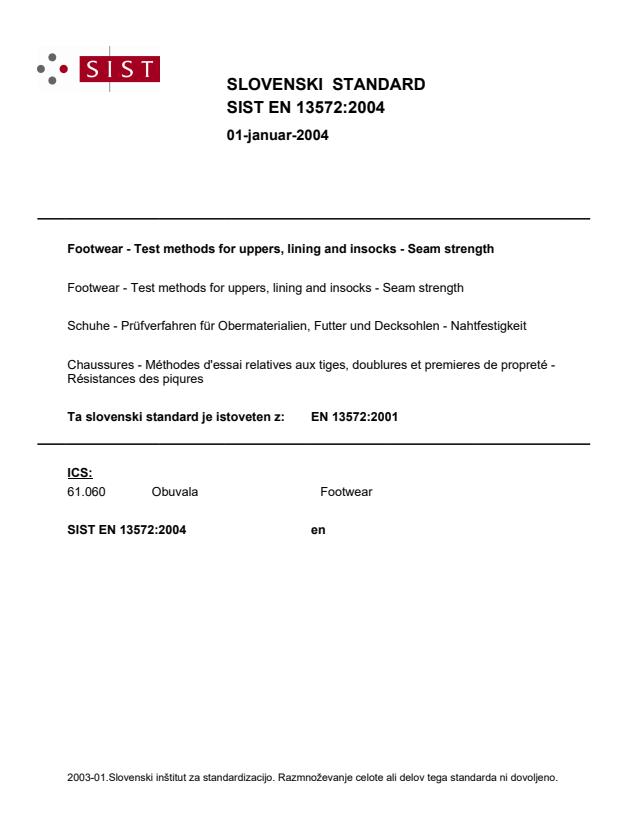
2003-01.Slovenski inštitut za standardizacijo. Razmnoževanje celote ali delov tega standarda ni dovoljeno.Footwear - Test methods for uppers, lining and insocks - Seam strengthSchuhe - Prüfverfahren für Obermaterialien, Futter und Decksohlen - NahtfestigkeitChaussures - Méthodes d'essai relatives aux tiges, doublures et premieres de propreté - Résistances des piquresFootwear - Test methods for uppers, lining and insocks - Seam strength61.060ObuvalaFootwearICS:Ta slovenski standard je istoveten z:EN 13572:2001SIST EN 13572:2004en01-januar-2004SIST EN 13572:2004SLOVENSKI
STANDARD
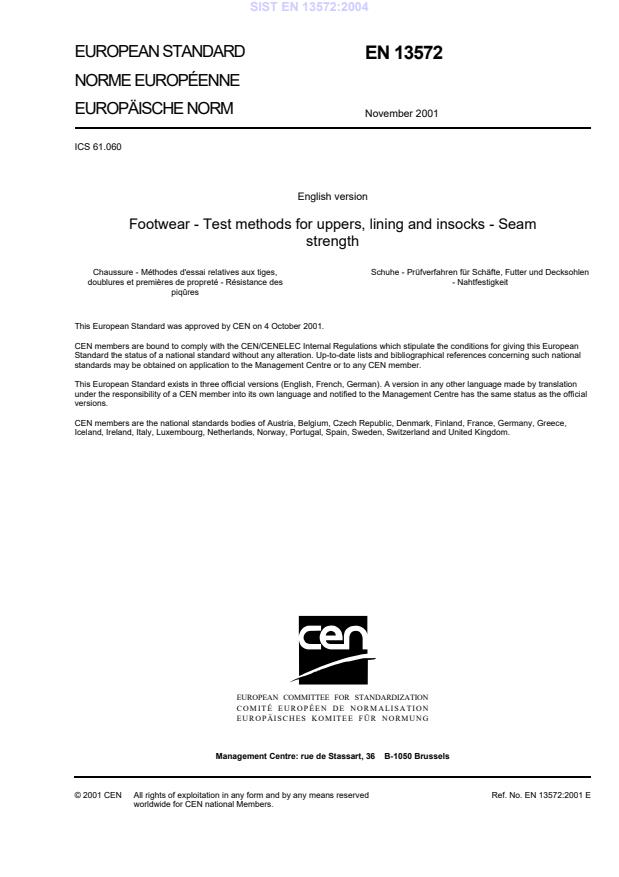
EUROPEAN STANDARDNORME EUROPÉENNEEUROPÄISCHE NORMEN 13572November 2001ICS 61.060English versionFootwear - Test methods for uppers, lining and insocks - SeamstrengthChaussure - Méthodes d'essai relatives aux tiges,doublures et premières de propreté - Résistance despiqûresSchuhe - Prüfverfahren für Schäfte, Futter und Decksohlen- NahtfestigkeitThis European Standard was approved by CEN on 4 October 2001.CEN members are bound to comply with the CEN/CENELEC Internal Regulations which stipulate the conditions for giving this EuropeanStandard the status of a national standard without any alteration. Up-to-date lists and bibliographical references concerning such nationalstandards may be obtained on application to the Management Centre or to any CEN member.This European Standard exists in three official versions (English, French, German). A version in any other language made by translationunder the responsibility of a CEN member into its own language and notified to the Management Centre has the same status as the officialversions.CEN members are the national standards bodies of Austria, Belgium, Czech Republic, Denmark, Finland, France, Germany, Greece,Iceland, Ireland, Italy, Luxembourg, Netherlands, Norway, Portugal, Spain, Sweden, Switzerland and United Kingdom.EUROPEAN COMMITTEE FOR STANDARDIZATIONCOMITÉ EUROPÉEN DE NORMALISATIONEUROPÄISCHES KOMITEE FÜR NORMUNGManagement Centre: rue de Stassart, 36
B-1050 Brussels© 2001 CENAll rights of exploitation in any form and by any means reservedworldwide for CEN national Members.Ref. No. EN 13572:2001 ESIST EN 13572:2004
...
Questions, Comments and Discussion
Ask us and Technical Secretary will try to provide an answer. You can facilitate discussion about the standard in here.
Loading comments...