


prEN 16842-11
(Main)Powered industrial trucks - Visibility - Test methods and verification - Part 11: Pallet stacking trucks (rider controlled)
Powered industrial trucks - Visibility - Test methods and verification - Part 11: Pallet stacking trucks (rider controlled)
This document specifies the requirements and test procedures for 360° visibility of self-propelled industrial rider-controlled pallet-stacking trucks in accordance with ISO 5053-1 (herein after referred to as trucks), without a load and it is intended to be used in conjunction with EN 16842-1.
This document also applies to pedestrian controlled trucks with foldable platform when used in ride-on mode.
Pedestrian-controlled and pedestrian-propelled trucks are not covered by this document.
Where specific requirements in this part are modified from the general requirements in EN 16842-1, the requirements of this part are truck specific and intended to be used for self-propelled industrial stand-on pallet-stacking trucks.
This part of EN 16842 deals with all significant hazards, hazardous situations or hazardous events relevant to the visibility of the operator for applicable machines when used as intended and under conditions of misuse which are reasonably foreseeable by the manufacturer.
Kraftbetriebene Flurförderzeuge - Sichtverhältnisse - Prüfverfahren und Verifikation - Teil 11: Gabelhochhubwagen (Mitfahrer bedient)
Dieses Dokument legt die Anforderungen und Prüfverfahren für die Rundumsicht (360°) von motorkraftbe
triebenen Gabelhochhubwagen (Mitfahrer bedient) ohne Last in Übereinstimmung mit ISO5053-1 (hier als Flurförderzeuge bezeichnet) fest und ist dafür vorgesehen, in Verbindung mit EN16842-1 angewendet zuden.
Dieses Dokument gilt auch für mitgängergeführte Flurförderzeuge mit klappbarer Plattform im Mitfahrmodus.
Mitgängergeführte und mitgängerbetriebene Flurförderzeuge werden durch dieses Dokument nicht abgedeckt.
Wenn spezifische Anforderungen in diesem Teil von den allgemeinen Anforderungen in EN16842-1 abweichen, sind die Anforderungen in diesem Teil für das Flurförderzeug spezifisch und für die Verwendung bei motorkraftbetriebenen Gabelhochhubwagen (Mitfahrer bedient) mit stehendem Bediener vorgesehen.
Dieser Teil von EN16842 behandelt alle signifikanten Gefährdungen, Gefährdungssituationen oder Gefähr
dungsereignisse, die für die Sichtverhältnisse des Bedieners bei vorgesehener Nutzung der betreffenden Maschinen relevant sind, wenn sie bestimmungsgemäß und unter Bedingungen, die vom Hersteller als Fehlanwendung vernünftigerweise vorhersehbar sind, verwendet werden.
Chariots de manutention automoteurs - Visibilité - Méthode d'essai et vérification - Partie 11 : Chariot à fourche (conducteur porté)
Le présent document spécifie les exigences et les modes opératoires relatifs à la visibilité sur 360° des chariots de manutention automoteurs à fourches recouvrantes à conducteur porté conformes à l’ISO 5053-1 (ci-après désignés chariot), sans charge et est destiné à être utilisé conjointement avec l’EN 16842-1.
Le présent document s’applique également aux chariots à conducteur accompagnant avec une plate-forme repliable lorsqu’ils sont utilisés en mode à conducteur porté.
Les chariots à conducteur accompagnant et à propulsion manuelle ne sont pas couverts par le présent document.
Lorsque des exigences spécifiques de la présente partie sont modifiées par rapport aux exigences générales de l’EN 16842-1, les exigences de la présente partie sont spécifiques au chariot et sont destinées à être utilisées pour les chariots de manutention automoteurs à fourches recouvrantes à conducteur debout.
La présente partie de l’EN 16842 traite de tous les phénomènes dangereux, situations dangereuses ou événements dangereux significatifs relatifs à la visibilité du conducteur pour les machines concernées lorsqu’elles sont utilisées comme prévu et dans des conditions de mauvaise utilisation raisonnablement prévisible par le fabricant.
Vozila za talni transport - Gnana vozila za talni transport - Vidno polje voznika - Preskusne metode in preverjanje - 11. del: Viličar (ki ga upravlja voznik)
General Information
- Status
- Not Published
- Publication Date
- 01-Jul-2026
- Technical Committee
- CEN/TC 150 - Industrial trucks - Safety
- Drafting Committee
- CEN/TC 150/WG 14 - Visibility
- Current Stage
- 4599 - Dispatch of FV draft to CMC - Finalization for Vote
- Start Date
- 08-Jan-2026
- Due Date
- 11-May-2026
- Completion Date
- 08-Jan-2026
Overview
The prEN 16842-11:2025 is a European standard developed by CEN that outlines specific requirements and test methods for 360° visibility on self-propelled, rider-controlled pallet stacking trucks. These powered industrial trucks are defined in accordance with ISO 5053-1 and are tested without a load to verify visibility conditions. This standard complements EN 16842-1 and focuses exclusively on rider-operated pallet stacking trucks, including pedestrian-controlled trucks used in ride-on mode with foldable platforms. It excludes pedestrian-controlled and pedestrian-propelled trucks.
Visibility is a critical safety factor for industrial trucks, and prEN 16842-11 addresses all significant hazards related to operator visibility during normal operation and reasonably foreseeable misuse. The standard provides systematic verification procedures to ensure operators can safely maneuver in environments where these trucks are utilized.
Key Topics
Scope and Application
This part of EN 16842 covers visibility requirements specifically for rider-controlled, self-propelled pallet stacking trucks. Test procedures apply when trucks operate without a load and include pedestrian-controlled trucks with foldable platforms in ride-on mode.Truck Configuration and Test Setup
The document details truck setup requirements such as fork height (load-carrying surface positioned up to 120 mm above the floor) and specifies the location of lighting equipment used to simulate operator eye positions during tests. It distinguishes between stand-on and sit-on operator positions, defining the standing index point (STIP) and seat index point (SIP) to ensure consistent test conditions.Testing Methodology
Visibility is assessed from the operator’s normal ride-on position using light fixtures and test screens simulating obstacles. The test paths are precisely laid out around the truck with defined distances from the truck profile to measure visibility zones. Both direct and indirect visibility tests are conducted, following procedures harmonized with EN 16842-1.Visibility Criteria
Acceptance criteria specify minimum illuminated visibility areas of at least 10,000 mm² with no dimension less than 50 mm on test objects, ensuring operators have clear visibility of obstacles during both traveling and maneuvering. Specific requirements vary depending on whether the operator’s line of sight is aligned or at right angles to the travel direction.Hazard Considerations
The standard addresses all relevant hazards, hazardous situations, and events related to operator visibility, ensuring a comprehensive safety evaluation during truck operation.
Applications
Warehouse and Logistics Operations
Rider-controlled pallet stacking trucks compliant with prEN 16842-11 are safer to operate in tight indoor environments involving pallet storage, retrieval, and stacking where all-around visibility is paramount.Manufacturing Facilities
Facilities that require precise handling and stacking of pallets benefit from standardized visibility criteria that help prevent accidents caused by limited operator sightlines.Supply Chain and Distribution Centers
Ensuring 360° visibility as per this standard reduces risk of collision and enhances operational efficiency in fast-moving loading docks and distribution centers.Safety Compliance and Equipment Selection
Organizations use prEN 16842-11 to verify equipment safety performance before purchase or deployment, supporting compliance with wider ISO and EN safety regulations for industrial trucks.
Related Standards
EN 16842-1:2018: Provides general requirements and test methods for visibility in powered industrial trucks, forming the foundational framework for part 11.
ISO 5053-1:2020: Defines types and vocabulary related to industrial trucks, used as a reference for truck classifications under this visibility standard.
EN ISO 3691-1:2015: Covers safety requirements and verification for self-propelled industrial trucks, which complements visibility testing by addressing overall truck safety.
Other Parts of EN 16842 Series: Includes standards for various types of powered industrial trucks like sit-on counterbalance trucks, reach trucks, order-picking trucks, and towing tractors, providing visibility requirements specific to each vehicle type.
By adhering to prEN 16842-11:2025, manufacturers and users of pallet stacking trucks ensure that their equipment meets rigorous visibility safety standards vital for preventing accidents and maintaining efficient industrial operations. The clear test procedures and acceptance criteria promote consistent evaluation and improve operator confidence across diverse industrial environments.

Frequently Asked Questions
prEN 16842-11 is a draft published by the European Committee for Standardization (CEN). Its full title is "Powered industrial trucks - Visibility - Test methods and verification - Part 11: Pallet stacking trucks (rider controlled)". This standard covers: This document specifies the requirements and test procedures for 360° visibility of self-propelled industrial rider-controlled pallet-stacking trucks in accordance with ISO 5053-1 (herein after referred to as trucks), without a load and it is intended to be used in conjunction with EN 16842-1. This document also applies to pedestrian controlled trucks with foldable platform when used in ride-on mode. Pedestrian-controlled and pedestrian-propelled trucks are not covered by this document. Where specific requirements in this part are modified from the general requirements in EN 16842-1, the requirements of this part are truck specific and intended to be used for self-propelled industrial stand-on pallet-stacking trucks. This part of EN 16842 deals with all significant hazards, hazardous situations or hazardous events relevant to the visibility of the operator for applicable machines when used as intended and under conditions of misuse which are reasonably foreseeable by the manufacturer.
This document specifies the requirements and test procedures for 360° visibility of self-propelled industrial rider-controlled pallet-stacking trucks in accordance with ISO 5053-1 (herein after referred to as trucks), without a load and it is intended to be used in conjunction with EN 16842-1. This document also applies to pedestrian controlled trucks with foldable platform when used in ride-on mode. Pedestrian-controlled and pedestrian-propelled trucks are not covered by this document. Where specific requirements in this part are modified from the general requirements in EN 16842-1, the requirements of this part are truck specific and intended to be used for self-propelled industrial stand-on pallet-stacking trucks. This part of EN 16842 deals with all significant hazards, hazardous situations or hazardous events relevant to the visibility of the operator for applicable machines when used as intended and under conditions of misuse which are reasonably foreseeable by the manufacturer.
prEN 16842-11 is classified under the following ICS (International Classification for Standards) categories: 53.060 - Industrial trucks. The ICS classification helps identify the subject area and facilitates finding related standards.
prEN 16842-11 is associated with the following European legislation: EU Directives/Regulations: 2006/42/EC. When a standard is cited in the Official Journal of the European Union, products manufactured in conformity with it benefit from a presumption of conformity with the essential requirements of the corresponding EU directive or regulation.
prEN 16842-11 is available in PDF format for immediate download after purchase. The document can be added to your cart and obtained through the secure checkout process. Digital delivery ensures instant access to the complete standard document.
Standards Content (Sample)
SLOVENSKI STANDARD
01-maj-2025
Vozila za talni transport - Gnana vozila za talni transport - Vidno polje voznika -
Preskusne metode in preverjanje - 11. del: Viličar (ki ga upravlja voznik)
Powered industrial trucks - Visibility - Test methods and verification - Part 11: Pallet
stacking trucks (rider controlled)
Kraftbetriebene Flurförderzeuge - Sichtverhältnisse - Prüfverfahren und Verifikation - Teil
11: Gabelhochhubwagen (Mitfahrer bedient)
Chariots de manutention automoteurs - Visibilité - Méthode d'essai et vérification - Partie
11 : Chariot à fourche (conducteur porté)
Ta slovenski standard je istoveten z: prEN 16842-11
ICS:
53.060 Industrijski tovornjaki Industrial trucks
2003-01.Slovenski inštitut za standardizacijo. Razmnoževanje celote ali delov tega standarda ni dovoljeno.
DRAFT
EUROPEAN STANDARD
NORME EUROPÉENNE
EUROPÄISCHE NORM
April 2025
ICS 53.060
English Version
Powered industrial trucks - Visibility - Test methods and
verification - Part 11: Pallet stacking trucks (rider
controlled)
Chariots de manutention automoteurs - Visibilité - Kraftbetriebene Flurförderzeuge - Sichtverhältnisse -
Méthode d'essai et vérification - Partie 11 : Chariot à Prüfverfahren und Verifikation - Teil 11:
fourche (conducteur porté) Gabelhochhubwagen (Mitfahrer bedient)
This draft European Standard is submitted to CEN members for enquiry. It has been drawn up by the Technical Committee
CEN/TC 150.
If this draft becomes a European Standard, CEN members are bound to comply with the CEN/CENELEC Internal Regulations
which stipulate the conditions for giving this European Standard the status of a national standard without any alteration.
This draft European Standard was established by CEN in three official versions (English, French, German). A version in any other
language made by translation under the responsibility of a CEN member into its own language and notified to the CEN-CENELEC
Management Centre has the same status as the official versions.
CEN members are the national standards bodies of Austria, Belgium, Bulgaria, Croatia, Cyprus, Czech Republic, Denmark, Estonia,
Finland, France, Germany, Greece, Hungary, Iceland, Ireland, Italy, Latvia, Lithuania, Luxembourg, Malta, Netherlands, Norway,
Poland, Portugal, Republic of North Macedonia, Romania, Serbia, Slovakia, Slovenia, Spain, Sweden, Switzerland, Türkiye and
United Kingdom.
Recipients of this draft are invited to submit, with their comments, notification of any relevant patent rights of which they are
aware and to provide supporting documentation.
Warning : This document is not a European Standard. It is distributed for review and comments. It is subject to change without
notice and shall not be referred to as a European Standard.
EUROPEAN COMMITTEE FOR STANDARDIZATION
COMITÉ EUROPÉEN DE NORMALISATION
EUROPÄISCHES KOMITEE FÜR NORMUNG
CEN-CENELEC Management Centre: Rue de la Science 23, B-1040 Brussels
© 2025 CEN All rights of exploitation in any form and by any means reserved Ref. No. prEN 16842-11:2025 E
worldwide for CEN national Members.
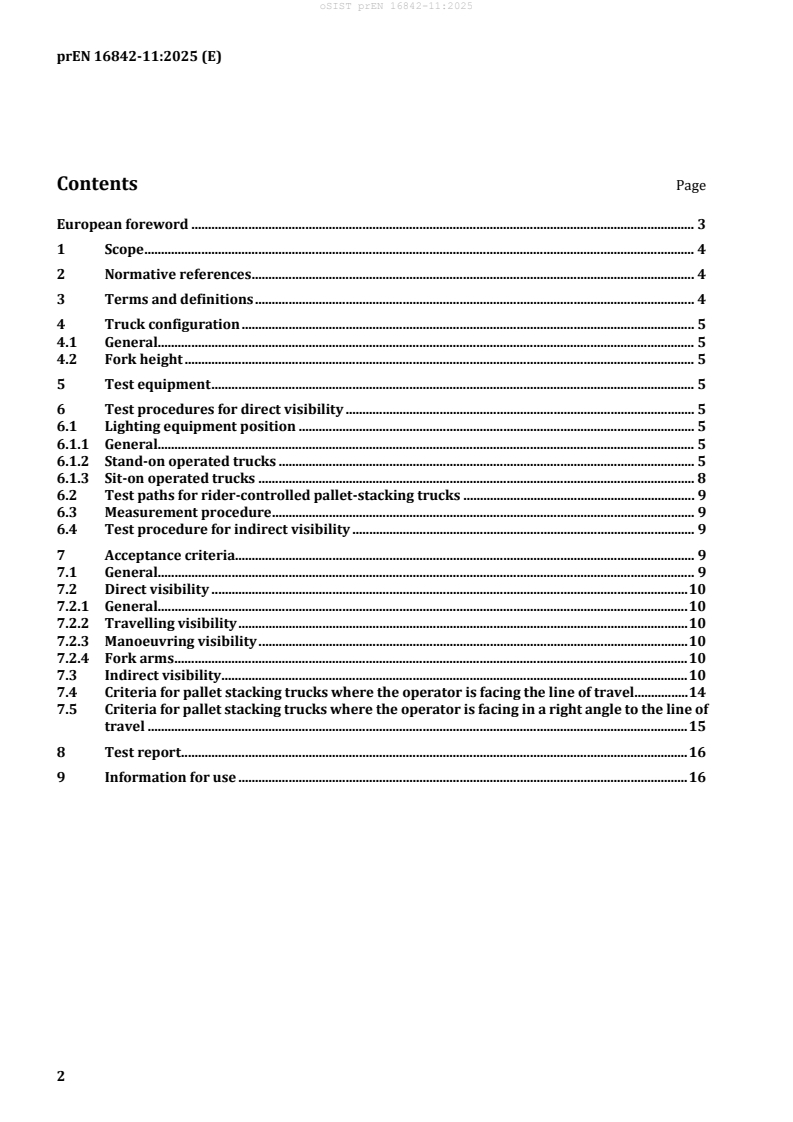
Contents Page
European foreword . 3
1 Scope . 4
2 Normative references . 4
3 Terms and definitions . 4
4 Truck configuration . 5
4.1 General. 5
4.2 Fork height . 5
5 Test equipment . 5
6 Test procedures for direct visibility . 5
6.1 Lighting equipment position . 5
6.1.1 General. 5
6.1.2 Stand-on operated trucks . 5
6.1.3 Sit-on operated trucks . 8
6.2 Test paths for rider-controlled pallet-stacking trucks . 9
6.3 Measurement procedure . 9
6.4 Test procedure for indirect visibility . 9
7 Acceptance criteria. 9
7.1 General. 9
7.2 Direct visibility . 10
7.2.1 General. 10
7.2.2 Travelling visibility . 10
7.2.3 Manoeuvring visibility . 10
7.2.4 Fork arms . 10
7.3 Indirect visibility . 10
7.4 Criteria for pallet stacking trucks where the operator is facing the line of travel . 14
7.5 Criteria for pallet stacking trucks where the operator is facing in a right angle to the line of
travel . 15
8 Test report . 16
9 Information for use . 16
European foreword
This document (prEN 16842-11:2025) has been prepared by Technical Committee CEN/TC 150
“Industrial Trucks – Safety”, the secretariat of which is held by BSI.
This document is currently submitted to the CEN Enquiry.
This document is intended to be used in combination with the requirements in EN 16842-1. The
EN 16842 series consists of the following parts under the general title “Powered industrial trucks –
Visibility – Test methods and verification”:
— part 1: General requirements;
— part 2: Sit-on counterbalance trucks and rough terrain masted trucks up to and including 10 000 kg
capacity;
— part 3: Reach trucks up to and including 10 000 kg capacity;
— part 4: Industrial variable reach trucks up to and including 10 000 kg capacity;
— part 5: Industrial variable reach trucks greater than 10 000 kg capacity;
— part 6: Sit-on counterbalance trucks and rough terrain masted trucks greater than 10 000 kg
capacity;
— part 7: Variable reach and masted container trucks handling freight containers of 6 m (20 ft) length
and longer;
— part 8: Stand on counterbalance trucks up to and including 10 000 kg capacity;
— part 9: Order-picking, lateral- and front-stacking trucks with elevating operator position;
— part 10: Towing and pushing tractors and burden carrier;
— part 11: Pallet stacking trucks (rider-controlled).
It is intended to develop the parts related to the following machinery:
— single side loader;
— multi-directional forklift truck;
— non-stacking low-lift straddle carrier (as defined in ISO 5053-1:2020, 3.18);
— stacking high-lift straddle carrier (as defined in ISO 5053-1:2020, 3.19).
1 Scope
This document specifies the requirements and test procedures for 360° visibility of self-propelled
industrial rider-controlled pallet-stacking trucks in accordance with ISO 5053-1 (herein after referred to
as trucks), without a load and it is intended to be used in conjunction with EN 16842-1.
This document also applies to pedestrian controlled trucks with foldable platform when used in ride-on
mode.
Pedestrian-controlled and pedestrian-propelled trucks are not covered by this document.
Where specific requirements in this part are modified from the general requirements in EN 16842-1, the
requirements of this part are truck specific and intended to be used for self-propelled industrial stand-
on pallet-stacking trucks.
This part of EN 16842 deals with all significant hazards, hazardous situations or hazardous events
relevant to the visibility of the operator for applicable machines when used as intended and under
conditions of misuse which are reasonably foreseeable by the manufacturer.
2 Normative references
The following documents are referred to in the text in such a way that some or all of their content
constitutes requirements of this document. For dated references, only the edition cited applies. For
undated references, the latest edition of the referenced document (including any amendments) applies.
EN 16842-1:2018, Powered industrial trucks — Visibility — Test methods and verification — Part 1:
General requirements
EN ISO 3691-1:2015, Industrial trucks —- Safety requirements and verification — Part 1: Self-propelled
industrial trucks, other than driverless trucks, variable-reach trucks and burden-carrier trucks
(ISO 3691-1:2011, including Cor 1:2013)
ISO 5053-1:2020, Industrial trucks — Vocabulary — Part 1: Types of industrial trucks
3 Terms and definitions
For the purposes of this document, the terms and definitions given in EN 16842-1:2018, ISO 5053-1:2020
and EN ISO 3691-1:2015 and the following apply.
NOTE Definition 3.1 of EN 16842-1:2018 is not applicable for stand-on straddle trucks covered by this part.
ISO and IEC maintain terminology databases for use in standardization at the following addresses:
— ISO Online browsing platform: available at https://www.iso.org/obp/
— IEC Electropedia: available at https://www.electropedia.org/
3.1
truck profile
contour which is determined by the largest rectangular width and length
parallel to the longitudinal axis of the truck, including the front vertical surface of the outriggers
Note 1 to entry: The blades of the fork arms are not taken into account.
As impacted by EN ISO 3691-1:2015/AC:2016 and EN ISO 3691-1:2015
...
Questions, Comments and Discussion
Ask us and Technical Secretary will try to provide an answer. You can facilitate discussion about the standard in here.
Loading comments...