

EN 716-2:2008+A1:2013
(Main + Amendment)Furniture - Children's cots and folding cots for domestic use - Part 2: Test methods
- Abstract
This part of EN 716 specifies test methods for assessing the safety of children's cots and folding cots for domestic use.
It applies to children’s cots and folding cots with an internal length greater than 900 mm but not more than 1 400 mm.
- Status
- Withdrawn
- Publication Date
- 08-Jan-2013
- Withdrawal Date
- 06-Oct-2026
- Technical Committee
- CEN/TC 207 - Furniture
- Drafting Committee
- CEN/TC 207/WG 2 - Kitchen and bathroom furniture
- Current Stage
- 9960 - Withdrawal effective - Withdrawal
- Start Date
- 07-Jun-2017
- Completion Date
- 07-Oct-2026
- Directive
- 2001/95/EC - General product safety

Relations
- Effective Date
- 19-Jan-2023
- Merged From
EN 716-2:2008 - Furniture - Children's cots and folding cots for domestic use - Part 2: Test methods - Effective Date
- 18-Jan-2023
- Replaced By
EN 716-2:2017 - Furniture - Children's cots and folding cots for domestic use - Part 2: Test methods - Effective Date
- 21-May-2014
- Effective Date
- 09-Feb-2026
- Effective Date
- 28-Jan-2026
- Effective Date
- 28-Jan-2026
- Effective Date
- 28-Jan-2026
- Effective Date
- 28-Jan-2026
Frequently Asked Questions
EN 716-2:2008+A1:2013 is a standard published by the European Committee for Standardization (CEN). Its full title is "Furniture - Children's cots and folding cots for domestic use - Part 2: Test methods". This standard covers: This part of EN 716 specifies test methods for assessing the safety of children's cots and folding cots for domestic use. It applies to children’s cots and folding cots with an internal length greater than 900 mm but not more than 1 400 mm.
This part of EN 716 specifies test methods for assessing the safety of children's cots and folding cots for domestic use. It applies to children’s cots and folding cots with an internal length greater than 900 mm but not more than 1 400 mm.
EN 716-2:2008+A1:2013 is classified under the following ICS (International Classification for Standards) categories: 97.140 - Furniture. The ICS classification helps identify the subject area and facilitates finding related standards.
EN 716-2:2008+A1:2013 has the following relationships with other standards: It is inter standard links to EN 716-2:2008/FprA1:2012, EN 716-2:2008, EN 716-2:2017, ISO 7619-2:2010, EN ISO 2439:2000, EN 16121:2013, EN 16121:2013+A1:2017, EN 716-1:2008+A1:2013. Understanding these relationships helps ensure you are using the most current and applicable version of the standard.
EN 716-2:2008+A1:2013 is associated with the following European legislation: EU Directives/Regulations: 2001/95/EC; Standardization Mandates: M/264. When a standard is cited in the Official Journal of the European Union, products manufactured in conformity with it benefit from a presumption of conformity with the essential requirements of the corresponding EU directive or regulation.
EN 716-2:2008+A1:2013 is available in PDF format for immediate download after purchase. The document can be added to your cart and obtained through the secure checkout process. Digital delivery ensures instant access to the complete standard document.
Standards Content (Sample)
2003-01.Slovenski inštitut za standardizacijo. Razmnoževanje celote ali delov tega standarda ni dovoljeno.Möbel - Kinderbetten und Reisekinderbetten für den Wohnbereich - Teil 2: PrüfverfahrenMeubles - Lits à nacelle fixes et pliants à usage domestique pour enfants - Partie 2 : Méthodes d'essaiFurniture - Children's cots and folding cots for domestic use - Part 2: Test methods97.140PohištvoFurnitureICS:Ta slovenski standard je istoveten z:EN 716-2:2008+A1:2013SIST EN 716-2:2008+A1:2013en,fr,de01-februar-2013SIST EN 716-2:2008+A1:2013SLOVENSKI
STANDARDSIST EN 716-2:20081DGRPHãþD
EUROPEAN STANDARD NORME EUROPÉENNE EUROPÄISCHE NORM
EN 716-2:2008+A1
January 2013 ICS 97.140 Supersedes EN 716-2:2008English Version
Furniture - Children's cots and folding cots for domestic use - Part 2: Test methods
Meubles - Lits à nacelle fixes et pliants à usage domestique pour enfants - Partie 2 : Méthodes d'essai
Möbel - Kinderbetten und Reisekinderbetten für den Wohnbereich - Teil 2: Prüfverfahren This European Standard was approved by CEN on 2 February 2008 and includes Amendment 1 approved by CEN on 17 November 2012.
CEN members are bound to comply with the CEN/CENELEC Internal Regulations which stipulate the conditions for giving this European Standard the status of a national standard without any alteration. Up-to-date lists and bibliographical references concerning such national standards may be obtained on application to the CEN-CENELEC Management Centre or to any CEN member.
This European Standard exists in three official versions (English, French, German). A version in any other language made by translation under the responsibility of a CEN member into its own language and notified to the CEN-CENELEC Management Centre has the same status as the official versions.
CEN members are the national standards bodies of Austria, Belgium, Bulgaria, Croatia, Cyprus, Czech Republic, Denmark, Estonia, Finland, Former Yugoslav Republic of Macedonia, France, Germany, Greece, Hungary, Iceland, Ireland, Italy, Latvia, Lithuania, Luxembourg, Malta, Netherlands, Norway, Poland, Portugal, Romania, Slovakia, Slovenia, Spain, Sweden, Switzerland, Turkey and United Kingdom.
EUROPEAN COMMITTEE FOR STANDARDIZATION
COMITÉ EUROPÉEN DE NORMALISATION EUROPÄISCHES KOMITEE FÜR NORMUNG
Management Centre:
Avenue Marnix 17,
B-1000 Brussels © 2013 CEN All rights of exploitation in any form and by any means reserved worldwide for CEN national Members. Ref. No. EN 716-2:2008+A1:2013: ESIST EN 716-2:2008+A1:2013
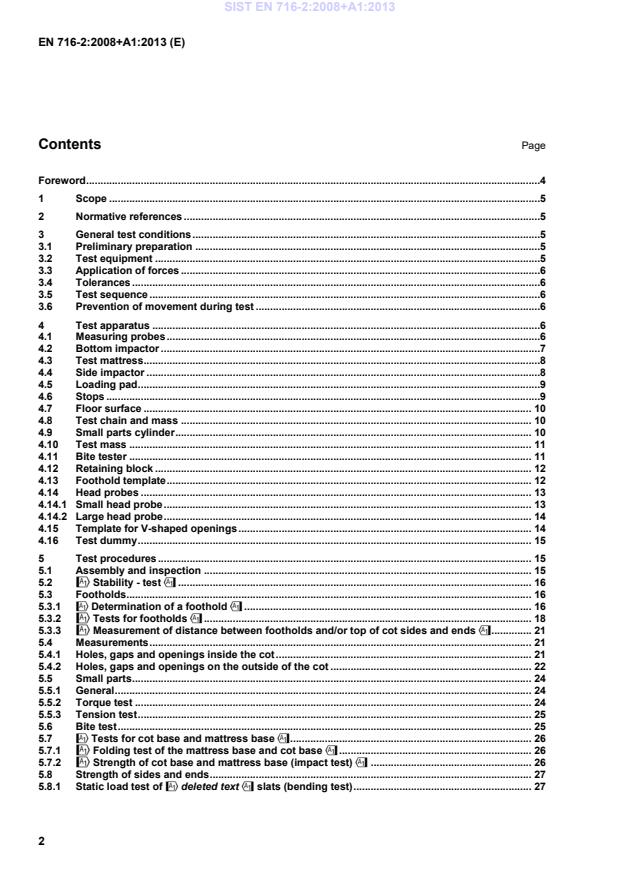
(E) 3 5.8.2 Strength of sides or side slats (impact test). 27 5.8.3 Strength of corners (impact test) . 30 5.8.4 Strength of mesh and flexible sides and ends (static load test) . 30 5.9 Strength of frame and fastenings . 31 5.9.1 Vertical static load test . 31 5.9.2 Durability test . 32 5.10 Snag points . 33 5.11 Locking mechanisms . 33 5.11.1 Durability . 33 5.11.2 Strength . 33 5.12 Stability test . 33 6 Test report . 33 Annex A (informative)
!A–deviations" . 35 Bibliography . 36
According to the CEN/CENELEC Internal Regulations, the national standards organisations of the following countries are bound to implement this European Standard: Austria, Belgium, Bulgaria, Croatia, Cyprus, Czech Republic, Denmark, Estonia, Finland, Former Yugoslav Republic of Macedonia, France, Germany, Greece, Hungary, Iceland, Ireland, Italy, Latvia, Lithuania, Luxembourg, Malta, Netherlands, Norway, Poland, Portugal, Romania, Slovakia, Slovenia, Spain, Sweden, Switzerland, Turkey and the United Kingdom. SIST EN 716-2:2008+A1:2013
(E) 5 1 Scope This part of EN 716 specifies test methods for assessing the safety of children's cots and folding cots for domestic use. It applies to children’s cots and folding cots with an internal length greater than 900 mm but not more than 1 400 mm. 2 Normative references The following referenced documents are indispensable for the application of this document. For dated references, only the edition cited applies. For undated references, the latest edition of the referenced document (including any amendments) applies. EN ISO 2439:2000, Flexible cellular polymeric materials - Determination of hardness (indentation technique) (ISO 2439:1997, including Technical Corrigendum 1:1998) ISO 7619-2, Rubber, vulcanized or thermoplastic — Determination of indentation hardness — Part 2: IRHD pocket meter method 3 General test conditions 3.1 Preliminary preparation The tests are designed to be applied to a cot that is fully assembled and ready for use. The test unit shall be stored in indoor ambient conditions for at least one week immediately prior to testing. Any deviation from this procedure shall be stated in the test report. Before testing, any fabrics intended to be removable shall be cleaned or washed twice in accordance with the manufacturer's instructions. If no instructions are supplied, the manner of washing/cleaning shall be stated in the test report. The tests shall be carried out under indoor ambient conditions, but if during a test the atmospheric temperature is outside the range 15 °C to 25 °C, the maximum and/or minimum temperature shall be recorded in the test report. The cot shall be tested as delivered. If the cot is a knock down type, it shall be assembled according to the manufacturer's instructions supplied with the cot. If the cot can be assembled, combined or adjusted in different ways, the most adverse combination shall be used for each test. Knock-down fittings shall be tightened before testing. Further re-tightening shall not take place unless this is specifically required by the manufacturer. In the case of designs not catered for in the test procedures, the tests shall be carried out as far as possible as described, and a list made of the deviations from the test procedures. 3.2 Test equipment Unless otherwise specified, the tests may be applied by any suitable device because results are dependent only upon correctly applied forces and loads and not upon the apparatus. SIST EN 716-2:2008+A1:2013
3.3 Application of forces The forces in the static load tests shall be applied sufficiently slowly enough to ensure that negligible dynamic force is applied. The forces in durability tests shall be applied at a rate to ensure that excessive heating does not occur. 3.4 Tolerances Unless otherwise stated, the following tolerances apply: Forces:
±
5 % of the nominal force; Masses:
±
0,5 % of the nominal mass; Dimensions: ±
1,0 mm of the nominal dimension; Angles:
±
2° of the nominal angle; Positioning of loading pads: ± 5 mm; Duration of forces: ( 2 ± 1) s for durability tests
(10 ± 2) s for static load tests, including tension, torque and bite tests. The tests are described in terms of the application of forces. Masses can, however, be used. The relationship 10 N = 1 kg shall be used for this purpose.
3.5 Test sequence The tests shall be carried out in the order laid down in this standard and on the same cot. 3.6 Prevention of movement during test If the cot tends to slide or roll during the tests specified in clause 5, it shall be restrained by stops (4.6).
4 Test apparatus 4.1 Measuring probes Probes made of plastics or other hard, smooth material mounted on a force-measuring device.
There shall be one probe with a diameter of 7 mm (-0,1/+0 mm), see Figure 1a. There shall be five probes with an angle of 30° ±
0,5° with diameters of 25 mm (0/+0,1 mm), 45 mm (0/+0,1 mm), 60 mm (0/+0,1 mm), 65 mm (0/+0,1 mm) and 85 mm (0/+0,1 mm) with conical ends, see Figure 1b. SIST EN 716-2:2008+A1:2013
(E) 7 There shall be four cylindrical probes with diameters of 5 mm (-0,1/+0 mm), 7 mm (-0,1/+0 mm), 12 mm (0/+0,1 mm) and 18 mm (0/+0,1 mm) with hemispherical ends, see Figure 1c.
Figure 1 a— 7 mm probe
Figure 1 b — Conical probes
Figure 1 c — Cylindrical probes Key 1 Ø 5 mm (-0,1/+0 mm), Ø 7 mm (-0,1/+0 mm), Ø 12 mm (0/+0,1 mm), Ø 18 mm (0/+0,1 mm) Figure 1 4.2 Bottom impactor An impactor with a total mass of 10 kg of hardwood or equivalent material with a hemispherical end and with dimensions in accordance with Figure 2. The impactor shall be guided so that it is kept vertical and always falls on the impact point.SIST EN 716-2:2008+A1:2013
Figure 2 — Bottom impactor 4.3 Test mattress A PUR foam sheet with a thickness of 60 mm, a bulk density of (35 ± 2) kg/m3 and an indentation hardness index of (170 ± 40) N in accordance with A.40 of EN ISO 2439:2000 and being at least 400 mm × 800 mm in area but not larger than the mattress base of the cot under test. The test mattress shall have a cotton cover with a mass per unit area of 100 g/m2 to 120 g/m2. 4.4 Side impactor A pendulum with a cylindrical head made of steel (Figure 3). The head of the pendulum shall be surrounded by a 10 mm thick layer of rubber of hardness 76 IRHD to 78 IRHD in accordance with ISO 7619-2. The total mass shall be 2 kg. SIST EN 716-2:2008+A1:2013
(E) 9 Dimensions in millimetres
Key 1 Pivot point 2 Centre of gravity 3 Rubber 76 to 78 IRHD Figure 3 — Side impactor 4.5 Loading pad A rigid cylindrical object, 100 mm in diameter, having a smooth hard surface and rounded edge with radius of 12 mm. 4.6 Stops Stops which prevent the article from sliding but not tilting, not higher than 12 mm except in cases where the design of the item necessitates the use of higher stops, in which case the lowest that will prevent the item from sliding shall be used. SIST EN 716-2:2008+A1:2013
Dimensions in millimetres
Figure 4 — Ball chain
Dimensions in millimetres
Key 1 Ball chain 2 Weight, mass 2,5 kg 3 Fixing point Figure 5 — Test chain and mass 4.9 Small parts cylinder For assessment of small components, having dimensions in accordance with Figure 6. NOTE The cylinder is identical to the one specified in EN 71-1 [1]. SIST EN 716-2:2008+A1:2013
(E) 11 Dimensions in millimetres
Figure 6 — Small parts cylinder 4.10 Test mass A weight having a mass of 10 kg and a cross-section of 100 mm × 30 mm. 4.11 Bite tester
An apparatus (Figure 8), consisting of two sets of teeth (Figure 7), made from H13 high chrome tool steel or equivalent and hardened to 45 Rockwell C to 50 Rockwell C. There shall be two teeth at the top and two at the bottom of the bite tester, positioned so that the vertical centre line of one pair of teeth is (1 ± 0,1) mm in front of the centre line of the other set of teeth. In the fully closed position the teeth shall overlap each other by (1 ± 0,1) mm. The outer most corners of the teeth shall have a radius of (0,3 ± 0,1) mm. The teeth shall be mounted so as to pivot about a point (50 ± 1) mm from the rear most pair of teeth and positioned so that when closed the centre lines of the two pairs of teeth are parallel to each other. The bite tester shall be equipped with a stop to prevent the distance between the teeth from exceeding (28 ± 1) mm when fully opened. The closing force of the teeth shall be set at (50 ± 5) N. The bite tester shall be provided with a guide to prevent items entering further into the fully opened jaws by more than (17 ± 1) mm. The bite tester shall be equipped with a means whereby a force of (50 ± 5) N may be applied along its centre line in a direction tending to pull the teeth off the sample. SIST EN 716-2:2008+A1:2013
Figure 7 — Test teeth
Dimensions in millimetres
Key 1 Position of guide 2 Pivot point Figure 8 — Bite tester 4.12 Retaining block Two retaining blocks made of rigid material with a width of 50 mm and a radius of 5 mm at the front edges. 4.13 Foothold template A strip of 10 mm thick transparent material cut to the shape as shown in Figure 9, marked on one face with the pattern as shown. SIST EN 716-2:2008+A1:2013
(E) 13 The sides of the template shall be at a right angle to the faces. All edges and corners shall be without any radius. Dimensions in millimetres
Key 1 Triangular cells plotted on a 5 x 5 grid Figure 9 — Template for foothold test (example of left hand template)
Two templates are required to provide a left and right hand template. The markings shown in Figure 9 shall be on the bottom face of each template to avoid parallax errors. 4.14 Head probes 4.14.1 Small head probe The small head probe shall be made from plastics or other hard, smooth material with the dimensions given in Figure 10. The radius shall
...