

prEN 3988
(Main)Aerospace series - Test methods for metallic materials - Constant amplitude strain-controlled low cycle fatigue testing
- Abstract
This document applies to uniaxial strain-controlled low cycle fatigue testing of metallic materials governed by EN aerospace standards. It defines the properties that need to be determined and the terms used in describing the tests and test pieces.
It specifies the equipment, the test pieces, the method of testing and the presentation of results. It applies to testing at ambient and elevated temperatures.
The purpose of this document is to ensure the comparability and reproducibility of the test results. It does not cover the evaluation or interpretation of the results.
This document is restricted to the use of test pieces having a circular cross-section. In some particular cases the practice can be applied to flat test pieces. The major difficulties concern the preparation of the test pieces and their alignment in the grips.
- Status
- Not Published
- Publication Date
- 18-Jul-2027
- Technical Committee
- ASD-STAN - Aerospace
- Drafting Committee
- ASD-STAN/D 4/S 5 - Test Methods
- Current Stage
- 4060 - Closure of enquiry - Enquiry
- Start Date
- 14-May-2026
- Completion Date
- 14-May-2026

Overview
prEN 3988: Aerospace Series - Test Methods for Metallic Materials - Constant Amplitude Strain-Controlled Low Cycle Fatigue Testing is a draft European Standard developed by CEN for the aerospace industry. This document specifies robust methods for conducting uniaxial, strain-controlled low cycle fatigue (LCF) tests on metallic materials in accordance with EN aerospace standards. The testing covers both ambient and elevated temperature conditions and aims to assure comparability and reproducibility across the aerospace sector.
This standard is essential for aerospace engineers, materials scientists, and testing laboratories focused on characterizing the fatigue life of metals used in aircraft, spacecraft, and other demanding aerospace applications. By adhering to prEN 3988, organizations ensure reliable, consistent test results essential for safety, quality, and regulatory compliance.
Key Topics
Scope of Testing:
- The document applies to uniaxial strain-controlled LCF testing, primarily for test pieces with circular cross-sections. In specific scenarios, flat test pieces may also be used.
- Covers testing at both room (ambient) and elevated temperatures.
Defined Properties and Terminology:
- Key terms such as maximum strain, strain range, stress amplitude, fatigue life, and stress-strain loops are standardized for consistency and communication.
- Properties required for test reporting are outlined.
Test Equipment Requirements:
- Specifications for tension-compression machines, extensometers, heating devices, and data recorders.
- Emphasis on calibration routines and alignment verification to minimize measurement errors.
Test Piece Preparation:
- Guidance on design, sampling, handling, and measurement to achieve precise and reproducible results.
- Details preferred test piece geometries and alignment procedures.
Test Methodology:
- Procedures for mounting, heating, and cycling test specimens.
- Criteria for test termination, post-test examination (fracture surface, stress-strain behavior), and fatigue life determination.
Data Presentation:
- Required contents of test reports, including essential and additional information.
- Standard formats for presentation of low cycle fatigue results.
Applications
prEN 3988 is tailored for use in aerospace sector material qualification and component development, offering practical value in the following areas:
Material Selection and Characterization:
- Enables precise assessment of fatigue properties of new or existing metallic alloys used in aerospace structures (e.g., turbine blades, fuselage components).
Design and Safety Verification:
- Supports engineers in evaluating the fatigue performance and reliability of structural parts subject to cyclic strains during service.
Quality Assurance and Compliance:
- Facilitates adherence to industry norms, assisting organizations in meeting European and international aerospace regulatory requirements.
Research & Development:
- Provides a standardized basis for academic and industrial studies on fatigue under low cycle conditions, enhancing comparability between research outputs.
Related Standards
The following standards and references support, complement, or are referenced within prEN 3988:
- EN 4258: Describes the overall organization of EN metallic material standards for aerospace applications.
- ASTM E1012: Standard Practice for Verification of Testing Frame and Specimen Alignment Under Tensile and Compressive Axial Force Application.
- Additional related EN and ISO standards cover broader materials testing, mechanical properties, and equipment calibration protocols.
By aligning with prEN 3988, aerospace organizations can trust in scientifically validated methods for low cycle fatigue testing, ensuring reliable data for engineering decisions and regulatory documentation. For maximum benefit, users should consult prEN 3988 alongside these related standards to establish a comprehensive, compliant material testing program.
Get Certified
Connect with accredited certification bodies for this standard

BUREAU VERITAS Certification Germany
Bureau Veritas certification in Germany.

Element Materials Technology
Materials testing and product certification.

AQMS Ltd.
AQMS provides ISO certification to SMEs across the UK.
Sponsored listings
Frequently Asked Questions
prEN 3988 is a draft published by the European Committee for Standardization (CEN). Its full title is "Aerospace series - Test methods for metallic materials - Constant amplitude strain-controlled low cycle fatigue testing". This standard covers: This document applies to uniaxial strain-controlled low cycle fatigue testing of metallic materials governed by EN aerospace standards. It defines the properties that need to be determined and the terms used in describing the tests and test pieces. It specifies the equipment, the test pieces, the method of testing and the presentation of results. It applies to testing at ambient and elevated temperatures. The purpose of this document is to ensure the comparability and reproducibility of the test results. It does not cover the evaluation or interpretation of the results. This document is restricted to the use of test pieces having a circular cross-section. In some particular cases the practice can be applied to flat test pieces. The major difficulties concern the preparation of the test pieces and their alignment in the grips.
This document applies to uniaxial strain-controlled low cycle fatigue testing of metallic materials governed by EN aerospace standards. It defines the properties that need to be determined and the terms used in describing the tests and test pieces. It specifies the equipment, the test pieces, the method of testing and the presentation of results. It applies to testing at ambient and elevated temperatures. The purpose of this document is to ensure the comparability and reproducibility of the test results. It does not cover the evaluation or interpretation of the results. This document is restricted to the use of test pieces having a circular cross-section. In some particular cases the practice can be applied to flat test pieces. The major difficulties concern the preparation of the test pieces and their alignment in the grips.
prEN 3988 is classified under the following ICS (International Classification for Standards) categories: 49.025.01 - Materials for aerospace construction in general. The ICS classification helps identify the subject area and facilitates finding related standards.
prEN 3988 is available in PDF format for immediate download after purchase. The document can be added to your cart and obtained through the secure checkout process. Digital delivery ensures instant access to the complete standard document.
Standards Content (Sample)
SLOVENSKI STANDARD
01-april-2026
Aeronavtika - Preskusne metode za kovinske materiale - Preskusi utrujenosti z
nizkim številom ciklov s konstantno amplitudo in nadzorom deformacije
Aerospace series - Test methods for metallic materials - Constant amplitude strain-
controlled low cycle fatigue testing
Luft- und Raumfahrt - Prüfverfahren für metallische Werkstoffe - Dehnungsgesteuerter
Kurzzeit-Ermüdungsversuch (LCF) mit konstanter Amplitude
Série aérospatiale - Méthodes d'essais applicables aux matériaux métalliques - Essais
de fatigue oligocyclique en déformation imposée
Ta slovenski standard je istoveten z: prEN 3988
ICS:
49.025.01 Materiali za letalsko in Materials for aerospace
vesoljsko gradnjo na splošno construction in general
2003-01.Slovenski inštitut za standardizacijo. Razmnoževanje celote ali delov tega standarda ni dovoljeno.
DRAFT
EUROPEAN STANDARD
NORME EUROPÉENNE
EUROPÄISCHE NORM
February 2026
ICS 49.025.01
English Version
Aerospace series - Test methods for metallic materials -
Constant amplitude strain-controlled low cycle fatigue
testing
Série aérospatiale - Méthodes d'essais applicables aux Luft- und Raumfahrt - Prüfverfahren für metallische
matériaux métalliques - Essais de fatigue oligocyclique Werkstoffe - Dehnungsgesteuerter Kurzzeit-
en déformation imposée Ermüdungsversuch (LCF) mit konstanter Amplitude
This draft European Standard is submitted to CEN members for enquiry. It has been drawn up by the Technical Committee ASD-
STAN.
If this draft becomes a European Standard, CEN members are bound to comply with the CEN/CENELEC Internal Regulations
which stipulate the conditions for giving this European Standard the status of a national standard without any alteration.
This draft European Standard was established by CEN in three official versions (English, French, German). A version in any other
language made by translation under the responsibility of a CEN member into its own language and notified to the CEN-CENELEC
Management Centre has the same status as the official versions.
CEN members are the national standards bodies of Austria, Belgium, Bulgaria, Croatia, Cyprus, Czech Republic, Denmark, Estonia,
Finland, France, Germany, Greece, Hungary, Iceland, Ireland, Italy, Latvia, Lithuania, Luxembourg, Malta, Netherlands, Norway,
Poland, Portugal, Republic of North Macedonia, Romania, Serbia, Slovakia, Slovenia, Spain, Sweden, Switzerland, Türkiye and
United Kingdom.
Recipients of this draft are invited to submit, with their comments, notification of any relevant patent rights of which they are
aware and to provide supporting documentation.
Warning : This document is not a European Standard. It is distributed for review and comments. It is subject to change without
notice and shall not be referred to as a European Standard.
EUROPEAN COMMITTEE FOR STANDARDIZATION
COMITÉ EUROPÉEN DE NORMALISATION
EUROPÄISCHES KOMITEE FÜR NORMUNG
CEN-CENELEC Management Centre: Rue de la Science 23, B-1040 Brussels
© 2026 CEN All rights of exploitation in any form and by any means reserved Ref. No. prEN 3988:2026 E
worldwide for CEN national Members.
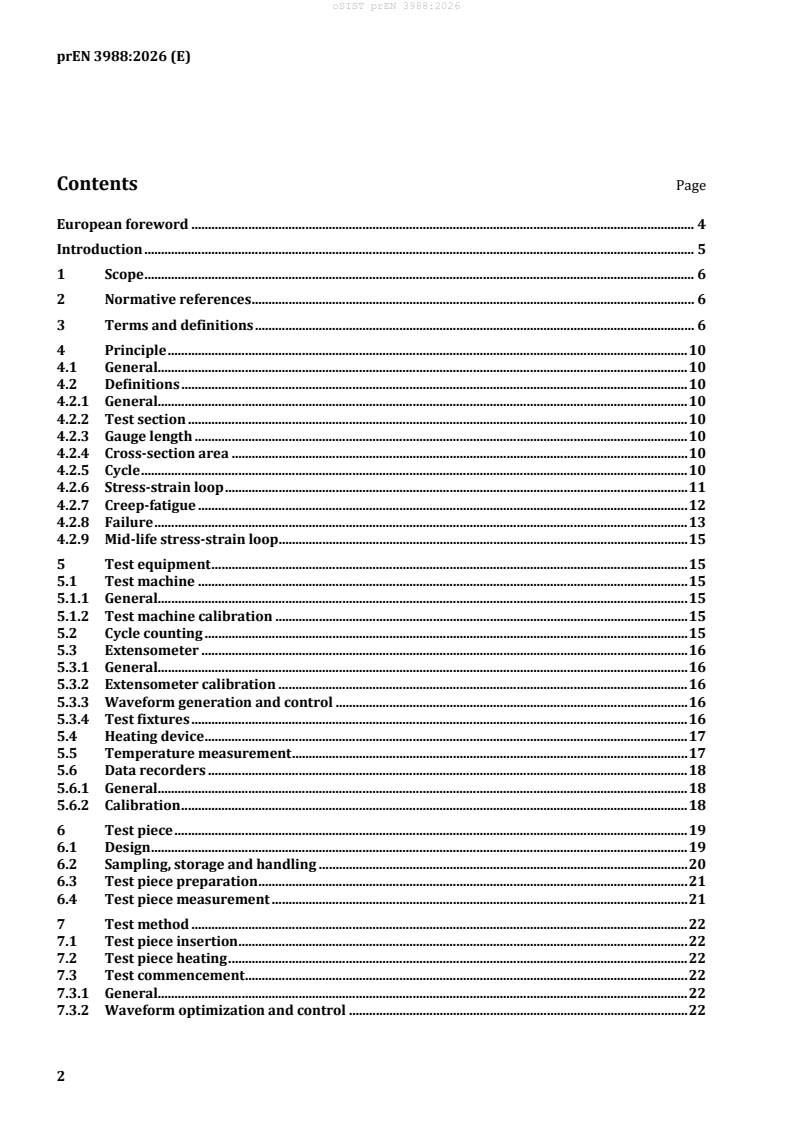
Contents Page
European foreword . 4
Introduction . 5
1 Scope . 6
2 Normative references . 6
3 Terms and definitions . 6
4 Principle . 10
4.1 General. 10
4.2 Definitions . 10
4.2.1 General. 10
4.2.2 Test section . 10
4.2.3 Gauge length . 10
4.2.4 Cross-section area . 10
4.2.5 Cycle . 10
4.2.6 Stress-strain loop . 11
4.2.7 Creep-fatigue . 12
4.2.8 Failure . 13
4.2.9 Mid-life stress-strain loop. 15
5 Test equipment . 15
5.1 Test machine . 15
5.1.1 General. 15
5.1.2 Test machine calibration . 15
5.2 Cycle counting . 15
5.3 Extensometer . 16
5.3.1 General. 16
5.3.2 Extensometer calibration . 16
5.3.3 Waveform generation and control . 16
5.3.4 Test fixtures . 16
5.4 Heating device . 17
5.5 Temperature measurement . 17
5.6 Data recorders . 18
5.6.1 General. 18
5.6.2 Calibration . 18
6 Test piece . 19
6.1 Design . 19
6.2 Sampling, storage and handling . 20
6.3 Test piece preparation . 21
6.4 Test piece measurement . 21
7 Test method . 22
7.1 Test piece insertion . 22
7.2 Test piece heating . 22
7.3 Test commencement . 22
7.3.1 General. 22
7.3.2 Waveform optimization and control . 22
7.3.3 Data recording . 24
7.4 Test termination . 25
8 Post-test checks . 25
8.1 Accuracy of control parameters . 25
8.2 Examination of the fracture surface . 25
8.3 Determination of the fatigue life . 25
8.4 Examination of the stress-strain loops . 26
9 Test report . 26
9.1 Essential information . 26
9.2 Additional information . 27
9.3 Presentation of results . 28
Annex A (informative) Use of thermocouples . 29
Annex B (informative) Test piece preparation . 30
Annex C (normative) Guidelines on test piece handling and degreasing . 32
Annex D (informative) Failure criteria . 33
Bibliography . 34
European foreword
This document (prEN 3988:2026) has been prepared by ASD-STAN.
After enquiries and votes carried out in accordance with the rules of this Association, this document has
received the approval of the National Associations and the Official Services of the member countries of
ASD-STAN, prior to its presentation to CEN.
This document is currently submitted to the CEN Enquiry.
Introduction
This document is part of the series of EN metallic material standards for aerospace applications. The
general organization of this series is described in EN 4258.
1 Scope
This document applies to uniaxial strain-controlled low cycle fatigue testing of metallic materials
governed by EN aerospace standards. It defines the properties that need to be determined and the
terms used in describing the tests and test pieces.
It specifies the equipment, the test pieces, the method of testing and the presentation of results. It
applies to testing at ambient and elevated temperatures.
The purpose of this document is to ensure the comparability and reproducibility of the test results. It
does not cover the evaluation or interpretation of the results.
This document is restricted to the use of test pieces having a circular cross-section. In some particular
cases the practice can be applied to flat test pieces. The major difficulties concern the preparation of the
test pieces and their alignment in the grips.
2 Normative references
The following documents are referred to in the text in such a way that some or all of their content
constitutes requirements of this document. For dated references, only the edition cited applies. For
undated references, the latest edition of the referenced document (including any amendments) applies.
ASTM E1012:2019, Standard Practice for Verification of Testing Frame and Specimen Alignment Under
Tensile and Compressive Axial Force Application
3 Terms and definitions
For the purposes of this document, the following terms and definitions apply.
ISO and IEC maintain terminology databases for use in standardization at the following addresses:
— ISO Online browsing platform: available at https://www.iso.org/obp/
— IEC Electropedia: available at https://www.electropedia.org/
3.1
force
F
instantaneous load applied to the test section, in kN
Note 1 to entry: Tensile forces are considered to be positive and compressive forces negative.
3.2
strain
ɛ
extension of the test piece gauge length, due to the force which is applied to the test piece, divided by its
original gauge length
Note 1 to entry: It is taken to be positive when the gauge length increases in length and negative when it contracts
as a percentage.
www.astm.org.
3.3
maximum strain
ɛ
max
highest algebraic value of strain applied during the strain cycle as a percentage
3.4
minimum strain
ɛ
min
lowest algebraic value of strain applied during the strain cycle as a percentage
3.5
mean strain
ɛ
m
half the algebraic sum of maximum and minimum strains as a percentage
3.6
strain range
Δɛ
algebraic difference between the maximum and minimum strains as a percentage
Note 1 to entry: The total strain range includes elastic and plastic strain ranges.
3.7
strain amplitude
ɛ
a
half the strain range as a percentage
3.8
strain ratio
Rɛ
algebraic ratio of the minimum strain to the maximum strain
Note 1 to entry: The A ratio, which is defined as the ratio of strain amplitude to the mean strain, is sometimes
used.
3.9
stress
σ
force divided by the nominal cross-sectional area, in MPa
Note 1 to entry: It is the independent variable in a stress-controlled fatigue test.
Note 2 to entry: The nominal cross-sectional area (engineering stress) is that calculated from measurements taken
at ambient temperature and no account is taken for the change in section as a result of expansion at elevated
temperatures.
3.10
maximum stress
σ
max
highest algebraic value of stress applied, in MPa
3.11
minimum stress
σ
min
lowest algebraic value of stress applied, in MPa
3.12
stress range
Δσ
arithmetic difference between maximum stress and minimum stress, in MPa
Note 1 to entry: Δσ = σmax - σmin
3.13
primary stress range
Δσ
algebraic difference between the maximum and minimum stresses, for creep-fatigue tests, in MPa (see
Figure 3)
3.14
secondary stress range
Δσ2
difference between the stresses at the points of reversal of strain, for creep-fatigue tests, in MPa (see
Figure 3)
3.15
stress amplitude
σ
a
half the stress range, in MPa
3.16
stress ratio
R
s
ratio of minimum stress to maximum stress during a fatigue cycle
Note 1 to entry: R = σ /σ
s min max
3.17
initial modulus of elasticity
E
O
modulus of elasticity determined on the loading portion of the first cycle or alternatively prior to start
of test, at test temperature, in MPa
3.18
mid-life modulus of elasticity
E
m
average of the modulus of elasticity determined on the loading and unloading portions of the mid-life
stress-strain loop, in MPa
3.19
inelastic strain range
Δɛ
e
stress range (secondary stress range for the creep-fatigue tests) divided by the modulus of elasticity, as
a percentage
3.20
inelastic strain range
Δɛ
p
difference between the total strain range and the elastic strain range, as a percentage
3.21
number of cycles
N
number of strain sequences applied
3.22
number of cycles during failure (general)
N
f(X)
number of cycles corresponding to a decrease of x % in the stress value extrapolated over the maximum
stress versus number of cycles curve when the maximum stress falls sharply to failure (see Figure 4)
3.23
fatigue life
N
f
number of cycles corresponding to a decrease of 10 % in the stress value extrapolated over the
maximum stress versus number of cycles curve when the maximum stress falls sharply to failure (see
Figure 4)
3.24
number of cycles to initiation of an apparent macro-crack
N
i(0)
number of cycles corresponding to the first discernible decrease of the maximum stress versus number
of cycles curve when the maximum stress falls sharply to failure (see Figure 4)
3.25
number of cycles to complete separation
N
f(100)
number of cycles corresponding to the complete separation of the test piece into two distinct parts
3.26
total number of cycles
N
t
total number of sequences applied
3.27
frequency
f
expressed in Hertz
3.28
parallel length
L
p
length in the gauge test section of a specimen or test piece that has equal test diameter or test width and
is parallel, in mm
3.29
specimen length
L
z
overall length of test specimen, in mm
4 Principle
4.1 General
The uniaxially-loaded strain-controlled low cycle fatigue test consists in maintaining a test piece at a
uniform temperature and subjecting it to a constant strain-amplitude waveform. The test piece has a
gauge length of constant circular cross-section on which an axial extensometer is mounted and the
applied force is varied such that the strain is controlled between set limits in accordance with a cycle of
chosen waveform. The magnitude of the applied cyclic force affects the development of microscopic
plastic strain within the test section, thus determining the fatigue life. A series of such tests, on
nominally identical test pieces allows the relationship between the applied strain and the number of
cycles to failure to be established.
The test is continued until a crack develops in the test piece so that the desired failure criterium is
reached, or until a specified number of cycles is reached.
The fatigue lives generated are typically less than 100 000 cycles to failure and the test regime is said to
be that of low cycle fatigue (LCF).
4.2 Definitions
4.2.1 General
For the purposes of this document, the following definitions apply:
4.2.2 Test section
The test section is defined as the region between the blending fillets at the gripping section of the test
piece.
4.2.3 Gauge length
The gauge length of the test piece is the portion of the test section where the extensometer is attached,
to measure the strain. The original gauge length is the gauge length measured at test temperature, prior
to the application of any force to the test piece. This “hot” gauge length may be determined by
monitoring the extensometer output during heating (see 7.2).
4.2.4 Cross-section area
The area of the gauge section of the test piece. The cross-section area shall be measured at ambient
temperature.
NOTE When designing a component which is intended to operate at elevated temperature, the endurance
curves (stress versus number of cycles to failure) need to be corrected to take into account the thermal expansion
of the test piece. This correction can be included in the component design calculation code.
4.2.5 Cycle
A cycle is defined as the smallest section of the strain-time function which is repeated periodically.
This is shown in Figure 1, together with appropriate nomenclature which further defines the strain
cycle.
Key
X time
Y strain
a strain amplitude ɛa
b mean strain ɛm
c minimum strain ɛmin
d strain range Δɛ
e maximum strain ɛmax
f one cycle
Figure 1 — Fatigue strain cycle
4.2.6 Stress-strain loop
The stress-strain path during one cycle is called stress-strain loop (see Figure 2).
Key
X stress σ
Y strain ɛ
σmax maximum stress
σmin minimum stress
Δɛp inelastic strain range
Δσ stress range
Δɛt strain range
Figure 2 — Typical stress-strain hysteresis diagram
4.2.7 Creep-fatigue
When the strain cycle includes a hold period at the maximum strain, the test is defined as a creep
fatigue test (see Figure 3).
Key
X strain
Y stress
a plastic strain range
b secondary stress range
c primary stress range
Figure 3 — Typical hysterisis diagram for a creep-fatigue test
4.2.8 Failure
Failure is defined as the moment when a macro-crack develops in the test piece that is large enough to
affect the compliance of the test piece. The number of cycles to failure is conventionally defined as the
number of cycles corresponding to a decrease of 10 % in the stress value extrapolated over the
maximum stress versus number of cycles curve when the maximum stress falls sharply, see Figure 4a)
and Figure 4b). Depending on the material which is tested and the test conditions, the number of cycles
to failure may be significantly lower than the number of cycles to complete separation of the test piece
into two distinct parts.
a) For materials with steady-state behaviour after hardening
b) For materials with continuous softening
Key
X cycles
Y stress
σmax maximum stress
Nf fatigue life
Ni number of cycles
X % tbd
Figure 4 — Determination of N and N
i f
4.2.9 Mid-life stress-strain loop
The stress-strain loop which is the closest recorded to half the number of cycles to failure is named mid-
life stress-strain loop (or half-life stress-strain loop).
5 Test equipment
5.1 Test machine
5.1.1 General
The tests shall be carried out on a tension-compression machine designed for a smooth start-up with no
backlash when passing through zero. In order to minimize the risk of buckling of the test piece, the
machine shall have great lateral rigidity and accurate alignment between the components used to grip
the test piece ends.
The machine loading system shall be a controlled system in which the straining of the test piece is
servo-controlled. It may be hydraulic or electromechanical.
During elevated temperature tests the machine load cell shall be suitably shielded and/or cooled such
that it remains within its temperature operating range.
5.1.2 Test machine calibration
The force measurement system shall be verified at intervals not exceeding one year. The method to be
used is that of ASTM E1012 with the following amendment, related to the application of test forces, to
cover calibration in tension and compression going through zero:
Three series of measurements shall be carried out. Each series shall comprise at least 20 force steps as
follows:
a) Five increasing force steps in tension at regular intervals from 20 % to 100 % of the full scale,
b) Ten decreasing force steps at regular intervals from 100 % of the full scale in tension down to the
full scale in compression,
c) Five increasing force steps at regular intervals from 100 % of the full scale in compression up to
zero.
The relative errors of accuracy, repeatability, reversibility, and zero shall be within the limits stated for
class 1.
During the calibration process, an initial calibration shall be performed prior to adjustment of the test
machine, such that the effect of any errors outside of the class 1,0 requirement can be understood. If
initial errors are present, then the calibration period is to be reviewed accordingly.
5.2 Cycle counting
The number of cycles applied to the test piece shall be recorded such that for tests lasting less than
10 000 cycles, individual cycles can be resolved, while for longer tests the resolution shall be better
than 0,1 % of the indicated life.
NOTE A calibrated timer is a desirable adjunct to the cycle counter. When used to indicate total elapsed time
to failure, it provides an excellent check against the cycle counter frequency for a fixed waveform frequency.
5.3 Extensometer
5.3.1 General
The strain applied to the test piece shall be measured and controlled using an axial extensometer
attached directly to the gauge section of the test piece.
The geometry of the contact zones and pressure of the extensometer on the test piece shall be such that
they prevent slippage of the extensometer without damaging the test piece.
The transducer section of the extensometer shall be protected from all heat fluctuations which are
likely to give rise to a drift or fluctuation in the strain signal originating from the heating or cooling
system and ambient air. Temperature compensation may offer an additional advantage.
It is suggested that tests be conducted in an enclosure within which the ambient temperature is
controlled. The region immediately surrounding the testing machine shall be protected from draughts.
5.3.2 Extensometer calibration
The extensometer, associated with its measuring system, shall be verified at intervals not exceeding one
year as class 0,5 of ASTM E1012:2019, for tension as well as compression. In addition, hysteresis shall
be equal to or less than 0,1 % of the measuring range.
During the calibration process, an initial calibration shall be performed prior to adjustment of the
extensometer conditioner, such that the effect of any errors outside of the class 0,5 requirement can be
understood. If initial errors are present then the calibration period is to be reduced accordingly.
5.3.3 Waveform generation and control
The strain cycle waveform shall be constant and is to be applied at a fixed frequency throughout the
duration of a test. The waveform generator in use shall have a repeatability such that the variation in
specified strain levels between successive cycles is within the calibration tolerance of the extensometer
as stated in 5.3.1, for the duration of the test.
A triangular or trapezoidal waveform is generally used for high temperatures. A sinusoidal waveform
may be used at lower temperatures if the effect on viscoplastic strains is negligible. The strain rate
(preferred) or the frequency shall be held constant within a test programme.
NOTE The range of frequencies for low-cycle fatigue tests is most often between 0,1 Hz and 1 Hz. In terms of
the total strain rate, the majority of tests are carried out within the interval ranging from 0,1 %/s to 2 %/s unless
the influence of rate on the behaviour of the material is being studied.
5.3.4 Test fixtures
5.3.4.1 General
The gripping device shall ensure that the arrangement of the test piece is reproducible. It shall have
surfaces ensuring the alignment of the test piece in order to meet the requirements specified in 5.5.2,
and surfaces allowing transmission of tensile and compressive forces without backlash throughout the
duration of the test.
To improve the parallelism, concentricity and perpendicularity of the reference surfaces of the grips,
the distance between the crosshead and actuator shall be as small as possible.
Materials shall be selected so as to ensure correct functioning throughout the test temperature range.
It is recommended that the tolerances for parallelism, concentricity, and perpendicularity of the
reference surface of the grips be less than 0,02 mm in order to achieve the alignment requirements
described in 5.5.2. A further benefit can be realized by minimizing the number of mechanical interfaces
in the load train.
5.3.4.2 Alignment verification
Alignment of the load train assembly shall be checked at intervals not exceeding one year or 100 tests,
whichever occurs sooner. In addition, it shall be checked following disassembly of the text fixtures,
movement of the machine crosshead or following a compressive failure that has caused the two test
piece halves to overlap.
It is recommended that the alignment is checked by means of a strain-gauged test piece of geometry
identical to that to be tested and that has been manufactured to the same tolerances.
The maximum bending strain determined in accordance with ASTM E1012:2019, Method 1 shall not
exceed 5 % of the mean axial strain induced at the lowest maximum tensile force and the maximum
compressive force to be encountered in the test program. This criterion shall be meet at each of four
positions as the test piece is rotated through 90°.
The use of two sets of strain gauges in groups of four, fixed at 90° intervals around the test section is
recommended. The gauges shall be equally distant from the test piece centre line, 3/4 of the parallel
gauge length apart. Any strain induced into the gauge length due to the gripping mechanism shall be
minimized to less than 100 micro strain.
The “Measurement Good Practice Guide No 1” from The National Physical Laboratory (NPL) is
recommended as a good detailed best practice document.
The use of dial gauge indicators in checking alignment shall be avoided. When they are used, the
tolerances adopted shall ensure an equivalent alignment error to that obtained using strain gauges.
However, bending induced by an aligned, but off-centred load train is not detected by this technique.
5.4 Heating device
Testing is generally conducted in air at ambient or elevated temperatures, although there may be a
requirement to test in vacuum or in a controlled atmosphere.
Where additional apparatus is used such as furnaces, chambers, etc., it is essential that the full force
indicated by the force indicator is being applied to the test piece and is not being diverted through the
auxiliary apparatus (e.g. by friction).
For elevated temperature tests the heating device employed shall be such that the test piece can be
uniformly heated to the specified temperature, and an indicated temperature variation along the test
section of less than or equal to 4 °C can be maintained for the duration of the test.
A resistance furnace with three control zones is recommended. If a direct induction heating system is
used, it is advisable to select a generator of medium frequency (f ≤ 100 kHz) to achieve minimal radial
thermal gradient in the test piece.
5.5 Temperature measurement
The temperature measuring system comprising sensors and readout equipment, shall be capable of
operating continuously for the duration of the test and have a resolution of at least 1 °C and an accuracy
of ± 2 °C. It shall be verified at intervals not exceeding one year over the working temperature range,
traceable to national standards by a documented method.
The use of thermocouples is recommended. Annex A describes their method of use.
For short test sections (<25 mm), two thermocouples should be positioned at the extremities of the test
section. For longer test sections at least three thermocouples equi-spaced along the test section shall be
used.
The variation in indicated temperature anywhere on the test section shall not exceed 4 °C.
For a given set of heating device, thermocouple position, grips, and test piece geometry, this number of
thermocouples may be reduced if experience shows that the temperature gradient in the test piece is
reproducible within the above tolerances.
The permitted deviations between the specified test temperature and the indicated temperature
measured at the surface of the test section are as indicated in Table 1.
Table 1 — Permitted deviations between indicated temperature and specified test temperature
Test temperature Tolerance
θ ≤ 600 °C ±2 °C
600 °C < θ ≤ 800 °C ±3 °C
800 °C < θ ±5 °C
For tests at ambient temperature (10 °C to 35 °C) it is not necessary to measure the test piece
temperature. In case of dispute the test shall be performed at a temperature of 23 °C ± 5 °C and the test
piece temperature shall be measured.
NOTE The effect of compounding errors could result in the real tolerance in temperature from the specified
level to be 3 °C greater.
The temperature rise due to plastic deformation shall be minimized (see 7.3.1) and shall be
compensated for within the Table 1 tolerances.
5.6 Data recorders
5.6.1 General
An automatic microcomputer system capable of carrying out the task of collecting data and processing
it simultaneously shall be used to monitor stress, strain and temperature as a function of time. This
information is required particularly to determine failure and to monitor changes in stress that occur
during hold periods.
This system will be used to plot stress-strain loops of force versus deformation or stress versus strain.
The sampling frequency of stress-strain data points shall be sufficient to ensure adequate definition of
the stress-strain loop specially in the regions of strain reversal (at least 200 data points per loop).
The system described above may be replaced by a strip chart recorder and a potentiometric X-Y
recorder. The recorders shall be used only when the test conditions result in a maximum pen velocity
that will not cause inaccurate records e.g. less than half of the recorder's slewing speed. For higher
frequencies, a digital storage oscilloscope or an oscilloscope equipped with a camera are acceptable
alternatives to the X-Y recorder.
The indicated test temperature shall be monitored throughout the test, within the accuracy stated in
5.7. A temperature observation shall be made at least every 5 min.
5.6.2 Calibration
The whole system of transducers, associated electronic conditioning or amplification and data
recording shall be calibrated as an entity over their working range at intervals not exceeding one year
and the deviations recorded on the calibration certificates.
The accuracy of all recording systems shall be kept within 1 % of full scale.
6 Test piece
6.1 Design
The type of test piece used depends on the objectives of the test program, the equipment capacity and
the form in which the material is available. The design, however, shall meet certain general criteria as
outlined below, in order to ensure a uniform distribution of stresses and strains in the gauge section
and the localization of failures inside the gauge length.
The geometry of the test piece shall fulfil the following conditions:
a) it shall have a parallel length longer than the extensometer base length, to allow strain
measurements to be taken using an axial extensometer. However, it shall not be excessively long, to
avoid the occurrence of failure outside the extensometer base length;
b) it shall be sufficiently compact to avoid the risk of compressive buckling and sufficiently slender to
avoid failure at the fillet;
c) it shall ensure uniform distribution of stresses and strains over the whole gauge length;
d) it shall have reference surfaces to ensure correct alignment.
Taking into account these requirements, the geometric dimensions mentioned in Figure 5 are
recommended.
The diameter of the gauge section of the test piece shall not be less than 4,5 mm and shall be held
constant in a test program to reduce test result variability.
When testing coarse grain alloys (for example cast alloys) the test piece diameter shall be at least five
times the average grain size.
For alloys that contain a small number of randomly-dispersed metallurgical defects, e.g. powder
metallurgy alloys, the test piece size shall be chosen such that the probability of finding a defect in the
gauge section is sufficiently high. The ratio of gauge length to diameter is also an important parameter
since near-surface defects lead to failure sooner than internal defects.
When characterizing thin wall cast alloys like turbine blade alloys, it may be necessary to use test pieces
having the same thickness as the real part. It this case a tubular test piece is recommended.
It is important for the general tolerances of the reference surfaces and test section of the test pieces to
show the three following properties:
— parallelism: 0,02 mm;
— concentricity: 0,02 mm;
— perpendicularity: 0,02 mm;
(these values are expressed in relation to the axis or reference plane).
The recommended gripping heads are as follows:
— shouldered heads (preferred);
— threaded heads;
— smooth cylindrical heads (with hydraulic jaws).
Recommended dimension of cylindrical test pieces are shown in Table 2.
a) Plain test piece
b) Test section profile for a cylindrical test piece
Figure 5 — Test section profile for cylindrical test pieces
Table 2 — Recommended dimension of cylindrical test pieces
Parameter Dimensions
diameter of gauge section (outer diameter)
0,6 < d'/d < 0,9
d = 4,5 mm
inner diameter d' = 5 mm
parallel length of gauge section l 1,5 < l/d < 2,5
fillet radius R 2 < R/d < 8
gripping diameter D, D' D/d ≥ 2,5
D'/d ≥ 1,5
length between heads length L may be minimized by the presence of a
second transition radius r.
6.2 Sampling, storage and handling
The position and orientation of test piece blanks cut out of components or billets can have a significant
effect on the fatigue properties of a material. It is therefore important that their identity is maintained
throughout the test piece manufacture process, and that this is traceable to their position and
orientation in the original material stock. Reference to EN ISO 3785 is recommended.
Each test piece blank and ultimately each test piece shall therefore be suitably marked in a reliable
manner. The test piece shall be marked at each end away from the test section, such that the two halves
can be identified post-fracture.
Machined test pieces shall be stored in a manner that protects them from mechanical damage such a
scratching, and environmental effects such as extreme humidity, etc.
Throughout the testing process, any special handling requirements for the material under investigation
shall be adhered to. The use of clean cotton gloves is recommended.
6.3 Test piece preparation
The condition of the test piece and method of preparation are of the utmost importance. Inappropriate
methods of preparation, which may be material specific, can greatly bias the data generated. While it
may be the purpose of some tests to establish the effect of a particular representative surface finish, for
standard test pieces the following guidelines shall be adhered to.
The technique established and approved for a specific material and test piece configuration shall not be
changed without first demonstrating that no bias is introduced by the alternative technique.
The final machining of the test pieces shall be performed in a manner consistently producing a smooth
surface with low residual compressive stresses. The recommended procedure, for test pieces with
circular cross section, comprises a fine turning or low stress grinding sequence followed by longitudinal
polishing (see Annex B for example of machining sequence which may be used in the production of test
pieces). The final polishing methods employed shall eliminate all circumferential machining marks or
scratches on the test piece gauge length or end transitions. A low-magnification examination (x 20) is
recommended as a final inspection check.
The magnitude of residual compressive stress at the surface of the test piece shall be less than 500 MPa.
Moreover, after removing 10 µm from the surface of the test piece, the magnitude of residual
compressive stress shall be less than 200 MPa, and at 50 µm from the surface less than 50 MPa.
The effect of contaminants such as cutting fluids and degreasing agents is also to be understood.
NOTE Assurance that compressive residual stresses are maintained at a low level throughout the
manufacturing route can be achieved by the use of X-ray residual stress measurement techniques.
6.4 Test piece measurement
The dimensions used for calculating the cross-sectional area of the test piece shall be measured prior to
the test on individual test pieces, to an accuracy of 0,2 % or 0,005 mm, whichever is the greater value.
The integrity of the surface finish shall not be jeopardised during this activity; the use of an optical
measurement method is highly recommended.
The dimensions (outer diameter and possibly inner diameter) of the test section shall be measured at
three positions along the gauge length. The average of these values are used to calculate cross sectional
area.
Applied stresses shall be calculated based on ambient temperature measurements and no
compensation is to be made for the change in section and effective stress due to heating for elevated
temperature tests, or due to
...