EN 2597:1998
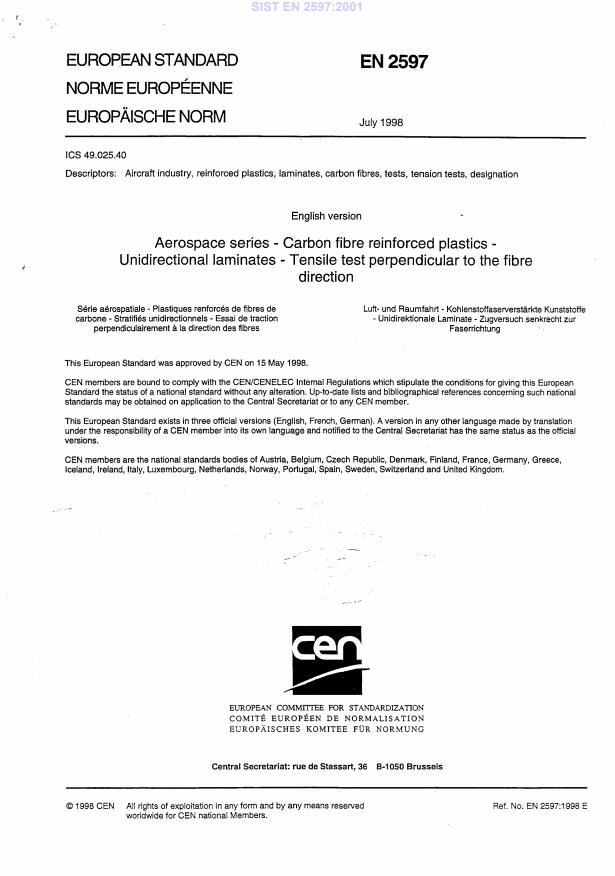
(Main)Aerospace series - Carbon fibre reinforced plastics - Unidirectional laminates - Tensile test perpendicular to the fibre direction
Aerospace series - Carbon fibre reinforced plastics - Unidirectional laminates - Tensile test perpendicular to the fibre direction
This standard specifies the method of determination of the ultimate tensile strength, tensile modulus and, if required, the Poisson's ratio and elongation at failure in tension of carbon fibre reinforced plastics in the form of unidirectional laminates. This method is only applicable to specimens the axis of which is perpendicular to the direction of the fibres.
Luft- und Raumfahrt - Kohlenstoffaserverstärkte Kunststoffe - Unidirektionale Laminate - Zugversuch senkrecht zur Faserrichtung
Diese Norm legt das Verfahren zur Bestimmung der Zugfestigkeit, des E-Moduls sowie ggf. der Querdehnungßahl und der Bruchdehnung von kohlenstoffaserverstärkten Kunststoffen in Form von unidirektionalen Laminaten fest. Dieses Verfahren ist nur auf Probekörper anwendbar, deren Längsachse senkrecht zur Faserrichtung verläuft.
Série aérospatiale - Plastiques renforcés de fibres de carbone - Stratifiés unidirectionnels - Essai de traction perpendiculairement à la direction des fibres
La présente norme spécifie la méthode de détermination de la résistance en traction, du module de traction et, éventuellement, du coefficient de Poisson et de l'allongement à rupture en traction des plastiques renforcés de fibres de carbone sous forme de stratifiés unidirectionnels. Cette méthode est seulement applicable aux éprouvettes dont l'axe est perpendiculaire à la direction des fibres.
Aerospace series - Carbon fibre reinforced plastics - Unidirectional laminates - Tensile test perpendicular to the fibre direction
General Information
Overview
EN 2597:1998 is a European standard developed by CEN that specifies the testing method for tensile properties of carbon fibre reinforced plastics (CFRP), particularly focusing on unidirectional laminates. This standard defines how to accurately determine the ultimate tensile strength, tensile modulus, and optionally, the Poisson’s ratio and elongation at failure for specimens where the test axis is perpendicular to the fibre direction. Its primary application lies within the aerospace industry, where precise mechanical characterization of CFRP materials is critical for structural integrity and performance.
Key Topics
Tensile Testing Method
EN 2597:1998 outlines the procedures for performing tensile tests on CFRP samples with fibres oriented perpendicularly to the direction of applied load.Material Focus
The standard exclusively addresses unidirectional carbon fibre reinforced plastics, which are widely used in aerospace components due to their superior strength-to-weight ratio.Measured Properties
- Ultimate Tensile Strength: The maximum stress the material can withstand before failure.
- Tensile Modulus: The stiffness of the laminate under tension.
- Poisson’s Ratio (optional): The ratio of transverse strain to axial strain.
- Elongation at Failure (optional): The strain at the point of material failure.
Specimen Orientation
The testing direction must be strictly perpendicular to the fibre orientation to capture the transverse tensile behavior of the composite laminate.Quality and Repeatability
The method ensures reproducible and comparable results essential for material selection and quality control in aerospace manufacturing.
Applications
EN 2597:1998 is highly relevant for:
Aerospace Component Design
Engineers use the test results to model and predict the mechanical behavior of CFRP components under operational stresses perpendicular to fibres.Material Certification and Validation
Manufacturers certify unidirectional CFRP materials against this standard to meet stringent aerospace industry requirements.Research and Development
R&D teams rely on this standardized testing procedure to develop new composite laminates with optimized transverse mechanical properties.Quality Control in Production
Ensures consistent material performance and detects manufacturing variances or defects in CFRP laminates.
Related Standards
- EN 2561 – Aerospace series - Carbon fibre reinforced plastics - Unidirectional laminates - Tensile test parallel to the fibre direction
- EN ISO 527-5 – Plastics - Tensile testing of fibre-reinforced plastic composites
- ASTM D3039 – Standard Test Method for Tensile Properties of Polymer Matrix Composite Materials
- EN 603 – Aerospace series - Carbon fibre reinforced plastics - Test methods for shear properties
By complying with EN 2597:1998, aerospace manufacturers and testing laboratories ensure reliable, standardized evaluation of critical tensile properties for CFRP unidirectional laminates, enhancing safety, performance, and innovation in composite material applications.
Standards Content (Sample)
2003-01.Slovenski inštitut za standardizacijo. Razmnoževanje celote ali delov tega standarda ni dovoljeno.Aerospace series - Carbon fibre reinforced plastics - Unidirectional laminates - Tensile test perpendicular to the fibre directionLuft- und Raumfahrt - Kohlenstoffaserverstärkte Kunststoffe - Unidirektionale Laminate - Zugversuch senkrecht zur FaserrichtungSérie aérospatiale - Plastiques renforcés de fibres de carbone - Stratifiés unidirectionnels - Essai de traction perpendiculairement a la direction des fibresAerospace series
...
Frequently Asked Questions
EN 2597:1998 is a standard published by the European Committee for Standardization (CEN). Its full title is "Aerospace series - Carbon fibre reinforced plastics - Unidirectional laminates - Tensile test perpendicular to the fibre direction". This standard covers: This standard specifies the method of determination of the ultimate tensile strength, tensile modulus and, if required, the Poisson's ratio and elongation at failure in tension of carbon fibre reinforced plastics in the form of unidirectional laminates. This method is only applicable to specimens the axis of which is perpendicular to the direction of the fibres.
This standard specifies the method of determination of the ultimate tensile strength, tensile modulus and, if required, the Poisson's ratio and elongation at failure in tension of carbon fibre reinforced plastics in the form of unidirectional laminates. This method is only applicable to specimens the axis of which is perpendicular to the direction of the fibres.
EN 2597:1998 is classified under the following ICS (International Classification for Standards) categories: 49.025.40 - Rubber and plastics. The ICS classification helps identify the subject area and facilitates finding related standards.
You can purchase EN 2597:1998 directly from iTeh Standards. The document is available in PDF format and is delivered instantly after payment. Add the standard to your cart and complete the secure checkout process. iTeh Standards is an authorized distributor of CEN standards.
Die Norm EN 2597:1998 ist ein wesentlicher Bestandteil der Luft- und Raumfahrtindustrie, da sie spezifische Methoden zur Bestimmung der mechanischen Eigenschaften von karbonfaserverstärkten Kunststoffen in Form unidirektionaler Laminate festlegt. Der Umfang der Norm umfasst die Ermittlung der ultimativen Zugfestigkeit, des Zugmoduls sowie bei Bedarf das Poisson-Verhältnis und die Verlängerung bis zum Versagen unter Zugbelastung. Ein zentraler Aspekt dieser Norm ist, dass sie sich ausschließlich auf Proben bezieht, deren Achse senkrecht zur Richtung der Fasern ausgerichtet ist, was eine präzise Analyse der Werkstoffeigenschaften ermöglicht. Die Stärken der EN 2597:1998 liegen in ihrer klaren und präzisen Definition des Prüfvorgangs, die sicherstellt, dass die Ergebnisse reproduzierbar und vergleichbar sind. Dies ist besonders wichtig für die Entwicklung und Qualitätssicherung von Komponenten in der Luft- und Raumfahrt, wo Materialversagen katastrophale Folgen haben kann. Darüber hinaus unterstützt die Norm Ingenieure und Techniker dabei, die Leistungsfähigkeit von karbonfaserverstärkten Kunststoffen besser zu verstehen und einzuschätzen, was zu innovativeren und leistungsfähigeren Anwendungen führen kann. Die Relevanz der Norm EN 2597:1998 erstreckt sich über den aktuellen Stand der Technik hinaus, da sie den Unternehmen hilft, die Vorgaben und Anforderungen der Branche zu erfüllen. Angesichts des zunehmenden Einsatzes von Leichtbaumaterialien in der Luftfahrt ist die Norm ein unverzichtbares Werkzeug, um die mechanischen Eigenschaften und die Zuverlässigkeit der verwendeten Materialien zu gewährleisten. Damit ist die EN 2597:1998 nicht nur für die Qualitätssicherung, sondern auch für die Forschung und Entwicklung im Bereich der modernen Luftfahrttechnik von großer Bedeutung.
EN 2597:1998 표준은 항공 우주 분야에서 탄소 섬유 강화 플라스틱의 단일 방향 적층체에 대한 인장 시험 방법을 규정하고 있습니다. 이 표준의 핵심 범위는 탄소 섬유 강화 플라스틱의 궁극적인 인장 강도, 인장 탄성 계수 및 필요 시 포아송 비와 인장 파단 시의 연신률을 결정하는 방법을 명시하고 있습니다. 특히, 본 방법은 섬유의 방향에 대해 수직인 축을 가진 시편에만 적용 가능합니다. 이 표준의 주요 강점은 탄소 섬유 강화 플라스틱에 대한 신뢰할 수 있는 시험 방법을 제공함으로써 다양한 항공 우주 응용 분야에서의 재료 선택과 설계에 기여할 수 있다는 점입니다. 인장 시험은 복합재료의 기계적 특성을 이해하는 데 필수적이며, EN 2597:1998은 이 특성을 평가하기 위한 명확한 지침을 제공합니다. 또한, 이 표준의 관련성은 탄소 섬유 강화 플라스틱이 항공 우주 산업에서 매우 중요한 재료로 자리 잡고 있는 가운데 더욱 부각됩니다. 이러한 재료는 경량화 및 강도 증가의 이점을 제공하므로, 정확한 시험 방법에 대한 요구가 크며, 이 표준은 이러한 요구를 충족시키고 있습니다. EN 2597:1998은 항공기 및 우주선의 구조적 안전성을 확보하기 위한 기초가 되는 중요한 문서로 평가받고 있습니다.
The standard EN 2597:1998 is pivotal within the aerospace industry, providing a comprehensive methodology for assessing the mechanical properties of carbon fibre reinforced plastics, specifically unidirectional laminates. Its scope is clearly defined, encompassing the determination of ultimate tensile strength and tensile modulus, while also offering provisions for calculating Poisson's ratio and elongation at failure when required. One of the standard's significant strengths lies in its rigorous testing procedure, which specifies that the tensile testing must be conducted on specimens oriented perpendicular to the fibre direction. This specific orientation is crucial, as it allows for an accurate evaluation of the material's performance under typical loading conditions encountered in aerospace applications. This precision ensures that the data obtained is relevant and reliable for engineers and designers working with carbon fibre composites. Moreover, the EN 2597:1998 standard serves as an essential reference point, ensuring consistency in testing methods across various laboratories and manufacturers. By adhering to this standard, organizations can ensure that their materials meet the necessary quality and performance criteria, thereby enhancing product safety and reliability in demanding aerospace environments. The relevance of this standard can also be seen in its contribution to research and development, as it provides a foundational framework upon which new innovations in carbon fibre technology can be built. Overall, the EN 2597:1998 standard not only enhances the understanding of the mechanical properties of carbon fibre reinforced plastics but also plays a critical role in fostering advancements and standardization within the aerospace sector.
La norme EN 2597:1998, faisant partie de la série Aéronautique, est d'une importance capitale pour l'évaluation des plastiques renforcés de fibres de carbone, notamment pour les laminés unidirectionnels. Cette norme se concentre sur la méthode de détermination de la résistance à la traction ultime, du module de traction ainsi que, si nécessaire, du coefficient de Poisson et de l'elongation à la rupture en tension. Les spécimens doivent avoir leur axe perpendiculaire à la direction des fibres, ce qui garantit que les résultats obtenus sont pertinents pour les applications spécifiques dans le domaine aérospatial. L'un des points forts de cette norme est sa capacité à standardiser les tests de traction, permettant ainsi une comparaison cohérente entre les différents matériaux et fabricants. Cela est essentiel dans un secteur où la performance et la fiabilité des matériaux peuvent avoir des conséquences critiques. EN 2597:1998 assure que les tests effectués sur les laminés unidirectionnels de fibres de carbone respectent des critères rigoureux, ce qui renforce la confiance des ingénieurs et des concepteurs dans la performance des matériaux testés. De plus, la pertinence de la norme réside dans son actualisation continue pour répondre aux évolutions technologiques dans le domaine de l'aéronautique. En effet, cela lui permet d'intégrer des pratiques de test modernes et des attentes changeantes en matière de performance des matériaux, tout en maintenant une hiérarchie de qualité et de conformité. En résumé, la norme EN 2597:1998 est un document fondamental qui établit des bases méthodologiques solides pour le test des plastiques renforcés de fibres de carbone sous des aspects critiques. Sa portée, ses forces en termes de standardisation et sa pertinence dans le domaine aérospatial font d'elle un outil indispensable pour les professionnels de l'industrie.
EN 2597:1998は、航空宇宙業界における炭素繊維強化プラスチックの評価手法を明確に定義した標準です。特に、単方向ラミネートとしての形式に使用される炭素繊維強化プラスチックの引張試験に関連するテスト手順が詳述されています。この標準の重要な範囲は、引張強度、引張弾性率、必要に応じてポアソン比および破断時の伸びを測定するための方法を明確に示しているところにあります。 この標準の強みは、その明確さと適用範囲の特定にあります。引張試験が繊維の方向に対して垂直なサンプルにのみ適用されることを強調しており、使用者がテスト結果を正確に解釈し、適切な材料選定を行うための信頼性を提供します。また、炭素繊維強化プラスチックの特性を詳細に評価する手法を提供することで、航空宇宙分野における安全性や性能向上に寄与します。 この標準が現在でも関連性を持つのは、炭素繊維強化プラスチックの用途が増加しているためであり、航空宇宙および関連産業において高性能な材料の需要が高まっています。信頼性のあるテスト方法を求める企業にとって、この標準は不可欠なリソースとなっています。


Questions, Comments and Discussion
Ask us and Technical Secretary will try to provide an answer. You can facilitate discussion about the standard in here.
Loading comments...