

CEN/TR 16512:2015
(Main)Child use and care articles - Guidelines for the safety of children’s slings
General Information
- Abstract
This Technical Report covers a product which is designed to carry a child solely on the carer’s torso, which does not have integrated openings for the child’s limbs and is designed to allow the carer a hands-free operation when standing and/or walking.
An integrated leg opening is an opening for the child’s legs which exists in the product prior to installation on the carer’s torso. A leg opening which is formed when the carer wears the product is not an integrated opening.
Children’s slings are not covered by EN 13209-1 and EN 13209-2.
- Status
- Published
- Publication Date
- 03-Feb-2015
- Technical Committee
- CEN/TC 252 - Child use and care articles
- Drafting Committee
- CEN/TC 252/WG 4 - Early learning and protection
- Current Stage
- 6060 - Definitive text made available (DAV) - Publishing
- Start Date
- 04-Feb-2015
- Due Date
- 22-Dec-2013
- Completion Date
- 04-Feb-2015


Overview
CEN/TR 16512:2015 - Child use and care articles: Guidelines for the safety of children’s slings - is a CEN Technical Report that provides safety guidance for the design, manufacture, testing and information of children’s slings (products designed to carry a child solely on the carer’s torso and to allow hands‑free use). The report clarifies hazards specific to slings (which do not have integrated limb openings and form their structure when worn) and identifies relevant requirements and test methods suitable for addressing those hazards.
Key topics and technical requirements
CEN/TR 16512:2015 addresses a range of safety topics and points to appropriate test methods (detailed in Annex A). Principal topics include:
- Scope & definitions - distinguishes slings from soft carriers and confirms slings are not covered by EN 13209‑1/2.
- Chemical hazards - control of toxic substances, including recommendations on formaldehyde testing (referencing EN ISO 14184‑1) and chemical migration considerations.
- Thermal hazards - flammability and surface‑flash behaviour of materials, plus guidance on overheating/hyperthermia and material selection for breathability.
- Choking & ingestion - small‑parts requirements and attachment strength to prevent detachment or breakage.
- Entrapment in mesh - design/test methods to avoid finger entrapment in mesh openings.
- Entanglement & strangulation - limits on cords, loops and prohibition of monofilament threads; loop size and cord length requirements and test methods.
- Suffocation hazards - guidance on material air permeability, sling design to prevent airway obstruction, and packaging restrictions (e.g. no drawstrings on carrying/storage bags with openings >360 mm).
- Structural integrity - static strength and durability testing to ensure secure support in use.
- Product information & marking - mandatory markings (manufacturer ID, model/batch, min/max weight or age), point‑of‑sale details, and clear user instructions including key warnings.
Applications and users
This Technical Report is intended for:
- Designers and manufacturers of baby slings and similar torso carriers - to incorporate safety by design.
- Testing laboratories and conformity assessors - to select relevant test methods from Annex A.
- Retailers and importers - to ensure correct marking, product information and point‑of‑sale advice.
- Regulators and consumer safety bodies - to evaluate sling safety risks and advise consumers.
- Healthcare professionals and caregivers - for understanding safety warnings and appropriate use (e.g., monitoring airway and suitability for pre‑term or low birthweight babies).
Related standards
- EN 13209‑2 (soft carriers) - referenced where appropriate
- EN 71‑1 / EN 71‑3 (toy safety aspects considered)
- EN ISO 14184‑1 (formaldehyde testing) Annex A of CEN/TR 16512:2015 lists additional standards and test methods relevant to sling safety.
Keywords: CEN/TR 16512:2015, children’s slings safety, baby sling guidelines, sling testing, product information, structural integrity, choking hazard, suffocation prevention.
Relations
- Effective Date
- 04-Feb-2026
- Effective Date
- 28-Jan-2026
- Effective Date
- 28-Jan-2026
- Effective Date
- 28-Jan-2026
- Effective Date
- 28-Jan-2026
Frequently Asked Questions
CEN/TR 16512:2015 is a technical report published by the European Committee for Standardization (CEN). Its full title is "Child use and care articles - Guidelines for the safety of children’s slings". This standard covers: This Technical Report covers a product which is designed to carry a child solely on the carer’s torso, which does not have integrated openings for the child’s limbs and is designed to allow the carer a hands-free operation when standing and/or walking. An integrated leg opening is an opening for the child’s legs which exists in the product prior to installation on the carer’s torso. A leg opening which is formed when the carer wears the product is not an integrated opening. Children’s slings are not covered by EN 13209-1 and EN 13209-2.
This Technical Report covers a product which is designed to carry a child solely on the carer’s torso, which does not have integrated openings for the child’s limbs and is designed to allow the carer a hands-free operation when standing and/or walking. An integrated leg opening is an opening for the child’s legs which exists in the product prior to installation on the carer’s torso. A leg opening which is formed when the carer wears the product is not an integrated opening. Children’s slings are not covered by EN 13209-1 and EN 13209-2.
CEN/TR 16512:2015 is classified under the following ICS (International Classification for Standards) categories: 97.190 - Equipment for children. The ICS classification helps identify the subject area and facilitates finding related standards.
CEN/TR 16512:2015 has the following relationships with other standards: It is inter standard links to EN 71-1:2026, EN ISO 14184-1:2011, EN 71-3:2019+A2:2024, EN 13209-2:2015, EN 71-1:2014+A1:2018. Understanding these relationships helps ensure you are using the most current and applicable version of the standard.
CEN/TR 16512:2015 is available in PDF format for immediate download after purchase. The document can be added to your cart and obtained through the secure checkout process. Digital delivery ensures instant access to the complete standard document.
Standards Content (Sample)
SLOVENSKI STANDARD
01-maj-2015
Izdelki za otroke - Smernice za varnost cul za nošenje otrok
Child use and care articles - Guidelines for the safety of children’s slings
Artikel für Säuglinge und Kleinkinder - Leitfaden zur Sicherheit von Babytragetüchern
Articles de puériculture - Lignes directrices pour la sécurité des écharpes porte-enfants
Ta slovenski standard je istoveten z: CEN/TR 16512:2015
ICS:
97.190 Otroška oprema Equipment for children
2003-01.Slovenski inštitut za standardizacijo. Razmnoževanje celote ali delov tega standarda ni dovoljeno.
TECHNICAL REPORT
CEN/TR 16512
RAPPORT TECHNIQUE
TECHNISCHER BERICHT
February 2015
ICS 97.190
English Version
Child use and care articles - Guidelines for the safety of
children's slings
Articles de puériculture - Lignes directrices pour la sécurité Artikel für Säuglinge und Kleinkinder - Leitfaden zur
des écharpes porte-enfants Sicherheit von Babytragetüchern
This Technical Report was approved by CEN on 9 September 2014. It has been drawn up by the Technical Committee CEN/TC 252.
CEN members are the national standards bodies of Austria, Belgium, Bulgaria, Croatia, Cyprus, Czech Republic, Denmark, Estonia,
Finland, Former Yugoslav Republic of Macedonia, France, Germany, Greece, Hungary, Iceland, Ireland, Italy, Latvia, Lithuania,
Luxembourg, Malta, Netherlands, Norway, Poland, Portugal, Romania, Slovakia, Slovenia, Spain, Sweden, Switzerland, Turkey and United
Kingdom.
EUROPEAN COMMITTEE FOR STANDARDIZATION
COMITÉ EUROPÉEN DE NORMALISATION
EUROPÄISCHES KOMITEE FÜR NORMUNG
CEN-CENELEC Management Centre: Avenue Marnix 17, B-1000 Brussels
© 2015 CEN All rights of exploitation in any form and by any means reserved Ref. No. CEN/TR 16512:2015 E
worldwide for CEN national Members.
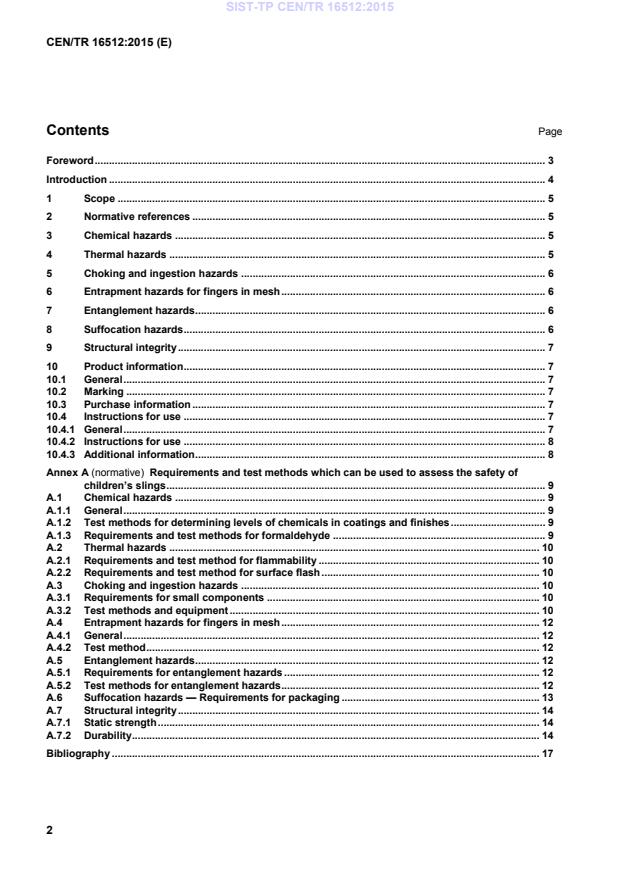
Contents Page
Foreword . 3
Introduction . 4
1 Scope . 5
2 Normative references . 5
3 Chemical hazards . 5
4 Thermal hazards . 5
5 Choking and ingestion hazards . 6
6 Entrapment hazards for fingers in mesh . 6
7 Entanglement hazards . 6
8 Suffocation hazards . 6
9 Structural integrity . 7
10 Product information . 7
10.1 General . 7
10.2 Marking . 7
10.3 Purchase information . 7
10.4 Instructions for use . 7
10.4.1 General . 7
10.4.2 Instructions for use . 8
10.4.3 Additional information . 8
Annex A (normative) Requirements and test methods which can be used to assess the safety of
children’s slings . 9
A.1 Chemical hazards . 9
A.1.1 General . 9
A.1.2 Test methods for determining levels of chemicals in coatings and finishes . 9
A.1.3 Requirements and test methods for formaldehyde . 9
A.2 Thermal hazards . 10
A.2.1 Requirements and test method for flammability . 10
A.2.2 Requirements and test method for surface flash . 10
A.3 Choking and ingestion hazards . 10
A.3.1 Requirements for small components . 10
A.3.2 Test methods and equipment . 10
A.4 Entrapment hazards for fingers in mesh . 12
A.4.1 General . 12
A.4.2 Test method . 12
A.5 Entanglement hazards . 12
A.5.1 Requirements for entanglement hazards . 12
A.5.2 Test methods for entanglement hazards . 12
A.6 Suffocation hazards — Requirements for packaging . 13
A.7 Structural integrity . 14
A.7.1 Static strength . 14
A.7.2 Durability . 14
Bibliography . 17
Foreword
This document (CEN/TR 16512:2015) has been prepared by Technical Committee CEN/TC 252 "Child use and
care articles", the secretariat of which is held by AFNOR.
Attention is drawn to the possibility that some of the elements of this document may be the subject of patent
rights. CEN [and/or CENELEC] shall not be held responsible for identifying any or all such patent rights.
Introduction
This Technical Report has been produced to provide safety guidance for designers, manufacturers, suppliers
and users of slings which are products designed to carry a child solely on the carer’s torso.
Slings are similar to soft carriers which are also designed to carry a child on the carer’s torso, the main
differences are that slings do not have integral openings for the child’s limbs and form their structure only when
attached to the carer’s torso. Slings consist of a variety of designs ranging from a hammock shaped product
suspended on the carer’s torso to a length of material wrapped around the carer’s body. Because of this wide
variety of designs, which in many cases can result in an unstructured product, it has proven very difficult to draft
a safety standard similar to that for EN 13209-2, Child use and care articles — Baby carriers — Safety
requirements and test methods — Part 2: Soft carrier.
These guidelines have been drafted to address potential hazards associated with slings. Where there are similar
hazards to those associated with soft carriers, these have been identified. Any requirements and test methods
which are given in EN 13209-2 and are appropriate to slings are detailed in Annex A. Any other requirements
and test methods from other standards which are also appropriate to slings have also been included in Annex A.
The bibliography contains a list of standards that have been considered when drafting this Technical Report.
1 Scope
This Technical Report covers a product which is designed to carry a child solely on the carer’s torso, which does
not have integrated openings for the child’s limbs and is designed to allow the carer a hands-free operation when
standing and/or walking.
An integrated leg opening is an opening for the child’s legs which exists in the product prior to installation on the
carer’s torso. A leg opening which is formed when the carer wears the product is not an integrated opening.
Children’s slings are not covered by EN 13209-1 and EN 13209-2.
2 Normative references
The following documents, in whole or in part, are normatively referenced in this document and are indispensable
for its application. For dated references, only the edition cited applies. For undated references, the latest edition
of the referenced document (including any amendments) applies.
EN 71-1, Safety of toys — Part 1: Mechanical and physical properties
EN 71-3, Safety of toys — Part 3: Migration of certain elements
EN 13209-2, Child use and care articles — Baby carriers — Safety requirements and test methods — Part 2:
Soft carrier
EN ISO 14184-1, Textiles — Determination of formaldehyde — Part 1: Free and hydrolysed formaldehyde (water
extraction method) (ISO 14184-1)
3 Chemical hazards
Harmful toxic chemicals can enter a child’s body by ingestion and inhalation. Information detailing chemical
hazards and their risk to young children can be found in CEN/TR 13387:2004, Clause 2.
The chemical hazards and risks for a sling are very similar to those of a soft carrier. Subclause A.1.1 states the
requirements given in EN 13209–2, which are used to address the hazards related to the ingestion of harmful
chemicals by a child. Subclause A.1.2 references the test method which is used to determine the toxic content of
these chemicals.
EN 13209-2 does not address the hazard of inhalation of formaldehyde. As slings may envelop the child, the
level of formaldehyde in the materials used should be controlled. Subclause A.1.3 references the standard which
details the requirements and test methods for the assessment of the level of formaldehyde.
4 Thermal hazards
Thermal hazards include hazards associated with flammability, the burning characteristics of materials and
overheating (hyperthermia) or exposure of a child to very low temperatures (hypothermia).
As slings may be used by the carer in and around the home, possibly near a naked flame, the flammability of the
materials used in slings and their burning characteristics should be controlled. Subclause A.2.1 gives the
requirements for the rate of spread of the flame and references the standard which details the test method.
Materials with a surface pile may be subject to surface flash which could occur if cigarette ash or a spark lands
on the sling. Subclause A.2.2 references the standard which details the requirements and test methods to
assess surface flash.
Overheating or hyperthermia, is a rise in the child’s core temperature. This could occur if the child becomes too
hot particularly in a sling which encompasses the child’s body. Consideration should be given to the type of
material used for the sling and to the product information which should alert the carer to the potential hazard of
the child becoming too hot.
The lowering of the child’s body temperature, hypothermia, is less likely to be a hazard.
5 Choking and ingestion hazards
Both choking and ingestion hazards can occur if a child puts small objects into their mouth and either attempts to
swallow them or actually swallows them.
Choking occurs when a child’s internal airways become blocked and their breathing is impeded. This is a serious
hazard as air cannot pass into a child’s lungs and irreversible brain damage can occur.
Ingestion of small objects which pass into the child’s stomach can cause internal blockages.
Where possible it is preferable to avoid the use of small objects attached to the sling. If however small objects
are used, they should be firmly attached to the product and there should be no possibility of them detaching
and/or breaking into small pieces.
Choking and ingestion hazards have been addressed for soft carriers. Clause A.3 gives the requirements and
test methods detailed in EN 13209–2 which are used to address these hazards.
6 Entrapment hazards for fingers in mesh
If a child’s finger becomes stuck in an opening, the flow of blood to the finger may be reduced. Slings should be
designed to eliminate openings in mesh where fingers could be trapped.
Clause A.4 gives the requirements and test method to address the hazards associated with the entrapment of a
child’s finger in mesh.
7 Entanglement hazards
If a child becomes entangled in a product, strangulation can occur.
Any cords, ribbons or similar parts should have their length limited so that they cannot encircle a child’s neck.
Clause A.5 gives the requirements and test method for the determination of the safety of the length of cords
Any loops should be sufficiently small so that they cannot pass over the child’s head. Clause A.5 gives the
requirements and a test method t
...