


EN 16232:2013+A2:2023
(Main)Child use and care articles - Infant swings
Child use and care articles - Infant swings
This European Standard specifies safety requirements and the corresponding test methods for infant swings intended for children up
to a weight of 9 kg or unable to sit up unaided.
If an infant swing has several functions or can be converted into another function, the relevant European Standards apply to it.
Swings falling under the scope of EN 71-8 are excluded from the scope of this European Standard.
Artikel für Säuglinge und Kleinkinder - Babyschaukeln
Diese Europäische Norm legt Sicherheitsanforderungen und die entsprechenden Prüfverfahren für Babyschaukeln fest, die für Kinder mit einem Gewicht von höchstens 9 kg bzw. für Kinder, die noch nicht selbstständig sitzen können, vorgesehen sind.
Für Babyschaukeln mit mehreren Funktionen oder für umbaubare Babyschaukeln gelten die dafür maßgebenden Europäischen Normen.
Babyschaukeln, die in den Anwendungsbereich der EN 71 8 fallen, sind nicht Bestandteil des Anwendungsbereiches dieser Europäischen Norm.
Siehe Begründungen in Anhang A.1.
Articles de puériculture - Balancelles suspendues pour enfant
La présente Norme européenne spécifie les exigences en matière de sécurité et les méthodes d’essai correspondantes pour les balancelles suspendues pour enfant pesant jusqu’à 9 kg ou incapable de tenir assis tout seul.
Si une balancelle suspendue pour enfant a plusieurs fonctions ou s’il est possible de lui conférer une autre fonction, elle relève des normes européennes correspondantes.
Les balancelles suspendues relevant du domaine d’application de l’EN 71-8 ne sont pas couvertes par la présente Norme européenne.
Voir justification en A.1.
Izdelki za otroke - Gugalnice za dojenčke (vključno z dopolnilom A2)
Ta evropski standard določa varnostne zahteve in ustrezne preskusne metode za gugalnice za dojenčke, namenjene za otroke
s težo do vključno 9 kg ali otroke, ki brez pomoči še ne morejo sedeti.
Če ima gugalnica za dojenčke več funkcij ali je mogoče njeno funkcijo spremeniti, se zanjo uporabljajo ustrezni evropski standardi.
Iz tega evropskega standarda so izvzete gugalnice, ki spadajo na področje uporabe standarda EN 71-8.
General Information
- Status
- Published
- Publication Date
- 19-Sep-2023
- Technical Committee
- CEN/TC 252 - Child use and care articles
- Drafting Committee
- CEN/TC 252/WG 1 - Seating and body care
- Current Stage
- 6060 - Definitive text made available (DAV) - Publishing
- Start Date
- 20-Sep-2023
- Due Date
- 11-Jan-2024
- Completion Date
- 20-Sep-2023
Relations
- Effective Date
- 29-Jan-2023
- Effective Date
- 29-Jan-2023
- Effective Date
- 09-Feb-2026
- Effective Date
- 09-Feb-2026
- Effective Date
- 09-Feb-2026
- Effective Date
- 09-Feb-2026
- Effective Date
- 09-Feb-2026
- Effective Date
- 28-Jan-2026
- Effective Date
- 28-Jan-2026
- Effective Date
- 28-Jan-2026
- Effective Date
- 28-Jan-2026
- Effective Date
- 28-Jan-2026
- Effective Date
- 28-Jan-2026
- Effective Date
- 28-Jan-2026
- Effective Date
- 28-Jan-2026
Buy Documents
EN 16232:2013+A2:2024 - BARVE
Frequently Asked Questions
EN 16232:2013+A2:2023 is a standard + national annex and/or foreword published by the European Committee for Standardization (CEN). Its full title is "Child use and care articles - Infant swings". This standard covers: This European Standard specifies safety requirements and the corresponding test methods for infant swings intended for children up to a weight of 9 kg or unable to sit up unaided. If an infant swing has several functions or can be converted into another function, the relevant European Standards apply to it. Swings falling under the scope of EN 71-8 are excluded from the scope of this European Standard.
This European Standard specifies safety requirements and the corresponding test methods for infant swings intended for children up to a weight of 9 kg or unable to sit up unaided. If an infant swing has several functions or can be converted into another function, the relevant European Standards apply to it. Swings falling under the scope of EN 71-8 are excluded from the scope of this European Standard.
EN 16232:2013+A2:2023 is classified under the following ICS (International Classification for Standards) categories: 97.190 - Equipment for children. The ICS classification helps identify the subject area and facilitates finding related standards.
EN 16232:2013+A2:2023 has the following relationships with other standards: It is inter standard links to EN 16232:2013+A1:2018, EN 16232:2013/prA2, EN 61672-2:2013, EN IEC 61558-2-7:2025, EN 61672-1:2013, EN 62115:2005, EN IEC 61558-2-16:2025, EN 71-11:2005, EN ISO 14184-1:2011, EN ISO 3746:2010, EN 71-10:2005, EN 71-3:2019+A2:2024, EN 71-2:2011+A1:2014, EN 717-1:2004, EN 622-1:2003. Understanding these relationships helps ensure you are using the most current and applicable version of the standard.
EN 16232:2013+A2:2023 is available in PDF format for immediate download after purchase. The document can be added to your cart and obtained through the secure checkout process. Digital delivery ensures instant access to the complete standard document.
Standards Content (Sample)
SL O V EN S K I SIST EN 16232:2013+A2
S T ANDAR D
julij 2024
Izdelki za otroke – Gugalnice za dojenčke (vključno z dopolnilom A2)
Child use and care articles – Infant swings
Articles de puériculture – Balancelles suspendues pour enfant
Artikel für Säuglinge und Kleinkinder – Babyschaukeln
Referenčna oznaka
ICS 97.190 SIST EN 16232:2013+A2:2024 ((sl)en)
Nadaljevanje na straneh od II do IV in od 1 do 66
© 2024-07 Standard je založil in izdal Slovenski inštitut za standardizacijo. Razmnoževanje celote ali delov tega standarda ni dovoljeno.
SIST EN 16232 : 2013+A2 : 2024
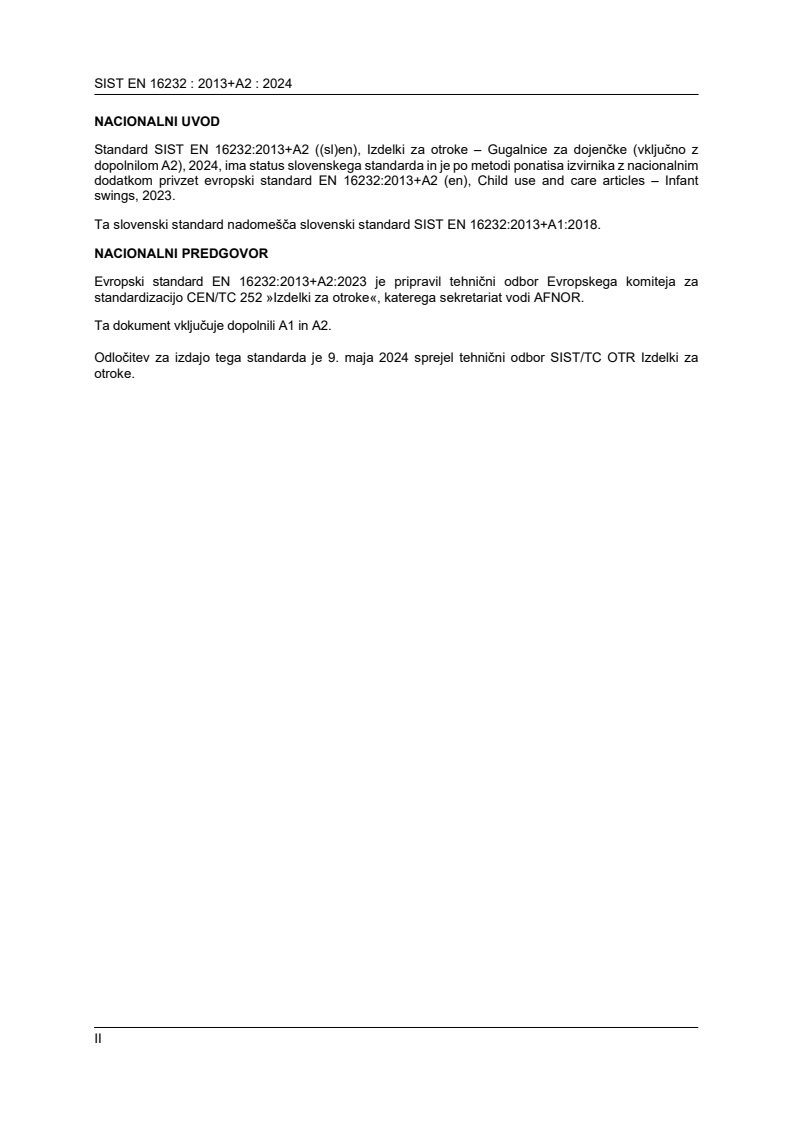
NACIONALNI UVOD
Standard SIST EN 16232:2013+A2 ((sl)en), Izdelki za otroke – Gugalnice za dojenčke (vključno z
dopolnilom A2), 2024, ima status slovenskega standarda in je po metodi ponatisa izvirnika z nacionalnim
dodatkom privzet evropski standard EN 16232:2013+A2 (en), Child use and care articles – Infant
swings, 2023.
Ta slovenski standard nadomešča slovenski standard SIST EN 16232:2013+A1:2018.
NACIONALNI PREDGOVOR
Evropski standard EN 16232:2013+A2:2023 je pripravil tehnični odbor Evropskega komiteja za
standardizacijo CEN/TC 252 »Izdelki za otroke«, katerega sekretariat vodi AFNOR.
Ta dokument vključuje dopolnili A1 in A2.
Odločitev za izdajo tega standarda je 9. maja 2024 sprejel tehnični odbor SIST/TC OTR Izdelki za
otroke.
II
SIST EN 16232 : 2013+A2 : 2024
NACIONALNI DODATEK
Dodatek C
(normativni)
Opozorila
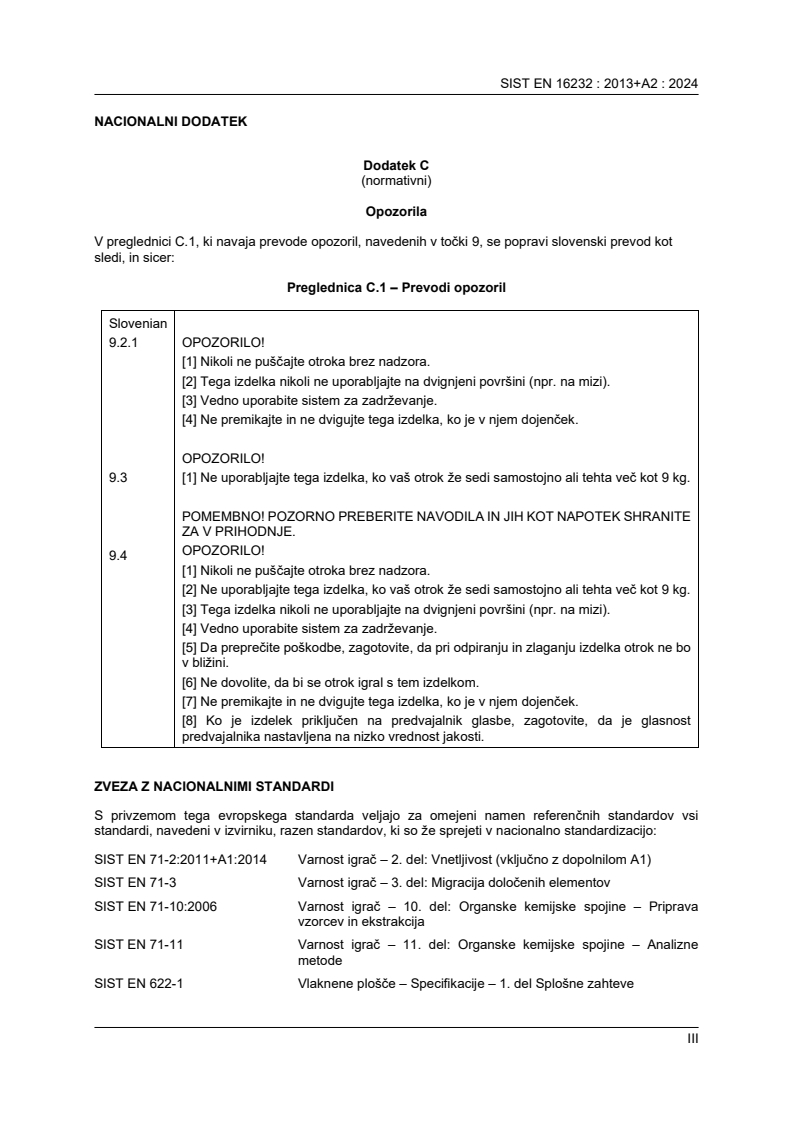
V preglednici C.1, ki navaja prevode opozoril, navedenih v točki 9, se popravi slovenski prevod kot
sledi, in sicer:
Preglednica C.1 – Prevodi opozoril
Slovenian
9.2.1 OPOZORILO!
[1] Nikoli ne puščajte otroka brez nadzora.
[2] Tega izdelka nikoli ne uporabljajte na dvignjeni površini (npr. na mizi).
[3] Vedno uporabite sistem za zadrževanje.
[4] Ne premikajte in ne dvigujte tega izdelka, ko je v njem dojenček.
OPOZORILO!
9.3 [1] Ne uporabljajte tega izdelka, ko vaš otrok že sedi samostojno ali tehta več kot 9 kg.
POMEMBNO! POZORNO PREBERITE NAVODILA IN JIH KOT NAPOTEK SHRANITE
ZA V PRIHODNJE.
OPOZORILO!
9.4
[1] Nikoli ne puščajte otroka brez nadzora.
[2] Ne uporabljajte tega izdelka, ko vaš otrok že sedi samostojno ali tehta več kot 9 kg.
[3] Tega izdelka nikoli ne uporabljajte na dvignjeni površini (npr. na mizi).
[4] Vedno uporabite sistem za zadrževanje.
[5] Da preprečite poškodbe, zagotovite, da pri odpiranju in zlaganju izdelka otrok ne bo
v bližini.
[6] Ne dovolite, da bi se otrok igral s tem izdelkom.
[7] Ne premikajte in ne dvigujte tega izdelka, ko je v njem dojenček.
[8] Ko je izdelek priključen na predvajalnik glasbe, zagotovite, da je glasnost
predvajalnika nastavljena na nizko vrednost jakosti.
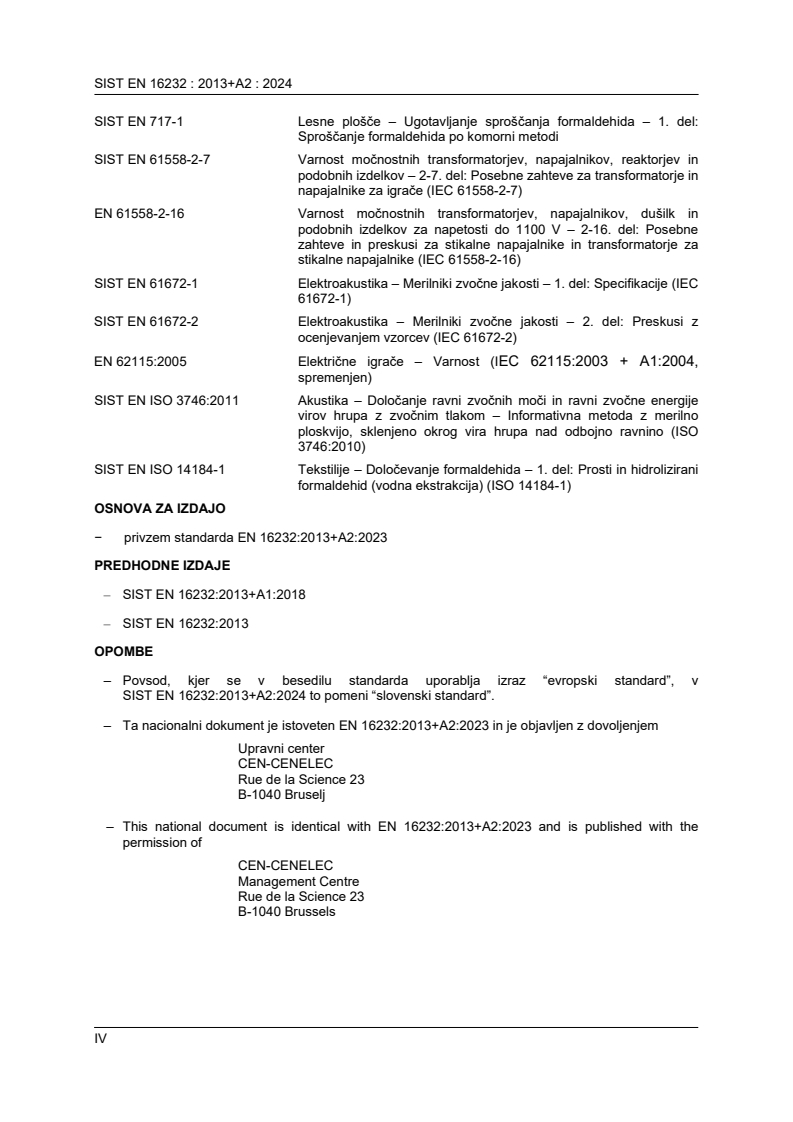
ZVEZA Z NACIONALNIMI STANDARDI
S privzemom tega evropskega standarda veljajo za omejeni namen referenčnih standardov vsi
standardi, navedeni v izvirniku, razen standardov, ki so že sprejeti v nacionalno standardizacijo:
SIST EN 71-2:2011+A1:2014 Varnost igrač – 2. del: Vnetljivost (vključno z dopolnilom A1)
SIST EN 71-3 Varnost igrač – 3. del: Migracija določenih elementov
SIST EN 71-10:2006 Varnost igrač – 10. del: Organske kemijske spojine – Priprava
vzorcev in ekstrakcija
SIST EN 71-11 Varnost igrač – 11. del: Organske kemijske spojine – Analizne
metode
SIST EN 622-1 Vlaknene plošče – Specifikacije – 1. del Splošne zahteve
III
SIST EN 16232 : 2013+A2 : 2024
SIST EN 717-1 Lesne plošče – Ugotavljanje sproščanja formaldehida – 1. del:
Sproščanje formaldehida po komorni metodi
SIST EN 61558-2-7 Varnost močnostnih transformatorjev, napajalnikov, reaktorjev in
podobnih izdelkov – 2-7. del: Posebne zahteve za transformatorje in
napajalnike za igrače (IEC 61558-2-7)
EN 61558-2-16 Varnost močnostnih transformatorjev, napajalnikov, dušilk in
podobnih izdelkov za napetosti do 1100 V – 2-16. del: Posebne
zahteve in preskusi za stikalne napajalnike in transformatorje za
stikalne napajalnike (IEC 61558-2-16)
SIST EN 61672-1 Elektroakustika – Merilniki zvočne jakosti – 1. del: Specifikacije (IEC
61672-1)
SIST EN 61672-2 Elektroakustika – Merilniki zvočne jakosti – 2. del: Preskusi z
ocenjevanjem vzorcev (IEC 61672-2)
EN 62115:2005 Električne igrače – Varnost (IEC 62115:2003 + A1:2004,
spremenjen)
SIST EN ISO 3746:2011 Akustika – Določanje ravni zvočnih moči in ravni zvočne energije
virov hrupa z zvočnim tlakom – Informativna metoda z merilno
ploskvijo, sklenjeno okrog vira hrupa nad odbojno ravnino (ISO
3746:2010)
SIST EN ISO 14184-1 Tekstilije – Določevanje formaldehida – 1. del: Prosti in hidrolizirani
formaldehid (vodna ekstrakcija) (ISO 14184-1)
OSNOVA ZA IZDAJO
− privzem standarda EN 16232:2013+A2:2023
PREDHODNE IZDAJE
– SIST EN 16232:2013+A1:2018
– SIST EN 16232:2013
OPOMBE
– Povsod, kjer se v besedilu standarda uporablja izraz “evropski standard”, v
– Ta nacionalni dokument je istoveten EN 16232:2013+A2:2023 in je objavljen z dovoljenjem
Upravni center
CEN-CENELEC
Rue de la Science 23
B-1040 Bruselj
– This national document is identical with EN 16232:2013+A2:2023 and is published with the
permission of
CEN-CENELEC
Management Centre
Rue de la Science 23
B-1040 Brussels
IV
EN 16232:2013+A2
EUROPEAN STANDARD
NORME EUROPÉENNE
September 2023
EUROPÄISCHE NORM
ICS 97.190 Supersedes EN 16232:2013+A1:2018
English Version
Child use and care articles - Infant swings
Articles de puériculture - Balancelles suspendues pour Artikel für Säuglinge und Kleinkinder - Babyschaukeln
enfant
This European Standard was approved by CEN on 16 April 2018 and includes Amendment 2 approved by CEN on 25 December
2022.
CEN members are bound to comply with the CEN/CENELEC Internal Regulations which stipulate the conditions for giving this
European Standard the status of a national standard without any alteration. Up-to-date lists and bibliographical references
concerning such national standards may be obtained on application to the CEN-CENELEC Management Centre or to any CEN
member.
This European Standard exists in three official versions (English, French, German). A version in any other language made by
translation under the responsibility of a CEN member into its own language and notified to the CEN-CENELEC Management
Centre has the same status as the official versions.
CEN members are the national standards bodies of Austria, Belgium, Bulgaria, Croatia, Cyprus, Czech Republic, Denmark, Estonia,
Finland, France, Germany, Greece, Hungary, Iceland, Ireland, Italy, Latvia, Lithuania, Luxembourg, Malta, Netherlands, Norway,
Poland, Portugal, Republic of North Macedonia, Romania, Serbia, Slovakia, Slovenia, Spain, Sweden, Switzerland, Türkiye and
United Kingdom.
EUROPEAN COMMITTEE FOR STANDARDIZATION
COMITÉ EUROPÉEN DE NORMALISATION
EUROPÄISCHES KOMITEE FÜR NORMUNG
CEN-CENELEC Management Centre: Rue de la Science 23, B-1040 Brussels
© 2023 CEN All rights of exploitation in any form and by any means reserved Ref. No. EN 16232:2013+A2:2023 E
worldwide for CEN national Members.
Contents Page
European foreword . 4
1 Scope . 5
2 Normative references . 5
3 Terms and definitions . 5
4 Test equipment . 6
4.1 Articulated test mass . 6
4.2 Test mass A . 7
4.3 Test mass B . 8
4.4 Small parts cylinder . 8
4.5 Feeler gauge . 8
4.6 !Test probes for finger entrapment . 9
4.7 Test surface for static slippage . 11
4.8 Test surface for stability. 11
4.9 Test equipment for sound level measurement . 11
5 General requirements and test conditions . 11
5.1 Product conditioning . 11
5.2 Test conditions . 11
5.3 Application of forces . 12
5.4 Tolerances . 12
5.5 Order of tests . 12
6 !Chemical hazards . 12
7 !Thermal hazards (see A.3) . 14
8 Mechanical hazards . 15
8.1 General. 15
8.1.1 Determination of the junction line . 15
8.1.2 Determination of protected volume . 15
8.2 Hazards due to sound level . 17
8.2.1 Requirement . 17
8.2.2 Test method . 17
8.3 !Entrapment hazards . 18
8.3.1 Requirement . 18
8.4 Hazards due to falling of the child . 18
8.4.1 Angles . 18
8.4.2 Restraint system . 24
8.5 Hazards due to moving parts . 25
8.5.1 Requirements for compression points . 25
8.5.2 Requirements for shear points . 25
8.6 Hazards due to folding of the product . 25
8.6.1 Requirements . 25
8.6.2 Test methods . 26
8.7 ! Entanglement hazards (see A.4.3) . 26
8.7.1 Requirements . 26
8.7.2 Test method . 27
8.8 Choking and ingestion hazard . 27
8.8.1 Requirements . 27
8.8.2 Test methods . 27
8.9 Suffocation hazards from packaging materials . 28
8.10 Hazards from edges, corners and protruding parts . 29
8.11 Hazards from inadequate structural integrity . 29
8.11.1 Static strength. 29
8.11.2 Durability of powered swinging mechanisms . 29
8.11.3 Reclining system . 29
8.12 Hazards from inadequate stability . 30
8.12.1 Requirements . 30
8.12.2 Test method for static stability . 30
8.12.3 Test method for dynamic stability . 30
8.13 Hazards from possible movement of the infant swing on the floor . 31
8.13.1 Requirement . 31
8.13.2 Test method . 31
8.14 Electrical hazards . 31
8.14.1 General . 31
8.14.2 Leakage prevention . 31
8.14.3 Test methods . 31
9 Product information . 32
9.1 General . 32
9.2 Marking of the product. 32
9.2.1 General requirements . 32
9.2.2 Requirements for infant swings with electrical components . 33
9.2.3 Durability of marking . 34
9.2.4 Test method for durability of marking . 34
9.3 Purchase information . 34
9.4 Instructions for use . 35
9.4.1 General . 35
9.4.2 Warnings . 35
9.4.3 Additional information . 35
9.4.4 Requirements for infant swings with electrical components . 36
Annex A (informative) Rationales . 37
A.1 General (see Clause 1) . 37
A.2 !Chemical hazards (see Clause 6) . 37
A.3 Protective volume and protective barriers (see 8.1.2 and 8.1.2.2). 37
A.4 Hazards due to sound level (see 8.2) . 37
A.5 Hazards due to detachment of toy bars . 38
A.6 Hazards from possible movement of the infant swing on the floor (see 8.13) . 38
A.7 !Hazards due to falling of the child (see 8.4) . 38
Annex B (informative) A-deviation . 39
Annex C (normative) Warnings . 40
Bibliography . 66
European foreword
This document (EN 16232:2013+A2:2023) has been prepared by Technical Committee CEN/TC 252
“Child care articles”, the secretariat of which is held by AFNOR.
#This European Standard shall be given the status of a national standard, either by publication of an
identical text or by endorsement, at the latest by March 2024 and conflicting national standards shall be
withdrawn at the latest by September 2024.$
Attention is drawn to the possibility that some of the elements of this document may be the subject of
patent rights. CEN shall not be held responsible for identifying any or all such patent rights.
This document includes Amendment 1 approved by CEN on 16 April 2018, and Amendment 2 approved
by CEN on 25 December 2022.
This document supersedes #EN 16232:2013+A1:2018$.
The start and finish of text introduced or altered by amendment is indicated in the text by tags !"
and #$.
According to the CEN-CENELEC Internal Regulations, the national standards organisations of the
following countries are bound to implement this European Standard: Austria, Belgium, Bulgaria, Croatia,
Cyprus, Czech Republic, Denmark, Estonia, Finland, France, Germany, Greece, Hungary, Iceland, Ireland,
Italy, Latvia, Lithuania, Luxembourg, Malta, Netherlands, Norway, Poland, Portugal, Republic of North
Macedonia, Romania, Serbia, Slovakia, Slovenia, Spain, Sweden, Switzerland, Türkiye and the United
Kingdom.
1 Scope
This European Standard specifies safety requirements and the corresponding test methods for infant
swings intended for children up to a weight of 9 kg or unable to sit up unaided.
If an infant swing has several functions or can be converted into another function, the relevant European
Standards apply to it.
Swings falling under the scope of EN 71-8 are excluded from the scope of this European Standard.
See rationale in A.1.
2 Normative references
The following documents, in whole or in part, are normatively referenced in this document and are
indispensable for its application. For dated references, only the edition cited applies. For undated
references, the latest edition of the referenced document (including any amendments) applies.
!EN 71-2:2011+A1:2014, Safety of toys — Part 2: Flammability"
!EN 71-3, Safety of toys — Part 3: Migration of certain elements"
!EN 71-10:2005, Safety of toys — Part 10: Organic chemical compounds — Sample preparation and
extraction"
!EN 71-11, Safety of toys — Part 11: Organic chemical compounds — Methods of analysis"
!EN 622-1, Fibreboards — Specifications — Part 1: General requirements"
!EN 717-1, Wood-based panels — Determination of formaldehyde release — Part 1: Formaldehyde
emission by the chamber method"
!deleted text"
EN 61558-2-7, Safety of power transformers, power supplies, reactors and similar products — Part 2-7:
Particular requirements and tests for transformers and power supplies for toys (IEC 61558-2-7)
EN 61558-2-16, Safety of transformers, reactors, power supply units and similar products for supply
voltages up to 1 100 V — Part 2-16: Particular requirements and tests for switch mode power supply units
and transformers for switch mode power supply units (IEC 61558-2-16)
EN 61672-1, Electroacoustics — Sound level meters — Part 1: Specifications (IEC 61672-1)
EN 61672-2, Electroacoustics — Sound level meters — Part 2: Pattern evaluation tests (IEC 61672-2)
EN 62115:2005, Electric toys — Safety (IEC 62115:2003, modified + A1:2004)
EN ISO 3746:2010, Acoustics — Determination of sound power levels and sound energy levels of noise
sources using sound pressure — Survey method using an enveloping measurement surface over a reflecting
plane (ISO 3746:2010)
!EN ISO 14184-1, Textiles — Determination of formaldehyde — Part 1: Free and hydrolysed
formaldehyde (water extraction method) (ISO 14184-1)"
3 Terms and definitions
For the purposes of this document, the following terms and definitions apply.
3.1
infant swing
stationary unit with a frame and mechanism that enables a child unable to sit up unaided to be swung
3.2
junction line
intersection of the seat and the backrest
4 Test equipment
4.1 Articulated test mass
9 kg articulated test mass made of steel (see Figure 1).
Dimensions in millimetres
Key
1 part to be placed onto the seat surface
2 part to be placed onto the backrest surface
3 hinge pin made of steel
E mass: (4 495 ± 50) g
F mass: (4 501 ± 50) g
G mass of hinge axle: (17 ± 0,5) g, length: 79,5 mm
Mass tolerance: (9 ± 0,1) kg
Dimensions tolerance: ± 2 mm
All edges shall be chamfered.
Figure 1 — Articulated test mass
4.2 Test mass A
Test mass A is a rigid cylinder (160 ± 5) mm in diameter and (300 ± 5) mm in height, having a mass of
+0,01
9 kg and with its centre of gravity in the centre of the cylinder. All edges shall have a radius of
(5 ± 1) mm. Two anchorage points shall be provided. These shall be positioned (150 ± 2,5) mm from the
base and at 180° to each other around the circumference (see Figure 2).
Dimensions in millimetres
Key
1 radius: (5 ± 1) mm
2 two anchorage points
Figure 2 — Test mass A
4.3 Test mass B
Test mass B is a (150 ± 30) mm by (200 ± 30) mm rectangular shaped sand bag with a mass of
(3 ± 0,1) kg.
4.4 Small parts cylinder
Small parts cylinder for the assessment of small components, having dimensions in accordance with
Figure 3.
Dimension in millimetres
Figure 3 — Small parts cylinder
4.5 Feeler gauge
Gauge with a thickness of (0,4 ± 0,02) mm and an insertion edge radius of (3 ± 0,5) mm (see Figure 4).
Dimensions in millimetres
Figure 4 — Feeler gauge
4.6 !Test probes for finger entrapment
4.6.1 Finger probes with hemispherical end
0 +01,
Probes made from plastic or other hard, smooth material of diameters 7 mm and 12 mm with
)
( −01, ( 0 )
a full hemispherical end that can be mounted on a force-measuring device, see Figure 5a).
Mesh probe made from plastic or other hard, smooth material as shown in Figure 5b).
Dimensions in millimetres
Key
Probe type 7 mm probe 12 mm probe
Diameter A 0
+01,
-0,1
Radius RB half of diameter A half of diameter A
1 Line scribed around circumference showing depth of penetration
Figure 5a) — Test probes with hemispherical end
Dimensions in millimetres
Key
Probe type Mesh probe
Diameter A 0
−01,
Diameter B 0
5,6
−01,
Radius RB half of diameter B
Figure 5b) — Test probe for mesh
Figure 5 – Test probes
4.6.2 Shape assessment probe
Probe made from plastics or other hard, smooth material with the dimensions shown in Figure 6.
Dimensions in millimetres
Key
A front view
B top view
C side view
D 3D view
Figure 6 — Shape assessment probe
"
4.7 Test surface for static slippage
Rigid plane covered with uncoated tempered float glass with a smooth surface and thickness of (6 ± 0,5)
mm, inclined at angle of (12 + 0,5/0)° to the horizontal.
4.8 Test surface for stability
Test surface, inclined at (15° + 0,5/0)° to the horizontal, covered with aluminium oxide paper of grade 80.
4.9 Test equipment for sound level measurement
The instrumentation system, including the microphone and cable, shall meet the requirements of a type 1
or type 2 instrument specified in EN 61672-1 and EN 61672-2.
When measuring high peak emission sound pressure levels, the microphone and the entire
instrumentation system shall have the capability of handling linear peak levels at least up to 125 dB.
5 General requirements and test conditions
5.1 Product conditioning
Before testing, any fabrics used shall be cleaned or washed and dried twice in accordance with the
manufacturer's instructions.
5.2 Test conditions
The tests shall be carried out in ambient conditions of (20 ± 5) °C.
The tests are designed to be applied to infant swings that are fully assembled and ready for use in
accordance with the manufacturer’s instructions. If the infant swing can be assembled or adjusted in
different ways, the most onerous combinations shall be used for each test.
If the infant swing has any battery-powered mechanism, it shall be tested using new non-rechargeable
alkaline batteries; if the infant swing is supplied with its own rechargeable battery pack, it shall be tested
with the battery pack fully charged in accordance with the instructions for use.
The batteries used are those with the voltage and size specified on the infant swing or in the instructions.
Lithium batteries or rechargeable batteries shall not be used unless their use is recommended in the
instructions.
If the infant swing fails to withstand a test and this could be due to a defective battery, the test shall be
repeated with a new set of batteries.
5.3 Application of forces
The forces in the static load tests shall be applied sufficiently slowly to ensure that negligible dynamic
force is applied.
5.4 Tolerances
Unless otherwise stated, the accuracy of the test equipment shall be:
— Forces: ± 5 % of the nominal force;
— Masses: ± 0,5 % of the nominal mass;
— Dimensions: ± 0,5 mm of the nominal dimension;
— Angles: ± 0,5° of the nominal angle;
The tests are described in terms of the application of forces. Masses can however be used. The
relationship 10 N = 1 kg may be used for this purpose.
Unless otherwise specified, the test forces may be applied by any suitable device which does not
adversely affect the results.
5.5 Order of tests
Unless otherwise stated in the test methods, the tests shall be carried out on the same infant swing in the
order listed in this standard.
6 !Chemical hazards
6.1 General
If testing is required, a separate unconditioned sample may be used for the tests in Clause 6.
6.2 Migration of certain elements (see A.2)
The migration of elements from materials on exterior surfaces shall not exceed the limits listed in Table 1.
Table 1 — Limits for heavy metals migration
Element mg/kg
Aluminium 70 000
Antimony 560
Arsenic 47
Barium 18 750
Boron 15 000
Cadmium 17
Chromium (III) 460
Chromium (VI) 0,2
Cobalt 130
Copper 7 700
Lead 23
Manganese 15 000
Mercury 94
Nickel 930
Selenium 460
Strontium 56 000
Tin 180 000
Organic tin 12
Zinc 46 000
When testing is performed, the method described in EN 71-3 shall be used.
Materials on the back of the backrest and the surface under the sitting surface are excluded from these
requirements.
6.3 Formaldehyde (see A.2)
Accessible textile components shall not contain free and hydrolysed formaldehyde in excess of 30 mg/kg.
When testing is performed, the method described in EN ISO 14184-1 shall be used.
Resin-bonded wood components shall not release formaldehyde in excess of 0,124 mg/m (class E1
according to EN 622-1).
When testing is performed, the method described in EN 717-1 shall be used.
6.4 Colorants and primary aromatic amines (see A.2)
When tested in accordance with EN 71-10:2005, Annex A, if the colour fastness to sweat of accessible
textile components is lower than 3-4 on the grey scale as defined in EN 20105-A03, the part shall be
tested for colorants with the methods described in EN 71-10 and EN 71-11 and the limits in Table 2 shall
be fulfilled.
Table 2 — Colourants limits
CoIour Index Generic Colour Index CAS Number Limit
Name (CIGN) Constitution Number
(CICN)
Disperse Blue 1 64500 2475–45–8 Action limit
Disperse Blue 3 61505 2475–46–9 Action limit
Disperse Blue 106 111935 12223-01-7 Action limit
Disperse Blue 124 111938 61951-51-7 Action limit
Disperse Yellow 3 11855 2832-40-8 Action limit
Disperse Orange 3 11855 730-40-5 Action limit
Disperse Orange 11132 12223-33-5 Action limit
37/76/59
13301-61-6
Disperse Red 1 11110 2872-52-8 Action limit
Solvent Yellow 1 11000 60-09-3 Action limit
Solvent Yellow 2 11020 60-11-7 Action limit
Solvent Yellow 3 11160 97-56-3 Action limit
Basic Red 9 42500 569-61-9 Action limit
Basic Violet 1 42535 8004-87-3 Action limit
Basic Violet 3 42555 548-62-9 Action limit
Acid Red 26 16150 3761–53–3 Action limit
Acid Violet 49 42640 1694–09–3 Action limit
6.5 Aniline (see A.2)
Aniline shall not exceed the limit of 30 mg/kg after reductive cleavage from accessible textile
components.
When testing is performed the method of EN ISO 14362-1 and EN ISO 17234-1, adapted as appropriate to
measure aniline, shall be used.
"
7 !Thermal hazards (see A.3)
7.1 Requirement
When tested in accordance with 7.2, there shall be no surface flash and the rate of spread of flame shall
not exceed 50 mm/s.
A separate sample, conditioned according to 5.1, may be used for these tests.
7.2 Test method
To verify the surface flash effect apply the test flame defined in EN 71-2:2011+A1:2014, 5.5 for (3 ± 0,5) s
to the infant swing in different places likely to cause surface flash.
To verify rate of spread of flame apply the test flame defined in EN 71-2:2011+A1:2014, 5.4.
"
8 Mechanical hazards
8.1 General
8.1.1 Determination of the junction line
The junction line is determined as in Figure 7.
Key
LL junction line
1 backrest
2 seat
Figure 7 — Junction line
When the seat unit is in the form of a hammock, then a theoretical junction line, “LL”, is determined as
shown in Figure 8.
NOTE The junction line might vary when the backrest is adjusted in different positions.
Key
LL junction line
CL vertical projection of C on the hammock
Figure 8 — Junction line for infant swings in form of a hammock
8.1.2 Determination of protected volume
8.1.2.1 General
The protected volume is determined as follows.
Place articulated test mass (see 4.1) on the seat unit with part 1 against the seat and with part 2 against
the backrest with the hinge aligned with the junction line and the longitudinal axis of the test mass
aligned with the longitudinal axis of the seat unit as shown in Figure 9.
The protected volume is the space around the test mass defined by a part of a cylinder with its main axis
along the projection of the junction line on the top surface of the test mass, a radius of 330 mm and a
width of 350 mm on each side from the longitudinal axis of the test mass as shown in Figure 9.
The area located behind the backrest and the area located underneath the seat is outside of the protected
volume.
The width of the protected volume may be reduced by the presence of protective barriers complying with
8.1.2.2. If another barrier (e.g. mesh or fabric decoration …) does not comply with 8.1.2.2, the full
protected volume as described above shall be considered. See A.2.
Dimensions in millimetres
Side view Top view
Key
1 origin from which the protected volume shall be measured: middle point of the junction line on the
top surface of the test mass
2 seat
3 backrest
Figure 9 — Protected volume
8.1.2.2 Protective barriers
8.1.2.2.1 Requirements
If present, protective barriers shall enclose a circular section with a radius of 350 mm and with its centre
on the junction line (see Figure 10).
NOTE The measurement of dimensions of protective barriers is taken without removing the articulated test
mass from the product.
Dimensions in millimetres
Figure 10 — Examples of protective barriers
If present, protective barriers shall not allow the test probe to come into contact to an entrapment,
compression or shearing point when tested in accordance with 8.1.2.2.2.
8.1.2.2.2 Test method
Push the 7mm probe (see 4.6) against the barrier from the inside of the infant swing with a force of 30 N;
check if it is possible to put the probe in any compression, shearing or entrapment point behind the
barrier.
This test shall be carried out in the most onerous position.
8.2 Hazards due to sound level
8.2.1 Requirement
When tested in accordance with 8.2.2, infant swings that include any device which generates sounds shall
conform to the following requirements:
a) the A-weighted emission sound pressure level, L , shall not exceed 80 dB when measured in a free
pA
field.
b) the C-weighted peak emission sound pressure level, L , shall not exceed 115 dB.
pC peak
This requirement does not apply to loudspeakers connected to external sound generating devices (e.g.
personal music players …).
8.2.2 Test method
Place the infant swing on a concrete floor in a test environment which meets the qualification
requirements of EN ISO 3746:2010, Annex A.
NOTE In practice this means that most normally furnished rooms with a volume exceeding 30 m will qualify.
Test rigs used for the mounting of the measuring device and/or the operator shall not affect the sound
emission of the infant swing nor cause sound reflections which will increase the sound pressure levels at
the measuring points.
The microphone (see 4.9) shall be placed at a distance of (30 ± 5) mm above the geometrical centre of the
top surface of the backrest and perpendicular to the backrest. The microphone shall be fixed to the
backrest to follow the swinging movement.
Operate the infant swing in the mode of its intended or foreseeable use which produces the highest
emission sound pressure level to the microphone position.
Allow the infant swing to reach normal operating mode(s) (e.g. speed, music level, …) before the tests are
performed.
If the infant swing has a clearly defined operating cycle, measure the A-weighted emission sound
pressure level, L , and the C-weighted peak emission sound pressure level, L , during at least one
pA pC peak
whole cycle. Quiet periods longer than 15 s shall be excluded from the measurement period.
Repeat the measurement three times.
The highest value recorded (L and L ) is the measurement result.
pA pC peak
!
8.3 Entrapment hazards
8.3.1 Requirement
When tested in accordance with 8.3.2, there shall be no completely bounded openings, within the
protected volume, between 7 mm and 12 mm unless the depth is less than 10 mm or unless the shape
assessment probe (see 4.6) enters when tested in accordance with 8.3.2.
When tested in accordance with 8.3.2, there shall be no openings in mesh, within the protected volume,
that allow the test probe for mesh (see 4.6) to penetrate to the 7 mm diameter section.
The test shall be carried out with the product in any intended position of use.
This requirement does not apply to the restraint system.
8.3.2 Test method
Check whether the 7 mm probe (see 4.6), with an applied force of up to 30 N, enters 10 mm or more into
any accessible completely bounded opening in any possible orientation.
If the 7 mm probe enters 10 mm or more, then the 12 mm probe (see 4.6) shall also enter 10 mm or more
with an applied force of up to 5 N.
If the 7 mm probe enters with an applied force of up to 30 N but the 12 mm probe does not enter 10 mm
or more with an applied force of up to 5 N, check whether the shape assessment probe (see 4.6) enters 10
mm or more with an applied force of up to 5 N.
Check whether the test probe for mesh (see 4.6), with an applied force of up to 30 N, penetrates
accessible openings in mesh up to the 7 mm diameter section.
"
8.4 Hazards due to falling of the child
8.4.1 Angles
8.4.1.1 Requirement for angles
When tested in accordance with 8.4.1.2.1, the angle between part 1 and part 2 of the articulated test mass
(α angle – see Figure 11) shall be not less than 90° in any position of use.
When tested in accordance with 8.4.1.2.2, the angle between part 2 of the articulated test mass and the
horizontal surface (β angle – see Figure 11) shall be between (0 and 80)°.
When tested in accordance with 8.4.1.2.2, the angle between part 1 of the articulated test mass and the
horizontal surface (δ angle – see Figure 11) shall not be less than 0°.
The lateral swinging angle (γ angle – see Figure 11) shall be between +20° and −20° when tested in
accordance with 8.4.1.2.3.
Key
α angle between part 1 and part 2 of the test mass
β angle between part 2 of the test mass and the horizontal surface
δ angle between part 1 of the test mass and the horizontal surface
γ angle drawn by the swinging frame from its rest position during lateral swinging movement
Figure 11 — Angles
8.4.1.2 Test methods for angles
8.4.1.2.1 Test method for α angle
Place the infant swing on a horizontal plane.
Place articulated test mass (see 4.1) on the seat unit with part 1 against the seat and with part 2 against
the backrest with the hinge aligned with the junction line and the longitudinal axis of the test mass
aligned with the longitudinal axis of the seat unit as shown in Figure 9.
If applicable, adjust the backrest in the most upright position.
Let the test mass and the seat unit reach the equilibrium.
Measure the α angle.
8.4.1.2.2 Test method for β and δ angles
Place the infant swing on a horizontal plane with some space under the plane to allow hanging of weights
(see Figure 12).
...
Questions, Comments and Discussion
Ask us and Technical Secretary will try to provide an answer. You can facilitate discussion about the standard in here.
Loading comments...