

EN 13160-5:2004
(Main)Leak detection systems - Part 5: Tank gauge leak detection systems
- Abstract
This document specifies the requirements for leak detection systems - class IV for use only with liquids as defined in the scope of EN 13352.
- Status
- Withdrawn
- Publication Date
- 21-Sep-2004
- Withdrawal Date
- 06-Oct-2026
- Technical Committee
- CEN/TC 393 - Equipment for storage tanks and for service stations
- Drafting Committee
- CEN/TC 393/WG 2 - Leak detecting devices for tanks and pipes
- Current Stage
- 9960 - Withdrawal effective - Withdrawal
- Start Date
- 06-Jul-2016
- Completion Date
- 07-Oct-2026


Relations
- Effective Date
- 13-Jul-2016
- Effective Date
- 28-Jan-2026
- Effective Date
- 28-Jan-2026
- Effective Date
- 28-Jan-2026
- Effective Date
- 28-Jan-2026
- Effective Date
- 28-Jan-2026
- Effective Date
- 28-Jan-2026
- Effective Date
- 28-Jan-2026
- Effective Date
- 28-Jan-2026
- Effective Date
- 28-Jan-2026
- Effective Date
- 28-Jan-2026
- Effective Date
- 28-Jan-2026
- Effective Date
- 28-Jan-2026
- Effective Date
- 28-Jan-2026
- Corrected By
EN 13160-5:2004/AC:2007 - Leak detection systems - Part 5: Tank gauge leak detection systems - Effective Date
- 08-Jun-2022
Get Certified
Connect with accredited certification bodies for this standard

Institut za varilstvo d.o.o. (Welding Institute)
Slovenia's leading welding institute since 1952. ISO 3834, EN 1090, pressure equipment certification, NDT personnel, welder qualification. Only IIW Au
Sponsored listings
Frequently Asked Questions
EN 13160-5:2004 is a standard published by the European Committee for Standardization (CEN). Its full title is "Leak detection systems - Part 5: Tank gauge leak detection systems". This standard covers: This document specifies the requirements for leak detection systems - class IV for use only with liquids as defined in the scope of EN 13352.
This document specifies the requirements for leak detection systems - class IV for use only with liquids as defined in the scope of EN 13352.
EN 13160-5:2004 is classified under the following ICS (International Classification for Standards) categories: 23.020.10 - Stationary containers and tanks. The ICS classification helps identify the subject area and facilitates finding related standards.
EN 13160-5:2004 has the following relationships with other standards: It is inter standard links to EN 13160-5:2016, EN 13160-6:2003, EN 13352:2002, EN 13160-4:2016+A1:2024, EN 28601:1992, EN 13160-6:2016, EN 228:2025, EN 976-1:1997, EN 590:2025, EN 13160-2:2016+A1:2024, EN 12285-3:2019, EN 12285-1:2018, EN 13160-3:2016+A1:2024, EN 13160-1:2003, EN 13160-5:2004/AC:2007. Understanding these relationships helps ensure you are using the most current and applicable version of the standard.
EN 13160-5:2004 is associated with the following European legislation: EU Directives/Regulations: 2014/34/EU, 305/2011, 73/23/EEC, 89/106/EEC, 92/31/EEC, 94/9/EC; Standardization Mandates: M/BC/CEN/92/46. When a standard is cited in the Official Journal of the European Union, products manufactured in conformity with it benefit from a presumption of conformity with the essential requirements of the corresponding EU directive or regulation.
EN 13160-5:2004 is available in PDF format for immediate download after purchase. The document can be added to your cart and obtained through the secure checkout process. Digital delivery ensures instant access to the complete standard document.
Standards Content (Sample)
2003-01.Slovenski inštitut za standardizacijo. Razmnoževanje celote ali delov tega standarda ni dovoljeno.Sistemi za kontrolo tesnosti - 5 del: Manometri na rezervoarjih kot sistem za zaznavanje tesnostiLeckanzeigesysteme - Teil 5: Tankinhalts-LeckanzeigesystemeSystemes de détection de fuites - Partie 5: Systemes de détection de fuites au moyen de jauges automatiques en citernesLeak detection systems - Part 5: Tank gauge leak detection systems23.040.99Drugi sestavni deli za cevovodeOther pipeline components23.020.10UH]HUYRDUMLStationary containers and tanksICS:Ta slovenski standard je istoveten z:EN 13160-5:2004SIST EN 13160-5:2004en01-november-2004SIST EN 13160-5:2004SLOVENSKI
STANDARD
EUROPEAN STANDARDNORME EUROPÉENNEEUROPÄISCHE NORMEN 13160-5September 2004ICS 23.020.10English versionLeak detection systems - Part 5: Tank gauge leak detectionsystemsSystèmes de détection de fuites - Partie 5: Systèmes dedétection de fuites au moyen de jauges automatiques enciternesLeckanzeigesysteme - Teil 5: Tankinhalts-LeckanzeigesystemeThis European Standard was approved by CEN on 9 July 2004.CEN members are bound to comply with the CEN/CENELEC Internal Regulations which stipulate the conditions for giving this EuropeanStandard the status of a national standard without any alteration. Up-to-date lists and bibliographical references concerning such nationalstandards may be obtained on application to the Central Secretariat or to any CEN member.This European Standard exists in three official versions (English, French, German). A version in any other language made by translationunder the responsibility of a CEN member into its own language and notified to the Central Secretariat has the same status as the officialversions.CEN members are the national standards bodies of Austria, Belgium, Cyprus, Czech Republic, Denmark, Estonia, Finland, France,Germany, Greece, Hungary, Iceland, Ireland, Italy, Latvia, Lithuania, Luxembourg, Malta, Netherlands, Norway, Poland, Portugal, Slovakia,Slovenia, Spain, Sweden, Switzerland and United Kingdom.EUROPEAN COMMITTEE FOR STANDARDIZATIONCOMITÉ EUROPÉEN DE NORMALISATIONEUROPÄISCHES KOMITEE FÜR NORMUNGManagement Centre: rue de Stassart, 36
B-1050 Brussels© 2004 CENAll rights of exploitation in any form and by any means reservedworldwide for CEN national Members.Ref. No. EN 13160-5:2004: ESIST EN 13160-5:2004
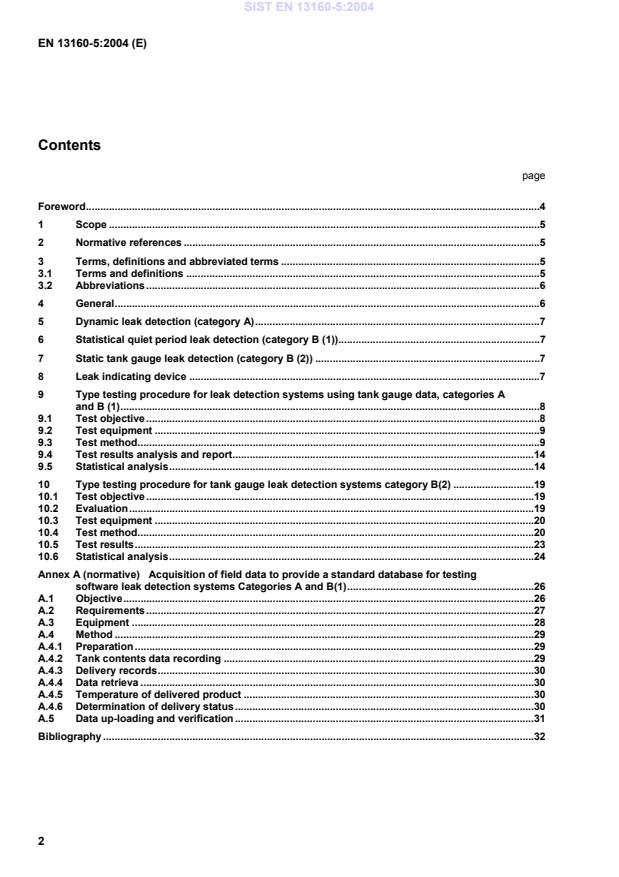
Acquisition of field data to provide a standard database for testing software leak detection systems Categories A and B(1).26 A.1 Objective.26 A.2 Requirements.27 A.3 Equipment.28 A.4 Method.29 A.4.1 Preparation.29 A.4.2 Tank contents data recording.29 A.4.3 Delivery records.30 A.4.4 Data retrieva.30 A.4.5 Temperature of delivered product.30 A.4.6 Determination of delivery status.30 A.5 Data up-loading and verification.31 Bibliography.32
Tables Table 1 — Performance requirements for categories of leak detection.7 Table 2 — Selection of data files according to tank capacity and shade temperature.10 Table 3 — Sequence of tests for leak detection categories A and B (1).13 Table 4 — Summary of results from qualitative evaluation.16 Table 5 — Sequence of tests for leak detection category B(2).23 Table A.A1 – Range of parameters.28
EN 228, Automotive fuels — Unleaded petrol — Requirements and test methods. EN 590, Automotive fuels — Diesel – Requirements and test methods. EN 976-1, Underground tanks of glass-reinforced plastics (GRP) — Horizontal cylindrical tanks for the non-pressure storage of liquid petroleum based fuels — Part 1: Requirements and test methods for single wall tanks. EN 12285-1, Workshop fabricated steel tanks — Part 1: Horizontal cylindrical single skin and double skin tanks for the underground storage of flammable and non-flammable
water polluting liquids. EN 13160-1:2003, Leak detection systems — Part 1: General principles. EN 13160-2, Leak detection systems — Part 2: Pressure and vacuum systems. EN 13160-3, Leak detection systems — Part 3: Liquid systems for tanks. EN 13160-4, Leak detection systems — Part 4: Liquid and/or vapour sensor systems for use in leakage containments or interstitial spaces. EN 13160-6, Leak detection systems — Part 6: Sensors in monitoring wells. EN 13352:2002, Specification for the performance of automatic tank contents gauges. EN 28601, Data elements and interchange formats — Information interchange — Representation of dates and times (ISO 8601:1988 and technical corrigendum 1:1991). 3 Terms, definitions and abbreviated terms For the purposes of this document, the terms and definitions given in EN 13160-1:2003 and the following apply. 3.1 Terms and definitions 3.1.1 quantitative output numerical indication of the leak rate estimated for a given test 3.1.2 qualitative output pass/fail indication for a given test with reference to a specified leak rate SIST EN 13160-5:2004
R is the simulated leak rate C
is the criterion or threshold for indicating a leak B is the estimated bias of the system SD is the standard deviation tb is the two-sample t-test bias 4 General General principles shall be according to EN 13160-1. Tank gauge leak detection systems shall be divided into two categories of operation: Category A: Systems providing leak detection for tanks and pipes, connected with the tank; Category B: Systems providing leak detection for tanks only. The minimum operational performance requirements for each category are contained in Table 1. SIST EN 13160-5:2004
In addition to the performance requirements in terms of leak rates specified in Table 1 above, the tank gauge leak detection system shall be able to detect a large loss of 300 l or more in a maximum time of 30 min. Any gauge system to be used for any category of leak detection shall have water detection capability according to EN 13352. 5 Dynamic leak detection (category A) For this category, the system shall communicate with the metering system, associated with the withdrawal of product from the storage tank, in order to receive details of all volumes dispensed from the tank. At the specified leak rate according to Table 1, the system shall have a probability of detection of at least 95 % whilst a false alarm rate shall not exceed 5 %. 6 Statistical quiet period leak detection (category B (1)) For this category, the system shall be capable of detecting the specified leak rate according to Table 1 with a probability of at least 95 % whilst operating at a false alarm rate of 5 % or less. 7 Static tank gauge leak detection (category B (2)) For this classification, the system shall be capable, when no product is being dispensed from or delivered to the tank, of detecting the specified leak rate according to Table 1 with a probability of at least 95 % whilst operating at a false alarm rate of 5 % or less. 8 Leak indicating device A leak indicating device shall be provided. In addition for categories A and B, the requirements of a gauge control device as defined in EN 13352 shall be met. An alarm shall be activated whenever a leak rate is detected at the specified rate or above, in accordance with Table 1. Where performance in accordance with Table 1 is not achievable within the required levels of probability, the results shall be reported as inconclusive. SIST EN 13160-5:2004
-5 °C to +30 °C; 9.1.2.2 Storage tank capacity:
10 000 l to 50 000 l; 9.1.2.3 Average daily throughput (per tank):
1 000 l to 12 000 l per day; 9.1.2.4 Delivery quantity per tank:
2 750 l to 9 500 l; 9.1.2.5 Delivery temperature:
-5 °C to +25 °C; 9.1.2.6 Delivery frequency:
2 to 7 per week; 9.1.2.7 Individual dispenser accuracy:
-0,3 % to +0,3 % of dispensed volume. 9.1.3 The system under test shall be qualified for use with database files representing at least one of 9.1.3.1 and 9.1.3.2 and, optionally, with 9.1.3.3, 9.1.3.4, 9.1.3.5 and/or 9.1.3.6: 9.1.3.1 Suction draw-off systems (where a hydraulic pumping device is incorporated into the dispenser); 9.1.3.2 Pressurised draw-off systems (where product is transferred from the tank to the dispenser by a remote pumping unit); 9.1.3.3 Blending dispenser systems (where product from two or more tanks is mixed at the dispenser); 9.1.3.4 Tank manifolding systems (where two or more tanks are connected together such that fuel may be drawn from the tanks independently); SIST EN 13160-5:2004
Multiple draw-off (minimum of 2 dispensers per tank, suction or pressure). 9.1.4 The system under test shall be qualified for use as a Category A or a Category B(1) leak detection system. 9.1.5 The system under test shall be qualified for use with data corresponding to each type of product in which it will detect leaks, such as unleaded gasoline according to EN 228, diesel fuel according to EN 590. 9.2 Test equipment 9.2.1 The following test equipment will be required: 9.2.1.1 A computer and associated data transfer peripherals. 9.2.1.2 Leak simulation and data analysis software, as necessary to process standard test database files in order to simulate leaks in the data as described in 9.3 and to submit data to the software of the tank gauge system under test 9.3 Test method 9.3.1 Objective The objective of the test schedule is to verify that the system under test will return leak test results in accordance with the criteria of 9.1.1 when data from the standard test database are processed by the leak detection software following modifications to simulate leaks at various rates. The manufacturer shall supply the system under test in the form of software loaded onto a computer which is capable of reading in and processing files from the standard test database. These files will be provided in a standard format (as defined in annex A) and shall be accepted without any pre-processing. The manufacturer shall state the initialisation period required for the system under test, which shall not exceed 28 days. 9.3.2 File sorting and selection A set of files shall be selected from the standard database, which includes data appropriate to those applications listed in 9.1.3, 9.1.4 and 9.1.5 for which the system under test is to be qualified. For each type of draw-off system and fuel, the files selected shall meet the following conditions: For each of the draw-off methods listed in 9.1.3, and each fuel listed in 9.1.5, between 25 % and 75 % of the data files selected should be taken from tanks where that type of draw-off system or fuel is in use. The same data file may cover two or more uses, for example a manifolded tank using pressurised draw-off via multiple dispensers. Leak detection systems to be tested will provide a quantitative or a qualitative output. A qualitative output will indicate a pass/fail result in accordance with Table 1. The minimum sample sizes for data files, which shall be collected for each of these types, are: 9.3.2.1 Systems with a Quantitative Output: ≥ 100 files (not more than 15 from the same tank); 9.3.2.2 Systems with a Qualitative Output: ≥ 240 files (not more than 36 from the same tank). SIST EN 13160-5:2004
9.3.3 Simulated tank leaks (constant) Leaks from tanks are simulated as a continuous loss of product from the tank at a constant leak rate. The figure in a record representing the volume of stored product is reduced by a value equivalent to the quantity of product that would be lost at the specified rate during the time period between the record and its predecessor. The simulated losses for all previous time periods are accumulated and the total subtracted from the figure representing stored volume. These accumulated losses are also carried forward through each delivery event such that the subtracted figure increases monotonous. Therefore, the volume figure, vi, of the ith record is replaced by vi', calculated according to equation (1): ()Rv
t - t
- v = 1j-ji1=jii∑′ (1) where R
= simulated leak rate;
tj
= time stamp of jth record;
tj-1 = time stamp of predecessor to jth record. Where tanks are connected via a siphon, the quantity of product corresponding to the leak over the specified time interval is divided by the number of tanks in the siphon arrangement and this quantity subtracted from the records for each of the tanks connected via the siphon. SIST EN 13160-5:2004
= kn1=kjj∑ (2) Therefore, the volume figure, vi, of the ith record is replaced by vi', calculated according to equation (3): ()r t - t
- v = j1j-ji1=jii∑′v (3) The simulated losses for prior periods are accumulated and similarly subtracted from the figure representing stored volume. These accumulated losses are also carried forward through each delivery event such that the subtracted figure increases monotonous. Where tanks are connected via a siphon, the quantity of product corresponding to the leak over the specified time interval is divided by the number of tanks in the siphon arrangement and this quantity subtracted from the records for each of the tanks connected via the siphon. 9.3.5 Simulated pipe leaks (suction and pressurised draw-off) Leaks from draw-off pipes are simulated as a loss of product from the pipe at a constant leak rate but only while a dispenser is drawing fuel. Each data file is first processed to accumulate the total time that fuel is being drawn from the pipe. The total volume of product which would be lost over the duration of the file (T) at a constant leak rate, R, is calculated and divided by the total dispensing time to give a leak rate, R', during dispensing, see equation (4): ) ts - te (jjn1=j∑′T_
R = R (4) where tej = end time of the jth dispensing transaction;
tsj = start time of the jth dispensing transaction;
n = total number of dispensing transactions in the file;
T = elapsed time from start to end of file. The figure in a record representing the volume of stored product is reduced by a value equivalent to the quantity of product which would be lost at the rate R' during the time period between the record and its predecessor, but only when a dispenser was drawing fuel during that period. The simulated losses for all previous time periods are accumulated and the total subtracted from the figure representing stored volume in this and all subsequent records (including periods where no fuel is drawn from the tank). These accumulated losses are also carried forward over each delivery event such that the subtracted figure increases monotonous. SIST EN 13160-5:2004
ts - te
- v = jjm1=jii′′∑Rv (5) where m = number of dispensing transactions whose end time is earlier than the time stamp of the ith record. Where tanks are connected via a manifold arrangement, the quantity of product corresponding to the leak over the specified time interval is divided by the number of tanks connected to the manifold and this quantity subtracted from the records for each of the tanks so connected. 9.3.6 Induced leak rates – quantitative systems The selected sample of 45 files is sub-divided at random into four sets, one of 15 files and three of 10 files each. For each specified leak rate to be detected in accordance with Table 1, simulated leaks are induced in these sets on the following basis: 9.3.6.1 15 files: zero leak rate; 9.3.6.2 10 files: specified leak rate x 0,5; 9.3.6.3 10 files: specified leak rate; 9.3.6.4 10 files: specified leak rate x 1,5. To prevent the system under test rounding identified leak rates to these values, in each set of files the actual leak rates induced are further randomised in a band of ±20 % about the leak rates according to 9.3.6.1 to 9.3.6.4. Where both constant and variable leak rates are to be simulated, the same set of original files are used for both simulations at the same leak rate according to 9.3.6.1 to 9.3.6.4, to enable subsequent performance comparisons of the different types of leak. 9.3.7 Induced leak rates – qualitative systems The selected sample of 120 files is sub-divided at random into two sets, each of 60 files. For each specified leak rate to be detected, simulated leaks are induced in these sets as follows (no further randomisation is applied): 9.3.7.1 60 files: zero leak rate; 9.3.7.2 60 files: specified leak rate. SIST EN 13160-5:2004
2,0;
4,0;
6,0 1 2 Tank (constant) 0;
1,0;
2,0;
3,0 7 3 Tank (constant) 0;
0,4;
0,8;
1,2 14 4 Tank (variable) 0;
2,0;
4,0;
6,0 1 5 Tank (variable) 0;
1,0;
2,0;
3,0 7 6 Tank (variable) 0;
0,4;
0,8;
1,2 14 7 Pipe 0;
2,0;
4,0;
6,0 1 8 Pipe 0;
1,0;
2,0;
3,0 7 9 Pipe 0;
0,4;
0,8;
1,2 14 NOTE Leak rates shown in italics do not apply to qualitative systems.
= mean indicated leak rate for the variable leak simulation; rc
= mean indicated leak rate for the constant leak simulation. The number of correct qualitative system pass/fail results for variable leak rates shall be at least as high as for constant leak rates. NOTE As leaks are defined as positive rates and gains as negative rates, then variable minus constant rate should be greater than zero to pass. 9.4.2 Qualification for use On the basis of the selection of files specified according to 9.3.2, those conditions of use defined in 9.1.3, 9.1.4 and 9.1.5 which have been applied during testing shall be identified. Type approval shall be restricted to the conditions so determined. For each condition of use, the variances of the standard deviations between leak test results from tanks with and without a particular condition shall meet the criteria defined in 9.5.12, or type approval shall not be given for that condition of use. However, where the results for a particular condition of use meet the performance requirements without inclusion of data not having that condition of use, type approval shall be given. 9.5 Statistical analysis 9.5.1 General The estimated leak rates or pass/fail indications recorded in each simulated leak test are used to predict the performance of the system under test in terms of meeting the criteria for probability of detection and probability of false alarm. Separate subsections are provided describing the data analysis for quantitative and qualitative methods. 9.5.2 Basic statistics for quantitative systems The n pairs of indicated and induced (simulated) leak rate data are used to calculate the mean squared error MSE, the bias, and the variance of the system under test as follows.
/ )S - L(
2iin1=i∑ = MSE (7) where Li is the indicated leak rate reported by the system under test and Si is the actual induced leak rate, for i from 1 to n for the different data bases. The bias, B, see equation (8): n
/ ) S - L (
iin1=i∑ = B (8) The bias, B, is the average difference between the indicated and induced leak rates over the number of tests. The bias is a measure of the accuracy of the system under test and can be either positive or negative. 9.5.5 Variance and standard deviation The variance is found from the equation (9): []1)
-(n
/
B - ) S - L (ii2 n1=i∑ = 2σ (9) Denote the standard deviation by SD. The standard deviation is the square root of the variance. 9.5.6 Test for zero bias To test whether the system under test has a bias that is statistically significantly different from zero, the following statistical test on the bias, B, calculated above is performed. Compute the t-statistic according to equation (10): B/SD
n = t (10) From a t-table, obtain the critical value corresponding to a t with (n-1) degrees of freedom and a two-sided 5 % significance level. For example, with n = 45, there are 44 degrees of freedom and the two-sided 5 % significance level leads to a critical value of 2,015. Denote this value by tc. Compare the absolute value of t to tc. If the absolute value of the calculated t is less than the critical value, the bias is not significantly different from zero and the system is assumed unbiased. If the absolute value of the calculated value of t exceeds the critical value then the method has a significant bias. If the bias, B, is positive, the system systematically over-estimates the leak rate. If B is negative, the system under-estimates the leak rate. SIST EN 13160-5:2004
SD/
) B
-
C (
>
t
{
P = PFA (11) where the probability is calculated from a t-distribution with the number of degrees of freedom associated with the standard deviation, which would be 44 where the full set of 45 tests is used. This formula assumes that the errors are approximately normally distributed. If the bias, B, was not significantly different from zero, B is taken to be zero. 9.5.8 Probability of detecting a specific leak rate, PD The probability of detection, PD, is the probability that the system will correctly identify a leak of specified size. In general for a leak rate of size R, PD is given by equation (12): }
SD/ ) B
-
R
-
C (
>
t {
P = PD (12) where C, B, and SD are as before, and the probability is calculated from the t-distribution with degrees of freedom corresponding to the SD, which would be 44 if the usual set of 45 records is used. 9.5.9 Mean and standard deviation of the tight tank test The tests conducted under the condition of no leak (tight tank) provide direct estimates of the performance of the system on a tight tank. Calculate the mean and standard deviation for the tests on the tight tank records by using the formulas above restricting the data to the data from the tight tank records. The sample size, n, will also be reduced, to 15 if there are 15 records with no induced leak, for example. 9.5.10 Statistics for qualitative systems The basic results of the system under test are reports that the tank and/or pipes are tight or leaking. As noted above there is a possibility that some results might be invalid. These results can be tabulated in Table 4 to summarise the results. Table 4 — Summary of results from qualitative evaluation Actual status reported
Tight Leaking Invalid Total (Ti + Li + Xi) Tight T1 L1 X1 N1 Leaking T2 L2 X2 N2
The numbers in Table 4 are used to directly estimate the PFA and PD. The number of tight results incorrectly identified as leaking, divided by the total number of tight tests estimates the PFA, see equation (13): ) X - N ( /
L = PFA111 (13) where the letters in the cells of Table 4 denote the number of results in the category indicated by the cell label. SIST EN 13160-5:2004
L = PD222 (14) In Table 4, N1 is the number of data records with no induced leak and N2 is the number of data records with induced leaks. Both numbers are normally 60. The proportion of records declared invalid shall also be reported separately for the tight and leaking records as well as for all records. These proportions are calculated according to equations (15), (16) and (17): N
/ X = (tight) PI11 (15) N
/ X = (leaking) PI22 (16) and ) N
+
N( /
) X
+
X ( = (total) PI2121 (17) for the proportion of invalid records among tight, leaking, and all records, respectively. The proportion of invalid records among all tank records provides an estimate of the proportion of tanks in a population represented by the evaluation database for which this method cannot be used. In order for the method to meet the required performance standard, PFA shall be less than or equal to 0,05 (5 %) and PD shall be at least 0,95 (95 %). If the number of records (either tight or leaking) were 60, the system under test could make at most 3 mistakes out of the 60 records and still meet these requirements. It is possible that the system might not make any errors, giving an estimated PFA of 0 or an estimated PD of 1. Since no system is expected to have zero errors in practice, it is important to calculate a confidence interval for the discrete proportion of false alarms or detections to give an indication of what range should be expected for the PFA or PD in practice. If no errors occur in the evaluation database, the confidence limit for PFA is given by equation (18): αN / 11 -
1 = UL (18) where (1 - .) is the confidence coefficient, which is generally set at 0,95. For one or more errors, the confidence limits are calculated from confidence limits for the parameter of a binomial distribution. These can be found in CRC Handbook of Tables for Probability and Statistics1), for example. If no errors occur in the evaluation in detecting leaks, a lower confidence bound for PD can be calculated according to equation (19): αN/ 12 = LL (19) Where again (1 - .) is the confidence coefficient, usually set at 0,95. For one or more errors in detecting leaks, the confidence limits for the binomial are used.
1) See annex B (informative). SIST EN 13160-5:2004
SD ( = F221 (20) Where SD1 and SD2 are the standard deviations calculated from the two groups. In forming the F ratio, use the standard deviation with the larger calculated value in the numerator. Compare the calculated value of F to the 95th percentile of an F-distribution with (n1 - 1) degrees of freedom in the numerator (corresponding to SD1) and (n2 - 1) degrees of freedom in the denominator (corresponding to SD2). The sample sizes are n1 and n2, respectively. If the calculated value of F is less than the tabled value, there is no significant evidence that the two population variances are different. In this case, use of the system is justified both where the condition of use is applied and where it is not. If the calculated value of F exceeds the tabled value, the two variances are significantly different at the 5 % significance level. This is evidence that the performance of the
...