


EN 374-2:1994
(Main)Protective gloves against chemicals and micro-organisms - Part 2: Determination of resistance to penetration
Protective gloves against chemicals and micro-organisms - Part 2: Determination of resistance to penetration
This standard specifies a test method for the penetration resistance of gloves that protect against chemicals and/or micro-organisms. At this time it is believed that gloves which resist penetration, when tested according to this part of EN 374, will form an effective barrier to microbiological hazards.
Schutzhandschuhe gegen Chemikalien und Mikroorganismen - Teil 2: Bestimmung des Widerstandes gegen Penetration
Gants de protection contre les produits chimiques et les micro-organismes - Partie 2: Détermination de la résistance à la pénétration
Varovalne rokavice za zaščito pred kemikalijami in mikroorganizmi - 2. del: Določanje odpornosti na penetracijo
General Information
- Status
- Withdrawn
- Publication Date
- 16-Jan-1994
- Withdrawal Date
- 09-Sep-2003
- Technical Committee
- CEN/TC 162 - Protective clothing including hand and arm protection and lifejackets
- Drafting Committee
- CEN/TC 162/WG 8 - Protective gloves
- Current Stage
- 9960 - Withdrawal effective - Withdrawal
- Start Date
- 10-Sep-2003
- Completion Date
- 10-Sep-2003
Relations
- Effective Date
- 22-Dec-2008



Get Certified
Connect with accredited certification bodies for this standard

NSF International
Global independent organization facilitating standards development and certification.

CIS Institut d.o.o.
Personal Protective Equipment (PPE) certification body. Notified Body NB-2890 for EU Regulation 2016/425 PPE.

Kiwa BDA Testing
Building and construction product certification.
Sponsored listings
Frequently Asked Questions
EN 374-2:1994 is a standard published by the European Committee for Standardization (CEN). Its full title is "Protective gloves against chemicals and micro-organisms - Part 2: Determination of resistance to penetration". This standard covers: This standard specifies a test method for the penetration resistance of gloves that protect against chemicals and/or micro-organisms. At this time it is believed that gloves which resist penetration, when tested according to this part of EN 374, will form an effective barrier to microbiological hazards.
This standard specifies a test method for the penetration resistance of gloves that protect against chemicals and/or micro-organisms. At this time it is believed that gloves which resist penetration, when tested according to this part of EN 374, will form an effective barrier to microbiological hazards.
EN 374-2:1994 is classified under the following ICS (International Classification for Standards) categories: 13.340.40 - Hand and arm protection. The ICS classification helps identify the subject area and facilitates finding related standards.
EN 374-2:1994 has the following relationships with other standards: It is inter standard links to EN 374-2:2003. Understanding these relationships helps ensure you are using the most current and applicable version of the standard.
EN 374-2:1994 is associated with the following European legislation: EU Directives/Regulations: 89/686/EEC; Standardization Mandates: M/BC/CEN/88/8. When a standard is cited in the Official Journal of the European Union, products manufactured in conformity with it benefit from a presumption of conformity with the essential requirements of the corresponding EU directive or regulation.
EN 374-2:1994 is available in PDF format for immediate download after purchase. The document can be added to your cart and obtained through the secure checkout process. Digital delivery ensures instant access to the complete standard document.
Standards Content (Sample)
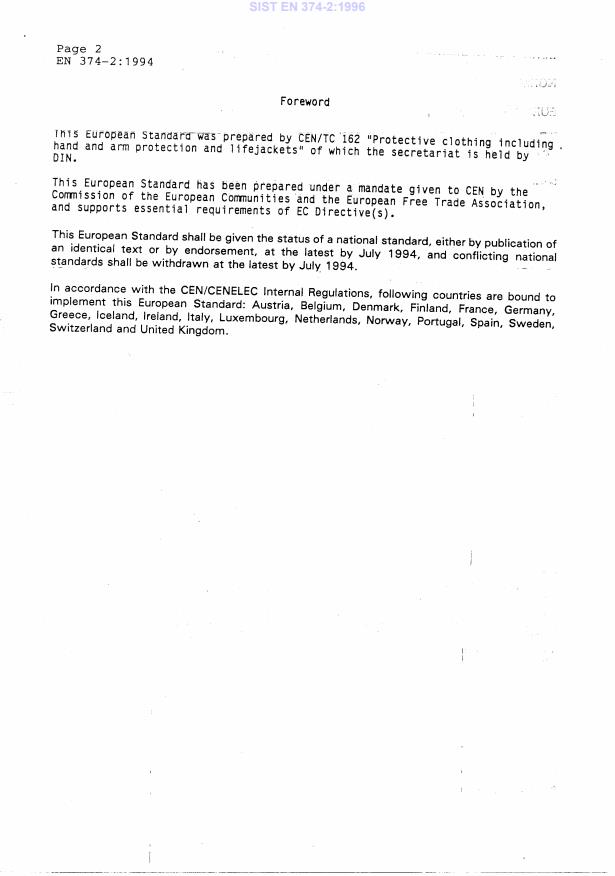
2003-01.Slovenski inštitut za standardizacijo. Razmnoževanje celote ali delov tega standarda ni dovoljeno.Schutzhandschuhe gegen Chemikalien und Mikroorganismen - Teil 2: Bestimmung des Widerstandes gegen PenetrationGants de protection contre les produits chimiques et les micro-organismes - Partie 2: Détermination de la résistance a la pénétrationProtective gloves against chemicals and micro-organisms
...
Questions, Comments and Discussion
Ask us and Technical Secretary will try to provide an answer. You can facilitate discussion about the standard in here.
Loading comments...