

EN 16847:2016
(Main)Fertilizers - Determination of complexing agents in fertilizers - Identification of heptagluconic acid by chromatography
- Abstract
This European Standard specifies a chromatographic method which allows the identification of heptagluconic acid (HGA) in fertilizers containing heptagluconic acid metal complexes.
This method is applicable to EC fertilizers containing complexed micro-nutrients, which are covered by Regulation (EC) No 2003/2003 [1].
- Status
- Published
- Publication Date
- 19-Jan-2016
- Technical Committee
- CEN/TC 260 - Fertilizers and liming materials
- Drafting Committee
- CEN/TC 260/WG 5 - Determination of chelating agents
- Current Stage
- 9093 - Decision to confirm - Review Enquiry
- Start Date
- 04-Oct-2021
- Completion Date
- 07-Oct-2026

Overview
EN 16847:2016 (CEN) defines a chromatographic method for the identification of heptagluconic acid (HGA) in fertilizers that contain HGA–metal complexes. The standard is applicable to EC fertilizers with complexed micronutrients covered by Regulation (EC) No 2003/2003. The method uses demetalation with phosphoric acid followed by high-performance liquid chromatography (HPLC) to detect HGA, enabling laboratories and manufacturers to confirm the presence and quantify this complexing agent.
Key Topics
- Scope: Identification of HGA in fertilizers containing HGA–metal complexes (liquid and solid matrices).
- Analytical principle: Demetalation of metal–HGA complexes with phosphoric acid and separation by HPLC on an NH2-bonded silica column; UV detection at 210 nm.
- Chromatographic conditions: Typical settings include an NH2 column (4.6 × 250 mm, 5 µm), isocratic eluent (phosphoric acid/methanol and acetonitrile), flow rate 1.0 ml/min, and a 20 µL injection loop.
- Sample preparation: Dissolve specified test portion in sample preparation solvent, demetalate, allow formation of metal phosphate (overnight), filter (0.2 µm) before injection.
- Calibration and quantification: Use HGA stock and calibration solutions to build a calibration curve; calculate HGA content as mass fraction (%) in the fertilizer.
- Interferences & limitations: High phosphate can obscure HGA peaks; gluconic acid, aspartic acid, humic or lignosulfonic substances may interfere. Common chelates (EDDHA family, EDTA, DTPA etc.) are resolved at longer retention times.
- Precision: Inter-laboratory validation reported repeatability and reproducibility data for representative samples (see EN 16847:2016 Annex D).
Applications
- Quality control and product specification for fertilizer manufacturers that use HGA as a chelating/complexing agent.
- Routine testing in analytical laboratories verifying complexing agents in micronutrient fertilizers.
- Regulatory compliance testing by authorities to confirm conformity with EU fertilizer regulations (Regulation (EC) No 2003/2003).
- Use in certification, import/export checks, and forensic analyses where identification of chelating agents like HGA is required.
Related Standards
- Regulation (EC) No 2003/2003 - EC fertilizers framework
- EN 15962 - determination of complexed metals (used to compute HGA:metal ratios)
- EN ISO 3696 - water for laboratory use
- EN 12944-1 / EN 12944-2 - vocabulary for fertilizers and liming materials
For laboratories implementing EN 16847:2016, adherence to specified sample preparation, chromatographic parameters, and interference considerations is essential to obtain reliable identification and quantification of heptagluconic acid (HGA) in fertilizer matrices.
Relations
- Effective Date
- 28-Jan-2026
- Effective Date
- 28-Jan-2026
- Effective Date
- 28-Jan-2026
- Referred By
CEN/TS 17791:2022 - Inorganic fertilizers - Determination of chelating and complexing agents - Effective Date
- 28-Jan-2026
- Effective Date
- 28-Jan-2026
Get Certified
Connect with accredited certification bodies for this standard

Control Union Certifications
Global certification for agriculture and sustainability.

ECOCERT
Organic and sustainability certification.

FSC International
Forest Stewardship Council certification.
Sponsored listings
Frequently Asked Questions
EN 16847:2016 is a standard published by the European Committee for Standardization (CEN). Its full title is "Fertilizers - Determination of complexing agents in fertilizers - Identification of heptagluconic acid by chromatography". This standard covers: This European Standard specifies a chromatographic method which allows the identification of heptagluconic acid (HGA) in fertilizers containing heptagluconic acid metal complexes. This method is applicable to EC fertilizers containing complexed micro-nutrients, which are covered by Regulation (EC) No 2003/2003 [1].
This European Standard specifies a chromatographic method which allows the identification of heptagluconic acid (HGA) in fertilizers containing heptagluconic acid metal complexes. This method is applicable to EC fertilizers containing complexed micro-nutrients, which are covered by Regulation (EC) No 2003/2003 [1].
EN 16847:2016 is classified under the following ICS (International Classification for Standards) categories: 65.080 - Fertilizers. The ICS classification helps identify the subject area and facilitates finding related standards.
EN 16847:2016 has the following relationships with other standards: It is inter standard links to EN 12944-2:1999, EN ISO 3696:1995, EN 12944-1:1999, CEN/TS 17791:2022, CEN/TS 17764:2022. Understanding these relationships helps ensure you are using the most current and applicable version of the standard.
EN 16847:2016 is associated with the following European legislation: EU Directives/Regulations: 2003/2003, 2019/1009; Standardization Mandates: M/418. When a standard is cited in the Official Journal of the European Union, products manufactured in conformity with it benefit from a presumption of conformity with the essential requirements of the corresponding EU directive or regulation.
EN 16847:2016 is available in PDF format for immediate download after purchase. The document can be added to your cart and obtained through the secure checkout process. Digital delivery ensures instant access to the complete standard document.
Standards Content (Sample)
2003-01.Slovenski inštitut za standardizacijo. Razmnoževanje celote ali delov tega standarda ni dovoljeno.]QDYDQMHDüngemittel - Bestimmung von Komplexbildnern in Düngemitteln - Bestimmung von Heptaglukonsäure mit ChromatographieEngrais - Détermination des agents complexants dans les engrais - Identification de l'acide heptagluconique par chromatographieFertilizers - Determination of complexing agents in fertilizers - Identification of heptagluconic acid by chromatography65.080GnojilaFertilizersICS:Ta slovenski standard je istoveten z:EN 16847:2016SIST EN 16847:2016en,fr,de01-december-2016SIST EN 16847:2016SLOVENSKI
STANDARD
EUROPEAN STANDARD NORME EUROPÉENNE EUROPÄISCHE NORM
EN 16847
January
t r s x ICS
x wä r z r English Version
Fertilizers æ Determination of complexing agents in fertilizers æ Identification of heptagluconic acid by chromatography Engrais æ Détermination des agents complexants dans les engrais æ Identification de l 5acide heptagluconique par chromatographie
Düngemittel æ Bestimmung von Komplexbildnern in Düngemitteln æ Identifikation von Heptaglukonsäure mit Chromatographie This European Standard was approved by CEN on
s y November
t r s wä
egulations which stipulate the conditions for giving this European Standard the status of a national standard without any alterationä Upætoædate lists and bibliographical references concerning such national standards may be obtained on application to the CENæCENELEC Management Centre or to any CEN memberä
translation under the responsibility of a CEN member into its own language and notified to the CENæCENELEC Management Centre has the same status as the official versionsä
CEN members are the national standards bodies of Austriaá Belgiumá Bulgariaá Croatiaá Cyprusá Czech Republicá Denmarká Estoniaá Finlandá Former Yugoslav Republic of Macedoniaá Franceá Germanyá Greeceá Hungaryá Icelandá Irelandá Italyá Latviaá Lithuaniaá Luxembourgá Maltaá Netherlandsá Norwayá Polandá Portugalá Romaniaá Slovakiaá Sloveniaá Spainá Swedená Switzerlandá Turkey and United Kingdomä
EUROPEAN COMMITTEE FOR STANDARDIZATION COMITÉ EUROPÉEN DE NORMALISATION EUROPÄISCHES KOMITEE FÜR NORMUNG
CEN-CENELEC Management Centre:
Avenue Marnix 17,
B-1000 Brussels
t r s x CEN All rights of exploitation in any form and by any means reserved worldwide for CEN national Membersä Refä Noä EN
s x z v yã t r s x ESIST EN 16847:2016
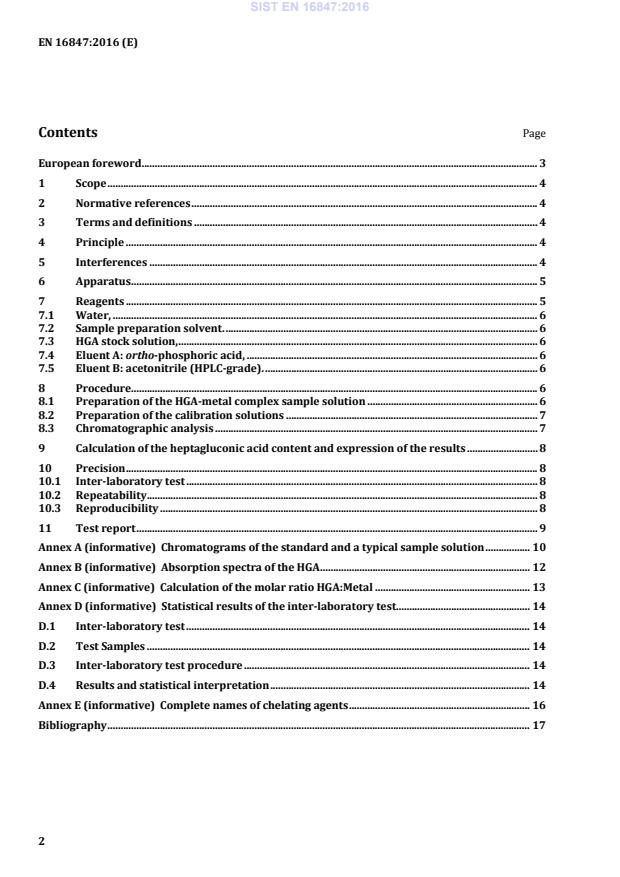
Chromatograms of the standard and a typical sample solution . 10 Annex B (informative)
Absorption spectra of the HGA . 12 Annex C (informative)
Calculation of the molar ratio HGA:Metal . 13 Annex D (informative)
Statistical results of the inter-laboratory test . 14 D.1 Inter-laboratory test . 14 D.2 Test Samples . 14 D.3 Inter-laboratory test procedure . 14 D.4 Results and statistical interpretation . 14 Annex E (informative)
Complete names of chelating agents . 16 Bibliography . 17
These substances can be detected in the chromatogram by the appearance of a peak at larger retention times. Therefore, the presence of these kinds of substances shall be taken into account when successive injections are scheduled. SIST EN 16847:2016
c) a NH2 column; internal diameter: 4,6 mm; column length: 250 mm; dp = 5 1); d) a NH2 guard-column (recommended); e) a UV-Vis detector with a 210 nm-filter; f) an integrator. 6.3 Chromatographic conditions, according to Table 1. Table 1 — Chromatographic conditions Flow rate Eluent A (7.4) % Eluent B (7.5) % 1 ml/min 75 25 6.4 Balance, Balance, with an accuracy of ± 0,1 mg. 6.5 Membrane filters. Micro membrane filters resistant to aqueous solutions, with porosity of respectively 0,45 0,2
7 Reagents Use only reagents of recognized analytical grade.
1) Phenosphere NH2 80A 5 µm 250×4,6 mm or equivalent. This is an example of suitable product available commercially. This information is given for the convenience of users of this European Standard and does not constitute an endorsement by CEN of this product. Equivalent products can be used if they can be shown to lead to the same results.
...