

FprEN 1977
(Main)Copper and copper alloys - Copper drawing stock (wire rod)
- Abstract
This document specifies the composition, mechanical, electrical and physical properties for high conductivity copper drawing stock (wire rod) suitable for fabrication into wire by cold drawing, principally for the manufacture of electrical conductors. This documentcovers drawing stock (wire rod), in nine grades of copper and nine silver-bearing copper grades. Normally, the cross-section is approximately circular, in a range of diameters from 6 mm.
- Status
- Not Published
- Publication Date
- 10-Feb-2027
- Technical Committee
- CEN/TC 133 - Copper and copper alloys
- Drafting Committee
- CEN/TC 133/WG 1 - Unwrought copper products
- Current Stage
- 4599 - Dispatch of FV draft to CMC - Finalization for Vote
- Start Date
- 24-Aug-2026
- Due Date
- 06-Jul-2027
- Completion Date
- 24-Aug-2026

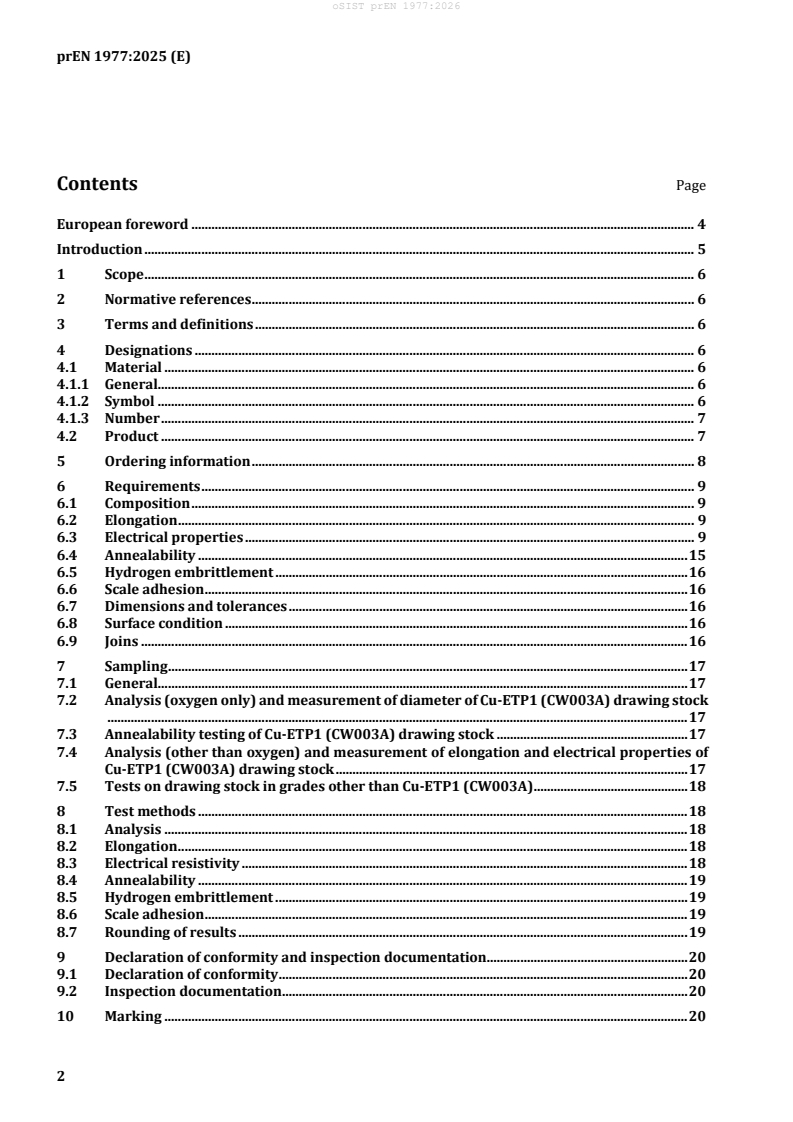
FprEN 1977 is a CEN document for copper and copper alloys - copper drawing stock (wire rod). It specifies the composition, mechanical, electrical and physical properties of high-conductivity wire rod intended for cold drawing, mainly for electrical conductors. The document covers nine copper grades and nine silver-bearing copper grades, and it sets the rules for designation, ordering, sampling, testing, conformity documents and marking.
What does FprEN 1977 specify?
FprEN 1977 applies to copper drawing stock supplied as coils, normally with an approximately circular cross-section and diameters from 6 mm. It organizes the subject into clauses on scope, normative references, terms, designation, ordering, requirements, sampling, test methods, conformity documentation and marking.
Annex A gives background on the relationship between electrical resistivity and conductivity. Annex B gives a normative Rapid Elongation Test method (AR-Test) for 8 mm Cu-ETP1 wire rod.
| Annex | What it covers |
|---|---|
| Annex A | Electrical resistivity and conductivity relationships, including IACS background |
| Annex B | Rapid Elongation Test method (AR-Test) for diameter 8 mm Cu-ETP1 wire rod |
What are the key requirements of FprEN 1977?
FprEN 1977 ties each grade to a defined chemical composition, then adds grade-specific mechanical, electrical and physical requirements. In practice, buyers use those tables to select the right grade, and producers use them to control melting, rolling, testing and acceptance.
Composition and designation
Clause 4 lets the material be designated by symbol or by number, using the systems based on ISO 1190-1 and EN 1412. Clause 5 then turns that into a product designation with the denomination, document number, material designation, nominal diameter, nominal coil mass and surface condition.
That matters because a complete order needs to identify the exact grade and product form. It reduces ambiguity between similar copper grades and makes traceability easier in purchasing and inspection.
Mechanical and electrical properties
Clause 6.2 requires hot-finished drawing stock to reach a minimum elongation of 30 %. For cold-finished material, the standard leaves elongation to be agreed if it is needed.
Clause 6.3 sets the electrical property requirements through Table 6, using volume resistivity at 20 °C as the mandatory property. The table also gives the related nominal conductivity values, which helps users compare grades for conductor applications.
Annealability, hydrogen embrittlement and surface behaviour
Clause 6.4 applies to Cu-ETP1 only. It requires a minimum spiral elongation number (S.E.N.) and also allows the Rapid Elongation Test (AR-Test) in Annex B as an alternative route, with the spiral elongation test in EN 12893 acting as the reference method if needed.
Clause 6.5 applies hydrogen embrittlement testing to the grades listed there, using EN ISO 2626. For Cu-PHCE, the assessment uses the reverse bend test; for the other applicable grades, it uses the close-bend test. Clause 6.6 separately requires Cu-OFE to meet the scale adhesion test in ISO 4746.
In practice, these clauses tell the producer which grades need extra process control, especially on oxygen level and annealing, because those factors affect crack resistance and forming behaviour.
Dimensions, surface condition and joins
Clause 6.7 gives diameter tolerances by size range in Table 7. For nominal diameters above 35 mm, the tolerance is left to agreement between supplier and purchaser.
Clause 6.8 allows two surface conditions: as manufactured, or cleaned, with or without protective coating. Cleaned material has to be ready for cold drawing without preliminary cleaning. Clause 6.9 requires each coil to be continuous unless joins are specifically allowed in the order.
That matters on the shop floor because coil condition affects drawability, scrap risk and downstream cleaning time.
Sampling and test control
Clause 7 gives different sampling rules for Cu-ETP1 and for the other grades. For Cu-ETP1, oxygen analysis and diameter measurement use one sampling unit per 60 t, while other analysis, elongation, resistivity and annealability use one sampling unit per 500 t. For the other grades, the manufacturer sets the sampling rate unless the purchaser specifies otherwise.
Clause 8 says sampling pieces must come from finished material and not be further treated except for machining needed to prepare test pieces. Results for composition, elongation and resistivity are rounded according to the stated rule in 8.7, so acceptance is based on consistent reported values.
Documentation and marking
Clause 9 lets the purchaser request a declaration of conformity in line with EN ISO/IEC 17050-1 or EN ISO/IEC 17050-2, and an inspection document in line with EN 10204. Clause 10 requires each coil to be marked with the maker’s name or trademark, the document number and grade, and the net mass.
For purchasing and quality teams, that is the practical link between the material delivered, the test evidence and the paperwork that accompanies it.
What terms does FprEN 1977 define?
- Drawing stock (wire rod) - an intermediate solid wrought product of uniform cross-section, supplied in coils, that is intended for further drawing.
- Material designation - the symbol or number used to identify a copper grade in the tables.
- Product designation - the standardized order code that combines denomination, EN 1977, material designation, nominal diameter, nominal coil mass and surface condition.
- S.E.N. (spiral elongation number) - the annealability measure used in EN 12893 for Cu-ETP1.
- AR-Test (Rapid Elongation Test) - the fast annealability test in Annex B for 8 mm Cu-ETP1 wire rod.
- IACS (International Annealed Copper Standard) - the conductivity reference used in Annex A and in the conductivity values in Table 6.
Who uses FprEN 1977?
Copper producers, rod mills, wire drawers and manufacturers of electrical conductors use FprEN 1977 to define the product they make and the tests they must pass. Buyers and quality managers use it to specify grade, diameter, coil mass, surface condition, joins, documentation and acceptance tests. Laboratories and inspection bodies use it for chemistry, elongation, resistivity, annealability, hydrogen embrittlement and scale adhesion work.
What changed in FprEN 1977 from the previous edition?
FprEN 1977 supersedes EN 1977:2013. The draft states these technical changes:
- references to EN 1655 were replaced by EN ISO/IEC 17050-1 and EN ISO/IEC 17050-2
- oxygen content limits were defined for oxygen-free coppers, and Table 5 was revised accordingly
- sampling frequencies for some tests were revised
Which standards are used with FprEN 1977?
- EN ISO/IEC 17050-1 - gives the general rules for a supplier’s declaration of conformity.
- EN ISO/IEC 17050-2 - gives the supporting documentation for that declaration.
- EN 10204 - gives the inspection document types that may accompany the product.
- EN 12893 - provides the spiral elongation number method used for annealability.
- EN ISO 2626 - provides the hydrogen embrittlement test and the close-bend or reverse-bend assessment.
- EN ISO 6892-1:2019 - provides the tensile test method used for elongation.
- IEC 60468 - gives the method for measuring resistivity of metallic materials.
- ISO 4746 - provides the scale adhesion test method.
- ISO 1190-1 - provides the copper alloy material designation system used for symbols.
- EN 1412 - provides the numerical designation system used for material numbers.
- IEC 60028 - provides the standard annealed copper basis used in Annex A.
- ISO 80000-1:2009 - provides the rounding guidance used for reported results.
What does the FprEN 1977 document contain?
The core tables set the chemical composition limits for the copper, phosphorus-containing and silver-bearing grades. Table 5 links each grade to the tests that apply, so users can see which materials need analysis, elongation, resistivity, annealability, hydrogen embrittlement or scale adhesion checks.
Table 6 gives the electrical property limits at 20 °C, and Table 7 gives diameter tolerances by size range. Table 8 sets sampling rates for the different tests.
Annex B adds a step-by-step AR-Test procedure, including sample preparation, annealing and tensile testing conditions. That annex is useful when a producer wants a quicker routine check for annealability on Cu-ETP1 wire rod.
Relations
- Effective Date
- 08-Oct-2025
Get Certified
Connect with accredited certification bodies for this standard

Element Materials Technology
Materials testing and product certification.

Inštitut za kovinske materiale in tehnologije
Institute of Metals and Technology. Materials testing, metallurgical analysis, NDT.
Sponsored listings
Frequently Asked Questions
FprEN 1977 is a draft published by the European Committee for Standardization (CEN). Its full title is "Copper and copper alloys - Copper drawing stock (wire rod)". This standard covers: This document specifies the composition, mechanical, electrical and physical properties for high conductivity copper drawing stock (wire rod) suitable for fabrication into wire by cold drawing, principally for the manufacture of electrical conductors. This documentcovers drawing stock (wire rod), in nine grades of copper and nine silver-bearing copper grades. Normally, the cross-section is approximately circular, in a range of diameters from 6 mm.
This document specifies the composition, mechanical, electrical and physical properties for high conductivity copper drawing stock (wire rod) suitable for fabrication into wire by cold drawing, principally for the manufacture of electrical conductors. This documentcovers drawing stock (wire rod), in nine grades of copper and nine silver-bearing copper grades. Normally, the cross-section is approximately circular, in a range of diameters from 6 mm.
FprEN 1977 is classified under the following ICS (International Classification for Standards) categories: 77.150.30 - Copper products. The ICS classification helps identify the subject area and facilitates finding related standards.
FprEN 1977 has the following relationships with other standards: It is inter standard links to EN 1977:2013. Understanding these relationships helps ensure you are using the most current and applicable version of the standard.
FprEN 1977 is available in PDF format for immediate download after purchase. The document can be added to your cart and obtained through the secure checkout process. Digital delivery ensures instant access to the complete standard document.
Standards Content (Sample)
SLOVENSKI STANDARD
01-april-2026
Baker in bakrove zlitine - Polizdelki za bakreno žico
Copper and copper alloys - Copper drawing stock (wire rod)
Kupfer und Kupferlegierungen - Vordraht aus Kupfer
Cuivre et alliages de cuivre - Fil machine en cuivre
Ta slovenski standard je istoveten z: prEN 1977
ICS:
77.150.30 Bakreni izdelki Copper products
2003-01.Slovenski inštitut za standardizacijo. Razmnoževanje celote ali delov tega standarda ni dovoljeno.
DRAFT
EUROPEAN STANDARD
prEN 1977
NORME EUROPÉENNE
EUROPÄISCHE NORM
January 2026
ICS 77.150.30 Will supersede EN 1977:2013
English Version
Copper and copper alloys - Copper drawing stock (wire
rod)
Cuivre et alliages de cuivre - Fil machine en cuivre Kupfer und Kupferlegierungen - Vordraht aus Kupfer
This draft European Standard is submitted to CEN members for enquiry. It has been drawn up by the Technical Committee
CEN/TC 133.
If this draft becomes a European Standard, CEN members are bound to comply with the CEN/CENELEC Internal Regulations
which stipulate the conditions for giving this European Standard the status of a national standard without any alteration.
This draft European Standard was established by CEN in three official versions (English, French, German). A version in any other
language made by translation under the responsibility of a CEN member into its own language and notified to the CEN-CENELEC
Management Centre has the same status as the official versions.
CEN members are the national standards bodies of Austria, Belgium, Bulgaria, Croatia, Cyprus, Czech Republic, Denmark, Estonia,
Finland, France, Germany, Greece, Hungary, Iceland, Ireland, Italy, Latvia, Lithuania, Luxembourg, Malta, Netherlands, Norway,
Poland, Portugal, Republic of North Macedonia, Romania, Serbia, Slovakia, Slovenia, Spain, Sweden, Switzerland, Türkiye and
United Kingdom.
Recipients of this draft are invited to submit, with their comments, notification of any relevant patent rights of which they are
aware and to provide supporting documentation.
Warning : This document is not a European Standard. It is distributed for review and comments. It is subject to change without
notice and shall not be referred to as a European Standard.
EUROPEAN COMMITTEE FOR STANDARDIZATION
COMITÉ EUROPÉEN DE NORMALISATION
EUROPÄISCHES KOMITEE FÜR NORMUNG
CEN-CENELEC Management Centre: Rue de la Science 23, B-1040 Brussels
© 2026 CEN All rights of exploitation in any form and by any means reserved Ref. No. prEN 1977:2026 E
worldwide for CEN national Members.
prEN 1977:2025 (E)
Contents Page
European foreword . 4
Introduction . 5
1 Scope . 6
2 Normative references . 6
3 Terms and definitions . 6
4 Designations . 6
4.1 Material . 6
4.1.1 General. 6
4.1.2 Symbol . 6
4.1.3 Number . 7
4.2 Product . 7
5 Ordering information . 8
6 Requirements . 9
6.1 Composition . 9
6.2 Elongation . 9
6.3 Electrical properties . 9
6.4 Annealability . 15
6.5 Hydrogen embrittlement . 16
6.6 Scale adhesion . 16
6.7 Dimensions and tolerances . 16
6.8 Surface condition . 16
6.9 Joins . 16
7 Sampling . 17
7.1 General. 17
7.2 Analysis (oxygen only) and measurement of diameter of Cu-ETP1 (CW003A) drawing stock
............................................................................................................................................................................. 17
7.3 Annealability testing of Cu-ETP1 (CW003A) drawing stock . 17
7.4 Analysis (other than oxygen) and measurement of elongation and electrical properties of
Cu-ETP1 (CW003A) drawing stock . 17
7.5 Tests on drawing stock in grades other than Cu-ETP1 (CW003A) . 18
8 Test methods . 18
8.1 Analysis . 18
8.2 Elongation . 18
8.3 Electrical resistivity . 18
8.4 Annealability . 19
8.5 Hydrogen embrittlement . 19
8.6 Scale adhesion . 19
8.7 Rounding of results . 19
9 Declaration of conformity and inspection documentation. 20
9.1 Declaration of conformity . 20
9.2 Inspection documentation. 20
10 Marking . 20
prEN 1977:2025 (E)
Annex A (informative) Information on electrical resistivity and conductivity relationships . 21
Annex B (normative) Rapid Elongation Test method (AR-Test) for diameter 8 mm Cu-ETP1 wire
rod . 23
Bibliography . 26
prEN 1977:2025 (E)
European foreword
This document (prEN 1977:2025) has been prepared by Technical Committee CEN/TC 133 “Copper and
copper alloys”, the secretariat of which is held by DIN.
This document will supersede EN 1977:2013.
prEN 1977:2025 includes the following significant technical changes with respect to EN 1977:2013:
a) References to EN 1655 have been replaced by EN ISO/IEC 17050-1 and EN ISO/IEC 17050-2.
b) Tables 1 and 2, limits have been defined for the oxygen content in oxygen-free coppers. Table 5 has
been revised accordingly.
c) Table 8, The sampling frequencies of some tests have been revised.
This document is one of a series of European Standards for products manufactured from refined copper
grades.
Other products are specified as follows:
— EN 1976, Copper and copper alloys — Cast unwrought copper products
— EN 1978, Copper and copper alloys — Copper cathodes
— EN 13602, Copper and copper alloys — Drawn, round copper wire for the manufacture of electrical
conductors
prEN 1977:2025 (E)
Introduction
Copper drawing stock (wire rod) is normally manufactured by one of the following process routes:
— continuous casting and hot rolling in tandem;
— continuous or semi-continuous casting and cold rolling;
— rolling of wire bar or billets; or
— extrusion.
Annex A (informative) gives information on the relationships between electrical resistivity and
conductivity (of copper).
Annex B (normative) describes the rapid elongation test method (AR-Test) for diameter 8 mm Cu-ETP1
wire rod.
prEN 1977:2025 (E)
1 Scope
This document specifies the composition, mechanical, electrical and physical properties for high
conductivity copper drawing stock (wire rod) suitable for fabrication into wire by cold drawing,
principally for the manufacture of electrical conductors. This documentcovers drawing stock (wire rod),
in nine grades of copper and nine silver-bearing copper grades. Normally, the cross-section is
approximately circular, in a range of diameters from 6 mm.
2 Normative references
The following documents, in whole or in part, are normatively referenced in this document and are
indispensable for its application. For dated references, only the edition cited applies. For undated
references, the latest edition of the referenced document (including any amendments) applies.
EN ISO/IEC 17050-1, Conformity assessment — Supplier’s declaration of conformity — Part 1: General
requirements(ISO/IEC 17050-1))
EN ISO/IEC 17050-2, Conformity assessment — Supplier ́s declaration of conformity — Part 2: Supporting
documentation(ISO/IEC 17050-2)
EN 10204, Metallic products — Types of inspection documents
EN 12893, Copper and copper alloys — Determination of spiral elongation number
EN ISO 2626, Copper — Hydrogen embrittlement test (ISO 2626)
EN ISO 6892-1:2019, Metallic materials — Tensile testing — Part 1: Method of test at room temperature
(ISO 6892-1:2019)
IEC 60468, Method of measurement of resistivity of metallic materials
ISO 4746, Oxygen-free copper — Scale adhesion test
3 Terms and definitions
For the purposes of this document, the following terms and definitions apply.
3.1
drawing stock
wire rod
intermediate solid wrought product, of uniform cross-section along its whole length, supplied in coils
4 Designations
4.1 Material
4.1.1 General
The material is designated either by symbol or number (see Tables 1 to 4).
4.1.2 Symbol
The material symbol designation is based on the designation system given in ISO 1190-1.
prEN 1977:2025 (E)
NOTE Although material symbol designations used in this document might be the same as those in other
standards using the designation system given in ISO 1190-1, the detailed composition requirements are not
necessarily the same.
4.1.3 Number
The material number designation is in accordance with the system given in EN 1412.
4.2 Product
The product designation provides a standardized pattern of designation from which a rapid and
unequivocal description of a product is conveyed in communication. It provides mutual comprehension
at the international level with regard to products which meet the requirements of the relevant European
Standard.
The product designation is no substitute for the full content of the standard.
The product designation for products to this documentshall consist of:
— denomination (copper drawing stock);
— number of this document(EN 1977);
— material designation, either symbol or number (see Tables 1 to 4);
— nominal diameter;
— nominal coil mass;
— surface condition (the following designations shall be used, as appropriate: M for as manufactured,
CL for cleaned).
The derivation of a product designation is shown in the following example.
EXAMPLE
Drawing stock (wire rod) conforming to this document, in material designated either Cu-ETP or CW004A, nominal
diameter 8 mm, in 1 000 kg coils, cleaned surface condition, shall be designated as follows:
prEN 1977:2025 (E)
5 Ordering information
In order to facilitate the enquiry, order and information of order procedures between the purchaser and
the supplier, the purchaser shall state on his enquiry and order the following information:
a) quantity of product required (mass or number of coils);
b) denomination (copper drawing stock);
c) number of this document(EN 1977);
d) material designation (see Tables 1 to 4);
e) nominal diameter;
f) nominal coil mass;
g) surface condition (see 6.8).
It is recommended that the product designation as described in 4.2 is used for items b) to g).
In addition, the purchaser shall also state on the enquiry and order any of the following, if required:
h) whether joins are permitted in the coils (see 6.9);
i) additional tests, if any, which the purchaser requires to be carried out by the manufacturer on the
material, selected from the tests appropriate to each copper grade given in Table 5;
j) whether a declaration of conformity is required (see 9.1);
k) whether an inspection document is required, and if so which type (see 9.2).
EXAMPLE
Ordering details for 5 000 kg of drawing stock conforming to EN 1977, in material designated either Cu-ETP or
CW004A, nominal diameter 8 mm, in 1 000 kg coils, cleaned surface condition:
5 000 kg Copper drawing stock EN 1977 – Cu-ETP – 8 – 1 000 – CL
prEN 1977:2025 (E)
or
5 000 kg Copper drawing stock EN 1977 – CW004A – 8 — 1 000 – CL
6 Requirements
6.1 Composition
The composition shall conform to the requirements for the appropriate grade given in Tables 1 to 4.
6.2 Elongation
Hot-finished drawing stock shall have a minimum elongation of 30 %. The test shall be carried out in
accordance with 8.2.
No elongation requirements are specified for cold-finished drawing stock. If such requirements are
necessary, they should be agreed between the purchaser and the supplier.
6.3 Electrical properties
The maximum volume resistivity at 20 °C of hot-finished drawing stock shall conform to the appropriate
requirements given in Table 6. The test shall be carried out in accordance with 8.3.
prEN 1977:2025 (E)
Composition % (mass fraction)
Material
Elements
designation
listed in this
Cu Ag As Bi Cd Co Cr Fe Mn Ni O P Pb S Sb Se Si Sn Te Zn
table other
than copper
Symbol Number
Cu-ETP1 CW003A min. − − − − − − − − − − − − − − − − − − − − − O
a c a a c a c c b c
− − 0,001 − 0,040 − 0,000 0,001 0,000 − 0,000 20 − 0,006 5
max. − 0,002 0,000 0,000 − − 0,000 −
a b c a b
5 5 20 0 5 5 4 20
Cu-OF1 CW007A min. − − − − − − − − − − − − − − − − − − − − − O
a c a a c a c c b c
max. − 0,002 0,000 0,000 − − − 0,001 − − −0,000 − 0,000 0,001 0,000 0,000 − − 0,000 20 − 0,006 5
a b c a b
5 5 20 0 5 5 5 4 20
Cu-OFE CW009A min. 99,99 − − − − − − − − − − − − − − − − − − − − −
0,002 0,000 0,000 0,000 0,001 −0,000 0,000 0,000 0,001 0,000 0,000
max. − − − 0,0005 0,0010 − 0,000 2 0,000 20 0,000 1 −
5 5 20 1 0 5 3 5 5 4 20
Cu-PHCE CW022A min. 99,99 − − − − − − − − − − 0,001 − − − − − − − − − −
d
0,006 0,000 0,001 0,000 0,000 − 0,000 2 0,000 20 0,000 1 −
max. − 0,002 0,000 0,000 0,000 − − 0,001 0,0005 0,0010 −
5 5 20 1 0 5 5 4 20
a
(As + Cd + Cr + Mn + P + Sb) max. 0,001 5 %.
b
(Bi + Se + Te) max. 0,000 3 %, of which (Se + Te) max. 0,000 30 %.
c
(Co + Fe + Ni + Si + Sn + Zn) max. 0,002 0 %.
d
The oxygen content shall be controlled by the manufacturer so that the material conforms to the hydrogen embrittlement requirements.
Element
total
excluding
prEN 1977:2025 (E)
Table 2 — Composition of copper grades, other than those made from Cu-CATH-1 (CR001A)
Composition % (mass fraction)
Material designation
Elemen other elements
a
Cu Bi O Pb
t (see Note)
Symbol Number total excluding
Cu-ETP CW004A min. 99,90 — — — — Ag, O
b
max. — 0,000 5 0,040 0,005 0,03
Cu-FRHC CW005A min. 99,90 — — — — Ag, O
b c
max. — — 0,040 — 0,06
Cu-OF CW008A min. 99,95 — — — — Ag
max. — 0,001 — 0,001 0,005 0,03
NOTE The total of other elements (than copper) is defined as the sum of Ag, As, Bi, Cd, Co, Cr, Fe, Mn, Ni, O,
P, Pb, S, Sb, Se, Si, Sn, Te and Zn, subject to the exclusion of any individual elements indicated.
a
Including silver, up to a maximum of 0,015 %.
b
Oxygen content up to 0,060 % is permitted, subject to agreement between the purchaser and the supplier.
c
Higher total impurities content is permitted, subject to agreement between the purchaser and the supplier.
Table 3 — Composition of phosphorus-containing copper grades
Composition % (mass fraction)
Material designation
other elements
a
Element Cu Bi P Pb
(see Note)
Symbol Number total excluding
Cu-PHC CW020A min. 99,95 — 0,001 — — Ag, P
b
max. — 0,000 5 0,006 0,005 0,03
Cu-HCP CW021A min. 99,95 — 0,002 — — Ag, P
b
max — 0,000 5 0,007 0,005 0,03
NOTE The total of other elements (than copper) is defined as the sum of Ag, As, Bi, Cd, Co, Cr, Fe, Mn, Ni, O,
P, Pb, S, Sb, Se, Si, Sn, Te and Zn, subject to the exclusion of any individual elements indicated.
a
Including silver, up to a maximum of 0,015 %.
b
The oxygen content shall be controlled by the manufacturer so that the material conforms to the hydrogen
embrittlement requirements.
prEN 1977:2024 (E)
Table 4 — Composition of silver-containing copper grades (silver-bearing coppers)
Composition % (mass fraction)
Material designation
other elements
Element Cu Ag Bi O P
(see Note)
excludin
Symbol Number total
g
CuAg0,04 CW011A min. Rem. 0,03 — — — — Ag, O
max. — 0,05 0,000 5 0,040 — 0,03
CuAg0,07 CW012A min. Rem. 0,06 — — — — Ag, O
max. — 0,08 0,000 5 0,040 — 0,03
CuAg0,10 CW013A min. Rem. 0,08 — − — — Ag, O
max. — 0,12 0,000 5 0,040 — 0,03
CuAg0,04P CW014A min. Rem. 0,03 — — 0,001 — Ag, P
a
max. — 0,05 0,000 5 — 0,007 0,03
CuAg0,07P CW015A min. Rem. 0,06 — — 0,001 — Ag, P
a
max. — 0,08 0,000 5 — 0,007 0,03
CuAg0,10P CW016A min. Rem. 0,08 — — 0,001 — Ag, P
a
max. — 0,12 0,000 5 — 0,007 0,03
CuAg0,04(OF) CW017A min. Rem. 0,03 — — — — Ag, O
a
— 0,006 5
max. — 0,05 0,000 5 —
CuAg0,07(OF) CW018A min. Rem. 0,06 — — — — Ag, O
a
max. — 0,08 0,000 5 — — 0,006 5
CuAg0,10(OF) CW019A min. Rem. 0,08 — — — — Ag, O
a
max. — 0,12 0,000 5 — — 0,006 5
NOTE The total of other elements (than copper) is defined as the sum of Ag, As, Bi, Cd, Co, Cr, Fe, Mn, Ni, O,
P, Pb, S, Sb, Se, Si, Sn, Te and Zn, subject to the exclusion of any individual elements indicated.
a
The oxygen content shall be controlled by the manufacturer so that the material conforms to the hydrogen
embrittlement requirements.
...