

EN 2157-2:1993
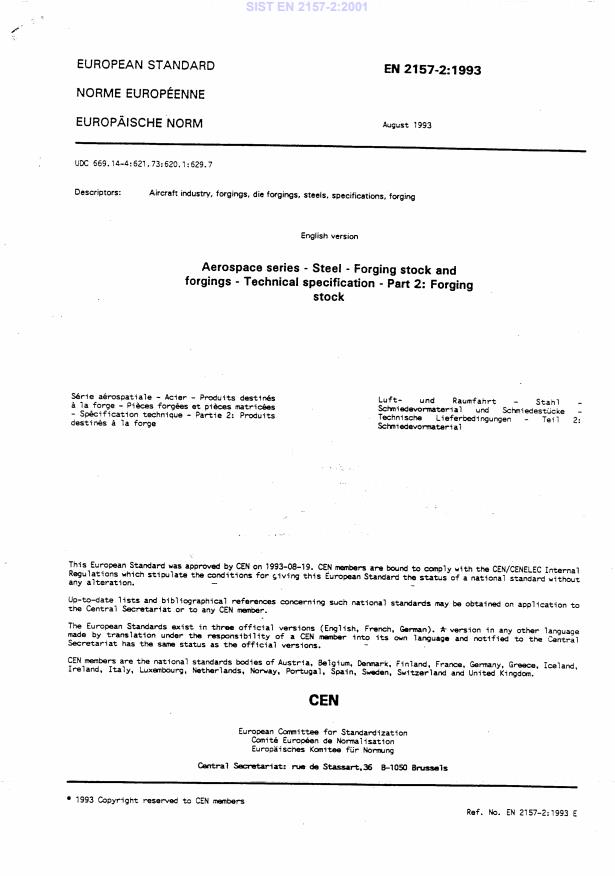
(Main)Aerospace series - Steel - Forging stock and forgings - Technical specification - Part 2: Forging stock
- Abstract
The present standard specifies the particular requirements for forging stock intended for the manufacture of steel forgings. This standard shall be used in conjunction with EN 2157-1. Bars and sections conforming to EN 2069-3 may be used as forgings stock provided that an agreement was established between the forging stock manufacturer and the purchaser to ensure that the requirements of the present standard are met.
- Status
- Published
- Publication Date
- 19-Aug-1993
- Withdrawal Date
- 27-Feb-1994
- Technical Committee
- ASD-STAN - Aerospace
- Drafting Committee
- ASD-STAN/D 4 - Metallic
- Current Stage
- 9093 - Decision to confirm - Review Enquiry
- Start Date
- 21-Jan-2024
- Completion Date
- 07-Oct-2026

Overview
EN 2157-2:1993 (CEN) - Aerospace series - Steel - Forging stock and forgings - Technical specification - Part 2: Forging stock specifies the particular requirements for forging stock intended for the manufacture of steel forgings. This Part 2 standard is intended to be used in conjunction with EN 2157-1 and clarifies obligations between forging stock manufacturers and purchasers. Bars and sections that conform to EN 2069-3 may be accepted as forging stock when a formal agreement ensures the requirements of EN 2157-2 are met.
This document is relevant to aerospace manufacturers, forging stock suppliers, procurement teams, and quality assurance professionals who need to manage material selection, inspection, and contractual requirements for steel forgings.
Key Topics
- Scope and intended use: Defines the application of forging stock for steel forgings in aerospace contexts.
- Interface with EN 2157-1: Part 2 is complementary to Part 1 and should be referenced together when specifying material and delivery conditions.
- Acceptance of EN 2069-3 material: Describes that bars and sections complying with EN 2069-3 can be used as forging stock provided a purchaser–manufacturer agreement is in place.
- Quality and conformity principles: Emphasizes the need for documented agreements, material verification and adherence to specified requirements before manufacture.
Applications
EN 2157-2:1993 is practical in several use cases:
- Procurement and supply chain: Use as a contractual reference when sourcing steel forging stock for aerospace components to ensure clarity on responsibilities and acceptance criteria.
- Manufacturing preparation: Guides forging shops in verifying incoming material suitability before forging operations commence.
- Quality assurance and inspection: Provides a framework to confirm that forging stock meets agreed material and dimensional expectations, reducing rework and nonconformances.
- Supplier agreements: Supports drafting supplier-purchaser agreements that explicitly align delivered stock with the standard’s requirements.
Benefits include improved traceability, consistent material acceptance practices, and clearer communication between suppliers and customers in aerospace forging projects.
Related Standards
- EN 2157-1 - Part 1: General provisions and overarching technical specification (use in conjunction with Part 2).
- EN 2069-3 - Bars and sections that may be accepted as forging stock when an agreement ensures EN 2157-2 compliance.
For procurement teams and quality engineers, referencing EN 2157-2:1993 in purchase orders and inspection plans helps ensure forging stock delivered for aerospace applications is appropriate, documented and conformant to agreed requirements.
Relations
- Effective Date
- 28-Jan-2026
- Effective Date
- 28-Jan-2026
- Effective Date
- 28-Jan-2026
- Effective Date
- 28-Jan-2026
- Effective Date
- 28-Jan-2026
- Effective Date
- 28-Jan-2026
- Effective Date
- 28-Jan-2026
- Effective Date
- 28-Jan-2026
- Referred By
EN 2222:2017 - Aerospace series - Steel FE-PL31 - Hardened and tempered - Hand and die forgings - Effective Date
- 28-Jan-2026
- Effective Date
- 28-Jan-2026
- Effective Date
- 28-Jan-2026
- Effective Date
- 28-Jan-2026
- Effective Date
- 28-Jan-2026
- Referred By
EN 2451:2019 - Aerospace series - Steel 31Ni10 - 1 230 MPa ≤ Rm ≤ 1 420 MPa - Forgings - De ≤ 40 mm - Effective Date
- 28-Jan-2026
- Effective Date
- 28-Jan-2026
Get Certified
Connect with accredited certification bodies for this standard

BUREAU VERITAS Certification Germany
Bureau Veritas certification in Germany.

Element Materials Technology
Materials testing and product certification.

AQMS Ltd.
AQMS provides ISO certification to SMEs across the UK.
Sponsored listings
Frequently Asked Questions
EN 2157-2:1993 is a standard published by the European Committee for Standardization (CEN). Its full title is "Aerospace series - Steel - Forging stock and forgings - Technical specification - Part 2: Forging stock". This standard covers: The present standard specifies the particular requirements for forging stock intended for the manufacture of steel forgings. This standard shall be used in conjunction with EN 2157-1. Bars and sections conforming to EN 2069-3 may be used as forgings stock provided that an agreement was established between the forging stock manufacturer and the purchaser to ensure that the requirements of the present standard are met.
The present standard specifies the particular requirements for forging stock intended for the manufacture of steel forgings. This standard shall be used in conjunction with EN 2157-1. Bars and sections conforming to EN 2069-3 may be used as forgings stock provided that an agreement was established between the forging stock manufacturer and the purchaser to ensure that the requirements of the present standard are met.
EN 2157-2:1993 is classified under the following ICS (International Classification for Standards) categories: 49.025.10 - Steels. The ICS classification helps identify the subject area and facilitates finding related standards.
EN 2157-2:1993 has the following relationships with other standards: It is inter standard links to EN 4466:2007, EN 3359:2007, EN 3476:2006, EN 3482:2019, EN 3163:2007, EN 4347:2007, EN 3364:2007, EN 4346:2007, EN 2222:2017, EN 3527:2007, EN 3527:2025, EN 3969:2006, EN 2476:2019, EN 2451:2019, EN 3364:2022. Understanding these relationships helps ensure you are using the most current and applicable version of the standard.
EN 2157-2:1993 is available in PDF format for immediate download after purchase. The document can be added to your cart and obtained through the secure checkout process. Digital delivery ensures instant access to the complete standard document.
Standards Content (Sample)
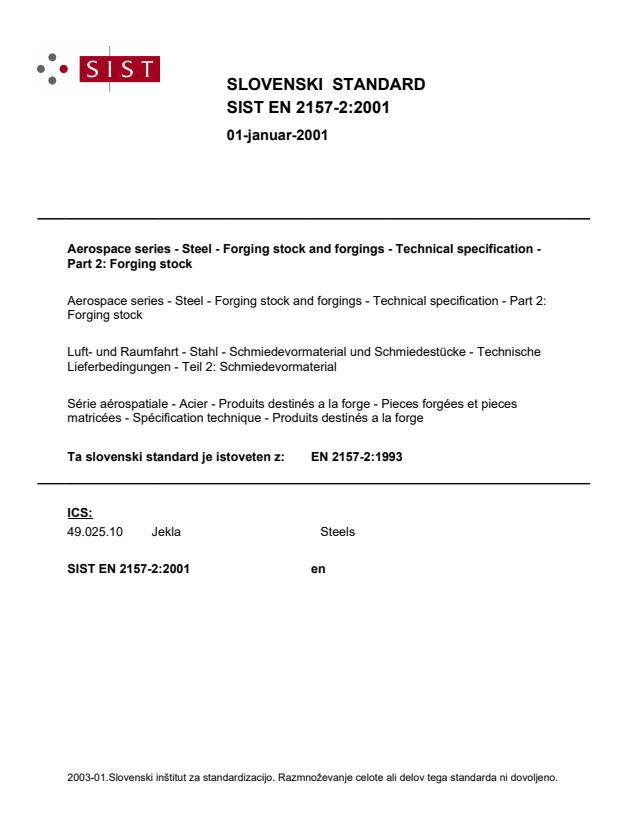
2003-01.Slovenski inštitut za standardizacijo. Razmnoževanje celote ali delov tega standarda ni dovoljeno.Aerospace series - Steel - Forging stock and forgings - Technical specification - Part 2: Forging stockLuft- und Raumfahrt - Stahl - Schmiedevormaterial und Schmiedestücke - Technische Lieferbedingungen - Teil 2: SchmiedevormaterialSérie aérospatiale - Acier - Produits destinés a la forge - Pieces forgées et pieces matricées - Spécification
...