


CEN/TS 15427-2-3:2023
(Main)Railway applications - Wheel/rail friction management - Part 2-3: Properties and Characteristics - Adhesion materials
Railway applications - Wheel/rail friction management - Part 2-3: Properties and Characteristics - Adhesion materials
This document specifies the requirements of adhesion materials intended to be applied to the interface between the wheel tread and the rail crown (active interface). It can be applied either directly or indirectly to the wheel tread or rail.
It outlines the information required for most approval procedures, the method of testing and routine control/monitoring of the material.
This document does not deal with Top of Rail materials. For Top of Rail materials see CEN/TS 15427 2 2:2023.
Bahnanwendungen - Reibungsmanagement zwischen Rad und Schiene - Teil 2-3: Eigenschaften und Merkmale - Kraftschlusserhöhende Materialien
Dieses Dokument legt die Anforderungen an kraftschlusserhöhende Materialien für die Anwendung auf der Kontaktfläche zwischen Radlauffläche und Fahrfläche der Schiene (aktive Kontaktfläche) fest. Diese können direkt oder indirekt auf die Radlauffläche oder die Schiene angewendet werden.
Es beschreibt die erforderlichen Informationen für die meisten Genehmigungsverfahren, das Prüfverfahren und die regelmäßige Kontrolle/Überwachung des Materials.
Dieses Dokument behandelt keine Kraftschlussmodifikatoren. Zu Kraftschlussmodifikatoren siehe CEN/TS 15427 2 2:2023.
Applications ferroviaires - Gestion des frottements roue/rail - Partie 2-3 : Propriétés et caractéristiques - Matériaux pour restauration d'adhérence
Le présent document spécifie les exigences applicables aux matériaux pour restauration d'adhérence destinés à être appliqués sur l'interface entre la bande de roulement de la roue et la tête de rail (interface active). Ils peuvent être appliqués directement ou indirectement, sur la bande de roulement ou sur le rail.
Le présent document précise également les informations nécessaires à la plupart des procédures de validation, la méthode d'essai et les tâches de contrôle/surveillance de routine du matériau.
Le présent document ne traite pas des lubrifiants de tête de rail. Pour les lubrifiants de tête de rail, se reporter à la CEN/TS 15427 2 2:2023.
Železniške naprave - Trenje na stiku kolo-tirnica - 2-3. del: Lastnosti in karakteristike - Lepilni materiali
Ta dokument določa zahteve lepilnih materialov, namenjenih za uporabo na vmesniku med kolesnim obročem in zgornjim robom tirnice (aktivni vmesnik). Uporabljati ga je mogoče posredno ali neposredno za kolesni obroč oziroma tirnico.
Podaja informacije, ki se zahtevajo pri večini postopkov odobritve, preskusno metodo in rutinsko kontrolo/spremljanje materiala.
Dokument ne obravnava materialov za zgornjo površino tirnic. Za tovrstne materiale glej standard FprCEN/TS 15427-2-2:2023.
General Information
- Status
- Published
- Publication Date
- 17-Oct-2023
- Technical Committee
- CEN/TC 256 - Railway applications
- Drafting Committee
- CEN/TC 256/SC 2/WG 38 - Flange lubrication
- Current Stage
- 6060 - Definitive text made available (DAV) - Publishing
- Start Date
- 18-Oct-2023
- Due Date
- 03-Sep-2023
- Completion Date
- 18-Oct-2023
Relations
- Effective Date
- 19-Jan-2023
Overview
CEN/TS 15427-2-3:2023 - "Railway applications - Wheel/rail friction management - Part 2-3: Properties and Characteristics - Adhesion materials" specifies requirements for adhesion materials applied at the wheel tread / rail crown (the active interface). It covers both dry particle products and pumpable traction gels, setting out the information needed for approval procedures, type testing, routine control and monitoring, packaging, labelling and storage. This Technical Specification is focused on wheel/rail friction management (adhesion), not Top-of-Rail materials (see CEN/TS 15427-2-2:2023).
Key topics and requirements
- Scope and definitions: clear definitions for adhesion material, active interface, trainborne and trackside equipment, dry particles and traction gels.
- Material performance and safety: materials must reduce slipping/sliding or aid recovery of traction/braking without compromising safety (braking distance, signalling, derailment).
- Compatibility & environmental concerns: testing for compatibility with top-of-rail systems, absence of intolerable fire risk, and no harmful environmental effects.
- Product specification & technical file: manufacturers must supply a detailed product specification and a technical file including type test results and an MSDS in the customer’s language.
- Testing & routine control: mandatory and optional tests (see Annex A) to demonstrate product suitability, batch-to-batch consistency and functional performance; Annexes B and C provide functional test guidance for dry particles and traction gels.
- Manufacturing change control: changes to composition or process that could affect properties must be documented and communicated; may require re-approval.
- Datasheet and labelling: technical datasheet must include identifying code, application method, operating temperature range, geometric/physical properties (dry particles) or viscosity/temperature range (traction gels). Packaging and labelling requirements (supplier, batch, handling instructions) are specified.
Practical applications
- Ensures standardized criteria for adhesion products used by:
- Infrastructure managers and railway undertakings approving adhesion materials for network use
- Manufacturers and suppliers developing dry particle products or traction gels for wheel/rail friction management
- Test laboratories performing type and routine tests in accordance with the specification
- Procurement and safety teams assessing compliance with safety, environmental and operational requirements
Related standards
- EN 15427-1-1 (flange lubrication), CEN/TS 15427-1-2 (Top of Rail materials), CEN/TS 15427-1-3 (equipment & adhesion application)
- EN 15427-2-1 (flange lubricants), CEN/TS 15427-2-2 (Top of Rail materials)
- Normative test references include EN 933-1, EN 1097 series, EN 1744-1, ISO 2049 and ISO 6072.
Keywords: CEN/TS 15427-2-3:2023, adhesion materials, wheel/rail friction management, traction gel, dry particles, railway standard, approval procedures, testing, routine control.

Frequently Asked Questions
CEN/TS 15427-2-3:2023 is a technical specification published by the European Committee for Standardization (CEN). Its full title is "Railway applications - Wheel/rail friction management - Part 2-3: Properties and Characteristics - Adhesion materials". This standard covers: This document specifies the requirements of adhesion materials intended to be applied to the interface between the wheel tread and the rail crown (active interface). It can be applied either directly or indirectly to the wheel tread or rail. It outlines the information required for most approval procedures, the method of testing and routine control/monitoring of the material. This document does not deal with Top of Rail materials. For Top of Rail materials see CEN/TS 15427 2 2:2023.
This document specifies the requirements of adhesion materials intended to be applied to the interface between the wheel tread and the rail crown (active interface). It can be applied either directly or indirectly to the wheel tread or rail. It outlines the information required for most approval procedures, the method of testing and routine control/monitoring of the material. This document does not deal with Top of Rail materials. For Top of Rail materials see CEN/TS 15427 2 2:2023.
CEN/TS 15427-2-3:2023 is classified under the following ICS (International Classification for Standards) categories: 45.040 - Materials and components for railway engineering. The ICS classification helps identify the subject area and facilitates finding related standards.
CEN/TS 15427-2-3:2023 has the following relationships with other standards: It is inter standard links to CEN/TS 15427-2-3:2021. Understanding these relationships helps ensure you are using the most current and applicable version of the standard.
CEN/TS 15427-2-3:2023 is associated with the following European legislation: EU Directives/Regulations: 2016/797/EU; Standardization Mandates: M/483. When a standard is cited in the Official Journal of the European Union, products manufactured in conformity with it benefit from a presumption of conformity with the essential requirements of the corresponding EU directive or regulation.
You can purchase CEN/TS 15427-2-3:2023 directly from iTeh Standards. The document is available in PDF format and is delivered instantly after payment. Add the standard to your cart and complete the secure checkout process. iTeh Standards is an authorized distributor of CEN standards.
Standards Content (Sample)
SLOVENSKI STANDARD
01-december-2023
Nadomešča:
SIST-TS CEN/TS 15427-2-3:2021
Železniške naprave - Trenje na stiku kolo-tirnica - 2-3. del: Lastnosti in
karakteristike - Lepilni materiali
Railway applications - Wheel/rail friction management - Part 2-3: Properties and
Characteristics - Adhesion materials
Bahnanwendungen - Reibungsmanagement zwischen Rad und Schiene - Teil 2-3:
Eigenschaften und Merkmale - Kraftschlusserhöhende Materialien
Applications ferroviaires - Gestion des frottements roue/rail - Partie 2-3 : Propriétés et
caractéristiques - Matériaux pour restauration d'adhérence
Ta slovenski standard je istoveten z: CEN/TS 15427-2-3:2023
ICS:
45.040 Materiali in deli za železniško Materials and components
tehniko for railway engineering
2003-01.Slovenski inštitut za standardizacijo. Razmnoževanje celote ali delov tega standarda ni dovoljeno.
CEN/TS 15427-2-3
TECHNICAL SPECIFICATION
SPÉCIFICATION TECHNIQUE
October 2023
TECHNISCHE SPEZIFIKATION
ICS 45.040 Supersedes CEN/TS 15427-2-3:2021
English Version
Railway applications - Wheel/rail friction management -
Part 2-3: Properties and Characteristics - Adhesion
materials
Applications ferroviaires - Gestion du frottement Bahnanwendungen - Reibungsmanagement zwischen
roue/rail - Parte 2-3: Propriétés et Caractéristiques - Rad und Schiene - Teil 2-3: Eigenschaften und
Matériau d'Adhésion Merkmale - Kraftschlusserhöhende Materialien
This Technical Specification (CEN/TS) was approved by CEN on 23 July 2023 for provisional application.
The period of validity of this CEN/TS is limited initially to three years. After two years the members of CEN will be requested to
submit their comments, particularly on the question whether the CEN/TS can be converted into a European Standard.
CEN members are required to announce the existence of this CEN/TS in the same way as for an EN and to make the CEN/TS
available promptly at national level in an appropriate form. It is permissible to keep conflicting national standards in force (in
parallel to the CEN/TS) until the final decision about the possible conversion of the CEN/TS into an EN is reached.
CEN members are the national standards bodies of Austria, Belgium, Bulgaria, Croatia, Cyprus, Czech Republic, Denmark, Estonia,
Finland, France, Germany, Greece, Hungary, Iceland, Ireland, Italy, Latvia, Lithuania, Luxembourg, Malta, Netherlands, Norway,
Poland, Portugal, Republic of North Macedonia, Romania, Serbia, Slovakia, Slovenia, Spain, Sweden, Switzerland, Türkiye and
United Kingdom.
EUROPEAN COMMITTEE FOR STANDARDIZATION
COMITÉ EUROPÉEN DE NORMALISATION
EUROPÄISCHES KOMITEE FÜR NORMUNG
CEN-CENELEC Management Centre: Rue de la Science 23, B-1040 Brussels
© 2023 CEN All rights of exploitation in any form and by any means reserved Ref. No. CEN/TS 15427-2-3:2023 E
worldwide for CEN national Members.
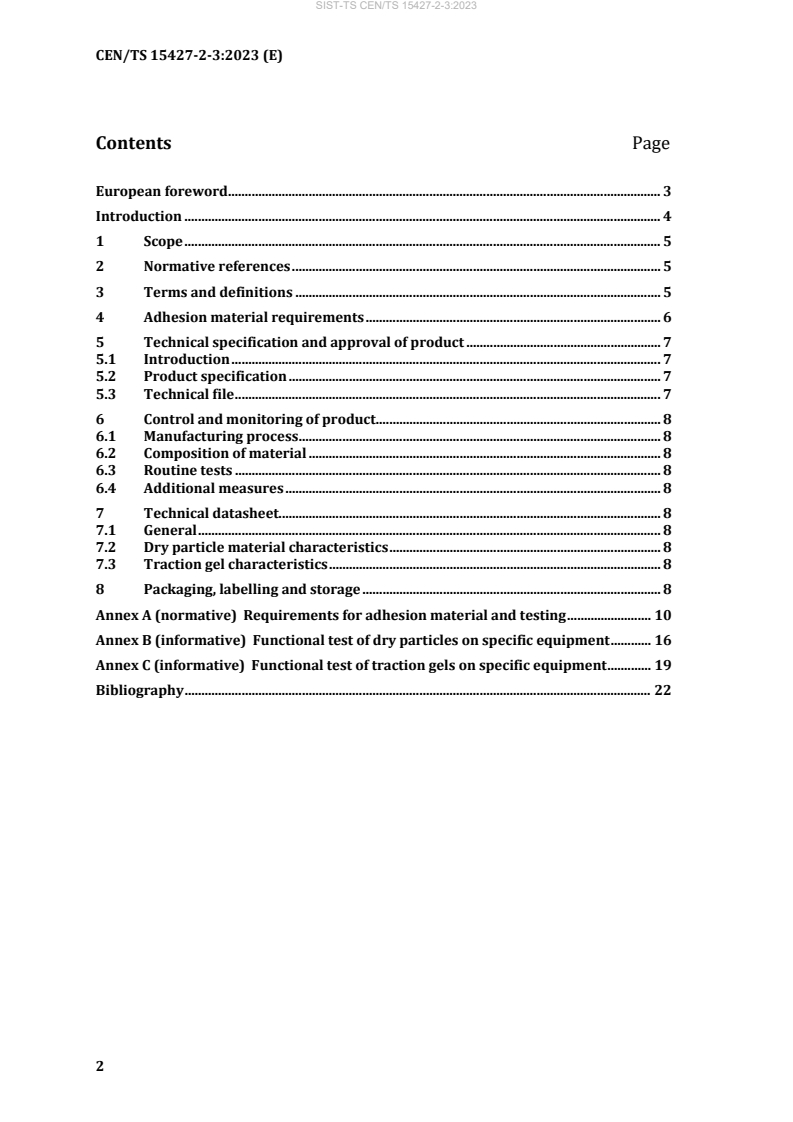
Contents Page
European foreword . 3
Introduction . 4
1 Scope . 5
2 Normative references . 5
3 Terms and definitions . 5
4 Adhesion material requirements . 6
5 Technical specification and approval of product . 7
5.1 Introduction . 7
5.2 Product specification . 7
5.3 Technical file . 7
6 Control and monitoring of product . 8
6.1 Manufacturing process . 8
6.2 Composition of material . 8
6.3 Routine tests . 8
6.4 Additional measures . 8
7 Technical datasheet. 8
7.1 General . 8
7.2 Dry particle material characteristics . 8
7.3 Traction gel characteristics . 8
8 Packaging, labelling and storage . 8
Annex A (normative) Requirements for adhesion material and testing . 10
Annex B (informative) Functional test of dry particles on specific equipment . 16
Annex C (informative) Functional test of traction gels on specific equipment . 19
Bibliography . 22
European foreword
This document (CEN/TS 15427-2-3:2023) has been prepared by Technical Committee
CEN/TC 256 “Railway Applications”, the secretariat of which is held by DIN.
Attention is drawn to the possibility that some of the elements of this document may be the
subject of patent rights. CEN shall not be held responsible for identifying any or all such
patent rights.
This document supersedes CEN/TS 15427-2-3:2021.
This document has been prepared under a Standardization Request addressed to CEN by the
European Commission.
This document is part of the following series:
— EN 15427-1-1, Railway applications - Wheel/Rail friction management - Part 1-1:
Equipment and Application – Flange lubrication
— CEN/TS 15427-1-2, Railway applications - Wheel/Rail friction management - Part 1-2:
Equipment and Application – Top of Rail materials
— CEN/TS 15427-1-3, Railway applications - Wheel/Rail friction management - Part 1-3:
Equipment and Application – Adhesion materials
— EN 15427-2-1, Railway applications - Wheel/Rail friction management - Part 2-1:
Properties and Characteristics – Flange lubricants
— CEN/TS 15427-2-2, Railway applications - Wheel/Rail friction management - Part 2-2:
Properties and Characteristics – Top of Rail materials
— CEN/TS 15427-2-3, Railway applications - Wheel/Rail friction management - Part 2-3:
Properties and Characteristics – Adhesion materials
— CEN/prTR 15427-3, Railway applications - Wheel/Rail friction management - Part 3:
Rationale for requirements and further background information
Any feedback and questions on this document should be directed to the users’ national
standards body. A complete listing of these bodies can be found on the CEN website.
According to the CEN/CENELEC Internal Regulations, the national standards organisations
of the following countries are bound to announce this Technical Specification: Austria,
Belgium, Bulgaria, Croatia, Cyprus, Czech Republic, Denmark, Estonia, Finland, France,
Germany, Greece, Hungary, Iceland, Ireland, Italy, Latvia, Lithuania, Luxembourg, Malta,
Netherlands, Norway, Poland, Portugal, Republic of North Macedonia, Romania, Serbia,
Slovakia, Slovenia, Spain, Sweden, Switzerland, Türkiye and the United Kingdom.
Introduction
Friction management using solid or fluid (oil, grease, etc.) substances at the wheel-rail
interface is a complex subject and includes the following aspects:
— lubrication of the wheel flange/ rail gauge corner interface, commonly referred to as
“flange or rail lubrication”;
— lubrication of the back of flange/ check rail interface; commonly referred to as “check
rail lubrication”;
— controlling the level of friction at the interface between the top of rail and the wheel
tread, commonly referred to as “top of rail friction management”;
— altering the level of adhesion at the interface between the top of rail and the wheel tread.
This document sets out requirements for the material to be used for adhesion management.
It specifies requirements for the material, how to test it and how to approve it.
The adhesion material should be tested to confirm there is:
— compatibility with top of rail systems;
— no intolerable increased risk of fire;
— no harmful environmental effects;
— no incompatibility between the different materials in use, particularly between solid and
fluid systems;
— satisfactory and consistent product quality and performance;
— no degradation to the safety of the railway (braking, signalling, derailment).
The main purpose of an adhesion material is to condition the wheel/ rail contact to either
prevent the occurrence of slipping or sliding or to enable recovery of traction/ braking where
slipping or sliding occurs.
1 Scope
This document specifies the requirements of adhesion materials intended to be applied to
the interface between the wheel tread and the rail crown (active interface). It can be applied
either directly or indirectly to the wheel tread or rail.
It outlines the information required for most approval procedures, the method of testing and
routine control/monitoring of the material.
This document does not deal with Top of Rail materials. For Top of Rail materials see
CEN/TS 15427-2-2:2023.
2 Normative references
The following documents are referred to in the text in such a way that some or all of their
content constitutes requirements of this document. For dated references, only the edition
cited applies. For undated references, the latest edition of the referenced document
(including any amendments) applies.
EN 933-1, Tests for geometrical properties of aggregates - Part 1: Determination of particle size
distribution - Sieving method
EN 1097-3, Tests for mechanical and physical properties of aggregates - Part 3: Determination
of loose bulk density and voids
EN 1097-6, Tests for mechanical and physical properties of aggregates - Part 6: Determination
of particle density and water absorption
EN 1097-5, Tests for mechanical and physical properties of aggregates - Part 5: Determination
of the water content by drying in a ventilated oven
EN 1744-1, Tests for chemical properties of aggregates - Part 1: Chemical analysis
EN 13755, Natural stone test methods - Determination of water absorption at atmospheric
pressure
ISO 2049, Petroleum products - Determination of colour (ASTM scale)
ISO 6072, Rubber - Compatibility between hydraulic fluids and standard elastomeric materials
3 Terms and definitions
For the purposes of this document, the following terms and definitions apply.
ISO and IEC maintain terminological databases for use in standardization at the following
addresses:
— ISO Online browsing platform: available at https://www.iso.org/obp
— IEC Electropedia: available at https://www.electropedia.org/
3.1
adhesion material
substance that is used to either prevent the occurrence of slipping or sliding or to enable
recovery of traction/ braking where slipping or sliding occurs
3.2
batch
entire content of a single identified production of material from the same manufacturing
process
3.3
active interface
contact area between the wheel tread and the crown of the rail
Note 1 to entry: For more information on this definition, see CEN/TS 15427-2-3.
3.4
trainborne equipment
type of equipment that delivers product to the active interface installed on a train
3.5
trackside equipment
type of equipment that delivers product to the active interface installed on or adjacent to the
track
3.6
customer
railway undertaking, infrastructure manager, manufacturer or buyer of railway products or
subassemblies, or their representative
3.7
supplier
provider of equipment, material and/or support services
Note 1 to entry: A supplier might also be the manufacturer of the product.
3.8
product specification
document defining other or additional requirements not defined in this standard
Note 1 to entry: Usually this is produced by and agreed between the customer and/or the supplier
or even a railway undertaking or an infrastructure manager and can be an accompaniment to
contractual requirements.
3.9
dry particles
conglomeration of discrete solid macroscopic particles with low moisture content
3.10
traction gel
traction enhancing product which can be pumped and applied as a fluid, and it consists of a
suspension of solid traction enhancing particles in a liquid or gel
4 Adhesion material requirements
The adhesion material shall be designed to either reduce the occurrence of slipping or sliding
or to enhance recovery of traction/ braking where slipping or sliding occurs.
Different materials may be used for traction/ braking.
When applied within the specified limits to the active interface the material shall not
compromise the safety of the railway (e.g. braking distance, signalling systems, derailment).
NOTE 1 See Annex A.
NOTE 2 Specified limits are normally understood and agreed between relevant parties before use
of material.
5 Technical specification and approval of product
5.1 Introduction
This section outlines the information required to gain approval on most railway networks. It
does not cover its performance on the railway.
5.2 Product specification
The product specification shall be fully documented and shall include the following
information:
a) Purpose of adhesion material;
b) Conformity to the applicable type tests as set out in Tables A.1 to A.3;
c) Conformance with other relevant local requirements (such as environmental, fire,
toxicity, etc.);
d) Application data:
1) including equipment it can be used with;
2) operating temperatures.
e) Additional validation tests (see Table A.3);
f) Any previous relevant experience (i.e. use in other countries);
g) Conditions for packaging, storage and labelling (see Clause 8).
NOTE Legislation and regulations (European, national or local) can include requirements on
ecological and environmental compatibility of materials (biodegradability, toxicity, etc.).
5.3 Technical file
A file of technical data showing compliance with the requirements in the product
specification and the results of type tests and trials shall be provided. A technical datasheet
shall also be provided (see Clause 7).
A material safety data sheet (MSDS) for the product in the language of the interested
customer or country shall be included.
6 Control and monitoring of product
6.1 Manufacturing process
If the manufacturing process is changed in a way that may affect the chemical composition,
geometric specification and/ or physical properties it shall be documented and the customer
shall be notified.
NOTE In some cases, this leads to a new approval being required.
6.2 Composition of material
If the composition of the material is changed in any way, it shall be documented and the
customer shall be notified.
NOTE In some cases, this leads to a new approval being required.
6.3 Routine tests
Routine tests ensure product consistency from batch to batch.
The routine tests are listed in Tables A1 to A3. If additional tests are required (such as those
not included in the tables or a type test) this and the frequency can be agreed between the
client and supplier.
The sample of material assessed for quality testing shall have been manufactured in a regular
production batch. The entire sample of material used for the routine tests shall be taken from
the same production batch and delivered in a single consignment.
The results of the routine tests shall be recorded.
6.4 Additional measures
Retention of test records and samples, witnessing of tests, calibration of test equipment shall
be considered.
7 Technical datasheet
7.1 General
The technical datasheet shall include the individual identifying code or name of the material,
a description of the product’s field of use and typical means of application. For each material
type, the information in the following subclauses shall also be included.
7.2 Dry particle material characteristics
The product shall be described by its geometric properties and/ or physical properties.
Further technical data shall be provided as listed under the ‘datasheet’ column in Table A.1.
7.3 Traction gel characteristics
The material shall be described by its viscosity, its temperature range. Further technical data
shall be provided as listed under the ‘datasheet’ column in Table A.2.
8 Packaging, labelling and storage
The packaging shall protect the contents from contamination and damage.
The labelling shall include at least the following:
— supplier’s name;
— brand name and/or c
...
The standard CEN/TS 15427-2-3:2023 is an essential document that addresses the requirements and characteristics of adhesion materials specifically designed for railway applications. Focusing on the active interface between the wheel tread and the rail crown, this standard provides a comprehensive framework for the effective management of wheel/rail friction. One of the key strengths of this standard is its thorough specification of the adhesion materials' properties, ensuring that they meet the necessary performance metrics for safe and efficient railway operations. The document articulates clear guidance on the application of these materials, allowing for both direct and indirect application to the wheel tread or rail. This versatility enhances its relevance in various operational contexts within the railway sector. Additionally, CEN/TS 15427-2-3:2023 includes detailed information pertinent to approval procedures. Conducting the outlined testing methods and routine control/monitoring of these materials ensures that compliance and quality standards are maintained, which is critical for operational safety and efficiency. It is important to note that this standard is distinct and does not encompass Top of Rail materials, which are addressed in a separate standard (CEN/TS 15427-2-2:2023). This delineation ensures that the document remains focused and relevant to its specific scope regarding adhesion materials, reinforcing the importance of using the correct materials for different applications in railway operations. Overall, CEN/TS 15427-2-3:2023 serves as a robust framework that supports the advancement of railway technology through improved friction management, making it an indispensable resource for professionals in the railway industry concerned with adhesion material applications.
CEN/TS 15427-2-3:2023 표준은 철도 애플리케이션에 있어 휠과 레일 간의 마찰 관리의 중요성을 다룹니다. 특히, 이 문서는 휠 테두리와 레일 크라운 사이의 접착 재료의 요구 사항을 명확히 규정하고 있습니다. 이 표준의 주요 강점 중 하나는 접착 재료의 직접적이거나 간접적인 적용 방법을 구체적으로 설명하고 있어, 다양한 실행 상황에 유연하게 대응할 수 있다는 점입니다. 또한, 이 문서는 대부분의 승인 절차에 필요한 정보와 함께 접착 재료의 시험 방법 및 일상적인 관리·모니터링 방법을 체계적으로 제시하여 실무에서의 유용성을 대폭 향상시킵니다. 이러한 측면은 안전성과 성능을 동시에 고려한 철도 운영에 중요한 역할을 합니다. CEN/TS 15427-2-3:2023는 Top of Rail 재료와 관련된 내용은 다루지 않지만, 상위 문서인 CEN/TS 15427 2 2:2023과 연계하여 체계적인 관리가 가능하다는 점에서 관련성 또한 높습니다. 이러한 연계는 전체 철도 시스템의 효율성 증가에 기여할 것으로 기대됩니다. 결론적으로, 이 표준은 휠과 레일 간의 접착 재료에 대한 구체적이고 실용적인 지침을 제공하여, 철도 안전성과 운영 효율성을 높이는 데 중요한 기초 자료로 기능합니다.
CEN/TS 15427-2-3:2023は、鉄道アプリケーションにおける車輪とレールの摩擦管理に関する重要な標準です。この文書は、車輪の踏面とレールの冠部(アクティブインターフェース)との間に適用される接着材料に関する要件を明確に規定しています。この標準の特徴は、接着材料が車輪踏面またはレールに直接または間接的に適用できる点です。 この規格は、接着材料のほとんどの承認手続きに必要な情報を提供し、材料の試験方法や日常的な管理・監視の手順を詳細に説明しています。特に、接着材料の特性や性能に関する明確な基準を設定することで、鉄道運行の安全性と効率性の向上に寄与します。また、接着材料は、摩擦管理における非常に重要な要素であるため、これに基づく規格は鉄道業界全体にとって重要な関連性を持っています。 ただし、トップオブレール材料については、本標準では扱われていないため、これに関する情報はCEN/TS 15427-2-2:2023を参照する必要があります。この区分けにより、ユーザーは必要な情報を容易に特定することができ、混乱を避けることができます。 全体として、CEN/TS 15427-2-3:2023は、鉄道業界における摩擦管理の標準化に向けた強力な基盤を提供するものであり、この標準に基づく接着材料の適用は、鉄道運行のパフォーマンス向上に資するものです。
Questions, Comments and Discussion
Ask us and Technical Secretary will try to provide an answer. You can facilitate discussion about the standard in here.
Loading comments...