

EN 1888-2:2018+A1:2022
(Main + Amendment)Child care articles - Wheeled child conveyances - Part 2: Pushchairs for children above 15 kg up to 22 kg
- Abstract
This European Standard specifies the additional safety requirements and test methods for pushchairs, designed for the carriage of one or more children, above15 kg and up to 22 kg each.
This European Standard applies in conjunction with and in addition to the European standard EN 1888-1 and it cannot be used separately.
- Status
- Published
- Publication Date
- 06-Dec-2022
- Technical Committee
- CEN/TC 252 - Child use and care articles
- Drafting Committee
- CEN/TC 252/WG 3 - Wheeled transportation
- Current Stage
- 9092 - Decision on results of review/2YR ENQ - revise - Review Enquiry
- Start Date
- 10-Oct-2025
- Completion Date
- 07-Oct-2026

Overview
EN 1888-2:2018+A1:2022 (CEN) specifies additional safety requirements and test methods for pushchairs designed to carry children above 15 kg and up to 22 kg each. This part supplements EN 1888-1:2018 and must be applied in conjunction with it; EN 1888-2 cannot be used alone. The standard focuses on practical safety outcomes for manufacturers, test laboratories and conformity assessors, aligning product design with predictable real-world loads and use conditions.
Key practical points: the standard defines a test mass (Test mass H) representing a 22 kg child, prescribes additional dynamic and durability cycles, and tightens requirements for restraint, braking, stability and product marking.
Key Topics
- Test mass H: a rigid cylinder of (220 ± 5) mm diameter and (320 ± 5) mm height, mass (22 +0.1/0) kg, with two anchorage points positioned (160 ± 2,5) mm from the base. This test mass is used across multiple tests to simulate a child up to 22 kg.
- Restraint system: the harness must be adjustable to secure the test mass H; attachment points and fasteners are tested (220 N for attachment, 250 N for fasteners) according to EN 1888-1 procedures.
- Parking and braking: tests in EN 1888-1 are repeated using test mass H, including additional abrasion conditioning of 33 000 cycles to ensure brake/parking durability under heavier loads.
- Stability and structural integrity: stability and dynamic strength tests are repeated with test mass H; attachment strength and seat unit durability are assessed. The irregular surface test adds 24 000 cycles with the backrest upright and forward-facing when possible.
- Handle strength and fatigue: handle strength testing uses test mass H for 3 300 additional cycles; conditional additional cycles apply if a downwards force to lift front wheels exceeds 450 N.
- Marking and information: products must be marked with the EN 1888-2 number/year and the maximum child weight pictogram. The pictogram has a minimum blue circle diameter of 25 mm and number height of at least 4 mm. Purchase and instruction information must state the maximum weight (up to 22 kg or 4 years, whichever comes first).
Applications
- Manufacturers: design validation and pre-compliance testing for pushchairs intended for children up to 22 kg.
- Test laboratories: standardized procedures and specific test mass H for repeatable mechanical, durability and stability testing.
- Regulatory & procurement: harmonised criteria for safety claims, labeling and documentation used across CEN member states.
Related Standards
- EN 1888-1:2018 - mandatory companion standard covering general requirements, terms and test sequences for pushchairs and prams.
Following EN 1888-2:2018+A1:2022 helps ensure robust product safety, clearer product information and demonstrable compliance for pushchairs designed for older/heavier children (up to 22 kg).
Relations
- Effective Date
- 12-Oct-2022
- Effective Date
- 12-Oct-2022
- Refers
EN 1888-1:2018 - Child care articles - Wheeled child conveyances - Part 1: Pushchairs and prams - Effective Date
- 28-Jan-2026
- Effective Date
- 28-Jan-2026
- Effective Date
- 15-Oct-2025
Frequently Asked Questions
EN 1888-2:2018+A1:2022 is a standard published by the European Committee for Standardization (CEN). Its full title is "Child care articles - Wheeled child conveyances - Part 2: Pushchairs for children above 15 kg up to 22 kg". This standard covers: This European Standard specifies the additional safety requirements and test methods for pushchairs, designed for the carriage of one or more children, above15 kg and up to 22 kg each. This European Standard applies in conjunction with and in addition to the European standard EN 1888-1 and it cannot be used separately.
This European Standard specifies the additional safety requirements and test methods for pushchairs, designed for the carriage of one or more children, above15 kg and up to 22 kg each. This European Standard applies in conjunction with and in addition to the European standard EN 1888-1 and it cannot be used separately.
EN 1888-2:2018+A1:2022 is classified under the following ICS (International Classification for Standards) categories: 97.190 - Equipment for children. The ICS classification helps identify the subject area and facilitates finding related standards.
EN 1888-2:2018+A1:2022 has the following relationships with other standards: It is inter standard links to EN 1888-2:2018, EN 1888-2:2018/FprA1:2022, EN 1888-1:2018, EN 1888-3:2024, prEN 1888-1. Understanding these relationships helps ensure you are using the most current and applicable version of the standard.
EN 1888-2:2018+A1:2022 is associated with the following European legislation: Standardization Mandates: M/264. When a standard is cited in the Official Journal of the European Union, products manufactured in conformity with it benefit from a presumption of conformity with the essential requirements of the corresponding EU directive or regulation.
EN 1888-2:2018+A1:2022 is available in PDF format for immediate download after purchase. The document can be added to your cart and obtained through the secure checkout process. Digital delivery ensures instant access to the complete standard document.
Standards Content (Sample)
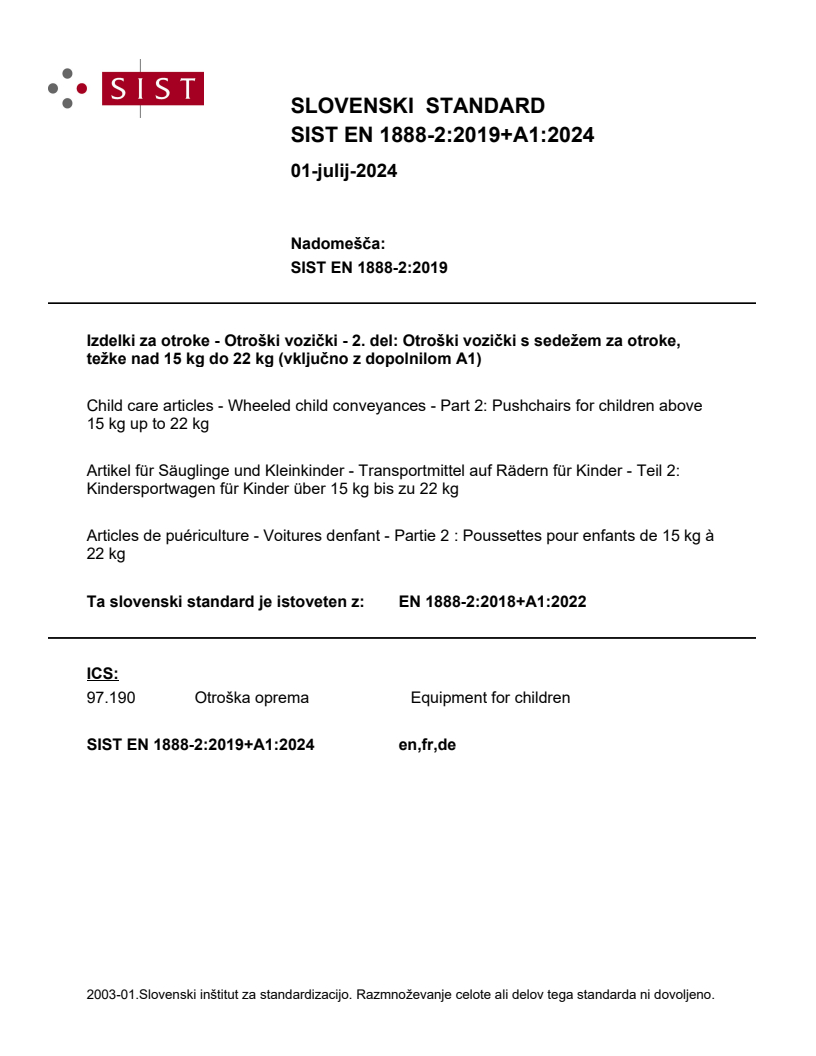
SLOVENSKI STANDARD
01-julij-2024
Nadomešča:
SIST EN 1888-2:2019
Izdelki za otroke - Otroški vozički - 2. del: Otroški vozički s sedežem za otroke,
težke nad 15 kg do 22 kg (vključno z dopolnilom A1)
Child care articles - Wheeled child conveyances - Part 2: Pushchairs for children above
15 kg up to 22 kg
Artikel für Säuglinge und Kleinkinder - Transportmittel auf Rädern für Kinder - Teil 2:
Kindersportwagen für Kinder über 15 kg bis zu 22 kg
Articles de puériculture - Voitures denfant - Partie 2 : Poussettes pour enfants de 15 kg à
22 kg
Ta slovenski standard je istoveten z: EN 1888-2:2018+A1:2022
ICS:
97.190 Otroška oprema Equipment for children
2003-01.Slovenski inštitut za standardizacijo. Razmnoževanje celote ali delov tega standarda ni dovoljeno.
EN 1888-2:2018+A1
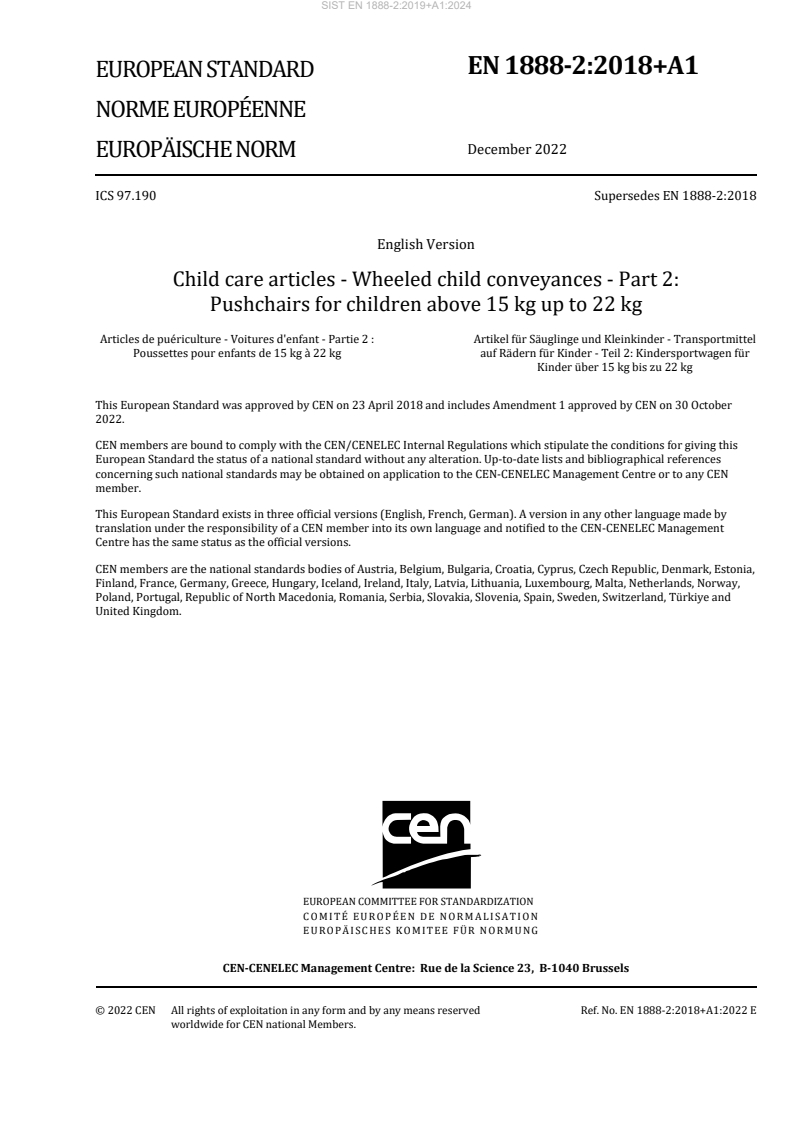
EUROPEAN STANDARD
NORME EUROPÉENNE
December 2022
EUROPÄISCHE NORM
ICS 97.190 Supersedes EN 1888-2:2018
English Version
Child care articles - Wheeled child conveyances - Part 2:
Pushchairs for children above 15 kg up to 22 kg
Articles de puériculture - Voitures d'enfant - Partie 2 : Artikel für Säuglinge und Kleinkinder - Transportmittel
Poussettes pour enfants de 15 kg à 22 kg auf Rädern für Kinder - Teil 2: Kindersportwagen für
Kinder über 15 kg bis zu 22 kg
This European Standard was approved by CEN on 23 April 2018 and includes Amendment 1 approved by CEN on 30 October
2022.
CEN members are bound to comply with the CEN/CENELEC Internal Regulations which stipulate the conditions for giving this
European Standard the status of a national standard without any alteration. Up-to-date lists and bibliographical references
concerning such national standards may be obtained on application to the CEN-CENELEC Management Centre or to any CEN
member.
This European Standard exists in three official versions (English, French, German). A version in any other language made by
translation under the responsibility of a CEN member into its own language and notified to the CEN-CENELEC Management
Centre has the same status as the official versions.
CEN members are the national standards bodies of Austria, Belgium, Bulgaria, Croatia, Cyprus, Czech Republic, Denmark, Estonia,
Finland, France, Germany, Greece, Hungary, Iceland, Ireland, Italy, Latvia, Lithuania, Luxembourg, Malta, Netherlands, Norway,
Poland, Portugal, Republic of North Macedonia, Romania, Serbia, Slovakia, Slovenia, Spain, Sweden, Switzerland, Türkiye and
United Kingdom.
EUROPEAN COMMITTEE FOR STANDARDIZATION
COMITÉ EUROPÉEN DE NORMALISATION
EUROPÄISCHES KOMITEE FÜR NORMUNG
CEN-CENELEC Management Centre: Rue de la Science 23, B-1040 Brussels
© 2022 CEN All rights of exploitation in any form and by any means reserved Ref. No. EN 1888-2:2018+A1:2022 E
worldwide for CEN national Members.
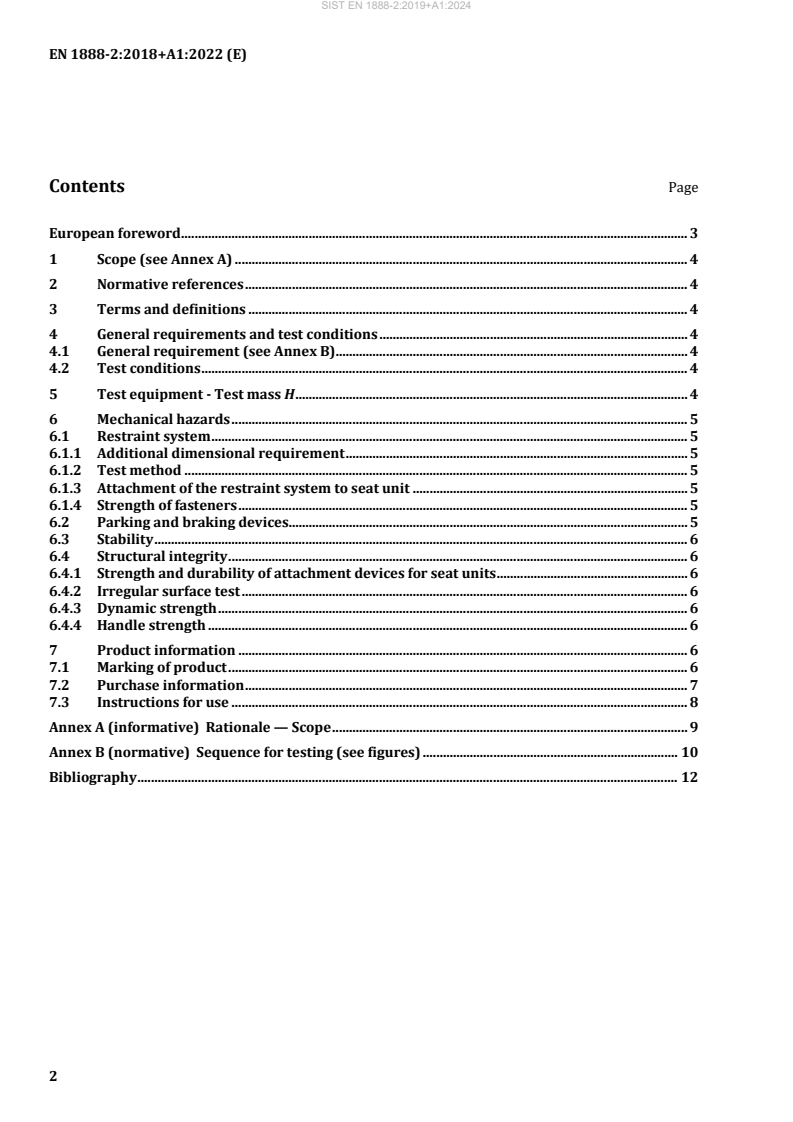
Contents Page
European foreword . 3
1 Scope (see Annex A) . 4
2 Normative references . 4
3 Terms and definitions . 4
4 General requirements and test conditions . 4
4.1 General requirement (see Annex B) . 4
4.2 Test conditions . 4
5 Test equipment - Test mass H . 4
6 Mechanical hazards . 5
6.1 Restraint system . 5
6.1.1 Additional dimensional requirement . 5
6.1.2 Test method . 5
6.1.3 Attachment of the restraint system to seat unit . 5
6.1.4 Strength of fasteners . 5
6.2 Parking and braking devices. 5
6.3 Stability . 6
6.4 Structural integrity . 6
6.4.1 Strength and durability of attachment devices for seat units . 6
6.4.2 Irregular surface test . 6
6.4.3 Dynamic strength . 6
6.4.4 Handle strength . 6
7 Product information . 6
7.1 Marking of product . 6
7.2 Purchase information . 7
7.3 Instructions for use . 8
Annex A (informative) Rationale — Scope . 9
Annex B (normative) Sequence for testing (see figures) . 10
Bibliography . 12
European foreword
This document (EN 1888-2:2018+A1:2022) has been prepared by Technical Committee CEN/TC 252
“Child care articles”, the secretariat of which is held by AFNOR.
This European Standard shall be given the status of a national standard, either by publication of an
identical text or by endorsement, at the latest by June 2023, and conflicting national standards shall be
withdrawn at the latest by June 2023.
This document supersedes !EN 1888-2:2018".
Attention is drawn to the possibility that some of the elements of this document may be the subject of
patent rights. CEN shall not be held responsible for identifying any or all such patent rights.
This document includes Amendment 1 approved by CEN on 30 October 2022.
The start and finish of text introduced or altered by amendment is indicated in the text by tags !".
This document has been prepared under a mandate given to CEN by the European Commission and the
European Free Trade Association.
In November 2014 the European Working Group CEN TC 252/WG 3 decided to split EN 1888 into
different parts to clearly treat in a different way, new products or new functions of wheeled child
conveyances.
EN 1888-2 covers pushchairs designed for the carriage of children up to 22 kg and is only applicable in
conjunction with EN 1888-1, which states general requirements for pushchairs and prams.
Compliance with EN 1888-1 is made mandatory to comply with EN 1888-2.
EN 1888 is currently composed with the following parts:
— EN 1888-1, Child care articles — Wheeled child conveyances — Part 1: Pushchairs and prams;
— EN 1888-2, Child care articles — Wheeled child conveyances — Part 2: Pushchairs for children above
15 kg up to 22 kg.
According to the CEN-CENELEC Internal Regulations, the national standards organisations of the
following countries are bound to implement this European Standard: Austria, Belgium, Bulgaria,
Croatia, Cyprus, Czech Republic, Denmark, Estonia, Finland, France, Germany, Greece, Hungary, Iceland,
Ireland, Italy, Latvia, Lithuania, Luxembourg, Malta, Netherlands, Norway, Poland, Portugal, Republic of
North Macedonia, Romania, Serbia, Slovakia, Slovenia, Spain, Sweden, Switzerland, Türkiye and the
United Kingdom.
1 Scope (see Annex
...