

EN 13546:2002+A1:2007
(Main + Amendment)Protective clothing - Hand, arm, chest, abdomen, leg, foot and genital protectors for field hockey goal keepers, and shin protectors for field players - Requirements and test methods
- Abstract
This standard specifies the general requirements for the ergonomics, performance, innocuousness, sizing and coverage of field hockey goal keepers’ equipment, providing protection to the hands, arms, chest, abdomen, legs, feet and genitals, and field players’ shin protectors. Requirements for the marking of equipment and the information to be supplied by the manufacturer are given. Test methods are described and performance levels are defined.
- Status
- Published
- Publication Date
- 12-Jun-2007
- Technical Committee
- CEN/TC 162 - Protective clothing including hand and arm protection and lifejackets
- Drafting Committee
- CEN/TC 162/WG 11 - Body protection for sports
- Current Stage
- 9060 - Closure of 2 Year Review Enquiry - Review Enquiry
- Start Date
- 02-Dec-2024
- Completion Date
- 02-Dec-2024
- Directive
- 2016/425 - Regulation (EU) 2016/425 of the European Parliament and of the Council of 9 March 2016 on personal protective equipment and repealing Council Directive 89/686/EECOJ Ref: C, C 113 OJ Date: 27-Mar-2018
89/686/EEC - Personal protective equipment (PPE)OJ Ref: C, C 205 OJ Date: 09-Jul-2011

Overview
EN 13546:2002+A1:2007 (CEN) is the European standard for field hockey protective equipment. It specifies requirements and test methods for goalkeepers’ protectors (hands, arms, chest, abdomen, legs, feet and genitals) and for field players’ shin protectors. The standard covers ergonomics, performance, innocuousness (chemical safety), sizing, zones of protection, marking and manufacturer information, and defines performance levels and laboratory test procedures. Amendment A1 (2007) is incorporated.
Key topics and requirements
- Scope and applicability: Goalkeeper equipment (padding, gloves, kickers, leg protectors, chest/abdomen/shoulder/hip/thigh protectors, hard and soft genital protectors) and player shin protectors (Type A/B distinctions).
- Ergonomics and sizing: Requirements for comfort, fit and body-dimension references (stature, waist, chest, crotch length) to ensure adequate coverage and mobility.
- Zones of protection: Minimum dimensions and defined areas to be tested for impact and coverage.
- Performance levels and impact testing: Defined performance categories and corresponding test severities; specific impact test methods, conditioning, and high ambient temperature considerations are described.
- Restraint and durability: Tests for attachment, retention and structural performance under use conditions.
- Innocuousness (chemical safety): Guidance and possible testing to ensure materials are not harmful to users; Annex A provides additional information.
- Marking and manufacturer information: Required product markings and consumer information to support safe selection and use.
- Exclusions and cross-sports note: Helmets, face masks and throat protection are not covered. Products from other sports (e.g., cricket, lacrosse) must meet the same or greater test severity to be appropriate for field hockey.
Practical applications and users
Who uses EN 13546:
- Manufacturers and product designers of field hockey protective equipment - for design, material selection and compliance.
- Test laboratories and certification bodies - to perform standardized impact, restraint and innocuousness tests.
- Procurement officers, clubs and sports federations - to specify minimum safety and performance levels for equipment.
- Standards bodies and regulators - for national adoption and conformity assessment across CEN member states.
How it’s used:
- Designing goalkeeper gear and shin pads that meet defined performance levels.
- Performing laboratory testing and product labeling in line with CEN requirements.
- Selecting appropriate protective equipment for different competition levels and ambient conditions.
Related standards
- EN 1082-1 (chain mail gloves and arm guards)
- ISO 3758 (care labelling symbols)
- ISO 8559 (garment construction and anthropometry)
Keywords: EN 13546, field hockey protective equipment, goalkeeper equipment, shin protectors, test methods, performance levels, CEN, ergonomics, safety standard.
Relations
- Effective Date
- 18-Jan-2023
- Effective Date
- 22-Dec-2008
- Effective Date
- 25-Aug-2026
- Effective Date
- 25-Aug-2026
- Effective Date
- 28-Jan-2026
- Effective Date
- 28-Jan-2026
Get Certified
Connect with accredited certification bodies for this standard

CIS Institut d.o.o.
Personal Protective Equipment (PPE) certification body. Notified Body NB-2890 for EU Regulation 2016/425 PPE.

Kiwa BDA Testing
Building and construction product certification.
Kmetijski inštitut Slovenije
Agricultural Institute of Slovenia. Soil testing, plant health, agricultural product analysis.
Sponsored listings
Frequently Asked Questions
EN 13546:2002+A1:2007 is a standard published by the European Committee for Standardization (CEN). Its full title is "Protective clothing - Hand, arm, chest, abdomen, leg, foot and genital protectors for field hockey goal keepers, and shin protectors for field players - Requirements and test methods". This standard covers: This standard specifies the general requirements for the ergonomics, performance, innocuousness, sizing and coverage of field hockey goal keepers’ equipment, providing protection to the hands, arms, chest, abdomen, legs, feet and genitals, and field players’ shin protectors. Requirements for the marking of equipment and the information to be supplied by the manufacturer are given. Test methods are described and performance levels are defined.
This standard specifies the general requirements for the ergonomics, performance, innocuousness, sizing and coverage of field hockey goal keepers’ equipment, providing protection to the hands, arms, chest, abdomen, legs, feet and genitals, and field players’ shin protectors. Requirements for the marking of equipment and the information to be supplied by the manufacturer are given. Test methods are described and performance levels are defined.
EN 13546:2002+A1:2007 is classified under the following ICS (International Classification for Standards) categories: 13.340.10 - Protective clothing. The ICS classification helps identify the subject area and facilitates finding related standards.
EN 13546:2002+A1:2007 has the following relationships with other standards: It is inter standard links to EN 13546:2002, EN 13546:2002/prA1, ISO 3758:2005, ISO 8559:1989, EN ISO 10642:2004, EN 1082-1:1996. Understanding these relationships helps ensure you are using the most current and applicable version of the standard.
EN 13546:2002+A1:2007 is associated with the following European legislation: EU Directives/Regulations: 2016/425, 89/686/EEC, 93/68/EEC, 93/95/EEC, 96/58/EC; Standardization Mandates: M/031. When a standard is cited in the Official Journal of the European Union, products manufactured in conformity with it benefit from a presumption of conformity with the essential requirements of the corresponding EU directive or regulation.
EN 13546:2002+A1:2007 is available in PDF format for immediate download after purchase. The document can be added to your cart and obtained through the secure checkout process. Digital delivery ensures instant access to the complete standard document.
Standards Content (Sample)
2003-01.Slovenski inštitut za standardizacijo. Razmnoževanje celote ali delov tega standarda ni dovoljeno.Schutzkleidung - Hand-, Arm-, Brustkorb-, Unterleibs-, Bein-, Fuß- und Genitalschützer für Feldhockey-Torwarte und Schienbeinschützer für Feldhockey-Spieler - Anforderungen und PrüfverfahrenVetements de protection - Protege-mains et bras, plastrons, protection abdominale, guetres, sabots et coquilles de gardiens de but de hockey sur gazon et protege-tibias de joueurs - Exigences et méthodes d'essaiProtective clothing - Hand, arm, chest, abdomen, leg, foot and genital protectors for field hockey goal keepers, and shin protectors for field players - Requirements and test methods97.220.40Oprema za športe na prostem in vodne športeOutdoor and water sports equipment13.340.10Varovalna oblekaProtective clothingICS:Ta slovenski standard je istoveten z:EN 13546:2002+A1:2007SIST EN 13546:2002+A1:2007en,fr,de01-november-2007SIST EN 13546:2002+A1:2007SLOVENSKI
STANDARD
EUROPEAN STANDARD NORME EUROPÉENNE EUROPÄISCHE NORM
EN 13546:2002+A1
June 2007 ICS 13.340.10 Supersedes EN 13546:2002English Version
Protective clothing - Hand, arm, chest, abdomen, leg, foot and genital protectors for field hockey goal keepers, and shin protectors for field players - Requirements and test methods
Vêtements de protection - Protége- mains et bras, plastrons, protection abdominale, guêtres, sabots et coquilles de gardiens de but de hockey sur gazon et protège-tibias de joueurs - Exigences et méthodes d'essai Schutzkleidung - Hand-, Arm-, Brustkorb-, Unterleibs-, Bein-, Fuss- und Genitalschützer für Feldhockey-Torwarte und Schienbeinschützer für Feldhockey-Spieler - Anforderungen und Prüfverfahren This European Standard was approved by CEN on 25 March 2002 and includes Amendment 1 approved by CEN on 10 May 2007.
CEN members are bound to comply with the CEN/CENELEC Internal Regulations which stipulate the conditions for giving this European Standard the status of a national standard without any alteration. Up-to-date lists and bibliographical references concerning such national standards may be obtained on application to the CEN Management Centre or to any CEN member.
This European Standard exists in three official versions (English, French, German). A version in any other language made by translation under the responsibility of a CEN member into its own language and notified to the CEN Management Centre has the same status as the official versions.
CEN members are the national standards bodies of Austria, Belgium, Bulgaria, Cyprus, Czech Republic, Denmark, Estonia, Finland, France, Germany, Greece, Hungary, Iceland, Ireland, Italy, Latvia, Lithuania, Luxembourg, Malta, Netherlands, Norway, Poland, Portugal, Romania, Slovakia, Slovenia, Spain, Sweden, Switzerland and United Kingdom.
EUROPEAN COMMITTEE FOR STANDARDIZATION
COMITÉ EUROPÉEN DE NORMALISATION EUROPÄISCHES KOMITEE FÜR NORMUNG
Management Centre: rue de Stassart, 36
B-1050 Brussels © 2007 CEN All rights of exploitation in any form and by any means reserved worldwide for CEN national Members. Ref. No. EN 13546:2002+A1:2007: ESIST EN 13546:2002+A1:2007
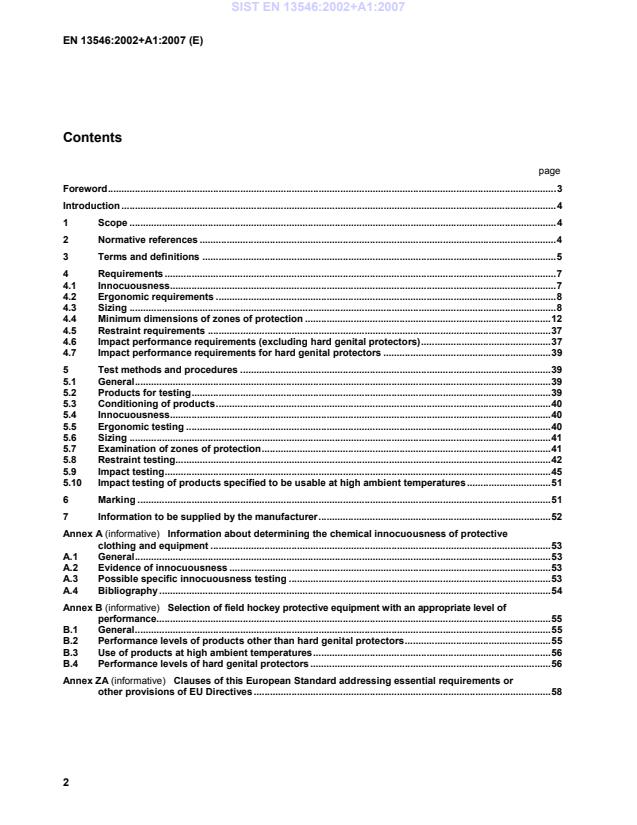
Information about determining the chemical innocuousness of protective clothing and equipment.53 A.1 General.53 A.2 Evidence of innocuousness.53 A.3 Possible specific innocuousness testing.53 A.4 Bibliography.54 Annex B (informative)
Selection of field hockey protective equipment with an appropriate level of performance.55 B.1 General.55 B.2 Performance levels of products other than hard genital protectors.55 B.3 Use of products at high ambient temperatures.56 B.4 Performance levels of hard genital protectors.56 Annex ZA (informative)
Clauses of this European Standard addressing essential requirements or other provisions of EU Directives.58
3.1.1 coverage area of the body which is covered by the whole of the protective equipment and its attachments 3.1.2 field hockey team game played on a natural or artificial turf surface between goals with sticks and a round hard ball 3.1.3 performance level number designating the category of the protection that it is intended the product should provide. This number is used in designating the test severity to which the product is to be subjected NOTE Annex B contains informative guidance on the meaning of performance levels and the choice of equipment. 3.1.4 protective equipment clothing and specific devices worn on the body, hands and feet, that are intended to reduce the severity of injuries from hockey balls, hockey sticks and other players 3.1.5 zone of protection area of protective equipment that is intended to provide protection, and is subject to specific testing 3.2 Protective equipment
3.2.1 abdominal protectors devices worn by goal-keepers to protect their abdomens below the waist from impacts. These devices may incorporate genital protectors 3.2.2 breast protectors devices worn by female goal-keepers to protect breast tissue from impacts and shearing forces. These devices are normally intended to be worn beneath chest protectors, and only then to provide the intended protection 3.2.3 chest protectors devices worn by goal-keepers to protect the anterior of their chests down to at least their waist level 3.2.4 elbow and forearm protectors devices worn by goal-keepers to protect their elbows and forearms from impacts. Normally the cuffs of gloves will overlap these protectors SIST EN 13546:2002+A1:2007
3.2.5.1 hard genital protectors devices worn to protect the male or female genitalia from impacts 3.2.5.2 soft genital protectors soft foam containing devices sometimes used by women instead of the hard protectors 3.2.6 gloves
3.2.6.1 glove and hand definitions the definitions in EN 1082-1 and the following shall apply 3.2.6.2 goal-keepers’ gloves the gloves are handed. They may be five digit or two digit designs, or may be hand enclosing protectors 3.2.6.3 the left or flat glove is used palm forwards to play the ball. Padding is provided on the anterior of the wrist and hand and on the finger tips, and on the lateral surface of the hand 3.2.6.4 the right or stick-holding glove is used to grip the hockey stick and is provided with padding to protect the outside or backs of the fingers, the thumb, and the anterior of the wrist 3.2.7 kickers devices worn by goal-keepers over their hockey boots or shoes, for the purposes of play or protection, and covering the fronts, the tops (instep), and sides of the feet 3.2.8 leg protectors devices worn by goal-keepers to block the ball entering the goal. The leg protectors are intended to be worn with kickers and to provide protection with the kicker, from the ankle to above the knee 3.2.9 shin protectors devices worn by field players providing limited impact protection to their tibias and ankles. Type A protectors include some medial and lateral ankle joint protection, but Type B protectors do not 3.2.10 shoulder and upper arm protectors devices worn by goal-keepers to protect the anterior aspects of their shoulders and upper arms from blows by hockey balls. The protection generally extends over the lateral surfaces of the arm and the upper surfaces of the shoulders.
These protectors may be attached to chest protectors or may be independent garments 3.2.11 thigh and hip protectors padding usually worn by goal-keepers as parts of trousers ending just above the knees. These trousers may incorporate genital protectors and abdominal protectors SIST EN 13546:2002+A1:2007
3.3.1 bust girth maximum horizontal girth measured during normal breathing with the subject standing upright and the tape-measure passed over the scapulae under the armpits and across the breasts:
normal underclothing to be worn 3.3.2 chest girth maximum horizontal girth measured during normal breathing with the subject standing upright and the tape-measure passed over the scapulae under the armpits and across the chest 3.3.3 stature (Height) vertical distance between the crown of the head and the ground, measured with the subject standing upright without shoes and with their feet together 3.3.4 total crotch length lower trunk length. Length measured from the centre of the front of the waist as defined above through the crotch to the side of the genitalia, to the centre of the back of the waist 3.3.5 under bust girth horizontal girth of the body immediately below the breasts measured as for the bust girth 3.3.6 waist girth maximum horizontal girth measured during normal breathing with the subject standing upright and the tape-measure passed around the body in the plane of the waist, 50 mm above the supra-cristal plane which is at the level of the highest points of the iliac crests. The dimension of 50 mm refers to a subject of 178 cm tall and should be scaled pro rata with the height of the actual subject 3.3.7 waist to waist over the shoulder length maximum length measured from the plane of the waist, as defined above, over the shoulder to the plane of the waist. The tape-measure crosses the shoulder at the mid point between the point of the shoulder and the junction of the shoulder to the neck. Anteriorly the tape measure passes over the chest (or bust) to a point 90 mm lateral to the midline of the body on the plane of the waist. Posteriorly the tape measure follows the shortest distance to a point 90 mm lateral to the midline of the body. The distances of 90 mm refer to a subject with a waist girth of 85 cm and should be scaled pro rata with the waist girth of the actual subject. Normal underclothing to be worn for the measurement 4 Requirements 4.1 Innocuousness Protective clothing and equipment for field hockey players shall meet a general requirement that the product is safe to use and fit for its purpose. It shall be designed and manufactured to provide protection when used according to the manufacturer’s instructions, without endangering the user or other players. There shall not be hard or sharp edges, seams, buckles or other items on the surfaces of the products that could harm the user or other players during normal use. Examination shall be made according to 5.4. Construction materials and incorporated substances, shall not harm those coming into contact with them. The manufacturer shall list in the Information supplied with the product, the substances used in the main components of the product, and shall label any product containing substances or preparations generally known to be hazardous. SIST EN 13546:2002+A1:2007
mm Dimension B Internal length
mm Dimension C Internal width at widest part
mm Dimension D Volumes
cm3 Female size 1 20 100 55 70 Female size 2 25 110 65 110 Female size 3 30 120 75 150 Male size 1 40 120 85 170 Male size 2 45 130 95 225 Male size 3 50 140 105 300
Figure 1a — Dimensions of hard genital protectors A side view of a genital protector placed on the 100 mm radius half cylinder. Bearing area indicator marks are shown 50 mm apart (b, b1).
Figure 1b — Dimensions of hard genital protectors A schematic side view of a genital protector trimmed to fit onto the 100 mm radius half cylinder. Dimensions A and B are shown. D
=
The volume to be measured, !dimension D"
= D SIST EN 13546:2002+A1:2007
Figure 1c — Dimensions of hard genital protectors
A schematic cross section of a genital protector on the 100 mm radius half cylinder.
D
=
The volume to be measured, dimension D. Figure 1
4.3.2 Nominal sizes of certain products In addition to sizing based on the users’ body dimensions as required in 4.3, manufacturers may, if appropriate, allocate their products to nominal sizes each of which covers a range of actual sizes. If nominal sizing is used the ranges and numbers in Table 1 shall be used. Sizing shall be verified as described in 5.6. = D SIST EN 13546:2002+A1:2007
Stature, cm Chest girth, cm Waist girth, cm
1 116 to 134 72 to 84 68 to 80 2 134 to 152 84 to 96 80 to 92 3 152 to 170 96 to 108 92 to 104 4 170 to 188 108 to 120 104 to 116 5 188 to 206 120 to 132 116 to 128
4.4 Minimum dimensions of zones of protection 4.4.1 General All protective equipment shall have a zone, or zones, of protection, the dimensions of which shall be related to the size of the largest user the equipment is intended to fit. The dimensions and positions of the zones of protection, relative to the coverage provided by the equipment, shall be given in the Information supplied by the manufacturer, (see clause 7). Methods for determining the dimensions of the zones of protection are described in clause 5. In principle, apart from hard genital protectors, the outer surfaces of the protectors are marked to show the areas in which blows directed towards the underlying skeletal structures will fall on particular constructions. These will be compared to the dimensions given below. The dimensions are those on the outer face of the product. When a product is bent around part of the body such as the lower leg, the thickness of the product has a significant effect on the fraction of the circumference of the limb protected. Values of transverse dimensions of such products require scaling if the thickness of the product is unusual. If the thickness of the product differs from the following by more than 15 %, scaling is necessary. The following thicknesses have been assumed: Shin protectors - 15 mm, Leg protectors - 50 mm, Kickers - 40 mm (only relevant on toe to heel dimensions), Thigh and hip protectors - 30 mm, elbow and forearm
protectors - 15 mm, Shoulder and upper arm protectors - 20 mm, Chest protectors, abdominal protectors and gloves do not require protective zone dimensions to be scaled for thickness. The dimensions of zones of protection shall be verified as described in 5.7. Areas outside zones 1, 2 or 3 do not have to meet impact or dimensional requirements and are designated zone 0. The zones, of the dimensions given below, will be subject to impact testing in accordance with 5.9 to establish compliance with the performance requirements. SIST EN 13546:2002+A1:2007
Key
=
Zone 1, ankle area
=
Zone 2, outer area 3
=
Zone 3, central area NOTE The central zone is shown for a left shin protector (solid line) and for the right shin protector (dotted line).
Figure 2 — A plan diagram of the outer surface of a shin protector showing the dimensions of the zones of protection listed in Table 3
= 1
= 2
= 3 SIST EN 13546:2002+A1:2007
Dimension C is the actual distance up the shin protector that dimension F is measured. Dimension D is the minimum distance below the instep notch that the outer zone shall extend. Dimensions M, N and O are the maximum radii of curvature permitted.
" Key
2K
=
Zone 2, knee outer area
2S
=
Zone 2, shin outer area
3K
=
Zone 3, knee inner area
3S
=
Zone 3, shin inner area XX
= line of the protector determined by marking the centre line of the tibia of a subject wearing the protector. Figure 3 — A plan diagram of the outer surface of a leg protector showing the dimensions of the zones of protection listed in the Table 4
(min.) Outer edge of the kicker 44,1 591 670 750 829 908 B
(actual) Distance from the end of the kicker to point B1 2,9 39 44 49 55 60 C
(actual) Distance B1
to C1 7,0 94 106 119 132 144 D
(min.) Smallest height of kicker between B1 and C1 7,5 101 114 128 141 154 E
(min.) Smallest height of kicker 7,0 94 106 119 132 144 F
(min.) Toe height of kicker 10,6 142 161 180 199 218 Shoe sizes that should be adequately covered by the size of kicker, (Point de Paris) 36, 37 38, 39, 4041, 42, 4344, 45 46, 47, 48The values of dimensions A, D, E and F are minimum values.
The values of dimensions B and C are the actual values to be used.
Table 6 — Requirements for the dimensions of zones of higher protection of kickers expressed as a percentage of stature, and in relation to user’s shoe sizes, and also (for information) the values of the dimensions in millimetres for the five nominal sizes Value of the dimension in millimetres for each nominal size Designation of the dimension Value of the dimension expressed as a percentage of the user’s stature 1 2 3 4 5 G
(min.) Length of medial and lateral areas 13,0 174 198 221 244 268 H (min.) Radius of curvature of the posterior ends of the medial and lateral areas 3,2 43 49 54 60 66 I (min.) Radius of curvature of the anterior ends of the medial and lateral areas 2,6 35 40 44 49 54 SIST EN 13546:2002+A1:2007
Key
=
Zone 1, outer area
2T
=
Zone 2, toe area
2L
=
Zone 2, lateral surface
3M
=
Zone 3, medial surface Figure 4 — A plan diagram of the outer surface of a kicker showing the dimensions of the zones of protection listed in Tables 5 and 6. For clarity, the tongue is omitted SIST EN 13546:2002+A1:2007
Waist girth Women& Men Short Regular Long 28 224 258 291 325 358 Short 18,4 147 169 191 213 236 Regular 20,8 166 190 215 240 265 Women Long 23,0 184 212 239 267 294 Short 16,1 129 148 167 187 206 Regular 18,4 147 169 191 213 236 B (min.)
Centre length
Men Long 20,7 166 190 215 240 294 Short 14,4 115 132 150 167 184 Regular 16,3 130 149 168 188 207 Women Long 18,0 144 166 187 209 230 Short 11,9 95 109 124 138 152 Regular 13,6 109 125 141 158 174 C (min.)
Side length
Men Long 15,3 122 141 159 177 196 The values of dimensions A, B and C are minimum values.
Figure 5 — A plan diagram of the outer surface of an abdominal protector showing the dimensions of the zone protection listed in Table 7 4.4.6 Thigh and hip protectors Thigh protectors and hip protectors shall have a continuous zone of protection from the waist to just above the knee. The thigh protector shall cover the anterior half of the circumference of the thigh. The hip protector shall cover the hip and upper part of the femur; it shall be continuous with the thigh pad. The protection provided by the hip and thigh pads shall be continuous, but a gap not exceeding 20 mm may exist between the structures. Nominal sizes are based on five waist girths and on three length sizes for each of these. The short fitting shall be 11 % shorter than the regular, and the long fitting shall be 12 % longer than the regular fitting. The minimum dimensions of the zones of protection are given in Table 8 and illustrated schematically in Figure 6. Dimension E shall be measured down the centre front of the thigh, and dimension F down the centre of the lateral surface of the hip region. The dimensions shall be measured from the level of the plane of the waist (see 3.3.5) when the product is worn by an appropriate subject. SIST EN 13546:2002+A1:2007
Key
=
zone of protection Figure 6 — A diagram of a pair of short trousers with thigh and hip protectors showing the dimensions of the zone of protection listed in Table 8 NOTE The trousers are shown opened flat by cuts in the centre back and along the inside leg seam. The waist is shown cut to facilitate the drawing.
= 1 SIST EN 13546:2002+A1:2007
Value of the dimension expressed as a percentage of the user’s waist girth or stature Value of the dimension in millimetres for each nominal size Designation of the dimension Waist girth Stature 1 2 3 4 5 A (min.)
752 865 978 1090 1203 B (min.)
23,5
188 216 244 272 301 C (min.)
22,5
180 207 234 261 288 D (min.)
18,5
148 170 192 215 237 Short
22,7 304 345 386 427 468 Regular
25,5 342 388 434 479 525 E (min.) Long
28,6 383 435 486 537 589 Short
10,5 141 160 179 197 216 Regular
11,8 158 179 201 222 243 F (min.) Long
13,2 177 201 224 248 272 Short
10,5 141 160 179 197 216 Regular
11,8 158 179 201 222 243 G (max.) Long
13,2 177 201 224 248 272 The values of dimensions A, B, C, D, E and F are minimum values.
The values of dimension G are the maximum values permitted.
4.4.7 Chest protectors Chest protectors shall have a zone of protection that covers the anterior of the chest, from the top of the shoulders to just below the waist. There shall be a zone of protection of high performance over at least the heart region. The dimensions of the zones of protection shall be based on the chest or bust girth, and the waist to waist over the shoulder length of the user. Nominal sizes are based on five chest girths and on three length sizes for each of these. The waist to waist length shall be 90 %, 100 % and 110 % of the chest girth for short, regular and long fittings respectively. The minimum dimensions of the zones of protection are given in Tables 9 and 10 and illustrated in Figure 7. Dimensions G and H define the centre of the heart area. The remaining dimensions are minimum values.
...