


EN 13506:2001
(Main)Water quality - Determination of mercury by atomic fluorescence spectrometry
Water quality - Determination of mercury by atomic fluorescence spectrometry
This European Standard specifies a method for the determination of mercury in drinking, surface, ground and rain water.
NOTE It is permissible, that this standard is also applied to industrial and municipal waste water after an additional digestion step under appropriate conditions.
The potential linear dynamic range is approximately 1 ng/l to 100 µg/l. In practice, the working range is often from 10 ng/l to 10 µg/l.
Samples containing mercury at concentrations higher than the working range can be analysed following appropriate dilution of the sample.
The method detection limit (MDL) will be dependent on the selected operating conditions and calibration range. With high purity reagents a MDL of less than 1 ng/l is obtainable.
The relative standard deviation is typically less than 5 % for concentrations greater than twenty times the method detection limit.
The sensitivity of this method is dependent on the selected operating conditions.
Wasserbeschaffenheit - Bestimmung von Quecksilber mittels Atomfluoreszenzspektrometrie
Diese Europäische Norm legt ein Verfahren für die Bestimmung von Quecksilber im Trink-, Oberflächen-, Grund- und Regenwasser fest.
ANMERKUNG Die Norm darf nach einem Aufschluss unter geeigneten Bedingungen auch für Industrie- und kommunale Abwässer angewendet werden.
Der erreichbare lineare Arbeitsbereich beträgt 1 ng/l bis 100 µg/l. In der Praxis liegt der Arbeitsbereich oft zwischen 10 ng/l und 10 µg/l.
Proben, die Quecksilber in Konzentrationen oberhalb des Arbeitsbereiches enthalten, können nach geeigneter Verdünnung analysiert werden.
Die Nachweisgrenze (XN) hängt von den gewählten Betriebsbedingungen und dem Kalibrierbereich ab. Bei hoher Reinheit der Reagenzien kann eine Nachweisgrenze von weniger als 1 ng/l erreicht werden.
Die relative Standardabweichung ist üblicherweise kleiner als 5 % für Konzentrationen, die das 20fache der Nachweisgrenze betragen.
Die Empfindlichkeit des Verfahrens ist von den gewählten Betriebsbedingungen abhängig.
Qualité de l'eau - Dosage du mercure par spectrométrie de fluorescence atomique
La présente Norme européenne spécifie une méthode pour le dosage du mercure dans l'eau potable, les eaux de surface, les eaux souterraines et les eaux de pluie.
NOTE Il est permis, que la présente norme est appliquée aux eaux résiduaires industrielles et domestiques après une étape de digestion supplémentaire, dans certaines conditions.
La gamme dynamique linéaire potentielle est d'environ 1 ng/l à 100 µg/l. Dans la pratique, la gamme de travail est le plus souvent de 10 ng/l à 10 µg/l.
Les échantillons contenant du mercure à des concentrations plus élevées que la gamme de travail peuvent être analysés après une dilution appropriée de l'échantillon.
La limite de détection de la méthode (LD) dépend des conditions de fonctionnement et de la gamme d'étalonnage sélectionnées. Avec des réactifs de pureté élevée, il est possible d'obtenir une limite de détection inférieure à 1 ng/l.
L'écart-type relatif est généralement inférieur à 5 % pour des concentrations supérieures à 20 fois la limite de détection de la méthode.
La sensibilité de la présente méthode dépend des conditions de fonctionnement sélectionnées.
Kakovost vode - Določevanje živega srebra z atomsko fluorescenčno spektrometrijo
General Information
- Status
- Withdrawn
- Publication Date
- 20-Nov-2001
- Withdrawal Date
- 08-Jan-2008
- Technical Committee
- CEN/TC 230 - Water analysis
- Drafting Committee
- CEN/TC 230/WG 1 - Physical and biochemical methods
- Current Stage
- 9960 - Withdrawal effective - Withdrawal
- Start Date
- 09-Jan-2008
- Completion Date
- 09-Jan-2008
Relations
- Effective Date
- 22-Dec-2008

Get Certified
Connect with accredited certification bodies for this standard

NSF International
Global independent organization facilitating standards development and certification.

CIS Institut d.o.o.
Personal Protective Equipment (PPE) certification body. Notified Body NB-2890 for EU Regulation 2016/425 PPE.

Kiwa BDA Testing
Building and construction product certification.
Sponsored listings
Frequently Asked Questions
EN 13506:2001 is a standard published by the European Committee for Standardization (CEN). Its full title is "Water quality - Determination of mercury by atomic fluorescence spectrometry". This standard covers: This European Standard specifies a method for the determination of mercury in drinking, surface, ground and rain water. NOTE It is permissible, that this standard is also applied to industrial and municipal waste water after an additional digestion step under appropriate conditions. The potential linear dynamic range is approximately 1 ng/l to 100 µg/l. In practice, the working range is often from 10 ng/l to 10 µg/l. Samples containing mercury at concentrations higher than the working range can be analysed following appropriate dilution of the sample. The method detection limit (MDL) will be dependent on the selected operating conditions and calibration range. With high purity reagents a MDL of less than 1 ng/l is obtainable. The relative standard deviation is typically less than 5 % for concentrations greater than twenty times the method detection limit. The sensitivity of this method is dependent on the selected operating conditions.
This European Standard specifies a method for the determination of mercury in drinking, surface, ground and rain water. NOTE It is permissible, that this standard is also applied to industrial and municipal waste water after an additional digestion step under appropriate conditions. The potential linear dynamic range is approximately 1 ng/l to 100 µg/l. In practice, the working range is often from 10 ng/l to 10 µg/l. Samples containing mercury at concentrations higher than the working range can be analysed following appropriate dilution of the sample. The method detection limit (MDL) will be dependent on the selected operating conditions and calibration range. With high purity reagents a MDL of less than 1 ng/l is obtainable. The relative standard deviation is typically less than 5 % for concentrations greater than twenty times the method detection limit. The sensitivity of this method is dependent on the selected operating conditions.
EN 13506:2001 is classified under the following ICS (International Classification for Standards) categories: 13.060.50 - Examination of water for chemical substances. The ICS classification helps identify the subject area and facilitates finding related standards.
EN 13506:2001 has the following relationships with other standards: It is inter standard links to EN ISO 17852:2008. Understanding these relationships helps ensure you are using the most current and applicable version of the standard.
EN 13506:2001 is available in PDF format for immediate download after purchase. The document can be added to your cart and obtained through the secure checkout process. Digital delivery ensures instant access to the complete standard document.
Standards Content (Sample)
2003-01.Slovenski inštitut za standardizacijo. Razmnoževanje celote ali delov tega standarda ni dovoljeno.Water quality - Determination of mercury by atomic fluorescence spectrometryVSHNWURPHWULMRQualité de l'eau - Dosage du mercure par spectrométrie de fluorescence atomiqueWasserbeschaffenheit - Bestimmung von Quecksilber mittels Atomfluoreszenzspektrometrie13.060.50VQRYLExamination of water for chemical substancesICS:SIST EN 13506:2003enTa slovenski standard je istoveten z:EN 13506:200101-maj-2003SIST EN 13506:2003SLOVENSKI
STANDARDSIST EN ISO 17852:20081DGRPHãþD
EUROPEAN STANDARDNORME EUROPÉENNEEUROPÄISCHE NORMEN 13506November 2001ICS 13.060.50English versionWater quality - Determination of mercury by atomic fluorescencespectrometryQualité de l'eau - Dosage du mercure par spectrométrie defluorescence atomiqueWasserbeschaffenheit - Bestimmung von Quecksilbermittels AtomfluoreszenzspektrometrieThis European Standard was approved by CEN on 4 October 2001.CEN members are bound to comply with the CEN/CENELEC Internal Regulations which stipulate the conditions for giving this EuropeanStandard the status of a national standard without any alteration. Up-to-date lists and bibliographical references concerning such nationalstandards may be obtained on application to the Management Centre or to any CEN member.This European Standard exists in three official versions (English, French, German). A version in any other language made by translationunder the responsibility of a CEN member into its own language and notified to the Management Centre has the same status as the officialversions.CEN members are the national standards bodies of Austria, Belgium, Czech Republic, Denmark, Finland, France, Germany, Greece,Iceland, Ireland, Italy, Luxembourg, Netherlands, Norway, Portugal, Spain, Sweden, Switzerland and United Kingdom.EUROPEAN COMMITTEE FOR STANDARDIZATIONCOMITÉ EUROPÉEN DE NORMALISATIONEUROPÄISCHES KOMITEE FÜR NORMUNGManagement Centre: rue de Stassart, 36
B-1050 Brussels© 2001 CENAll rights of exploitation in any form and by any means reservedworldwide for CEN national Members.Ref. No. EN 13506:2001 E
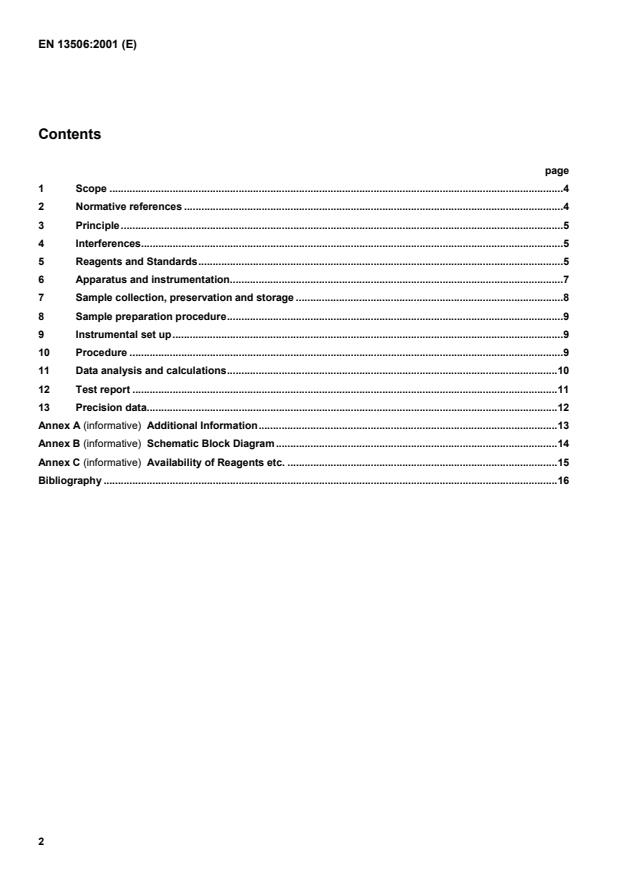
Additional Information.13Annex B (informative)
Schematic Block Diagram.14Annex C (informative)
Availability of Reagents etc.15Bibliography.16
(K2Cr2O7) = 0,05 g/lDissolve 50 mg of K2Cr2O7 in 50 ml nitric acid (5.7) and dilute to 1 000 ml with water (5.2).5.9 Hydrochloric acid (HCl), w(HCl) = 120 g/kgDilute 167 ml of high purity hydrochloric acid w(HCl) = 360 g/kg ( (HCl) = 1,19 g/ml) to 500 ml with water (5.2).5.10 Tin(II)chloride solution,
(SnCl2
2 H2O) = 20 g/lAdd 10,0 g of tin(II)chloride dihydrate to 150 ml of hydrochloric acid (5.9). Heat to dissolve. Dilute to 500 ml withwater (5.2). To remove any traces of mercury, bubble the solution with argon, nitrogen or air e.g. at a flow rate of2 l/min for 15 min.NOTEThe hydrochloric acid used to prepare this solution can be analytical grade since any mercury present will beremoved on bubbling.5.11 Reagent blankFor each 100 ml, prepare a solution containing 15 ml of hydrochloric acid (5.9) and 2 ml of potassium bromide -potassium bromate reagent (5.5). Add 100 µl of ascorbic acid solution (5.6) for each 10 ml prepared [5]. It isessential that the same reagents used for sample and standard preparation are used for preparation of the reagentblank. Treat the reagent blank like a sample.NOTEOn the continuous flow system, the reagent blank solution is run as background for automatic blank subtraction.This solution can contain trace levels of detectable amounts of mercury.5.12 Mercury standard solutions5.12.1 Mercury stock solution A,
(Hg) = 1 000 mg/lUse a commercially available quantitative standard solution. This solution is stable for at least six months.Alternatively use a stock solution prepared from ultra high purity grade chemicals (99,99 / 99,999 % (mass fraction)pure). Dissolve 0,1354 g of mercury(II)chloride HgCl2 in 20 ml water (5.2). Add 5 ml of nitric acid (5.7) and dilute to100 ml.WARNING — Do not dry the inorganic salt, it is highly toxic.5.12.2 Mercury stock solution B, (Hg) = 10 mg/lDilute 1 ml of stock solution A (5.12.1) with water (5.2) to approximately 20 ml. Add 2 ml of potassium bromide -potassium bromate reagent (5.5) and 15 ml of hydrochloric acid (5.9) and dilute to 100 ml in a borosilicatevolumetric flask with water. Prepare weekly.
(Hg) = 100 µg/lDilute 1 ml of stock solution B (5.12.2) to 100 ml with reagent blank (5.11) in a borosilicate flask.Prepare the solution on the day of use.5.12.4 Mercury stock solution D,
(Hg) = 1 µg/lDilute 1 ml of stock solution C (5.12.3) to 100 ml with reagent blank (5.11) in a borosilicate flask.Prepare the solution freshly before each series of measurements.5.12.5 Calibration standardsPrepare a minimum of five mercury calibration standards spanning the concentration range of interest by serialdilution of the stock solution D (5.12.4). Each calibration standard shall contain 15 ml of hydrochloric acid (5.9) and2 ml of potassium bromide - potassium bromate reagent (5.5) per 100 ml in borosilicate volumetric flasks. Plasticflasks should not be used if they are permeable to mercury(0) vapour. Prepare daily.The matrix of the reagent blank solution shall be identical to that of the standard solutions.For the concentration range from 10 ng/l to 100 ng/l, for example, proceed as follows: Prepare 5 calibration standards of concentrations 10 ng/l, 30 ng/l, 50 ng/l, 70 ng/l and 100 ng/l by taking 1 ml,3 ml, 5 ml, 7 ml and 10 ml respectively of mercury stock solution D (5.12.4) and diluting accurately to 100 mlwith reagent blank (5.11).For the concentration range from 2 ng/l to 20 ng/l, for example, proceed as follows: Prepare a working stock solution of 100 ng/l by taking 10 ml of mercury stock solution D (5.12.4) and diluting itaccurately to 100 ml with reagent blank (5.11). Prepare daily. From
...
Questions, Comments and Discussion
Ask us and Technical Secretary will try to provide an answer. You can facilitate discussion about the standard in here.
Loading comments...