


EN 12350-12:2010
(Main)Testing fresh concrete - Part 12: Self-compacting concrete - J-ring test
Testing fresh concrete - Part 12: Self-compacting concrete - J-ring test
This European Standard specifies the procedure for determining the passing ability (measured by the blocking step), the flow spread and t500J flow time of self-compacting concrete as the concrete flows through the J-ring.
The test is not suitable when the maximum size of aggregate exceeds 40 mm.
NOTE In respect to the relationship between aggregate size and bar spacing, the test is intended to assess the passing ability of the concrete proposed with the bar spacing typically in the works. If the concrete blocks then the aggregate size could be too large for the particular application.
Prüfung von Frischbeton - Teil 12: Selbstverdichtender Beton - Blockierring-Versuch
Essai pour béton frais - Partie 12: Béton auto-plaçant - Essai d'écoulement à l'anneau
La présente norme spécifie la méthode de détermination de l'aptitude à l'écoulement en milieu confiné (mesurée par le palier de blocage), l'étalement et le temps d'étalement t500J du béton auto-plaçant lorsque le béton s'écoule à travers un anneau supportant une grille d’armatures.
Cet essai ne convient pas lorsque le diamètre maximum des granulats excède 40 mm.
NOTE En ce qui concerne la relation entre le diamètre des granulats et l’espacement des barres, l’essai est destiné à évaluer le taux de remplissage du béton proposé pour un espacement des barres représentatif des ouvrages à bétonner. Si le béton se bloque, il se peut que le diamètre des granulats soit trop important pour cette application.
Preskušanje svežega betona - 12. del: Samozgoščevalni beton - Preskus z J-obročem
Ta evropski standard določa postopek za ugotavljanje zmožnosti prehodnosti (merjene z ukrepom blokiranja), obseg razleza in t500J čas razleza za samozgoščevalni beton, ko se beton pretaka skozi J-obroč. Ta preskus ni ustrezen, če največja velikost agregata presega 40 mm.
General Information
- Status
- Published
- Publication Date
- 20-Jul-2010
- Withdrawal Date
- 30-Jan-2011
- Technical Committee
- CEN/TC 104 - Concrete ( performance, production, placing and compliance criteria )
- Drafting Committee
- CEN/TC 104/SC 1 - Revision of ENV 206
- Current Stage
- 9093 - Decision to confirm - Review Enquiry
- Start Date
- 18-Jun-2021
- Completion Date
- 14-Apr-2025
- Directive
- 89/106/EEC - Construction products
Relations
- Effective Date
- 21-May-2011
Overview
EN 12350-12:2010 (CEN) specifies the procedure for the J-ring test used to evaluate self-compacting concrete (SCC). The test quantifies the concrete's ability to pass through congested reinforcement and narrow openings (the passing ability), measures the flow spread (SFJ) and, where required, records the t500J flow time - the time to reach a 500 mm diameter. The method complements other SCC tests and is not suitable where the maximum aggregate size exceeds 40 mm.
Key Topics
- Purpose: Assess passing ability, flow spread and t500J for SCC prior to casting to help ensure adequate in-situ filling and reinforcement embedment without vibration.
- Apparatus: Uses a J-ring placed over the slump cone. Two configurations are defined:
- Narrow gap J-ring: 16 smooth steel bars, 18 ± 0.5 mm diameter, bar spacing approx. 41 ± 1 mm, ring diameter 300 ± 2 mm.
- Wide gap J-ring: 12 smooth steel bars, 18 ± 0.5 mm diameter, bar spacing approx. 59 ± 1 mm, ring diameter 300 ± 2 mm.
- Measurements:
- Passing ability (PJ): Determined from vertical height differences measured at the centre and around the J-ring (recorded to the nearest 1 mm) and expressed in millimetres.
- Flow spread (SFJ): Mean of the two orthogonal spread diameters (d1 and d2), expressed to the nearest 10 mm; SFJ = (d1 + d2) / 2.
- t500J: Time from cone lift to first contact of SCC with the 500 mm circle, recorded to the nearest 0.5 s (if requested).
- Procedure highlights: Sample according to EN 12350-1. Place the J-ring concentrically, fill cone in one operation, lift cone vertically in 1–3 s, measure spreads and height differences, inspect for segregation.
Applications
- Quality control on-site and in laboratories to verify SCC compositions before casting.
- Design validation when changing constituents or mix proportions to confirm passing ability through reinforcement layouts.
- Comparative testing for mix selection where passing ability and spread performance are critical (e.g., heavily reinforced elements, complex formwork).
Practical notes:
- Use the narrow gap J-ring to simulate congested reinforcement. If blocking occurs, consider whether aggregate size or mix design is inappropriate for the intended bar spacing.
- Report any signs of segregation (e.g., mortar ring or coarse aggregate concentration) qualitatively.
Related Standards
- EN 12350-1: Sampling
- EN 12350-8: Slump-flow test for SCC (procedure alignment)
- EN 12350-10: L-box test for SCC (alternative passing test)
- ISO 5725-2: Repeatability and reproducibility assessment
The EN 12350-12:2010 J-ring test provides practical, repeatable metrics for SCC passing ability and flow performance to support reliable workability assessment and site quality control.

Frequently Asked Questions
EN 12350-12:2010 is a standard published by the European Committee for Standardization (CEN). Its full title is "Testing fresh concrete - Part 12: Self-compacting concrete - J-ring test". This standard covers: This European Standard specifies the procedure for determining the passing ability (measured by the blocking step), the flow spread and t500J flow time of self-compacting concrete as the concrete flows through the J-ring. The test is not suitable when the maximum size of aggregate exceeds 40 mm. NOTE In respect to the relationship between aggregate size and bar spacing, the test is intended to assess the passing ability of the concrete proposed with the bar spacing typically in the works. If the concrete blocks then the aggregate size could be too large for the particular application.
This European Standard specifies the procedure for determining the passing ability (measured by the blocking step), the flow spread and t500J flow time of self-compacting concrete as the concrete flows through the J-ring. The test is not suitable when the maximum size of aggregate exceeds 40 mm. NOTE In respect to the relationship between aggregate size and bar spacing, the test is intended to assess the passing ability of the concrete proposed with the bar spacing typically in the works. If the concrete blocks then the aggregate size could be too large for the particular application.
EN 12350-12:2010 is classified under the following ICS (International Classification for Standards) categories: 91.100.30 - Concrete and concrete products. The ICS classification helps identify the subject area and facilitates finding related standards.
EN 12350-12:2010 has the following relationships with other standards: It is inter standard links to EN 12390-1:2012. Understanding these relationships helps ensure you are using the most current and applicable version of the standard.
EN 12350-12:2010 is associated with the following European legislation: EU Directives/Regulations: 305/2011, 89/106/EEC; Standardization Mandates: M/128. When a standard is cited in the Official Journal of the European Union, products manufactured in conformity with it benefit from a presumption of conformity with the essential requirements of the corresponding EU directive or regulation.
You can purchase EN 12350-12:2010 directly from iTeh Standards. The document is available in PDF format and is delivered instantly after payment. Add the standard to your cart and complete the secure checkout process. iTeh Standards is an authorized distributor of CEN standards.
Standards Content (Sample)
2003-01.Slovenski inštitut za standardizacijo. Razmnoževanje celote ali delov tega standarda ni dovoljeno.REURþHPPrüfung von Frischbeton - Teil 12: Selbstverdichtender Beton - Blockierring-VersuchEssai pour béton frais - Partie 12 : Béton auto-plaçant - Essai d'écoulement à l'anneauTesting fresh concrete - Part 12: Self-compacting concrete - J-ring test91.100.30Beton in betonski izdelkiConcrete and concrete productsICS:Ta slovenski standard je istoveten z:EN 12350-12:2010SIST EN 12350-12:2010en,fr,de01-december-2010SIST EN 12350-12:2010SLOVENSKI
STANDARD
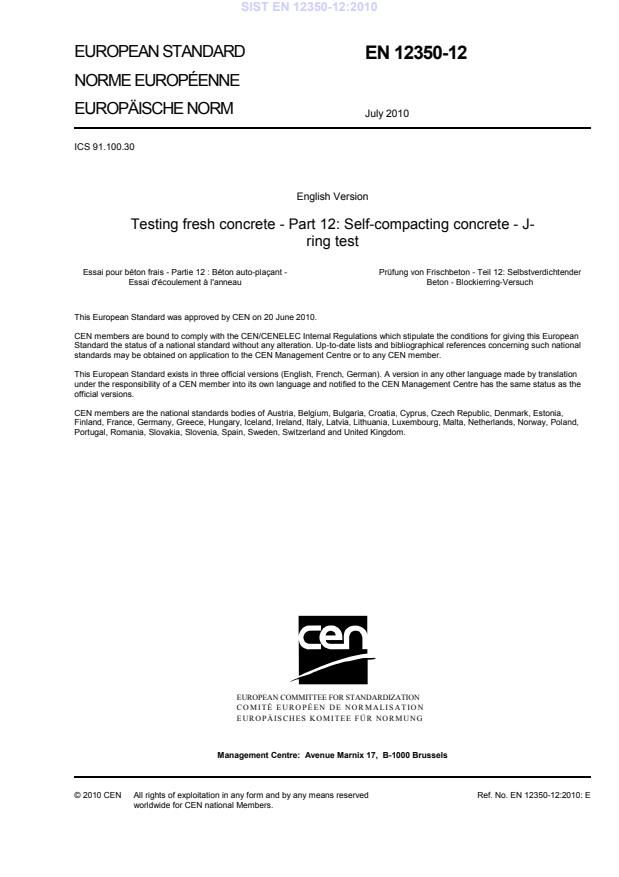
EUROPEAN STANDARD NORME EUROPÉENNE EUROPÄISCHE NORM
EN 12350-12
July 2010 ICS 91.100.30 English Version
Testing fresh concrete - Part 12: Self-compacting concrete - J-ring test
Essai pour béton frais - Partie 12 : Béton auto-plaçant - Essai d'écoulement à l'anneau
Prüfung von Frischbeton - Teil 12: Selbstverdichtender Beton - Blockierring-Versuch This European Standard was approved by CEN on 20 June 2010.
CEN members are bound to comply with the CEN/CENELEC Internal Regulations which stipulate the conditions for giving this European Standard the status of a national standard without any alteration. Up-to-date lists and bibliographical references concerning such national standards may be obtained on application to the CEN Management Centre or to any CEN member.
This European Standard exists in three official versions (English, French, German). A version in any other language made by translation under the responsibility of a CEN member into its own language and notified to the CEN Management Centre has the same status as the official versions.
CEN members are the national standards bodies of Austria, Belgium, Bulgaria, Croatia, Cyprus, Czech Republic, Denmark, Estonia, Finland, France, Germany, Greece, Hungary, Iceland, Ireland, Italy, Latvia, Lithuania, Luxembourg, Malta, Netherlands, Norway, Poland, Portugal, Romania, Slovakia, Slovenia, Spain, Sweden, Switzerland and United Kingdom.
EUROPEAN COMMITTEE FOR STANDARDIZATION
COMITÉ EUROPÉEN DE NORMALISATION EUROPÄISCHES KOMITEE FÜR NORMUNG
Management Centre:
Avenue Marnix 17,
B-1000 Brussels © 2010 CEN All rights of exploitation in any form and by any means reserved worldwide for CEN national Members. Ref. No. EN 12350-12:2010: ESIST EN 12350-12:2010
The test is not suitable when the
...
Questions, Comments and Discussion
Ask us and Technical Secretary will try to provide an answer. You can facilitate discussion about the standard in here.
Loading comments...