

EN 13634:2010
(Main)Protective footwear for motorcycle riders - Requirements and test methods
- Abstract
This European Standard applies to protective footwear for motorcycle riders for use while riding motorcycles for on or off road activities. It specifies the requirements for protection, ergonomic characteristics, innocuousness, mechanical properties, marking and information for users. It also describes the appropriate test methods.
- Status
- Withdrawn
- Publication Date
- 14-Dec-2010
- Withdrawal Date
- 06-Oct-2026
- Technical Committee
- CEN/TC 161 - Foot and leg protectors
- Drafting Committee
- CEN/TC 161/WG 2 - Specifications for footwear for professional use
- Current Stage
- 9960 - Withdrawal effective - Withdrawal
- Start Date
- 09-Dec-2015
- Completion Date
- 07-Oct-2026
- Directive
- 89/686/EEC - Personal protective equipment (PPE)OJ Ref: C, C 205 OJ Date: 09-Jul-2011

Relations
- Effective Date
- 22-Dec-2008
- Replaced By
EN 13634:2015 - Protective footwear for motorcycle riders - Requirements and test methods - Effective Date
- 29-Nov-2010
- Effective Date
- 25-Aug-2026
- Effective Date
- 11-Feb-2026
- Effective Date
- 28-Jan-2026
- Effective Date
- 28-Jan-2026
- Effective Date
- 28-Jan-2026
- Refers
EN ISO 11642:2025 - Leather - Tests for colour fastness - Colour fastness to water (ISO 11642:2025) - Effective Date
- 28-Jan-2026
- Effective Date
- 28-Jan-2026
- Effective Date
- 28-Jan-2026
- Effective Date
- 28-Jan-2026
- Effective Date
- 28-Jan-2026
- Effective Date
- 28-Jan-2026
- Effective Date
- 28-Jan-2026
- Refers
EN ISO 20344:2004 - Personal protective equipment - Test methods for footwear (ISO 20344:2004) - Effective Date
- 28-Jan-2026
Get Certified
Connect with accredited certification bodies for this standard

CIS Institut d.o.o.
Personal Protective Equipment (PPE) certification body. Notified Body NB-2890 for EU Regulation 2016/425 PPE.

Kiwa BDA Testing
Building and construction product certification.
Kmetijski inštitut Slovenije
Agricultural Institute of Slovenia. Soil testing, plant health, agricultural product analysis.
Sponsored listings
Frequently Asked Questions
EN 13634:2010 is a standard published by the European Committee for Standardization (CEN). Its full title is "Protective footwear for motorcycle riders - Requirements and test methods". This standard covers: This European Standard applies to protective footwear for motorcycle riders for use while riding motorcycles for on or off road activities. It specifies the requirements for protection, ergonomic characteristics, innocuousness, mechanical properties, marking and information for users. It also describes the appropriate test methods.
This European Standard applies to protective footwear for motorcycle riders for use while riding motorcycles for on or off road activities. It specifies the requirements for protection, ergonomic characteristics, innocuousness, mechanical properties, marking and information for users. It also describes the appropriate test methods.
EN 13634:2010 is classified under the following ICS (International Classification for Standards) categories: 13.340.50 - Leg and foot protection. The ICS classification helps identify the subject area and facilitates finding related standards.
EN 13634:2010 has the following relationships with other standards: It is inter standard links to EN 13634:2002, EN 13634:2015, ISO 5423:1992, ISO 4649:2010, EN 17092-5:2020, EN ISO 17075:2007, EN 17092-6:2020, EN ISO 11642:2025, EN 17092-2:2020, EN 17092-1:2020, EN 17092-4:2020, EN 17092-3:2020, EN ISO 20345:2004, EN 1621-1:1997, EN ISO 20344:2004. Understanding these relationships helps ensure you are using the most current and applicable version of the standard.
EN 13634:2010 is associated with the following European legislation: EU Directives/Regulations: 89/686/EEC, 93/68/EEC, 93/95/EEC, 96/58/EC; Standardization Mandates: M/031. When a standard is cited in the Official Journal of the European Union, products manufactured in conformity with it benefit from a presumption of conformity with the essential requirements of the corresponding EU directive or regulation.
EN 13634:2010 is available in PDF format for immediate download after purchase. The document can be added to your cart and obtained through the secure checkout process. Digital delivery ensures instant access to the complete standard document.
Standards Content (Sample)
2003-01.Slovenski inštitut za standardizacijo. Razmnoževanje celote ali delov tega standarda ni dovoljeno.Varovalna obutev za voznike motornih koles - Zahteve in preskusne metodeSchutzschuhe für Motorradfahrer - Anforderungen und PrüfverfahrenChaussures de protection des motocyclistes - Exigences et méthodes d'essaiProtective footwear for motorcycle riders - Requirements and test methods43.140Motorna kolesa in mopediMotor cycles and mopeds13.340.50Varovanje nog in stopalLeg and foot protectionICS:Ta slovenski standard je istoveten z:EN 13634:2010SIST EN 13634:2011en,fr,de01-junij-2011SIST EN 13634:2011SLOVENSKI
STANDARDSIST EN 13634:20021DGRPHãþD
EUROPEAN STANDARD NORME EUROPÉENNE EUROPÄISCHE NORM
EN 13634
December 2010 ICS 13.340.50 Supersedes EN 13634:2002English Version
Protective footwear for motorcycle riders - Requirements and test methods
Chaussures de protection des motocyclistes - Exigences et méthodes d'essai
Schutzschuhe für Motorradfahrer - Anforderungen und Prüfverfahren This European Standard was approved by CEN on 6 November 2010.
CEN members are bound to comply with the CEN/CENELEC Internal Regulations which stipulate the conditions for giving this European Standard the status of a national standard without any alteration. Up-to-date lists and bibliographical references concerning such national standards may be obtained on application to the CEN-CENELEC Management Centre or to any CEN member.
This European Standard exists in three official versions (English, French, German). A version in any other language made by translation under the responsibility of a CEN member into its own language and notified to the CEN-CENELEC Management Centre has the same status as the official versions.
CEN members are the national standards bodies of Austria, Belgium, Bulgaria, Croatia, Cyprus, Czech Republic, Denmark, Estonia, Finland, France, Germany, Greece, Hungary, Iceland, Ireland, Italy, Latvia, Lithuania, Luxembourg, Malta, Netherlands, Norway, Poland, Portugal, Romania, Slovakia, Slovenia, Spain, Sweden, Switzerland and United Kingdom.
EUROPEAN COMMITTEE FOR STANDARDIZATION
COMITÉ EUROPÉEN DE NORMALISATION EUROPÄISCHES KOMITEE FÜR NORMUNG
Management Centre:
Avenue Marnix 17,
B-1000 Brussels © 2010 CEN All rights of exploitation in any form and by any means reserved worldwide for CEN national Members. Ref. No. EN 13634:2010: ESIST EN 13634:2011
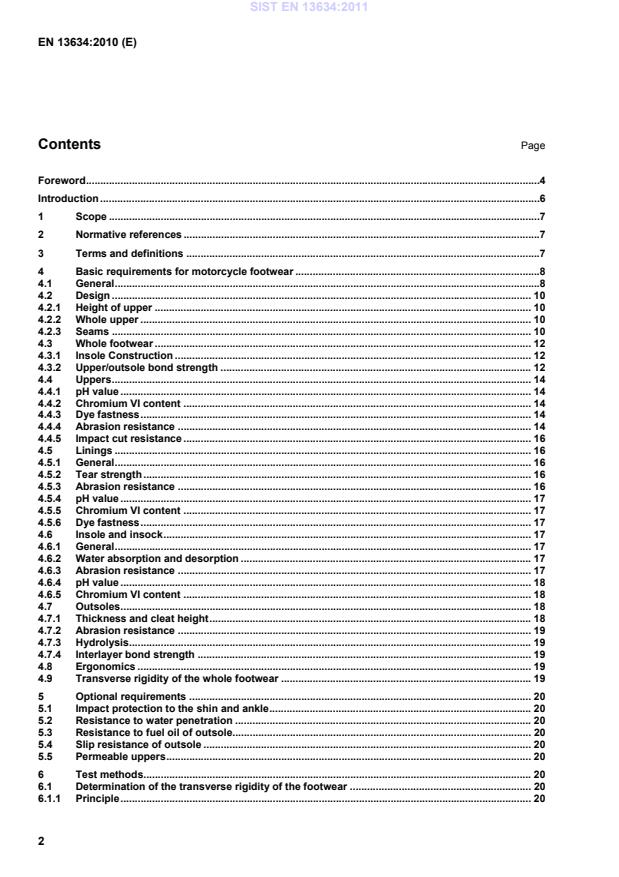
Ergonomic and size testing . 26Annex B (informative)
Uncertainty of measurement and interpretation of results . 28Annex ZA (informative)
Relationship between this European Standard and the Essential Requirements of EU Directive 89/686/EEC Personal Protective Equipment . 30Bibliography . 31 SIST EN 13634:2011
Annex A is normative. Annex B is informative. The following significant technical changes have been introduced in comparison with the former edition
EN 13634:2002: a) The title and scope have been modified; the scope is not any more limited to professional motorcycle riders; b) Two distinct performance levels have been introduced; c) Definitions for protective layer and professional rider were deleted; d) Minimum number of samples and test specimens and their origin specified; e) Height of upper specified depending on the footwear size; f) Design requirements for seams specified more precisely in Figure 1; g) Basic requirements for insoles and insocks specified in more detail; h) Requirement added for CrVI content of leather in upper and lining; i) Abrasion resistance requirement modified for upper, linings and insoles and insocks; j) Impact zones and material areas for upper resistance to impact cut specified; k) Requirement and test method for impact cut resistance modified; l) Optional requirement for slip resistance of outsole included; m) Optional requirement for permeable uppers included; n) Marking requirements modified; SIST EN 13634:2011
1) EN ISO 20345:2004 is impacted by the stand-alone amendment EN ISO 20345:2004/A1:2007. SIST EN 13634:2011
Table 1 – Minimum number of samples and test specimens and their origin Property Clause Samples Take test specimens only from footwear Height of the upper 4.2.1 One pair in each of 3 sizes YES Seams 4.2.3 One pair in each of 3 sizes YES Upper/outsole bond strength 4.3.2 One pair in each of 3 sizes YES pH value 4.4.1 One sample only of each leather NO Chromium VI content 4.4.2 One sample only of each leather NO Dye fastness 4.4.3 One sample only of each material NO Abrasion resistance 4.4.4 5 test specimens from each material
NO Impact cut resistance 4.4.5 One sample only of each material NO Lining Tear strength 4.5.2 One sample only of each material NO Lining Abrasion resistance 4.5.3 One sample only of each material NO Lining pH value 4.5.4 One sample only of each leather NO Lining Chromium VI content 4.5.5 One sample only of each leather NO Insocks 4.6 One sample only
NO Outsole thickness and cleat height 4.7.1 One pair in each of 3 sizes YES Outsole abrasion resistance 4.7.2 One pair in each of 3 sizes YES Outsole hydrolysis 4.7.3 One pair in each of 3 sizes YES Outsole interlayer bond strength 4.7.4 One pair in each of 3 sizes YES Ergonomics 4.8 One pair in each of 3 sizes YES Transverse rigidity of the whole footwear
4.9 One pair in each of 3 sizes YES Impact energy protection ankle / shin 5.1 One pair in each of 3 sizes YES Water resistance 5.2 One pair in each of 3 sizes YES Resistance to fuel oil 5.3 One pair in each of 3 sizes YES Slip resistance of outsoles 5.4 One pair in each of 3 sizes YES Permeable uppers 5.5 One sample only of each material YES NOTE 3 Sizes = 1 pair in the smallest available size + 1 pair in the largest available size + 1 pair from the middle of the size range SIST EN 13634:2011
4.2.2 Whole upper Upper material shall meet the requirements in 4.4. 4.2.3 Seams
Where present, overlapping constructional seams on the outer side of the forepart of the boot in Zone A (defined in Figure 1 a) as below height B and less than 0,5 x L from the toe end) shall be constructed such that the exposed edge of the material overlap is not facing the front of the boot, see Figures 1 b) and 1 c).
L12BLA 123 b) Seam not suitable 32 c) Seam suitable Key B Height B (see Table 3) 1 Exposed edge to front 2 Heel end 3 Toe end A – Zone A a) Zones where seam types to be checked Figure 1 Seams SIST EN 13634:2011
Table 3 Height B as shown in Figure 1 a) Footwear sizeHeight(B)mm Paris Point UK 36 and below Up to 3½ 44 37 and 38 4 to 5 46 39 and 40 5½ to 6½ 48 41 and 42 7 to 8 50 43 and 44 8½ to 10 52 45 and above 10½ and above 53
4.3 Whole footwear 4.3.1 Insole Construction Either an insole or insock shall be present in such a way that it cannot be removed without damaging the footwear, see acceptable options as detailed in Table 4. 4.3.2 Upper/outsole bond strength When footwear is tested in accordance with the method described in EN ISO 20344:2004, 5.2, the bond strength shall be not less than 4,0 N/mm unless there is tearing of the sole material in which case the bond strength shall be not less than 3,0 N/mm. SIST EN 13634:2011
Table 4 Basic requirements for insoles and/or insocks
Options
Component to be assessed Requirements to fulfil Thickness EN ISO 20345:2004, 5.7.1 pH a EN ISO 20345:2004, 5.7.2 Water absorption desorption EN ISO 20345:2004, 5.7.3 Abrasion EN ISO 20345:2004, 5.7.4.1 Chromium VI a EN ISO 20345:2004, 5.7.5 Abrasion EN ISO 20345:2004, 5.7.4.2
No insole or if present not fulfilling the requirements
Non-removable insock
Insock
X
X
X
X
X
Insole present No insock
Insole
X
X
X
X
X
Seat sock present
3 Full insock, non-removable Insock and Insole together
X
X
Insock
X
X X
4 Full insock, removable and water permeable b
Insole
X
X
X
X
X
Insock
X
X X
5 Full insock, removable not water permeable b
Insole
X
X
X
X
X
Insock
X
X
X
X X
means that the requirement shall be met. a
Those requirements are only for leather. b
A water permeable insock is one that, when tested in accordance with EN ISO 20344:2004, 7.2, lets water through in.60 s or less
If the footwear includes different types of leather, whether in contact with the skin or not, each leather type shall be tested separately and comply with the above requirement. At least two samples shall be taken from different items of footwear for each leather type. 4.4.3 Dye fastness Footwear shall not be manufactured from material containing dyes which will readily migrate when it becomes wet with water. When any inner surfaces of the upper that will be adjacent to the wearers foot or hose (unnecessary if not coloured) are tested in accordance with EN ISO 11642, the change in colour of any component of the multifibre fabric shall be not worse than Grey Scale rating 3. 4.4.4 Abrasion resistance When the full thickness of the upper (i.e. upper + lining) is tested in accordance with the procedure in EN 13595-2, the abrasion resistance shall be classified as below. All material type combinations shall be tested and the upper classified on the lowest result (see Table 5): Table 5 Requirements for upper resistance to abrasion
Minimum abrasion resistance Areas (see Figure 2 and Table 6) Level 1 Level 2A 1,5 s 2,5 s B 5 s 12 s
Key
1 = Zone 1 shin region 2 = Zone 2 ankle region
= Area A
= Area B Figure 2 Impact zones and material areas (see Table 6)
(Paris Points) Size
(English) A BCDE F min. min. min. max. min. max. 38 and below 5 and below 70 45 80 17 40 120 39 to 42 5.5 to 8 75 50 90 19 50 125 43 and above 8.5 and above 80 55 95 21 55 130 In order to accommodate different ergonomic requirements for different riding disciplines small deviations of Area A material are permitted in Area B provided the total infiltration is not greater than 8 cm2 per boot. The lower tangent of zone 2 is used to define the lower limits for measurements E & F. Zone 2 is located by centering point X over the natural centre of the ankle as felt through the footwear worn by an appropriate subject.
4.4.5 Impact cut resistance When the full thickness of the upper (i.e. upper + lining) is tested in accordance with the procedure in EN 13595-4, the impact cut resistance of the upper shall be classified as below. All material type combinations shall be tested and the upper classified on the lowest result (see Table 7): Table 7 Requirements for upper resistance to impact cut Areas (see Figure 2 and Table 6) Level 1 Level 2A Impact speed 2,0 m/s,
maximum knife penetration 25 mm Impact speed 2,0 m/s,
maximum knife penetration 25
...