


EN 12447:2021
(Main)Geotextiles and geotextile-related products - Screening test method for determining the resistance to hydrolysis in water
Geotextiles and geotextile-related products - Screening test method for determining the resistance to hydrolysis in water
This document specifies a screening test method for determining the resistance of geotextiles and geotextile-related products to hydrolysis by exposing test specimens to water at elevated temperatures, followed by an evaluation of the changes in properties resulting from such exposure. It is intended as a means of establishing a minimum acceptable level of durability.
The tests described in this document do not allow the determination of reduction factors. The tests described in this document are screening tests to show the ability of a product to serve for a certain time. The reference strength and retained strength of products investigated in this document need to be determined in the same way in accordance with EN 12226.
The test is applicable to any geotextile and geotextile-related product susceptible to hydrolysis, in particular polyester and polyamide based materials, and in addition to the yarns from which these geotextiles are made.
This method is not intended for determining the resistance of geotextiles to hydrolysis under highly acid or alkaline conditions.
NOTE Performance tests to predict long-term lifetime or to compare products of different polymers or of similar polymers with differing structures can be based on the same method but with a wider range of temperatures and durations.
Geotextilien und geotextilverwandte Produkte - Auswahlprüfverfahren zur Bestimmung der Hydrolysebeständigkeit in Wasser
Dieses Dokument legt ein Prüfverfahren zur Bestimmung der Beständigkeit von Geotextilien und geotextilverwandten Produkten gegen Hydrolyse fest, indem Messproben bei erhöhten Temperaturen Wasser ausgesetzt und dann bewertet werden, um die durch diese Einflüsse bedingten Eigenschaftsänderungen zu ermitteln. Das Prüfverfahren ist zur Festlegung einer Mindestanforderung für die Beständigkeit vorgesehen.
Die in diesem Dokument beschriebenen Prüfungen erlauben keine Bestimmung von Reduktionsfaktoren. Die in diesem Dokument beschriebenen Prüfungen sind Auswahlprüfverfahren, die die Funktionsfähigkeit eines Produkts über einen bestimmten Zeitraum aufzeigen. Die Referenzfestigkeit und die Restfestigkeit der in diesem Dokument untersuchten Produkte müssen auf dieselbe Art und Weise nach EN 12226 bestimmt werden.
Die Prüfung ist auf alle hydrolyseanfälligen Geotextilien und geotextilverwandten Produkte anwendbar, besonders auf Materialien auf Polyester- und Polyamidbasis und zusätzlich auf die Garne, aus denen diese Geotextilien hergestellt sind.
Dieses Verfahren ist nicht zur Bestimmung der Beständigkeit von Geotextilien gegen Hydrolyse unter stark sauren oder alkalischen Bedingungen vorgesehen.
ANMERKUNG Auf der Grundlage dieses Verfahrens können auch anwendungsbezogene Prüfungen zur Vorhersage der Langzeitlebensdauer oder zum Vergleich von Produkten aus unterschiedlichen Polymeren oder aus gleichen Polymeren mit unterschiedlicher Struktur entwickelt werden, wobei jedoch für Temperatur und Dauer weitere Bereiche ausgewählt werden.
Géotextiles et produits apparentés - Méthode d'essai sélective pour la détermination de la résistance à l'hydrolyse dans l'eau
Le présent document spécifie une méthode d’essai sélective permettant de déterminer la résistance des géotextiles et des produits apparentés aux géotextiles à l’hydrolyse par exposition d’éprouvettes à de l’eau à températures élevées, suivie d’une évaluation des changements de propriétés résultant de cette exposition. Le but de cet essai est d’établir un niveau minimal acceptable de durabilité.
Les essais décrits dans ce document ne permettent pas la détermination de facteurs de réduction. Les essais décrits dans ce document constituent des essais sélectifs permettant d’évaluer l’aptitude de service d’un produit pour une durée spécifique. La résistance de référence et la résistance résiduelle des produits examinés dans ce document nécessitent d’être déterminés conformément à l’EN 12226.
L’essai s’applique à tous les géotextiles et produits apparentés aux géotextiles sensibles à l’hydrolyse, notamment les matériaux à base de polyester et de polyamide et par extension aux fils dont les géotextiles sont faits.
La méthode décrite n’est pas prévue pour la détermination de la résistance des géotextiles à l’hydrolyse dans des conditions élevées d’alcalinité ou d’acidité.
NOTE Les essais de performance destinés à prévoir la durée de vie à long terme ou à comparer les produits composés de polymères différents ou des mêmes polymères mais ayant une structure différente peuvent utiliser la même méthode mais avec une plage plus large de températures et de durées.
Geotekstilije in geotekstilijam sorodni izdelki - Presejalna preskusna metoda za ugotavljanje odpornosti proti hidrolizi v vodi
General Information
- Status
- Published
- Publication Date
- 31-Aug-2021
- Withdrawal Date
- 30-Mar-2022
- Technical Committee
- CEN/TC 189 - Geotextiles and geotextile-related products
- Drafting Committee
- CEN/TC 189/WG 5 - Durability
- Current Stage
- 6060 - Definitive text made available (DAV) - Publishing
- Start Date
- 01-Sep-2021
- Due Date
- 22-Dec-2021
- Completion Date
- 01-Sep-2021
Relations
- Effective Date
- 08-Sep-2021
Overview
EN 12447:2021 - Geotextiles and geotextile-related products - specifies a screening test method to determine the resistance of geotextiles and related products to hydrolysis in water. The standard exposes specimens to deionised water at elevated temperature (80 ± 2 °C) and evaluates changes in mechanical properties after exposure. It is intended to establish a minimum acceptable level of durability, particularly for materials susceptible to internal hydrolysis such as polyester and polyamide fibres.
Key topics and technical requirements
- Test principle: Immersion of test and control specimens in hot deionised water followed by mechanical evaluation (retained and reference strength).
- Temperature and medium: Use deionised water (EN ISO 3696, class 3) at (80 ± 2) °C; temperature recorded at least once daily.
- Specimens:
- Minimum of five test and five control specimens per test direction (machine and cross-machine unless otherwise agreed).
- Coated materials: test without coating; manufacturer must ensure coating degradation does not influence yarn hydrolysis.
- Yarn specimens may be tested wound loosely on inert tubes.
- Apparatus: Containers of inert material (stainless steel or borosilicate glass); total specimen volume ≤ 10% of container free space; mass of water : mass of specimens ≥ 30:1.
- Control exposure: Control specimens immersed for 6 hours, then stored in the dark at room temperature.
- Test durations: Provides screening durations mapped to nominal service-life estimates in natural soils (pH 4–9, soil temp ≤ 25 °C):
- Reinforcement/long-term strength applications: 28 d → 25 y; 56 d → 50 y; 112 d → 100 y.
- Other applications: 14 d → 25 y; 28 d → 50 y; 56 d → 100 y.
- Post-exposure conditioning: At least 16 h at (20 ± 2) °C and (65 ± 5)% RH before mechanical testing.
- Limitations: Screening tests do not provide reduction factors and are not intended for highly acidic or alkaline hydrolysis conditions.
Applications
- Quality control and durability screening of geotextiles, geocomposites and yarns used in drainage, reinforcement, filtration and soil separation.
- Early verification of product susceptibility to hydrolytic degradation for polyester and polyamide based geosynthetics.
- Input to product development, specification compliance and acceptance testing where a minimum hydrolysis resistance level is required.
Who uses this standard
- Geosynthetics manufacturers and R&D laboratories
- Materials engineers and geotechnical consultants specifying long-term performance
- Test laboratories performing durability assessment and product certification
Related standards
- EN 12226 - General tests for evaluation following durability testing (reference and retained strength)
- EN ISO 2062 - Yarn breaking force (CRE tester)
- EN ISO 3696 - Water for analytical laboratory use
- Bibliography includes EN 13249, EN ISO 5077, EN ISO 10318-1 for broader geosynthetics context
Keywords: EN 12447:2021, geotextiles, hydrolysis resistance, screening test, geosynthetics durability, polyester, polyamide, elevated temperature testing.



Frequently Asked Questions
EN 12447:2021 is a standard published by the European Committee for Standardization (CEN). Its full title is "Geotextiles and geotextile-related products - Screening test method for determining the resistance to hydrolysis in water". This standard covers: This document specifies a screening test method for determining the resistance of geotextiles and geotextile-related products to hydrolysis by exposing test specimens to water at elevated temperatures, followed by an evaluation of the changes in properties resulting from such exposure. It is intended as a means of establishing a minimum acceptable level of durability. The tests described in this document do not allow the determination of reduction factors. The tests described in this document are screening tests to show the ability of a product to serve for a certain time. The reference strength and retained strength of products investigated in this document need to be determined in the same way in accordance with EN 12226. The test is applicable to any geotextile and geotextile-related product susceptible to hydrolysis, in particular polyester and polyamide based materials, and in addition to the yarns from which these geotextiles are made. This method is not intended for determining the resistance of geotextiles to hydrolysis under highly acid or alkaline conditions. NOTE Performance tests to predict long-term lifetime or to compare products of different polymers or of similar polymers with differing structures can be based on the same method but with a wider range of temperatures and durations.
This document specifies a screening test method for determining the resistance of geotextiles and geotextile-related products to hydrolysis by exposing test specimens to water at elevated temperatures, followed by an evaluation of the changes in properties resulting from such exposure. It is intended as a means of establishing a minimum acceptable level of durability. The tests described in this document do not allow the determination of reduction factors. The tests described in this document are screening tests to show the ability of a product to serve for a certain time. The reference strength and retained strength of products investigated in this document need to be determined in the same way in accordance with EN 12226. The test is applicable to any geotextile and geotextile-related product susceptible to hydrolysis, in particular polyester and polyamide based materials, and in addition to the yarns from which these geotextiles are made. This method is not intended for determining the resistance of geotextiles to hydrolysis under highly acid or alkaline conditions. NOTE Performance tests to predict long-term lifetime or to compare products of different polymers or of similar polymers with differing structures can be based on the same method but with a wider range of temperatures and durations.
EN 12447:2021 is classified under the following ICS (International Classification for Standards) categories: 59.080.70 - Geotextiles. The ICS classification helps identify the subject area and facilitates finding related standards.
EN 12447:2021 has the following relationships with other standards: It is inter standard links to EN 12447:2001. Understanding these relationships helps ensure you are using the most current and applicable version of the standard.
You can purchase EN 12447:2021 directly from iTeh Standards. The document is available in PDF format and is delivered instantly after payment. Add the standard to your cart and complete the secure checkout process. iTeh Standards is an authorized distributor of CEN standards.
Standards Content (Sample)
SLOVENSKI STANDARD
01-november-2021
Nadomešča:
SIST EN 12447:2002
Geotekstilije in geotekstilijam sorodni izdelki - Presejalna preskusna metoda za
ugotavljanje odpornosti proti hidrolizi v vodi
Geotextiles and geotextile-related products - Screening test method for determining the
resistance to hydrolysis in water
Geotextilien und geotextilverwandte Produkte - Auswahlprüfverfahren zur Bestimmung
der Hydrolysebeständigkeit in Wasser
Géotextiles et produits apparentés - Méthode d'essai sélective pour la détermination de
la résistance à l'hydrolyse dans l'eau
Ta slovenski standard je istoveten z: EN 12447:2021
ICS:
59.080.70 Geotekstilije Geotextiles
2003-01.Slovenski inštitut za standardizacijo. Razmnoževanje celote ali delov tega standarda ni dovoljeno.
EN 12447
EUROPEAN STANDARD
NORME EUROPÉENNE
September 2021
EUROPÄISCHE NORM
ICS 59.080.70 Supersedes EN 12447:2001
English Version
Geotextiles and geotextile-related products - Screening
test method for determining the resistance to hydrolysis in
water
Géotextiles et produits apparentés - Méthode d'essai Geotextilien und geotextilverwandte Produkte -
sélective pour la détermination de la résistance à Auswahlprüfverfahren zur Bestimmung der
l'hydrolyse dans l'eau Hydrolysebeständigkeit in Wasser
This European Standard was approved by CEN on 18 July 2021.
CEN members are bound to comply with the CEN/CENELEC Internal Regulations which stipulate the conditions for giving this
European Standard the status of a national standard without any alteration. Up-to-date lists and bibliographical references
concerning such national standards may be obtained on application to the CEN-CENELEC Management Centre or to any CEN
member.
This European Standard exists in three official versions (English, French, German). A version in any other language made by
translation under the responsibility of a CEN member into its own language and notified to the CEN-CENELEC Management
Centre has the same status as the official versions.
CEN members are the national standards bodies of Austria, Belgium, Bulgaria, Croatia, Cyprus, Czech Republic, Denmark, Estonia,
Finland, France, Germany, Greece, Hungary, Iceland, Ireland, Italy, Latvia, Lithuania, Luxembourg, Malta, Netherlands, Norway,
Poland, Portugal, Republic of North Macedonia, Romania, Serbia, Slovakia, Slovenia, Spain, Sweden, Switzerland, Turkey and
United Kingdom.
EUROPEAN COMMITTEE FOR STANDARDIZATION
COMITÉ EUROPÉEN DE NORMALISATION
EUROPÄISCHES KOMITEE FÜR NORMUNG
CEN-CENELEC Management Centre: Rue de la Science 23, B-1040 Brussels
© 2021 CEN All rights of exploitation in any form and by any means reserved Ref. No. EN 12447:2021 E
worldwide for CEN national Members.
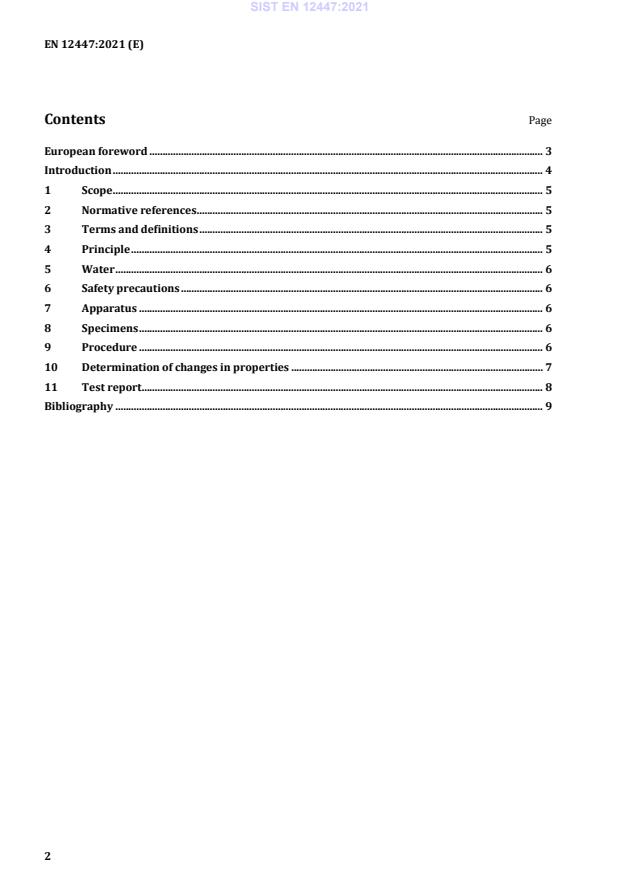
Contents Page
European foreword . 3
Introduction . 4
1 Scope . 5
2 Normative references . 5
3 Terms and definitions . 5
4 Principle . 5
5 Water . 6
6 Safety precautions . 6
7 Apparatus . 6
8 Specimens . 6
9 Procedure . 6
10 Determination of changes in properties . 7
11 Test report . 8
Bibliography . 9
European foreword
This document (EN 12447:2021) has been prepared by Technical Committee CEN/TC 189
“Geosynthetics”, the secretariat of which is held by NBN.
This European Standard shall be given the status of a national standard, either by publication of an
identical text or by endorsement, at the latest by March 2022, and conflicting national standards shall
be withdrawn at the latest by March 2022.
Attention is drawn to the possibility that some of the elements of this document may be the subject of
patent rights. CEN shall not be held responsible for identifying any or all such patent rights.
This document supersedes EN 12447:2001.
In comparison with the previous edition, the following technical modifications have been made:
— test temperature has been reduced;
— the exposure of the control specimen has been extended to 6 h;
— tables with test durations have been added.
Any feedback and questions on this document should be directed to the users’ national standards body.
A complete listing of these bodies can be found on the CEN website.
According to the CEN-CENELEC Internal Regulations, the national standards organisations of the
following countries are bound to implement this European Standard: Austria, Belgium, Bulgaria,
Croatia, Cyprus, Czech Republic, Denmark, Estonia, Finland, France, Germany, Greece, Hungary, Iceland,
Ireland, Italy, Latvia, Lithuania, Luxembourg, Malta, Netherlands, Norway, Poland, Portugal, Republic of
North Macedonia, Romania, Serbia, Slovakia, Slovenia, Spain, Sweden, Switzerland, Turkey and the
United Kingdom.
Introduction
This document describes a screening test method to establish a minimum acceptance level of resistance
of geotextiles and geotextile-related products to soil moisture.
In certain polymers moisture leads to hydrolysis throughout the thickness of the fibre (internal
hydrolysis) but the rate of degradation is such that over short periods it is only measurable at elevated
temperatures, e.g. by immersion in hot water.
1 Scope
This document specifies a screening test method for determining the resistance of geotextiles and
geotextile-related products to hydrolysis by exposing test specimens to water at elevated temperatur
...
The EN 12447:2021 standard provides a critical screening test method designed to assess the resistance of geotextiles and geotextile-related products to hydrolysis when exposed to water under elevated temperatures. Its scope is well-defined, targeting the evaluation of changes in properties following this exposure, thereby establishing a minimum acceptable level of durability for these materials. One of the primary strengths of the standard lies in its applicability to a broad range of geotextiles, particularly those made from polyester and polyamide. This inclusion ensures that the standard is relevant to various product types within the geotextile industry, making it an essential document for manufacturers and users alike. Additionally, the standard clearly delineates that the tests are screening tests; it focuses on demonstrating the ability of these products to maintain performance over a certain timeframe without quantifying reduction factors, which aligns with its objective of determining durability rather than precise performance metrics. The EN 12447:2021 also directs users to perform complementary strength evaluations in accordance with EN 12226, thus ensuring a comprehensive approach to performance assessment. However, it is essential to note that the standard does not apply to conditions involving highly acidic or alkaline environments, which is a limitation that practitioners should be aware of when considering the effectiveness of geotextile products in challenging conditions. Moreover, the standard's method is designed in such a way that it could potentially serve as a basis for further performance tests aimed at predicting longevity or benchmarking different products concerning hydrolysis resistance. This flexibility adds to its relevance in the ongoing development of geotextile technology. Overall, the EN 12447:2021 is a robust and pertinent standard for anyone involved with geotextiles, providing a clear methodology for assessing hydrolysis resistance and contributing positively to the improvement of material durability in various applications.
SIST EN 12447:2021 문서의 검토는 지오텍스타일 및 지오텍스타일 관련 제품의 내수성 검사를 위한 스크리닝 시험 방법을 명확하게 정의하고 있습니다. 이 표준은 시험 시료를 높은 온도의 물에 노출시키고, 이러한 노출로 인한 특성 변화를 평가함으로써 내수성의 저항력을 판별하는 방법을 제공합니다. 이러한 테스트는 제품의 최소한의 내구성 기준을 설정하기 위한 수단으로 설계되었습니다. 표준의 강점 중 하나는 종합적인 내수성 시험 절차를 제공함으로써 지오텍스타일 제품이 특정 기간 동안 사용될 수 있는 능력을 입증할 수 있도록 한다는 점입니다. 또한, 이 문서에 포함된 시험 절차는 EN 12226에 따라 조사된 제품의 기준 강도 및 유지 강도를 동일한 방식으로 결정해야 함을 강조하고 있습니다. 이 시험 방법은 폴리에스터 및 폴리아미드 기반 재료와 같은 하이드롤라시스에 민감한 모든 지오텍스타일 및 지오텍스타일 관련 제품에 적용 가능하며, 이러한 지오텍스타일로 제작된 실에도 적용됩니다. 그러나 이 방법은 강한 산성 또는 알칼리성 조건에서의 지오텍스타일의 하이드롤라시스 저항성을 결정하는 데는 적합하지 않다는 점도 명시되어 있습니다. 또한, 이 표준은 다양한 온도와 기간을 적용한 성능 테스트를 통해 제품의 장기적인 수명을 예측하거나, 서로 다른 고분자 또는 구조가 다른 유사 고분자 제품을 비교하는 데에도 활용될 수 있다는 유연성을 제공합니다. 이러한 점에서 SIST EN 12447:2021은 지오텍스타일 산업에서의 내수성 평가 및 내구성 기준의 확립에 매우 중요한 역할을 수행하고 있습니다.
EN 12447:2021は、地質織物および地質織物関連製品の水に対する加水分解耐性を評価するためのスクリーニングテスト方法を定めた標準である。この文書の範囲は、試験標本を高温の水にさらし、その結果として物性の変化を評価することにより、耐久性の最低基準を確立することを目的としている。重要なのは、このテストが製品が一定の時間にわたって機能する能力を示すためのスクリーニングテストであるという点である。 この標準には、加水分解に対する耐性を測定するための詳細な手法が包含されており、特にポリエステルやポリアミドなどの素材に敏感な地質織物や関連製品に適用可能である。また、この標準に従い、試験された製品の基準強度と保持強度は、EN 12226に準拠して決定する必要があることも明記されている。 加水分解の影響を受ける所有性を評価することは、長期的な耐用年数を予測するためや、異なるポリマーや構造の類似ポリマーを比較するためのパフォーマンステストの基盤としても利用可能であり、将来的にはより広範囲な温度と期間を考慮した試験方法に拡張することができる。 ただし、強酸または強アルカリ環境下での耐性を測定するための方法としては意図されていない点に留意が必要である。これにより、使用環境に応じた適用性を考慮しつつ、多様な用途における製品の性能を保証することが可能となる。 全体として、EN 12447:2021は、地質織物の耐久性を体系的に評価するための重要な指針を提供しており、業界内での関連性は非常に高い。
Questions, Comments and Discussion
Ask us and Technical Secretary will try to provide an answer. You can facilitate discussion about the standard in here.
Loading comments...