


EN 12221-1:2008+A1:2013
(Main)Child use and care articles - Changing units for domestic use - Part 1: Safety requirements
Child use and care articles - Changing units for domestic use - Part 1: Safety requirements
This part of EN 12221 specifies safety requirements for changing units for domestic use for children with a body weight no more than 15 kg.
EN 12221 only covers the function of the item as a changing unit. If the changing unit can be converted or used as another function it shall comply with other relevant standards, e.g. cots, storage furniture, etc.
The changing unit may be foldable and can be fitted with a child bathtub or other additional items.
Changing pads are only covered by this standard when they form a part of the changing unit.
Artikel für Säuglinge und Kleinkinder - Wickeleinrichtungen für den Hausgebrauch - Teil 1: Sicherheitstechnische Anforderungen
Dieser Teil von EN 12221 legt die sicherheitstechnischen Anforderungen für Wickeleinrichtungen im Hausgebrauch für Kinder mit einem Körpergewicht von höchstens 15 kg fest.
EN 12221 bezieht sich nur auf die Funktion des Gegenstandes als eine Wickeleinrichtung. Falls die Wickeleinrichtung umgebaut oder mit einer weiteren Funktion benutzt werden kann, muss sie weitere zutreffende Normen erfüllen, wie z. B. Normen für Kinderbetten und Ablagemöbel.
Die Wickeleinrichtung darf zusammenklappbar sein und kann mit einer Kinderbadewanne oder weiteren zusätzlichen Zubehörteilen ausgestattet sein.
Wickelunterlagen sind nur Gegenstand dieser Norm, wenn sie Teil der Wickeleinrichtung sind.
Articles de puériculture - Dispositifs à langer à usage domestique - Partie 1: Exigences de sécurité
La présente partie de l’EN 12221 fixe les exigences de sécurité applicables aux dispositifs à langer à usage domestique pour les enfants pesant au maximum 15 kg.
L’EN 12221 traite uniquement de la fonction de l’article considéré en tant que «dispositif à langer». Si un dispositif à langer est convertible ou susceptible d’être utilisé pour d’autres fonctions (lit d’enfant, meuble de rangement, etc.), il doit être conforme aux autres normes applicables.
Le dispositif à langer peut être pliable et équipé d’une baignoire pour enfant ou d’autres accessoires.
Les matelas à langer ne sont couverts par la présente norme que lorsqu’ils font partie intégrante du dispositif à langer.
Izdelki za otroke - Previjalne mize za domačo uporabo - 1. del: Varnostne zahteve (vključno z dopolnilom A1)
Ta del standarda EN 12221 določa varnostne zahteve za previjalne mize za domačo uporabo za otroke s telesno težo do 15 kg. EN 12221 zajema samo eno funkcijo elementa, in sicer uporabo kot previjalno mizo. Če je previjalno mizo mogoče pretvoriti ali uporabljati za drugo funkcijo, mora biti v skladu z drugimi ustreznimi standardi, npr. za posteljice, shranjevalno pohištvo itd. Previjalna miza je lahko zložljiva in je na njo mogoče pritrditi otroško kad ali druge dodatne elemente. Ta standard zajema previjalne podloge le, kadar so del previjalne mize.
General Information
- Status
- Published
- Publication Date
- 20-Aug-2013
- Withdrawal Date
- 27-Feb-2014
- Technical Committee
- CEN/TC 252 - Child use and care articles
- Drafting Committee
- CEN/TC 252/WG 1 - Seating and body care
- Current Stage
- 9092 - Decision on results of review/2YR ENQ - revise - Review Enquiry
- Start Date
- 09-Jul-2020
- Completion Date
- 14-Apr-2025
Relations
- Effective Date
- 19-Jan-2023
- Effective Date
- 19-Jan-2023
- Effective Date
- 19-Jan-2023
Overview
EN 12221-1:2008+A1:2013 is a CEN European standard that specifies safety requirements for changing units for domestic use (changing tables) intended for children up to a body weight of 15 kg. It covers the changing-unit function only - if the product converts to or doubles as other furniture (cots, storage furniture, etc.) those functions must meet the relevant standards. Foldable units, integrated bathtubs and attached changing pads (when part of the unit) are included.
Key topics and technical requirements
The standard focuses on mechanical safety, materials and dimensions to reduce risk during nappy changing. Key requirements include:
- Maximum child weight: intended for children with body weight no more than 15 kg (type 1 and type 2 distinctions apply).
- Changing area dimensions:
- Type 1 (up to 11 kg): minimum 380 mm × 650 mm
- Type 2 (up to 15 kg): minimum 550 mm × 750 mm
- Materials and chemical limits: coatings and accessible materials must meet migration and heavy‑metal limits (tests referenced to EN 71‑3).
- Holes, gaps and entrapment: strict gap-size limits in the accessibility zone to prevent finger, limb and head entrapment (examples: forbidden gaps in ranges such as 7–12 mm, 25–45 mm, 65–223 mm as defined and tested).
- Cords and loops: cords/strings limited to ≤ 220 mm free length; loops limited to ≤ 360 mm peripheral dimension.
- Edges and protrusions: accessible edges must be rounded/chamfered and burr‑free; barrier/changing surface upper edges have minimum 2 mm radius.
- Moving parts and locking: moving-part clearances must avoid shear/squeeze points; folding/locking mechanisms must resist unintended collapse - either ≥ 50 N release force or require two-step/simultaneous actions to release.
- Castors/wheels: restricted arrangements (either 2+ castors plus other supports, or 4+ castors with at least two lockable). Locks must prevent rolling after testing.
- Stability and strength: units must not overturn in prescribed tests and must retain function after strength testing.
- Prohibited fasteners: self‑tapping screws are not permitted where components are intended to be removed for transport/storage.
- Test methods: referenced in EN 12221‑2 (Part 2: Test methods).
Applications and users
EN 12221-1 is used by:
- Manufacturers and designers of changing units / changing tables for the domestic market
- Product safety engineers and compliance teams preparing CE/national compliance documentation
- Test laboratories performing safety verification per EN 12221‑2
- Retailers and procurement specialists specifying safe changing furniture for homes, nurseries and childcare settings
Practical benefits include reduced entrapment, fall and chemical risks, safer folding/locking design, and clearer technical criteria for production and testing.
Related standards
- EN 12221-2:2008+A1:2013 - Part 2: Test methods (mandatory companion document)
- EN 71-1, EN 71-3 - referenced for mechanical/toy safety and migration of elements (materials testing)
- Other furniture standards may apply if the unit also functions as cot, storage furniture, etc.
Keywords: EN 12221-1:2008+A1:2013, changing units, changing tables, safety requirements, child care furniture, accessibility zone, stability, test methods.

Frequently Asked Questions
EN 12221-1:2008+A1:2013 is a standard published by the European Committee for Standardization (CEN). Its full title is "Child use and care articles - Changing units for domestic use - Part 1: Safety requirements". This standard covers: This part of EN 12221 specifies safety requirements for changing units for domestic use for children with a body weight no more than 15 kg. EN 12221 only covers the function of the item as a changing unit. If the changing unit can be converted or used as another function it shall comply with other relevant standards, e.g. cots, storage furniture, etc. The changing unit may be foldable and can be fitted with a child bathtub or other additional items. Changing pads are only covered by this standard when they form a part of the changing unit.
This part of EN 12221 specifies safety requirements for changing units for domestic use for children with a body weight no more than 15 kg. EN 12221 only covers the function of the item as a changing unit. If the changing unit can be converted or used as another function it shall comply with other relevant standards, e.g. cots, storage furniture, etc. The changing unit may be foldable and can be fitted with a child bathtub or other additional items. Changing pads are only covered by this standard when they form a part of the changing unit.
EN 12221-1:2008+A1:2013 is classified under the following ICS (International Classification for Standards) categories: 97.190 - Equipment for children. The ICS classification helps identify the subject area and facilitates finding related standards.
EN 12221-1:2008+A1:2013 has the following relationships with other standards: It is inter standard links to EN 12221-1:2008/FprA1, EN 12221-1:2008, FprEN 12221. Understanding these relationships helps ensure you are using the most current and applicable version of the standard.
EN 12221-1:2008+A1:2013 is associated with the following European legislation: EU Directives/Regulations: 2001/95/EC; Standardization Mandates: M/264. When a standard is cited in the Official Journal of the European Union, products manufactured in conformity with it benefit from a presumption of conformity with the essential requirements of the corresponding EU directive or regulation.
You can purchase EN 12221-1:2008+A1:2013 directly from iTeh Standards. The document is available in PDF format and is delivered instantly after payment. Add the standard to your cart and complete the secure checkout process. iTeh Standards is an authorized distributor of CEN standards.
Standards Content (Sample)
2003-01.Slovenski inštitut za standardizacijo. Razmnoževanje celote ali delov tega standarda ni dovoljeno.Artikel für Säuglinge und Kleinkinder - Wickeleinrichtungen für den Hausgebrauch - Teil 1: Sicherheitstechnische AnforderungenArticles de puériculture - Dispositifs à langer à usage domestique - Partie 1: Exigences de sécuritéChild use and care articles - Changing units for domestic use - Part 1: Safety requirements97.190Otroška opremaEquipment for childrenICS:Ta slovenski standard je istoveten z:EN 12221-1:2008+A1:2013SIST EN 12221-1:2008+A1:2013en,fr,de01-oktober-2013SIST EN 12221-1:2008+A1:2013SLOVENSKI
STANDARDSIST EN 12221-1:20081DGRPHãþD
EUROPEAN STANDARD NORME EUROPÉENNE EUROPÄISCHE NORM
EN 12221-1:2008+A1
August 2013 ICS 97.190 Supersedes EN 12221-1:2008
English Version
Child use and care articles - Changing units for domestic use - Part 1: Safety requirements
Articles de puériculture - Dispositifs à langer à usage domestique - Partie 1: Exigences de sécurité
Artikel für Säuglinge und Kleinkinder - Wickeleinrichtungen für den Hausgebrauch - Teil 1: Sicherheitstechnische Anforderungen This European Standard was approved by CEN on 18 February 2008 and includes Amendment 1 approved by CEN on 8 July 2013.
CEN members are bound to comply with the CEN/CENELEC Internal Regulations which stipulate the conditions for giving this European Standard the status of a national standard without any alteration. Up-to-date lists and bibliographical references concerning such national standards may be obtained on application to the CEN-CENELEC Management Centre or to any CEN member.
This European Standard exists in three official versions (English, French, German). A version in any other language made by translation under the responsibility of a CEN member into its own language and notified to the CEN-CENELEC Management Centre has the same status as the official versions.
CEN members are the national standards bodies of Austria, Belgium, Bulgaria, Croatia, Cyprus, Czech Republic, Denmark, Estonia, Finland, Former Yugoslav Republic of Macedonia, France, Germany, Greece, Hungary, Iceland, Ireland, Italy, Latvia, Lithuania, Luxembourg, Malta, Netherlands, Norway, Poland, Portugal, Romania, Slovakia, Slovenia, Spain, Sweden, Switzerland, Turkey and United Kingdom.
EUROPEAN COMMITTEE FOR STANDARDIZATION
COMITÉ EUROPÉEN DE NORMALISATION
EUROPÄISCHES KOMITEE FÜR NORMUNG
Management Centre:
Avenue Marnix 17,
B-1000 Brussels © 2013 CEN All rights of exploitation in any form and by any means reserved worldwide for CEN national Members. Ref. No. EN 12221-1:2008+A1:2013: E SIST EN 12221-1:2008+A1:2013
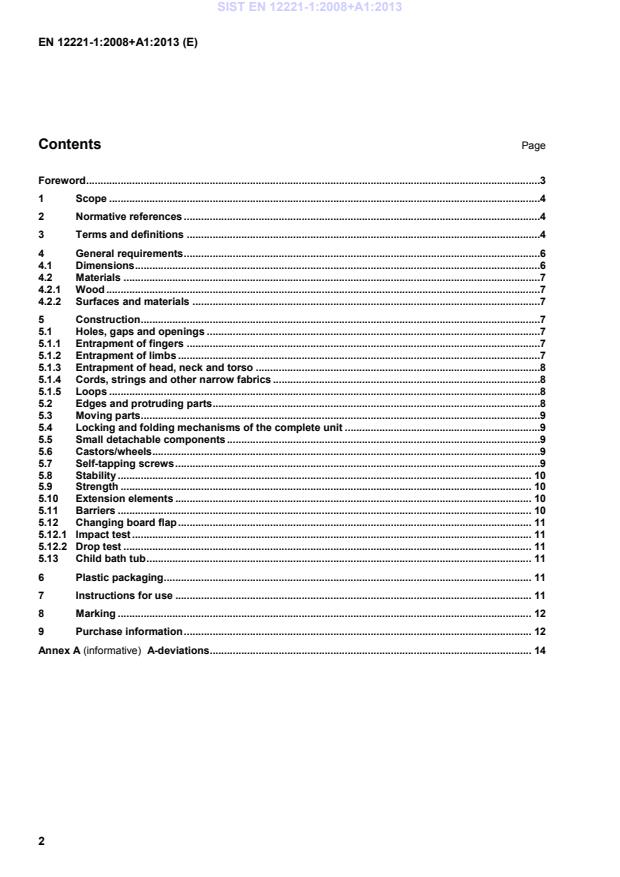
A-deviations . 14
1 Scope This part of EN 12221 specifies safety requirements for changing units for domestic use for children with a body weight no more than 15 kg. EN 12221 only covers the function of the item as a changing unit. If the changing unit can be converted or used as another function it shall comply with other relevant standards, e.g. cots, storage furniture, etc. The changing unit may be foldable and can be fitted with a child bathtub or other additional items. Changing pads are only covered by this standard when they form a part of the changing unit. 2 Normative references The following referenced documents are indispensable for the application of this document. For dated references, only the edition cited applies. For undated references, the latest edition of the referenced document (including any amendments) applies.
EN 71-1, Safety of toys - Part 1: Mechanical and physical properties EN 71-3, Safety of toys - Part 3: Migrations of certain elements !EN 12221-2:2008+A1:2013, Child use and care articles - Changing units for domestic use - Part 2: Test methods" 3 Terms and definitions For the purposes of this document, the following terms and definitions apply. 3.1 changing unit elevated structure designed to support a child in a lying position for the purpose of allowing a caregiver to change the child’s nappy !3.1.1
type 1 changing unit changing unit intended for use for children from birth up to an age of 12 months, up to 11 kg in accordance with the manufacturer’s instructions for use 3.1.2
type 2 changing unit changing unit intended for use for children from birth up to 15 kg in accordance with the manufacturer's instructions for use" 3.2 wall mounted changing unit changing unit designed to be attached to a wall
3.3 accessibility zone space around the changing area within the child’s reach. The volume contained within 550 mm above the changing area and within 200 mm around the changing area measured horizontally from the inside of the area, see Figure 1a) and Figure 1b) SIST EN 12221-1:2008+A1:2013
For contoured bathtubs the vertical volume is measured from a horizontal line drawn from the highest point where the child is seated, see Figure 1c)
Dimensions in millimetres
Key
1 Accessibility zone 2 Barrier Figure 1a) — Top view of accessibility zone Dimensions in millimetres
Key 1 Accessibility zone 2 Barrier Figure 1b) — Front view of accessibility zone SIST EN 12221-1:2008+A1:2013
Dimensions in millimetres
Key
1 Accessibility zone
Figure 1c) — Bathtub accessibility zone – example of a section view 3.4 extension element component that can be pulled out and pushed in
EXAMPLE baskets, drawers and alike 3.5 shear and squeeze point gaps, in which a part of the body may be crushed when two parts move relative to each other 3.6 V-shaped opening
opening with the apex downwards and an included angle of less than 60° 3.7
changing board flap changing surface that is raised to provide access to another function, e.g. a bathtub
...
Questions, Comments and Discussion
Ask us and Technical Secretary will try to provide an answer. You can facilitate discussion about the standard in here.
Loading comments...