

prEN 13832-1
(Main)Footwear protecting against chemicals - Part 1: Terminology and test methods
- Abstract
This document specifies test methods for the determination of the resistance of footwear against selected chemicals for the following circumstances: splashing, degradation, and permeation.
- Status
- Not Published
- Publication Date
- 30-Mar-2026
- Technical Committee
- CEN/TC 161 - Foot and leg protectors
- Current Stage
- 4060 - Closure of enquiry - Enquiry
- Start Date
- 18-Dec-2025
- Due Date
- 11-Mar-2025
- Completion Date
- 18-Dec-2025

Overview
prEN 13832-1 (Footwear protecting against chemicals - Part 1: Terminology and test methods) is a CEN draft standard prepared by CEN/TC 161. It defines terminology and laboratory test methods to determine the resistance of footwear and footwear materials to selected chemicals under three exposure scenarios: splashing, degradation and permeation. This part is one of three in the EN 13832 series and is intended to supersede EN 13832-1:2018 when published.
Key topics and technical requirements
- Scope and terminology: Aligns terms with EN ISO 20344 and EN 16523-1; defines degradation, permeation and splashing as test concepts.
- Laboratory safety and conditioning: Users must follow normal laboratory practice and applicable regulations. Test pieces are conditioned (typically 23 ± 2 °C, 50 ± 5 % RH) before testing.
- Sampling: Minimum sample counts and locations are specified (see Table 1), with guidance when full component test pieces are not available.
- Splashing test: Whole footwear are exposed by pouring defined volumes of chemical; procedural details include:
- Pour volumes and containers: (60 ± 6) ml applied using (20 ± 2) ml portions.
- Application angle and distance: footwear at ~45° (±10°); pouring distance 4–6 cm.
- Timings for inspection: short post‑exposure wait (2 min ±15 s for volatile liquids or 10 min ±30 s otherwise), follow‑up inspections at ~1 h (±2 min) and 24 h (±30 min).
- Tray, absorbent paper and damage assessment requirements; reporting of penetration and damage.
- Degradation and permeation tests: Procedures to assess physical property changes (e.g., swelling, embrittlement, discoloration) and molecular permeation through materials, with apparatus, sample preparation and result expression described.
- Test reporting and uncertainty: Detailed reporting requirements and guidance to estimate measurement uncertainty using standard approaches (ISO/IEC guides, ISO 5725, JCGM).
Applications and who uses it
prEN 13832-1 is practical for:
- PPE and safety footwear manufacturers (design validation and material selection)
- Independent testing laboratories and certification bodies (performance testing and compliance)
- Occupational safety professionals and procurement teams (selecting footwear for chemical hazards)
- R&D teams (material compatibility and durability studies) Use cases include quality control, product development, conformity assessment, and workplace PPE selection where chemical splash, prolonged contact or permeation risks exist.
Related standards
- EN ISO 20344:2021 (Test methods for footwear)
- EN ISO 20345/20346/20347:2022 (Safety/protective/occupational footwear)
- EN 16523-1:2015+A1:2018 (Permeation by liquid chemicals)
- ISO 37, ISO 23529 and other referenced ISO/IEC guidance for uncertainty and sampling
prEN 13832-1 is essential when evaluating chemical resistance of footwear materials and ensuring reliable PPE performance in workplaces with chemical exposure hazards.
Relations
- Revises
EN 13832-1:2018 - Footwear protecting against chemicals - Part 1: Terminology and test methods - Effective Date
- 31-Jan-2024
Get Certified
Connect with accredited certification bodies for this standard

CIS Institut d.o.o.
Personal Protective Equipment (PPE) certification body. Notified Body NB-2890 for EU Regulation 2016/425 PPE.

Kiwa BDA Testing
Building and construction product certification.
Kmetijski inštitut Slovenije
Agricultural Institute of Slovenia. Soil testing, plant health, agricultural product analysis.
Sponsored listings
Frequently Asked Questions
prEN 13832-1 is a draft published by the European Committee for Standardization (CEN). Its full title is "Footwear protecting against chemicals - Part 1: Terminology and test methods". This standard covers: This document specifies test methods for the determination of the resistance of footwear against selected chemicals for the following circumstances: splashing, degradation, and permeation.
This document specifies test methods for the determination of the resistance of footwear against selected chemicals for the following circumstances: splashing, degradation, and permeation.
prEN 13832-1 is classified under the following ICS (International Classification for Standards) categories: 13.340.50 - Leg and foot protection. The ICS classification helps identify the subject area and facilitates finding related standards.
prEN 13832-1 has the following relationships with other standards: It is inter standard links to EN 13832-1:2018. Understanding these relationships helps ensure you are using the most current and applicable version of the standard.
prEN 13832-1 is associated with the following European legislation: EU Directives/Regulations: 2016/425; Standardization Mandates: M/571, M/571 AMD 1. When a standard is cited in the Official Journal of the European Union, products manufactured in conformity with it benefit from a presumption of conformity with the essential requirements of the corresponding EU directive or regulation.
prEN 13832-1 is available in PDF format for immediate download after purchase. The document can be added to your cart and obtained through the secure checkout process. Digital delivery ensures instant access to the complete standard document.
Standards Content (Sample)
SLOVENSKI STANDARD
01-december-2025
Obutev za varovanje pred kemikalijami - 1. del: Izrazje in preskusne metode
Footwear protecting against chemicals - Part 1: Terminology and test methods
Schuhe zum Schutz gegen Chemikalien - Teil 1: Terminologie und Prüfverfahren
Chaussure protégeant contre les produits chimiques - Partie 1 : Terminologie et
méthodes d'essais
Ta slovenski standard je istoveten z: prEN 13832-1
ICS:
13.340.50 Varovanje nog in stopal Leg and foot protection
2003-01.Slovenski inštitut za standardizacijo. Razmnoževanje celote ali delov tega standarda ni dovoljeno.
DRAFT
EUROPEAN STANDARD
NORME EUROPÉENNE
EUROPÄISCHE NORM
September 2025
ICS 13.340.50 Will supersede EN 13832-1:2018
English Version
Footwear protecting against chemicals - Part 1:
Terminology and test methods
Chaussures protégeant contre les produits chimiques - Schuhe zum Schutz gegen Chemikalien - Teil 1:
Partie 1 : Terminologie et méthodes d'essais Terminologie und Prüfverfahren
This draft European Standard is submitted to CEN members for enquiry. It has been drawn up by the Technical Committee
CEN/TC 161.
If this draft becomes a European Standard, CEN members are bound to comply with the CEN/CENELEC Internal Regulations
which stipulate the conditions for giving this European Standard the status of a national standard without any alteration.
This draft European Standard was established by CEN in three official versions (English, French, German). A version in any other
language made by translation under the responsibility of a CEN member into its own language and notified to the CEN-CENELEC
Management Centre has the same status as the official versions.
CEN members are the national standards bodies of Austria, Belgium, Bulgaria, Croatia, Cyprus, Czech Republic, Denmark, Estonia,
Finland, France, Germany, Greece, Hungary, Iceland, Ireland, Italy, Latvia, Lithuania, Luxembourg, Malta, Netherlands, Norway,
Poland, Portugal, Republic of North Macedonia, Romania, Serbia, Slovakia, Slovenia, Spain, Sweden, Switzerland, Türkiye and
United Kingdom.
Recipients of this draft are invited to submit, with their comments, notification of any relevant patent rights of which they are
aware and to provide supporting documentation.
Warning : This document is not a European Standard. It is distributed for review and comments. It is subject to change without
notice and shall not be referred to as a European Standard.
EUROPEAN COMMITTEE FOR STANDARDIZATION
COMITÉ EUROPÉEN DE NORMALISATION
EUROPÄISCHES KOMITEE FÜR NORMUNG
CEN-CENELEC Management Centre: Rue de la Science 23, B-1040 Brussels
© 2025 CEN All rights of exploitation in any form and by any means reserved Ref. No. prEN 13832-1:2025 E
worldwide for CEN national Members.
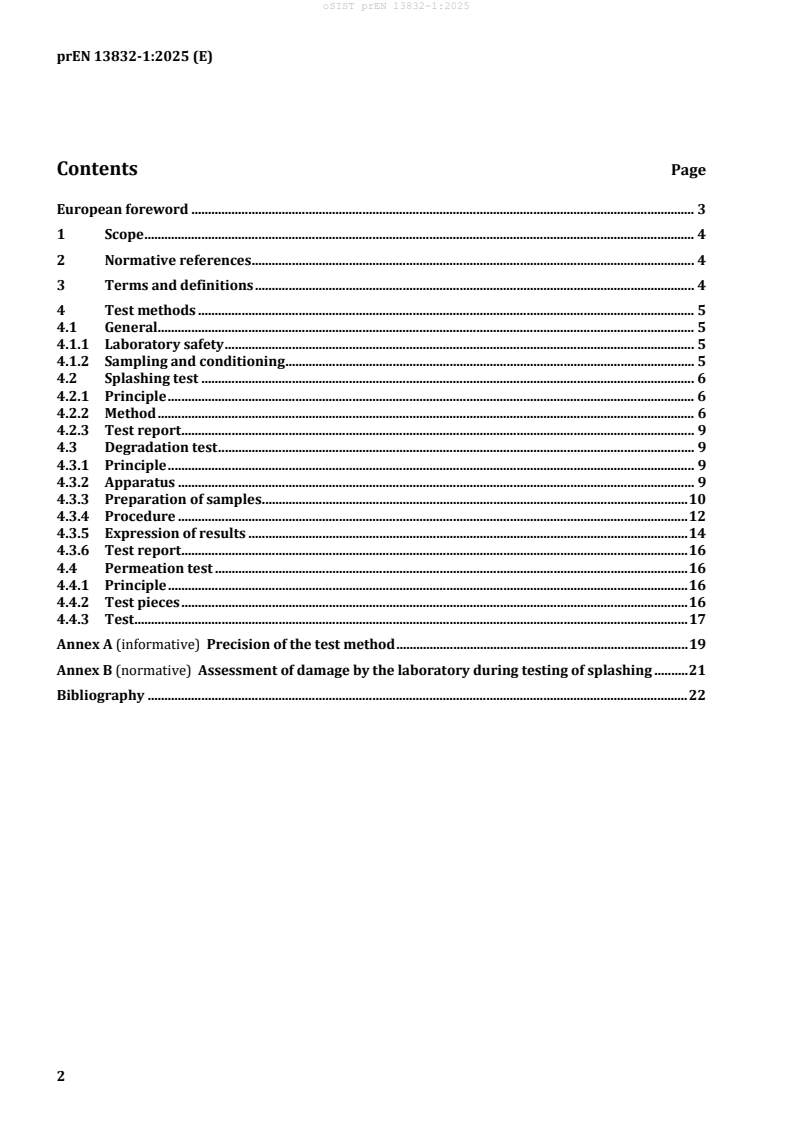
Contents Page
European foreword . 3
1 Scope . 4
2 Normative references . 4
3 Terms and definitions . 4
4 Test methods . 5
4.1 General. 5
4.1.1 Laboratory safety . 5
4.1.2 Sampling and conditioning . 5
4.2 Splashing test . 6
4.2.1 Principle . 6
4.2.2 Method . 6
4.2.3 Test report . 9
4.3 Degradation test . 9
4.3.1 Principle . 9
4.3.2 Apparatus . 9
4.3.3 Preparation of samples . 10
4.3.4 Procedure . 12
4.3.5 Expression of results . 14
4.3.6 Test report . 16
4.4 Permeation test . 16
4.4.1 Principle . 16
4.4.2 Test pieces . 16
4.4.3 Test . 17
Annex A (informative) Precision of the test method . 19
Annex B (normative) Assessment of damage by the laboratory during testing of splashing . 21
Bibliography . 22
European foreword
This document (prEN 13832-1:2025) has been prepared by Technical Committee CEN/TC 161 “Foot
and leg protection”, the secretariat of which is held by BSI.
This document is currently submitted to the CEN Enquiry.
This document will supersede EN 13832-1:2018.
EN 13832, Footwear protecting against chemicals, is published in three parts:
— Part 1: Terminology and test methods
— Part 2: Requirements for limited contact with chemicals
— Part 3: Requirements for prolonged contact with chemicals
Overview of major technical changes compared to the previous edition:
— reference to the new standards EN ISO 20345:2022, EN ISO 20346:2022 and EN ISO 20347:2022;
— new examination in 4.2.2 k) and l);
— change in Table 2, new test for upper seams;
— safety precautions in 4.1.1;
— new Figure 5;
— change in Table 2 (refence to ISO 37);
— new subclause 4.3.5;
— new drawing in Figure 1.
1 Scope
This document specifies test methods for the determination of the resistance of footwear against
selected chemicals for the following circumstances: splashing, degradation, and permeation.
2 Normative references
The following documents are referred to in the text in such a way that some or all of their content
constitutes requirements of this document. For dated references, only the edition cited applies. For
undated references, the latest edition of the referenced document (including any amendments) applies.
EN 16523-1:2015+A1:2018, Determination of material resistance to permeation by chemicals — Part 1:
Permeation by liquid chemical under conditions of continuous contact
EN ISO 868:2003, Plastics and ebonite — Determination of indentation hardness by means of a durometer
(Shore hardness) (ISO 868:2003)
EN ISO 17697:2016, Footwear — Test methods for uppers, lining and insocks — Seam strength
(ISO 17697:2016)
EN ISO 20344:2021, Personal protective equipment — Test methods for footwear (ISO 20344:2021)
EN ISO 20345:2022, Personal protective equipment — Safety footwear (ISO 20345:2021)
EN ISO 20346:2022, Personal protective equipment — Protective footwear (ISO 20346:2021)
EN ISO 20347:2022, Personal protective equipment — Occupational footwear (ISO 20347:2021)
ISO 37:2024, Rubber, vulcanized or thermoplastic — Determination of tensile stress-strain properties
ISO 23529:2016, Rubber — General procedures for preparing and conditioning test pieces for physical
test methods
3 Terms and definitions
For the purposes of this document, the terms and definitions given in EN ISO 20344:2021 and
EN 16523-1:2015+A1:2018 and the following apply.
ISO and IEC maintain terminology databases for use in standardization at the following addresses:
— ISO Online browsing platform: available at https://www.iso.org/obp
— IEC Electropedia: available at https://www.electropedia.org/
3.1
degradation
deleterious change in one or more properties of a footwear material due to contact with a chemical
Note 1 to entry: These changes may include, e.g. flaking, swelling, disintegration, embrittlement, discoloration,
dimensions, appearance, hardening and softening.
As impacted by EN ISO 20344:2021/A1:2024.
As impacted by EN ISO 20345:2022/A1:2024.
As impacted by EN ISO 20346:2022/A1:2024.
As impacted by EN ISO 20347:2022/A1:2024.
3.2
permeation
process by which a chemical move through a footwear material at a molecular level
Note 1 to entry: Permeation involves the following:
— absorption of molecules of the chemical into the contacted (outside) surface of a material;
— diffusion of the absorbed molecules into the material;
— desorption of the molecules from the opposite (inside) surface of the material.
3.3
splashing
contact after pouring of chemical on the footwear
3.4
test chemical
chemical that is used to assess the behaviour of a footwear or a footwear material after a defined
contact under the laboratory test conditions
Note 1 to entry: The chemical can cause adverse effects to the human body by contact with the skin.
4 Test methods
4.1 General
4.1.1 Laboratory safety
Safety precautions — Person using this document should be familiar with normal laboratory practice.
This document does not purport to address all the safety problems, if any, associated with its use. It is
the responsibility of the user to apply established Health and Safety practices and to ensure compliance
with the applicable regulations.
4.1.2 Sampling and conditioning
The minimum number of samples, i.e. separate items of footwear, to be tested in order to verify
compliance with the requirements specified in EN ISO 20344:2021, together with the minimum number
of test pieces to be taken from each sample, are given in Table 1.
Wherever possible, test pieces shall be taken from the whole footwear item unless otherwise stated.
If it is not possible to obtain a large enough test piece from the footwear, then a sample of the material
from which the component has been manufactured may be used instead and this should be noted in the
test report.
Table 1 — Minimum number of samples and test specimens or test pieces for one chemical
Test only on the final
Tests Number of test pieces from each sample
footwear
Table 1 of EN ISO 20344:2021 is applicable
Splashing test
1 pair of shoes (the medium size of the range) per chemical yes
(4.2)
— 2 discs for outsole (one before and one after each
chemical exposure), one pair at least
Degradation test
If possible
(4.3)
— 2 discs for upper (one before and one after each chemical
exposure) one pair at least
Permeation test
3 discs from the weakest part of the upper for each chemical yes
(4.4)
All test pieces shall be conditioned in a standard atmosphere of (23 ± 2) °C and (50 ± 5) % relative
humidity for a minimum of 24 h before testing, unless otherwise stated in the test method.
The maximum time which shall elapse between removal from the conditioning atmosphere and the
start of testing shall be not greater than 10 min, unless otherwise stated in the test method.
For each of the required measurements performed in accordance with this document, a corresponding
estimate of the uncertainty of measurement should be evaluated. One of the following approaches
should be used:
[9]
— a statistical method, e.g. as given in ISO 5725-2:2019 ;
[10]
— a mathematical method, e.g. as given in ISO/IEC Guide 98-3:2014 ;
[11]
— uncertainty and conformity assessment as given in ISO/IEC Guide 98-4:2012 ;
[12]
— JCGM 100:2008 .
4.2 Splashing test
4.2.1 Principle
The whole footwear samples are exposed in standardized conditions for several periods of time, by
pouring of a limited volume of specific liquid chemicals.
Damage to the materials and structure of the footwear including ingress through seams and
manufactured structure is assessed at specified step of the test method.
4.2.2 Method
A pair of shoes shall be evaluated per chemical to be applied. If several chemicals have to be chosen, it is
necessary to use a new pair of footwear for each chemical:
a) clean the footwear with a dry absorbent paper to remove any productions residues;
b) lightly mark (a waxed pencil or chalk have been found to be suitable) the sides of the test sample
with a horizontal line as defined in Figure 1. The height h is given by Table 8 (Minimum height,
below which the requirements of the upper shall be fulfilled) of EN ISO 20345:2022. This is to
define the tested area (under this line) to allow accurate application of the test chemical;
Key
h height of the tested area
1 test area
Figure 1 — Tested area for the splashing test
c) store the footwear for at least 24 h in an environment at (23 ± 2) °C and (50 ± 5) % rh. The test shall
be performed between (20 and 25) °C;
d) fill the footwear with absorbent paper as a trace medium for liquid ingress. Ensure the paper is in
contact with the seams of the footwear at the front, bellows and lacing in particular;
e) fasten the footwear (for example, by lacing);
f) prepare a minimum of 130 ml of the chosen test chemical;
g) place the footwear into a tray of a sufficient size [(30 ± 1) cm large (40 ± 1) cm long (5 ± 1) cm high]
to allow residual liquid to drain from around the footwear during application. The material
constituting the tray shall not be affected by the test chemical. Any accidental spillage during
application into the inner of the footwear shall be prevented;
h) pour (60 ± 6) ml of test liquid evenly across the two sides and front of the footwear using a
(20 ± 2) ml containers.
NOTE It has been found that using smaller containers each holding (20 ± 2) ml of the test liquid per side and
across the centre front makes application more consistent.
The footwear shall have an angle of (45 ± 10) degrees when pouring chemicals onto the side
sections. Using the 20 ml container, move along the drawn line and wet the test area of the sample.
The pouring distance shall be between 4 cm and 6 cm (see Figure 2). Leave any spilled volume in
the tray in contact with the outsole until the first examination is completed;
Key
1 20 ml container for test chemical
2 test area
3 upper edge of test area (see Figure 1)
4 pouring distance, 4 cm to 6 cm
Figure 2 — Splashing test principle
i) if the tested chemical has a high volatility (greater than 10 Kpa at 20 °C):
— leave the samples for a period of 2 min ± 15 s prior to removal from the tray;
For other chemicals:
— leave the samples for a period of 10 min ± 30 s prior to removal from the tray;
j) then assess any initial damage. The following changes are considered as damage:
— example given Annex B;
— discoloration, cracking, delamination, etc.;
— seam opening;
— hardening, softening, melting;
k) again, pour (60 ± 6) ml of test liquid evenly across the two sides and front of the footwear using a
(20 ± 2) ml containers;
l) 1 h (±2 min) after pouring the chemical, carry out a visual inspection of the two footwear,
comparing it to an original (or photographs) and note any damage or visual change as defined in
Annex B (for example, surface marking or damage, damage to components, lack of functionality).
Remove the absorbent paper from inside the footwear and, if any liquid penetration is visible as
damp patches, note the location of ingress.
Check the area under any lacing or fastenings where spilt liquid might be trapped and not easily
visible. Assess any initial damage (see 4.2.2 j). If necessary for a correct damage assessment, cut and
open the test sample to assess any internal damage or wetness;
m) 24 h (±30 min) after pouring the chemical, carry out a second visual inspection of the two footwear,
comparing it to an original (or photographs) and note any damage (see 4.2.2 j) or visual change as
defined in Annex B.
4.2.3 Test report
The test report shall include the following information:
a) the number and date of this document, i.e. prEN 13832-1:2025, 4.2;
b) a full description of the sample and its origin;
c) for each tested chemical:
1) a full description of the chemicals used in the splashing test,
2) the appearance of the test piece after the splashing tests (e.g. cracking, delamination) after 2 or
10 min, 1 h after the test and 24 h after the test,
3) any penetration of chemical inside the footwear,
4) any trapped chemical in the footwear (inside or outside);
d) any deviation from test methods.
4.3 Degradation test
4.3.1 Principle
Some basic physical properties of the footwear component (upper and outsole) are checked before and
after contact with chemicals.
4.3.2 Apparatus
4.3.2.1 Degradation cell. The apparatus shall be suitable for holding the test piece. A suitable
apparatus is illustrated in Figure 3 and comprises a base-plate (5) and an open-ended cylindrical
cell (4) that is held tightly against the test piece (6) by the wing nuts (1) mounted on the bolts (2).
NOTE A hole of diameter approximately 50 mm can be made in the
...