

EN 200:2008
(Main)Sanitary tapware - Single taps and combination taps for water supply systems of type 1 and type 2 - General technical specification
- Abstract
This European Standard specifies:
a) the field of application for pillar taps, bib taps, single and multi-hole combination taps for use in:
1) a supply system of Type 1 (see Figure 1);
2) a supply system of Type 2 (see Figure 2);
b) the dimensional, leaktightness, pressure resistance, hydraulic performance, mechanical strength, endurance and acoustic characteristics of nominal size ½ and ¾ single taps and combination taps;
c) test methods to verify the characteristics.
d) The tests described in this European Standard are type tests (laboratory tests) and not quality control tests carried out during manufacture.
This European Standard applies to draw-off taps (single taps and combination taps) for use with sanitary appliances installed in rooms used for bodily hygiene (cloakrooms, bathrooms etc.) and in kitchens, i.e. for use with baths, wash basins, bidets, showers and sinks.
Figure 1 shows a supply system of Type 1 with a pressure range of (0,05 to 1,0) Mpa [(0,5 to 10) bar].
Figure 2 shows a supply system of Type 2 with a pressure range of (0,01 to 1,0) Mpa [(0,1 to 10) bar].
This European Standard applies to sanitary draw-off taps of nominal size ½ and ¾ (PN 10).
The conditions of use and classifications are given in Table 1 but note the comments in Table 2.
- Status
- Withdrawn
- Publication Date
- 15-Jul-2008
- Withdrawal Date
- 06-Oct-2026
- Technical Committee
- CEN/TC 164 - Water supply
- Drafting Committee
- CEN/TC 164/WG 8 - Sanitary tapware
- Current Stage
- 9960 - Withdrawal effective - Withdrawal
- Start Date
- 20-Dec-2023
- Completion Date
- 07-Oct-2026



Relations
- Effective Date
- 22-Dec-2008
- Effective Date
- 26-Jun-2019
- Effective Date
- 01-Apr-2026
- Effective Date
- 28-Jan-2026
- Effective Date
- 28-Jan-2026
- Effective Date
- 28-Jan-2026
- Effective Date
- 28-Jan-2026
- Effective Date
- 28-Jan-2026
- Effective Date
- 28-Jan-2026
- Effective Date
- 28-Jan-2026
- Effective Date
- 28-Jan-2026
- Effective Date
- 28-Jan-2026
- Effective Date
- 28-Jan-2026
- Effective Date
- 28-Jan-2026
Get Certified
Connect with accredited certification bodies for this standard

DIBt (Deutsches Institut für Bautechnik)
German Institute for Building Technology.
DIN CERTCO
DIN Group product certification.

Aboma Certification B.V.
Specialized in construction, metal, and transport sectors.
Sponsored listings
Frequently Asked Questions
EN 200:2008 is a standard published by the European Committee for Standardization (CEN). Its full title is "Sanitary tapware - Single taps and combination taps for water supply systems of type 1 and type 2 - General technical specification". This standard covers: This European Standard specifies: a) the field of application for pillar taps, bib taps, single and multi-hole combination taps for use in: 1) a supply system of Type 1 (see Figure 1); 2) a supply system of Type 2 (see Figure 2); b) the dimensional, leaktightness, pressure resistance, hydraulic performance, mechanical strength, endurance and acoustic characteristics of nominal size ½ and ¾ single taps and combination taps; c) test methods to verify the characteristics. d) The tests described in this European Standard are type tests (laboratory tests) and not quality control tests carried out during manufacture. This European Standard applies to draw-off taps (single taps and combination taps) for use with sanitary appliances installed in rooms used for bodily hygiene (cloakrooms, bathrooms etc.) and in kitchens, i.e. for use with baths, wash basins, bidets, showers and sinks. Figure 1 shows a supply system of Type 1 with a pressure range of (0,05 to 1,0) Mpa [(0,5 to 10) bar]. Figure 2 shows a supply system of Type 2 with a pressure range of (0,01 to 1,0) Mpa [(0,1 to 10) bar]. This European Standard applies to sanitary draw-off taps of nominal size ½ and ¾ (PN 10). The conditions of use and classifications are given in Table 1 but note the comments in Table 2.
This European Standard specifies: a) the field of application for pillar taps, bib taps, single and multi-hole combination taps for use in: 1) a supply system of Type 1 (see Figure 1); 2) a supply system of Type 2 (see Figure 2); b) the dimensional, leaktightness, pressure resistance, hydraulic performance, mechanical strength, endurance and acoustic characteristics of nominal size ½ and ¾ single taps and combination taps; c) test methods to verify the characteristics. d) The tests described in this European Standard are type tests (laboratory tests) and not quality control tests carried out during manufacture. This European Standard applies to draw-off taps (single taps and combination taps) for use with sanitary appliances installed in rooms used for bodily hygiene (cloakrooms, bathrooms etc.) and in kitchens, i.e. for use with baths, wash basins, bidets, showers and sinks. Figure 1 shows a supply system of Type 1 with a pressure range of (0,05 to 1,0) Mpa [(0,5 to 10) bar]. Figure 2 shows a supply system of Type 2 with a pressure range of (0,01 to 1,0) Mpa [(0,1 to 10) bar]. This European Standard applies to sanitary draw-off taps of nominal size ½ and ¾ (PN 10). The conditions of use and classifications are given in Table 1 but note the comments in Table 2.
EN 200:2008 is classified under the following ICS (International Classification for Standards) categories: 91.140.70 - Sanitary installations. The ICS classification helps identify the subject area and facilitates finding related standards.
EN 200:2008 has the following relationships with other standards: It is inter standard links to EN 200:2004, EN 200:2023, EN 1717:2025+A1:2026, EN 1113:2015, EN 246:2021, EN 1717:2025, EN 248:2002, EN ISO 3822-2:1995, EN 1254-2:2021, EN ISO 228-1:2003, EN 1112:2008, EN ISO 3822-4:1997, EN ISO 3822-1:1999, EN 14506:2005. Understanding these relationships helps ensure you are using the most current and applicable version of the standard.
EN 200:2008 is available in PDF format for immediate download after purchase. The document can be added to your cart and obtained through the secure checkout process. Digital delivery ensures instant access to the complete standard document.
Standards Content (Sample)
2003-01.Slovenski inštitut za standardizacijo. Razmnoževanje celote ali delov tega standarda ni dovoljeno.Sanitärarmaturen - Auslaufventile und Mischbatterien für Wasserversorgungssysteme vom Typ 1 und Typ 2 - Allgemeine technische SpezifikationRobinetterie sanitaire - Robinets simples et mélangeurs pour les systèmes d'alimentation type 1 et type 2 - Spécifications techniques généralesSanitary tapware - Single taps and combination taps for water supply systems of type 1 and type 2 - General technical specification91.140.70Sanitarne napraveSanitary installationsICS:Ta slovenski standard je istoveten z:EN 200:2008SIST EN 200:2009en,fr,de01-januar-2009SIST EN 200:2009SLOVENSKI
STANDARDSIST EN 200:20051DGRPHãþD
EUROPEAN STANDARDNORME EUROPÉENNEEUROPÄISCHE NORMEN 200July 2008ICS 91.140.70Supersedes EN 200:2004
English VersionSanitary tapware - Single taps and combination taps for watersupply systems of type 1 and type 2 - General technicalspecificationRobinetterie sanitaire - Robinets simples et mélangeurspour les systèmes d'alimentation type 1 et type 2 -Spécifications techniques généralesSanitärarmaturen - Auslaufventile und Mischbatterien fürWasserversorgungssysteme vom Typ 1 und Typ 2 -Allgemeine technische SpezifikationThis European Standard was approved by CEN on 15 June 2008.CEN members are bound to comply with the CEN/CENELEC Internal Regulations which stipulate the conditions for giving this EuropeanStandard the status of a national standard without any alteration. Up-to-date lists and bibliographical references concerning such nationalstandards may be obtained on application to the CEN Management Centre or to any CEN member.This European Standard exists in three official versions (English, French, German). A version in any other language made by translationunder the responsibility of a CEN member into its own language and notified to the CEN Management Centre has the same status as theofficial versions.CEN members are the national standards bodies of Austria, Belgium, Bulgaria, Cyprus, Czech Republic, Denmark, Estonia, Finland,France, Germany, Greece, Hungary, Iceland, Ireland, Italy, Latvia, Lithuania, Luxembourg, Malta, Netherlands, Norway, Poland, Portugal,Romania, Slovakia, Slovenia, Spain, Sweden, Switzerland and United Kingdom.EUROPEAN COMMITTEE FOR STANDARDIZATIONCOMITÉ EUROPÉEN DE NORMALISATIONEUROPÄISCHES KOMITEE FÜR NORMUNGManagement Centre: rue de Stassart, 36
B-1050 Brussels© 2008 CENAll rights of exploitation in any form and by any means reservedworldwide for CEN national Members.Ref. No. EN 200:2008: ESIST EN 200:2009
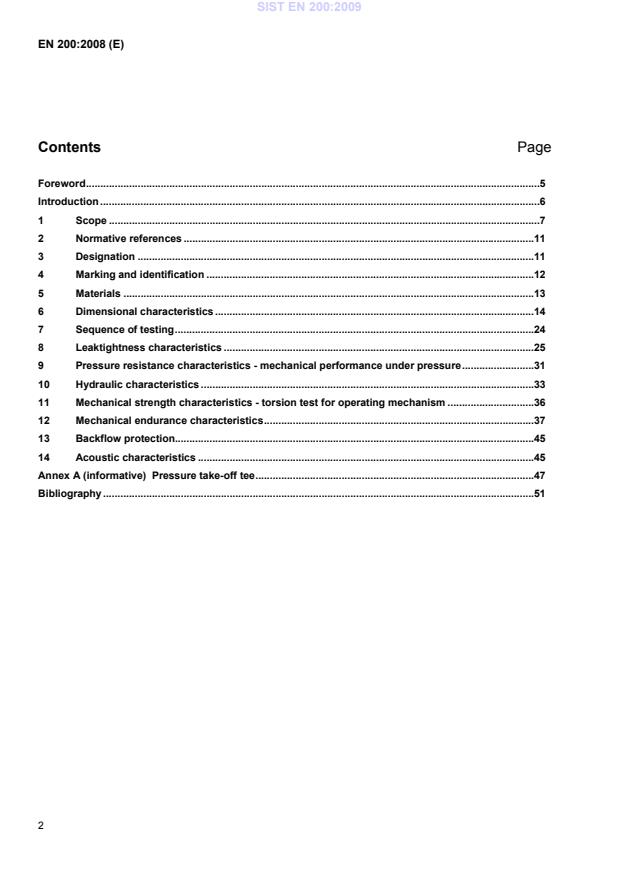
Contents Page Foreword.5 Introduction.6 1 Scope.7 2 Normative references.11 3 Designation.11 4 Marking and identification.12 5 Materials.13 6 Dimensional characteristics.14 7 Sequence of testing.24 8 Leaktightness characteristics.25 9 Pressure resistance characteristics - mechanical performance under pressure.31 10 Hydraulic characteristics.33 11 Mechanical strength characteristics - torsion test for operating mechanism.36 12 Mechanical endurance characteristics.37 13 Backflow protection.45 14 Acoustic characteristics.45 Annex A (informative)
Pressure take-off tee.47 Bibliography.51
of Type 2.31 Figure 14 - Flow rate test apparatus for taps for Type 2 supply systems.35 Figure 15 - Life test –closing torque vs time.40 Figure 16 - Endurance test rig for divided-outlet swivel spout.45 Figure A.1 - Pressure take-off tee (test rig Type 1 taps).47 Figure A.2 - Schematic examples of pressure take-off tees (test rig Type 1 taps).49
Table.Page Table 1 - Conditions of use/Classifications.8 Table 2 - Performance characteristics to be noted if used outside the recommended operating range.8 Table 3 - Designation.12 Table 4 - Inlet dimensions (Pillar & bib taps, single- & multi-hole combination taps).15 Table 5 - Outlet dimensions (Remote outlets, pillar taps, bib taps, single- and multi-hole combination taps).19 Table 6 - Mounting dimensions (Pillar taps, single- and multi-hole combination taps).22 Table 7 - Test Sequence.25 Table 8 - Summary of tightness tests.30 Table 9 - Summary of pressure resistance characteristic tests.33 Table 10 - Minimum flow rates and test pressures according to application.36 Table 11 - Endurance Test conditions.39 Table 12 - Summary of test conditions for diverters.42 Table 13 - Flow rate classes (EN ISO 3822-4:1997, Annex A).46 Table 14 - Acoustic group.46 Table A.1 - Dimensions of the pressure take-off tee.48
Introduction In respect of potential adverse effects on the quality of water intended for human consumption, caused by the product covered by this European Standard. This European Standard provides no information as to whether the product can be used without restriction in any of the Member States of the EU or EFTA. It should be noted that, while awaiting the adoption of verifiable European criteria, existing national regulations concerning the use and/or the characteristics of these products remain in force. This document identifies characteristics and technical requirements for single and combination taps.
the field of application for pillar taps, bib taps, single and multi-hole combination taps for use in: 1) a supply system of Type 1 (see Figure 1); 2) a supply system of Type 2 (see Figure 2); b)
the dimensional, leaktightness, pressure resistance, hydraulic performance, mechanical strength, endurance and acoustic characteristics of nominal size ½ and ¾ single taps and combination taps; c)
test methods to verify the characteristics. The tests described in this European Standard are type tests (laboratory tests) and not quality control tests carried out during manufacture. This European Standard applies to draw-off taps (single taps and combination taps) for use with sanitary appliances installed in rooms used for bodily hygiene (cloakrooms, bathrooms etc.) and in kitchens, i.e. for use with baths, wash basins, bidets, showers and sinks. Figure 1 shows a supply system of Type 1 with a pressure range of (0,05 to 1,0) Mpa [(0,5 to 10) bar]. Figure 2 shows a supply system of Type 2 with a pressure range of (0,01 to 1,0) Mpa [(0,1 to 10) bar]. This European Standard applies to sanitary draw-off taps of nominal size ½ and ¾ (PN 10). The conditions of use and classifications are given in Table 1. The Table 2 gives the performance characteristics to be noted if the tap is used outside the recommended operating range. SIST EN 200:2009
Table 1 — Conditions of use/Classifications Operating range of taps Flow rate classes Acoustics Marking Water supply system Limits Recommended See Table 13 See 14 See 4 Type 1 see Figure 1 Dynamic Pressure > 0,05 Mpa (0,5 bar) Static Pressure ≤ 1,0 Mpa (10,0 bar) Dynamic Pressure (0,1 to 0,5) Mpa [(1.0 to 5,0) bar] see note b) Z ≤ 0,15 l/s A ≤ 0,25 l/s S ≤ 0,33 l/s B ≤ 0,42 l/s C ≤ 0,50 l/s D ≤ 0,63 l/s
Group I -
Group II –
unclassified
for example IA IIC/B
I /- a) II /- a) See Table 10 Type 2 see Figure 2 Dynamic Pressure > 0,01 Mpa (0,1 bar) Static Pressure ≤ 1,0 Mpa (10,0 bar) Dynamic Pressure (0,02 to 0,1) MPa [(0,2 to 1,0) bar] see note b) X ≤ 0,125 l/s Y ≤ 0,250 l/s R d) ≤ 0,125 l/s Hot and
≤ 0,070 l/s Cold see note c) (unclassified) X Y R Temperature ≤ 90 °C < 65 °C
a) Without flow rate class: Taps without interchangeable outlet accessories are tested with the original outlet accessories of the manufacturer and are not marked with a flow rate class. b) Measured at the shower outlet when incorporated. c) There is usually no acoustic classification for taps used in supply systems of Type 2 and no specifications governing the level of noise emissions from these water installations. If supply pressures are such that excessive noise is generated it is recommended that pressure or flow regulators are fitted in the system, or where practicable, taps conforming to the appropriate acoustic classification given in 14.3.5 are used. d) Combination taps with divided outlet (mains fed on cold inlet) for Type 2 systems: It is essential that such taps are connected to a main's water supply capable of maintaining a minimum flow pressure of 0,04 MPa (0,4 bar) through the cold inlet.
Table 2 — Performance characteristics to be noted if used outside the recommended operating range Issue Supply system Type 1 Supply system Type 2 Operational Force Taps for Type 2 systems having rapid action mechanisms can require a higher operating force.
Diverter Operation Taps for Type 2 systems can require more operational force. Taps for Type 1 systems with automatic diverters may not hold in the shower mode due to low dynamic supply pressure. Flow Performance Taps for Type 2 systems can result in excessive flow velocities. Taps for Type 1 systems may not provide an acceptable rate of flow. Noise National regulations can require an acoustically classified tap to be specified. Taps for Type 1 and Type 2 systems can result in excessive noise when used above the recommended maximum pressure.
Key 1 Cold water 2 Hot water 3 Mains supply pipe (Supply pressures up to 10 bar)
4 Water heater Figure 1 - Supply system of Type 1 with a pressure range of (0,05 to 1,0) MPa [(0,5 to 10) bar] SIST EN 200:2009
Key 1 Cold water storage cistern (cover omitted for clarity) 2 Warning pipe 3 Vent pipe 4 Hot water cylinder 5 Alternative cistern fed cold supply to sanitary appliances 6 To boiler 7 Mains supply pipe (supply pressures up to 10 bar) Figure 2 - Supply system of Type 2 with a pressure range of (0,01 to 1,0) MPa [(0,1 to 10) bar] Figure 2 shows a vented domestic hot water and cold water supply system incorporating gravity hot water, mains cold water and alternative gravity cold water supply to sanitary appliances. SIST EN 200:2009
Table 3 — Designation Tapware according to application (see Table 1) Supply system Type 1 or Type 2 (see Table 1) Type of tap Pillar, bib tap or combination tap Intended use Basin, bidet, sink, bath or shower Nominal size
½ or ¾ Mounting method Horizontal or vertical surfaces Body Single or multi-hole, visible, or concealed Diverter with or without diverter Type of outlet Fixed, moveable, divided, with or without flow rate regulator Acoustic group and classification Taps for supply system of Type 1 Taps for supply system of Type 2 Group I, or group II, or unclassified Water saving properties Yes / No
Flow rate class Supply system Type 1 Z, A, S, B, C, D Supply system Type 2 X, Y, R Ref. to this European Standard EN 200 4 Marking and identification 4.1 Marking 4.1.1 Requirements for taps for a supply system of Type 1 Taps for a supply system of Type 1 shall be marked permanently and legibly with: the manufacturer's or agent’s name or identification - on the body or handle; the manufacturer's name or identification - on the headwork (not applicable when the headwork is of a special design to suit the body); the acoustic group (see Table 14) and the flow rate class(es) (see Table 13), if applicable - on the body. For water saving taps, appropriate information to installers and users shall be provided. NOTE
In the case of Bath/Shower taps, the flow rate is indicated by the first letter for the bath outlet and by the second letter for the shower outlet. SIST EN 200:2009
Name or identification. 4.2 Identification 4.2.1 Colour code The control devices for taps shall be identified: for cold water by the colour blue or word/letters for cold; for hot water by the colour red or word/letters for hot; any other suitable means. 4.2.2 Disposition of control device 4.2.2.1 Horizontal arrangements The cold water control device shall be on the right and the hot water control device on the left, when viewed from the front. 4.2.2.2 Vertical arrangements Vertical arrangements of control devices require the hot water control device to be uppermost. 4.2.3 Divided outlet combination taps In the case of divided outlet combination taps for supply systems of Type 2 (with mains fed on cold inlet) which give cold water flow rates at 0,01 MPa (0,1 bar) of less than 7,5 l/min the cold-water inlet shall be colour coded blue, e.g. using coloured tape, disks, paint or any other suitable means. 5 Materials 5.1 Chemical and hygiene requirements All materials coming into contact with water intended for human consumption shall present no risk to health. SIST EN 200:2009
They shall not cause any change of the drinking water in terms of quality, appearance, smell or taste. 5.2 Exposed surface conditions Visible chromium plated surfaces and Ni-Cr coatings shall comply with the requirements of EN 248. 6 Dimensional characteristics 6.1 General remarks The design and construction of components without defined dimensions permits various design solutions to be adopted by the manufacturer. Special cases are covered in 6.5. 6.2 Inlet dimensions Inlet dimensions shall be as specified in Table 4, Figure 3, Figure 4 and Figure 5. SIST EN 200:2009
Table 4 — Inlet dimensions (Pillar & bib taps, single- & multi-hole combination taps) Inlet dimensions (in mm) Comments Shank, Union, Bib tap, Captive nut A G ½ B A 1 G ¾ B Shank, Union In accordance with EN ISO 228-1 A 2 9 min Captive nut A 3 15 min Shank, Union (straight or eccentric) A 6 11 min Bib tap size ½ A 7 14 min Bib tap size ¾ Useful thread length
Connecting centres
G a 150 + 1 Supply connection, Straight unions G 1 140 to 160 2 – hole wall mounted size ½ - with eccentric unions (extension of this range is permitted) G 2 200 + 3,5 G 3 180 + 5 Multi-hole combination tap
Inlet connections N 1 12,3 + 0,2 N 2 5 min Type A size ½
N 1 15,2 + 0,05 N 2 13 min Type B size ½
30° chamfer/flat 0,3 N 1 14.7 + 0,3 N 2 6,4 min Type C size ½
N 1 19.9 + 0,3 N 2 6,4 min Type C size ¾
T
Plain end ∅ 10, 12, 15, G ½ or G 3/8 male or female
Copper tube(s) or flexible hose(s) U 350 min
Tube(s) or flexible hose(s)
Flexible hoses in accordance with
prEN 13618-1 and/or prEN 13618-2 a Other dimensions are permissible (for replacement) when market tradition requires it, provided the manufacturer specifies the actual dimension in literature to avoid confusion with the standard dimension – which can be achieved using an excentric connection.
1 2 Key 1 Flexible hose 2 Plain tube Figure 3 - Bib taps ½ and ¾ - Single-hole taps ½ SIST EN 200:2009
Figure 5 - Supply connections for taps and remote outlets SIST EN 200:2009
6.3 Outlet dimensions Outlet dimensions shall be as specified in Table 5, Figure 6, Figure 7, Figure 8 and Figure 9. When nozzle outlets are used with flow rate regulators conforming with EN 246, the manufacturing tolerances chosen for the connecting threads of the outlets shall be compatible with those of the connecting threads of the flow rate regulators, in order to ensure interchangeability. SIST EN 200:2009
Table 5 - Outlet dimensions (Remote outlets, pillar taps, bib taps, single- and multi-hole combination taps) Outlet dimensions (in mm) Comments E 25 min Outlet Orifice - Lowest point - All taps and outlets Dimension from lowest point of the outlet orifice including any flow rate regulator or flow straightener, to the mounting surface. For a period of 5 years following approval at final vote a value of 20 mm is acceptable for size ½ taps for Type 2 systems. Regulations exist in some EU Member States that set dimensions greater than those indicated in this standard. D 80 min Pillar tap ½, ¾, Bib tap
67 min Pillar tap ½ for Type 2 systems D 1 90 min Horizontal mounted combination tap D 3 115 min Wall mounted combination tap Separate spout Dimension from the centre of the outlet orifice including any flow rate regulator or flow straightener. A G ½ B A 1 G ¾ B Remote outlet
In accordance with EN ISO 228-1 A 4 7,5 min. Useful thread length A 5 9,5 min. Shower Outlet Free length of
connection Nozzle outlets to accept flow rate regulators shall be in accordance with EN 246. NOTE Nozzle outlets not in accordance with EN 246, are covered by 6.5.
1 2 Key 1 Pillar tap 2 Bib tap Figure 6 - Pillar and bib taps SIST EN 200:2009
Figure 9 - Bath/shower combination tap
6.4 Mounting dimensions Mounting dimensions shall be as specified in Table 6, Figure 10, Figure 11 and Figure 12. Table 6 - Mounting dimensions (Pillar taps, single- and multi-hole combination taps) Dimensions (in mm) Comments Shank diameter
H 1 24 max Two hole combination taps size ½ Fixed centres H 2 29 max Pillar tap size ½, separate outlet, side spray, 3 hole combination tap size ½ Adjustable centres H 3 33,5 max Single hole combination tap, Pillar tap size ¾, 2-hole combination tap size ¾
3-hole combination tap size ½
Base or flange
J 1 42 min 50 min Pillar tap size ½, Basin, Bidet, Sink Pillar tap size ¾, 2-hole combination tap size ¾ J 2 45 min Bath, Bath/Shower, Basin, Bidet, Sink
Dimension of base or flange J 3 50 max Pillar tap, Single & Multi hole combination tap Diameter of clamping washer V 32 max Basin, Bidet, Sink V 1 35 max Bath – Two hole combination tap V 3 47 max 3-hole combination tap Flange projection to rear
L Dimension which allows taps and outlets to be fitted on to supports of thickness between 1 mm and 18 mm Minimum range (mm) of supports, which allows the installation of the tap
1 2 3 Key 1 Basin; Bidet; Sink 2 Remote spray attachment 3 Pillar tap Figure 10 - Single hole combination tap
Figure 11 - Two hole combination tap (fixed centres) SIST EN 200:2009
Figure 12 - Three hole combination tap (adjustable centres) 6.5 Special cases Single taps and combination taps intended for special applications, e.g. for installation on sanitary appliances not conforming with European Standards, or where dimensional interchangeability is not a requirement can incorporate dimensional deviations provided that: all other requirements of this European Standard are satisfied; secure fixing to the mounting surface is provided with all fixing holes covered; thread connections to the supply pipes comply with EN ISO 228-1; the air gap dimension E > 25 mm or a backflow prevention device is provided in accordance with EN 1717; the D1 dimension shall be coordinated with the appropriate sanitary appliance. The manufacturer's literature including the installation instructions supplied with the tapware shall indicate clearly that the tapware is for special applications. 6.6 Flexible hoses for shower outlets Requirements for flexible hoses for shower outlets shall be as specified in EN 1113. 6.7 Shower outlets Requirements for Shower outlets shall be as specified in EN 1112. 7 Sequence of testing The samples shall be subjected to the test sequence shown in Table 7.
Dimensions (see 6) 2 Leaktightness (see 8) Flow rate (see 10) 3 Endurance (see 12) Mechanical strength (see 11) 4 Leaktightness (see 8) Leaktightness (see 8) 5
Pressure resistance (see 9) NOTE Acoustic testing will require three samples which may be different from the two mentioned above. 8 Leaktightness characteristics 8.1 General This clause describes the test methods that shall be carried out to verify the leaktightness of the complete tap and specifies the corresponding requirements (see Table 8). 8.2 Test methods 8.2.1 Principle The principle of the test consists of checking under cold water pressure the leaktightness of: the obturator (see 8.3); the complete tap (see 8.4); the bath/shower diverter (either manual or with automatic return) (see 8.5, 8.6 and 8.7). In the case of a diverter with automatic return being considered to provide backflow prevention, it shall comply with the requirements of EN 14506 8.2.2 Apparatus A hydraulic test circuit, capable of supplying the required pressures and of maintaining them throughout the duration of the tests. A hydraulic test circuit, capable of supplying gradually the required static and dynamic pressures and of maintaining them throughout the duration of the test. 8.3 Leaktightness of the obturator and of the tap upstream of the obturator(s) with the obturator in the closed position 8.3.1 Procedure a) Connect the tap to the test circuit; b) with the outlet orifice open, and generally turned downwards, close the obturator(s) using a torque of (1,5 ± 0,15) Nm for nominal size ½ and (2,5 ± 0,25) Nm for nominal size ¾; if a stuffing box is used to ensure leaktightness of the headwork, the packing gland shall be loosened before application of the closing torque; c) apply to the inlet of the tap a water pressure of (1,6 ± 0,05) MPa [(16,0 ± 0,5) bar] and maintain it for (60 ± 5) s. SIST EN 200:2009
8.3.2 Requirements Verification of leaktightness upstream of the obturator: throughout the duration of the test there shall be no leakage or seepage through the walls. Verification of leaktightness of the obturator: throughout the duration of the test there shall be no leakage of the obturator, i.e. at the outlet. 8.4 Leaktightness of the tap downstream of the obturator(s) with the obturator open 8.4.1 General Not applicable when the outlet cannot be closed. 8.4.2 Procedure a) Connect the tap to the test circuit; b) if a stuffing box is used to ensure leaktightness of the headwork, ensure that the packing gland is tightened in accordance with the manufacturer’s instructions; c) with the outlet orifice(s) artificially closed, and generally turned downwards open the obturator(s); d) apply to the inlet of the tap a water pressure of (0,4 ± 0,02) MPa [(4,0 ± 0,2) bar] and maintain it for (60 ± 5) s; e) gradually reduce the pressure to (0,02 ± 0,002) MPa [(0,2 ± 0,02) bar] and maintain it for (60 ± 5) s. 8.4.3 Requirement Thro
...