

CEN/TS 16931-3-2:2026
(Main)Electronic invoicing – Part 3-2 Syntax binding of EN 16931-1 to ISO/IEC 19845 (UBL) invoice and credit note
- Abstract
This CEN Technical Specification (TS) contains the mapping between the semantic data model of an electronic invoice (EN 16931-1) and the UBL syntax. For each element in the semantic model (including sub-elements or supplementary components such as Code List identifiers) it is defined which element in the syntax is to be used to contain its information contents. Any mismatches between semantics, format, cardinality or structure are indicated. Any rules to be followed when using the specific syntax are stated informally
in this TS. If later versions of UBL support the semantics more accurately, this is indicated. For earlier versions (from UBL 2.1 onwards) also a solution is presented.
- Status
- Published
- Publication Date
- 26-Aug-2027
- Technical Committee
- CEN/TC 434 - Electronic Invoicing
- Drafting Committee
- CEN/TC 434/WG 3 - Syntax bindings
- Current Stage
- 6060 - Definitive text made available (DAV) - Publishing
- Start Date
- 29-Jul-2026
- Due Date
- 27-Aug-2027
- Completion Date
- 27-Aug-2027

CEN/TS 16931-3-2:2026 is a CEN Technical Specification that binds the EN 16931-1 semantic model to UBL invoice and credit note syntax. It tells implementers which UBL XML elements carry each invoice information element, including sub-elements and scheme identifiers, and it flags mismatches in semantics, structure, cardinality and datatype. It is intended for electronic invoicing systems that need interoperable invoice and credit note data.
What does CEN/TS 16931-3-2:2026 specify?
CEN/TS 16931-3-2:2026 specifies the mapping between the semantic model of an electronic invoice in EN 16931-1 and the UBL syntax. In practice, that means the document shows where each business term goes in the XML message, and how to handle differences between the model and the syntax.
The document is organized into five clauses:
- Clause 1 gives the scope.
- Clause 2 names the normative reference.
- Clause 3 defines the key terms used in the binding.
- Clause 4 contains the UBL syntax binding, including invoice and credit note mappings.
- Clause 5 summarizes mapping mismatches by type.
What are the key requirements of CEN/TS 16931-3-2:2026?
The document binds EN 16931-1 to UBL
CEN/TS 16931-3-2:2026 is a syntax binding, not a semantic model. Its job is to connect each information element in EN 16931-1 to the UBL element that carries the content, including supplementary components such as scheme identifiers. For implementers, this is the bridge between invoice business terms and the XML structure exchanged between systems.
The binding is based on UBL 2.5 and later UBL 2.x versions
Clause 4.2 states that the syntax binding is based on UBL Version 2.5. It also says that UBL 2.5 and later UBL 2.x versions contain the syntax elements needed for this revision of EN 16931-1, and that implementations should use the latest backward-compatible UBL 2.x version published by the OASIS UBL Technical Committee. In practice, this tells developers which UBL family to target when building or updating support.
Invoice and credit note mappings are given in normative tables
Clause 4.5 gives the normative mapping for the invoice model, and Clause 4.6 gives the normative mapping for the credit note model. These tables map each semantic business term to a UBL XPath, its type, its effective cardinality in syntax, and any discrepancy with the semantic model. That matters because the mapping tables are the part you use when implementing or validating an actual message.
The document distinguishes normative and informative mappings
The semantic model to syntax tables are normative, while the reverse syntax to semantic model tables are informative. That means the forward mapping defines the binding to follow, while the reverse mapping is there to help implementers read UBL messages back into EN 16931-1 business terms. This is useful when troubleshooting or when building parsers and validators.
Clause 4.4 defines effective cardinality
CEN/TS 16931-3-2:2026 explains effective cardinality as the occurrence count of a business term in the syntax, calculated from the cardinalities along the XPath path. The calculation matters when a business term sits inside several nested XML nodes, because the overall multiplicity is not always obvious from one element alone. For readers, this is the part that helps explain why a term can behave differently in syntax than in the semantic model.
The document records mismatches and how they are resolved
Clause 4.3 and Clause 5 classify mismatches at semantic, structural, cardinality and syntactical levels. The mapping tables include a discrepancy-and-resolution column, so implementers can see whether a mismatch is only a notation issue, a structural difference, or a cardinality issue that needs special handling. In practice, this is where the document tells you what to do when EN 16931-1 and UBL do not line up exactly.
Backwards compatibility with EN 16931-3-2:2017 is built in
Clause 4.7 says that conformant applications should be able to interpret invoices and credit notes defined by EN 16931-3-2:2017. It then gives compatibility mappings for old and new structures. The 2026 revision reflects changes such as the move to UBL 2.5, new mappings for buyer reference, notes, delivery note references, penalty interest, line delivery details and item type identification scheme handling. For existing systems, this section is the migration guide.
Validation artefacts are provided for implementation checks
Clause 4.8 states that Schematron validation artefacts are provided at the EU Connecting Europe GitHub site. That gives implementers a concrete way to test whether UBL instance documents conform to the standard. For quality and compliance teams, this is the practical check that supports implementation and regression testing.
The mapping uses named code lists and datatypes
Across the tables, the binding uses specific controlled values such as UNTDID 1001 for invoice and credit note type codes, UNTDID 1153 for some scheme identifiers, UNTDID 5189 and UNTDID 7161 for allowance and charge reasons, ISO 4217 for currency codes, ISO 3166-1 for country codes, and UNECE Rec. 20 and Rec. 21 for unit of measure codes. It also uses W3C XPath expressions and XSD datatypes in the syntax columns. For readers, this tells you which external lists and datatype rules your software has to support.
What terms does CEN/TS 16931-3-2:2026 define?
- Electronic Invoice - an invoice issued, transmitted and received in a structured electronic format that allows automatic electronic processing.
- Information Element - the smallest unit of data used to represent one item of information in an Electronic Invoice.
- Structured Information Element - an information element that can be processed automatically.
- Business Term - the label assigned to an information element and used as its primary reference.
- Business Terms Group - a group of related Business Terms, such as the Seller-related group and its child groups.
- Semantic Data Model - a structured set of logically interrelated information.
- Core Invoice Model - the semantic data model of the core elements of an electronic invoice.
- Core Invoice Usage Specification (CIUS) - a specification that adds detailed guidance, examples and business rules for use in a specific trading situation.
- Syntax - the machine-readable format used to represent the information elements in an Electronic Invoice instance.
Who uses CEN/TS 16931-3-2:2026?
CEN/TS 16931-3-2:2026 is used by people who implement, validate or procure electronic invoicing systems. That includes software vendors, ERP and procurement teams, public administration e-invoicing projects, and compliance or quality managers who need to check whether an invoice profile is mapped correctly.
It is also relevant to buyers and sellers who exchange electronic invoices and credit notes in structured form. In practice, they use it to make sure their systems send, receive and validate the same data elements in the same way.
What changed in CEN/TS 16931-3-2:2026 from the previous edition?
CEN/TS 16931-3-2:2026 supersedes CEN/TS 16931-3-2:2020 and CEN/TS 16931-3-2:2017. The update aligns the binding with EN 16931-1:2026 and bases it on UBL 2.5.
The 2026 edition states these changes in the mapping itself:
- new UBL 2.5 syntax elements are used for several business terms, including buyer reference, delivery note reference, penalty interest, annotation content, line and collection totals, and item supply type code
- backwards-compatibility mappings are provided for applications that still handle the 2017 structure
- the item type identification scheme code changed from the earlier scheme coding approach to UNTDID 7143 in the compatibility tables
- note handling is split through Annotation and SubjectCode in the newer mapping
- the document adds Schematron validation artefacts for conformance checking
Which standards are used with CEN/TS 16931-3-2:2026?
The only normative reference named in Clause 2 is EN 16931-1.
| Reference | What it contributes |
|---|---|
| EN 16931-1 | The semantic data model of the core elements of an electronic invoice, which CEN/TS 16931-3-2 maps to UBL. |
| CEN/TS 16931-3-1 | The methodology for syntax bindings of the core elements of an electronic invoice. |
| CEN/TS 16931-3-3 | The syntax binding for UN/CEFACT XML Cross Industry Invoice. |
| CEN/TS 16931-3-4 | The syntax binding for UN/EDIFACT INVOIC. |
| CEN/TS 16931-2 | The list of syntaxes that comply with EN 16931-1. |
| CEN/TS 16931-5 | Guidance on sector or country extensions in conjunction with EN 16931-1. |
What does the CEN/TS 16931-3-2:2026 document contain?
CEN/TS 16931-3-2:2026 contains the mapping tables for invoice and credit note messages, including semantic-to-syntax and syntax-to-semantic views. It also contains explanations of UBL XML versions, mismatch categories, effective cardinality, and backwards compatibility handling.
The document includes XPath-based mappings, datatype references, code-list references and discrepancy notes for individual business terms. It also includes mismatch summaries and validation guidance, so it can be used for implementation, testing and conformance checking rather than only for reading the model.
Relations
- Effective Date
- 14-Jan-2026
- Effective Date
- 12-Aug-2026
- Effective Date
- 05-Aug-2026
- Effective Date
- 05-Aug-2026
Get Certified
Connect with accredited certification bodies for this standard

BSI Group
BSI (British Standards Institution) is the business standards company that helps organizations make excellence a habit.

NYCE
Mexican standards and certification body.
Sponsored listings
Frequently Asked Questions
CEN/TS 16931-3-2:2026 is a technical specification published by the European Committee for Standardization (CEN). Its full title is "Electronic invoicing – Part 3-2 Syntax binding of EN 16931-1 to ISO/IEC 19845 (UBL) invoice and credit note". This standard covers: This CEN Technical Specification (TS) contains the mapping between the semantic data model of an electronic invoice (EN 16931-1) and the UBL syntax. For each element in the semantic model (including sub-elements or supplementary components such as Code List identifiers) it is defined which element in the syntax is to be used to contain its information contents. Any mismatches between semantics, format, cardinality or structure are indicated. Any rules to be followed when using the specific syntax are stated informally in this TS. If later versions of UBL support the semantics more accurately, this is indicated. For earlier versions (from UBL 2.1 onwards) also a solution is presented.
This CEN Technical Specification (TS) contains the mapping between the semantic data model of an electronic invoice (EN 16931-1) and the UBL syntax. For each element in the semantic model (including sub-elements or supplementary components such as Code List identifiers) it is defined which element in the syntax is to be used to contain its information contents. Any mismatches between semantics, format, cardinality or structure are indicated. Any rules to be followed when using the specific syntax are stated informally in this TS. If later versions of UBL support the semantics more accurately, this is indicated. For earlier versions (from UBL 2.1 onwards) also a solution is presented.
CEN/TS 16931-3-2:2026 is classified under the following ICS (International Classification for Standards) categories: 35.240.20 - IT applications in office work; 35.240.63 - IT applications in trade. The ICS classification helps identify the subject area and facilitates finding related standards.
CEN/TS 16931-3-2:2026 has the following relationships with other standards: It is inter standard links to CEN/TS 16931-3-2:2020, EN 16931-1:2026, CEN/TS 16931-5:2025, CEN/TR 16931-5:2017. Understanding these relationships helps ensure you are using the most current and applicable version of the standard.
CEN/TS 16931-3-2:2026 is associated with the following European legislation: EU Directives/Regulations: 2014/55/EU, 2025/516, 2025/517; Standardization Mandates: M/621. When a standard is cited in the Official Journal of the European Union, products manufactured in conformity with it benefit from a presumption of conformity with the essential requirements of the corresponding EU directive or regulation.
CEN/TS 16931-3-2:2026 is available in PDF format for immediate download after purchase. The document can be added to your cart and obtained through the secure checkout process. Digital delivery ensures instant access to the complete standard document.
Standards Content (Sample)
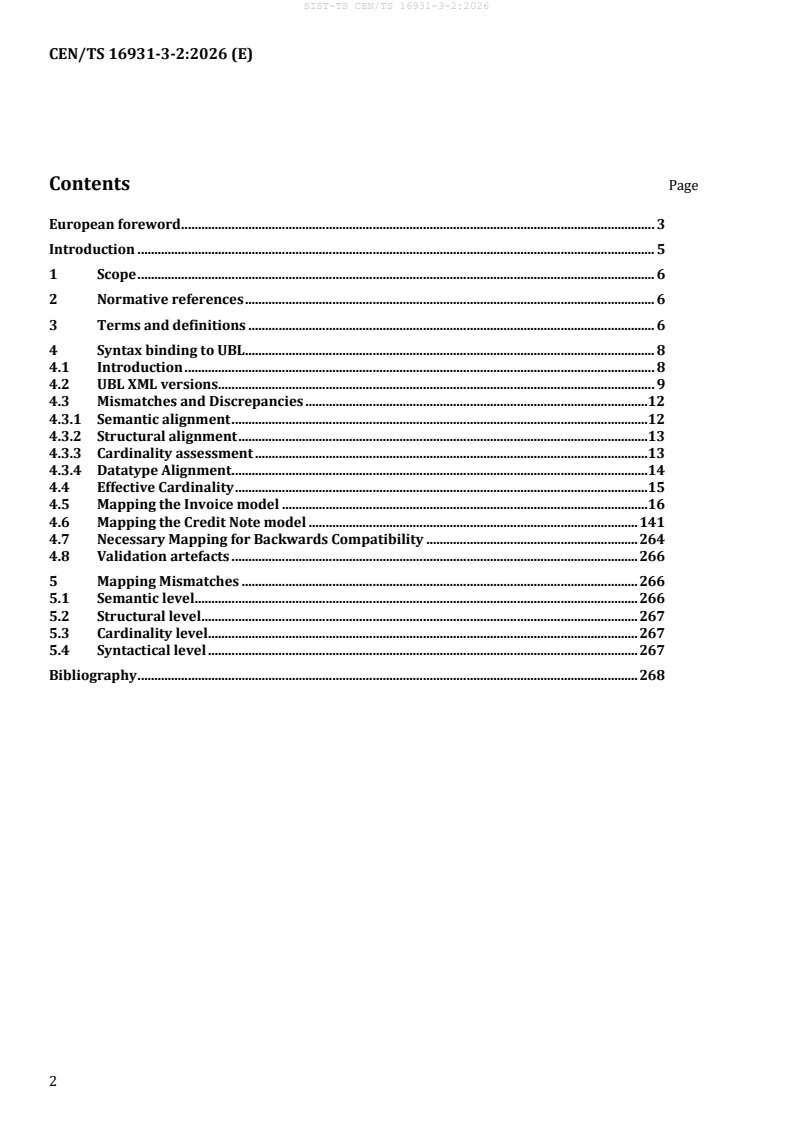
Contents
- Introduction
- 1 Scope
- 2 Normative references
- 3 Terms and definitions
- 3.1 Electronic Invoice
- 3.2 Information Element
- 3.3 Structured Information Element
- 3.4 Business Term
- 3.5 Business Terms Group
- 3.6 Semantic Data Model
- 3.7 Core Invoice Model
- 3.8 Core Elements of an Electronic Invoice
- 3.9 Extended Information Element
- 3.10 Core Invoice Usage Specification (CIUS)
- 3.11 Core Invoice Instance Document
- 3.12 Extension Specification
- 3.13 Identifier
- 3.14 Identification Scheme
- 3.15 Compliant
- 3.16 Core Conformant
- 3.17 Syntax
- 4 Syntax binding to UBL
- 4.1 Introduction
- 4.2 UBL XML versions
- 4.3 Mismatches and Discrepancies
- 4.4 Effective Cardinality
- 4.5 Mapping the Invoice model
- 1. W3C XPath expression pointing to a single element or attribute (with @ prefix)
- 1. Mismatch (see 4.3 Mismatches and Discrepancies)
- 2. Resolution
- 1 TypeCode/@listID[.='1001'] tring
- 20 Intro 2.a, e.g. Ampère per
- 20 Intro 2.a, e.g. Ampère per Codes for Package
- 20 Intro 2.a, e.g. Ampère per
- 20 Intro 2.a, e.g. Ampère per
- 4.6 Mapping the Credit Note model
- 20 Intro 2.a, e.g. Ampère per
- 20 Intro 2.a, e.g. Ampère per (with
- 20 Intro 2.a, e.g. Ampère per
- 20 Intro 2.a, e.g. Ampère per
- 4.7 Necessary Mapping for Backwards Compatibility
- 4.8 Validation artefacts
- 5 Mapping Mismatches
- 5.1 Semantic level
- 5.2 Structural level
- 5.3 Cardinality level
- 5.4 Syntactical level
- Bibliography
Introduction
The European Commission estimates that “The mass adoption of e-invoicing within the EU would lead to significant economic benefits and it is estimated that moving from paper to e-invoices will generate savings of around EUR 240 billion over a six-year period” [3]. Based on this recognition “The Commission wants to see e-invoicing become the predominant method of invoicing by 2020 in Europe.” As a means to achieve this goal, Directive 2014/55/EU [1] on electronic invoicing in public procurement aims at facilitating the use of electronic invoices by economic operators when supplying goods, works and services to the public administration (B2G), as well as the support for trading between economic operators themselves (B2B). In particular, it sets out the legal framework for the establishment and adoption of a European standard (EN) for the semantic data model of the core elements of an electronic invoice (EN 16931-1).
The semantic data model of the core elements of an electronic invoice – the core invoice model – as described in EN 16931-1 is based on the proposition that a limited, but sufficient set of information elements can be defined that supports generally applicable invoice-related functionalities. This CEN Technical Specification CEN/TS 16931-3-2 defines the binding of the core elements of the invoice to UBL. Other subparts of this CEN Technical Specification define the binding method (CEN/TS 16931-3-1) and map the core invoice model to other syntaxes such as UN/CEFACT XML (CEN/TS 16931-3-3) and UN/EDIFACT (CEN/TS 16931-3-4).
By ensuring interoperability of electronic invoices, the European standard and its ancillary European standardization deliverables will serve to remove market barriers and obstacles to trade deriving from the existence of different national rules and standards – and thus contribute to the goals set by the European Commission.
SIST-TS CEN/TS 16931-3-2:2026 CEN/TS 16931-3-2:2026 (E)
1 Scope
This document specifies the mapping between the semantic model of an electronic invoice, included in EN 16931-1 and the UBL syntax. For each element in the semantic model (including sub-elements or supplementary components such as Identification scheme identifiers) it is defined which element in the syntax is to be used to contain its information contents. Any mismatches between semantics, format, cardinality or structure are indicated.
2 Normative references
The following documents are referred to in the text in such a way that some or all of their content constitutes requirements of this document. For dated references, only the edition cited applies. For undated references, the latest edition of the referenced document (including any amendments) applies. EN 16931-1, Electronic invoicing - Part 1: Semantic data model of the core elements of an electronic invoice
3 Terms and definitions
For the purposes of this document, the following terms and definitions apply.
3.1 Electronic Invoice
invoice that has been issued, transmitted and received in a structured electronic format which allows for its automatic and electronic processing [SOURCE: Directive 2014/55/EU [1]]
3.2 Information Element
smallest unit of data that is used to represent an item of information within an Electronic Invoice Note 1 to entry:
The EN identifies these elements using Business Terms (BTs). In EN 16931-1 section 6.3 is a table of information elements contained in the Core Invoice Model.
3.3 Structured Information Element
information element that can be processed automatically
3.4 Business Term
label assigned to a given information element which is used as a primary reference
3.5 Business Terms Group
group of related Business Terms Note 1 to entry:
BTs can be aggregated within Business Terms Groups (BGs). For example, the BG Seller contains all the information elements needed to describe the entity that is selling the good or service. BG Seller also contains its own BGs such as address and contact i.e. BG Seller acts as a parent Group to child Groups for addresses and contact details that are related to the Seller.
SIST-TS CEN/TS 16931-3-2:2026 CEN/TS 16931-3-2:2026 (E)
3.6 Semantic Data Model
structured set of logically interrelated information
3.7 Core Invoice Model
semantic data model of the Core Elements of an Electronic Invoice Note 1 to entry: The model contains the Core Elements of an Electronic Invoice – see EN 16931-1 Clause 4 for a more detailed explanation. The Core Invoice Model is composed of mandatory information elements that every invoice shall contain along with conditional elements that can be used when required.
3.8 Core Elements of an Electronic Invoice
set of information elements that most Electronic Invoices contain in order to enable interoperability, including the necessary information to ensure legal compliance
3.9 Extended Information Element
information element within the Scope for Extensions but outside the Core Invoice Model Note 1 to entry: Extended Information Elements are sometimes informally referred to as extensions in other documents.
3.10 Core Invoice Usage Specification (CIUS)
specification that provides detailed guidance, explanations, and examples, as well as rules (business rules) related to the actual implementation and use of structured information elements present in the Core Invoice Model in a specific trading situation
3.11 Core Invoice Instance Document
instance of an Electronic Invoice that is conformant with the Core Invoice Model
3.12 Extension Specification
specification describing the use of Extended Information Elements to the Core Invoice Model that may reuse Extension Components Note 1 to entry: An Extension Specification is intended to be published in the eInvoice Registry. It is typically written by a Representative/Representatives of a Sectoral Organisation for its members to describe an Invoice that includes the Core Semantic Model elements, Extension Components, and other elements needed for business. Note 2 to entry: The resulting invoice model contains information elements that do not form a strict subset of the Core Invoice Model. An Extension Specification can also provide additional explanations and examples.
3.13 Identifier
character string used to establish the identity of, and distinguish uniquely, one instance of an object within an Identification Scheme from all other objects within the same scheme Note 1 to entry: An Identifier may be a word, number, letter, symbol, or any combination of those, depending on the Identification Scheme used.
SIST-TS CEN/TS 16931-3-2:2026 CEN/TS 16931-3-2:2026 (E)
3.14 Identification Scheme
collection of Identifiers applicable for a given type of object governed under a common set of rules
3.15 Compliant
meets all the legal requirements and follows all the legal rules of any Directive associated with the standard, particularly the VAT Directive
3.16 Core Conformant
respects all the normative rules of the Core Invoice Model Note 1 to entry: A Core Conformant instance is not expected to throw any error when using CEN/TC434/WG3 validation artefacts for the Core Invoice Model.
3.17 Syntax
machine-readable format used to represent the information elements contained in an Electronic Invoice instance Note 1 to entry: CEN/TS 16931-2 contains the list of syntaxes that comply with EN 16931-1 and that are mandatory for public bodies in the European Union.
4 Syntax binding to UBL
4.1 Introduction
The Universal Business Language (UBL) is developed by the OASIS open standards consortium. OASIS is a non-profit, international consortium that drives the development, convergence and adoption of open standards for the global information society.
UBL is designed to provide a universally understood and recognized syntax for legally binding business documents and to operate within a standard business framework such as ISO 15000 (ebXML)[4] to provide a complete, standards-based infrastructure that can extend the benefits of existing EDI systems to businesses of all sizes. UBL is freely available to everyone without legal encumbrance or licensing fees. UBL is widely used around the world for procurement (e.g. ordering and electronic invoicing), sourcing (e.g. tendering and catalogues), replenishment (e.g. managed inventory) and transportation and logistics (e.g. waybills, forwarding instructions, and intermodal freight management). UBL provides the standards for the PEPPOL (Pan European eProcurement Online) network and public procurement initiatives in Austria, Belgium, Czech Republic, Denmark, Finland, France, Germany, Greece, Iceland, Ireland, Italy, Netherlands, Norway, Spain, Sweden, and UK (NHS).
UBL schemas are modular, reusable, and extensible in XML-aware ways. As the first standard implementation of ebXML Core Components Technical Specification 2.01, the UBL Library is based on a conceptual model of information components known as Business Information Entities (BIEs). These components are assembled into specific document models such as invoice and order. These document models are then transformed in accordance with UBL Naming and Design Rules into W3C XSD schema syntax as defined from the OASIS UBL Technical Committee [5]. This approach facilitates the creation of UBL-based document types beyond those specified in this release.
SIST-TS CEN/TS 16931-3-2:2026 CEN/TS 16931-3-2:2026 (E)
4.2 UBL XML versions
This Syntax binding is based on UBL Version 2.5. Although it is not restricted to a specific UBL version, only UBL 2.5 and any subsequent UBL 2.x version have all syntax elements which are needed for the current revision EN 16931-1:2026.
The old EN 16931-3-2:2017 was based on UBL 2.1 (released as an ISO and IEC International Standard, and given the designation ‘ISO/IEC 19845:2015’). Later versions of UBL are backwards compatible with version 2.1.
The following Tables list the new UBL 2.5 syntax elements being used in EN 16931-3-2:2026 in the order of the semantic model. Table 1 shows the XPaths for the Invoice, Table 2 for the Credit Note. For guidance on backwards compatible mapping, see Tables 14 and 15:
Table 1 — New UBL invoice XML ID XPath (old and new) Reason BT-10 changed to have UBL2.1:
unbounded cardinality /Invoice/cbc:BuyerReference BT-10 (appear more than once) Since UBL 2.5:
and may have a Code in /Invoice/cac:BuyerAssignedReference/cbc:BuyerReference BT-10-1 Since UBL 2.5 Qualifying the Buyer BT-10-1 /Invoice/cac:BuyerAssignedReference/cbc:BuyerReferenceC Reference with a Code ode from UNTDID 1153 [6]
Since UBL 2.5:
BT-197 New BT /Invoice/cac:DeliveryNoteDocumentReference/cbc:ID
Since UBL 2.5:
BT-182 /Invoice/cac:PaymentTerms/cac:PenaltyInterestRate/cbc:In New BT terestRatePercent
UBL 2.1:
There was no Invoice /Invoice/cbc:Note BT-21 Note Subject Code in Since UBL 2.5:
UBL 2.1 /Invoice/cac:Annotation/cbc:SubjectCode UBL 2.1: Invoice Note could be /Invoice/cbc:Note added in UBL 2.1 only BT-22 Since UBL 2.5: once. Unbounded were /Invoice/cac:Annotation/cbc:AnnotationContent its translations. New BT Since UBL 2.5: with BT-213 /Invoice/cac:AllowanceCharge/cac:TaxCategory/cbc:Supply cbc:ChargeIndicator TypeCode [.='false']
New BT Since UBL 2.5:
with /Invoice/cac:AllowanceCharge/cac:TaxCategory/cbc:Supply BT-214 cbc:ChargeIndicator TypeCode [.='true']
SIST-TS CEN/TS 16931-3-2:2026 CEN/TS 16931-3-2:2026 (E) ID XPath (old and new) Reason
Since UBL 2.5:
BT-179 /Invoice/cac:CollectionInvoiceLine/cbc:TaxInclusiveLineExt New BT ensionAmount
Since UBL 2.5:
BT-180 /Invoice/cac:CollectionInvoiceLine/cac:Item/cbc:Descriptio New BT
n
Since UBL 2.5:
BT-210 /Invoice/cac:TaxTotal/cac:TaxSubtotal/cac:TaxCategory/cb New BT
c:SupplyTypeCode
Since UBL 2.5:
BT-198 /Invoice/cac:InvoiceLine/cac:Delivery/cac:DeliveryNoteDoc New BT umentReference/cbc:ID
Since UBL 2.5:
BT-199 /Invoice/cac:InvoiceLine/cac:Delivery/cac:DeliveryNoteLin New BT eReference/cbc:LineID
Since UBL 2.4:
BT-196 /Invoice/cac:InvoiceLine/cac:Item/cac:ClassifiedTaxCategor New BT y/cbc:ItemSupplyTypeCode
Table 2 — New UBL credit note XML ID XPath (old and new) Reason UBL 2.1:
There was no CreditNote /CreditNote/cac:PaymentMeans/cbc:PaymentDueDate BT-9 Note cbc:DueDate in Since UBL 2.2:
UBL 2.1 /CreditNote/cbc:DueDate BT-10 changed to have UBL 2.1: /CreditNote/cbc:BuyerReference unbounded cardinality Since UBL 2.5:
BT-10 (appear more than once) /CreditNote/cac:BuyerAssignedReference/cbc:BuyerRefere and may have a Code nce from UNTDID 1153 [6] Since UBL 2.5 Qualifying the Buyer BT-10-1 /CreditNote/cac:BuyerAssignedReference/cbc:BuyerRefere Reference with a Code nceCode from UNTDID 1153 [6]
Since UBL 2.5:
BT-197 New BT /CreditNote/cac:DeliveryNoteDocumentReference/cbc:ID
SIST-TS CEN/TS 16931-3-2:2026 CEN/TS 16931-3-2:2026 (E) ID XPath (old and new) Reason
Since UBL 2.5:
BT-182 /CreditNote/cac:PaymentTerms/cac:PenaltyInterestRate/cb New BT c:InterestRatePercent
UBL 2.1:
There was no Credit /CreditNote/cbc:Note BT-21 Note Subject Code in Since UBL 2.5:
UBL 2.1 /CreditNote/cac:Annotation/cbc:SubjectCode UBL 2.1: Credit Note could be /CreditNote/cbc:Note added in UBL 2.1 only BT-22 Since UBL 2.5: once. Unbounded were /CreditNote/cac:Annotation/cbc:AnnotationContent its translations. New BT Since UBL 2.5:
with /CreditNote/cac:AllowanceCharge/cac:TaxCategory/cbc:Sup BT-213 cbc:ChargeIndicator plyTypeCode [.='false']
New BT Since UBL 2.5:
with /CreditNote/cac:AllowanceCharge/cac:TaxCategory/cbc:Sup BT-214 cbc:ChargeIndicator plyTypeCode [.='true']
Since UBL 2.5:
/CreditNote/cac:CollectionCreditNoteLine/cbc:TaxInclusive BT-179 New BT LineExtensionAmount
Since UBL 2.5:
BT-180 /CreditNote/cac:CollectionCreditNoteLine/cac:Item/cbc:Des New BT cription
Since UBL 2.5:
BT-210 /CreditNote/cac:TaxTotal/cac:TaxSubtotal/cac:TaxCategory New BT
/cbc:SupplyTypeCode
Since UBL 2.5:
BT-198 /CreditNote/cac:CreditNoteLine/cac:Delivery/cac:DeliveryN New BT oteDocumentReference/cbc:ID
Since UBL 2.5:
BT-199 /CreditNote/cac:CreditNoteLine/cac:Delivery/cac:DeliveryN New BT oteLineReference/cbc:LineID
Since UBL 2.4:
BT-196 New BT /CreditNote/cac:CreditNoteLine/cac:Item/cac:ClassifiedTax Category/cbc:ItemSupplyTypeCode
SIST-TS CEN/TS 16931-3-2:2026 CEN/TS 16931-3-2:2026 (E) As all later UBL 2.x versions are backward compatible with UBL 2.5, implementations should use the latest backward-compatible UBL 2.x version published by the OASIS UBL Technical Committee [5]. The last column of the mapping table, entitled "Discrepancy and resolution", may include versionrelated information of the following types in addition to other content:
1. indication that a data syntax element was introduced after UBL 2.1, e.g. "since UBL 2.5" 2. indication that the syntax cardinality was subsequently aligned with the semantic cardinality, e.g. "Cardinality since CII D22B". The latter does not apply to UBL
4.3 Mismatches and Discrepancies
4.3.1 Semantic alignment
The first step in mapping a semantic model to a syntax is to determine if each element in the semantic model has a corresponding element in the syntax. The corresponding element in the syntax shall have a similar or wider semantic definition with respect to the definition of the semantic model element. The definition of the syntax element may be implied by the name of that element. For example: an element named “VAT Amount” in the semantic model may be mapped to an element named “Tax Amount” in the syntax specification. As VAT is a type of tax, the element “Tax Amount” is a wider concept than VAT Amount. The semantic relation between elements from the semantic model and elements from the syntax specification can be specified using SKOS [7] relation types The following types of semantic mismatches between individual elements that may occur are listed in Table 3:
Table 3 —Semantic alignment SOURCE TARGET ID Example Issue Resolution (Semantic) (Syntax) SEM-1 wider smaller SOURCE specifies ‘Taxes’, The semantic rules of 1) find another element in while TARGET specifies TARGET may be violated. TARGET to put the violating ‘VAT’ instances (those taxes that are not VAT) (SKOS: narrower) 2) accept that you are abusing an element in TARGET for something it was not (entirely) designed for.
3) Request to widen semantic definition of TARGET SEM-2 smaller wider SOURCE specifies "VAT", All instances that comply Unless other elements are Target specifies "Taxes" to SOURCE will also mapped to the wider element as comply to TARGET, but well, specify the narrower (SKOS: broader) some of the semantics are meaning in the documentation lost: the type of Tax is not (VAT instead of Tax).
specified any more.
SEM-3 overlap overlap SOURCE specifies The semantic rules of 1) accept that you are abusing an Employee (including TARGET may be violated. element in TARGET for something teachers, staff, researchers it was not (entirely) designed for. –that are on payroll- etc) 2) Request to widen semantic and TARGET specifies definition of TARGET Researcher (can be both enlisted as employee, but also be a student).
(SKOS: related) SEM-4 match no match TARGET is missing any It is not possible to put 1) Use a (more) generic element element to specify a certain information in the 2) Request to add an element in person. TARGET. TARGET.
SIST-TS CEN/TS 16931-3-2:2026 CEN/TS 16931-3-2:2026 (E)
4.3.2 Structural alignment
The second step is to review the “structural context” of the information element in the respective syntaxes. The structural context of an element is part of its semantic definition. Electronic messages in the different syntaxes represent data in different levels, groupings and sequences. For example, a VAT Amount element on line level in the model should not be mapped on a VAT Amount element on document level in the syntax specification.
Structural mismatches are listed in Table 4:
Table 4 —Structural alignment SOURCE TARGET ID Example Issue Resolution (Semantic) (Syntax) STR-1 Hierarchical Hierarch Packing of items can be Yes Complex mapping. Packs are order one to ical listed as items and then lifted to higher level and many order where they are packed or as equivalent packs need to be many to a list of packs and what items combined.
one are in each pack.
STR-2 element on element SOURCE specifies element at Possibly if higher level higher level on lower top level with a single cardinalities cause level repetition but TARGET is in a conflicts.
class that is also used for other data that requires repetition of the class.
STR-3 grouping A- different SOURCE may define a group Possibly. B-C grouping of elements such as payment instructions that may be repeated as a group but if those elements are differently grouped in TARGET, that repetition may be problematic.
STR-4 higher detail less SOURCE has Yes. Agree on a rule to concatenate detail <name/firstname and elements from SOURCE to name/lastname> and TARGET TARGET only has <name>.
STR-5 less detail higher TARGET has Depends Agree on a rule (if possible) to detail <name/firstname and split the SOURCE element into name/lastname> and several TARGET elements SOURCE only has <name>.
4.3.3 Cardinality assessment
Cardinality defines whether or not an element shall be used, may be omitted and how many times it might be repeated in a specific context. The cardinality of an element in the syntax shall be the same or less restrictive than the corresponding element in the model. An element that is mandatory in the model may be optional in the syntax specification, but not the other way around. An element that is repeating in the model shall also be repeating in the syntax specification. The cardinality mismatches that may occur are listed in Table 5:
Table 5 —Alignment of cardinalities ID SOURCE TARGET Example Issue Resolution
...