


EN 17738:2023
(Main)Geotextiles and geotextile-related products - Damage during installation procedure - Full scale test
Geotextiles and geotextile-related products - Damage during installation procedure - Full scale test
This document describes a procedure for producing mechanical damage to geotextiles and geotextile-related products due only to compaction of soil or other materials. The damage is assessed visually and by the loss of tensile strength or other reference tests used to assess the damage caused by this procedure.
The method described is a full-scale test procedure, using a range of fills and compaction methods, and for the derivation of a reduction factor for installation damage for geotextiles and geotextile-related products.
This document excludes geosynthetic barriers and products used in pavements and asphalt overlays.
Geotextilien und geotextilverwandte Produkte - Beschädigung während des Einbaus - Großmaßstäbliches Prüfverfahren
Dieses Dokument beschreibt ein Verfahren zur Erzeugung einer mechanischen Beschädigung an Geotextilien und geotextilverwandten Produkten ausschließlich durch Verdichtung von Boden oder anderen Materialien. Die Beschädigung wird durch Sichtprüfung und anhand des Verlustes der Zugfestigkeit oder weiteren Referenzprüfungen, die zur Bewertung der durch dieses Verfahren hervorgerufenen Beschädigung verwendet werden, bewertet.
Bei dem beschriebenen Verfahren handelt es sich um ein großmaßstäbliches Prüfverfahren, bei dem eine Reihe an Schüttungen und Verdichtungsverfahren angewendet wird und mit dem ein Abminderungsfaktor für die Beschädigung durch Einbau für Geotextilien und geotextilverwandte Produkte abgeleitet werden kann.
Dieses Dokument schließt geosynthetische Dichtungsbahnen und Produkte aus, die in Fahrbahnen und Asphaltdeckschichten verwendet werden.
Géotextiles et produits apparentés - Endommagement pendant la procédure d’installation - Essai en grandeur réelle
Le présent document décrit un mode opératoire pour produire un endommagement mécanique des géotextiles et des produits apparentés résultant uniquement du compactage de sols ou d’autres matériaux. L’endommagement est évalué visuellement et par détermination de la perte de résistance à la traction ou par d’autres essais de référence pour évaluer l’endommagement causé par ce mode opératoire.
La méthode décrite est un mode opératoire d’essai en grandeur réelle reposant sur un éventail de remblais et de méthodes de compactage, et pour le calcul d’un facteur de réduction de l’endommagement à la mise en œuvre des géotextiles et des produits apparentés.
Ce mode opératoire ne s’applique pas aux géosynthétiques d’étanchéité et aux produits utilisés dans les chaussées et les couches de roulement en enrobés.
Geotekstilije in geotekstilijam sorodni izdelki - Poškodbe med postopkom namestitve - Celovit preskus
Ta dokument opisuje postopek za ustvarjanje mehanske poškodbe na geotekstilijah ali z njimi
povezanih izdelkih samo zaradi utrjenosti tal ali drugih materialov. Poškodba se oceni vizualno in z izgubo natezne trdnosti ali pa se za oceno poškodb zaradi tega postopka uporabijo drugi referenčni poskusi.
Opisana metoda je preskus polnega obsega, kjer se uporablja različne metode polnjenja in utrjevanja, in za izpeljavo redukcijskega faktorja za poškodbe namestitve za geotekstilije in z njimi povezane
izdelke.
Ta dokument izključuje geosintetične pregrade in izdelke, ki se uporabljajo v pločnikih in asfaltnih prevlekah.
General Information
- Status
- Published
- Publication Date
- 04-Apr-2023
- Technical Committee
- CEN/TC 189 - Geotextiles and geotextile-related products
- Drafting Committee
- CEN/TC 189/WG 3 - Mechanical testing
- Current Stage
- 6060 - Definitive text made available (DAV) - Publishing
- Start Date
- 05-Apr-2023
- Due Date
- 10-Jun-2022
- Completion Date
- 05-Apr-2023
Overview
Standard Reference: EN 17738:2023 (CEN)
EN 17738:2023 specifies a full‑scale test method to assess mechanical damage to geotextiles and geotextile‑related products caused by installation (primarily compaction of soil or other fills). The procedure quantifies damage by visual inspection and by measuring loss of a reference property (commonly wide‑width tensile strength). Results are used to derive a design reduction factor (RF) for installation damage. The standard excludes geosynthetic barriers and products used in pavements or asphalt overlays.
Key topics and requirements
- Test principle: Install full‑scale geotextile specimens beneath controlled fills, compact with representative equipment and methods, then recover and assess damage.
- Sampling & control: Specimen sampling follows EN ISO 9862; control (uninstalled) samples must be retained from the same roll/lot for baseline comparison.
- Specimen layout: Recommended test arrangement uses multiple bays (typical bay size 3 m × 3 m) and sufficient material to obtain wide‑width tensile or other reference tests.
- Fill types & grading: Tests use a range of fills (coarse, medium, fine) defined by reference grading parameters (e.g., d50) with documented particle size distributions.
- Compaction regimes: Multiple compaction levels (e.g., light, standard, heavy) and lift thicknesses (e.g., 200 mm or 400 mm) are simulated to reflect realistic construction conditions.
- Assessment methods: Visual damage recording plus mechanical testing (e.g., EN ISO 10319 wide‑width tensile) to calculate percentage change in the reference property.
- Output: Derivation of a reduction factor (RF) for installation damage (calculation guidance in Annex A) and a detailed test report.
- Environmental & conditioning: Samples conditioned and tested under specified ambient conditions (e.g., 20 ± 2 °C or reported).
Applications and users
This standard is practical for:
- Geotechnical and civil engineers designing reinforced soil walls, slopes, embankments, drainage systems and other soil‑geosynthetic structures.
- Geotextile manufacturers performing product qualification and durability assessments.
- Construction contractors and testing laboratories verifying installation risks and quality control.
- Specifiers and regulators requiring documented allowances for installation damage in design (RF values). Practical use cases include selecting appropriate geotextile types, defining installation procedures, and incorporating installation damage factors into design calculations.
Related standards
- EN ISO 9862 - Geosynthetics: sampling and specimen preparation
- EN ISO 10318‑1 - Geosynthetics: terms and definitions
- EN ISO 10319 - Geosynthetics: wide‑width tensile test
EN 17738:2023 helps translate realistic construction practices into measurable performance outcomes, enabling safer, more reliable geotextile design and specification by accounting for installation‑induced damage.



Frequently Asked Questions
EN 17738:2023 is a standard published by the European Committee for Standardization (CEN). Its full title is "Geotextiles and geotextile-related products - Damage during installation procedure - Full scale test". This standard covers: This document describes a procedure for producing mechanical damage to geotextiles and geotextile-related products due only to compaction of soil or other materials. The damage is assessed visually and by the loss of tensile strength or other reference tests used to assess the damage caused by this procedure. The method described is a full-scale test procedure, using a range of fills and compaction methods, and for the derivation of a reduction factor for installation damage for geotextiles and geotextile-related products. This document excludes geosynthetic barriers and products used in pavements and asphalt overlays.
This document describes a procedure for producing mechanical damage to geotextiles and geotextile-related products due only to compaction of soil or other materials. The damage is assessed visually and by the loss of tensile strength or other reference tests used to assess the damage caused by this procedure. The method described is a full-scale test procedure, using a range of fills and compaction methods, and for the derivation of a reduction factor for installation damage for geotextiles and geotextile-related products. This document excludes geosynthetic barriers and products used in pavements and asphalt overlays.
EN 17738:2023 is classified under the following ICS (International Classification for Standards) categories: 59.080.70 - Geotextiles. The ICS classification helps identify the subject area and facilitates finding related standards.
You can purchase EN 17738:2023 directly from iTeh Standards. The document is available in PDF format and is delivered instantly after payment. Add the standard to your cart and complete the secure checkout process. iTeh Standards is an authorized distributor of CEN standards.
Standards Content (Sample)
SLOVENSKI STANDARD
01-junij-2023
Geotekstilije in geotekstilijam sorodni izdelki - Poškodbe med postopkom
namestitve - Celovit preskus
Geotextiles and Geotextile related products - Damage during installation procedure - Full
scale test
Geotextilien und geotextilverwandte Produkte - Beschädigung während des Einbaus -
Großmaßstäbliches Prüfverfahren
Géotextiles et produits apparentés - Endommagement pendant la procédure
d’installation - Essai en grandeur réelle
Ta slovenski standard je istoveten z: EN 17738:2023
ICS:
59.080.70 Geotekstilije Geotextiles
2003-01.Slovenski inštitut za standardizacijo. Razmnoževanje celote ali delov tega standarda ni dovoljeno.
EN 17738
EUROPEAN STANDARD
NORME EUROPÉENNE
April 2023
EUROPÄISCHE NORM
ICS 59.080.70
English Version
Geotextiles and geotextile-related products - Damage
during installation procedure - Full scale test
Géotextiles et produits apparentés - Endommagement Geotextilien und geotextilverwandte Produkte -
pendant la procédure d'installation - Essai en grandeur Beschädigung während des Einbaus -
réelle Großmaßstäbliches Prüfverfahren
This European Standard was approved by CEN on 3 March 2023.
CEN members are bound to comply with the CEN/CENELEC Internal Regulations which stipulate the conditions for giving this
European Standard the status of a national standard without any alteration. Up-to-date lists and bibliographical references
concerning such national standards may be obtained on application to the CEN-CENELEC Management Centre or to any CEN
member.
This European Standard exists in three official versions (English, French, German). A version in any other language made by
translation under the responsibility of a CEN member into its own language and notified to the CEN-CENELEC Management
Centre has the same status as the official versions.
CEN members are the national standards bodies of Austria, Belgium, Bulgaria, Croatia, Cyprus, Czech Republic, Denmark, Estonia,
Finland, France, Germany, Greece, Hungary, Iceland, Ireland, Italy, Latvia, Lithuania, Luxembourg, Malta, Netherlands, Norway,
Poland, Portugal, Republic of North Macedonia, Romania, Serbia, Slovakia, Slovenia, Spain, Sweden, Switzerland, Türkiye and
United Kingdom.
EUROPEAN COMMITTEE FOR STANDARDIZATION
COMITÉ EUROPÉEN DE NORMALISATION
EUROPÄISCHES KOMITEE FÜR NORMUNG
CEN-CENELEC Management Centre: Rue de la Science 23, B-1040 Brussels
© 2023 CEN All rights of exploitation in any form and by any means reserved Ref. No. EN 17738:2023 E
worldwide for CEN national Members.
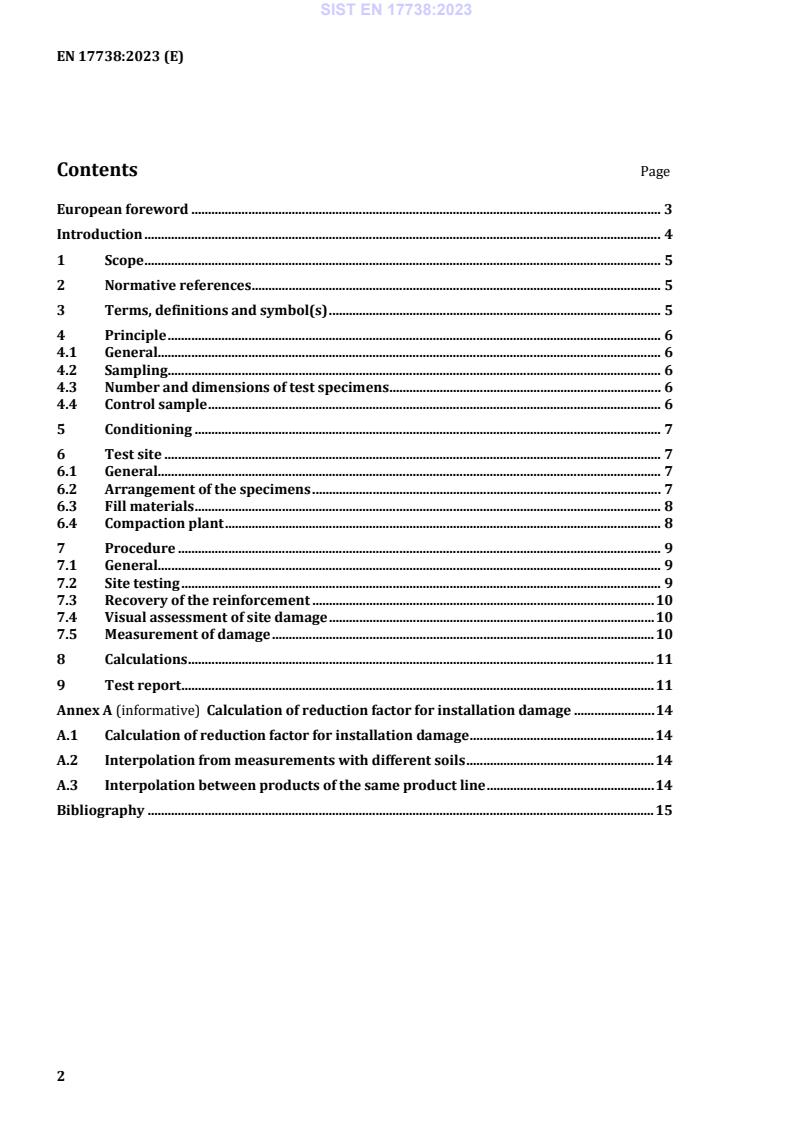
Contents Page
European foreword . 3
Introduction . 4
1 Scope . 5
2 Normative references . 5
3 Terms, definitions and symbol(s) . 5
4 Principle . 6
4.1 General. 6
4.2 Sampling . 6
4.3 Number and dimensions of test specimens . 6
4.4 Control sample . 6
5 Conditioning . 7
6 Test site . 7
6.1 General. 7
6.2 Arrangement of the specimens . 7
6.3 Fill materials . 8
6.4 Compaction plant . 8
7 Procedure . 9
7.1 General. 9
7.2 Site testing . 9
7.3 Recovery of the reinforcement . 10
7.4 Visual assessment of site damage . 10
7.5 Measurement of damage . 10
8 Calculations . 11
9 Test report . 11
Annex A (informative) Calculation of reduction factor for installation damage . 14
A.1 Calculation of reduction factor for installation damage . 14
A.2 Interpolation from measurements with different soils . 14
A.3 Interpolation between products of the same product line . 14
Bibliography . 15
European foreword
This document (EN 17738:2023) has been prepared by Technical Committee CEN/TC 189 “Geotextiles”,
the secretariat of which is held by NBN.
This European Standard shall be given the status of a national standard, either by publication of an
identical text or by endorsement, at the latest by October 2023, and conflicting national standards shall
be withdrawn at the latest by October 2023.
Attention is drawn to the possibility that some of the elements of this document may be the subject of
patent rights. CEN shall not be held responsible for identifying any or all such patent rights.
Any feedback and questions on this document should be directed to the users’ national standards body.
A complete listing of these bodies can be found on the CEN website.
According to the CEN-CENELEC Internal Regulations, the national standards organisations of the
following countries are bound to implement this European Standard: Austria, Belgium, Bulgaria, Croatia,
Cyprus, Czech Republic, Denmark, Estonia, Finland, France, Germany, Greece, Hungary, Iceland, Ireland,
Italy, Latvia, Lithuania, Luxembourg, Malta, Netherlands, Norway, Poland, Portugal, Republic of North
Macedonia, Romania, Serbia, Slovakia, Slovenia, Spain, Sweden, Switzerland, Türkiye and the United
Kingdom.
Introduction
This document describes the procedure to evaluate the damaging during the installation of a geotextile
and geotextile-related product. The test can be used to evaluate the RF of the geotextile and geotextile-
ID
related product, this parameter is fundamental for design purpose.
1 Scope
This document describes a procedure for producing mechanical damage to geotextiles and geotextile-
related products due only to compaction of soil or other materials. The damage is assessed visually and
by the loss of tensile strength or other reference tests used to assess the damage caused by this procedure.
The method described is a full-scale test procedure, using a range of fills and compaction methods, and
for the derivation of a reduction factor for installation damage for geotextiles and geotextile-related
products.
This document excludes geosynthetic barriers and products used in pavements and asphalt overlays.
2 Normative references
The following documents are referred to in the text in such a way that some or all of their content
constitutes requirements of this document. For dated references, only the edition cited applies. For
undated references, the latest edition of the referenced document (including any amendments) applies.
EN ISO 9862, Geosynthetics - Sampling and preparation of test specimens (ISO 9862)
EN ISO 10318-1, Geosynthetics - Part 1: Terms and definitions (ISO 10318-1)
EN ISO 10319, Geosynthetics - Wide-width tensile test (ISO 10319)
3 Terms, definitions and symbol(s)
For the purposes of this document, the terms and definitions given in EN ISO 10318-1 and the following
apply.
ISO and IEC maintain terminology databases for use in standardization at the following addresses:
— ISO Online browsing platform: available at https://www.iso.org/obp
— IEC Electropedia: available at https://www.electropedia.org/
3.1
reference test
test used to determine a particular property of the geotextile and geotextile-related product being
damaged in this procedure
3.2
reference grading parameter
specific diameter in the particle size distribution used to characterize each type of fill used in the
procedure (e.g. d of the soil)
3.3
RF
ID
reduction factor to allow for the effect of installation damage; expressed as the ratio of the mean tensile
strength of the undamaged material to the mean tensile strength of the damaged material, in relationship
to the reference grading parameter of each fill used and to the compaction method used
4 Principle
4.1 General
A full scale geotextile and geotextile-related product specimen is placed under a range of fills that
conform to the agreed upon grading limits; the fills are compacted in accordance with and in excess of
the agreed upon specification.
The specimens are large enough to be used for wide-width tensile testing (EN ISO 10319) or the test used
to measure the reference property.
The geotextile and geotextile-related product specimen is then removed from the test apparatus,
examined for any visual damage and subjected to a mechanical test, to measure the change in mechanical
properties. The result is expressed as the change (in percent) of the reference property. The visual
damage is also reported.
4.2 Sampling
The test specimens from the samples shall be taken in accordance with EN ISO 9862.
4.3 Number and dimensions of test specimens
The amount of geotextile and geotextile-related product to install in and retrieve from a test section is a
function of the type and number of laboratory tests to be conducted for assessment of damage. An amount
of material sufficient to obtain enough tests on representative specimens, for each type of test, should be
installed for each set of installation conditions.
In the recommended installation, geotextiles and geotextile-related products shall be cut to cover the
nine test bays in Figure 1. If the width of the product is lower than the width of each test bay in Figure 1,
adjacent strips shall be placed, without overlapping.
The test sample should be marked prior to installation and exhumation, or a template made, showing the
exact location where specimens for testing are to be obtained. They shall also be labelled with sufficient
information to ensure identification of the exposed sample and associated exposure conditions, such as:
geotextile and geotextile-related product and fill type. Machine and transverse machine direction of
specimens shall be designated. Designation of specimen locations is recommended to eliminate potential
bias in specimen selection after the geotextile and geotextile-related product has been damaged.
Alternate areas may also be designated in the event the primary specimen area is damaged by
exhumation.
From the exhumed damaged specimens, cut the specimens for the reference test in machine direction
(MD), in staggered positions across and along the damaged specimen.
Specimens prepared for tensile test shall be cut as required in EN ISO 10319. When other reference tests
are used, the number and dimensions of specimens shall suit the specific reference test procedure.
4.4 Control sample
Control or base line (un-installed) sample(s) of the geotextile(s) and geotextile-related product(s) being
investigated shall be from the same roll of material that is to be installed in the test section. Sample(s)
from each roll of geotextile and geotextile-related product shall be gathered in cases where multiple
geotextile and geotextile-related product rolls are used in the test section. Document all control sample
information pertinent to sample such as: date of manufacture, manufacturer or supplier, geotextile and
geotextile-related product grade and type, machine and transverse machine directions, and roll and lot
number, if available. These control samples shall be handled and stored in such a manner to eliminate, or
minimize, damage or degradation (for example, without exposure to ultraviolet light).
The orientation of the exhumed sample(s) and control sample(s) shall be documented. That is, the left
and right hand sides of each sample shall correspond. It is also recommended that the control sample
should be a direct continuation of the exhumed sample so as to minimize differences in control and
exhumed specimen properties due to inherent product variability.
The positions of the test specimens on the control sample, relative to roll edge, should correspond with
the positions of the exhumed sample.
5 Conditioning
Keep samples in a dry ambient without exposing to sunlight, at the same temperature of the testing
environment, for 24 h.
Tests should be carried out at a temperature of (20 ± 2) °C. When this is not possible the temperature of
the test environment shall be measured and reported.
6 Test site
6.1 General
Geosynthetic and soil placement techniques shall model the methods anticipated during construction but
may also be designed to model hypothetical conditions such as various degrees of compaction, lift heights,
drop heights, equipment operations, and/or types of fill material.
In the recommended installation, a level site should be prepared and laid out in nine bays, typically each
having 3 m length × 3 m wid
...
기사 제목: EN 17738:2023 - 지오텍스타일과 관련 제품 - 설치 절차 중 발생하는 손상 - 전체 규모의 테스트 기사 내용: 이 문서는 토양이나 다른 물질의 압축에 의해 발생하는 지오텍스타일과 관련 제품의 기계적 손상을 생성하는 절차를 설명합니다. 손상은 시각적으로 판단되며, 인장강도 손실 또는 이 절차에 의해 발생한 손상을 평가하기 위해 사용되는 기타 참조 시험으로도 평가됩니다. 기술된 방법은 전체 규모의 테스트 과정을 사용하며, 다양한 적재 및 압축 방법을 사용하여 지오텍스타일과 관련 제품에 대한 설치 손상의 감소계수를 유도하기 위해 사용됩니다. 이 문서는 지오시제적 방벽이나 포장재와 같은 제품을 포함하지 않습니다.
The article introduces a document, EN 17738:2023, which focuses on the damage caused to geotextiles and geotextile-related products during the installation process. The damage is specifically attributed to soil or other materials being compacted. The extent of damage is assessed visually and through tests that measure the loss of tensile strength or other reference indicators. The document outlines a full-scale test procedure that utilizes various types of fills and compaction methods. It aims to establish a reduction factor to quantify the degree of installation damage for geotextiles and geotextile-related products. Notably, the document does not cover geosynthetic barriers or products utilized in pavement and asphalt overlays.
記事のタイトル: EN 17738:2023 - 地工テキスタイルおよび関連製品 - 施工手順中の損傷 - 実大規模試験 記事内容:この文書は、土壌または他の材料の圧縮による地工テキスタイルおよび関連製品の機械的な損傷の生成手順について説明しています。損傷は視覚的に評価され、引張強度の減少やこの手順によって引き起こされた損傷を評価するための他の基準試験でも評価されます。 述べられた方法は、様々な土材と圧縮方法を使用した実大規模試験手順であり、地工テキスタイルおよび関連製品の施工損傷の削減係数の導出に使用されます。 ただし、この文書は地工シンセティックバリアや舗装およびアスファルトオーバーレイに使用される製品は対象外です。
Questions, Comments and Discussion
Ask us and Technical Secretary will try to provide an answer. You can facilitate discussion about the standard in here.
Loading comments...