


EN 13328-2:2002
(Main)Breathing system filters for anaesthetic and respiratory use - Part 2: Non-filtration aspects
Breathing system filters for anaesthetic and respiratory use - Part 2: Non-filtration aspects
Specifies non-filtration aspects including connectors, leakage
Filter für Atemsysteme zur Anwendung bei Anästhesie und Beatmung - Teil 2: Aspekte, die nicht die Filtration betreffen
Filtres pour systèmes respiratoires utilisés en anesthésie et soins respiratoires - Partie 2: Propriétés autres que la filtration
Sistem dihalnih filtrov za anestezijsko in dihalno uporabo - 2. del: Nefiltracijski vidiki
General Information
- Status
- Withdrawn
- Publication Date
- 12-Nov-2002
- Withdrawal Date
- 18-Mar-2008
- Technical Committee
- CEN/TC 215 - Respiratory and anaesthetic equipment
- Drafting Committee
- CEN/TC 215/WG 4 - Tracheal tubes and other equipment
- Current Stage
- 9960 - Withdrawal effective - Withdrawal
- Start Date
- 19-Mar-2008
- Completion Date
- 19-Mar-2008
- Directive
- 93/42/EEC - Medical devices
Relations
- Effective Date
- 22-Dec-2008
- Effective Date
- 28-Jan-2026
- Effective Date
- 22-Dec-2008

Get Certified
Connect with accredited certification bodies for this standard

BSI Group
BSI (British Standards Institution) is the business standards company that helps organizations make excellence a habit.

TÜV Rheinland
TÜV Rheinland is a leading international provider of technical services.

TÜV SÜD
TÜV SÜD is a trusted partner of choice for safety, security and sustainability solutions.
Sponsored listings
Frequently Asked Questions
EN 13328-2:2002 is a standard published by the European Committee for Standardization (CEN). Its full title is "Breathing system filters for anaesthetic and respiratory use - Part 2: Non-filtration aspects". This standard covers: Specifies non-filtration aspects including connectors, leakage
Specifies non-filtration aspects including connectors, leakage
EN 13328-2:2002 is classified under the following ICS (International Classification for Standards) categories: 11.040.10 - Anaesthetic, respiratory and reanimation equipment. The ICS classification helps identify the subject area and facilitates finding related standards.
EN 13328-2:2002 has the following relationships with other standards: It is inter standard links to EN ISO 23328-2:2008, EN 1861:1998, EN 13328-2:2002/A1:2003. Understanding these relationships helps ensure you are using the most current and applicable version of the standard.
EN 13328-2:2002 is associated with the following European legislation: EU Directives/Regulations: 93/42/EEC; Standardization Mandates: M/023. When a standard is cited in the Official Journal of the European Union, products manufactured in conformity with it benefit from a presumption of conformity with the essential requirements of the corresponding EU directive or regulation.
EN 13328-2:2002 is available in PDF format for immediate download after purchase. The document can be added to your cart and obtained through the secure checkout process. Digital delivery ensures instant access to the complete standard document.
Standards Content (Sample)
2003-01.Slovenski inštitut za standardizacijo. Razmnoževanje celote ali delov tega standarda ni dovoljeno.Breathing system filters for anaesthetic and respiratory use - Part 2: Non-filtration aspectsSistem dihalnih filtrov za anestezijsko in dihalno uporabo - 2. del: Nefiltracijski vidikiFiltres pour systemes respiratoires utilisés en anesthésie et soins respiratoires - Partie 2: Propriétés autres que la filtrationFilter für Atemsysteme zur Anwendung bei Anästhesie und Beatmung - Teil 2: Aspekte, die nicht die Filtration betreffen11.040.10Anestezijska, respiratorna in reanimacijska opremaAnaesthetic, respiratory and reanimation equipmentICS:SIST EN 13328-2:2003enTa slovenski standard je istoveten z:EN 13328-2:200201-marec-2003SIST EN 13328-2:2003SLOVENSKI
STANDARD
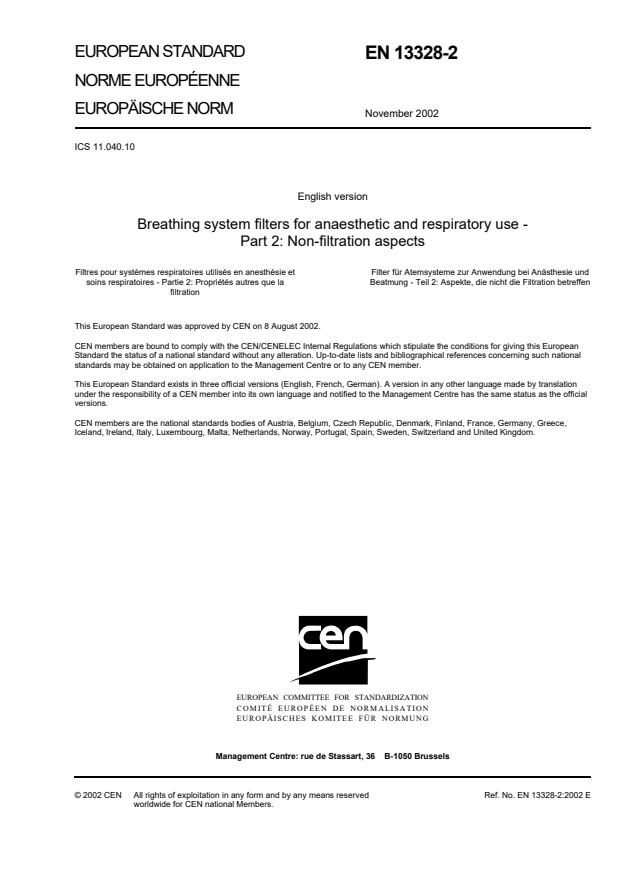
EUROPEAN STANDARDNORME EUROPÉENNEEUROPÄISCHE NORMEN 13328-2November 2002ICS 11.040.10English versionBreathing system filters for anaesthetic and respiratory use -Part 2: Non-filtration aspectsFiltres pour systèmes respiratoires utilisés en anesthésie etsoins respiratoires - Partie 2: Propriétés autres que lafiltrationFilter für Atemsysteme zur Anwendung bei Anästhesie undBeatmung - Teil 2: Aspekte, die nicht die Filtration betreffenThis European Standard was approved by CEN on 8 August 2002.CEN members are bound to comply with the CEN/CENELEC Internal Regulations which stipulate the conditions for giving this EuropeanStandard the status of a national standard without any alteration. Up-to-date lists and bibliographical references concerning such nationalstandards may be obtained on application to the Management Centre or to any CEN member.This European Standard exists in three official versions (English, French, German). A version in any other language made by translationunder the responsibility of a CEN member into its own language and notified to the Management Centre has the same status as the officialversions.CEN members are the national standards bodies of Austria, Belgium, Czech Republic, Denmark, Finland, France, Germany, Greece,Iceland, Ireland, Italy, Luxembourg, Malta, Netherlands, Norway, Portugal, Spain, Sweden, Switzerland and United Kingdom.EUROPEAN COMMITTEE FOR STANDARDIZATIONCOMITÉ EUROPÉEN DE NORMALISATIONEUROPÄISCHES KOMITEE FÜR NORMUNGManagement Centre: rue de Stassart, 36
B-1050 Brussels© 2002 CENAll rights of exploitation in any form and by any means reservedworldwide for CEN national Members.Ref. No. EN 13328-2:2002 E
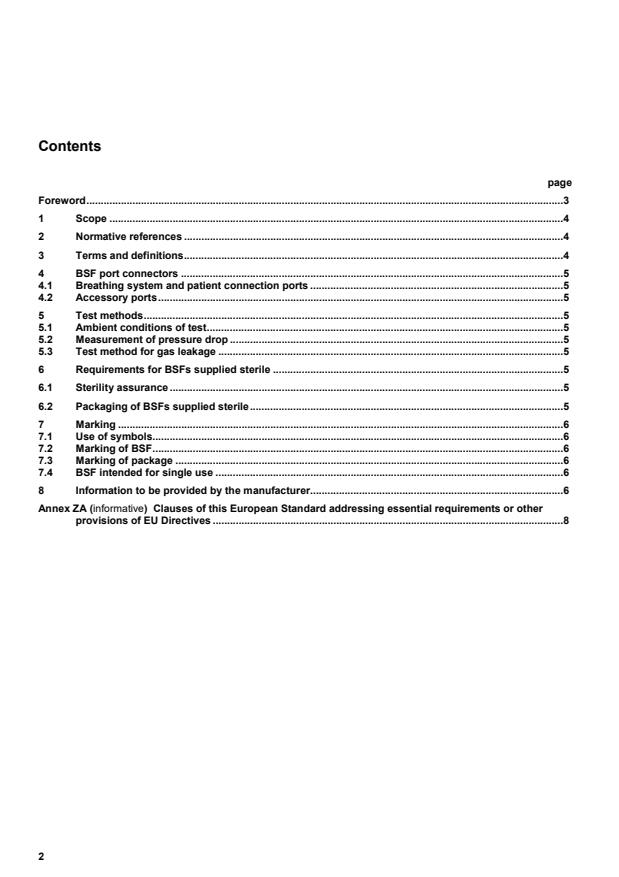
2ContentspageForeword.31Scope.42Normative references.43Terms and definitions.44BSF port connectors.54.1Breathing system and patient connection ports.54.2Accessory ports.55Test methods.55.1Ambient conditions of test.55.2Measurement of pressure drop.55.3Test method for gas leakage.56Requirements for BSFs supplied sterile.56.1Sterility assurance.56.2Packaging of BSFs supplied sterile.57Marking.67.1Use of symbols.67.2Marking of BSF.67.3Marking of package.67.4BSF intended for single use.68Information to be provided by the manufacturer.6Annex ZA (informative)
Clauses of this European Standard addressing essential requirements or otherprovisions of EU Directives.8
41 ScopeThis Part of this European Standard specifies requirements for non-filtration aspects of breathing system filters(BSFs) intended for the
...
Questions, Comments and Discussion
Ask us and Technical Secretary will try to provide an answer. You can facilitate discussion about the standard in here.
Loading comments...