


FprCEN/TS 18383
(Main)Packaging - Design for recycling for plastic packaging products - Guideline for design for recycling of flexible packaging made of biodegradable plastics
General Information
- Abstract
This document defines specific process and design criteria to evaluate the compatibility with collection, sorting, and recycling process of the part of the flexible packaging unit which comprises the main body and the integrated components predominantly made of biodegradable plastics, as well as of separate components predominantly made of biodegradable plastics.
This document is not about the compostability of packaging, i.e. its ability to be organically recovered through composting.
- Status
- Not Published
- Publication Date
- 09-Dec-2026
- Technical Committee
- CEN/TC 261 - Packaging
- Current Stage
- 5020 - Submission to Vote - Formal Approval
- Start Date
- 23-Jul-2026
- Due Date
- 28-Dec-2026
- Completion Date
- 23-Jul-2026

Overview
FprCEN/TS 18383:2026, developed by the European Committee for Standardization (CEN), presents comprehensive guidelines for the design for recycling of flexible packaging made predominantly from biodegradable plastics. It aims to support the development of recyclable packaging that is compatible with existing and evolving collection, sorting, and recycling processes in Europe. This technical specification focuses solely on material recycling and does not address compostability or organic recovery (e.g., composting).
Biodegradable plastics in scope can be processed through mechanical and chemical recycling streams-such as those for PLA, PHA, and aliphatic-aromatic copolyesters. The document harmonizes design practices to improve recyclability and supports compliance with key European regulations, notably the Packaging and Packaging Waste Regulation (PPWR).
Key Topics
Definitions and Scope
The standard clarifies core concepts including biodegradable plastics, recycling compatibility, and the distinction between compostability and recyclability. Flexible packaging units and separate components (predominantly made of biodegradable plastics) fall within the scope.Design Criteria for Recycling
Practical, material-specific guidelines are provided for:- Poly(lactic acid) (PLA)-based flexible packaging
- Polyhydroxyalkanoate (PHA)-based packaging
- Aliphatic-aromatic copolyester packaging
Each material class is evaluated against compatibility with collection, sorting, and recycling, with recommendations categorized as:
- Green: Fully compatible constituents for recycling streams.
- Yellow: Limited compatibility; may require extra measures.
- Red: Not compatible or disruptive to recycling processes.
General Design Principles
- Prefer natural color packaging to ease sorting.
- Minimize adhesives and labels; ensure easy removal.
- Reduce complex multi-material blends that hinder recyclability.
- Design for easy emptying to reduce residual content and contamination.
Sortability & Process Alignment The guidance considers the impact of packaging design on current European sorting infrastructures. Recommendations help ensure flexible packaging is recognized and efficiently separated in recycling facilities.
Applications
Organizations and packaging designers will find this standard highly relevant for:
- Product Development
Integrating recyclability at the design stage for single-use flexible packaging, especially for consumer goods, food products, and industrial goods. - Compliance
Ensuring packaging meets European regulations on recyclability and waste management, reducing risk of non-conformity under the PPWR and related directives. - Innovation
Supporting R&D in biodegradable plastics by defining pathways for integrating new materials into recycling systems, facilitating circular economy initiatives. - Enhanced Recyclability
Improving the collection and processing rates for biodegradable plastic packaging, aiding the transition towards more sustainable packaging systems.
Related Standards
This technical specification directly references and aligns with key European and international standards, including:
- EN 18120-1:2026
Packaging - Design for recycling of plastic packaging - Definitions and principles. - EN 18120-3:2026
Packaging - Design for recycling of plastic packaging - Criteria to evaluate recyclability. - EN 13432:2000
Packaging - Requirements for packaging recoverable through composting and biodegradation (not addressed for material recycling but relevant for distinguishing compostability). - European Printing Ink Association (EuPIA) Exclusion Policy
Guidance on permissible inks and related materials used in printing on plastic packaging. - Directive (EU) 2019/904 (SUPD)
Ban on oxo-degradable plastics, influencing material selection for sustainable packaging.
By following the recommendations in FprCEN/TS 18383:2026, manufacturers and designers of flexible biodegradable plastic packaging can contribute to developing a functional, scalable recycling system in Europe, improve the environmental profile of their products, and align with regulatory expectations for sustainable packaging solutions.
Get Certified
Connect with accredited certification bodies for this standard

NSF International
Global independent organization facilitating standards development and certification.

Smithers Quality Assessments
US management systems and product certification.

BRCGS (Brand Reputation Compliance Global Standards)
Global food safety and quality standards owner.
Sponsored listings
Frequently Asked Questions
FprCEN/TS 18383 is a draft published by the European Committee for Standardization (CEN). Its full title is "Packaging - Design for recycling for plastic packaging products - Guideline for design for recycling of flexible packaging made of biodegradable plastics". This standard covers: This document defines specific process and design criteria to evaluate the compatibility with collection, sorting, and recycling process of the part of the flexible packaging unit which comprises the main body and the integrated components predominantly made of biodegradable plastics, as well as of separate components predominantly made of biodegradable plastics. This document is not about the compostability of packaging, i.e. its ability to be organically recovered through composting.
This document defines specific process and design criteria to evaluate the compatibility with collection, sorting, and recycling process of the part of the flexible packaging unit which comprises the main body and the integrated components predominantly made of biodegradable plastics, as well as of separate components predominantly made of biodegradable plastics. This document is not about the compostability of packaging, i.e. its ability to be organically recovered through composting.
FprCEN/TS 18383 is classified under the following ICS (International Classification for Standards) categories: 13.030.50 - Recycling; 55.020 - Packaging and distribution of goods in general; 83.080.20 - Thermoplastic materials. The ICS classification helps identify the subject area and facilitates finding related standards.
FprCEN/TS 18383 is available in PDF format for immediate download after purchase. The document can be added to your cart and obtained through the secure checkout process. Digital delivery ensures instant access to the complete standard document.
Standards Content (Sample)
SLOVENSKI STANDARD
01-september-2026
Embalaža - Načrtovanje za recikliranje plastične embalaže - Smernica za
načrtovanje za recikliranje fleksibilne embalaže iz biorazgradljiive plastike
Packaging - Design for recycling for plastic packaging products - Guideline for design for
recycling of flexible packaging made of biodegradable plastics
Verpackung - Recyclingorientierte Gestaltung von Kunststoffverpackungsprodukten -
Leitfaden für die recyclingorientierte Gestaltung von flexiblen Verpackungen aus aus
biologisch abbaubaren Kunststoffen
Ta slovenski standard je istoveten z: FprCEN/TS 18383
ICS:
13.030.50 Recikliranje Recycling
55.020 Pakiranje in distribucija blaga Packaging and distribution of
na splošno goods in general
83.080.20 Plastomeri Thermoplastic materials
2003-01.Slovenski inštitut za standardizacijo. Razmnoževanje celote ali delov tega standarda ni dovoljeno.
FINAL DRAFT
TECHNICAL SPECIFICATION
SPÉCIFICATION TECHNIQUE
TECHNISCHE SPEZIFIKATION
July 2026
ICS 13.030.50; 55.020; 83.080.20
English Version
Packaging - Design for recycling for plastic packaging
products - Guideline for design for recycling of flexible
packaging made of biodegradable plastics
Verpackung - Recyclingorientierte Gestaltung von
Kunststoffverpackungsprodukten - Leitfaden für die
recyclingorientierte Gestaltung von flexiblen
Verpackungen aus aus biologisch abbaubaren
Kunststoffen
This draft Technical Specification is submitted to CEN members for Vote. It has been drawn up by the Technical Committee
CEN/TC 261.
CEN members are the national standards bodies of Austria, Belgium, Bulgaria, Croatia, Cyprus, Czech Republic, Denmark, Estonia,
Finland, France, Germany, Greece, Hungary, Iceland, Ireland, Italy, Latvia, Lithuania, Luxembourg, Malta, Netherlands, Norway,
Poland, Portugal, Republic of North Macedonia, Romania, Serbia, Slovakia, Slovenia, Spain, Sweden, Switzerland, Türkiye and
United Kingdom.
Recipients of this draft are invited to submit, with their comments, notification of any relevant patent rights of which they are
aware and to provide supporting documentation.
Warning : This document is not a Technical Specification. It is distributed for review and comments. It is subject to change
without notice and shall not be referred to as a Technical Specification.
EUROPEAN COMMITTEE FOR STANDARDIZATION
COMITÉ EUROPÉEN DE NORMALISATION
EUROPÄISCHES KOMITEE FÜR NORMUNG
CEN-CENELEC Management Centre: Rue de la Science 23, B-1040 Brussels
© 2026 CEN All rights of exploitation in any form and by any means reserved Ref. No. FprCEN/TS 18383:2026 E
worldwide for CEN national Members.
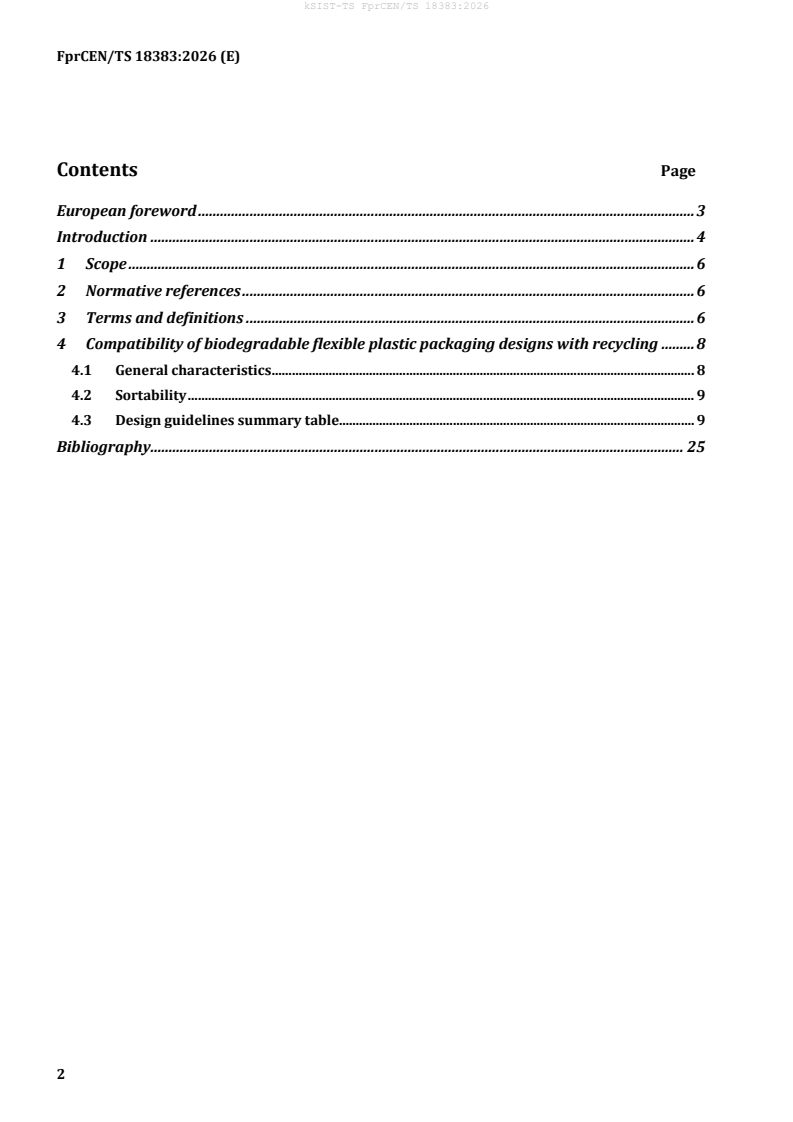
Contents Page
European foreword . 3
Introduction . 4
1 Scope . 6
2 Normative references . 6
3 Terms and definitions . 6
4 Compatibility of biodegradable flexible plastic packaging designs with recycling . 8
4.1 General characteristics . 8
4.2 Sortability . 9
4.3 Design guidelines summary table. 9
Bibliography. 25
European foreword
This document (FprCEN/TS 18383:2026) has been prepared by Technical Committee CEN/TC 261
“Packaging”, the secretariat of which is held by AFNOR.
This document is currently submitted to the Vote on TS.
Introduction
Biodegradable plastics are polymeric materials able to be broken down by biological processes under
aerobic conditions to carbon dioxide, water and mineral salts of any other elements present
(mineralization) and new biomass.
Biodegradability is an intrinsic property that is determined by the fundamental chemical composition
and structure of a material. Chemical bonds of biodegradable polymers are recognized by naturally
occurring enzymes and the biodegradability of polymeric materials is determined by the chemical
structure responsible for functional group stability, reactivity, hydrophilicity and swelling behaviour.
The rate and extent of biodegradation depend on the polymer’s chemical composition, crystallinity,
molecular weight, and environmental parameters such as temperature, moisture, pH, and microbial
community composition.
Recycling is generally defined by the Waste Framework Directive (2008/98/EC) as any recovery
operation where waste materials are reprocessed into products, materials, or substances for original or
other purposes. It includes organic material reprocessing but excludes energy recovery and conversion
into fuels or materials for backfilling.
On the other hand, according to the PPWR, material recycling refers specifically to the reprocessing of
waste into materials or substances, excluding biological treatment, organic material reprocessing, energy
recovery, and conversion into fuels or backfilling materials.
Following the Regulation (EU) 2025/40 , known as the Packaging and Packaging Waste Regulation
(“PPWR”) most packaging placed on the market, including packaging made of biodegradable plastic
polymers and other biodegradable materials, shall be recyclable i.e. it is designed for material recycling,
and when it becomes waste, it can be collected separately and sorted into specific waste streams without
affecting the recyclability of other waste streams and recycled at scale. However, certain compostable
packaging is exempt from meeting material recycling requirements due to a derogation (in line with
Article 9.1 and 9.2 of the PPWR).
On this basis, different types of packaging made from biodegradable plastics can be created that need to
be managed appropriately.
— The first type comprises packaging made from biodegradable plastics that falls within packaging
applications that are required by European or national laws to be compatible with the standard for
composting in industrially controlled conditions in bio-waste treatment facilities. This packaging is
marked with labels as compostable and enter the biodegradable waste stream (known as bio-waste).
It is not recycled as material but converted into compost or similar substances. Compostable
packaging generally needs to fulfil a number of requirements, including being made from
biodegradable materials and containing undesirable substances at levels below certain
predetermined thresholds. It also may not negatively impact the final compost end product. The
characteristics of compostable packaging are defined by a relevant European standard (EN 13432).
— The second type comprises packaging made from biodegradable plastics that would need to be
recovered by material recycling because the derogation is only applied to some territories. There is
growing interest in certain packaging formats that can be recycled in both the bio-waste stream and
the material recycling stream, depending on local regulations and infrastructure.
— The third type concerns packaging made from biodegradable plastics that is not intended to be
recovered by organic recycling, either due to the decision of the person placing it on the market or
current regulations. In this case, the use of biodegradable plastic is not motivated by its
biodegradability, but by other factors. The fact that it is biodegradable is incidental; this
Regulation (EU) 2025/40 of the European Parliament and of the Council of 19 December 2024 on packaging and
packaging waste (commonly known as the “PPWR”)
characteristic is neither communicated nor used for recovery purposes. It is important to note that
this is already the case with other biodegradable packaging materials, such as paper-based
packaging, which, despite being predominantly made of a biodegradable material (i.e. cellulose), are
generally recovered by material recycling and not labelled as compostable. In this case, the packaging
needs to be designed to enable material recycling, but it is not required to show biodegradability
according to the criteria defined in the relevant European standard for compostable packaging.
This document addresses the second and the third types of packaging.
Biodegradable polymers such as polylactic acid (PLA), aliphatic-aromatic polyesters, and
polyhydroxyalkanoates (PHA), can be used to produce plastic packaging that can be recycled similarly to
PET. However, the adoption of packaging made of biodegradable plastics is currently limited compared
to widely used plastics like PE, PP, PET and separate sorting and recycling systems still need to be built
up at scale. Therefore, this technical specification (TS) is based on experiences from other plastics and
from ongoing European projects aimed at scaling up sorting and recycling procedures.
The objective of this TS is to facilitate consistent design for recycling criteria for packaging made from
biodegradable plastics, ensuring that when sorting and recycling infrastructure mature, these
specifications can be smoothly incorporated into the broader standard framework. This document
provides guidance based on current technological capabilities and does not represent state-of-
the-art collection, sorting and recycling as defined in EN 18120. As technical developments progress
and further consensus is achieved the content of this Technical Specification may be subject to
modification, review and revision.
This technical specification (TS) intends to follow the philosophy of EN 18120 consisting of 15 parts.
Given the early market implementation in Europe of packaging made from biodegradable plastics and
the low volumes of such packaging currently in the waste streams, existing material recycling
technologies for packaging waste made from biodegradable plastics (with levels of maturity varying
depending on the polymer type) do not currently fit into the “state-of-the-art” definition as set in
EN 18120. Therefore, these TS are proposed outside the scope of EN 18120 at this stage, while
maintaining its philosophy and structure as closely as possible. EN 18120 aims via a series of guidelines
and protocols to establish consistency and improvement for the Design for recycling for household,
industrial and commercial plastic packaging products.
Design for recycling guidelines are a common way of describing compatibility with plastic packaging
collection, sorting and recycling into recycled plastic. They provide guidance on the level compatibility,
defined as:
— Green: Packaging constituents with full compatibility with collection, sorting and recycling;
— Yellow: Packaging constituents with limited compatibility with collection, sorting and recycling;
— Red: Packaging constituents which are not compatible with collection, sorting and recycling.
Recyclability guidelines will require regular review and improvement to reflect innovations in design,
collection, sorting and recycling.
The Design for Recycling Guidelines provided cover all steps from design for recycling, packaging waste
collection, sorting, recycling into recycled plastic and to use in a new application. Compliance with the
design guidelines does not guarantee that the recycled plastic quality will be fit for purpose for a specific
targeted end application or compliant with applicable regulations.
Packaging recyclability is the combination of design for recycling, proven collection, sorting, and
recycling.
1 Scope
This document defines specific process and design criteria to evaluate the compatibility with collection,
sorting, and recycling process of the part of the flexible packaging unit which comprises the main body
and the integrated components predominantly made of biodegradable plastics, as well as of separate
components predominantly made of biodegradable plastics.
This document is not about the compostability of packaging, i.e. its ability to be organically recovered
through composting.
2 Normative references
The following documents are referred to in the text in such a way that their content constitutes
requirements of this document. For dated references, only the edition cited applies. For undated
references, the latest edition of the referenced document (including any amendments) applies.
EN 18120-1:2026, Packaging — Design for recycling of plastic packaging — Part 1: Definitions and
principles for design-for-recycling of plastic packaging
EN 18120-3:2026, Packaging — Design for recycling of plastic packaging — Part 3: Process and criteria to
evaluate the recyclability of plastic packaging
EN 13432:2000, Packaging — Requirements for packaging recoverable through composting and
biodegradation — Test scheme and evaluation criteria for the final acceptance of packaging
European Printing Ink Association (EuPIA). EuPIA Exclusion Policy for Printing Inks and Related Products
– 5th Edition (June 2023)
3 Terms and definitions
For the purposes of this document, the following terms and definitions apply. For all other terms and
definitions that are not defined below, please refer to the definitions in EN 18120-1.
ISO and IEC maintain terminology databases for use in standardization at the following addresses:
— ISO Online browsing platform: available at https://www.iso.org/obp/
— IEC Electropedia: available at https://www.electropedia.org/
3.1
aliphatic-aromatic copolyester
thermoplastic copolyester made by the polycondensation of an aliphatic diol with aliphatic and aromatic
diacids
3.2
biodegradable plastic
plastic capable of undergoing biological decomposition, such that it ultimately decomposes into carbon
dioxide (CO ), biomass and water, and meets the inherent biodegradability requirements of the relevant
composting standards
Note 1 to entry: Biodegradable plastic in the context of this document is characterized only by its inherent
biodegradability as per EN 13432:2000 (and not by other requirements of EN 13432:2000)
3.3
depolymerisation
reversion of a polymer to its monomer(s) or to a polymer of lower relative molecular mass
3.4
green category
category for identifying components or constituents of a plastic packaging that is in the scope of the
design for recycling guidelines of a given packaging type and are recognised as compatible with collection,
sorting and recycling processes or are demonstrated as suitable for recycling through technical
evaluation and can fully meet the quality requirements of secondary raw material in the recycling process
3.5
oxo(bio)degradable additive, oxo(bio)degradation additive
additive which, through oxidation, leads to the fragmentation of the plastic material into micro-fragments
or to chemical decomposition
Note 1 to entry: Definition is based on definition EN 18120-1:2026, 3.92.
Note 2 to entry: Oxo(bio)degradable additive and oxo(bio)degradation additive are used synonymously.
3.6
polybutylene adipate terephthalate
PBAT
thermoplastic copolyester made by the polycondensation of 1,4 butanediol with terephthalic acid and
adipic acid
3.7
polybutylene succinate
PBS
thermoplastic polyester made by the polycondensation of succinic acid and 1,4-butanediol
3.8
polycaprolactone
PCL
thermoplastic polyester made by the ring-opening polymerization of ε-caprolactone
3.9
polyethylene glycol
PEG
thermoplastic polyether made by polymerization of ethylene glycol
3.10
polyethylene wax
low-molecular-weight synthetic polymer of ethylene, characterized by wax-like properties such as low
viscosity, hardness, and high melt point
3.11
polyhydroxyalkanoate
PHA
thermoplastic polyester, predominantly consisting of 3-hydroxybutyrate and/or 4-hydroxybutyrate (e.g.,
PHB, PHBV, PHBH, P3,4HB)
3.12
polylactic acid
PLA
thermoplastic polyester made by the polymerisation of lactic acid or lactide
3.13
polytetramethylene glycol
PTMG
synthetic resin made by the polymerization of tetramethylene glycol
3.14
red category
category for identifying components or constituents of a plastic packaging that is in the scope of the
design for recycling guidelines of a given packaging type and generally leads to rejection of the packaging
item in sorting or recycling processes or are generally recognized as detrimental (disrupting) for
recycling or are demonstrated as disrupting for recycling through technical evaluation or are
demonstrated as unacceptably downgrading the yield or the quality of plastic secondary raw materials
3.15
yellow category
category for identifying components or constituents of a plastic packaging that is in the scope of the
design for recycling guidelines of a given packaging type and are recognized as acceptable with limited
compatibility with collection, sorting and recycling processes, or are demonstrated as having limited
compatibility through technical evaluation or will not meet all the quality requirements for secondary
raw material in the recycling process
4 Compatibility of biodegradable flexible plastic packaging designs with
recycling
4.1 General characteristics
Generic aspects for design compatibility with recycling are covered in EN 18120-1:2026. The following
guidance tables shall be consulted when designing flexible packaging made from biodegradable plastic
for material recyclability. The tables provide combined design guidance for all considered material
recycling processes. This document considers mechanical and chemical recycling of flexible packaging
made of biodegradable plastics as recycling technologies. It considers the outlets described in Table 1.
Table 1 — Outlets for recyclates considered in this document
Packaging type Recycling technology Outlet
Flexible packaging made Mechanical and chemical Chemical recycling: recycled PLA for any
predominantly from PLA recycling application including packaging
Mechanical recycling: recycled PLA for any
film application including packaging
Flexible packaging made Mechanical recycling Film for packaging or other applications
predominantly from PHA where the quality of the recycled material is
retained, where feasible
Flexible packaging made Mechanical recycling Film for packaging or other applications
predominantly from aliphatic- where the quality of the recycled material is
aromatic copolyesters retained, where feasible
At the time of creation of this document, the exact requirements for chemical recycling processes were not known
in detail. A future revision may introduce specific requirements.
These current recycling technologies for packaging made from biodegradable plastics, for post-consumer waste,
are not yet able to conform to the “state-of-the-art” definition in EN 18120. For post-industrial waste recycling,
however, some technologies already conform to such “state-of-the-art” definition.
The design guidance provided in this document covers a) main packaging components which constitute
flexible packaging made from biodegradable plastics, with all their integrated components and all
constituents, including those which are removed during the recycling process and b) separate
components (of other types of packaging) which constitute biodegradable flexible plastic materials, with
all their constituents, including those which are removed during the recycling process.
It does not cover separate components of flexible packaging (which are already separated before and
during the sorting process) as per the definition of EN 18120-1:2026 and as determined according to
EN 18120-3:2026, unless these again constitute flexible packaging.
Separate components shall be evaluated separately, as described in EN 18120-1:2026. As such, a separate
component of flexible packaging predominantly made of biodegradable plastics can be fully compatible
with recycling even when an integrated component or a constituent of the same specification would only
have limited or no compatibility with recycling according to the guidance in this document. Equally,
separate components of flexible packaging can be incompatible with recycling while an integrated
component of the same specification may be compatible.
The following general principles shall be followed when designing flexible packaging made from
biodegradable plastics:
— prefer natural colour packaging where possible, mainly in the main component of the packaging;
— minimize the adhesives used for bonding the different elements of the packaging and ensure they are
easily removable and are compatible with the recycling processes;
— minimize labels;
— design the packaging, where possible and taking into account the filling good, in such a way that it
eases emptying of its content to minimize residual content.
4.2 Sortability
The design guidance provided by this Technical Specification considers effects on the sortability of
packaging. It does however not provide details on established sorting processes or a method for
determining sortability. Where sortability testing is advised in the guidance of this document, the
provisions of EN 18120-3:2026 shall apply. This includes the consideration of the effect of residual
product content after emptying on the sortability.
4.3 Design guidelines summary table
The design guidelines in the following tables have been established reflecting collection, sorting and
recycling in Europe.
The tables in this subclause provide differentiated design guidance for biodegradable flexible packaging
predominantly made from aliphatic aromatic copolyesters, PHA and PLA, acknowledging differences
between both the properties of these plastics as well as parameters of their recycling processes and
different possible end uses for the recycled plastic. When aliphatic aromatic copolyesters and/or PHA
and/or PLA are present in a packaging des
...