

EN 4726:2015
(Main)Aerospace series - Acceptance of the cosmetic variations in appearance of aircraft cabin parts
- Abstract
This standard defines surfaces on visible components in the aircraft cabin. Surfaces will be considered under the aspects of technical feasibility of the industrial design.
This standard is a guideline between airlines, supplier and OEMs with regard to cosmetic issues.
This document aims to:
a) Provide the supplier with quality criteria, which need to be met during the production, testing- and quality-inspection-process,
b) Guide airline-, OEM- and supplier-quality assurance with a description of cosmetic standards for following inspections:
- Supplier internal QA inspection;
- First article inspection;
- Source inspection;
- Incoming inspection;
- Final assembly line cabin inspection.
- Status
- Withdrawn
- Publication Date
- 08-Sep-2015
- Withdrawal Date
- 06-Oct-2026
- Technical Committee
- ASD-STAN - Aerospace
- Drafting Committee
- ASD-STAN/D 1 - General
- Current Stage
- 9960 - Withdrawal effective - Withdrawal
- Start Date
- 28-Nov-2018
- Completion Date
- 07-Oct-2026

Relations
- Effective Date
- 05-Dec-2018
- Effective Date
- 28-Jan-2026
- Effective Date
- 28-Jan-2026
- Refers
EN ISO/CIE 11664-2:2022 - Colorimetry - Part 2: CIE standard illuminants (ISO/CIE 11664-2:2022) - Effective Date
- 28-Jan-2026
- Effective Date
- 28-Jan-2026
- Effective Date
- 28-Jan-2026
- Refers
EN ISO/CIE 11664-4:2019 - Colorimetry - Part 4: CIE 1976 L*a*b* colour space (ISO/CIE 11664-4:2019) - Effective Date
- 28-Jan-2026
Get Certified
Connect with accredited certification bodies for this standard

BUREAU VERITAS Certification Germany
Bureau Veritas certification in Germany.

Element Materials Technology
Materials testing and product certification.

AQMS Ltd.
AQMS provides ISO certification to SMEs across the UK.
Sponsored listings
Frequently Asked Questions
EN 4726:2015 is a standard published by the European Committee for Standardization (CEN). Its full title is "Aerospace series - Acceptance of the cosmetic variations in appearance of aircraft cabin parts". This standard covers: This standard defines surfaces on visible components in the aircraft cabin. Surfaces will be considered under the aspects of technical feasibility of the industrial design. This standard is a guideline between airlines, supplier and OEMs with regard to cosmetic issues. This document aims to: a) Provide the supplier with quality criteria, which need to be met during the production, testing- and quality-inspection-process, b) Guide airline-, OEM- and supplier-quality assurance with a description of cosmetic standards for following inspections: - Supplier internal QA inspection; - First article inspection; - Source inspection; - Incoming inspection; - Final assembly line cabin inspection.
This standard defines surfaces on visible components in the aircraft cabin. Surfaces will be considered under the aspects of technical feasibility of the industrial design. This standard is a guideline between airlines, supplier and OEMs with regard to cosmetic issues. This document aims to: a) Provide the supplier with quality criteria, which need to be met during the production, testing- and quality-inspection-process, b) Guide airline-, OEM- and supplier-quality assurance with a description of cosmetic standards for following inspections: - Supplier internal QA inspection; - First article inspection; - Source inspection; - Incoming inspection; - Final assembly line cabin inspection.
EN 4726:2015 is classified under the following ICS (International Classification for Standards) categories: 49.095 - Passenger and cabin equipment. The ICS classification helps identify the subject area and facilitates finding related standards.
EN 4726:2015 has the following relationships with other standards: It is inter standard links to EN 4726:2018, EN ISO/CIE 11664-1:2019, EN ISO/CIE 11664-5:2024, EN ISO/CIE 11664-2:2022, EN ISO 2813:2014, EN 12464-1:2021, EN ISO/CIE 11664-4:2019. Understanding these relationships helps ensure you are using the most current and applicable version of the standard.
EN 4726:2015 is available in PDF format for immediate download after purchase. The document can be added to your cart and obtained through the secure checkout process. Digital delivery ensures instant access to the complete standard document.
Standards Content (Sample)
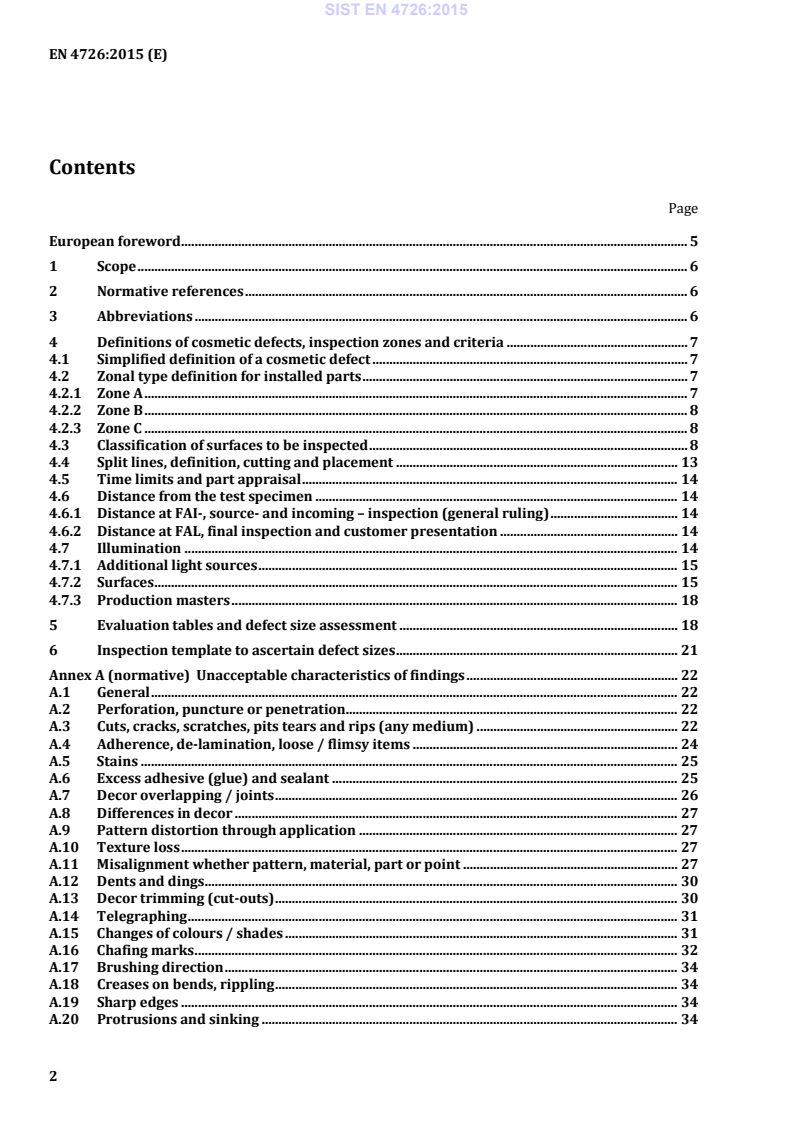
2003-01.Slovenski inštitut za standardizacijo. Razmnoževanje celote ali delov tega standarda ni dovoljeno.NDELQHLuft- und Raumfahrt - Akzeptanz von kosmetischen Qualitätsabweichungen bei Flugzeug-KabinenbauteilenSérie aérospatiale - Acceptation des variations esthétiques de l'aspect des éléments de cabine d'avionAerospace series - Acceptance of the cosmetic variations in appearance of aircraft cabin parts49.095Oprema za potnike in oprema kabinPassenger and cabin equipmentICS:Ta slovenski standard je istoveten z:EN 4726:2015SIST EN 4726:2015en,fr,de01-november-2015SIST EN 4726:2015SLOVENSKI
STANDARD
EUROPEAN STANDARD NORME EUROPÉENNE EUROPÄISCHE NORM
EN 4726
September
t r s w ICS
v {ä r { w English Version
Aerospace series æ Acceptance of the cosmetic variations in appearance of aircraft cabin parts Série aérospatiale æ Acceptation des variations esthétiques de l 5aspect des éléments de cabine d 5avion Luftæ und Raumfahrt æ Akzeptanz von kosmetischen Qualitätsabweichungen bei FlugzeugæKabinenbauteilenThis European Standard was approved by CEN on
s r January
t r s wä
egulations which stipulate the conditions for giving this European Standard the status of a national standard without any alterationä Upætoædate lists and bibliographical references concerning such national standards may be obtained on application to the CENæCENELEC Management Centre or to any CEN memberä
translation under the responsibility of a CEN member into its own language and notified to the CENæCENELEC Management Centre has the same status as the official versionsä
CEN members are the national standards bodies of Austriaá Belgiumá Bulgariaá Croatiaá Cyprusá Czech Republicá Denmarká Estoniaá Finlandá Former Yugoslav Republic of Macedoniaá Franceá Germanyá Greeceá Hungaryá Icelandá Irelandá Italyá Latviaá Lithuaniaá Luxembourgá Maltaá Netherlandsá Norwayá Polandá Portugalá Romaniaá Slovakiaá Sloveniaá Spainá Swedená Switzerlandá Turkey andUnited Kingdomä
EUROPEAN COMMITTEE FOR STANDARDIZATION COMITÉ EUROPÉEN DE NORMALISATION EUROPÄISCHES KOMITEE FÜR NORMUNG
CEN-CENELEC Management Centre:
Avenue Marnix 17,
B-1000 Brussels
t r s w CEN All rights of exploitation in any form and by any means reserved worldwide for CEN national Membersä Refä Noä EN
v y t xã t r s w ESIST EN 4726:2015
Page European foreword . 5 1 Scope . 6 2 Normative references . 6 3 Abbreviations . 6 4 Definitions of cosmetic defects, inspection zones and criteria . 7 4.1 Simplified definition of a cosmetic defect . 7 4.2 Zonal type definition for installed parts . 7 4.2.1 Zone A . 7 4.2.2 Zone B . 8 4.2.3 Zone C . 8 4.3 Classification of surfaces to be inspected . 8 4.4 Split lines, definition, cutting and placement . 13 4.5 Time limits and part appraisal . 14 4.6 Distance from the test specimen . 14 4.6.1 Distance at FAI-, source- and incoming – inspection (general ruling) . 14 4.6.2 Distance at FAL, final inspection and customer presentation . 14 4.7 Illumination . 14 4.7.1 Additional light sources . 15 4.7.2 Surfaces . 15 4.7.3 Production masters . 18 5 Evaluation tables and defect size assessment . 18 6 Inspection template to ascertain defect sizes . 21 Annex A (normative)
Unacceptable characteristics of findings . 22 A.1 General . 22 A.2 Perforation, puncture or penetration. 22 A.3 Cuts, cracks, scratches, pits tears and rips (any medium) . 22 A.4 Adherence, de-lamination, loose / flimsy items . 24 A.5 Stains . 25 A.6 Excess adhesive (glue) and sealant . 25 A.7 Decor overlapping / joints . 26 A.8 Differences in decor . 27 A.9 Pattern distortion through application . 27 A.10 Texture loss . 27 A.11 Misalignment whether pattern, material, part or point . 27 A.12 Dents and dings . 30 A.13 Decor trimming (cut-outs) . 30 A.14 Telegraphing . 31 A.15 Changes of colours / shades . 31 A.16 Chafing marks . 32 A.17 Brushing direction . 34 A.18 Creases on bends, rippling . 34 A.19 Sharp edges . 34 A.20 Protrusions and sinking . 34 SIST EN 4726:2015
Tables Table 1 — Evaluation Table valid for parts up to: 0,25 m2 . 18 Table 2 — Evaluation table valid for parts up to: 0,5 m2 . 19 Table 3 — Evaluation table valid for parts larger than: 0,5 m2 . 20 Table 4 — Evaluation table valid for broad but not long defects, e. g. scratches, low marks, over spraying, hairs etc. . 20
Figures Figure 1 — Cabin lining .9 Figure 2 — Pax seat . 10 Figure 3 — CAS seat . 11 Figure 4 — Cabin monument . 11 Figure 5 — Galley . 12 Figure 6 — Example for other cabin parts . 13 Figure 7— Example for inspection template to ascertain defect sizes . 21 Figure A.1 — Example of a perforation finding . 22 Figure A.2 — Example of a crack finding . 23 Figure A.3 — Example of a cut finding . 23 Figure A.4 — Example of a paint defect finding . 23 Figure A.5 — Example of a scratch finding . 24 Figure A.6 — Example of a scratch finding . 24 Figure A.7 — Example of a poor adhesion finding . 25 Figure A.8 — Example of a stain finding . 25
This document aims to: a) Provide the supplier with quality criteria, which need to be met during the production, testing- and quality-inspection-process,
b) Guide airline-, OEM- and supplier-quality assurance with a description of cosmetic standards for following inspections: Supplier internal QA inspection; First article inspection;
Source inspection;
Incoming inspection;
Final assembly line cabin inspection. 2 Normative references The following documents, in whole or in part, are normatively referenced in this document and are indispensable for its application. For dated references, only the edition cited applies. For undated references, the latest edition of the referenced document (including any amendments) applies.
EN 12464-1, Light and lighting — Lighting of work places — Part 1: Indoor work places EN ISO 2813, Paints and varnishes — Determination of specular gloss of non-metallic paint films at 20°, 60° and 85° EN ISO 11664-1, Colorimetry — Part 1: CIE standard colorimetric observers EN ISO 11664-2, Colorimetry — Part 2: CIE standard observers EN ISO 11664-4, Colorimetry — Part 4: CIE 1976 L*a*b* Colour space EN ISO 11664-5, Colorimetry — Part 5: CIE 1976 L*u*v* Colour space and u', v' uniform chromaticity scale diagram
3 Abbreviations
For the purposes of this document, the following abbreviations and definitions apply. A/C aircraft CDR critical design review 3D three dimensional SIST EN 4726:2015
Industrial design colour specification NTF non-textile floor OEM original equipment manufacturer Pax passenger PTS purchaser technical specification PVF polyvinyl fluoride QA quality assurance QC quality control TTL taxi, take-off and landing SU Service unit 4 Definitions of cosmetic defects, inspection zones and criteria 4.1 Simplified definition of a cosmetic defect Cosmetic defects are deviations from the standard or customized specifications/definitions if they are distinct without additional illumination and/or mirror and according to the defined criteria’s within this standard. The defects listed encompass any process relevant material. Pick-ups raised by OEM which are disputed between both parties (OEM and supplier) are subject to be finally decided by the customer. Any decision has to be documented and to be attached to each individual unit. Samples have to be supplied by the supplier and/or the customer to the OEM in order to validate the inspection. 4.2 Zonal type definition for installed parts 4.2.1 Zone A All surfaces (and edges) directly visible after installation in TTL position from a standing or seating position; specially critically parts regarded by the customer e.g. table top / backs and video arms and as well as areas around logos. SIST EN 4726:2015
Key 1 Side wall stowage lid shown open to view lid inside
A zone
B zone
C zone Figure 1 — Cabin lining SIST EN 4726:2015
Key 1 Stowages insides: B zone 2 Rear walls, if free standing: A zone; if rear side very close to a wall (i.e. masked by wall): B zone 3 Aisle walls, if aisle side: A zone; if window side: B zone 4 Underneath, if "footrest" returns down and backwards: B zone; if "footrest" returns up and backwards: A zone; if "footrest" cannot be viewed incl. during operational movement: C zone 5 Reade side: A zone 6 Stowage insides: B zone 7 Tables top and bottom: A zone 8 LCD monitor: A zone
A zone
B zone Figure 2 — Pax seat
Key 1 Only if flush to a wall: B zone behind headrest, back of seat 2 A zone, under seat pan shroud, underneath of footrest
A zone
B zone Figure 3 — CAS seat
Typical monument with
magazine rack and doghouse Typical monument without additional furnishings Key
A zone
B zone Figure 4 — Cabin monument SIST EN 4726:2015
Key 1 Shelves and cupboards for: fixed parts e.g. ovens, boilers: C zone 2 Unless gap makes sides visible then first 10 cm A zone; removable parts e.g. SU first 10 cm is A zone thereafter C zone 3 Stowage inside: B zone incl. door inside trolley doors inside 4 Underneath is C zone 5 Underneath is B zone, because it cannot be directly viewed; if higher this will become an A zone
A zone
B zone
C zone Figure 5 — Galley
Key 1 Corpus outside: A zone; if masked by wall, seat, etc. visible area: B zone, any areas completely not visible: C zone 2 Corpus inside: B zone; if part of inside not visible by normal operation: C zone 3 Drawer and door inside: B zone 4 Door outside: A zone 5 Bottom: C zone 6 Backside if outboard lateral side: B zone; if free standing: A zone
A zone
B zone
C zone Figure 6 — Example for other cabin parts 4.4 Split lines, definition, cutting and placement Decor split line positions are defined by the OEM corporate cabin design department under advisement and in conjunction with the supplier so as to include all aspects of design prerequisites and feasibility.
Split lines are inherent to a successful and controllable development and in some cases a necessity to achieve pattern harmony; therefore a split line or its position cannot be accepted as a reason for customer rejection. Due to the complex nature of the definition process split lines are shown in the corresponding colour specification to provide design direction and understanding.
General split line rules: a) Any applied film, split line position tolerance is 2 mm, i.e. ± 1 mm on curved or wavy surfaces and will be 1 mm, i.e. − 0,5 mm on purely flat surfaces.
b) In cases of split line production templates, the templates may also be used for quality inspection checks. c) Split line necessity overrules aesthetic reasoning. d) Parts with integrated deep recesses or 3
...