

EN 13191-2:2000
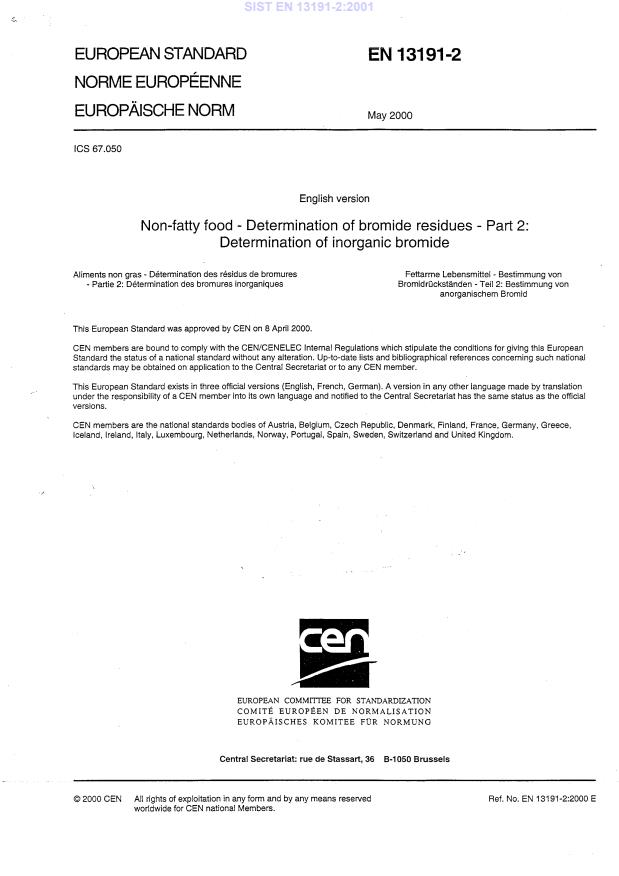
(Main)Non-fatty food - Determination of bromide residues - Part 2: Determination of inorganic bromide
- Abstract
This European Standard specifies a gas chromatographic method for the determination of inorganic bromide residues in non-fatty foods. Generally, the maximum residue levels are expressed in terms of bromide ion from all sources but not including covalently bound bromine. The method is applicable to cereals, dried fruit, dried vegetables, dried mushrooms, fresh fruit and vegetables. It has been validated in an interlaboratory study on maize flour, carrot flakes, lettuce, potatoes, cereal flour and hazelnuts (1), (2).
- Status
- Published
- Publication Date
- 23-May-2000
- Technical Committee
- CEN/TC 275 - Food analysis - Horizontal methods
- Drafting Committee
- CEN/TC 275/WG 3 - Pesticides and PCB's in foods of animal origin
- Current Stage
- 9093 - Decision to confirm - Review Enquiry
- Start Date
- 02-Jul-2021
- Completion Date
- 30-Sep-2026

Overview
EN 13191-2:2000 (CEN) specifies a gas chromatographic method for the determination of inorganic bromide residues in non‑fatty foods. The standard defines how to measure bromide ion from all sources (excluding covalently bound bromine) and is intended for routine monitoring and compliance testing where maximum residue levels (MRLs) are expressed as bromide ion.
Key topics and requirements
- Analytical technique: Gas chromatography-based determination of inorganic bromide residues.
- Matrix scope: Applicable to a range of non‑fatty foods including cereals, dried fruit, dried vegetables, dried mushrooms, and fresh fruit and vegetables.
- Residue expression: Results are reported as bromide ion from all sources, specifically excluding covalently bound bromine species.
- Validation: Method performance was validated in an interlaboratory study on representative matrices such as maize flour, carrot flakes, lettuce, potatoes, cereal flour and hazelnuts.
- Intended use: Designed for laboratories performing routine residue analysis and for regulatory compliance checks of bromide MRLs in non‑fatty foods.
- Standard reference: EN 13191-2:2000 published by CEN; national adoptions (e.g., SIST EN 13191-2:2001) reflect its harmonized status across European member bodies.
Applications
- Food testing laboratories: Implement the gas chromatographic procedure to quantify inorganic bromide residues in non‑fatty food samples for quality control and reporting.
- Regulatory authorities and border control: Use the method to verify compliance with national or regional maximum residue levels (MRLs) expressed as bromide ion.
- Food producers and trade: Monitor raw materials and finished products (cereals, dried vegetables, fruits, mushrooms, fresh produce) to support product safety declarations and export compliance.
- Research and method development: Serve as a validated baseline method for comparison, method transfer, or further analytical refinement for bromide residue analysis.
Related standards
- EN 13191-2:2000 is part of the broader body of European standards covering test methods for food products. Users should consult relevant national adoptions (e.g., SIST EN 13191-2) and other CEN standards on residues and analytical methods for potential complementary procedures or matrix-specific guidance.
Keywords: EN 13191-2:2000, inorganic bromide determination, gas chromatography, bromide residues, non‑fatty food, maximum residue levels, food testing, CEN.
Relations
- Effective Date
- 28-Jan-2026
Get Certified
Connect with accredited certification bodies for this standard

BSI Group
BSI (British Standards Institution) is the business standards company that helps organizations make excellence a habit.

Bureau Veritas
Bureau Veritas is a world leader in laboratory testing, inspection and certification services.

DNV
DNV is an independent assurance and risk management provider.
Sponsored listings
Frequently Asked Questions
EN 13191-2:2000 is a standard published by the European Committee for Standardization (CEN). Its full title is "Non-fatty food - Determination of bromide residues - Part 2: Determination of inorganic bromide". This standard covers: This European Standard specifies a gas chromatographic method for the determination of inorganic bromide residues in non-fatty foods. Generally, the maximum residue levels are expressed in terms of bromide ion from all sources but not including covalently bound bromine. The method is applicable to cereals, dried fruit, dried vegetables, dried mushrooms, fresh fruit and vegetables. It has been validated in an interlaboratory study on maize flour, carrot flakes, lettuce, potatoes, cereal flour and hazelnuts (1), (2).
This European Standard specifies a gas chromatographic method for the determination of inorganic bromide residues in non-fatty foods. Generally, the maximum residue levels are expressed in terms of bromide ion from all sources but not including covalently bound bromine. The method is applicable to cereals, dried fruit, dried vegetables, dried mushrooms, fresh fruit and vegetables. It has been validated in an interlaboratory study on maize flour, carrot flakes, lettuce, potatoes, cereal flour and hazelnuts (1), (2).
EN 13191-2:2000 is classified under the following ICS (International Classification for Standards) categories: 67.050 - General methods of tests and analysis for food products. The ICS classification helps identify the subject area and facilitates finding related standards.
EN 13191-2:2000 has the following relationships with other standards: It is inter standard links to EN ISO 3696:1995. Understanding these relationships helps ensure you are using the most current and applicable version of the standard.
EN 13191-2:2000 is available in PDF format for immediate download after purchase. The document can be added to your cart and obtained through the secure checkout process. Digital delivery ensures instant access to the complete standard document.
Standards Content (Sample)
2003-01.Slovenski inštitut za standardizacijo. Razmnoževanje celote ali delov tega standarda ni dovoljeno.HYDQMHFettarme Lebensmittel - Bestimmung von Bromidrückständen - Teil 2: Bestimmung von anorganischem BromidAliments non gras - Détermination des résidus de bromures - Partie 2: Détermination des bromures inorganiquesNon-fatty food - Determination of bromide residues - Part 2: Determination of inorganic bromide67.050Splošne preskusne in analizne metode za živilske proi
...