

prEN 18289
(Main)Ventilation for buildings - Metallic ventilation ducts - Requirements and test methods
- Abstract
This document specifies dimensions, tolerances and denomination for rigid metallic ductwork used for ventilation air conditioning of buildings including test methods and performance characteristics regarding strength and leakage for ductwork, ducts and fittings in laboratory conditions.
The test methods, shapes, designs and performance characteristics are applicable for ventilation ducts with circular and rectangular cross sections. The leakage test methods are also applicable to other cross sections.
This document does not include ductwork made from insulation duct board, which is covered in EN 13403 [6], non-metallic ductwork, covered in EN 17192 [7] and all components that have more functions than the transport of air for example fire dampers, filter units, air terminal devices handled in EN 1751 [8] and EN 15727 [9]. This document does not include requirements for the overall system design for the air tightness which is covered in EN 16798-3 [10]. On-site tests are given in EN 12599 [11].
- Status
- Not Published
- Publication Date
- 28-Feb-2027
- Technical Committee
- CEN/TC 156 - Ventilation for buildings
- Drafting Committee
- CEN/TC 156/WG 3 - Ductwork
- Current Stage
- 4060 - Closure of enquiry - Enquiry
- Start Date
- 23-Apr-2026
- Due Date
- 08-May-2025
- Completion Date
- 23-Apr-2026

Overview
prEN 18289: Ventilation for Buildings – Metallic Ventilation Ducts – Requirements and Test Methods is a draft European Standard developed by CEN/TC 156. It specifies key requirements and laboratory test methods for rigid metallic ductwork systems used in building ventilation and air conditioning. This standard defines essential criteria such as dimensions, tolerances, performance characteristics, and airtightness classes for both ducts and their fittings. The document addresses both circular and rectangular-cross section metallic ventilation ducts, establishing benchmarks for physical strength and leakage under laboratory conditions.
prEN 18289 is intended to supersede several previous standards (EN 12237, EN 14239, EN 1505, EN 1506, EN 1507), providing unified guidelines to ensure quality, reliability, and consistent performance in the manufacture, testing, and application of metallic ventilation ducts.
Key Topics
Dimensions and Tolerances: Specifies nominal sizes and geometric properties for both rectangular and circular rigid metallic ductwork, ensuring compatibility and interchangeability.
- Dimensions for standard sizes
- Tolerances for length, angles, and connection sides
- Requirements for straight ducts, branches, bends, transformation pieces, and joints
Performance Characteristics: Outlines technical benchmarks for:
- Mechanical strength (resistance to bulging, caving, and deflection)
- Airtightness and air leakage rates across defined classes (ATC1 - ATC7)
- Test pressure ranges and deformation limits
Testing Methods: Details laboratory procedures for:
- Airtightness measurement (methods and correction for ambient conditions)
- Mechanical strength tests (setups for ducts and joints)
- Reporting requirements for reliable, repeatable, and traceable results
Material Requirements: While the focus is on galvanized steel, the standard allows for the use of other metallic materials, provided that they meet essential performance and airtightness criteria.
Exclusions: The standard does not cover ductwork made from insulation duct board (EN 13403), non-metallic ducts (EN 17192), or multifunctional components like fire dampers and filter units (EN 1751, EN 15727). System-wide airtightness requirements and on-site testing are covered by EN 16798-3 and EN 12599, respectively.
Applications
prEN 18289 is vital for a range of stakeholders in the building and HVAC industry, including:
- Manufacturers: Provides standardization of production, ensuring product compatibility and performance.
- Designers and Contractors: Assists in specifying and selecting compliant ductwork for new and retrofit projects, improving system efficiency and safety.
- Testing Laboratories: Supplies clear methodologies for product certification and quality assurance.
- Regulatory Authorities: Offers a reference for code compliance and building inspection processes.
Typical use cases include:
- Commercial, residential, and industrial building ventilation and air conditioning systems
- New construction and refurbishment projects requiring certified metallic duct systems
- Quality control in manufacturing facilities for HVAC components
Related Standards
For a holistic approach to building ventilation systems, prEN 18289 should be referenced alongside the following standards:
- EN 13403 – Ventilation for buildings – Non-metallic ducts made from insulation ductboards
- EN 17192 – Ventilation for buildings – Ductwork made from non-metallic materials
- EN 1751 – Air terminal devices – Aerodynamic testing of dampers and valves
- EN 15727 – Air handling units – Mechanical performance and airtightness
- EN 16798-3 – Energy performance and system design for non-residential ventilation and room air conditioning
- EN 12599 – Field testing of installed ventilation systems
prEN 18289 offers a comprehensive, unified approach to metallic ventilation ductwork in buildings, supporting energy efficiency, indoor air quality, and lifecycle performance. For contractors, engineers, and manufacturers, compliance with this standard is fundamental to delivering high-quality, reliable ventilation solutions.
Relations
- Effective Date
- 03-Dec-2025
- Effective Date
- 03-Dec-2025
- Effective Date
- 03-Dec-2025
- Effective Date
- 03-Dec-2025
- Effective Date
- 03-Dec-2025
Get Certified
Connect with accredited certification bodies for this standard

DIBt (Deutsches Institut für Bautechnik)
German Institute for Building Technology.
DIN CERTCO
DIN Group product certification.

Aboma Certification B.V.
Specialized in construction, metal, and transport sectors.
Sponsored listings
Frequently Asked Questions
prEN 18289 is a draft published by the European Committee for Standardization (CEN). Its full title is "Ventilation for buildings - Metallic ventilation ducts - Requirements and test methods". This standard covers: This document specifies dimensions, tolerances and denomination for rigid metallic ductwork used for ventilation air conditioning of buildings including test methods and performance characteristics regarding strength and leakage for ductwork, ducts and fittings in laboratory conditions. The test methods, shapes, designs and performance characteristics are applicable for ventilation ducts with circular and rectangular cross sections. The leakage test methods are also applicable to other cross sections. This document does not include ductwork made from insulation duct board, which is covered in EN 13403 [6], non-metallic ductwork, covered in EN 17192 [7] and all components that have more functions than the transport of air for example fire dampers, filter units, air terminal devices handled in EN 1751 [8] and EN 15727 [9]. This document does not include requirements for the overall system design for the air tightness which is covered in EN 16798-3 [10]. On-site tests are given in EN 12599 [11].
This document specifies dimensions, tolerances and denomination for rigid metallic ductwork used for ventilation air conditioning of buildings including test methods and performance characteristics regarding strength and leakage for ductwork, ducts and fittings in laboratory conditions. The test methods, shapes, designs and performance characteristics are applicable for ventilation ducts with circular and rectangular cross sections. The leakage test methods are also applicable to other cross sections. This document does not include ductwork made from insulation duct board, which is covered in EN 13403 [6], non-metallic ductwork, covered in EN 17192 [7] and all components that have more functions than the transport of air for example fire dampers, filter units, air terminal devices handled in EN 1751 [8] and EN 15727 [9]. This document does not include requirements for the overall system design for the air tightness which is covered in EN 16798-3 [10]. On-site tests are given in EN 12599 [11].
prEN 18289 is classified under the following ICS (International Classification for Standards) categories: 91.140.30 - Ventilation and air-conditioning systems. The ICS classification helps identify the subject area and facilitates finding related standards.
prEN 18289 has the following relationships with other standards: It is inter standard links to EN 1507:2006, EN 14239:2004, EN 12237:2003, EN 1505:1997, EN 1506:2007. Understanding these relationships helps ensure you are using the most current and applicable version of the standard.
prEN 18289 is associated with the following European legislation: EU Directives/Regulations: 305/2011. When a standard is cited in the Official Journal of the European Union, products manufactured in conformity with it benefit from a presumption of conformity with the essential requirements of the corresponding EU directive or regulation.
prEN 18289 is available in PDF format for immediate download after purchase. The document can be added to your cart and obtained through the secure checkout process. Digital delivery ensures instant access to the complete standard document.
Standards Content (Sample)
SLOVENSKI STANDARD
01-marec-2026
Prezračevanje stavb - Kovinski prezračevalni kanali - Zahteve in preskusne metode
Ventilation for buildings - Metallic ventilation ducts - Requirements and test methods
Lüftung in Gebäuden - Standard für metallische Luftleitungen - Anforderungen und
Prüfmethoden
Ventilation des bâtiments - Conduits de ventilation métalliques - Exigences et méthodes
d'essai
Ta slovenski standard je istoveten z: prEN 18289
ICS:
91.060.40 Dimniki, jaški, kanali Chimneys, shafts, ducts
91.140.30 Prezračevalni in klimatski Ventilation and air-
sistemi conditioning systems
2003-01.Slovenski inštitut za standardizacijo. Razmnoževanje celote ali delov tega standarda ni dovoljeno.
DRAFT
EUROPEAN STANDARD
NORME EUROPÉENNE
EUROPÄISCHE NORM
January 2026
ICS 91.140.30 Will supersede EN 12237:2003, EN 14239:2004, EN
1505:1997, EN 1506:2007, EN 1507:2006
English Version
Ventilation for buildings - Metallic ventilation ducts -
Requirements and test methods
Ventilation des bâtiments - Conduits de ventilation Lüftung in Gebäuden - Standard für metallische
métalliques - Exigences et méthodes d'essai Luftleitungen - Anforderungen und Prüfmethoden
This draft European Standard is submitted to CEN members for enquiry. It has been drawn up by the Technical Committee
CEN/TC 156.
If this draft becomes a European Standard, CEN members are bound to comply with the CEN/CENELEC Internal Regulations
which stipulate the conditions for giving this European Standard the status of a national standard without any alteration.
This draft European Standard was established by CEN in three official versions (English, French, German). A version in any other
language made by translation under the responsibility of a CEN member into its own language and notified to the CEN-CENELEC
Management Centre has the same status as the official versions.
CEN members are the national standards bodies of Austria, Belgium, Bulgaria, Croatia, Cyprus, Czech Republic, Denmark, Estonia,
Finland, France, Germany, Greece, Hungary, Iceland, Ireland, Italy, Latvia, Lithuania, Luxembourg, Malta, Netherlands, Norway,
Poland, Portugal, Republic of North Macedonia, Romania, Serbia, Slovakia, Slovenia, Spain, Sweden, Switzerland, Türkiye and
United Kingdom.
Recipients of this draft are invited to submit, with their comments, notification of any relevant patent rights of which they are
aware and to provide supporting documentation.
Warning : This document is not a European Standard. It is distributed for review and comments. It is subject to change without
notice and shall not be referred to as a European Standard.
EUROPEAN COMMITTEE FOR STANDARDIZATION
COMITÉ EUROPÉEN DE NORMALISATION
EUROPÄISCHES KOMITEE FÜR NORMUNG
CEN-CENELEC Management Centre: Rue de la Science 23, B-1040 Brussels
© 2026 CEN All rights of exploitation in any form and by any means reserved Ref. No. prEN 18289:2026 E
worldwide for CEN national Members.
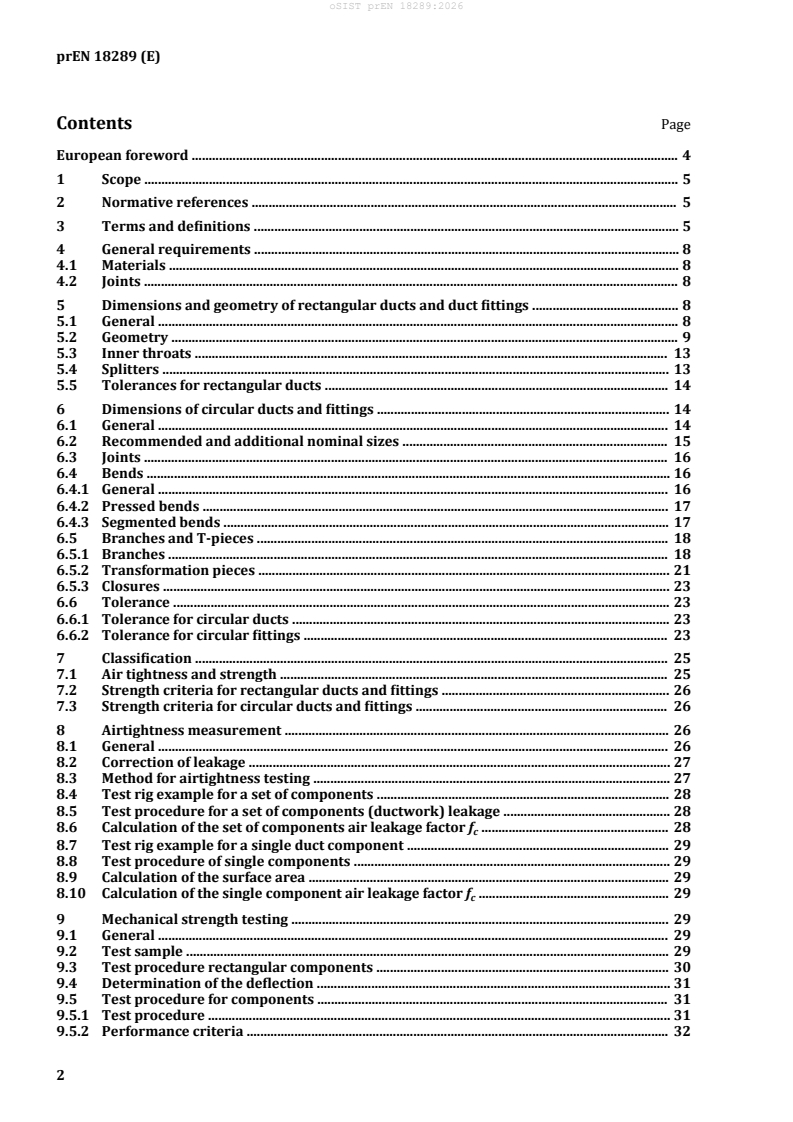
Contents Page
European foreword . 4
1 Scope . 5
2 Normative references . 5
3 Terms and definitions . 5
4 General requirements . 8
4.1 Materials . 8
4.2 Joints . 8
5 Dimensions and geometry of rectangular ducts and duct fittings . 8
5.1 General . 8
5.2 Geometry . 9
5.3 Inner throats . 13
5.4 Splitters . 13
5.5 Tolerances for rectangular ducts . 14
6 Dimensions of circular ducts and fittings . 14
6.1 General . 14
6.2 Recommended and additional nominal sizes . 15
6.3 Joints . 16
6.4 Bends . 16
6.4.1 General . 16
6.4.2 Pressed bends . 17
6.4.3 Segmented bends . 17
6.5 Branches and T-pieces . 18
6.5.1 Branches . 18
6.5.2 Transformation pieces . 21
6.5.3 Closures . 23
6.6 Tolerance . 23
6.6.1 Tolerance for circular ducts . 23
6.6.2 Tolerance for circular fittings . 23
7 Classification . 25
7.1 Air tightness and strength . 25
7.2 Strength criteria for rectangular ducts and fittings . 26
7.3 Strength criteria for circular ducts and fittings . 26
8 Airtightness measurement . 26
8.1 General . 26
8.2 Correction of leakage . 27
8.3 Method for airtightness testing . 27
8.4 Test rig example for a set of components . 28
8.5 Test procedure for a set of components (ductwork) leakage . 28
8.6 Calculation of the set of components air leakage factor f . 28
c
8.7 Test rig example for a single duct component . 29
8.8 Test procedure of single components . 29
8.9 Calculation of the surface area . 29
8.10 Calculation of the single component air leakage factor f . 29
c
9 Mechanical strength testing . 29
9.1 General . 29
9.2 Test sample . 29
9.3 Test procedure rectangular components . 30
9.4 Determination of the deflection . 31
9.5 Test procedure for components . 31
9.5.1 Test procedure . 31
9.5.2 Performance criteria . 32
9.5.3 Test setup . 32
10 Measurement accuracy and test reports . 32
10.1 General requirements . 32
10.2 Air flow measurement . 33
10.3 Differential pressure measurement . 33
10.4 Ambient pressure . 33
10.5 Temperature measurement . 33
10.6 Deflection, bulging or carving . 33
11 Leakage test report . 33
11.1 General data . 33
11.2 Test result . 34
12 Strength test report . 34
12.1 General data . 34
12.2 Test result . 35
Annex A (normative) Surface area calculation . 36
A.1 General . 36
A.2 Calculation rules . 36
A.3 Example of Measurement and calculation of a circular components . 37
A.4 Example of Measurement and calculation of a rectangular set of components . 38
Annex B (normative) Correction of air flow rate according to ambient conditions . 39
Annex C (informative) Example for rectangular set of components . 41
C.1 Drawing . 41
C.2 Table of parts . 43
Bibliography . 44
European foreword
This document (prEN 18289:2026) has been prepared by Technical Committee CEN/TC "156
Ventilation for buildings", the secretariat of which is held by BSI.
This document is currently submitted to the CEN Enquiry.
This document will supersede EN 1505:1997 [1], EN 1506:2007 [2], EN 1507:2006 [3],EN 12237:2003
[4] and EN 14239:2004 [5].
editions:
— Change of the flow correction method
— Clârificâtion of test methods and definitions
1 Scope
This document specifies dimensions, tolerances and denomination for rigid metallic ductwork used for
ventilation air conditioning of buildings including test methods and performance characteristics
regarding strength and leakage for ductwork, ducts and fittings in laboratory conditions.
The test methods, shapes, designs and performance characteristics are applicable for ventilation ducts
with circular and rectangular cross sections. The leakage test methods are also applicable to other cross
sections.
This document does not include ductwork made from insulation duct board, which is covered in EN
13403 [6], non-metallic ductwork, covered in EN 17192 [7] and all components that have more functions
than the transport of air for example fire dampers, filter units, air terminal devices handled in EN 1751
[8] and EN 15727 [9]. This document does not include requirements for the overall system design for
the air tightness which is covered in EN 16798-3 [10]. On-site tests are given in EN 12599 [11].
2 Normative references
The following documents are referred to in the text in such a way that some or all of their content
constitutes requirements of this document. For dated references, only the edition cited applies. For
undated references, the latest edition of the referenced document (including any amendments) applies.
EN 1505:1997, Ventilation for buildings - Sheet metal air ducts and fittings with rectangular cross section
- Dimensions
EN 12792:2003, Ventilation for buildings - Symbols, terminology and graphical symbols
EN 13403, Ventilation for buildings - Non-metallic ducts - Ductwork made from insulation ductboards
EN 16798-3:2025, Energy performance of buildings - Ventilation for buildings - Part 3: For non-residential
buildings - Performance requirements for ventilation and room-conditioning systems (Modules M5-1,
M5-4)
EN 16798-3:2025, Energy performance of buildings - Ventilation for buildings - Part 3: For non-residential
buildings - Performance requirements for ventilation and room-conditioning systems (Modules M5-1,
M5-4)
EN 16798-3:2025, Energy performance of buildings - Ventilation for buildings - Part 3: For non-residential
buildings - Performance requirements for ventilation and room-conditioning systems (Modules M5-1,
M5-4)
3 Terms and definitions
For the purposes of this document, the following terms and definitions apply.
ISO and IEC maintain terminology databases for use in standardization at the following addresses:
— IEC Electropedia: available at http://www.electropedia.org/
— ISO Online browsing platform: available at http://www.iso.org/obp
3.1
air leakage factor
f
c
air tightness expressed as the air leakage rate (3.3) per unit envelope area
3.2
air leakage limit
f
max
maximum permitted air leakage factor (3.1) for the ducts (3.9)and duct fittings (3.10) according to its
air tightness class
3.3
air leakage flow rate
q
v
rate of air leakage a component (3.19) or components subjected to air pressure
3.4
ATC
components
component leakage
leakage of a duct (3.9), duct fitting (3.10) or damper etc. measured in a model assembly with a
single component (3.19) (relevant for component (3.19) quality)
[SOURCE: EN 16798-3:2025 Table 20]
3.5
ATC
set of components
set of components leakage
leakage of ducts, fittings and dampers etc. measured in a model assembly with multiple components,
relevant for set of component (3.19) quality
[SOURCE: EN 16798-3:2025 Table 20]
3.6
atmospheric pressure
p
a
ambient pressure of the ambient air
3.7
bulging, caving
s
e
largest deformation of the sides of a duct (3.9) or enclosure when subjected to a negative (caving) or
positive (bulging) pressure
Note 1 to entry: It is given as the measured difference in distance between a reference plane and the maximum
point of deflection when subjected to a negative or positive pressure.
3.8
deflection of a joint
s
j
largest deformation of a joint when subjected to a positive or negative pressure
Note 1 to entry: It is given as the measured difference in distance between a reference plane outside the joint to
the joint with and without pressure.
3.9
duct
envelope of a space in which the air is carried
3.10
duct fitting
components of ductwork (3.12) incorporating one or several of the following changes relative to the
length of the duct (3.9), the orientation of the duct (3.9), the shape of the straight length of the duct (3.9)
or the area of the cross-section of the duct (3.9)
EXAMPLE Examples of duct (3.9) fittings are:
- Bend or elbow;
- Transformation;
- Branch
Note 1 to entry: A part from rigid components of ducting there are flexible sleeves which reduce the propagation
of mechanical and/or acoustic vibrations between two components or ease the assembly of the installation.
[SOURCE: EN 12792:2003]
3.11
surface area
A
j
total area of the outer surface of a duct (3.9) and duct fittings (3.10)
3.12
ductwork
system or network of ducts (3.9) and their components (3.19) for the transport of air
3.13
effective length
l, l , l
1 3
length by which a duct (3.9) or a duct fitting (3.10) contributes to the overall length of a ductwork (3.12)
3.14
insertion length
l
i
length by which a fitting or duct (3.9) overlaps with female end of a connecting duct (3.9)
3.15
measured air leakage rate
q
vl
measured air leakage flow rate (3.3) before correction
3.16
nominal size
reference dimension used for designation, calculation and application of duct (3.9) and duct fitting (3.10)
Note 1 to entry: a, b for rectangular ducts and fittings and D for circular ducts (3.9) and duct fitting (3.10)
n
[SOURCE: EN 12792:2003]
3.17
overlap length
l
p
length by which a duct fitting (3.10) or duct (3.9) overlaps with female end of a connecting duct (3.9)
3.18
pressure drop
difference in total pressure between two points in an installation usually caused by frictional resistance
to flow in a duct (3.9) or component (3.19) or set of components (3.20)
3.19
component
duct (3.9) or duct fitting (3.10) for the air tightness and mechanical strength tests under laboratory
conditions (relevant for component quality)
3.20
set of components
selection of ducts (3.9) and duct fittings (3.10) for the air tightness and mechanical strength tests under
laboratory conditions (relevant for set of components quality)
3.21
operating pressure limit
p
s
maximum design static air pressure difference for the ducts (3.9) and duct fittings (3.10) according to
its air tightness class
3.22
test pressure
p
t
test static air pressure difference between the pressure within the duct (3.9) components (3.19) and the
pressure of the surrounding air
3.23
total joint length
L
sum of the installed joint circumferences of the ducts (3.9) and duct fittings (3.10)
4 General requirements
4.1 Materials
This document is written for products made of galvanized steel. Other metallic materials can be used
as long as the airtightness and strength criteria are respected.
4.2 Joints
This document is written with slip in fittings for the circular system and the flânged rectangular system
as a base. Other connection systems can be used as long as the airtightness and strength criteria are
respected. The denomination of length height width e.t.c. shall also be used.
5 Dimensions and geometry of rectangular ducts and duct fittings
5.1 General
A duct (3.9) represents a rectangular cross-section with a straight length with no deviation. All others
are duct (3.9) fittings. Ducts and duct (3.9) fittings are ordered in groups with similar geometrical
characteristics.
To avoid excessive pressure drop (3.18) the components should have reduced angles and large radius
or shoulders.
Fittings with inner throat (for example groups 20, 30, 70) shall be designed first as radius style,
otherwise mitred style. Angled style shall be avoided. All of them are permitted (for details to inner
throat alternatives see below Table 2 , 4.2 Geometry)
Fittings with transformation surfaces (for example groups 40, 50, 60, 70) shall be designed with angles
from surface to longitudinal axis not more than 30 degrees.
This document covers rectangular ducts and fittings with a minimum side length of 100 mm and a
maximum side length of 2.000 mm.
Table 1 — Groups of products
group group explanation example
00 special 01 end cap, splitter, bâffle, telescopic joint, ….
10 ducts 10 duct, 16 square branch, 17 angled branch, ….
20 bends with rounded outside 20 bend – symmetric, 21 bend – asymmetric, 22 bend
….
30 bends with angular outside 30 bend – symmetric, 31 bend – asymmetric, 32 bend
….
40 transformations rectangular to rectangular 40 transformation – symmetric., 41 transformation –
asymmetric, 46 shoe branch, ….
50 transformations rectangular to circular 50 transformation – symmetric., 51 transformation –
asymmetric, 52 ….
60 transformations rectangular without 60 transformation – symmetric., 61 transformation –
restriction asymmetric, 62 ….
70 t-pieces 70 t-piece straight, 71 t-piece branched, 72 .
80 others h/y-piece, combination, ….
5.2 Geometry
Table 2 — Basic definitions for all rectangular ducts and duct fittings
dimension description used at
a, b measure refer to connection C1 all parts
c, d measure refer to connection C2 parts with a second connection
g, h measure refer to connection C3 parts with a third connection
C1, C2, C3 connection sides all parts
m straight extension refer to connection C1
n straight extension refer to connection C2
o straight extension refer to connection C3
r, r radius throat bends, t-pieces
x, y measure refer to coordinating system X/Y-axis transformations, t-pieces
X/Y origin upper right corner of connection C1 (a, b) all parts
Table 3
Type of duct and Identifier
duct fitting. of duct
and duct
Drawing from EN
fitting
ISO 10209 [12] ,
projection
method 1.
End cap 01
rectangular
Duct 10
Square branch 16
Angled branch 17
Bend with 20
rounded outside,
symmetric
Bend with 21
rounded outside,
asymmetric
Bend with angular 30
outside
symmetric
bend with angular 31
outside
asymmetric
transformation 40
rectangular to
rectangular,
symmetric
transformation 41
rectangular to
rectangular,
asymmetric
shoe branch 46
transformation 50
rectangular to
circular,
symmetric
transformation 51
rectangular to
circular,
asymmetric
transformation 60
rectangular
without
restriction
transformation 61
rectangular
without
restriction
t-piece 70
rectangular,
straight
t-piece 71
rectangular, with
offset
For examples and drawings, Annex C
5.3 Inner throats
Alternative styles for inner throats (concerning groups 20, 30, 70 and identifier 46) are permitted under
the conditions described in Figure 1.
WARNING Be aware of higher pressure drop (3.18) and lower energy efficiency if the standard radiussed style
for fittings with inner throat is not used. The radiussed style produces the best, the sharp angled style the worst
result in this regard.
NOTE two edges 90°/2=45°≤ max. 45°
three edges: 90°/3=30°≤ max. 45°
a) Mitred and multiple mitred
NOTE one edge: 90°/1=90°≤max. 90°
b) Sharp angle
Figure 1 — Alternative inner throats
5.4 Splitters
It is recommended that splitters are positioned in accordance with Figure 2. Designers should take
individual system requirements regarding acoustics, velocity and pressure drop (3.18) into account
when selecting duct (3.9) fittings.
Splitters are required for components in group No. 20 (bends with rounded outside) with angles > 45 °.
Figure 2 — Bends with splitters
5.5 Tolerances for rectangular ducts
The following tolerances for rectangular ducts shall apply:
— The tolerance of the length l of a straight duct (3.9) or a fitting is : -5 mm/+10 mm
— The tolerance of angles is: ±2°.
— For all other dimensions: a, b, c , d , g , h, m , n , o , r , r , x , y : ±5 mm
6 Dimensions of circular ducts and fittings
6.1 General
The nominal sizes are given in Table 4 and tolerances are given in Table 6. Male ends may have slightly
smaller diameter to fit inside female ends.
The insertion length (3.14) and overlap length (3.17) of a joint is shown in Figure 3 and the minimum
length is given in Table 6.
Figure 3 — Insertion length and overlap length of a joint
Airtightness can be achieved by purpose-designed gaskets, tape or mastic between each component
(3.19) .
6.2 Recommended and additional nominal sizes
The nominal sizes are given in Table 4.
Table 4
Recommended and additional nominal sizes
Recommended nominal sizes Renard series Comment (examples)
(D ) in mm
n
80 R10 For metallic ducts
100 R10 For metallic ducts
125 R10 For metallic ducts
160 R10 For metallic ducts
200 R10 For metallic ducts
250 R10 For metallic ducts
315 R10 For metallic ducts
400 R10 For metallic ducts
500 R10 For metallic ducts
630 R10 For metallic ducts
800 R10 For metallic ducts
1 000 R10 For metallic ducts
1 250 R10 For metallic ducts
Additional nominal sizes (D ) Renard series Comment (examples)
n
in mm
Recommended and additional nominal sizes
63 R10 For metallic ducts / for compatibility with non-
metallic ducts
75 --- For compatibility with non-metallic ducts
90 --- For compatibility with non-metallic ducts
150 --- For compatibility with metallic ducts 6 inch
300 --- For compatibility with metallic ducts 12 inch
355 R20 For metallic ducts where space is limited
450 R20 For metallic ducts where space is limited
560 R20 For metallic ducts where space is limited
710 R20 For metallic ducts
...