


EN 12350-4:2019
(Main)Testing fresh concrete - Part 4: Degree of compactability
Testing fresh concrete - Part 4: Degree of compactability
This document specifies a method for determining the consistence of fresh concrete by determining the degree of compactability.
The test is suitable for specimens having a declared value of D of the coarsest fraction of aggregates actually used in the concrete (Dmax) not greater than 63 mm.
If the degree of compactability is less than 1,04 or more than 1,46, the concrete has a consistence for which the degree of compactability test is not suitable.
Prüfung von Frischbeton - Teil 4: Verdichtungsmaß
Dieses Dokument legt ein Verfahren zur Bestimmung der Konsistenz von Frischbeton durch Bestimmung des Verdichtungsmaßes fest.
Die Prüfung ist für Proben geeignet, deren deklarierter Wert D des Größtkorns der tatsächlich im Beton verwendeten Gesteinskörnungen (Dmax) nicht größer als 63 mm ist.
Wenn das Verdichtungsmaß kleiner als 1,04 oder größer als 1,46 ist, hat der Beton eine Konsistenz, für die die Prüfung des Verdichtungsmaßes nicht geeignet ist.
Essais pour béton frais - Partie 4 : Indice de serrage
Le présent document spécifie une méthode de détermination de la consistance du béton frais par l’indice de serrage.
L’essai est adapté aux échantillons ayant une valeur déclarée de D pour les plus gros granulats effectivement utilisés dans le béton (Dmax) inférieure ou égale à 63 mm.
Si l’indice de serrage est inférieur à 1,04 ou supérieur à 1,46, le béton présente une consistance pour laquelle l’essai de l’indice de serrage n’est pas adapté.
Preskušanje svežega betona - 4. del: Stopnja zgoščenosti
Ta evropski standard določa metodo za določanje konsistence svežega betona z določanjem stopnje zgoščenosti.
Preskus je primeren za primerke, pri katerih je deklarirana vrednost D najbolj grobega agregata, ki je dejansko uporabljen v betonu (Dmax), manjša od 63 mm.
Če je stopnja zgoščenosti manj kot 1,04 ali več kot 1,46, ima beton konsistenco, za katero preskus stopnje zgoščenosti ni primeren.
General Information
Relations
Overview
EN 12350-4:2019 - Testing fresh concrete - Part 4: Degree of compactability - specifies a standardized laboratory method to determine the consistence of fresh concrete by measuring its degree of compactability. The method applies to concretes with a declared maximum aggregate size Dmax ≤ 63 mm. If the measured degree of compactability is less than 1.04 or greater than 1.46, the test is not suitable for that concrete consistency.
Keywords: EN 12350-4:2019, degree of compactability, testing fresh concrete, consistence, Dmax
Key topics and requirements
- Principle: Fill a vertical compaction container without tamping, strike off the top, compact by vibration, then measure the distance from the compacted surface to the container rim to calculate the compactability.
- Apparatus (per EN 12350-1 and Part 4 specifics):
- Compaction container: internal dimensions 200 ±2 mm × 200 ±2 mm base, 400 ±2 mm height; wall/base thickness ≥ 1.5 mm.
- Trowel, straight-edged scraper (>200 mm), rule, moist cloth, remixing tray, shovel.
- Compaction means: vibrating table (reference method) or internal vibrator (careful use to avoid loss of entrained air).
- Procedure:
- Moisten container, place concrete by tilting trowel from each edge without compacting, strike off without densifying, compact by vibration until no further volume reduction.
- Measure internal height h and mean distance s from compacted surface to upper edges (four sides).
- Compute degree of compactability c:
- c = h / (h − s)
- Report c to two decimal places (nearest 0.01).
- Sampling: take and remix samples according to EN 12350-1.
- Test report: must reference the standard, sample ID, location/date, compaction method, result (to two decimals), deviations and responsible signatory. Optional: temperature and test time.
- Precision: inter-laboratory data referenced (VAB round-robin document).
Applications
- Quality control and acceptance testing of fresh concrete batches on-site and in laboratories.
- Verifying mix consistence for production control and compliance with specifications.
- Comparing performance of different mixes or admixtures with respect to flow and compactability under vibration.
- Useful in precast and cast-in-place concrete operations where vibration compaction is used.
Who should use this standard
- Concrete testing laboratories and quality control engineers
- Concrete producers and batching plants
- Contractors, site supervisors and precast manufacturers
- Specifiers and consulting engineers preparing test programs or acceptance criteria
Related standards
- EN 12350-1: Sampling and common apparatus (required reference)
- Other parts of EN 12350 series: Slump (Part 2), Vebe (Part 3), Flow table (Part 5), Density (Part 6), Air content (Part 7), plus self‑compacting concrete tests (Parts 8–12).
Using EN 12350-4:2019 helps ensure consistent, reproducible measurement of concrete compactability for vibration‑based compaction processes and supports reliable quality assurance in construction projects.
Frequently Asked Questions
EN 12350-4:2019 is a standard published by the European Committee for Standardization (CEN). Its full title is "Testing fresh concrete - Part 4: Degree of compactability". This standard covers: This document specifies a method for determining the consistence of fresh concrete by determining the degree of compactability. The test is suitable for specimens having a declared value of D of the coarsest fraction of aggregates actually used in the concrete (Dmax) not greater than 63 mm. If the degree of compactability is less than 1,04 or more than 1,46, the concrete has a consistence for which the degree of compactability test is not suitable.
This document specifies a method for determining the consistence of fresh concrete by determining the degree of compactability. The test is suitable for specimens having a declared value of D of the coarsest fraction of aggregates actually used in the concrete (Dmax) not greater than 63 mm. If the degree of compactability is less than 1,04 or more than 1,46, the concrete has a consistence for which the degree of compactability test is not suitable.
EN 12350-4:2019 is classified under the following ICS (International Classification for Standards) categories: 91.100.30 - Concrete and concrete products. The ICS classification helps identify the subject area and facilitates finding related standards.
EN 12350-4:2019 has the following relationships with other standards: It is inter standard links to EN 12350-4:2009. Understanding these relationships helps ensure you are using the most current and applicable version of the standard.
EN 12350-4:2019 is associated with the following European legislation: EU Directives/Regulations: 305/2011. When a standard is cited in the Official Journal of the European Union, products manufactured in conformity with it benefit from a presumption of conformity with the essential requirements of the corresponding EU directive or regulation.
You can purchase EN 12350-4:2019 directly from iTeh Standards. The document is available in PDF format and is delivered instantly after payment. Add the standard to your cart and complete the secure checkout process. iTeh Standards is an authorized distributor of CEN standards.
Standards Content (Sample)
SLOVENSKI STANDARD
01-september-2019
Nadomešča:
SIST EN 12350-4:2009
Preskušanje svežega betona - 4. del: Stopnja zgoščenosti
Testing fresh concrete - Part 4: Degree of compactability
Prüfung von Frischbeton - Teil 4: Verdichtungsmaß
Essais pour béton frais - Partie 4 : Indice de serrage
Ta slovenski standard je istoveten z: EN 12350-4:2019
ICS:
91.100.30 Beton in betonski izdelki Concrete and concrete
products
2003-01.Slovenski inštitut za standardizacijo. Razmnoževanje celote ali delov tega standarda ni dovoljeno.
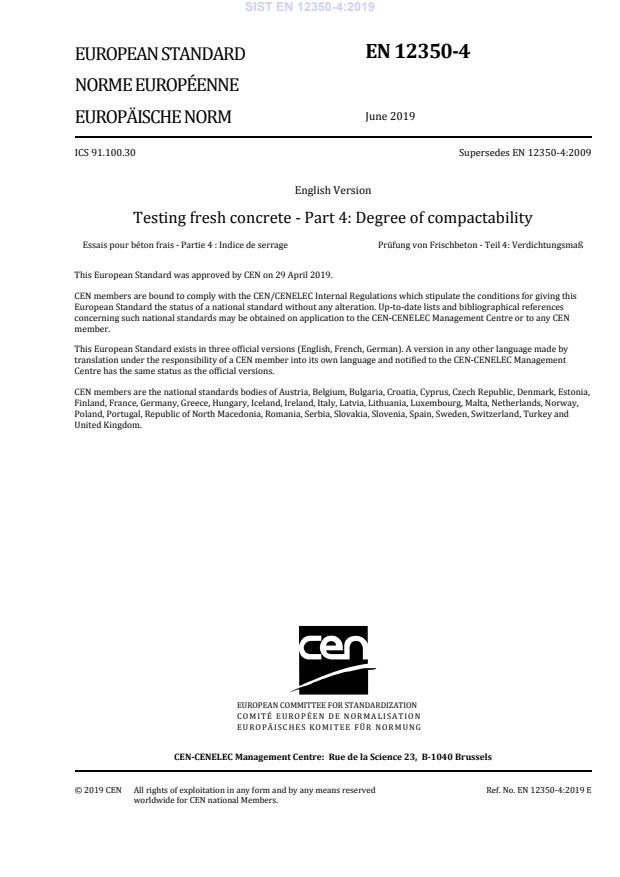
EN 12350-4
EUROPEAN STANDARD
NORME EUROPÉENNE
June 2019
EUROPÄISCHE NORM
ICS 91.100.30 Supersedes EN 12350-4:2009
English Version
Testing fresh concrete - Part 4: Degree of compactability
Essais pour béton frais - Partie 4 : Indice de serrage Prüfung von Frischbeton - Teil 4: Verdichtungsmaß
This European Standard was approved by CEN on 29 April 2019.
CEN members are bound to comply with the CEN/CENELEC Internal Regulations which stipulate the conditions for giving this
European Standard the status of a national standard without any alteration. Up-to-date lists and bibliographical references
concerning such national standards may be obtained on application to the CEN-CENELEC Management Centre or to any CEN
member.
This European Standard exists in three official versions (English, French, German). A version in any other language made by
translation under the responsibility of a CEN member into its own language and notified to the CEN-CENELEC Management
Centre has the same status as the official versions.
CEN members are the national standards bodies of Austria, Belgium, Bulgaria, Croatia, Cyprus, Czech Republic, Denmark, Estonia,
Finland, France, Germany, Greece, Hungary, Iceland, Ireland, Italy, Latvia, Lithuania, Luxembourg, Malta, Netherlands, Norway,
Poland, Portugal, Republic of North Macedonia, Romania, Serbia, Slovakia, Slovenia, Spain, Sweden, Switzerland, Turkey and
United Kingdom.
EUROPEAN COMMITTEE FOR STANDARDIZATION
COMITÉ EUROPÉEN DE NORMALISATION
EUROPÄISCHES KOMITEE FÜR NORMUNG
CEN-CENELEC Management Centre: Rue de la Science 23, B-1040 Brussels
© 2019 CEN All rights of exploitation in any form and by any means reserved Ref. No. EN 12350-4:2019 E
worldwide for CEN national Members.
Contents Page
European foreword . 3
1 Scope . 4
2 Normative references . 4
3 Terms and definitions . 4
4 Principle . 4
5 Apparatus . 4
6 Sampling . 5
7 Procedure. 6
8 Expression of results . 7
9 Test report . 7
10 Precision . 7
Bibliography . 8
European foreword
This document (EN 12350-4:2019) has been prepared by Technical Committee CEN/TC 104 “Concrete
and related products”, the secretariat of which is held by SN.
This European Standard shall be given the status of a national standard, either by publication of an
identical text or by endorsement, at the latest by December 2019, and conflicting national standards
shall be withdrawn at the latest by December 2019.
Attention is drawn to the possibility that some of the elements of this document may be the subject of
patent rights. CEN shall not be held responsible for identifying any or all such patent rights.
This document supersedes EN 12350-4:2009.
This standard is one of a series on testing concrete.
EN 12350, Testing fresh concrete, consists of the following parts:
— Part 1: Sampling and common apparatus
— Part 2: Slump test
— Part 3: Vebe test
— Part 4: Degree of compactability
— Part 5: Flow table test
— Part 6: Density
— Part 7: Air content – Pressure methods
— Part 8: Self-compacting concrete – Slump-flow test
— Part 9: Self-compacting concrete – V-funnel test
— Part 10: Self-compacting concrete – L-box test
— Part 11: Self-compacting concrete – Sieve segregation test
— Part 12: Self-compacting concrete – J-ring test
The following amendments have been made to the 2009 edition of this standard:
a) editorial revisions;
b) reference to common apparatus and specification given in EN 12350-1.
According to the CEN-CENELEC Internal Regulations, the national standards organisations of the
following countries are bound to implement this European Standard: Austria, Belgium, Bulgaria,
Croatia, Cyprus, Czech Republic, Denmark, Estonia, Finland, France, Germany, Greece, Hungary, Iceland,
Ireland, Italy, Latvia, Lith
...
SLOVENSKI STANDARD
01-september-2019
Nadomešča:
SIST EN 12350-4:2009
Preskušanje svežega betona - 4. del: Stopnja zgoščenosti
Testing fresh concrete - Part 4: Degree of compactability
Prüfung von Frischbeton - Teil 4: Verdichtungsmaß
Essais pour béton frais - Partie 4 : Indice de serrage
Ta slovenski standard je istoveten z: EN 12350-4:2019
ICS:
91.100.30 Beton in betonski izdelki Concrete and concrete
products
2003-01.Slovenski inštitut za standardizacijo. Razmnoževanje celote ali delov tega standarda ni dovoljeno.
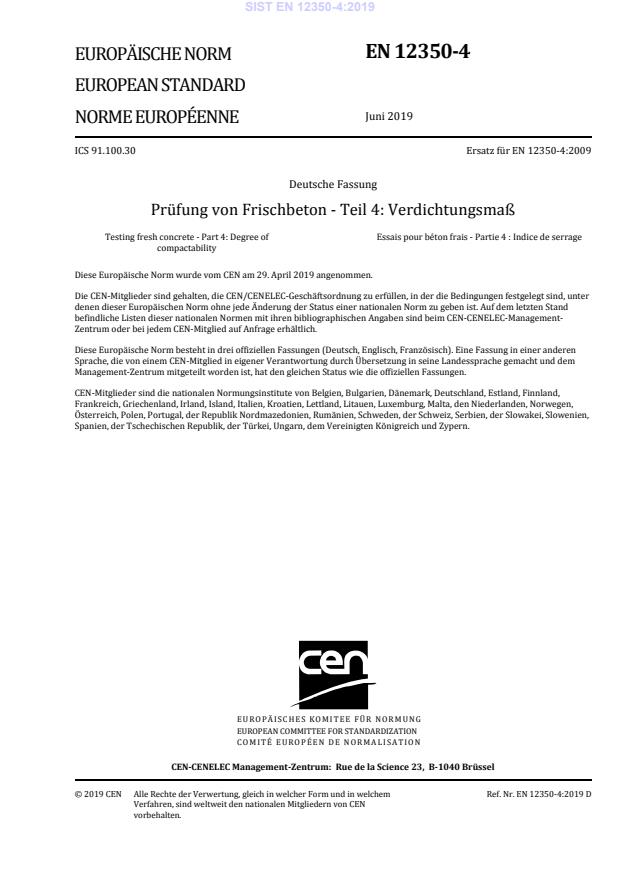
EN 12350-4
EUROPÄISCHE NORM
EUROPEAN STANDARD
Juni 2019
NORME EUROPÉENNE
ICS 91.100.30 Ersatz für EN 12350-4:2009
Deutsche Fassung
Prüfung von Frischbeton - Teil 4: Verdichtungsmaß
Testing fresh concrete - Part 4: Degree of Essais pour béton frais - Partie 4 : Indice de serrage
compactability
Diese Europäische Norm wurde vom CEN am 29. April 2019 angenommen.
Die CEN-Mitglieder sind gehalten, die CEN/CENELEC-Geschäftsordnung zu erfüllen, in der die Bedingungen festgelegt sind, unter
denen dieser Europäischen Norm ohne jede Änderung der Status einer nationalen Norm zu geben ist. Auf dem letzten Stand
befindliche Listen dieser nationalen Normen mit ihren bibliographischen Angaben sind beim CEN-CENELEC-Management-
Zentrum oder bei jedem CEN-Mitglied auf Anfrage erhältlich.
Diese Europäische Norm besteht in drei offiziellen Fassungen (Deutsch, Englisch, Französisch). Eine Fassung in einer anderen
Sprache, die von einem CEN-Mitglied in eigener Verantwortung durch Übersetzung in seine Landessprache gemacht und dem
Management-Zentrum mitgeteilt worden ist, hat den gleichen Status wie die offiziellen Fassungen.
CEN-Mitglieder sind die nationalen Normungsinstitute von Belgien, Bulgarien, Dänemark, Deutschland, Estland, Finnland,
Frankreich, Griechenland, Irland, Island, Italien, Kroatien, Lettland, Litauen, Luxemburg, Malta, den Niederlanden, Norwegen,
Österreich, Polen, Portugal, der Republik Nordmazedonien, Rumänien, Schweden, der Schweiz, Serbien, der Slowakei, Slowenien,
Spanien, der Tschechischen Republik, der Türkei, Ungarn, dem Vereinigten Königreich und Zypern.
EUROPÄISCHES KOMITEE FÜR NORMUNG
EUROPEAN COMMITTEE FOR STANDARDIZATION
COMITÉ EUROPÉEN DE NORMALISATION
CEN-CENELEC Management-Zentrum: Rue de la Science 23, B-1040 Brüssel
© 2019 CEN Alle Rechte der Verwertung, gleich in welcher Form und in welchem Ref. Nr. EN 12350-4:2019 D
Verfahren, sind weltweit den nationalen Mitgliedern von CEN
vorbehalten.
Inhalt
Seite
Europäisches Vorwort.3
1 Anwendungsbereich .5
2 Normative Verweisungen .5
3 Begriffe .5
4 Kurzbeschreibung .5
5 Geräte .5
5.1 Geräte für die Prüfung von Frischbeton .5
6 Probenahme .7
7 Durchführung.7
8 Prüfergebnis .8
9 Prüfbericht .8
10 Präzision .9
Literaturhinweise . 10
Europäisches Vorwort
Dieses Dokument (EN 12350-4:2019) wurde vom Technischen Komitee CEN/TC 104 „Beton und zugehörige
Produkte“ erarbeitet, dessen Sekretariat von SN gehalten wird.
Diese Europäische Norm muss den Status einer nationalen Norm erhalten, entweder durch Veröffentlichung
eines identischen Textes oder durch Anerkennung bis Dezember 2019, und etwaige entgegenstehende
nationale Normen müssen bis Dezember 2019 zurückgezogen werden.
Es wird auf die Möglichkeit hingewiesen, dass einige Elemente dieses Dokuments Patentrechte berühren
können. CEN ist nicht dafür verantwortlich, einige oder alle diesbezüglichen Patentrechte zu identifizieren.
Dieses Dokument ersetzt EN 12350-4:2009.
Diese Norm ist Bestandteil einer Normenreihe für die Prüfung von Beton.
EN 12350, Prüfung von Frischbeton, besteht aus den folgenden Teilen:
— Teil 1: Probenahme und Prüfgeräte
— Teil 2: Setzmaß
— Teil 3: Vébé-Prüfung
— Teil 4: Verdichtungsmaß
— Teil 5: Ausbreitmaß
— Teil 6: Frischbetonrohdichte
— Teil 7: Luftgehalt — Druckverfahren
— Teil 8: Selbstverdichtender Beton — Setzfließversuch
— Teil 9: Selbstverdichtender Beton — Auslauftrichterversuch
— Teil 10: Selbstverdichtender Beton — L-Kasten-Versuch
— Teil 11: Selbstverdichtender Beton — Bestimmung der Sedimentationsstabilität im Siebversuch
— Teil 12: Selbstverdichtender Beton — Blockierring-Versuch
Gegenüber der Ausgabe von 2009 dieser Norm wurden folgende Änderungen vorgenommen:
a) redaktionelle Überarbeitungen;
b) Verweisung auf die in EN 12350-1 angegebenen Prüfgeräte und Festlegungen.
Entsprechend der CEN-CENELEC-Geschäftsordnung sind die nationalen Normungsinstitute der folgenden
Länder gehalten, diese Europäische Norm zu übernehmen: Belgien, Bulgarien, Dänemark, Deutschland, die
Republik Nordmazedonien, Estland, Finnland, Frankreich, Grie
...
La norme SIST EN 12350-4:2019, intitulée "Essai du béton frais - Partie 4 : Degré de compacité", définit de manière claire et précise une méthode pour évaluer la consistance du béton frais à travers la détermination du degré de compactabilité. Cette norme est particulièrement pertinente pour les professionnels impliqués dans l'industrie de la construction, car elle établit des critères objectifs pour la qualité du béton utilisé dans les ouvrages. Le champ d'application de cette norme est bien défini, car elle s'applique aux échantillons dont la valeur déclarée D de la fraction grossière des granulats utilisés dans le béton (Dmax) ne dépasse pas 63 mm. Cela garantit que les tests réalisés sont conformes aux pratiques et matériaux couramment utilisés, renforçant ainsi la fiabilité des résultats obtenus. Parmi les forces notables de la norme SIST EN 12350-4:2019, on trouve son approche systématique pour évaluer la consistance du béton. En définissant des plages de valeurs pour le degré de compactabilité, la norme permet aux utilisateurs d'identifier rapidement si le béton respecte les exigences minimales de performance. En effet, si le degré de compactabilité est inférieur à 1,04 ou supérieur à 1,46, cela indique que le béton a une consistance pour laquelle le test de compactabilité n'est pas approprié. Cette précision aide à sécuriser la qualité des matériaux de construction, minimisant ainsi les risques dans les projets. La pertinence de cette norme dans le contexte actuel de l'industrie du béton ne peut être sous-estimée. Alors que les constructions modernes exigent des matériaux aux caractéristiques spécifiques pour optimiser la durabilité et la sécurité, cette norme offre un cadre utile pour les professionnels cherchant à garantir que le béton utilisé répond à des standards acceptables. En intégrant des critères techniques clairement définis, la norme SIST EN 12350-4:2019 soutient les efforts d’amélioration continue et d'innovation dans le secteur de la construction.
Die Norm EN 12350-4:2019 legt eine methodische Grundlage zur Bestimmung der Konsistenz von Frischbeton durch die Ermittlung des Grades der Kompaktheit fest. Sie ist insbesondere relevant für Proben, deren deklarierten Wert D der gröbsten Fraktion der tatsächlich verwendeten Gesteinskörnungen (Dmax) 63 mm nicht überschreitet. Ein wesentlicher Stärke dieser Norm liegt in ihrer präzisen Definition der Testmethodik, die eine standardisierte Vorgehensweise zur Bewertung der Konsistenz von Frischbeton ermöglicht. Dies bietet den Fachleuten in der Bauindustrie zuverlässige und nachvollziehbare Ergebnisse, die für die Qualitätssicherung unerlässlich sind. Der Grad der Kompaktheit ist ein entscheidender Faktor, da er Einfluss auf die Dauerhaftigkeit und Leistungsfähigkeit des Betons hat. Darüber hinaus verdeutlicht die Norm, dass die Prüfung des Grades der Kompaktheit bei Werten unter 1,04 oder über 1,46 nicht geeignet ist. Diese klare Definition hilft, Missverständnisse zu vermeiden und ermöglicht es den Anwendern, nur übertragbare und gültige Ergebnisse zu erzielen. Durch die Bereitstellung einer spezifischen Testmethode trägt EN 12350-4:2019 zur Effizienzsteigerung in der Bewertung und Anwendung von Frischbeton bei. Dies ist besonders relevant für Ingenieure und Bauunternehmen, die konsistente Qualität in ihren Projekten sicherstellen müssen. In der modernen Baupraxis ist die Anwendung dieser Norm von großer Bedeutung, um die Anforderungen an die Betonqualität optimal zu erfüllen und gleichzeitig wirtschaftliche sowie umwelttechnische Aspekte zu berücksichtigen.
EN 12350-4:2019は、新鮮なコンクリートの試験に関する重要な標準であり、特にコンクリートの練り具合(コンシステンシー)を評価するためのコンパクタビリティ(密度性)の程度を測定する方法を明確に示しています。この文書は、実際に使用される粗骨材の最大寸法(Dmax)が63mm以下の試料に適しており、標準の適用範囲を明確に定義しています。 この標準の強みは、コンクリートのコンシステンシー評価における客観性と再現性にあります。適切な試験手順に基づくことで、コンクリートの施工に必要な情報を提供し、品質管理や建設プロジェクトにおける安全性に寄与します。また、コンパクタビリティの評価は、実際の施工状況における混和物の性能を示す指標となり、特に工程管理において不可欠な要素です。 さらに、コンパクタビリティの度合いが1.04未満または1.46を超える場合、この試験が適用できないことが明記されている点も重要です。これにより、非適合なコンクリートを使用するリスクを低減し、より高い品質を確保することが可能になります。 EN 12350-4:2019は、現場でのコンクリートの品質評価を支援し、建築業界の持続的な進化を促進するための基盤を築いています。そのため、コンクリート関連の標準化文書の中でも極めて関連性の高いものであると言えるでしょう。
표준 EN 12350-4:2019은 신선한 콘크리트의 일관성을 측정하기 위한 방법을 규정하고 있으며, 주로 응집성을 결정하는 데 초점을 맞추고 있습니다. 이 문서의 강점은 콩크리트에 사용되는 최대 골재 크기(Dmax)가 63mm를 넘지 않는 시편에 대해 적절한 시험 방법을 제공한다는 점입니다. compactability의 정도를 평가하기 위해 이 방식을 활용할 수 있으며, 이는 콘크리트가 포장 시 얼마나 잘 응집되는지를 이해하는 데 중요한 역할을 합니다. 테스트 결과가 compactability이 1.04 미만이거나 1.46을 초과할 경우, 해당 콘크리트는 시험의 적합성이 없음을 알려줍니다. 이는 품질 관리 및 신뢰할 수 있는 콘크리트 공급을 위한 유용한 기준이 됩니다. 따라서, EN 12350-4:2019 표준은 콘크리트를 시험하는 데 있어 매우 중요하고 유의미한 자료입니다. 이 표준을 통해 건설 산업에서 신선한 콘크리트의 품질과 안전성을 극대화할 수 있으며, 특히 compactability 측정이 필요한 다양한 상황에서 활용될 수 있습니다.
The standard EN 12350-4:2019 provides a comprehensive framework for testing the consistency of fresh concrete through the evaluation of its degree of compactability. This method is particularly relevant for practitioners in the field of construction and civil engineering, ensuring that concrete used in various applications meets necessary performance criteria. The scope of this document delineates clear parameters for testing, specifically addressing specimens with a maximum aggregate size (Dmax) not exceeding 63 mm. This specification reinforces the standard's applicability in typical construction scenarios, where careful assessment of concrete properties is crucial for structural integrity. One of the notable strengths of EN 12350-4:2019 is its scientific approach to measuring compactability, which is vital for understanding how concrete will behave during placement. By establishing a defined range of compactability values - with a threshold of 1.04 as the lower limit, and 1.46 as the upper limit - the standard provides clear criteria for determining the suitability of the concrete's consistency. This clarity aids engineers and contractors in making informed decisions about material selection and handling, ultimately contributing to the durability and longevity of concrete structures. Moreover, the documentation of methods and procedures within this standard ensures that different laboratories can achieve consistent testing results, thus enhancing the reliability of the compactability assessment. This consistency is essential for maintaining quality control in concrete production, which is vital for compliance with safety and performance standards in construction. In summary, the relevance of EN 12350-4:2019 in the context of fresh concrete testing cannot be overstated. Its clear guidelines on the degree of compactability equip industry professionals with the necessary tools to evaluate and ensure the quality of concrete, thus fostering improved outcomes in construction projects.
Questions, Comments and Discussion
Ask us and Technical Secretary will try to provide an answer. You can facilitate discussion about the standard in here.
Loading comments...