

EN 196-10:2006
(Main)Methods of testing cement - Part 10: Determination of the water-soluble chromium (VI) content of cement
- Abstract
This European Standard specifies the method for the determination of the water-soluble chromium (VI) content of cement.
A reference method is described consisting of two stages, an extraction procedure and an analysis of the filtered extract. Guidance on other extraction procedures, suitable for screening tests, for factory production control or other purposes, is given but in case of dispute or failure to comply with a regulatory limit only the reference method is used. The reference method has alternatives whereby the filtered extract may be subjected to an oxidation step or not. The criteria by which the appropriate procedure is selected are set down. Other instrumental procedures may be used for the analysis of the filtered extract provided they are calibrated against the analysis of the filtered extract using the reference procedure. In the case of a dispute, only the reference method is used.
Annex A sets out a normative procedure to be followed in case this test method is used as the basis for evaluation of conformity of a cement with the regulatory limit in Directive 2003/53/EC.
This European Standard describes a method that applies to cements. It may have wider applicability but this would need to be verified by testing on a product-by-product basis. Guidance in the possible application of this European Standard to the determination of the water-soluble chromium (VI) content of cement-containing preparations is given in Annex B.
Annexes C and D provide information on other test procedures based on paste extraction and thus depart from the performance of cement in its normal conditions of use. They may be carried out with or without the oxidation process. Users should be aware that results using these methods might be significantly different to those obtained by the reference method. In the case of dispute or failure to comply with the regulatory limit only the reference method is used.
- Status
- Withdrawn
- Publication Date
- 25-Jul-2006
- Withdrawal Date
- 06-Oct-2026
- Technical Committee
- CEN/TC 51 - Cement and building limes
- Drafting Committee
- CEN/TC 51/WG 15 - Revision of methods of testing cement
- Current Stage
- 9960 - Withdrawal effective - Withdrawal
- Start Date
- 18-May-2016
- Completion Date
- 07-Oct-2026
- Directive
- 76/769/EEC - Restrictions on the marketing and use of certain dangerous substances and preparationsOJ Ref: C, C 23 OJ Date: 28-Jan-2005


Relations
- Effective Date
- 02-Oct-2013
- Effective Date
- 28-Jan-2026
- Effective Date
- 28-Jan-2026
Get Certified
Connect with accredited certification bodies for this standard

DIBt (Deutsches Institut für Bautechnik)
German Institute for Building Technology.
DIN CERTCO
DIN Group product certification.

Aboma Certification B.V.
Specialized in construction, metal, and transport sectors.
Sponsored listings
Frequently Asked Questions
EN 196-10:2006 is a standard published by the European Committee for Standardization (CEN). Its full title is "Methods of testing cement - Part 10: Determination of the water-soluble chromium (VI) content of cement". This standard covers: This European Standard specifies the method for the determination of the water-soluble chromium (VI) content of cement. A reference method is described consisting of two stages, an extraction procedure and an analysis of the filtered extract. Guidance on other extraction procedures, suitable for screening tests, for factory production control or other purposes, is given but in case of dispute or failure to comply with a regulatory limit only the reference method is used. The reference method has alternatives whereby the filtered extract may be subjected to an oxidation step or not. The criteria by which the appropriate procedure is selected are set down. Other instrumental procedures may be used for the analysis of the filtered extract provided they are calibrated against the analysis of the filtered extract using the reference procedure. In the case of a dispute, only the reference method is used. Annex A sets out a normative procedure to be followed in case this test method is used as the basis for evaluation of conformity of a cement with the regulatory limit in Directive 2003/53/EC. This European Standard describes a method that applies to cements. It may have wider applicability but this would need to be verified by testing on a product-by-product basis. Guidance in the possible application of this European Standard to the determination of the water-soluble chromium (VI) content of cement-containing preparations is given in Annex B. Annexes C and D provide information on other test procedures based on paste extraction and thus depart from the performance of cement in its normal conditions of use. They may be carried out with or without the oxidation process. Users should be aware that results using these methods might be significantly different to those obtained by the reference method. In the case of dispute or failure to comply with the regulatory limit only the reference method is used.
This European Standard specifies the method for the determination of the water-soluble chromium (VI) content of cement. A reference method is described consisting of two stages, an extraction procedure and an analysis of the filtered extract. Guidance on other extraction procedures, suitable for screening tests, for factory production control or other purposes, is given but in case of dispute or failure to comply with a regulatory limit only the reference method is used. The reference method has alternatives whereby the filtered extract may be subjected to an oxidation step or not. The criteria by which the appropriate procedure is selected are set down. Other instrumental procedures may be used for the analysis of the filtered extract provided they are calibrated against the analysis of the filtered extract using the reference procedure. In the case of a dispute, only the reference method is used. Annex A sets out a normative procedure to be followed in case this test method is used as the basis for evaluation of conformity of a cement with the regulatory limit in Directive 2003/53/EC. This European Standard describes a method that applies to cements. It may have wider applicability but this would need to be verified by testing on a product-by-product basis. Guidance in the possible application of this European Standard to the determination of the water-soluble chromium (VI) content of cement-containing preparations is given in Annex B. Annexes C and D provide information on other test procedures based on paste extraction and thus depart from the performance of cement in its normal conditions of use. They may be carried out with or without the oxidation process. Users should be aware that results using these methods might be significantly different to those obtained by the reference method. In the case of dispute or failure to comply with the regulatory limit only the reference method is used.
EN 196-10:2006 is classified under the following ICS (International Classification for Standards) categories: 91.100.30 - Concrete and concrete products. The ICS classification helps identify the subject area and facilitates finding related standards.
EN 196-10:2006 has the following relationships with other standards: It is inter standard links to EN 196-10:2016, EN 196-1:2005, EN 196-7:2007. Understanding these relationships helps ensure you are using the most current and applicable version of the standard.
EN 196-10:2006 is associated with the following European legislation: EU Directives/Regulations: 76/769/EEC. When a standard is cited in the Official Journal of the European Union, products manufactured in conformity with it benefit from a presumption of conformity with the essential requirements of the corresponding EU directive or regulation.
EN 196-10:2006 is available in PDF format for immediate download after purchase. The document can be added to your cart and obtained through the secure checkout process. Digital delivery ensures instant access to the complete standard document.
Standards Content (Sample)
2003-01.Slovenski inštitut za standardizacijo. Razmnoževanje celote ali delov tega standarda ni dovoljeno.Methods of testing cement - Part 10: Determination of the water-soluble chromium (VI) content of cementFHPHQWXMéthodes d'essai des ciments - Partie 10 : Détermination de la teneur du ciment en chrome VI soluble dans l'eauPrüfverfahren für Zement - Teil 10: Bestimmung des Gehaltes an wasserlöslichem Chrom (VI) in ZementTa slovenski standard je istoveten z:EN 196-10:2006SIST EN 196-10:2006en91.100.10Cement. Mavec. Apno. MaltaCement. Gypsum. Lime. MortarICS:SLOVENSKI
STANDARDSIST EN 196-10:200601-november-2006
EUROPEAN STANDARDNORME EUROPÉENNEEUROPÄISCHE NORMEN 196-10July 2006ICS 91.100.30 English VersionMethods of testing cement - Part 10: Determination of the water-soluble chromium (VI) content of cementMéthodes d'essai des ciments - Partie 10 : Déterminationde la teneur du ciment en chrome VI soluble dans l'eauPrüfverfahren für Zement - Teil 10: Bestimmung desGehaltes an wasserlöslichem Chrom (VI) in ZementThis European Standard was approved by CEN on 19 June 2006.CEN members are bound to comply with the CEN/CENELEC Internal Regulations which stipulate the conditions for giving this EuropeanStandard the status of a national standard without any alteration. Up-to-date lists and bibliographical references concerning such nationalstandards may be obtained on application to the Central Secretariat or to any CEN member.This European Standard exists in three official versions (English, French, German). A version in any other language made by translationunder the responsibility of a CEN member into its own language and notified to the Central Secretariat has the same status as the officialversions.CEN members are the national standards bodies of Austria, Belgium, Cyprus, Czech Republic, Denmark, Estonia, Finland, France,Germany, Greece, Hungary, Iceland, Ireland, Italy, Latvia, Lithuania, Luxembourg, Malta, Netherlands, Norway, Poland, Portugal, Romania,Slovakia, Slovenia, Spain, Sweden, Switzerland and United Kingdom.EUROPEAN COMMITTEE FOR STANDARDIZATIONCOMITÉ EUROPÉEN DE NORMALISATIONEUROPÄISCHES KOMITEE FÜR NORMUNGManagement Centre: rue de Stassart, 36
B-1050 Brussels© 2006 CENAll rights of exploitation in any form and by any means reservedworldwide for CEN national Members.Ref. No. EN 196-10:2006: E
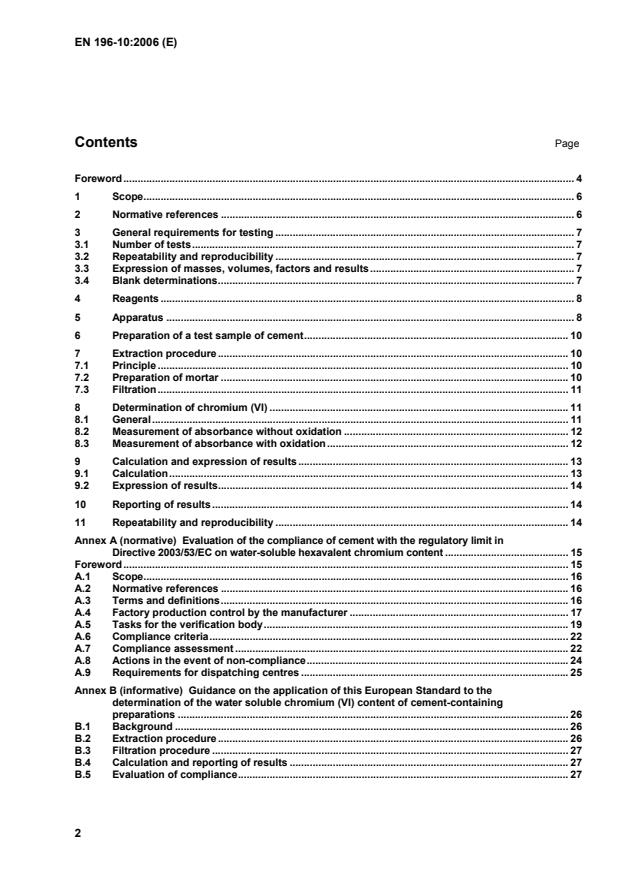
Evaluation of the compliance of cement with the regulatory limit in Directive 2003/53/EC on water-soluble hexavalent chromium content.15 Foreword.15 A.1 Scope.16 A.2 Normative references.16 A.3 Terms and definitions.16 A.4 Factory production control by the manufacturer.17 A.5 Tasks for the verification body.19 A.6 Compliance criteria.22 A.7 Compliance assessment.22 A.8 Actions in the event of non-compliance.24 A.9 Requirements for dispatching centres.25 Annex B (informative)
Guidance on the application of this European Standard to the determination of the water soluble chromium (VI) content of cement-containing preparations.26 B.1 Background.26 B.2 Extraction procedure.26 B.3 Filtration procedure.27 B.4 Calculation and reporting of results.27 B.5 Evaluation of compliance.27
Guidance on screening test method (1) using paste extraction - method based on DS 1020.28 C.1 Object and field of application.28 C.2 Principle.28 C.3 Reagents.28 C.4 Apparatus.29 C.5 Procedure.29 C.6 Calculation of results.30 C.7 Reporting result.30 C.8 Precision and accuracy.30 C.9 Report.30 Annex D (informative)
Guidance on screening test method (2) using paste extraction – method based on TRGS 613.31 D.1 Significance and use.31 D.2 Basic principles of the method.31 D.3 Apparatus.31 D.4 Materials.32 D.5 Construction of a calibration curve.32 D.6 Sample preparation and analysis.33 D.7 Evaluation and Interpretation.33 D.8 Health and safety.34 Annex E (informative)
Guidance on the photometric determination of chromium reduction capacity in cements.35 Foreword.35 E.1 Summary.35 E.2 Scope.35 E.3 Apparatus.35 E.4 Reagents.36 E.5 Procedure.37 E.6 Calculations.37 E.7 Result.38 E.8 Control of instrument.38 Bibliography.39
According to the CEN/CENELEC Internal Regulations, the national standards organizations of the following countries are bound to implement this European Standard: Austria, Belgium, Cyprus, Czech Republic, Denmark, Estonia, Finland, France, Germany, Greece, Hungary, Iceland, Ireland, Italy, Latvia, Lithuania, Luxembourg, Malta, Netherlands, Norway, Poland, Portugal, Romania, Slovakia, Slovenia, Spain, Sweden, Switzerland and United Kingdom.
1 Scope This European Standard specifies the method for the determination of the water-soluble chromium (VI) content of cement. A reference method is described consisting of two stages, an extraction procedure and an analysis of the filtered extract. Guidance on other extraction procedures, suitable for screening tests, for factory production control or other purposes, is given but in case of dispute or failure to comply with a regulatory limit only the reference method is used. The reference method has alternatives whereby the filtered extract may be subjected to an oxidation step or not. The criteria by which the appropriate procedure is selected are set down. Other instrumental procedures may be used for the analysis of the filtered extract provided they are calibrated against the analysis of the filtered extract using the reference procedure. In the case of a dispute, only the reference method is used. Annex A sets out a normative procedure to be followed in case this test method is used as the basis for evaluation of conformity of a cement with the regulatory limit in Directive 2003/53/EC. This European Standard describes a method that applies to cements. It may have wider applicability but this would need to be verified by testing on a product-by-product basis. Guidance in the possible application of this European Standard to the determination of the water-soluble chromium (VI) content of cement-containing preparations is given in Annex B. Annexes C and D provide information on other test procedures based on paste extraction and thus depart from the performance of cement in its normal conditions of use. They may be carried out with or without the oxidation process. Users should be aware that results using these methods might be significantly different to those obtained by the reference method. In the case of dispute or failure to comply with the regulatory limit only the reference method is used. Annex E provides guidance on a method for determination of the excess reducing agent content of cement as used in the factory internal control system of some countries. Manufacturers using such an internal control method should assure themselves of the relevance of results in comparison with testing by the reference method. 2 Normative references The following referenced documents are indispensable for the application of this document. For dated references, only the edition cited applies. For undated references, the latest edition of the referenced document (including any amendments) applies. EN 196-1:2005, Methods of testing cement — Part 1: Determination of strength EN 196-7, Methods of testing cement — Part 7: Methods of taking and preparing samples of cement EN 45011, General requirements for bodies operating product certification systems (ISO/IEC Guide 65:1996) EN ISO/IEC 17020, General criteria for the operation of various types of bodies performing inspection (ISO/IEC 17020:1998) EN ISO/IEC 17025, General requirements for the competence of testing and calibration laboratories (ISO/IEC 17025:2005)
= 1,18 to 1,19. 4.2 Dilute hydrochloric acid, 1,0 mol/l. 4.3 Dilute hydrochloric acid, 0,04 mol/l. 4.4 Acetone, (CH3.CO.CH3),
= 0,79. 4.5 Indicator solution. Dissolve 0,125 g of s-diphenylcarbazide (C6H5NHNH)2CO,
(1,5-diphenylcarbohydrazide) in 25 ml of acetone (4.4) in a 50 ml volumetric flask. Make up to the mark with acetone. The indicator solution will keep for one week, if kept refrigerated. 4.6 Standard chromate solution 4.6.1 Stock solution: Dissolve 0,141 4 g dried potassium dichromate (K2Cr2O7), dried to constant mass at (140 ± 5) °C, in water in a 1 000 ml volumetric flask and make up to the mark with water. The stock solution will keep for one month. This solution contains 50 mg Cr (VI) in a litre. NOTE Ready-to-use stock solution is commercially available. 4.6.2 Standard solution: Transfer 50,0 ml stock solution (4.6.1) to a 500 ml volumetric flask and make up to the mark with water. This solution contains 5 mg Cr (VI) in a litre. The standard solution will keep for one month. 4.7 CEN standard sand, in accordance with EN 196-1. 4.8 Sodium peroxodisulfate (sodium persulfate), Na2S2O8. 4.9 Orthophosphoric acid, H3PO4, (85 %). 5 Apparatus 5.1 Balance(s), analytical balance, capable of weighing to an accuracy of ± 0,000 5 g, and a laboratory balance, capable of weighing to an accuracy of ± 1 g. 5.2 Mixer, two speed in accordance with EN 196-1. 5.3 Spectrophotometer, for measuring the absorbance of a solution at 540 nm, or filter photometer equipped with a filter giving maximum transmission at approximately 540 nm. 5.4 Cells, with a light path of 10 mm.
Key 1 mortar 2 filter funnel 3 to vacuum 4 low form beaker 5 filter flask 6 sand
Figure 1 — Typical arrangement of filtration equipment Filtration equipment consisting of a Buchner funnel, (e.g. diameter 205 mm, fitted onto a 2 litre filter flask), partially full of sand, inside which is a low form beaker to collect the filtrate, placed on top of the bed of sand. The apparatus is connected to a vacuum pump (see Figure 1). 5.10
Laboratory oven, capable of maintaining a temperature of (140 ± 5) °C.
20 min after addition of the indicator solution. 8.2.3 Determination of chromium (VI) concentration Determine the concentration, (C), of water-soluble chromium (VI) in mg/litre from the calibration curve. 8.3 Measurement of absorbance with oxidation 8.3.1 Construction of the calibration curve 8.3.1.1 Preparation of calibration solutions Weigh (500 ± 1) mg sodium peroxodisulfate (4.8) into 250 ml wide-necked conical flasks, add 5 ml ortho-phosphoric acid (concentration 85 %) (4.9), and 2,0 ml; 4,0 ml; 10,0 ml; 20,0 ml; and 30,0 ml standard solution (4.6.2).
20 min after addition of the indicator solution. 8.3.1.3 Plotting the calibration curve Construct the calibration curve by plotting the measured absorbance values against the concentration of chromium (VI). The validity of the calibration shall be checked at least once per month, or before use when infrequently used, by testing the mid-range sample, which shall not depart from the calibration value by more than ± 2 % of the calibrated value. 8.3.2 Sample absorbance with oxidation Weigh (500 ± 1) mg sodium peroxodisulfate (4.8) into a 250 ml wide-necked conical flask, add 5 ml ortho-phosphoric acid (concentration 85 %) (4.9) and, by pipette, 5,0 ml, (V2), of the filtrate (7.3). Carry out the oxidation and measurement of absorbance in accordance with 8.3.1.2. 8.3.3 Determination of chromium (VI) concentration Determine the concentration, (C), of water soluble chromium (VI) in mg/l from the calibration curve. 9 Calculation and expression of results 9.1 Calculation Calculate the content of chromium (VI), K, in % by mass of the cement as received to the nearest 0,000 01 % using Equation (1): 412310−×××=MVVVCK (1) where
K is the content of chromium (VI) in the cement, in %;
C is the concentration of chromium (VI) taken from the calibration curve, in mg/l;
V1 is the volume of elutant (7.2.1), in ml;
V2 is the volume of filtrate (8.2.2) or (8.3.2) used in the analysis, in ml;
V3 is the volume of the volumetric flask (8.2.2) or (8.3.1.2), in ml;
M is the mass of cement eluted (7.2.1), in g. NOTE 1 V3/V2 is the dilution factor used for the dilution of the test filtrate at 8.2.3 or 8.3.2 and 8.3.1.2. NOTE 2 V1/M is the water to cement ratio used in the preparation of the mortar, nominally 0,50 but see NOTE 2 at 7.2.1. NOTE 3 For cement containing preparations, M is the mass of the cement fraction in the suspended preparation, in g. 9.2 Expression of results Express the results as, either the mean of two test results, where the determination is carried out in duplicate, or a single value where the determination consists of one test, for water soluble chromium (VI) content in percentage by mass of cement as received. NOTE To convert results expressed in % by mass to 10-6 (ppm) (µg/g) multiply by 10 000. 10 Reporting of results Report the water soluble chromium (VI) content to the nearest 0,000 1 % by mass of the cement as received. Report any departures from the reference method used in the determination. 11 Repeatability and reproducibility For cements having a water-soluble chromium (VI) content between 0,0001 % and 0,000 5 %: The standard deviation for repeatability, Sr, is 0,000 015 % by mass. The standard deviation for reproducibility, SR, is 0,000 040 % by mass.
Evaluation of the compliance of cement with the regulatory limit in Directive 2003/53/EC on water-soluble hexavalent chromium content Foreword Directive 2003/53/EC of the European Parliament and of the Council of 18 June 2003 amending for the 26th time Council Directive 76/769/EEC relating to restrictions on the marketing and use of certain dangerous substances and preparations (nonylphenol, nonylphenol ethoxylate and cement) prohibits, among other requirements, the marketing and use of cements and cement-containing preparations which, when hydrated, contain more than 0,000 2 % of water-soluble hexavalent chromium, determined as percentage by mass of dry cement. This legislation is intended to minimise the occurrence of chromate-related allergic contact dermatitis arising from the use of cement or cement-containing preparations. It should be noted that limitation of hexavalent chromium will provide improved protection against allergic contact dermatitis only and that use of correct personal protective equipment will still be required for handling wet cement In order to prevent irritant contact dermatitis caused by the highly alkaline nature of cement paste. In order to comply with the regulatory limit it is usually necessary to include a reducing agent during production of the cement or cement-containing preparation, which converts soluble hexavalent chromium into insoluble trivalent chromium during hydration. Directive 2003/53/EC further requires that the declared storage period for which the reducing agent remains effective in respect of compliance with the regulatory limit, be legibly indicated on packaging and dispatch documentation. CEN/TC 51 “Cement and building limes” added the drafting of a European Standard for a single method for determining hexavalent chromium in cement to its work programme in 2002 (EN 196-10). The aim of this normative Annex to EN 196-10 is to provide a scheme for the evaluation of compliance to the requirements in Directive 2003/53/EC.
A.1 Scope This European Standard specifies the scheme for the evaluation of compliance with the regulatory limit for water-soluble hexavalent chromium in Directive 2003/53/EC (as implemented by the relevant Member State) applying to cements, based on the manufacturer’s auto control with third-party verification. This European Standard provides technical rules for factory production control by the manufacturer, including auto control testing of samples, and for third-party verification of factory production control. It also provides rules for actions to be followed in the event of non-compliance with the procedure set in place by the manufacturer, or that of exceeding the limit of water-soluble hexavalent chromium, hereafter to be referred to as “water-soluble chromium (VI)”. This European Standard applies to all cements within the meaning of the term “cement” in Directive 2003/53/EC. A.2 Normative references See Clause 2. A.3 Terms and definitions For the purposes of this Annex, the following terms and definitions apply. A.3.1 water-soluble chromium (VI) chromium in cement, which is soluble in water as chromate (e.g. during the mixing process) A.3.2 “dry” cement sample of cement as received by the testing laboratory A.3.3 verification body impartial body, possessing the necessary organisation, staff, competence and integrity to carry out, according to predetermined criteria, tasks such as evaluation, acceptance recommendation and subsequent audit of those operations undertaken by the manufacturer to check the compliance of cement with the requirements of Directive 2003/53/EC and, whenever appropriate, testing and test result assessment A.3.4 reducing agent additive incorporated in cement for the purpose of reducing the water-soluble chromium (VI) during hydration, thus rendering chromium insoluble A.3.5 shelf life storage period declared by the manufacturer for which the reducing agent remains effective in limiting the water-soluble chromium (VI) content to the limit required by Directive 2003/53/EC when cement is stored in accordance with the conditions recommended by the manufacturer
...