

EN 15621:2012
(Main)Animal feeding stuffs - Determination of calcium, sodium, phosphorus, magnesium, potassium, sulphur, iron, zinc, copper, manganese and cobalt after pressure digestion by ICP-AES
- Abstract
This European Standard specifies a method for the determination of the minerals calcium, sodium, phosphorus, magnesium, potassium and sulphur and the elements iron, zinc, copper, manganese, cobalt in animal feeding stuffs by inductively coupled plasma atomic emission spectrometry (ICP-AES) after pressure digestion.
The method was fully statistically tested and evaluated within 11 animal feeding stuff samples for the minerals calcium, sodium, phosphorus, magnesium, potassium and sulphur and the elements iron, zinc, copper, manganese and cobalt.
For potassium and sulphur the HORRAT values were mostly higher than 2. Therefore, for these elements the method is more applicable as a screening method and not for confirmatory purposes.
Other elements like molybdenum, lead, cadmium, arsenic were not fully statistically tested and evaluated within 11 animal feeding stuff samples because these elements did not occur in concentrations higher than the limit of quantification in most of these samples. A single laboratory validation is therefore necessary for the use of this multi element method for these elements.
The method limit of quantification for each element is dependent on the sample matrix as well as on the instrument. The method is not applicable for determination of low concentrations of elements. A limit of quantification of 1 mg/kg should normally be obtained.
NOTE This method can also be used for the determination of minerals in products with high mineral content (> 5 %), yet for this purpose other more precise analytical techniques are available.
- Status
- Withdrawn
- Publication Date
- 07-Feb-2012
- Withdrawal Date
- 06-Oct-2026
- Technical Committee
- CEN/TC 327 - Animal feeding stuffs - Methods of sampling and analysis
- Drafting Committee
- CEN/TC 327/WG 4 - Heavy metals, trace elements and minerals
- Current Stage
- 9960 - Withdrawal effective - Withdrawal
- Start Date
- 09-Aug-2017
- Completion Date
- 07-Oct-2026

Relations
- Effective Date
- 18-Sep-2010
- Effective Date
- 16-Aug-2017
- Effective Date
- 28-Jan-2026
- Effective Date
- 28-Jan-2026
Get Certified
Connect with accredited certification bodies for this standard

Control Union Certifications
Global certification for agriculture and sustainability.

ECOCERT
Organic and sustainability certification.

FSC International
Forest Stewardship Council certification.
Sponsored listings
Frequently Asked Questions
EN 15621:2012 is a standard published by the European Committee for Standardization (CEN). Its full title is "Animal feeding stuffs - Determination of calcium, sodium, phosphorus, magnesium, potassium, sulphur, iron, zinc, copper, manganese and cobalt after pressure digestion by ICP-AES". This standard covers: This European Standard specifies a method for the determination of the minerals calcium, sodium, phosphorus, magnesium, potassium and sulphur and the elements iron, zinc, copper, manganese, cobalt in animal feeding stuffs by inductively coupled plasma atomic emission spectrometry (ICP-AES) after pressure digestion. The method was fully statistically tested and evaluated within 11 animal feeding stuff samples for the minerals calcium, sodium, phosphorus, magnesium, potassium and sulphur and the elements iron, zinc, copper, manganese and cobalt. For potassium and sulphur the HORRAT values were mostly higher than 2. Therefore, for these elements the method is more applicable as a screening method and not for confirmatory purposes. Other elements like molybdenum, lead, cadmium, arsenic were not fully statistically tested and evaluated within 11 animal feeding stuff samples because these elements did not occur in concentrations higher than the limit of quantification in most of these samples. A single laboratory validation is therefore necessary for the use of this multi element method for these elements. The method limit of quantification for each element is dependent on the sample matrix as well as on the instrument. The method is not applicable for determination of low concentrations of elements. A limit of quantification of 1 mg/kg should normally be obtained. NOTE This method can also be used for the determination of minerals in products with high mineral content (> 5 %), yet for this purpose other more precise analytical techniques are available.
This European Standard specifies a method for the determination of the minerals calcium, sodium, phosphorus, magnesium, potassium and sulphur and the elements iron, zinc, copper, manganese, cobalt in animal feeding stuffs by inductively coupled plasma atomic emission spectrometry (ICP-AES) after pressure digestion. The method was fully statistically tested and evaluated within 11 animal feeding stuff samples for the minerals calcium, sodium, phosphorus, magnesium, potassium and sulphur and the elements iron, zinc, copper, manganese and cobalt. For potassium and sulphur the HORRAT values were mostly higher than 2. Therefore, for these elements the method is more applicable as a screening method and not for confirmatory purposes. Other elements like molybdenum, lead, cadmium, arsenic were not fully statistically tested and evaluated within 11 animal feeding stuff samples because these elements did not occur in concentrations higher than the limit of quantification in most of these samples. A single laboratory validation is therefore necessary for the use of this multi element method for these elements. The method limit of quantification for each element is dependent on the sample matrix as well as on the instrument. The method is not applicable for determination of low concentrations of elements. A limit of quantification of 1 mg/kg should normally be obtained. NOTE This method can also be used for the determination of minerals in products with high mineral content (> 5 %), yet for this purpose other more precise analytical techniques are available.
EN 15621:2012 is classified under the following ICS (International Classification for Standards) categories: 65.120 - Animal feeding stuffs. The ICS classification helps identify the subject area and facilitates finding related standards.
EN 15621:2012 has the following relationships with other standards: It is inter standard links to CEN/TS 15621:2007, EN 15621:2017, EN ISO 3696:1995, EN ISO 6498:2012. Understanding these relationships helps ensure you are using the most current and applicable version of the standard.
EN 15621:2012 is available in PDF format for immediate download after purchase. The document can be added to your cart and obtained through the secure checkout process. Digital delivery ensures instant access to the complete standard document.
Standards Content (Sample)
2003-01.Slovenski inštitut za standardizacijo. Razmnoževanje celote ali delov tega standarda ni dovoljeno.Futtermittel - Bestimmung von Calcium, Natrium, Phosphor, Magnesium, Kalium, Schwefel, Eisen, Zink, Kupfer, Mangan und Kobalt nach Druckaufschluss mittels ICP-AESAliments pour animaux - Dosage du calcium, du sodium, du phosphore, du magnésium, du potassium, du soufre, du fer, du zinc, du cuivre, du manganèse et du cobalt après digestion sous pression par ICP-AESAnimal feeding stuffs - Determination of calcium, sodium, phosphorus, magnesium, potassium, sulphur, iron, zinc, copper, manganese and cobalt after pressure digestion by ICP-AES65.120KrmilaAnimal feeding stuffsICS:Ta slovenski standard je istoveten z:EN 15621:2012SIST EN 15621:2012en,fr,de01-april-2012SIST EN 15621:2012SLOVENSKI
STANDARDSIST-TS CEN/TS 15621:20071DGRPHãþD
EUROPEAN STANDARD NORME EUROPÉENNE EUROPÄISCHE NORM
EN 15621
February 2012 ICS 65.120 Supersedes CEN/TS 15621:2007English Version
Animal feeding stuffs - Determination of calcium, sodium, phosphorus, magnesium, potassium, sulphur, iron, zinc, copper, manganese and cobalt after pressure digestion by ICP-AES
Aliments pour animaux - Dosage du calcium, du sodium, du phosphore, du magnésium, du potassium, du soufre, du fer, du zinc, du cuivre, du manganèse et du cobalt après digestion sous pression par ICP-AES
Futtermittel - Bestimmung von Calcium, Natrium, Phosphor, Magnesium, Kalium, Schwefel, Eisen, Zink, Kupfer, Mangan und Kobalt nach Druckaufschluss mittels ICP-AES This European Standard was approved by CEN on 30 December 2011.
CEN members are bound to comply with the CEN/CENELEC Internal Regulations which stipulate the conditions for giving this European Standard the status of a national standard without any alteration. Up-to-date lists and bibliographical references concerning such national standards may be obtained on application to the CEN-CENELEC Management Centre or to any CEN member.
This European Standard exists in three official versions (English, French, German). A version in any other language made by translation under the responsibility of a CEN member into its own language and notified to the CEN-CENELEC Management Centre has the same status as the official versions.
CEN members are the national standards bodies of Austria, Belgium, Bulgaria, Croatia, Cyprus, Czech Republic, Denmark, Estonia, Finland, France, Germany, Greece, Hungary, Iceland, Ireland, Italy, Latvia, Lithuania, Luxembourg, Malta, Netherlands, Norway, Poland, Portugal, Romania, Slovakia, Slovenia, Spain, Sweden, Switzerland, Turkey and United Kingdom.
EUROPEAN COMMITTEE FOR STANDARDIZATION
COMITÉ EUROPÉEN DE NORMALISATION EUROPÄISCHES KOMITEE FÜR NORMUNG
Management Centre:
Avenue Marnix 17,
B-1000 Brussels © 2012 CEN All rights of exploitation in any form and by any means reserved worldwide for CEN national Members. Ref. No. EN 15621:2012: ESIST EN 15621:2012
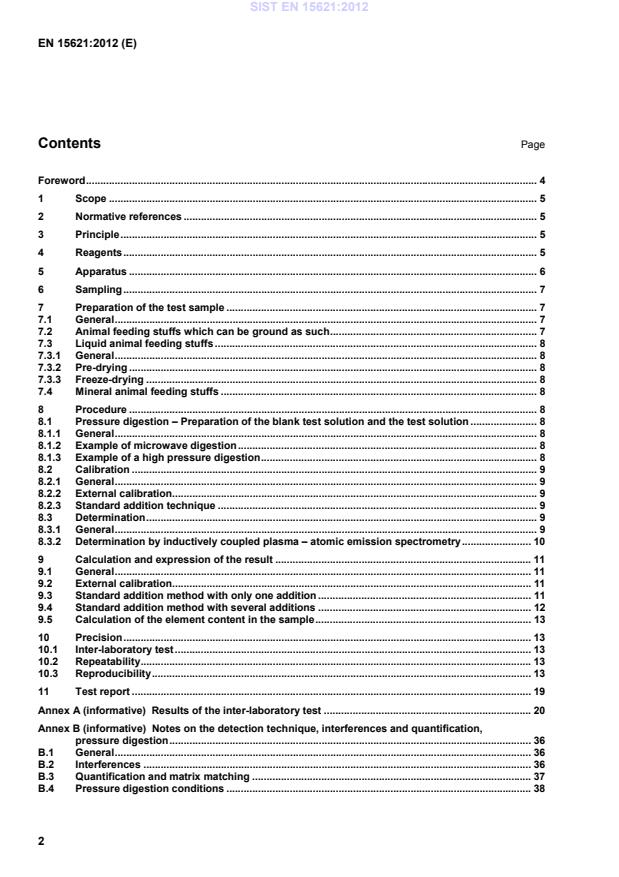
Results of the inter-laboratory test . 20Annex B (informative)
Notes on the detection technique, interferences and quantification, pressure digestion . 36B.1General . 36B.2Interferences . 36B.3Quantification and matrix matching . 37B.4Pressure digestion conditions . 38SIST EN 15621:2012
WARNING — The use of this European Standard can involve hazardous materials, operations and equipment. This standard does not purport to address all the safety problems associated with its use. It is the responsibility of the user of this European Standard to establish appropriate safety and health practices and determine the applicability of regulatory limitations prior to use. 4 Reagents Use only reagents of recognized analytical grade, and water conforming to grade 2 of EN ISO 3696. SIST EN 15621:2012
Element stock solutions with concentrations different from 1 000 mg/l may be used as well. 4.5 Standard solutions. Depending on the scope, different multi-element standard solutions may be necessary. In general, when combining multi-element standard solutions, their chemical compatibility and the possible hydrolysis of the components shall be regarded. Spectral interferences from other elements present in multi-element standards also need to be considered. Various combinations of elements at different concentrations can be used, provided that the stock standard solutions (4.4) are diluted with the same acid and equal concentration as the acid in the test solution to a range of standards that covers the concentrations of the elements to be determined.
The multi-element standard solutions are considered to be stable for several months, if stored in the dark. 5 Apparatus Usual laboratory apparatus and, in particular, the following: NOTE For the determination of sodium in low concentrations it is advisable not to use glassware since glassware can be a source of sodium contamination. 5.1 Laboratory grinder. 5.1.1 Laboratory grinder, capable of grinding to a particle size of less than or equal to 1 mm, e.g. a knife mill or equivalent. 5.1.2 Laboratory grinder, capable of grinding to a particle size of less than or equal to 0,1 mm, e.g. a ball mill or equivalent. NOTE It should be checked that the mill used does not influence the concentration of elements in the sample (e.g. adsorption, contamination) which have to be analysed. 5.2 Analytical balance, capable of weighing to an accuracy of 1 mg. 5.3 Pressure digestion apparatus, commercially available. SIST EN 15621:2012
Instead of polytetrafluoroethylene (PTFE) holders, it is better to use graduated quartz holders, fluorinated ethylene propylene (FEP) holders or perfluoroalkoxy (PFA) holders. Quartz is advisable to be used for decomposition temperatures above 230 °C. 5.4 One-mark volumetric flasks, of capacity 1 000 ml. 5.5 Inductively coupled plasma – Atomic Emission Spectrometer. The instrument shall be equipped with radial plasma as a minimum requirement; axial plasma is equally acceptable. Background correction shall also be performed when necessary. Settings of the working conditions (e.g. viewing height, gas flows, RF or plasma power, sample uptake rate, integration time, and number of replicates) shall be optimised according the manufacturer’s instructions. 5.6 Freeze drying equipment, capable of freeze-drying liquid animal feeding stuffs. 6 Sampling Sampling is not part of the method specified in this International Standard. A recommended sampling method is given in EN ISO 6497 [2]. It is important that the laboratory receives a sample which is truly representative and has not been damaged or changed during transport or storage. 7 Preparation of the test sample 7.1 General Prepare the test sample in accordance with prEN ISO 6498: The grinding must be done in conditions such that the substance is not appreciably heated and that no contamination takes place by the grinding tools; The operation is to be repeated as many times as is necessary and it must be effected as quickly as possible in order to prevent any gain or loss of constituents (water); The whole ground product is placed in a flask made of e.g. polypropylene, which can be stoppered and stored in such way to prevent any change in composition; Before any weighing is carried out for the analysis, the whole test sample must be thoroughly mixed for reasons of homogeneity. Since a maximum of 0,5 g of sample is used for the digestion it is of the utmost importance to have a homogeneous sample in order to take a representative sub sample. 7.2 Animal feeding stuffs which can be ground as such
Grind the laboratory sample (usually 500 g), using a laboratory grinder (0) or mortar, until a particle size of 1 mm or less has been reached. SIST EN 15621:2012
7.3.1 General Liquid feeding stuffs shall be pre-dried according to the procedure described in 7.3.2 or freeze-dried according to the procedure described in 7.3.3. 7.3.2 Pre-drying Pre-dry the laboratory sample at a temperature of 70 °C ± 5 °C during at least 16 h to reduce the moisture content. The mass of the sample before and after the pre-drying is to be determined using an analytical balance (5.2). Grind the pre-dried sample in accordance with 7.2. 7.3.3 Freeze-drying Freeze-dry the laboratory sample following the instructions of the freeze-drying equipment (5.6). The mass of the sample before and after the freeze-drying is to be determined using an analytical balance (5.2). Grind the freeze-dried sample in accordance with 7.2. 7.4 Mineral animal feeding stuffs Mineral compounds, except mineral products containing crystalline water, e.g. MgCl2.6H2O, shall be ground using a laboratory grinder (5.1.2) or mortar until a particle size of 0,1 mm or less has been reached. Mineral products containing crystalline water should not be ground. 8 Procedure 8.1 Pressure digestion – Preparation of the blank test solution and the test solution 8.1.1 General Match the initial sample mass to the capacity of the digestion vessel, with the manufacturer's instructions being strictly observed for safety reasons. Determine the necessary digestion temperature and digestion time (see EN 13805 [1], see Annex B). 8.1.2 Example of microwave digestion
When using 100 ml vessels, weigh about 0,5 g of the prepared test sample to the nearest 1 mg. Add 3 ml of nitric acid (4.1) and 0,5 ml of hydrogen peroxide (4.3), seal the digestion vessel and the pressure holders in the correct manner. Leave to pre-digest outside the microwave for about 30 min. Apply low microwave energy at the beginning of the digestion and slowly raise the energy to the maximum power, e.g. start with 100 W, raise up to 600 W within 5 min, hold for 5 min, raise to 1 000 W, hold for 10 min, cool down for minimum 20 min to 25 min. Treat a blank in the same way. Dilute the digestion solution accordingly with water. The solution obtained after dilution is called the test solution. Proceed in accordance with 8.2. 8.1.3 Example of a high pressure digestion When using a 100 ml vessel, weigh about 0,5 g of the prepared test sample to the nearest 1 mg. Add 3 ml of nitric acid (4.1), seal the digestion vessel and the pressure vessel in the correct manner and heat from room temperature to 150 °C in 60 min, then to 300 °C in 40 min and keep 300 °C for 90 min before cooling down. Treat a blank in the same way. SIST EN 15621:2012
8.2.3 Standard addition technique
The standard addition curve should consist of at least two points, of which, one is an addition. For those elements whose concentration is near the limit of quantification, the standard addition curve should consist of at least four points, of which, three are additions. If three additions are used, the concentration of the highest standard should be 3 to 5 times the concentration in the sample solution. 8.3 Determination 8.3.1 General Analytical lines, selectivity, limits of detection and quantification, precision, linear working area, and interferences have to be established before operating the ICP-AES system. SIST EN 15621:2012
Mo 202,030 Al, Fe Co 228,616 Ti 204,598
Cu 324,754 Ti, Fe Na 330,237
327,396
588,995
Fe 238,200 Co 589,592 Ar 259,940
P
178,287 I K 766,490 Mg, Ar 213,618 Cu, Fe, Mo, Zn769,900
214,914 Cu, Al, Mg
Mg
279,079
177,428 Cu 279,553
S 181,972
285,213 Fe 182,036
As 188,979
Zn 206,200
189,042
213,856 P
193,696
Cd 214,438
197,197
226,502
Pb 216,999
228,802
220,353
261,418 Al, Co, Ti
Table 1 gives relevant analytical lines and possible interferences for the determination with ICP-AES. Other wavelengths than those specified in Table 1 can be used (see also Annex B). 8.3.2.2 External calibration method Aspirate the blank test solution (8.1), the calibration solutions prepared from the standard solutions (4.5), and the test solution (8.1) in ascending order separately into the plasma and measure the emission of the element to be determined using an external calibration (8.2.2).
NOTE If the test solution contains residues, decant the solution into the test tube from which the test solution is aspirated into the ICP. Use the first decanted portion to rinse the test tube. Perform at least two replicates. Average the values if the values fall within an accepted range. After each measurement, aspirate water or nitric acid solution (4.2). 8.3.2.3 Standard addition technique Aspirate the blank test solution (8.1), the test solution (8.1), and the test solution prepared by standard addition technique (8.2.3) in ascending order separately into the plasma, and measure the emission of the element to be determined.
is the net signal of the calibration solution; stc
is the concentration, in mg/l, of the calibration solution; a
is the intersection; b
is the slope. Calculate the element concentration cf, in mg/l, in the test solution (8.1) using the slope b and the intersection a found in (1) as follows: baScff−= (2) where fS
is the net signal of the test solution. 9.3 Standard addition method with only one addition In the most simple case of standard addition, where only one addition is made, the element concentration cf, in mg per l, in the test solution (8.1) is determined as follows: ()fssfVSScVSc×−××=010 (3) where sc
is the concentration, in mg/l, of the standard solution; sV
is the volume, in l, of the standard solution added; SIST EN 15621:2012
is the volume, in l, of the test solution (8.1) used to prepare the solution without addition; 0S
is the net signal of the solution without addition; 1S
is the net signal after addition. 9.4 Standard addition method with several additions In case of several additions, regression techniques on the linear model of variable y as a function of variable x, have to be used to determine the element concentration of the test solution (8.1). Generally, this model can be written as: iixbay×+= (4) In this particular case of three standard additions,
iiSy=
(for i = 0, 1, 2, 3); (5) isiVcx×=
(for i = 0, 1, 2, 3); (6) a
is the intersection; b
is the slope; where sc
is the concentration, in mg/l, of the standard solution; iV
are the various volumes, in litres, of the standard solution added; iS
are the net signals after the various additions.
The values of a and b can then be calculated as follows: ()∑∑∑∑−×−×=22iiiiixxnyxynb
(7) nxbyaii∑∑×−=
(8) where
n is the number of solutions measured (n= 4 in case of three additions). The element concentration cf, in mg/l, of the test solution (8.1) can then be found using the following equation: ffVbac=
(9) where
fV
is the volume, in l, of the test solution (8.1) used to prepare the solution without addition. SIST EN 15621:2012
(10) The element content for the other elements Fe, Zn, Cu, Mn, Co, Mo, Cd, As, Pb in the sample or mass fraction of element welem, expressed in mg/kg, is determined using the following equation: ()tblfVmccw×−=elem
(11) where fc is the concentration, in mg/l, of the test solution (8.1), as determined using equation (2) or (3) or (9); blc
is the concentration, in mg/l, of the blank solution; m
is the mass of sample, in kg, taken for the extraction by digestion, and corrected for water content; tV
is the total volume, in l, of the test solution (8.1). If the test solution (8.1) has been diluted further, take into account the dilution factor. If the sample has been pre-dried or freeze-dried (7.3), recalculate the result to the fresh weight of the sample taking into account the loss of moisture during pre-drying or freeze-drying. 10 Precision 10.1 Inter-laboratory test An inter-laboratory test
...