


EN 751-3:2022+A1:2023
(Main)Sealing materials for metallic threaded joints in contact with 1st, 2nd and 3rd family gases and hot water - Part 3: Unsintered PTFE tapes and PTFE strings
Sealing materials for metallic threaded joints in contact with 1st, 2nd and 3rd family gases and hot water - Part 3: Unsintered PTFE tapes and PTFE strings
This document specifies requirements and test methods for unsintered polytetrafluorethylene (PTFE) tapes and polytetrafluorethylene (PTFE) strings (PTFE tapes or PTFE strings, for short) which are suitable for sealing threaded metallic joints as specified in EN 10226-1:2004.
This document covers two classes of PTFE tapes and PTFE strings suitable for fine (F) and coarse (G) threads.
The PTFE tapes and PTFE strings are used as sealing materials for metallic threaded joints in contact with 1st family gases (town gas), 2nd family gases (natural gas) and 3rd family gases (liquefied petroleum gases (LPG)) up to 500 kPa, up to 700 kPa for hot water of heating systems, and up to 20 kPa in gas appliances and their auxiliary equipment. The maximum working pressure covered in this document is 2000 kPa which is relevant to LPG storage. The temperature range is limited to −20 °C to 125 °C.
Dichtmittel für metallene Gewindeverbindungen in Kontakt mit Gasen der 1., 2. und 3. Familie und Heißwasser - Teil 3: Ungesinterte PTFE-Bänder und -Fäden
Dieses Dokument legt Anforderungen und Prüfverfahren für ungesinterte Polytetrafluorethylen-(PTFE)-Bänder und Polytetrafluorethylen-(PTFE)-Fäden (im weiteren als PTFE-Bänder oder PTFE-Fäden bezeichnet) fest, die geeignet sind metallene Gewindeverbindungen abzudichten, wie sie in EN 10226-1:2004 festgelegt sind.
Dieses Dokument behandelt zwei Klassen von PTFE-Bändern und PTFE-Fäden, die für feine (F) und grobe (G) Gewinde geeignet sind.
Die PTFE-Bänder und PTFE-Fäden werden als Dichtmittel für metallene Gewindeverbindungen verwendet, die für den Einsatz in Installationen bis zu einem Druck von 500 kPa bei Gasen der 1. Familie (Stadtgas), der 2. Familie (Erdgas) und der 3. Familie (Flüssiggas) und bis zu einem Druck von 700 kPa bei Heißwasser von Heizungsanlagen vorgesehen sind, außerdem für den Einsatz in Gasgeräten und deren Zusatzeinrichtungen bis zu einem Druck von 20 kPa. Der maximale durch dieses Dokument abgedeckte Betriebsdruck von 2000 kPa betrifft die Flüssiggaslagerung. Der Temperaturbereich ist begrenzt auf-20 °C bis 125 °C.
Matériaux d'étanchéité pour raccords filetés en contact des gaz de la 1ère, 2ème et 3ème famille et de l'eau chaude - Partie 3 : Bandes et cordons en PTFE non fritté
Le présent document prescrit les exigences et les méthodes d'essai auxquelles les bandes en polytétrafluoroéthylène (PTFE) et cordons en polytétrafluoroéthylène (PTFE) non frittés (appelées dans le reste du document bandes PTFE ou cordons PTFE) doivent satisfaire pour étanchéiser les raccords filetés métalliques conformes à l'EN 10226-1 :2004.
Le présent document couvre les deux classes de bandes et cordons en PTFE adaptées aux filetages à pas fins (F) et aux filetages à pas gros (G).
Les bandes et cordons en PTFE sont utilisés sur les installations de gaz de la 1ère famille (gaz de ville), de la 2ème famille (gaz naturel) et de la 3ème famille (gaz de pétrole liquéfiés (GPL)) jusqu'à 500 kPa et jusqu'à 700 kPa pour l'eau chaude des systèmes de chauffage, et jusqu'à 20 kPa pour les appareils à gaz et leur équipement auxiliaire. La pression maximale de fonctionnement couverte par le présent document est de 2000 kPa pour ce qui concerne le stockage du GPL. La plage de température est comprise entre −20 °C & 125 °C.
Tesnilni materiali za kovinske navojne zveze v stiku s plini 1., 2. in 3. družine ter vročo vodo - 3. del: Nesintrani PTFE trakovi in vrvice (vključno z dopolnilom A1)
Ta dokument določa zahteve in preskusne metode za nesintrane trakove in vrvice iz politetrafluoroetilena (na kratko: PTFE trakovi oz. vrvice), ki so primerni za tesnjenje kovinskih navojnih zvez, kot je določeno v standardu EN 10226-1:2004.
Ta dokument zajema dva razreda PTFE trakov in vrvic, primerna za drobne (F) in grobe (G) navoje.
PTFE trakovi in vrvice se uporabljajo kot tesnilni materiali za kovinske navojne zveze, ki so v stiku s plini iz 1. skupine (mestni plin), plini iz 2. skupine (zemeljski plin) ter plini iz 3. skupine (utekočinjeni naftni plin (LPG)) do največ 500 kPa, do 700 kPa za vročo vodo ogrevalnih sistemov ter do 20 kPa v plinskih napravah in njihovi dodatni opremi. Največji delovni tlak, obravnavan v tem dokumentu, je 2000 kPa, kar je relevantno za hranjenje utekočinjenega naftnega plina (LPG). Temperaturno območje je omejeno na −20 °C do 125 °C.
General Information
Relations
Overview
EN 751-3:2022+A1:2023 (CEN) specifies requirements and test methods for unsintered PTFE tapes and PTFE strings used as sealing materials for metallic threaded joints (per EN 10226-1). The standard covers two classes (F and G) for fine and coarse threads, defines material and dimensional requirements, and limits application to gas and hot-water systems within specified pressure and temperature ranges.
Key facts
- Product: virgin, unsintered PTFE (no APFO/PFOA)
- Use: sealing metallic threaded joints in contact with 1st, 2nd and 3rd family gases and hot water
- Pressure: up to 500 kPa for gases; up to 700 kPa for heating hot water; up to 20 kPa in gas appliances; max covered = 2000 kPa (LPG storage)
- Temperature range: −20 °C to 125 °C
Key topics and technical requirements
- Materials: PTFE must be virgin, unsintered, free from visible inclusions and manufactured without APFO/PFOA.
- Classification:
- Class F - for fine threads (DN ≤ 10)
- Class G - for fine and coarse threads (DN ≤ 50)
- Geometry:
- Tapes: thin, wide (example typical tape 12 mm × 0.10 mm)
- Strings (cords): thicker, narrow (example 2 mm × 0.5 mm)
- Dimensional and mass controls:
- Length, width and thickness tolerances specified
- Mass per area (tapes) minimums: ≥ 60 g/m2 (class F), ≥ 100 g/m2 (class G) or ≥ 90% of declared manufacturer value
- Performance tests:
- Residual lubricant content, PTFE structure (e.g., thermal analysis references), wrapping properties
- Post-assembly tests: sealing properties and dismantling behaviour
- Marking & documentation: package marking and user instructions required; must state declared dimensions and batch information
- Practical notes from the standard:
- Turning back of tape during installation is discouraged (not reproducible in tests)
- Vibration test removed from test schedule
- PTFE is usually white but other colors may be used
Applications and who uses it
- Target users: plumbing and heating installers, gas appliance manufacturers, LPG storage operators, jointing material manufacturers, test laboratories, conformity assessors and regulatory bodies.
- Typical applications: sealing threaded connections in gas distribution (town gas, natural gas, LPG), heating systems hot water joints, gas appliances and auxiliary equipment.
- Benefits: ensures reliable, standardized sealing performance for metallic threaded joints across gas and hot-water systems; supports compliance and product specification.
Related standards
- EN 10226-1 (pipe thread dimensions and tolerances)
- EN 10226-3 (verification by limit gauges)
- EN 751 series (Part 1 anaerobic jointing compounds; Part 2 non‑hardening jointing compounds)
- EN ISO 11357-3 and EN ISO 11358-1 (thermal and thermogravimetric test methods referenced)
Keywords: EN 751-3:2022+A1:2023, PTFE tape, PTFE string, unsintered PTFE, sealing materials, metallic threaded joints, gas sealing, hot water sealing, EN 10226-1.
Standards Content (Sample)
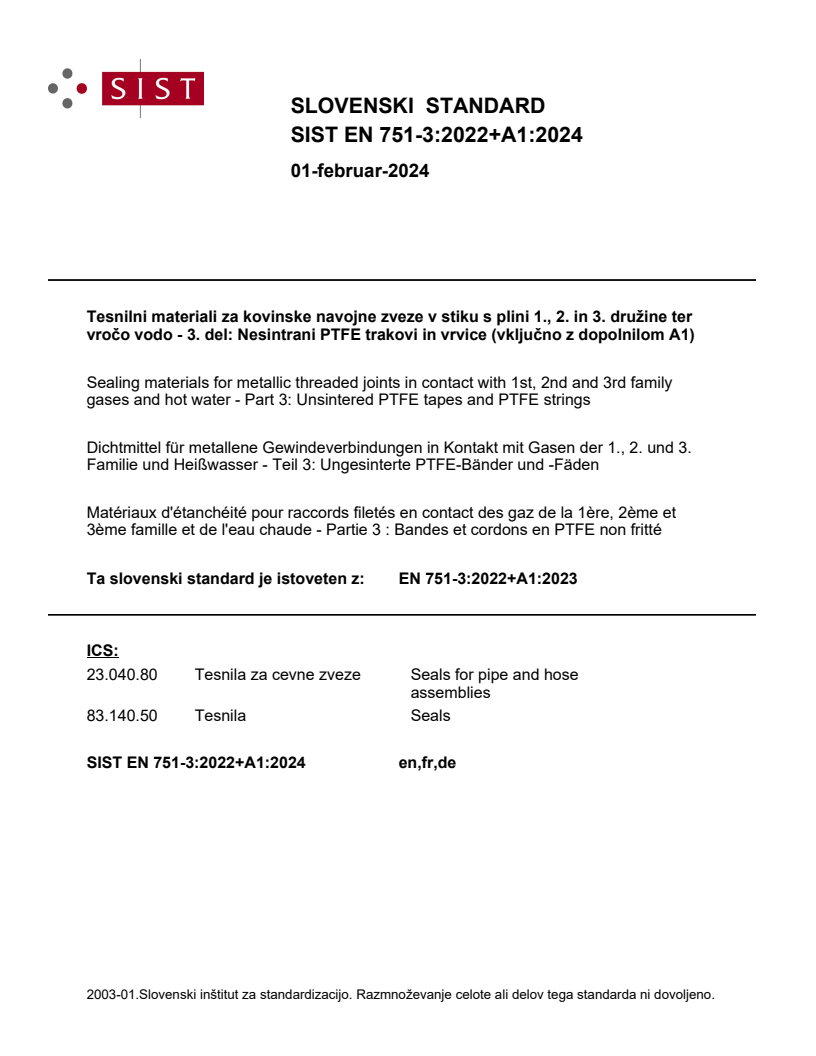
SLOVENSKI STANDARD
01-februar-2024
Tesnilni materiali za kovinske navojne zveze v stiku s plini 1., 2. in 3. družine ter
vročo vodo - 3. del: Nesintrani PTFE trakovi in vrvice (vključno z dopolnilom A1)
Sealing materials for metallic threaded joints in contact with 1st, 2nd and 3rd family
gases and hot water - Part 3: Unsintered PTFE tapes and PTFE strings
Dichtmittel für metallene Gewindeverbindungen in Kontakt mit Gasen der 1., 2. und 3.
Familie und Heißwasser - Teil 3: Ungesinterte PTFE-Bänder und -Fäden
Matériaux d'étanchéité pour raccords filetés en contact des gaz de la 1ère, 2ème et
3ème famille et de l'eau chaude - Partie 3 : Bandes et cordons en PTFE non fritté
Ta slovenski standard je istoveten z: EN 751-3:2022+A1:2023
ICS:
23.040.80 Tesnila za cevne zveze Seals for pipe and hose
assemblies
83.140.50 Tesnila Seals
2003-01.Slovenski inštitut za standardizacijo. Razmnoževanje celote ali delov tega standarda ni dovoljeno.
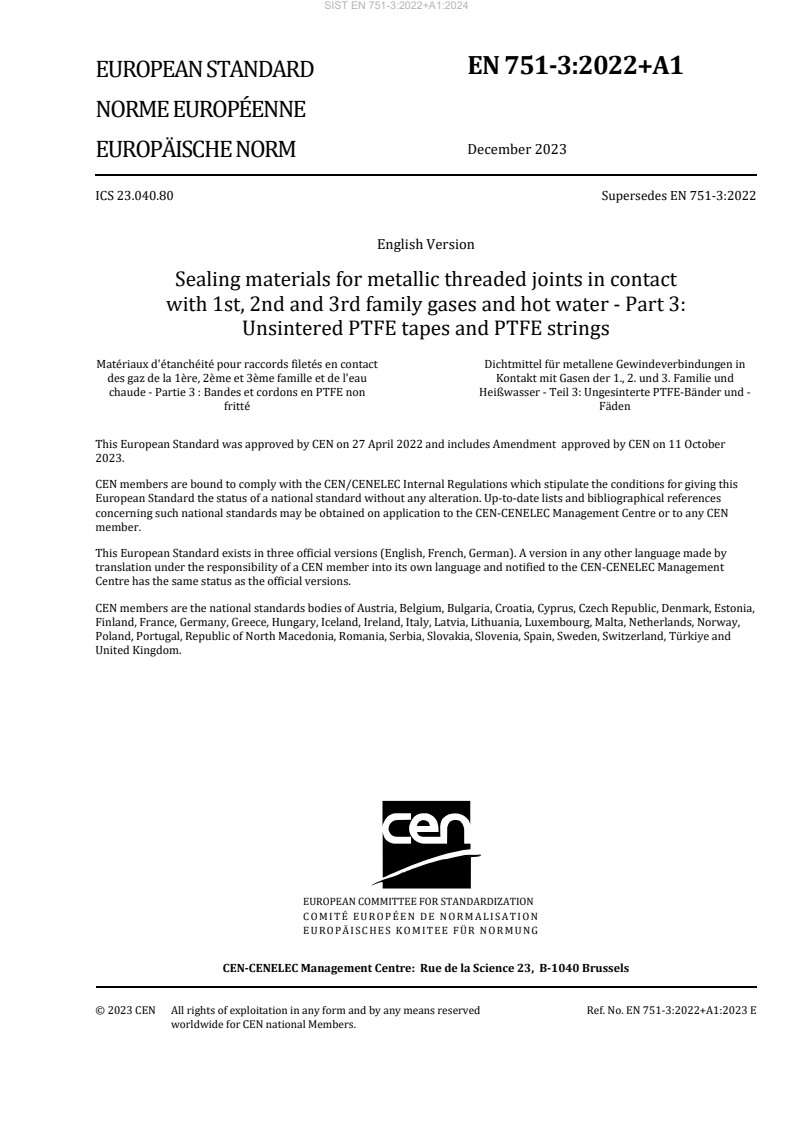
EN 751-3:2022+A1
EUROPEAN STANDARD
NORME EUROPÉENNE
December 2023
EUROPÄISCHE NORM
ICS 23.040.80 Supersedes EN 751-3:2022
English Version
Sealing materials for metallic threaded joints in contact
with 1st, 2nd and 3rd family gases and hot water - Part 3:
Unsintered PTFE tapes and PTFE strings
Matériaux d'étanchéité pour raccords filetés en contact Dichtmittel für metallene Gewindeverbindungen in
des gaz de la 1ère, 2ème et 3ème famille et de l'eau Kontakt mit Gasen der 1., 2. und 3. Familie und
chaude - Partie 3 : Bandes et cordons en PTFE non Heißwasser - Teil 3: Ungesinterte PTFE-Bänder und -
fritté Fäden
This European Standard was approved by CEN on 27 April 2022 and includes Amendment approved by CEN on 11 October
2023.
CEN members are bound to comply with the CEN/CENELEC Internal Regulations which stipulate the conditions for giving this
European Standard the status of a national standard without any alteration. Up-to-date lists and bibliographical references
concerning such national standards may be obtained on application to the CEN-CENELEC Management Centre or to any CEN
member.
This European Standard exists in three official versions (English, French, German). A version in any other language made by
translation under the responsibility of a CEN member into its own language and notified to the CEN-CENELEC Management
Centre has the same status as the official versions.
CEN members are the national standards bodies of Austria, Belgium, Bulgaria, Croatia, Cyprus, Czech Republic, Denmark, Estonia,
Finland, France, Germany, Greece, Hungary, Iceland, Ireland, Italy, Latvia, Lithuania, Luxembourg, Malta, Netherlands, Norway,
Poland, Portugal, Republic of North Macedonia, Romania, Serbia, Slovakia, Slovenia, Spain, Sweden, Switzerland, Türkiye and
United Kingdom.
EUROPEAN COMMITTEE FOR STANDARDIZATION
COMITÉ EUROPÉEN DE NORMALISATION
EUROPÄISCHES KOMITEE FÜR NORMUNG
CEN-CENELEC Management Centre: Rue de la Science 23, B-1040 Brussels
© 2023 CEN All rights of exploitation in any form and by any means reserved Ref. No. EN 751-3:2022+A1:2023 E
worldwide for CEN national Members.
Contents Page
European foreword . 3
Introduction . 4
1 Scope . 5
2 Normative references . 5
3 Terms and definitions . 6
4 Differentiation and classification of PTFE tapes and PTFE strings . 6
4.1 Differentiation . 6
4.2 Classification . 6
5 Requirements . 7
5.1 Requirements to be met by the PTFE tape and PTFE strings as received . 7
5.1.1 General . 7
5.1.2 Tape and string dimensions . 7
5.1.3 Mass . 7
5.1.4 Residual lubricant content . 8
5.1.5 PTFE structure and material . 8
5.1.6 Wrapping properties . 8
5.2 Requirements to be met by the PTFE tape and PTFE string after assembly . 8
5.2.1 Sealing properties . 8
5.2.2 Dismantling . 8
6 Test samples and documentation . 9
6.1 Test samples . 9
6.2 Test documentation . 9
7 Test methods . 9
7.1 General . 9
7.2 Test methods for PTFE tapes or PTFE strings as received . 9
7.2.1 Test of general requirements . 9
7.2.2 Measurement of dimensions . 9
7.2.3 Measurement of mass . 10
7.2.4 Determination of residual lubricant content . 10
7.2.5 Test of PTFE structure . 11
7.2.6 Test of wrapping properties . 11
7.3 Test of PTFE tapes or PTFE strings after assembly . 14
7.3.1 Test of sealing properties . 14
7.3.2 Test of dismantling . 18
8 Marking and instructions . 18
8.1 Marking on packages . 18
8.2 Instructions . 18
Annex ZA (informative) Relationship between this European Standard and the essential
requirements of Regulation (EU) 2016/426 aimed to be covered . 19
Bibliography . 20
European foreword
This document (EN 751-3:2022+A1:2023) has been prepared by Technical Committee CEN/TC 208
“Elastomeric seals for joints in pipework and pipelines”, the secretariat of which is held by BSI.
This European Standard shall be given the status of a national standard, either by publication of an
identical text or by endorsement, at the latest by June 2024, and conflicting national standards shall be
withdrawn at the latest by June 2024.
Attention is drawn to the possibility that some of the elements of this document may be the subject of
patent rights. CEN shall not be held responsible for identifying any or all such patent rights.
This document supersedes !EN 751-3:2022".
This document includes Amendment 1, approved by CEN on 2023-10-11.
The start and finish of text introduced or altered by amendment is indicated in the text by tags !"
This document has been prepared under a Standardization Request given to CEN by the European
Commission and the European Free Trade Association, and supports essential requirements of EU
Directive(s).
For relationship with EU Directive(s), see informative Annex ZA, which is an integral part of this
document.
!deleted paragraphs"
The EN 751 series comprises the listed parts:
— Part 1: Anaerobic jointing compounds;
— Part 2: Non-hardening jointing compounds;
— Part 3: Unsintered PTFE tapes and strings.
Any feedback and questions on this document should be directed to the users’ national standards body.
A complete listing of these bodies can be found on the CEN website.
According to the CEN-CENELEC Internal Regulations, the national standards organisations of the
following countries are bound to implement this European Standard: Austria, Belgium, Bulgaria, Croatia,
Cyprus, Czech Republic, Denmark, Estonia, Finland, France, Germany, Greece, Hungary, Iceland, Ireland,
Italy, Latvia, Lithuania, Luxembourg, Malta, Netherlands, Norway, Poland, Portugal, Republic of North
Macedonia, Romania, Serbia, Slovakia, Slovenia, Spain, Sweden, Switzerland, Turkey and the United
Kingdom.
Introduction
This document specifies requirements and test methods for tapes and strings produced from virgin
unsintered polytetrafluorethylene (PTFE) for use with metallic threaded joints. It specifies two classes of
PTFE tapes and PTFE strings – mainly differing in thickness and mass per area – for fine (F) and coarse
(G) threads.
A universally applicable PTFE tape or PTFE string may be used for all gas, potable water and hot water
installation.
In respect of potential adverse effects of the jointing compounds covered by this document on the quality
of water intended for human consumption this document provides no information as to whether the
jointing compounds may be used without restriction in any of the Member States of the EU or EFTA. The
use and characteristics of the jointing compounds should comply with current regulations, where they
exist, depending the acceptance of verifiable European criteria.
Compared to previous standard EN 751-3:1996, this document does not include an assessment of the
turning back properties. It has been determined in practice and during periodic tests that these
properties can only be reproduced to a limited extent. Turning back during installation should be avoided.
Should a connection made with PTFE tapes or threads nevertheless (have to) be turned back during
installation, this is the responsibility of the user. It is common sense that installations are checked for
tightness after completion.
Although PTFE natural colour is white and most common for PTFE tapes and PTFE strings, other colours
may be used as well.
Test practice since the standard was published has shown that the vibration test has not provided any
additional information about the tightness of the threaded connections. Therefore, the test was removed
from the test schedule of the standard.
1 Scope
This document specifies requirements and test methods for unsintered polytetrafluorethylene (PTFE)
tapes and polytetrafluorethylene (PTFE) strings (PTFE tapes or PTFE strings, for short) which are
suitable for sealing threaded metallic joints as specified in EN 10226-1:2004.
This document covers two classes of PTFE tapes and PTFE strings suitable for fine (F) and coarse (G)
threads.
The PTFE tapes and PTFE strings are used as sealing materials for metallic threaded joints in contact with
st nd rd
1 family gases (town gas), 2 family gases (natural gas) and 3 family gases (liquefied petroleum
gases (LPG)) up to 500 kPa, up to 700 kPa for hot water of heating systems, and up to 20 kPa in gas
appliances and their auxiliary equipment. The maximum working pressure covered in this document is
2000 kPa which is relevant to LPG storage. The temperature range is limited to −20 °C to 125 °C.
2 Normative references
The following documents are referred to in the text in such a way that some or all of their content
constitutes requirements of this document. For dated references, only the edition cited applies. For
undated references, the latest edition of the referenced document (including any amendments) applies.
EN 10242:1994, Threaded pipe fittings in malleable cast iron
EN 10255:2004+A1:2007, Non-alloy steel tubes suitable for welding and threading — Technical delivery
conditions
EN 12164:2016, Copper and copper alloys — Rod for free machining purposes
EN 10226-1:2004, Pipe threads where pressure tight joints are made on the threads — Part 1: Taper
external threads and parallel internal threads — Dimensions, tolerances and designation
EN 10226-3:2005, Pipes threads where pressure tight joints are made on the threads — Part 3: Verification
by means of limit gauges
EN ISO 11357-3:2018, Plastics — Differential scanning calorimetry (DSC) — Part 3: Determination of
temperature and enthalpy of melting and crystallization (ISO 11357-3:2018)
EN ISO 11358-1:2014, Plastics — Thermogravimetry (TG) of polymers — Part 1: General principles
(ISO 11358-1:2014)
This document is currently impacted by the stand-alone amendments EN 10242:1994/A1:1999 and
EN 10242:1994/A2:2003.
3 Terms and definitions
For the purposes of this document, the following terms and definitions apply.
ISO and IEC maintain terminological databases for use in standardization at the following addresses:
— ISO Online browsing platform: available at https://www.iso.org/obp
— IEC Electropedia: available at https://www.electropedia.org/
3.1
PTFE tape
thread sealing tape manufactured from virgin unsintered polytetraflourethylene (PTFE) without fillers
or additives
3.2
PTFE string
thread sealing string manufactured from virgin unsintered polytetraflourethylene (PTFE) without fillers
or additives
Note 1 to entry: PTFE strings are also known as “PTFE cords”.
3.3
gas family
group of gaseous fuels with similar burning behaviour linked together by a range of Wobbe indices
Note 1 to entry: For further information on types of gases see EN 437:2021.
3.4
batch
any quantity of PTFE-tapes or PTFE strings manufactured in a single mix at one time
4 Differentiation and classification of PTFE tapes and PTFE strings
4.1 Differentiation
Tapes and strings differ in their geometry, weight per unit area and application. Both have a rectangular
geometry, whereby the tapes are thin and wide, while the strings are thick and narrow. Therefore, tapes
have to be wrapped overlapping, while strings are wrapped crosswise with a larger number of windings.
In addition, the strings have a greater weight per unit area.
NOTE 1 Typical tape dimensions; 12 mm × 0,10 mm.
NOTE 2 String dimensions; e.g. 2 mm × 0,5 mm, other cross sections are possible.
4.2 Classification
There are two classes of PTFE tapes and PTFE strings suitable only for fine (F) and for fine and coarse (G)
threads in accordance with Table 1.
Table 1 — Classification of PTFE tapes and PTFE strings
Class Thread Nominal size
a
F EN 10226-1:2004 taper/parallel
DN ≤ 10
G EN 10226-1:2004 taper/parallel DN ≤ 50
a
Class F tapes and strings may also be used for other dimensions when the number of turns of the thread is
-1
≥ 7,5 cm .
5 Requirements
5.1 Requirements to be met by the PTFE tape and PTFE strings as received
5.1.1 General
PTFE shall be produced without using APFO (ammonium perfluorooctanoate) and PFOA
(perfluorooctanoic acid).
The PTFE tape and PTFE string shall be free from inclusions or imperfections visible to the naked eye and
shall be free from any surface or edge defects, when tested in accordance with 7.2.1.
5.1.2 Tape and string dimensions
5.1.2.1 Length
The actual length of the PTFE tape and PTFE string, when tested in accordance with 7.2.2.1, shall not be
less than that marked on the spool/ dispenser.
5.1.2.2 Width
The actual width of the PTFE tape, when tested in accordance with 7.2.2.2, shall not differ from that
marked on the spool by more than ±0,5 mm.
The actual width of the PTFE string, when tested in accordance with 7.2.2.2, shall not differ from that
marked on the dispenser by more than ±10 %.
5.1.2.3 Thickness
The thickness of the PTFE tape and PTFE string, when tested in accordance with 7.2.2.3, shall not differ
from the stated value by more than ±10 %.
5.1.3 Mass
5.1.3.1 Mass per area for PTFE tapes
The mass per area of the PTFE tape, when tested in accordance with 7.2.3.1, shall be greater than 90 %
of the value declared by the manufacturer, but not less than:
— 60 g/m for class F;
— 100 g/m for class G.
5.1.3.2 Mass per length for PTFE strings
The mass per length of the PTFE string, when tested in accordance with 7.2.3.2, shall be greater than 90 %
of the value declared by the manufacturer, but not less than 0,3 g/m for both classes.
5.1.4 Residual lubricant content
The residual lubricant content of the PTFE tape and PTFE string, when tested in accordance with 7.2.4.1
or 7.2.4.2, shall not exceed 0,1 % by mass.
5.1.5 PTFE structure and material
Using DSC (differential scanning calorimetry) method. The conditions during manufacture shall be such
that the tape or string remains in the unsintered state, during the test in accordance with 7.2.5 a shift or
change in the peak temperature of the initial melting peak shall be given. The enthalpy for the first heating
shall be significantly higher than for the second one. The following peak temperatures shall be met:
— (345 ± 5) °C during heating up from ambient temperature to (380 ± 5) °C;
— (312 ± 5) °C during cooling down from (380 ± 5) °C to (50 ± 5) °C;
— (327 ± 5) °C during heating up from (50 ± 5) °C to (380 ± 5) °C.
NOTE Experience shows that these requirements only can be met by use of virgin materials.
PTFE tapes or PTFE strings shall be manufactured from virgin consistent PTFE that does not contain any
filler (exception of colour) and is free of APFO and/or PFOA.
5.1.6 Wrapping properties
When wrapped around the specified thread in accordance with 7.2.6.1 or 7.2.6.2, the PTFE tape shall
conform to and hold the thread form. The finishing end of the PTFE tape shall remain in position with no
tendency to unwind. During wrapping the PTFE tape shall not break, tear, or split.
When wrapped around the specified thread in accordance with 7.2.6.3 or 7.2.6.4, the PTFE string shall
conform to and hold the thread form. The finishing end of the PTFE string shall remain in position with
no tendency to unwind. During wrapping the PTFE string shall not break, tear, or split.
5.2 Requirements to be met by the PTFE tape and PTFE string after assembly
5.2.1 Sealing properties
5.2.1.1 General
When tested in accordance with the methods described in 7.3.1 the PTFE tape and PTFE string shall not
permit any leakage, when each test assembly is tested in accordance with 7.3.1.2 and 7.3.1.3 in sequence.
5.2.1.2 Tightness
When pressurized, within 1 h after preparation all the joints in the test assemblies shall not leak, when
tested in accordance with 7.3.1.2.
5.2.1.3 Resistance to temperature cycling
The sealing p
...
Frequently Asked Questions
EN 751-3:2022+A1:2023 is a standard published by the European Committee for Standardization (CEN). Its full title is "Sealing materials for metallic threaded joints in contact with 1st, 2nd and 3rd family gases and hot water - Part 3: Unsintered PTFE tapes and PTFE strings". This standard covers: This document specifies requirements and test methods for unsintered polytetrafluorethylene (PTFE) tapes and polytetrafluorethylene (PTFE) strings (PTFE tapes or PTFE strings, for short) which are suitable for sealing threaded metallic joints as specified in EN 10226-1:2004. This document covers two classes of PTFE tapes and PTFE strings suitable for fine (F) and coarse (G) threads. The PTFE tapes and PTFE strings are used as sealing materials for metallic threaded joints in contact with 1st family gases (town gas), 2nd family gases (natural gas) and 3rd family gases (liquefied petroleum gases (LPG)) up to 500 kPa, up to 700 kPa for hot water of heating systems, and up to 20 kPa in gas appliances and their auxiliary equipment. The maximum working pressure covered in this document is 2000 kPa which is relevant to LPG storage. The temperature range is limited to −20 °C to 125 °C.
This document specifies requirements and test methods for unsintered polytetrafluorethylene (PTFE) tapes and polytetrafluorethylene (PTFE) strings (PTFE tapes or PTFE strings, for short) which are suitable for sealing threaded metallic joints as specified in EN 10226-1:2004. This document covers two classes of PTFE tapes and PTFE strings suitable for fine (F) and coarse (G) threads. The PTFE tapes and PTFE strings are used as sealing materials for metallic threaded joints in contact with 1st family gases (town gas), 2nd family gases (natural gas) and 3rd family gases (liquefied petroleum gases (LPG)) up to 500 kPa, up to 700 kPa for hot water of heating systems, and up to 20 kPa in gas appliances and their auxiliary equipment. The maximum working pressure covered in this document is 2000 kPa which is relevant to LPG storage. The temperature range is limited to −20 °C to 125 °C.
EN 751-3:2022+A1:2023 is classified under the following ICS (International Classification for Standards) categories: 23.040.80 - Seals for pipe and hose assemblies. The ICS classification helps identify the subject area and facilitates finding related standards.
EN 751-3:2022+A1:2023 has the following relationships with other standards: It is inter standard links to EN 751-3:2022. Understanding these relationships helps ensure you are using the most current and applicable version of the standard.
EN 751-3:2022+A1:2023 is associated with the following European legislation: EU Directives/Regulations: 2016/426; Standardization Mandates: M/595. When a standard is cited in the Official Journal of the European Union, products manufactured in conformity with it benefit from a presumption of conformity with the essential requirements of the corresponding EU directive or regulation.
You can purchase EN 751-3:2022+A1:2023 directly from iTeh Standards. The document is available in PDF format and is delivered instantly after payment. Add the standard to your cart and complete the secure checkout process. iTeh Standards is an authorized distributor of CEN standards.
EN 751-3:2022+A1:2023は、金属製のネジジョイントに使用される未焼結ポリテトラフルオロエチレン(PTFE)テープおよびPTFEストリングに関する標準化文書であり、専門的な要件や試験方法を明確に示しています。この標準の範囲は、EN 10226-1:2004で定められたネジ付き金属ジョイントに適したPTFEテープおよびPTFEストリングを対象としています。 この文書は、細いネジ(F)および太いネジ(G)用の2種類のPTFEテープとPTFEストリングのクラスをカバーしており、使用用途によって適切なセaling材料を選定する際の指針となります。特に、都市ガス(1種ガス)、天然ガス(2種ガス)、および液化石油ガス(LPG)(3種ガス)と接触する金属製ネジジョイントにおいて、最大500 kPaの圧力に耐えられる性能を保証しています。また、加熱システムによる熱水の最大700 kPa、ガス機器およびその補助装置においては20 kPaまでの使用をカバーしています。 この標準は、特にLPGの貯蔵に関連する2000 kPaという最高作業圧力を考慮しており、厳しい適用条件下でも信頼性の高い性能を提供します。さらに、温度範囲は−20 °Cから125 °Cまでに制限されており、様々な使用条件でも安定した性能が期待できます。 EN 751-3:2022+A1:2023は、特にガスおよび熱水関連の安全性を確保する上で非常に重要な役割を果たしており、業界における信頼性と品質を向上させるための基盤となる標準です。セaling材料としてのPTFEテープおよびPTFEストリングの適切な使用が、長期的な性能と安全性の確保に貢献することは明白です。
표준 EN 751-3:2022+A1:2023은 금속 나사 연결부에 적합한 비소결 폴리테트라플루오로에틸렌(PTFE) 테이프 및 PTFE strings의 요구 사항과 시험 방법을 명확하게 규정하고 있습니다. 이 문서는 EN 10226-1:2004에 명시된 나사 연결부의 밀봉에 사용되는 두 가지 클래스의 PTFE 테이프 및 PTFE strings를 다루고 있으며, 정밀한(F) 나사 및 거친(G) 나사에 적합한 제품을 포함합니다. 특히 PTFE 테이프와 PTFE strings는 1류 가스(도시가스), 2류 가스(천연가스), 3류 가스(액화석유가스(LPG))와의 접촉에 대해 500 kPa까지, 난방 시스템의 온수에 대해서는 700 kPa까지, 가스 기구 및 보조 장비에 대해서는 최대 20 kPa까지 사용될 수 있도록 설계되었습니다. 이 문서에서 규정된 최대 작업 압력은 LPG 저장과 관련된 2000 kPa로, 실제 운영 환경에서의 안전성을 보장합니다. 온도 범위는 -20 °C에서 125 °C로 제한되어 있어 다양한 환경에서의 적용 가능성을 높이고 있습니다. 이 표준은 비소결 PTFE 테이프 및 PTFE strings의 품질과 안정성을 보장하여, 금속 나사 연결부의 밀봉 성능을 향상시키는 데 필수적인 역할을 수행합니다. EN 751-3:2022+A1:2023은 가스 및 온수 시스템에서의 안전성과 신뢰성을 확보하는 데 중요한 기초 자료로 자리 잡고 있습니다.
Die Norm EN 751-3:2022+A1:2023 legt die Anforderungen und Prüfmethoden für unsinterte Polytetrafluorethylen (PTFE) Bänder und PTFE Schnüre fest, die speziell als Dichtungsmaterialien für metallische Gewindeverbindungen in Kontakt mit Gasen der 1., 2. und 3. Familie sowie heißem Wasser verwendet werden. Diese Norm ist insbesondere von Bedeutung für die Gewährleistung der Sicherheit und Zuverlässigkeit in Anwendungen, bei denen es auf Dichtungsmaterialien für metallische Gewinde ankommt. Ein wesentlicher Vorteil dieser Norm liegt in der klaren Kategorisierung der PTFE Bänder und PTFE Schnüre in zwei Klassen, die auf feine (F) und grobe (G) Gewinde abgestimmt sind. Dies ermöglicht eine präzise Auswahl des geeigneten Dichtungsmaterials gemäß den spezifischen Anforderungen der jeweiligen Anwendung und sorgt somit für eine optimale Dichtwirkung. Die Norm betrachtet Anwendungen mit unterschiedlichen Druckbereichen und Temperaturen, wodurch sie vielseitig einsetzbar ist. So sind die PTFE Materialien für Gasanwendungen bis zu einem maximalen Betriebsdruck von 2000 kPa bei LPG-Speicherung zugelassen und können in einem Temperaturbereich von −20 °C bis 125 °C eingesetzt werden. Die Norm ist besonders relevant für die Sicherheitstechnik und die Normierung in der Gas- und Heizungsindustrie, da sie spezifische Anforderungen an die Dichtungsleistung stellt. Die Möglichkeit, PTFE Bänder und PTFE Schnüre sowohl für industrielle Anwendungen als auch für den Heizungsbau zu verwenden, verstärkt ihre Relevanz zusätzlich. Durch die Einführung von standardisierten Prüfmethoden wird die Qualität und Zuverlässigkeit der verwendeten Dichtungsmaterialien gesichert, was für die gesamte Branche von großer Bedeutung ist. Zusammenfassend bietet die EN 751-3:2022+A1:2023 eine umfassende Grundlage für die Verwendung von PTFE Bändern und PTFE Schnüren in sicherheitsrelevanten Anwendungen und stellt sicher, dass geeignete Dichtungsmaterialien zur Verfügung stehen, um die Integrität der metallischen Gewindeverbindungen zu gewährleisten.
Le document SIST EN 751-3:2022+A1:2024 établit des exigences et des méthodes d'essai pour les bandes et les cordons en polytétrafluoroéthylène (PTFE) non frittés, qui sont essentiels pour le scellement des joints filetés métalliques, conformément à la norme EN 10226-1:2004. Ce standard est particulièrement pertinent pour les applications en contact avec des gaz de 1ère, 2ème et 3ème famille, ainsi que pour l'eau chaude, en garantissant des performances fiables et sécurisées. Une des forces de cette norme réside dans sa capacité à couvrir deux classes de PTFE : les bandes et cordons adaptés aux filetages fins (F) et gros (G). Cela permet une grande flexibilité et une compatibilité avec une large gamme d'applications industrielles et domestiques. De plus, les exigences pour les matériaux de scellement en PTFE sont spécifiquement adaptées aux conditions rigoureuses, notamment avec une pression de service pouvant atteindre 2000 kPa, ce qui est crucial pour le stockage de GPL, et une plage de températures de -20 °C à 125 °C, offrant ainsi une robustesse face aux variations climatiques. L'importance de la norme SIST EN 751-3:2022+A1:2024 s'étend également à son rôle dans la sécurité des installations gazières, en veillant à ce que les matériaux de scellement soient appropriés pour des pressions allant jusqu'à 500 kPa pour les gaz et 700 kPa pour l'eau chaude dans les systèmes de chauffage. Établir des standards comme celui-ci renforce la confiance dans l'utilisation des joints métalliques et contribue à la prévention des fuites dans les appareils à gaz et leur équipement auxiliaire. En résumé, ce document normatif constitue une référence clé pour les professionnels du secteur, garantissant des matériaux de scellement en PTFE de haute qualité, adaptés à des applications variées dans le domaine des gaz et de l'eau chaude. La norme assure non seulement la conformité aux exigences de sécurité, mais également l'efficacité des installations dans lesquelles ces matériaux sont employés.
The standard EN 751-3:2022+A1:2023 provides a comprehensive framework regarding the use of sealing materials specifically designed for metallic threaded joints that come into contact with various gas families and hot water. This document outlines precise requirements and testing methods for unsintered polytetrafluorethylene (PTFE) tapes and PTFE strings, ensuring their suitability for sealing applications in accordance with the established guidelines in EN 10226-1:2004. One of the significant strengths of this standard lies in its clear delineation between the two classes of PTFE tapes and strings, accommodating both fine (F) and coarse (G) threaded joints. This classification promotes better compatibility and reliability in various applications, thereby enhancing safety in systems that involve contact with 1st family gases (town gas), 2nd family gases (natural gas), and 3rd family gases (liquefied petroleum gases, or LPG). By specifying maximum working pressures-up to 2000 kPa for LPG storage-and temperature limits ranging from −20 °C to 125 °C, the standard effectively addresses critical safety and performance parameters that are vital for industrial and domestic applications alike. The relevance of EN 751-3:2022+A1:2023 extends beyond mere compliance; it serves as an essential reference for manufacturers, users, and regulatory bodies to ensure the integrity and functionality of sealing solutions in gas and hot water systems. Given the substantial risks associated with gas leakage, the establishment of standardized testing methods and performance criteria in this document is a crucial safeguard that supports both public safety and the operational efficiency of gas appliances and their ancillary equipment. In summary, the EN 751-3:2022+A1:2023 standard stands out for its comprehensive coverage of sealing materials, precise classifications, and stringent performance criteria, making it a relevant and critical document in the sphere of gas and heating system safety.
Questions, Comments and Discussion
Ask us and Technical Secretary will try to provide an answer. You can facilitate discussion about the standard in here.
Loading comments...