

EN 751-3:2022
(Main)Sealing materials for metallic threaded joints in contact with 1st, 2nd and 3rd family gases and hot water - Part 3: Unsintered PTFE tapes and PTFE strings
- Abstract
This document specifies requirements and test methods for unsintered polytetrafluorethylene (PTFE) tapes and polytetrafluorethylene (PTFE) strings (PTFE tapes or PTFE strings, for short) which are suitable for sealing threaded metallic joints as specified in EN 10226-1:2004.
This document covers two classes of PTFE tapes and PTFE strings suitable for fine (F) and coarse (G) threads.
The PTFE tapes and PTFE strings are used as sealing materials for metallic threaded joints in contact with 1st family gases (town gas), 2nd family gases (natural gas) and 3rd family gases (liquefied petroleum gases (LPG)) up to 500 kPa, up to 700 kPa for hot water of heating systems, and up to 20 kPa in gas appliances and their auxiliary equipment. The maximum working pressure covered in this document is 2000 kPa which is relevant to LPG storage. The temperature range is limited to −20 °C to 125 °C.
- Status
- Withdrawn
- Publication Date
- 07-Jun-2022
- Withdrawal Date
- 06-Oct-2026
- Technical Committee
- CEN/TC 208 - Elastomeric seals for joints in pipework and pipelines
- Current Stage
- 9960 - Withdrawal effective - Withdrawal
- Start Date
- 13-Dec-2023
- Completion Date
- 07-Oct-2026
- Directive
- 2016/426 - REGULATION (EU) 2016/426 OF THE EUROPEAN PARLIAMENT AND OF THE COUNCIL of 9 March 2016 on appliances burning gaseous fuels and repealing Directive 2009/142/ECOJ Ref: 2024/224, OJ, OJ L, OJ L, 2024/224 OJ Date: 12-Jan-2024

Relations
- Effective Date
- 15-Jun-2022
- Effective Date
- 25-May-2022
- Effective Date
- 18-Oct-2023
- Effective Date
- 28-Jan-2026
- Effective Date
- 28-Jan-2026
- Effective Date
- 28-Jan-2026
- Effective Date
- 28-Jan-2026
- Effective Date
- 28-Jan-2026
- Effective Date
- 28-Jan-2026
- Effective Date
- 28-Jan-2026
- Effective Date
- 28-Jan-2026
- Effective Date
- 28-Jan-2026
Get Certified
Connect with accredited certification bodies for this standard

Institut za varilstvo d.o.o. (Welding Institute)
Slovenia's leading welding institute since 1952. ISO 3834, EN 1090, pressure equipment certification, NDT personnel, welder qualification. Only IIW Au
Sponsored listings
Frequently Asked Questions
EN 751-3:2022 is a standard published by the European Committee for Standardization (CEN). Its full title is "Sealing materials for metallic threaded joints in contact with 1st, 2nd and 3rd family gases and hot water - Part 3: Unsintered PTFE tapes and PTFE strings". This standard covers: This document specifies requirements and test methods for unsintered polytetrafluorethylene (PTFE) tapes and polytetrafluorethylene (PTFE) strings (PTFE tapes or PTFE strings, for short) which are suitable for sealing threaded metallic joints as specified in EN 10226-1:2004. This document covers two classes of PTFE tapes and PTFE strings suitable for fine (F) and coarse (G) threads. The PTFE tapes and PTFE strings are used as sealing materials for metallic threaded joints in contact with 1st family gases (town gas), 2nd family gases (natural gas) and 3rd family gases (liquefied petroleum gases (LPG)) up to 500 kPa, up to 700 kPa for hot water of heating systems, and up to 20 kPa in gas appliances and their auxiliary equipment. The maximum working pressure covered in this document is 2000 kPa which is relevant to LPG storage. The temperature range is limited to −20 °C to 125 °C.
This document specifies requirements and test methods for unsintered polytetrafluorethylene (PTFE) tapes and polytetrafluorethylene (PTFE) strings (PTFE tapes or PTFE strings, for short) which are suitable for sealing threaded metallic joints as specified in EN 10226-1:2004. This document covers two classes of PTFE tapes and PTFE strings suitable for fine (F) and coarse (G) threads. The PTFE tapes and PTFE strings are used as sealing materials for metallic threaded joints in contact with 1st family gases (town gas), 2nd family gases (natural gas) and 3rd family gases (liquefied petroleum gases (LPG)) up to 500 kPa, up to 700 kPa for hot water of heating systems, and up to 20 kPa in gas appliances and their auxiliary equipment. The maximum working pressure covered in this document is 2000 kPa which is relevant to LPG storage. The temperature range is limited to −20 °C to 125 °C.
EN 751-3:2022 is classified under the following ICS (International Classification for Standards) categories: 23.040.80 - Seals for pipe and hose assemblies. The ICS classification helps identify the subject area and facilitates finding related standards.
EN 751-3:2022 has the following relationships with other standards: It is inter standard links to EN 751-3:1996, EN 751-3:1996/AC:1997, EN 751-3:2022+A1:2023, EN 12164:2016, EN ISO 11358-1:2014, EN ISO 11357-3:2018, EN 10226-3:2005, EN 10242:1994/A2:2003, EN 10242:1994, EN 10242:1994/A1:1999, EN 10255:2004+A1:2007, EN 10226-1:2004. Understanding these relationships helps ensure you are using the most current and applicable version of the standard.
EN 751-3:2022 is associated with the following European legislation: EU Directives/Regulations: 2016/426, 305/2011; Standardization Mandates: M/131, M/BC/CEN/89/6. When a standard is cited in the Official Journal of the European Union, products manufactured in conformity with it benefit from a presumption of conformity with the essential requirements of the corresponding EU directive or regulation.
EN 751-3:2022 is available in PDF format for immediate download after purchase. The document can be added to your cart and obtained through the secure checkout process. Digital delivery ensures instant access to the complete standard document.
Standards Content (Sample)
SLOVENSKI STANDARD
01-november-2022
Nadomešča:
SIST EN 751-3:1997
SIST EN 751-3:1997/AC:1999
Tesnilni materiali za kovinske navojne zveze v stiku s plini 1., 2. in 3. družine ter
vročo vodo - 3. del: Nesintrani PTFE trakovi in vrvice
Sealing materials for metallic threaded joints in contact with 1st, 2nd and 3rd family
gases and hot water - Part 3: Unsintered PTFE tapes and PTFE strings
Dichtmittel für metallene Gewindeverbindungen in Kontakt mit Gasen der 1., 2. und 3.
Familie und Heißwasser - Teil 3: Ungesinterte PTFE-Bänder und -Fäden
Matériaux d'étanchéité pour raccords filetés en contact des gaz du 1ère, 2ème et 3ème
groupe et de l'eau chaude - Partie 3 : Bandes et cordons en PTFE non fritté
Ta slovenski standard je istoveten z: EN 751-3:2022
ICS:
23.040.80 Tesnila za cevne zveze Seals for pipe and hose
assemblies
83.140.50 Tesnila Seals
2003-01.Slovenski inštitut za standardizacijo. Razmnoževanje celote ali delov tega standarda ni dovoljeno.
EN 751-3
EUROPEAN STANDARD
NORME EUROPÉENNE
June 2022
EUROPÄISCHE NORM
ICS 23.040.80 Supersedes EN 751-3:1996
English Version
Sealing materials for metallic threaded joints in contact
with 1st, 2nd and 3rd family gases and hot water - Part 3:
Unsintered PTFE tapes and PTFE strings
Matériaux d'étanchéité pour raccords filetés en contact Dichtmittel für metallene Gewindeverbindungen in
des gaz de la 1ère, 2ème et 3ème famille et de l'eau Kontakt mit Gasen der 1., 2. und 3. Familie und
chaude - Partie 3 : Bandes et cordons en PTFE non Heißwasser - Teil 3: Ungesinterte PTFE-Bänder und -
fritté Fäden
This European Standard was approved by CEN on 27 April 2022.
CEN members are bound to comply with the CEN/CENELEC Internal Regulations which stipulate the conditions for giving this
European Standard the status of a national standard without any alteration. Up-to-date lists and bibliographical references
concerning such national standards may be obtained on application to the CEN-CENELEC Management Centre or to any CEN
member.
This European Standard exists in three official versions (English, French, German). A version in any other language made by
translation under the responsibility of a CEN member into its own language and notified to the CEN-CENELEC Management
Centre has the same status as the official versions.
CEN members are the national standards bodies of Austria, Belgium, Bulgaria, Croatia, Cyprus, Czech Republic, Denmark, Estonia,
Finland, France, Germany, Greece, Hungary, Iceland, Ireland, Italy, Latvia, Lithuania, Luxembourg, Malta, Netherlands, Norway,
Poland, Portugal, Republic of North Macedonia, Romania, Serbia, Slovakia, Slovenia, Spain, Sweden, Switzerland, Turkey and
United Kingdom.
EUROPEAN COMMITTEE FOR STANDARDIZATION
COMITÉ EUROPÉEN DE NORMALISATION
EUROPÄISCHES KOMITEE FÜR NORMUNG
CEN-CENELEC Management Centre: Rue de la Science 23, B-1040 Brussels
© 2022 CEN All rights of exploitation in any form and by any means reserved Ref. No. EN 751-3:2022 E
worldwide for CEN national Members.
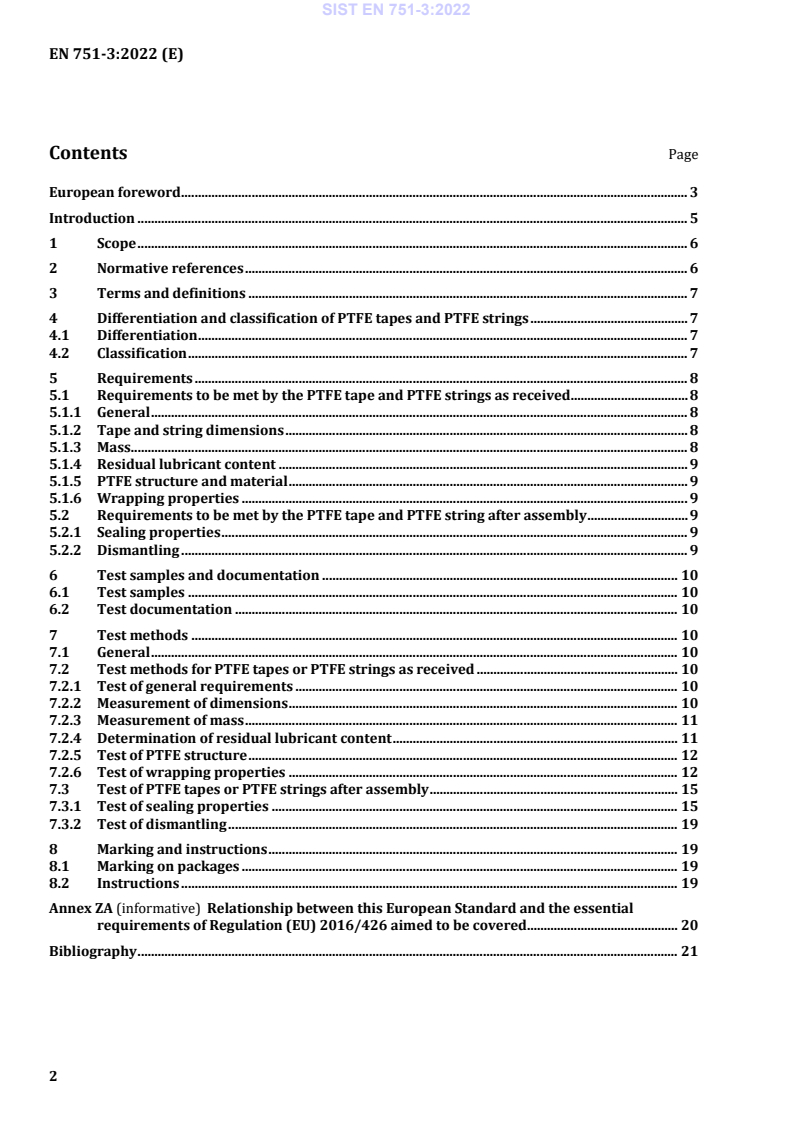
Contents Page
European foreword . 3
Introduction . 5
1 Scope . 6
2 Normative references . 6
3 Terms and definitions . 7
4 Differentiation and classification of PTFE tapes and PTFE strings . 7
4.1 Differentiation . 7
4.2 Classification . 7
5 Requirements . 8
5.1 Requirements to be met by the PTFE tape and PTFE strings as received . 8
5.1.1 General . 8
5.1.2 Tape and string dimensions . 8
5.1.3 Mass . 8
5.1.4 Residual lubricant content . 9
5.1.5 PTFE structure and material . 9
5.1.6 Wrapping properties . 9
5.2 Requirements to be met by the PTFE tape and PTFE string after assembly . 9
5.2.1 Sealing properties . 9
5.2.2 Dismantling . 9
6 Test samples and documentation . 10
6.1 Test samples . 10
6.2 Test documentation . 10
7 Test methods . 10
7.1 General . 10
7.2 Test methods for PTFE tapes or PTFE strings as received . 10
7.2.1 Test of general requirements . 10
7.2.2 Measurement of dimensions . 10
7.2.3 Measurement of mass . 11
7.2.4 Determination of residual lubricant content . 11
7.2.5 Test of PTFE structure . 12
7.2.6 Test of wrapping properties . 12
7.3 Test of PTFE tapes or PTFE strings after assembly . 15
7.3.1 Test of sealing properties . 15
7.3.2 Test of dismantling . 19
8 Marking and instructions . 19
8.1 Marking on packages . 19
8.2 Instructions . 19
Annex ZA (informative) Relationship between this European Standard and the essential
requirements of Regulation (EU) 2016/426 aimed to be covered . 20
Bibliography . 21
European foreword
This document (EN 751-3:2022) has been prepared by Technical Committee CEN/TC 208 “Elastomeric
seals for joints in pipework and pipelines”, the secretariat of which is held by BSI.
This European Standard shall be given the status of a national standard, either by publication of an
identical text or by endorsement, at the latest by December 2022, and conflicting national standards shall
be withdrawn at the latest by December 2022.
Attention is drawn to the possibility that some of the elements of this document may be the subject of
patent rights. CEN shall not be held responsible for identifying any or all such patent rights.
This document supersedes EN 751-3:1996.
This document has been prepared under a Standardization Request given to CEN by the European
Commission and the European Free Trade Association, and supports essential requirements of EU
Directive(s) / Regulation(s).
For relationship with EU Directive(s) / Regulation(s), see informative Annex ZA, which is an integral part
of this document.
The following main technical changes have been made compared to EN 751-3:1996:
a) normative references have been updated;
b) definitions have been added;
c) requirements and tests for strings have been added;
d) differentiation between PTFE tapes and PTFE strings has been added;
e) restriction of use of APFO and PFOA has been added;
f) requirements and testing of mass per area and mass per length have been specified and added;
g) requirements and testing for the PTFE structure and material have been added;
h) wrapping properties have been specified;
i) possibility of adjustment has been deleted;
j) for the determination of residual lubricant content, a thermogravimetric method has been added;
k) for the determination of residual lubricant content, the quantities and associated vessel volumes
were reduced in the analytical method;
l) for the determination of structure and material, DSC method has been added;
m) testing of wrapping properties has been added and specified;
n) requirements for the test samples and their assembly have been added and specified;
o) evaluation of failed samples after assembly has been added;
p) temperature cycling test has been revised and specified;
q) vibration test has been deleted;
r) marking has been clarified;
s) Annex ZA has been added.
The EN 751 series comprises the listed parts:
— Part 1: Anaerobic jointing compounds;
— Part 2: Non-hardening jointing compounds;
— Part 3: Unsintered PTFE tapes and strings.
Any feedback and questions on this document should be directed to the users’ national standards body.
A complete listing of these bodies can be found on the CEN website.
According to the CEN-CENELEC Internal Regulations, the national standards organisations of the
following countries are bound to implement this European Standard: Austria, Belgium, Bulgaria, Croatia,
Cyprus, Czech Republic, Denmark, Estonia, Finland, France, Germany, Greece, Hungary, Iceland, Ireland,
Italy, Latvia, Lithuania, Luxembourg, Malta, Netherlands, Norway, Poland, Portugal, Republic of North
Macedonia, Romania, Serbia, Slovakia, Slovenia, Spain, Sweden, Switzerland, Turkey and the United
Kingdom.
Introduction
This document specifies requirements and test methods for tapes and strings produced from virgin
unsintered polytetrafluorethylene (PTFE) for use with metallic threaded joints. It specifies two classes of
PTFE tapes and PTFE strings – mainly differing in thickness and mass per area – for fine (F) and coarse
(G) threads.
A universally applicable PTFE tape or PTFE string may be used for all gas, potable water and hot water
installation.
In respect of potential adverse effects of the jointing compounds covered by this document on the quality
of water intended for human consumption this document provides no information as to whether the
jointing compounds may be used without restriction in any of the Member States of the EU or EFTA. The
use and characteristics of the jointing compounds should comply with current regulations, where they
exist, depending the acceptance of verifiable European criteria.
Compared to previous standard EN 751-3:1996, this document does not include an assessment of the
turning back properties. It has been determined in practice and during periodic tests that these
properties can only be reproduced to a limited extent. Turning back during installation should be avoided.
Should a connection made with PTFE tapes or threads nevertheless (have to) be turned back during
installation, this is the responsibility of the user. It is common sense that installations are checked for
tightness after completion.
Although PTFE natural colour is white and most common for PTFE tapes and PTFE strings, other colours
may be used as well.
Test practice since the standard was published has shown that the vibration test has not provided any
additional information about the tightness of the threaded connections. Therefore, the test was removed
from the test schedule of the standard.
1 Scope
This document specifies requirements and test methods for unsintered polytetrafluorethylene (PTFE)
tapes and polytetrafluorethylene (PTFE) strings (PTFE tapes or PTFE strings, for short) which are
suitable for sealing threaded metallic joints as specified in EN 10226-1:2004.
This document covers two classes of PTFE tapes and PTFE strings suitable for fine (F) and coarse (G)
threads.
The PTFE tapes and PTFE strings are used as sealing materials for metallic threaded joints in contact with
st nd rd
1 family gases (town gas), 2 family gases (natural gas) and 3 family gases (liquefied petroleum gases
(LPG)) up to 500 kPa, up to 700 kPa for hot water of heating systems, and up to 20 kPa in gas appliances
and their auxiliary equipment. The maximum working pressure covered in this document is 2000 kPa
which is relevant to LPG storage. The temperature range is limited to −20 °C to 125 °C.
2 Normative references
The following documents are referred to in the text in such a way that some or all of their content
constitutes requirements of this document. For dated references, only the edition cited applies. For
undated references, the latest edition of the referenced document (including any amendments) applies.
EN 10242:1994, Threaded pipe fittings in malleable cast iron
EN 10255:2004+A1:2007, Non-alloy steel tubes suitable for welding and threading — Technical delivery
conditions
EN 12164:2016, Copper and copper alloys — Rod for free machining purposes
EN 10226-1:2004, Pipe threads where pressure tight joints are made on the threads — Part 1: Taper
external threads and parallel internal threads — Dimensions, tolerances and designation
EN 10226-3:2005, Pipes threads where pressure tight joints are made on the threads — Part 3: Verification
by means of limit gauges
EN ISO 11357-3:2018, Plastics — Differential scanning calorimetry (DSC) — Part 3: Determination of
temperature and enthalpy of melting and crystallization (ISO 11357-3:2018)
EN ISO 11358-1:2014, Plastics — Thermogravimetry (TG) of polymers — Part 1: General principles
(ISO 11358-1:2014)
This document is currently impacted by the stand-alone amendments EN 10242:1994/A1:1999 and
EN 10242:1994/A2:2003.
3 Terms and definitions
For the purposes of this document, the following terms and definitions apply.
ISO and IEC maintain terminological databases for use in standardization at the following addresses:
— ISO Online browsing platform: available at https://www.iso.org/obp
— IEC Electropedia: available at https://www.electropedia.org/
3.1
PTFE tape
thread sealing tape manufactured from virgin unsintered polytetraflourethylene (PTFE) without fillers
or additives
3.2
PTFE string
thread sealing string manufactured from virgin unsintered polytetraflourethylene (PTFE) without fillers
or additives
Note 1 to entry: PTFE strings are also known as “PTFE cords”.
3.3
gas family
group of gaseous fuels with similar burning behaviour linked together by a range of Wobbe indices
Note 1 to entry: For further information on types of gases see EN 437:2021.
3.4
batch
any quantity of PTFE-tapes or PTFE strings manufactured in a single mix at one time
4 Differentiation and classification of PTFE tapes and PTFE strings
4.1 Differentiation
Tapes and strings differ in their geometry, weight per unit area and application. Both have a rectangular
geometry, whereby the tapes are thin and wide, while the strings are thick and narrow. Therefore, tapes
have to be wrapped overlapping, while strings are wrapped crosswise with a larger number of windings.
In addition, the strings have a greater weight per unit area.
NOTE 1 Typical tape dimensions; 12 mm × 0,10 mm.
NOTE 2 String dimensions; e.g. 2 mm × 0,5 mm, other cross sections are possible.
4.2 Classification
There are two classes of PTFE tapes and PTFE strings suitable only for fine (F) and for fine and coarse (G)
threads in accordance with Table 1.
Table 1 — Classification of PTFE tapes and PTFE strings
Class Thread Nominal size
a
F EN 10226-1:2004 taper/parallel DN ≤ 10
G EN 10226-1:2004 taper/parallel DN ≤ 50
a
Class F tapes and strings may also be used for other dimensions when the number of turns of the thread is
-1
≥ 7,5 cm .
5 Requirements
5.1 Requirements to be met by the PTFE tape and PTFE strings as received
5.1.1 General
PTFE shall be produced without using APFO (ammonium perfluorooctanoate) and PFOA
(perfluorooctanoic acid).
The PTFE tape and PTFE string shall be free from inclusions or imperfections visible to the naked eye and
shall be free from any surface or edge defects, when tested in accordance with 7.2.1.
5.1.2 Tape and string dimensions
5.1.2.1 Length
The actual length of the PTFE tape and PTFE string, when tested in accordance with 7.2.2.1, shall not be
less than that marked on the spool/ dispenser.
5.1.2.2 Width
The actual width of the PTFE tape, when tested in accordance with 7.2.2.2, shall not differ from that
marked on the spool by more than ±0,5 mm.
The actual width of the PTFE string, when tested in accordance with 7.2.2.2, shall not differ from that
marked on the dispenser by more than ±10 %.
5.1.2.3 Thickness
The thickness of the PTFE tape and PTFE string, when tested in accordance with 7.2.2.3, shall not differ
from the stated value by more than ±10 %.
5.1.3 Mass
5.1.3.1 Mass per area for PTFE tapes
The mass per area of the PTFE tape, when tested in accordance with 7.2.3.1, shall be greater than 90 %
of the value declared by the manufacturer, but not less than:
— 60 g/m for class F;
— 100 g/m for class G.
5.1.3.2 Mass per length for PTFE strings
The mass per length of the PTFE string, when tested in accordance with 7.2.3.2, shall be greater than 90 %
of the value declared by the manufacturer, but not less than 0,3 g/m for both classes.
5.1.4 Residual lubricant content
The residual lubricant content of the PTFE tape and PTFE string, when tested in accordance with 7.2.4.1
or 7.2.4.2, shall not exceed 0,1 % by mass.
5.1.5 PTFE structure and material
Using DSC (differential scanning calorimetry) method. The conditions during manufacture shall be such
that the tape or string remains in the unsintered state, during the test in accordance with 7.2.5 a shift or
change in the peak temperature of the initial melting peak shall be given. The enthalpy for the first heating
shall be significantly higher than for the second one. The following peak temperatures shall be met:
— (345 ± 5) °C during heating up from ambient temperature to (380 ± 5) °C;
— (312 ± 5) °C during cooling down from (380 ± 5) °C to (50 ± 5) °C;
— (327 ± 5) °C during heating up from (50 ± 5) °C to (380 ± 5) °C.
NOTE Experience shows that these requirements only can be met by use of virgin materials.
PTFE tapes or PTFE strings shall be manufactured from virgin consistent PTFE that does not contain any
filler (exception of colour) and is free of APFO and/or PFOA.
5.1.6 Wrapping properties
When wrapped around the specified thread in accordance with 7.2.6.1 or 7.2.6.2, the PTFE tape shall
conform to and hold the thread form. The finishing end of the PTFE tape shall remain in position with no
tendency to unwind. During wrapping the PTFE tape shall not break, tear, or split.
When wrapped around the specified thread in accordance with 7.2.6.3 or 7.2.6.4, the PTFE string shall
conform to and hold the thread form. The finishing end of the PTFE string shall remain in position with
no tendency to unwind. During wr
...