

EN 15153-3:2020
(Main)Railway applications - External visible and audible warning devices - Part 3: Visible warning devices for urban rail
- Abstract
This European Standard defines the functional and technical requirements for exterior visible warning devices for urban rail vehicles as defined in the CEN-CENELEC Guide 26, i.e. metro systems, trams, light rail, and local rail systems.
This European Standard also defines the requirements for testing and conformity assessment.
NOTE The requirements for exterior visible warning devices for heavy rail vehicles are found in EN 15153–1.
The decision was taken by simple majority with 14 positive vote(s), 0 negative vote(s) and 9 abstention(s).
- Status
- Published
- Publication Date
- 14-Jan-2020
- Withdrawal Date
- 30-Jul-2020
- Technical Committee
- CEN/TC 256 - Railway applications
- Drafting Committee
- CEN/TC 256/WG 9 - Lighting
- Current Stage
- 9093 - Decision to confirm - Review Enquiry
- Start Date
- 03-Sep-2025
- Completion Date
- 07-Oct-2026



Overview
EN 15153-3:2020 - published by CEN - is the European standard that defines functional and technical requirements for external visible warning devices for urban rail. It covers metro systems, trams, light rail and local rail systems (as defined in CEN‑CENELEC Guide 26) and includes requirements for testing and conformity assessment. EN 15153-3 is Part 3 of the EN 15153 series (visible and audible warning devices); requirements for heavy rail visible devices are in EN 15153-1.
Key topics and technical requirements
- Scope and definitions: clarifies terms such as urban guided transport (UGT), metro, tram, light rail, local rail and device types (head lamp, marker lamp, tail lamp, daytime running lamp, etc.).
- Device application matrix: identifies which visible devices are mandatory, optional or conditional for each vehicle type (Metro, Tram, Light Rail, Local Rail). Examples from the standard:
- Metro vehicles must have at each end two white lamps (head or lower marker lamps) and two red tail lamps as a minimum.
- Upper marker lamps and additional special‑function lamps may be fitted by agreement between contractors.
- Optical limits: combined lamps are allowed if each function’s optical requirements are met. Decorative/additional lights are permitted with luminance limits (each additional light not greater than 30 000 cd·m‑2).
- Positioning and function: lamp positioning, lighting functions (e.g., daytime running lamps, direction indicators, reversing lamps, fog lamps, retro‑reflectors) are covered in the requirements (see Clause 5).
- Testing and conformity: Clause 6 defines test requirements and references EN 15153‑1 and relevant UN ECE regulations for verification and compliance.
Applications and users
Who uses EN 15153-3:2020:
- Rolling stock designers and manufacturers (metro, tram, light rail, local rail)
- System integrators and contractors responsible for vehicle fitment and safety compliance
- Railway operators, infrastructure managers and procurement teams specifying vehicle lighting/warning devices
- Test laboratories and conformity assessment bodies performing verification and certification
Practical uses:
- Specifying compliant exterior lamps and marker systems for new or refurbished urban rail vehicles
- Ensuring interoperable, safe visible warning systems for vehicles operating in mixed urban environments
- Guiding contract requirements between suppliers and operators regarding mandatory vs optional lighting features
Related standards
- EN 15153‑1:2020 - Head, marker and tail lamps for heavy rail (normative reference)
- EN 15153 series (Parts 1–4) and relevant UN ECE lighting regulations referenced for test methods and performance criteria
Keywords: EN 15153-3:2020, visible warning devices, urban rail, metro lighting, tram lamps, light rail safety, railway standards, testing and conformity.
Relations
- Effective Date
- 28-Jan-2026
Get Certified
Connect with accredited certification bodies for this standard

IRIS Certification (UNIFE)
International Railway Industry Standard certification.

TÜV SÜD Rail GmbH
TÜV SÜD railway certification services.

Bureau Veritas Railway Certification
Railway and transportation certification.
Sponsored listings
Frequently Asked Questions
EN 15153-3:2020 is a standard published by the European Committee for Standardization (CEN). Its full title is "Railway applications - External visible and audible warning devices - Part 3: Visible warning devices for urban rail". This standard covers: This European Standard defines the functional and technical requirements for exterior visible warning devices for urban rail vehicles as defined in the CEN-CENELEC Guide 26, i.e. metro systems, trams, light rail, and local rail systems. This European Standard also defines the requirements for testing and conformity assessment. NOTE The requirements for exterior visible warning devices for heavy rail vehicles are found in EN 15153–1. The decision was taken by simple majority with 14 positive vote(s), 0 negative vote(s) and 9 abstention(s).
This European Standard defines the functional and technical requirements for exterior visible warning devices for urban rail vehicles as defined in the CEN-CENELEC Guide 26, i.e. metro systems, trams, light rail, and local rail systems. This European Standard also defines the requirements for testing and conformity assessment. NOTE The requirements for exterior visible warning devices for heavy rail vehicles are found in EN 15153–1. The decision was taken by simple majority with 14 positive vote(s), 0 negative vote(s) and 9 abstention(s).
EN 15153-3:2020 is classified under the following ICS (International Classification for Standards) categories: 45.060.10 - Tractive stock; 45.140 - Metro, tram and light rail equipment. The ICS classification helps identify the subject area and facilitates finding related standards.
EN 15153-3:2020 has the following relationships with other standards: It is inter standard links to EN 15153-1:2020. Understanding these relationships helps ensure you are using the most current and applicable version of the standard.
EN 15153-3:2020 is associated with the following European legislation: Standardization Mandates: M/486. When a standard is cited in the Official Journal of the European Union, products manufactured in conformity with it benefit from a presumption of conformity with the essential requirements of the corresponding EU directive or regulation.
EN 15153-3:2020 is available in PDF format for immediate download after purchase. The document can be added to your cart and obtained through the secure checkout process. Digital delivery ensures instant access to the complete standard document.
Standards Content (Sample)
SLOVENSKI STANDARD
01-marec-2020
Železniške naprave - Zunanje vidne in zvočne opozorilne naprave - 3. del: Vidne
opozorilne naprave za mestno železnico
Railway applications - External visible and audible warning devices - Part 3: Visible
warning devices for urban rail
Bahnanwendungen - Äußere optische und akustische Warneinrichtungen - Teil 3:
Optische Warneinrichtungen für städtische Schienenbahnen
Applications ferroviaires - Dispositifs externes d'avertissement optiques et acoustiques -
Partie 3 : Dispositifs d'avertissement optiques pour le rail urbain
Ta slovenski standard je istoveten z: EN 15153-3:2020
ICS:
45.060.10 Vlečna vozila Tractive stock
45.140 Oprema za podzemne vlake, Metro, tram and light rail
tramvaje in lahka tirna vozila equipment
2003-01.Slovenski inštitut za standardizacijo. Razmnoževanje celote ali delov tega standarda ni dovoljeno.
EN 15153-3
EUROPEAN STANDARD
NORME EUROPÉENNE
January 2020
EUROPÄISCHE NORM
ICS 45.060.10; 45.140
English Version
Railway applications - External visible and audible
warning devices - Part 3: Visible warning devices for urban
rail
Applications ferroviaires - Dispositifs externes Bahnanwendungen - Äußere optische und akustische
d'avertissement optiques et acoustiques - Partie 3 : Warneinrichtungen - Teil 3: Optische
Dispositifs d'avertissement optiques pour le rail urbain Warneinrichtungen für städtische Schienenbahnen
This European Standard was approved by CEN on 6 October 2019.
CEN members are bound to comply with the CEN/CENELEC Internal Regulations which stipulate the conditions for giving this
European Standard the status of a national standard without any alteration. Up-to-date lists and bibliographical references
concerning such national standards may be obtained on application to the CEN-CENELEC Management Centre or to any CEN
member.
This European Standard exists in three official versions (English, French, German). A version in any other language made by
translation under the responsibility of a CEN member into its own language and notified to the CEN-CENELEC Management
Centre has the same status as the official versions.
CEN members are the national standards bodies of Austria, Belgium, Bulgaria, Croatia, Cyprus, Czech Republic, Denmark, Estonia,
Finland, France, Germany, Greece, Hungary, Iceland, Ireland, Italy, Latvia, Lithuania, Luxembourg, Malta, Netherlands, Norway,
Poland, Portugal, Republic of North Macedonia, Romania, Serbia, Slovakia, Slovenia, Spain, Sweden, Switzerland, Turkey and
United Kingdom.
EUROPEAN COMMITTEE FOR STANDARDIZATION
COMITÉ EUROPÉEN DE NORMALISATION
EUROPÄISCHES KOMITEE FÜR NORMUNG
CEN-CENELEC Management Centre: Rue de la Science 23, B-1040 Brussels
© 2020 CEN All rights of exploitation in any form and by any means reserved Ref. No. EN 15153-3:2020 E
worldwide for CEN national Members.
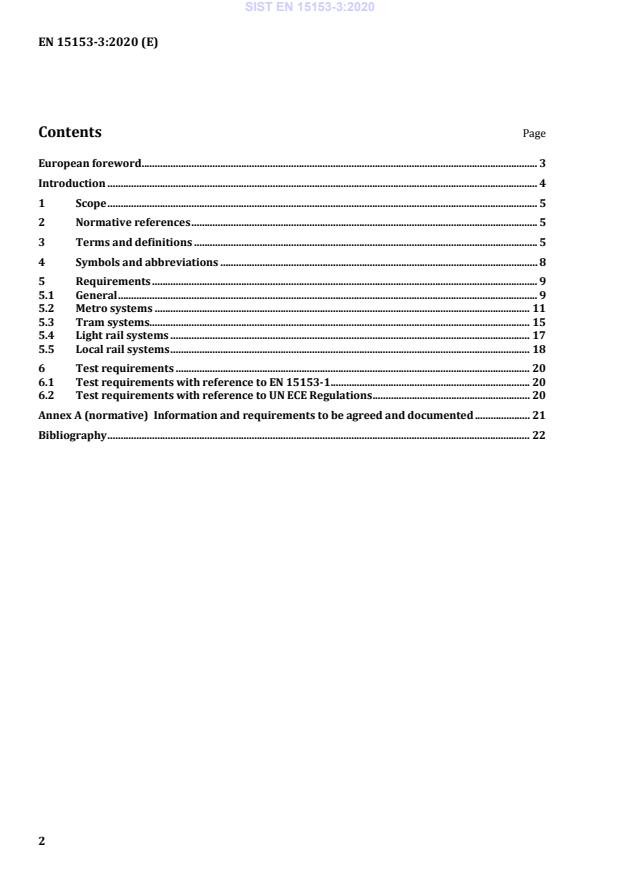
Contents Page
European foreword . 3
Introduction . 4
1 Scope . 5
2 Normative references . 5
3 Terms and definitions . 5
4 Symbols and abbreviations . 8
5 Requirements . 9
5.1 General . 9
5.2 Metro systems . 11
5.3 Tram systems. 15
5.4 Light rail systems . 17
5.5 Local rail systems . 18
6 Test requirements . 20
6.1 Test requirements with reference to EN 15153-1. 20
6.2 Test requirements with reference to UN ECE Regulations . 20
Annex A (normative) Information and requirements to be agreed and documented . 21
Bibliography . 22
European foreword
This document (EN 15153-3:2020) has been prepared by Technical Committee CEN/TC 256 “Railway
applications”, the secretariat of which is held by DIN.
This European Standard shall be given the status of a national standard, either by publication of an
identical text or by endorsement, at the latest by July 2020, and conflicting national standards shall be
withdrawn at the latest by July 2020.
Attention is drawn to the possibility that some of the elements of this document may be the subject of
patent rights. CEN shall not be held responsible for identifying any or all such patent rights.
This series of documents Railway applications — External visible and audible warning devices consists of
the following parts:
— Part 1: Head, marker and tail lamps for heavy rail;
— Part 2: Warning horns for heavy rail;
— Part 3: Visible warning devices for urban rail (this document);
— Part 4: Audible warning devices for urban rail.
According to the CEN-CENELEC Internal Regulations, the national standards organisations of the
following countries are bound to implement this European Standard: Austria, Belgium, Bulgaria,
Croatia, Cyprus, Czech Republic, Denmark, Estonia, Finland, France, Germany, Greece, Hungary, Iceland,
Ireland, Italy, Latvia, Lithuania, Luxembourg, Malta, Netherlands, Norway, Poland, Portugal, Republic of
North Macedonia, Romania, Serbia, Slovakia, Slovenia, Spain, Sweden, Switzerland, Turkey and the
United Kingdom.
Introduction
This document sets out the requirements for external visible warning devices for urban rail vehicles, as
defined in the CEN-CENELEC Guide 26.
1 Scope
This document defines the functional and technical requirements for exterior visible warning devices
for urban rail vehicles as defined in the CEN-CENELEC Guide 26, i.e. metro systems, trams, light rail, and
local rail systems.
This document also defines the requirements for testing and conformity assessment.
NOTE The requirements for exterior visible warning devices for heavy rail vehicles are found in EN 15153–1.
2 Normative references
The following documents are referred to in the text in such a way that some or all of their content
constitutes requirements of this document. For dated references, only the edition cited applies. For
undated references, the latest edition of the referenced document (including any amendments) applies.
EN 15153-1:2020, Railway applications — External visible and audible warning devices – Part 1: Head,
marker and tail lamps for heavy rail
3 Terms and definitions
For the purposes of this document, the following terms and definitions apply.
ISO and IEC maintain terminological databases for use in standardization at the following addresses:
• IEC Electropedia: available at http://www.electropedia.org/
• ISO Online browsing platform: available at https://www.iso.org/obp
3.1
urban guided transport (UGT) systems
system covering metro, tram and light rail, and defined as public transport systems permanently guided
at least by one rail, intended for the operation of local, urban and suburban passenger services with
self-propelled vehicles and operated either segregated or not from general road and pedestrian traffic
Note 1 to entry: Adapted from CEN-CENELEC Guide 26.
3.2
metro system
UGT system operated on its own right of way and segregated from general road and pedestrian traffic;
consequently designed for operations in tunnels, viaducts or on surface level but with physical
separation in such a way that inadvertent access is not possible
Note 1 to entry: In different parts of the world, Metro systems are also known as the underground, the subway
or the tube. Rail systems with specific construction issues operating on a segregated guideway (e.g. monorail, rack
railways) are also treated as Metros as long as they are designated as part of the urban public transport network.
Note 2 to entry: Adapted from CEN-CENELEC Guide 26.
3.3
tram
UGT system not segregated from general road and pedestrian traffic, which shares its right of way with
general road and/or pedestrian traffic and is therefore embedded in its relevant national road traffic
legislation (highway codes and specific adaptations)
Note 1 to entry: Adapted from CEN-CENELEC Guide 26.
3.4
light rail
UGT system operated on parts of the system not segregated from general road and pedestrian traffic,
and on parts of the system with segregated right-of-way. The segregation may include some sections of
line where inadvertent access is not possible
Note 1 to entry: Adapted from CEN-CENELEC Guide 26.
3.5
local rail system
system connecting city centres with their suburban hinterland or regional local centres, operated on
rights of way, which are basically segregated from general road and/or pedestrian traffic and/or which
can be declared by law as independent from the public environment, even if they are not segregated by
location, form of construction or appropriate measures
Note 1 to entry: Local rail systems, by national decision complying with Article 1.3 (a) or (b) of Directive
2008/57/EC, may be excluded from the European Community Rail System.
Note 2 to entry: For historical reasons local rail systems may be strongly influenced by conventional railway
parameters and their operations procedures.
Note 3 to entry: Adapted from CEN-CENELEC Guide 26.
3.6
tram/train
vehicle designed for combined use on both a light-rail infrastructure and a heavy-rail infrastructure
[SOURCE: DIRECTIVE (EU) 2016/797, Article 2, §18, modified – "tram-train means a", at the start of the
definition, deleted.]
3.7
vehicle
the complete assembly of one or more cars
3.8
tramcar
one car of a tram
3.9
head lamp
device fitted to the front of the vehicle that emits white light, intended to provide visual warning of an
approaching vehicle, and/or to illuminate the area immediately in front of the vehicle
[SOURCE: EN 15153–1:2020, 3.2, modified – "train" replaced by "vehicle", "line and lineside", at the end
of the definition, replaced by "area immediately in front of the vehicle".]
3.10
daytime running lamp
lamp facing in a forward direction used to make the vehicle more easily visible when driving during
daytime
[SOURCE: UN ECE Regulation 87]
3.11
direction indicator
lamp used to indicate to other road users that the driver intends to change direction to the right or to
the left
3.12
stop lamp
signal to indicate to other road users to the rear of the vehicle that its driver is applying the brake
Note 1 to entry: Stop lamps are not required to be lit when the vehicle is not in service, for example when
parked.
3.13
hazard warning signal
simultaneous operation of all of a vehicle's direction indicator lamps to show that the vehicle
temporarily constitutes a special danger to other road users
3.14
retro-reflector
device used to indicate the presence of a vehicle by the reflection of light emanating from a light source
not connected to the vehicle, the observer being situated near the source
3.15
front fog lamp
lamp used to improve the illumination of the area ahead of the vehicle in case of fog or any similar
condition of reduced visibility
3.16
rear fog lamp
lamp used to make the vehicle more easily visible from the rear in dense fog
3.17
side marker lamp
lamp used to indicate the presence of the vehicle when viewed from the side
3.18
outline marker lamp
lamp fitted near to the extreme outer edge and as close as possible to the top of the vehicle and
intended to indicate clearly the vehicle's overall width
Note 1 to entry: This lamp is intended, for certain vehicles, to draw particular attention to the bulk of the
vehicle.
3.19
marker lamp
device fitted to the front of the vehicle that emits white light, intended to indicate the presence of a
vehicle, to provide visual warning of an approaching vehicle and/or to illuminate retro-reflective
lineside signs
[SOURCE: EN 15153–1:2020, 3.3, modified – "train" replaced by "vehicle" (three times), Note 1 to entry
deleted.]
3.20
tail lamp
device fitted to the rear of the vehicle that emits red light, intended to indicate the presence of the rail
vehicle
[SOURCE: EN 15153–1:2020, 3.4, modified – "train" replaced by "vehicle", "train" replaced by "rail
vehicle", "and to indicate the end of the complete train formation"deleted, Note 1 to entry deleted.]
3.21
reversing lamp
lamp fitted to the rear of the vehicle, intended to provide visual warning of a reversing vehicle, and/or
to illuminate the area immediately to the rear of the vehicle
[SOURCE: UN ECE Regulation 23]
3.22
light source
system for generating light in a lamp
[SOURCE: EN 15153–1:2020, 3.6]
3.23
optical axis of lamp
axis defined by the manufacturer against which the luminous intensity requirements are assessed
[SOURCE: EN 15153–1:2020, 3.8]
3.24
lit area
active optical area of a lamp projected into a plane perpendicular to the optical axis
[SOURCE: EN 15153–1:2020, 3.10, modified – "onto" replaced by "into".]
3.25
geometric centre
location defined as the ‘centre of gravity’ for the lit area of the lamp
Note 1 to entry: For irregular shaped lamps, this may be outside the lit area.
3.26
contractor
organization responsible for
— the design, manufacture or supply of the visible warning devices; and
— the purchase, installation or use of the visible warning devices
4 Symbols and abbreviations
For the purposes of this document, the following symbols and abbreviations apply.
−2
cd·m Candela per square metre, the SI unit of luminance
LED Light Emitting Diode
5 Requirements
5.1 General
The technical requirements for visible warning devices on metro vehicles, trams, light rail, and local rail
vehicles are set out in 5.2, 5.3, 5.4 and 5.5 (respectively). The testing requirements are set out in
Clause 6.
The application requirements are set out in Table 1.
Table 1 — Application requirements for visible warning devices on urban rail vehicles
Visible warning device Local rail
Tram
vehicle
(including
(including
Metro Light rail tram/trains
tram/trains
vehicle vehicle operating
operating
Device type Number
on heavy
on city /
rail infra-
street level)
structure)
Head lamps 2 M M M
a
M
Marker lamps 2 - - M
Daytime
b b b
2 -
M M M
running lamps
Direction
f f f
N -
M M M
indicators
Tail lamps 2 M M M M
Stop lamps 2 - M M M
Hazard warning
N - M M M
lamps
Rear-mounted
N - M M M
retro-reflectors
Reversing
c c c
1 or 2 -
M M M
lamp(s)
Front fog
2 - O O O
lamp(s)
Upper marker
1 O O O M
lamp
Outline marker
N - O O O
lamps
Minimum
Side marker
- O O O
d
lamps
Rear fog
e e
1 or 2 - O
O O
lamp(s)
Minimum
Side retro-
- M M O
d
reflectors
Key
M = mandatory
N = depends on the vehicle configuration
O = optional
Visible warning device Local rail
Tram
vehicle
(including
(including
Metro Light rail tram/trains
tram/trains
vehicle vehicle operating
operating
Device type Number
on heavy
on city /
rail infra-
street level)
structure)
a
As a minimum, the specified number of one device type shall be fitted.
b
This may be the lit dipped head lamps according to 5.3.2.2.
c
In the case of bi-directional vehicles, this may be the head lamps.
d
Per each side of the vehicle.
e
by agreement between contractors, these may be mandatory
f
by agreement between contractors, these may be optional
5.2 Metro systems
5.2.1 Provision of visible warning devices on metro systems
As a minimum, vehicles operating on metro systems shall be fitted with the following exterior visible
warning devices at each end of the vehicle:
a) two white lamps, which may be head lamps or lower marker lamps, or a combination;
b) two red tail lamps.
Additionally, and only by agreement between the contractors, one upper marker lamp may be installed.
The upper marker lamp may be the lit destination indicator. If a destination indicator is not provided,
the upper marker lamp shall follow the requirements set out in 5.2.2.2.3.
Only by agreement between the contractors, additional tail lamp(s) and marker lamp(s) with special
warning or signalling functions may be installed, provided that they comply with the prescribed optical
requirements and that they do not adversely affect the parameters given in this document.
Combined lamps (i.e. lamps capable of different functions) are permissible provided that the
requirements for individual lamp functions are achieved.
Additional lights may be provided for decorative lighting, to reflect the current design of metro vehicles.
−2
In this case, the luminance of each additional light shall be not greater than 30 000 cd·m .
NOTE This is close to the maximum permissible luminance limit for dimmed lower marker lamps as defined
in EN 15153–1:2020, 5.4.2 and 5.4.4.
5.2.2 Requirements for visible warning devices on metro systems
5.2.2.1 Positioning of lamps
5.2.2.1.1 General
The positioning of head, marker and tail lamps shall be as set out in 5.2.2.1.2, 5.2.2.1.3 and 5.2.2.1.4
respectively.
5.2.2.1.2 Positioning of head lamps
The two head lamps shall both be located at the same height, with their geometric centres above the
floor level of the driver’s cab or the passenger compartment, whichever is the lower.
NOTE The intention is to leave this requirement open for different vehicle designs.
The arrangement of the two head lamps shall be such that the distance between their geometric centres
is not less than 50 % of the width of the vehicle and they shall be arranged symmetrically about the
centre line of the vehicle.
5.2.2.1.3 Positioning of marker lamps
The two lower marker lamps shall be located at the same height, with their geometric centres above the
floor level of the driver’s cab or the passenger compartment, whichever is the lower.
NOTE The intention is to leave this requirement open for different vehicle designs.
The arrangement of the two marker lamps shall be such that the distance between their geometric
centres is not less than 50 % of the width of the vehicle and they shall be arranged symmetrically about
the centre line of the vehicle.
Where fitted, the upper marker lamp shall be located centrally and above the lower marker or head
lamps. The vertical separation between the geometric centre of the upper marker lamp and the lower
marker or head lamps shall be equal to or greater than 600 mm.
5.2.2.1.4 Positioning of tail lamps
The two tail lamps shall be located at the same height, with their geometric centres above the floor level
of the driver’s cab or the passenger compartment, whichever is the lower.
NOTE The intention is to leave this requirement open for different vehicle designs.
The arrangement of the two tail lamps shall be such that the distance between their geometric centres
is not less than 50 % of the width of the vehicle and they shall be arranged symmetrically about the
centre line of the vehicle.
5.2.2.2 Lamp requirements
5.2.2.2.1 General
On a given vehicle, each head / marker / tail lamp type shall be of the same design.
NOTE Mixing of individual lamp types is not permissible, for example it is permissible to use two head lamps
based on EN 15153-1 or two head lamps based on the applicable UN/ECE Regulation. However, it is not
permissible to use one head lamp based on EN 15153-1 and the other based on the applicable UN/ECE Regulation.
5.2.2.2.2 Head lamps
5.2.2.2.2.1 General
Where provided, head lamps should comply with UN/ECE Regulation 113, or the requirements of
5.2.2.2.2.2 to 5.2.2.2.2.5 of this docume
...