

CEN/TR 17920:2023
(Main)BIM in infrastructure - Standardization need and recommendations
- Abstract
The scope of this document is as per the scope of CEN/TC 442/WG 6, that is:
- Identify key stakeholders.
- Investigate existing activities within standardization for BIM in infrastructure (3.1).
- Formulate the need for standardization related to the implementation of BIM for infrastructure (3.1) in Europe, not covered by existing standards and ongoing standards development.
- Make recommendation on whether standards are to be developed and if so, how this can be done.
For the purpose of this document, the term 'BIM standards' is a loose reference to standards available for the use of BIM, including those under the responsibility of CEN/TC 442, ISO/TC 211 and ISO/TC 59. It is not a defined term.
- Status
- Published
- Publication Date
- 07-Feb-2023
- Technical Committee
- CEN/TC 442 - Building Information Modelling (BIM)
- Drafting Committee
- CEN/TC 442/WG 6 - Infrastructure
- Current Stage
- 6060 - Definitive text made available (DAV) - Publishing
- Start Date
- 08-Feb-2023
- Due Date
- 14-Mar-2023
- Completion Date
- 08-Feb-2023



Overview
CEN/TR 17920:2023 - “BIM in infrastructure – Standardization need and recommendations” is a CEN technical report produced by CEN/TC 442/WG 6. It investigates the standardization needs for Building Information Modelling (BIM) in infrastructure across Europe, identifies key stakeholders, maps existing standardization activity, highlights gaps where current standards do not meet infrastructure needs, and makes recommendations on whether and how standards should be developed or revised.
Key topics and technical focus
This report structures its analysis around the EN ISO 19650 series and covers practical BIM topics for infrastructure projects including:
- Stakeholder engagement and analysis (asset owners, national transport authorities, consortia, professional bodies, software vendors)
- Survey findings and case studies to capture real-world requirements and practices
- Current initiatives and standards landscape, including CEN/TC 442, ISO/TC 211, ISO/TC 59 (and related subcommittees), buildingSMART™, OGC and national programmes
- Information requirements and security considerations (cross-referenced to EN ISO 19650-5)
- Information delivery cycle and lifecycle stages specific to infrastructure vs buildings
- Project and asset information management functions
- Delivery team capability and capacity
- Information container models and collaborative working
- Information delivery planning, model federation and domain-oriented models
- Managing collaborative production of information, classification and Common Data Environment (CDE) workflows
- Annexes with examples, case studies and survey details
Practical applications - who uses this standard
This technical report is a guidance and scoping document rather than a normative standard. Practical users and beneficiaries include:
- Infrastructure asset owners and operators (rail, road, water, utilities) seeking to align BIM requirements with standards
- National and regional transport authorities defining procurement and lifecycle information policies
- BIM managers, information managers and project teams planning information delivery, CDEs and federated models
- Standards bodies and working groups assessing gaps and prioritizing standard development
- Software vendors and system integrators aligning tools to emerging European requirements
- Industry consortia and professional bodies coordinating interoperability and best practices
Related standards and initiatives
- EN ISO 19650 series (information management for the built environment)
- EN ISO 19650-5 (security-minded approaches)
- CEN/TC 442 (BIM), ISO/TC 211, ISO/TC 59 and other ISO subcommittees
- Industry consortia: buildingSMART™, Open Geospatial Consortium (OGC), Conference of European Directors of Roads (CEDR)
This report is a resource for aligning infrastructure BIM practice with European standardization, informing future standards work and helping practitioners adopt interoperable, lifecycle-focused information management.
Relations
- Effective Date
- 09-Feb-2026
- Effective Date
- 28-Jan-2026
Get Certified
Connect with accredited certification bodies for this standard

BSI Group
BSI (British Standards Institution) is the business standards company that helps organizations make excellence a habit.

NYCE
Mexican standards and certification body.
Sponsored listings
Frequently Asked Questions
CEN/TR 17920:2023 is a technical report published by the European Committee for Standardization (CEN). Its full title is "BIM in infrastructure - Standardization need and recommendations". This standard covers: The scope of this document is as per the scope of CEN/TC 442/WG 6, that is: - Identify key stakeholders. - Investigate existing activities within standardization for BIM in infrastructure (3.1). - Formulate the need for standardization related to the implementation of BIM for infrastructure (3.1) in Europe, not covered by existing standards and ongoing standards development. - Make recommendation on whether standards are to be developed and if so, how this can be done. For the purpose of this document, the term 'BIM standards' is a loose reference to standards available for the use of BIM, including those under the responsibility of CEN/TC 442, ISO/TC 211 and ISO/TC 59. It is not a defined term.
The scope of this document is as per the scope of CEN/TC 442/WG 6, that is: - Identify key stakeholders. - Investigate existing activities within standardization for BIM in infrastructure (3.1). - Formulate the need for standardization related to the implementation of BIM for infrastructure (3.1) in Europe, not covered by existing standards and ongoing standards development. - Make recommendation on whether standards are to be developed and if so, how this can be done. For the purpose of this document, the term 'BIM standards' is a loose reference to standards available for the use of BIM, including those under the responsibility of CEN/TC 442, ISO/TC 211 and ISO/TC 59. It is not a defined term.
CEN/TR 17920:2023 is classified under the following ICS (International Classification for Standards) categories: 35.240.67 - IT applications in building and construction industry. The ICS classification helps identify the subject area and facilitates finding related standards.
CEN/TR 17920:2023 has the following relationships with other standards: It is inter standard links to ISO 6707-1:2020, EN ISO 19650-1:2018. Understanding these relationships helps ensure you are using the most current and applicable version of the standard.
CEN/TR 17920:2023 is available in PDF format for immediate download after purchase. The document can be added to your cart and obtained through the secure checkout process. Digital delivery ensures instant access to the complete standard document.
Standards Content (Sample)
SLOVENSKI STANDARD
01-april-2023
BIM v infrastrukturi - Potreba po standardizaciji in priporočila
BIM in infrastructure - Standardization need and recommendations
BIM in der Infrastruktur - Normungsbedarf und Empfehlungen
Modélisation des informations de la construction (BIM) applicable dans les
infrastructures - Besoin de normalisation et recommandations
Ta slovenski standard je istoveten z: CEN/TR 17920:2023
ICS:
01.120 Standardizacija. Splošna Standardization. General
pravila rules
35.240.67 Uporabniške rešitve IT v IT applications in building
gradbeništvu and construction industry
2003-01.Slovenski inštitut za standardizacijo. Razmnoževanje celote ali delov tega standarda ni dovoljeno.
CEN/TR 17920
TECHNICAL REPORT
RAPPORT TECHNIQUE
February 2023
TECHNISCHER REPORT
ICS 35.240.67
English Version
BIM in infrastructure - Standardization need and
recommendations
Modélisation des informations de la construction (BIM) BIM in der Infrastruktur - Normungsbedarf und
applicable dans les infrastructures - Besoin de Empfehlungen
normalisation et recommandations
This Technical Report was approved by CEN on 30 January 2023. It has been drawn up by the Technical Committee CEN/TC 442.
CEN members are the national standards bodies of Austria, Belgium, Bulgaria, Croatia, Cyprus, Czech Republic, Denmark, Estonia,
Finland, France, Germany, Greece, Hungary, Iceland, Ireland, Italy, Latvia, Lithuania, Luxembourg, Malta, Netherlands, Norway,
Poland, Portugal, Republic of North Macedonia, Romania, Serbia, Slovakia, Slovenia, Spain, Sweden, Switzerland, Türkiye and
United Kingdom.
EUROPEAN COMMITTEE FOR STANDARDIZATION
COMITÉ EUROPÉEN DE NORMALISATION
EUROPÄISCHES KOMITEE FÜR NORMUNG
CEN-CENELEC Management Centre: Rue de la Science 23, B-1040 Brussels
© 2023 CEN All rights of exploitation in any form and by any means reserved Ref. No. CEN/TR 17920:2023 E
worldwide for CEN national Members.
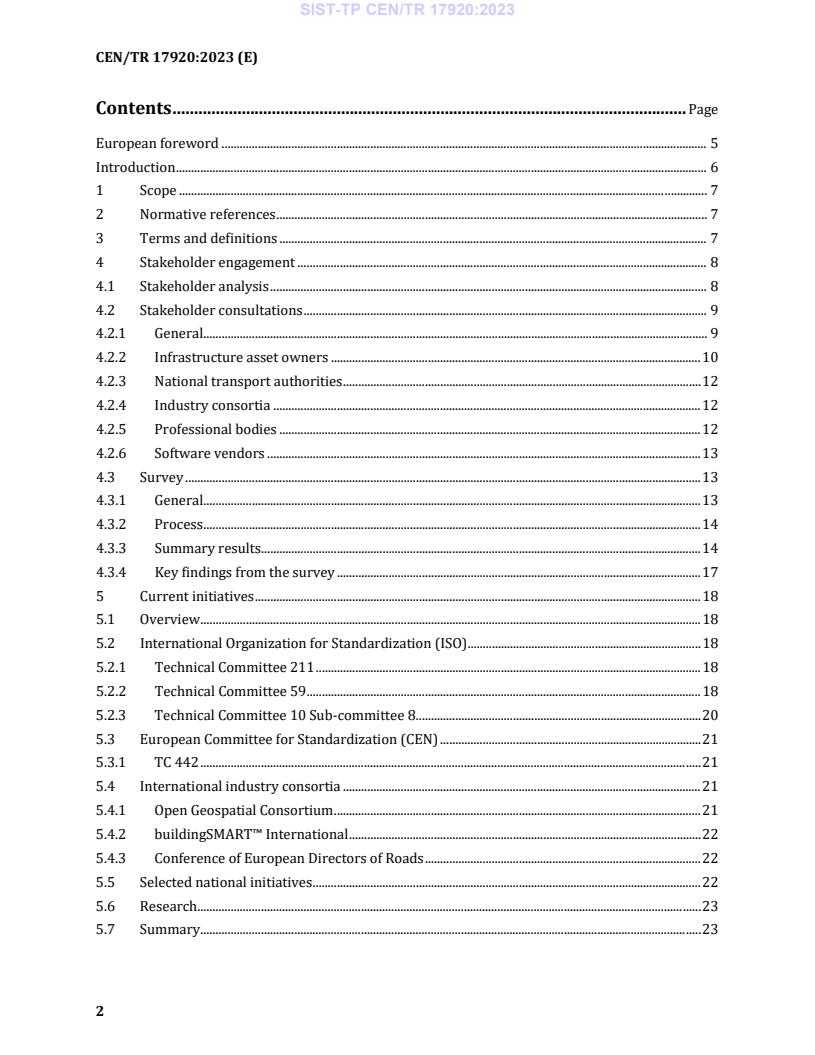
Contents . Page
European foreword . 5
Introduction . 6
1 Scope . 7
2 Normative references . 7
3 Terms and definitions . 7
4 Stakeholder engagement . 8
4.1 Stakeholder analysis . 8
4.2 Stakeholder consultations . 9
4.2.1 General . 9
4.2.2 Infrastructure asset owners . 10
4.2.3 National transport authorities . 12
4.2.4 Industry consortia . 12
4.2.5 Professional bodies . 12
4.2.6 Software vendors . 13
4.3 Survey . 13
4.3.1 General . 13
4.3.2 Process . 14
4.3.3 Summary results . 14
4.3.4 Key findings from the survey . 17
5 Current initiatives . 18
5.1 Overview . 18
5.2 International Organization for Standardization (ISO) . 18
5.2.1 Technical Committee 211 . 18
5.2.2 Technical Committee 59 . 18
5.2.3 Technical Committee 10 Sub-committee 8 . 20
5.3 European Committee for Standardization (CEN) . 21
5.3.1 TC 442 . 21
5.4 International industry consortia . 21
5.4.1 Open Geospatial Consortium . 21
5.4.2 buildingSMART™ International . 22
5.4.3 Conference of European Directors of Roads . 22
5.5 Selected national initiatives . 22
5.6 Research . 23
5.7 Summary . 23
6 Information requirements . 23
6.1 Relative characteristics of information management for infrastructure assets . 23
6.1.1 General . 23
6.1.2 Security minded approach to information management according to EN ISO 19650-5 [16]
6.2 Key findings . 24
7 The information delivery cycle. 24
7.1 Relative characteristics of BIM for infrastructure . 24
7.2 Common stages of an infrastructure project . 25
7.2.1 General . 25
7.2.2 Considerations on EN ISO 19650-2 [17] . 26
7.2.3 Considerations on EN ISO 19650-3 [3] . 27
7.3 Key findings . 29
8 Project and asset information management functions . 29
8.1 General . 29
8.2 Relative characteristics of BIM for infrastructure . 29
8.3 Key findings . 30
9 Delivery team capability and capacity . 30
9.1 Overview . 30
9.2 Relative characteristics of BIM for infrastructure . 31
9.3 Key findings . 31
10 Information container-based collaborative working . 32
10.1 General . 32
10.2 Relative characteristics of BIM for infrastructure . 32
10.3 Key findings . 33
11 Information delivery planning . 33
11.1 Models and data . 33
11.2 Federation of the models . 33
11.2.1 General . 33
11.2.2 Information model . 34
11.2.3 Model federated for purpose . 34
11.2.4 Domain oriented model . 34
11.3 Introduction to information production for infrastructure (3.1) . 34
11.4 Commonly applied information requirements for infrastructure assets . 34
12 Managing the collaborative production of information . 37
12.1 Relative characteristics of information requirements for infrastructure (Classification) . 37
12.2 Key findings . 41
13 Common data environment (CDE) solution and workflow . 41
13.1 Relative characteristics of BIM for infrastructure (3.1) . 41
13.1.1 CDE solution capabilities . 41
13.1.2 CDE Guidance . 42
13.2 Key findings . 42
14 Conclusions . 43
15 Recommendations . 43
Annex A (informative) Examples and case studies . 45
Annex B (informative) Survey details . 63
Bibliography . 65
European foreword
This document (CEN/TR 17920:2023) has been prepared by Technical Committee CEN/TC 442
“Building Information Modelling (BIM)”, the secretariat of which is held by Standards Norway.
Attention is drawn to the possibility that some of the elements of this document may be the subject
of patent rights. CEN shall not be held responsible for identifying any or all such patent rights.
Any feedback and questions on this document should be directed to the users’ national standards
body. A complete listing of these bodies can be found on the CEN website.
Introduction
CEN/TC 442 is the European technical committee for standardization in the field of structured
semantic life cycle information for the built environment. CEN/TC 442 has published numerous
European standards for BIM in recent years, and many others are in development. Most of this
standardization effort has been in collaboration with international organizations, especially ISO/TC
59/SC 13, the international standardization committee for organization and digitization of
information about buildings and civil engineering works, including building information modelling
(BIM).
There is a perception that the information requirements of stakeholders in the infrastructure (3.1)
domain are not as well served by European and international standards as the requirements of those
in the buildings domain. CEN/TC 442 Working Group 6 (WG 6), Infrastructure, was established to
identify stakeholders in the infrastructure (3.1) domain, ascertain their needs in relation to
standardization for BIM, review if those needs are met by current and forthcoming standards, and,
accordingly, make recommendations for the development or revision of standards.
This document presents the findings and recommendations of CEN/TC 442/WG 6. The report is
intended to inform future work of CEN/TC 442. In its current work-in-progress state, this report is
also intended to support consultation by WG 6 with other working groups within CEN/TC 442 on the
basis that those working groups are more familiar with the standards for which they are responsible
and the associated standardization efforts.
The process for identification of relevant stakeholder groupings and the results of engagement with
selected stakeholders are presented in Clause 4. Engagement included discussions with stakeholders
at a national level and survey of stakeholders across Europe. Selected current initiatives for
standardization of BIM for infrastructure (3.1) are discussed in Clause 5. Clauses 6 through 13 are
structured to correspond to EN ISO 19650-1:2018, Clauses 5 through 12. Based on the analyses
conducted by Working Group 6, each clause discusses the characteristics of BIM for infrastructure
(3.1) relative to those of BIM for buildings, in the context of the relevant standards. The key question
asked in each case is if the standards suitably meet the needs of infrastructure. Key findings are then
presented in each case.
The findings are summarized in Clause 14 and recommendations are provided in Clause 15. In
addition to looking broadly across the range of BIM standards, Working Group 6 investigated some
detailed use cases to enable contextualisation of analyses within real-life industry practice. Annex A
presents details of selected case studies analysed. Annex B provides the questions fromt the industry
survey.
As of August 2022, Working Group 6 is in the processes of final editing and refinement of this report.
This should be borne in mind by those reviewing this work-in-progress report issued for the purpose
of internal CEN/TC 442 consideration.
1 Scope
The scope of this document is as per the scope of CEN/TC 442/WG 6, that is:
— Identify key stakeholders.
— Investigate existing activities within standardization for BIM in infrastructure (3.1).
— Formulate the need for standardization related to the implementation of BIM for infrastructure
(3.1) in Europe, not covered by existing standards and ongoing standards development.
— Make recommendation on whether standards are to be developed and if so, how this can be done.
For the purpose of this document, the term 'BIM standards' is a loose reference to standards available
for the use of BIM, including those under the responsibility of CEN/TC 442, ISO/TC 211 and
ISO/TC 59. It is not a defined term.
2 Normative references
The following documents are referred to in the text in such a way that some or all of their content
constitutes requirements of this document. For dated references, only the edition cited applies. For
undated references, the latest edition of the referenced document (including any amendments)
applies.
EN ISO 19650-1:2018, Organization and digitization of information about buildings and civil
engineering works, including building information modelling (BIM) - Information management using
building information modelling - Part 1: Concepts and principles (ISO 19650-1:2018)
ISO 6707-1:2020, Buildings and civil engineering works — Vocabulary — Part 1: General terms
3 Terms and definitions
For the purposes of this document, the terms and definitions given in ISO 6707-1:2020 and
EN ISO 19650-1:2018 apply.
ISO and IEC maintain terminological databases for use in standardization at the following addresses:
— IEC Electropedia: available at http://www.electropedia.org/
— ISO Online browsing platform: available at http://www.iso.org/obp
3.1
infrastructure
system of fixed assets needed for the operation of an organization
Note 1 to entry: For the purpose of this document, infrastructure is taken to cover civil assets and exclude
building assets.
Note 2 to entry: Examples include a structure such as a dam, bridge, road, railway, runway, utilities, pipeline,
or sewerage system, or the result of operations such as dredging, earthwork, geotechnical processes. [Adapted
from ISO 6707-1:2004]
[SOURCE: Adapted from EN ISO 9000:2015 [1] and ISO 50007:2017 [2]]
3.2
class
category or division of things based on one or more criteria for inclusion and exclusion
[SOURCE: EN ISO 15926-1:2004, 3.1.1, notes removed]
3.3
classification
process of assigning objects to classes according to criteria
[SOURCE: ISO 22274:2013, 3.5]
4 Stakeholder engagement
4.1 Stakeholder analysis
The scope of work for this document included identifying key stakeholders and investigating existing
activities. At the outset, a list of typical stakeholder types was identified, broadly grouped under
organization types and professions. The stakeholder types were classified under two criteria with
regard to international standardization of BIM for infrastructure (3.1) in Europe:
— Their power to influence adoption of standards.
— Their interest in the adoption of standards.
Refer to Figure 1 for a matrix of the analysis results. This represents a typical condition rather than
that in any one country. Selected stakeholders were omitted or grouped for ease of presentation. Key
stakeholders for engagement during the development of this document were identified as those with
high power and high interest.
Figure 1 — Stakeholder analysis matrix
4.2 Stakeholder consultations
4.2.1 General
Based on the results of the stakeholder analysis, stakeholders were engaged as discussed below. This
engagement was either direct as part of this study or indirect as part of the authors’ activities with
national standards organizations, industry bodies, research or professional work. The engagement
considered the stakeholders’ perspectives on the need for standardization related to the
implementation of BIM for infrastructure (3.1) in Europe, and whether or not current European
standards address that need.
4.2.2 Infrastructure asset owners
With reference to the clause on national transport authorities, the focal point of this part looks into
different type of asset owners as road, rail, airports, waterways etc. Multiple asset owners from every
country are managing their assets to the best of their ability but may be limiting active sharing of
their management methods and structures, with the potential to benefit other asset owners of the
same category. Figure 2 shows collaboration between infrastructure owners.
Infrastructure asset owners and operators are largely the same; the owners take over from the
contractor after a new construction is done or when an ongoing operation task is done, by way of
renovated/replaced assets, whereas the operators assume the responsibility for the on-going
maintenance. Owners of infrastructure (3.1), being either state owned or privately owned (private
networks, railways located on industrial production sites, etc.), usually focus on the return on
investment (profit/service achieved) (ISO/TR 21245). Power supply companies are themselves
infrastructure asset owners, e.g. owning their pipelines as well as network supply companies are
owning their cables, where others telecom suppliers are renting to the infrastructure (3.1). Usually,
infrastructure (3.1) as road, rail, runways are owned and maintained by the owners (national
government authorities or agencies), while transport modes as
(train/vehicle/heating/water/network) running on rail-tracks/roads/pipes, will be owned by
private people or companies.
Figure 2 — Collaboration across infrastructure owners
In the life cycle of assets, we again look to the following succession of life cycle stages (Figure 4, 7.2)
belonging to the infrastructure (3.1) asset owners: stage 1 is planning and, after construction in
stage 4, when the asset owner takes over, they act in stage 5, which is handover. Stage 6, which is
operation, and stage 7, which is demolition. The delivery period of an infrastructure (3.1) project is
often extended and can have several starts and stops in the process, due to environmental, public
involvement, political or economic reasons. As such, stage 2-4 can span several years, which is why
the delivery of project data needs to be predictable, well-structured and can be applied to the
handover and operations in a systematic way.
Asset ownership demands can be enforced from the very beginning of an early design phase and
requires satisfactory deliverables in each subsequent stage. EN ISO 19650-3 [3] emphasizes the
importance of setting up a clear information standard as well as information production methods
and procedures. This entails the structuring and classification (3.3) of information between asset
owners, to ensure that information is useful in a handover to any future operational phase delivery.
A progressive delivery of information needs to satisfy, at any all stage, the infrastructure (3.1) asset
owner. They need to be eligible to look back through the asset information, e.g. to analyse the purpose
of the asset, executed pre-scheduled maintenance and activities as well as reasons for any
unscheduled maintenance activities, in the prior life of the asset. It is very important in the delivery
phase, that information not only describes the finished and delivered construction, but also provides
critical information for owners to maintain their assets.
Industry collaboration
Infrastructure asset owners need a common toolbox that helps them align with each of their projects,
allowing for easier collaboration with fewer misunderstandings. The required toolbox could include
specialized software, Common data environments or organizational structures that lend themselves
to integrated, knowledge-sharing practices in asset management, to incentivize new collaboration
between asset owners, in the exchange of methods and processes for common, continuous
improvement.
Collaboration across infrastructure asset owners could lead to multiple benefits by sharing
integration and co-working solutions, or the appropriate way to apply the softwares they use to
manage their project to execute a work order. One obvious development could be to engage in cross-
organizational pilot projects with multiple asset owners, where they each provide input by sharing
experiences. The diagram shown in Figure 2 above is a proposed workflow, potentially ensuring the
collaboration of asset management ownership e.g. between national authorities/infrastructure
owners and private companies (client/contractors), to benefit from each other’s data.
On the basis of this process, retrieving classified object data according to the needs of other asset
owners to compare work differences would be a valuable enhancement, e.g. by having an object
library to benefit both asset owners, knowing the object by the same name, settling for a common
syntax and name attribution. Infrastructure assets are not necessarily physical construction objects,
but it can be virtual and that information, in and of itself, should be treated as an asset too. It can be
represented by a part of or a collection or a derivative of physical components.
When looking at infrastructure asset owners who have their individual asset systems without
collaboration, the individual initiatives can be useful on their own, but not across the several projects
that make up national infrastructure. For this reason it is useful to make a common classification
(3.3) library which indicates similar or equal classification (3.3) codes across projects. Infrastructure
asset owners can benefit from using classification (3.3) to have control of information models,
tender/bidding material, asset information model etc. The value for asset owners will be generated
through modelling individual objects. When a classification (3.3) code is generated for an object, it
will initially be placed in a three-dimensional model, after which it will be distributed to the correct
hierarchical position in an asset management system. From the code, every infrastructure asset
owner will be able to read the object due to common coding.
Moreover, as level of information need is a commonly used approach to simplify object
understanding and delivery details, a designer can produce a model or its objects in the required
level of detail, whereafter a contractor builds the component exactly, with respect to the designed
detail and delivers a physical structure and its related information package to asset owners, so the
infrastructure asset owner is able to continue maintaining their asset through as-built information.
Additional information can be found in the technical report produced on behalf of buildingSMART™:
Infrastructure Asset Management and a report “Built environment data standards and their
integration: an analysis of IFC, CityGML and LandInfra (bSI&OGC)”.
4.2.3 National transport authorities
Engagement with national transport authorities (e.g. road, rail, airports and waterways) has shown
that there is a need for consistently-adopted European standards for BIM for infrastructure (3.1).
These authorities seek to procure and manage asset information to enable improved outcomes for
transport network safety and efficiency. However, the wide variety of historical, current and
forthcoming organizational, national and international standards leads to inconsistent approaches
within and between organizations. Further, inadequate interoperability in legacy information
management systems and data formats means that deriving value from historical and new
information is very challenging.
Transport authorities wish to adopt standards when procuring and managing asset information.
However, often they are concerned that adopting standards for which there is not yet a critical mass
of industry adoption could lead to inefficient investment. As such, the authorities need suitable
standards but also the associated use cases for application, data dictionaries / object type libraries,
software applications and databases, and industry knowledge that facilitate effective adoption.
Ironically, in the absence of consistent, wide scale demand from large public and private clients such
as national transport authorities, the industry supply chain and software vendors are less likely to
invest in adopting these BIM standards in a consistent manner.
4.2.4 Industry consortia
Working Group 6 engaged with industry consortia through liaison and through common
representation across bodies. Major international industry consortia such as buildingSMART™ and
Open Geospatial Consortium (OGC) develop standards, some of which progress to being international
standards. Feedback showed that such bodies have ongoing activities addressing the needs of
infrastructure domain stakeholders.
For example, The Infrastructure Room (commonly referred to as InfraRoom) within
buildingSMART™ was established in 2013 to address the limited support for infrastructure (3.1)
within the IFC data model. The InfraRoom is led by an elected Steering Committee with
representation from industry, owner, academic and software stakeholders. The first project
undertaken was known as IFC 4.1 that provided a general definition of an alignment such as the
centreline of a road, track, kerb or other linear feature. This new entity was needed to support linear
rather than coordinate referencing, which is typically adopted in infrastructure (3.1). The InfraRoom
has extended the coverage to include IFC extensions for bridges (interim release as IFC 4.2), roads,
ports and waterways, common schema elements and is working on tunnel entities. The InfraRoom
works in close cooperation with the Railway Room who together have delivered IFC 4.3 as a new
production standard for validation. Once finalized with core MVDs and available software
certification, IFC 4.3 will form part of the next release of EN ISO 16739-1 [4], which is expected in
2023.
4.2.5 Professional bodies
Professional bodies represent the interests of their members. These bodies can be quite influential
at a national level, both in relation to the professional practices of their members and through
lobbying of government. Many such bodies have BIM committees that have supported and promoted
the consistent adoption of BIM, often through collaboration with other professional bodies. Prior to
the publication of international BIM standards, the work of professional body BIM committees often
involved the development and publication of guidelines, templates and recommendation, which
became de facto industry standards.
Now that international BIM standards are available, there is a risk that some professional bodies
continue to promote the legacy national practices, which could impede the effective implementation
of international standards. It is important to make sure that professional bodies have sound
knowledge and understanding of relevant international standards within their field of expertise to
avoid confusion and to support consistent adoption of open BIM.
4.2.6 Software vendors
Software applications used in the infrastructure (3.1) sector are fundamental to effective project and
asset information management. Software vendors are considering the importance of developing and
updating tools in accordance to open formats compatibility (e.g. Industry Foundation Classes –
EN ISO 16739-1 [4], InfraGML, CityGML and LandXML) and information management processes.
Typically, these implementations have required significant investment by software vendors. More
recently, there is a trend towards sharing of open source software modules such that implementation
of open BIM functionality within software applications is more financially viable, especially for
smaller vendors.
There is a significant need for implementation of new open standards: for example, buildingSMART™
international is leading several Rooms (groups of specialists who work together to improve the built
environment) for Infrastructure, Railway, Airport and more, to develop and deploy open digital
information models for infrastructure (3.1). Further information about current initiatives are
reported in Clause 5.
Considering the efforts around open BIM and the life cycle stages for infrastructure (3.1), it is critical
that software houses develop and maintain applications according to every stage and stakeholder
need. Ideally for software vendors, this would be in response to a clear market demand for such
functionality. However, in some cases public clients are reluctant to adopt and specify open BIM until
such a time as they are confident that appropriate software and industry capabilities are available.
As such, software vendors may also push the market towards open BIM, as some vendors are already
doing.
4.3 Survey
4.3.1 General
Working Group 6 decided it would serve the purpose of this document best if empirical data was
available. To that effect a survey was developed with the aim of engaging with various actors in the
delivery phase of infrastructure (3.1) assets to ascertain for the sample surveyed:
1) the extent of BIM adoption in infrastructure (3.1) projects;
2) the awareness and adoption of international BIM standards in infrastructure (3.1) projects; and;
3) the perceived suitability of international BIM standards to infrastructure (3.1) projects.
The French mirror committee proposed the first draft of a questionnaire which was thoroughly
discussed and developed further by the Working Group members. The outcome was a questionnaire
available in two languages and covering a wide range of aspects. The English version was circulated
across Europe from December 2020 to March 2021, the French version from the end of March
through to the end of April 2021.
Initial analysis of the survey results indicated some technical errors in the setup of the survey. For
example, the software enabled some users to terminate the survey without having answered all
questions. The errors were rectified for the French version. The survey sample size was not large
enough for statistical analysis. As such, the errors were recognized but the data set was considered
suitable for use.
4.3.2 Process
The working group was presented with the challenge of confirming the form in which to conduct the
study. In principal there were two options under discussion with a combined survey and interview
being the first one and a web-based survey being the second. The time-consuming nature of
interviews, together with challenges regarding comparability of answers made that the less
attractive choice. As such, a web-based survey was progressed.
The survey targeted individuals who had worked on an infrastructure project in which BIM processes
had been adopted. Respondents were told to consider one infrastructure project in which they were
involved when answering the questions. The survey started with some questions regarding the type
of project and the respondent's role. The next section of questions aimed to investigate if client
requirements were in place and if those were aligned with international standards and to which
degree they served the given project. The next section was about planning any BIM related activities
and production af any descriptive documents. The final section elicited information regarding
specific deliverables, validation of information, and the perceived outcomes realized.
Most of the 42 questions were multiple choice, seeking answers in either a 'Yes'/'No' form or a five-
point Likert scale. Some questions provided an opportunity for respondent comment. All the
questions, except the introductory ones, were in some form or another associated with an ISO or CEN
standard. The survey was distributed through social media and email by members of Working Group
6.
4.3.3 Summary results
4.3.3.1 General
158 individuals responded to the survey. 38 % were addressing a project in which the main type of
infrastructure (3.1) was 'Road' and 26 % 'Rail', with the remainder across other types of
infrastructure (3.1). Twenty-seven % were addressing projects of capital value less than €5 million,
47 % more than €50m, and the rest in between. (Note that multiple individuals may have been
addressing any one project.) 32 % of respondents were from client type organizations, 47 % from
construction contractors, 53 % from designer/consultant firms, and the remainder from software
companies and suppliers (e.g. manufacturers and fabricators). For the project they were addressing,
66 % of respondents were performing the role of BIM manager or information manager, and 34 % as
project manager.
Figure 3 provides the summary results for the multiple-choice questions. Detailed analysis showed
that presentation of results at greater granularity could be misleading due to the relatively low
number of respondents.
Figure 3 — Summary numerical survey results
Assuming that the survey results were reflective of the perspective of the wider industry, the
following can be considered:
— Industry is satisfied that EN ISO 19650 standards are suitable for BIM on infrastructure projects;
— There is good maturity in some critical steps of the EN ISO 19650 processes (e.g. exchange
information requirements, BIM execution plans);
— There is lower maturity in some critical steps of the EN ISO 19650 processes (e.g. level of
information need, mobilization plans, information delivery plans);
— There are difficulties in suitable application of the array of standards and the national /
organizational implementations of those standards;
— There is a lack of suitable internationally-consistent supporting libraries / data dictionaries,
thereby hampering practical implementation at the data level;
— Inconsistency of application across borders is increasing the costs to industry;
— There is a lack of technical skills in industry to apply open BIM effectively;
— Poor BIM specification results in increased costs.
4.3.3.2 Challenges
4.3.3.2.1 General
The results and feedbacks from the survey underline potential challenges summarized and related
to the topics as follows.
4.3.3.2.2 open BIM
The adoption of open BIM methods and standards provides opportunities at all asset life cycle phases.
buildingSMART™ state that open BIM has six key principles:
— Interoperability is key for industry digital transformation;
— Open and neutral standards help facilitate interoperability;
— Reliable information exchanges rely on independent quality benchmarks;
— Collaboration workflows are enhanced by open data formats;
— Flexibility of choice of technology supports stakeholders;
— Sustainability is safeguarded by long-term interoperable data standards.
Many survey respondents identified that infrastructure entities in IFC (EN ISO 16739-1:2020 [4])
could have brought benefits to their projects or corresponding asset owners. Once IFC 4.3 for
infrastructure (3.1) becomes fully available with supporting certified software these open BIM
benefits should become more significant.
4.3.3.2.3 Software
Software solutions used within a framework of the BIM approach should be selected on their
suitability for handling infrastructure project requirements rather than user familiarity, e.g. many
software applications for modelling buildings are unable to address the concepts of linear
infrastructure. Moreover, interoperability considerations such as allowing the integration with GIS,
asset management databases or with a common data environment solution should be made during
software selection.
4.3.3.2.4 Organizations
The survey results show that sometimes there is still a lack of knowledge, technical expertise and
mature application of the methods. Parties often do not understand that BIM processes, when
implemented in a consistent and organized manner, provide project and/or asset management
benefits, albeit at increase cost to some. (76 % of respondents perceived that the client
...