

FprEN 17768
(Main)Organic and organo-mineral fertilizers - Digestion by aqua regia for subsequent determination of elements
- Abstract
This document specifies the procedure for digestion of different organic and organo-mineral fertilizers with aqua regia to enable a subsequent determination of arsenic (As), cadmium (Cd), copper (Cu), chromium (Cr), lead (Pb), nickel (Ni), boron (B), cobalt (Co), iron (Fe), manganese (Mn), molybdenum (Mo), zinc (Zn), mercury (Hg), phosphorus (P), potassium (K), magnesium (Mg), calcium (Ca), sulfur (S) and sodium (Na).
This document is applicable to the component materials “by-products”, when used as components of fertilizing products, as well as fertilizing product blends, where the blend is a mix of at least two of the following components: fertilizers, liming materials, soil improvers, growing media, inhibitors, plant bi-ostimulants, and where the following category: organic fertilizers, organo-mineral fertilizers is the highest % in the blend by mass or volume, or in the case of liquid form by dry mass. If the organic ferti-lizer or the organo-mineral fertilizer is not the highest % in the blend, the European Standard for the highest % of the blend applies. In case a fertilizing product blend is composed of components in equal quantity, the user decides which standard to apply.
NOTE 1 Variations in analytical methods for fertilizing product blends can lead to differing results as some components or matrix interactions can affect the outcome. Validation procedures have shown that developed standard methods are robust and reliable across diverse product compositions, but possible interferences and unexpected results when analysing fertilizing product blends are possible.
The digests are suitable for analysis using EN 17770 [11] and EN 17769 [10].
This document is applicable and validated for several types of matrices as indicated in Annex A of FprEN 17770:2026 [11].
NOTE 2 Digests prepared by the procedure given in this document can also be applied for determination of other elements.
NOTE 3 Alternatively, inductively coupled plasma mass spectrometry (ICP-MS) can be used for the measure-ment if the user proves that the method gives the same results.
- Status
- Not Published
- Publication Date
- 17-Feb-2027
- Technical Committee
- CEN/TC 260 - Fertilizers and liming materials
- Drafting Committee
- CEN/TC 260/WG 8 - Organic and organo-mineral fertilizers
- Current Stage
- 5020 - Submission to Vote - Formal Approval
- Start Date
- 29-Oct-2026
- Due Date
- 23-May-2027
- Completion Date
- 23-May-2027

FprEN 17768 is a CEN draft European Standard for the digestion of organic and organo-mineral fertilizers with aqua regia before elemental analysis. It specifies a laboratory method that prepares sample solutions for the subsequent determination of As, Cd, Cu, Cr, Pb, Ni, B, Co, Fe, Mn, Mo, Zn, Hg, P, K, Mg, Ca, S and Na. It is aimed at laboratories and product assessors working with organic fertilizers, organo-mineral fertilizers, certain fertilizing product blends, and by-products used as components of fertilizing products.
What does FprEN 17768 specify?
FprEN 17768 specifies the aqua regia digestion procedure, the sample handling needed before digestion, and the preparation of the resulting test solution for later measurement. The document is organized into clauses for scope, normative references, terms and definitions, principle, sampling and sample preparation, reagents, apparatus, procedure, and test report, plus an informative annex for adjustments.
| Annex | What it covers |
|---|---|
| Annex A | Adjustment to different digestion procedures and measurement apparatuses, including final volumes and sample-mass calculations |
The scope matters in practice because the standard is tied to product type. If a fertilizing product blend contains several component categories, the standard to use depends on which category is present at the highest percentage by mass or volume, or by dry mass for liquids.
What are the key requirements of FprEN 17768?
Product selection in the scope: FprEN 17768 applies to organic fertilizers, organo-mineral fertilizers, related by-products used as components, and blends where those fertilizer categories are the dominant fraction. In practice, the analyst must choose the correct standard for the blend before testing, because the wrong method can give inconsistent results.
Digestion principle: Clause 4 requires boiling the sample in aqua regia for two hours under reflux. This is the core preparation step that converts the sample into a solution suitable for later elemental measurement.
Sampling and preparation: Clause 5 keeps sampling outside the method itself but requires representative samples and sample preparation in accordance with EN 1482-2. For users, this means the digestion result is only meaningful if the sample really represents the product being assessed.
Reagents and apparatus control: Clauses 6 and 7 call for low-contamination water and acids, cleaned glassware and plasticware, and equipment that minimizes contamination. Boron determination needs extra care with borosilicate glassware. In practice, cleanliness and material choice can affect trace-element results.
Main digestion steps: Clause 8.2 sets the sample mass range, the acid additions, the reflux digestion, dilution to volume, and optional filtration or centrifugation. The resulting digest may be measured immediately or stored in tightly closed vessels for a limited period.
Pre-concentration for dilute liquids: Clause 8.3 adds an evaporation step for liquid samples with low dry matter content when the measurement method is not sensitive enough. Annex A explains how to adjust the sample mass so the analyte concentration stays above the limit of quantification (LOQ).
Blank testing and reporting: Clause 8.4 requires a blank test solution prepared in the same way as the sample, and Clause 9 defines what must appear in the test report. This lets the laboratory separate true sample signal from contributions from reagents, glassware, and filter paper.
What terms does FprEN 17768 define?
- Digestion - The standard uses digestion to mean mineralizing the organic matter of a sample and dissolving its mineral part, at least partly, with a reagent mixture.
- Blank test solution - A blank test solution is prepared exactly like the sample solution but without the test portion, so the laboratory can check background contamination.
- Dry matter - Dry matter is the basis used to express some sample masses and limits, especially for liquid samples and the calculations in Annex A.
- LOQ - The limit of quantification is the concentration level the measurement must exceed for reliable determination of an element.
- ICP-MS - Inductively coupled plasma mass spectrometry may be used as an alternative measurement technique if the user proves it gives the same results.
Who uses FprEN 17768?
FprEN 17768 is used by analytical laboratories, fertilizer manufacturers, contract testing labs, and quality or regulatory staff who need a standard digestion step before measuring elemental content. It is especially relevant for work on organic fertilizers, organo-mineral fertilizers, fertilizing product blends, and by-products used as fertilizer components.
What changed in FprEN 17768 from the previous edition?
FprEN 17768 will supersede CEN/TS 17768:2022. The foreword states these main changes:
- adoption of the Technical Specification as a European Standard
- updated scope, including clearer rules for fertilizing product blends and additional elements
- addition of prEN 17773 to the normative references
- new terms and definitions
- revised sampling and sample preparation
- more detail in the principle, including digestion time
- expanded apparatus guidance to reduce boron contamination
- revised bibliography
Which standards are used with FprEN 17768?
| Standard | What it contributes |
|---|---|
| prEN 17773 | Dry matter content determination used for liquid samples and Annex A calculations |
| EN 12944-1 | General fertilizer vocabulary |
| EN 12944-2 | Vocabulary for terms relating to fertilizers |
| EN 1482-2 | General sample preparation provisions |
| EN 1482-1 | Recommended sampling provisions |
| EN 1482-3 | Sampling of static heaps |
| prEN 17769 | Mercury determination after this digestion step |
| prEN 17770 | Total content of specific elements by ICP-AES after this digestion step |
What does the FprEN 17768 document contain?
FprEN 17768 contains the full digestion procedure, from reagent selection and apparatus requirements to reflux digestion, dilution, optional filtration, and storage of the digest. It also includes a separate pre-concentration route for low dry matter liquid samples, plus a blank test solution procedure and the minimum contents of the test report.
Annex A provides adjustment rules for 150 ml, 100 ml, and 50 ml final volumes and gives formulas for calculating the sample mass from the LOQ and dry matter content. It also includes worked examples to help laboratories choose a suitable sample size for their instrument and target element.
Relations
- Effective Date
- 11-Jun-2025
Get Certified
Connect with accredited certification bodies for this standard

Control Union Certifications
Global certification for agriculture and sustainability.

ECOCERT
Organic and sustainability certification.

FSC International
Forest Stewardship Council certification.
Sponsored listings
Frequently Asked Questions
FprEN 17768 is a draft published by the European Committee for Standardization (CEN). Its full title is "Organic and organo-mineral fertilizers - Digestion by aqua regia for subsequent determination of elements". This standard covers: This document specifies the procedure for digestion of different organic and organo-mineral fertilizers with aqua regia to enable a subsequent determination of arsenic (As), cadmium (Cd), copper (Cu), chromium (Cr), lead (Pb), nickel (Ni), boron (B), cobalt (Co), iron (Fe), manganese (Mn), molybdenum (Mo), zinc (Zn), mercury (Hg), phosphorus (P), potassium (K), magnesium (Mg), calcium (Ca), sulfur (S) and sodium (Na). This document is applicable to the component materials “by-products”, when used as components of fertilizing products, as well as fertilizing product blends, where the blend is a mix of at least two of the following components: fertilizers, liming materials, soil improvers, growing media, inhibitors, plant bi-ostimulants, and where the following category: organic fertilizers, organo-mineral fertilizers is the highest % in the blend by mass or volume, or in the case of liquid form by dry mass. If the organic ferti-lizer or the organo-mineral fertilizer is not the highest % in the blend, the European Standard for the highest % of the blend applies. In case a fertilizing product blend is composed of components in equal quantity, the user decides which standard to apply. NOTE 1 Variations in analytical methods for fertilizing product blends can lead to differing results as some components or matrix interactions can affect the outcome. Validation procedures have shown that developed standard methods are robust and reliable across diverse product compositions, but possible interferences and unexpected results when analysing fertilizing product blends are possible. The digests are suitable for analysis using EN 17770 [11] and EN 17769 [10]. This document is applicable and validated for several types of matrices as indicated in Annex A of FprEN 17770:2026 [11]. NOTE 2 Digests prepared by the procedure given in this document can also be applied for determination of other elements. NOTE 3 Alternatively, inductively coupled plasma mass spectrometry (ICP-MS) can be used for the measure-ment if the user proves that the method gives the same results.
This document specifies the procedure for digestion of different organic and organo-mineral fertilizers with aqua regia to enable a subsequent determination of arsenic (As), cadmium (Cd), copper (Cu), chromium (Cr), lead (Pb), nickel (Ni), boron (B), cobalt (Co), iron (Fe), manganese (Mn), molybdenum (Mo), zinc (Zn), mercury (Hg), phosphorus (P), potassium (K), magnesium (Mg), calcium (Ca), sulfur (S) and sodium (Na). This document is applicable to the component materials “by-products”, when used as components of fertilizing products, as well as fertilizing product blends, where the blend is a mix of at least two of the following components: fertilizers, liming materials, soil improvers, growing media, inhibitors, plant bi-ostimulants, and where the following category: organic fertilizers, organo-mineral fertilizers is the highest % in the blend by mass or volume, or in the case of liquid form by dry mass. If the organic ferti-lizer or the organo-mineral fertilizer is not the highest % in the blend, the European Standard for the highest % of the blend applies. In case a fertilizing product blend is composed of components in equal quantity, the user decides which standard to apply. NOTE 1 Variations in analytical methods for fertilizing product blends can lead to differing results as some components or matrix interactions can affect the outcome. Validation procedures have shown that developed standard methods are robust and reliable across diverse product compositions, but possible interferences and unexpected results when analysing fertilizing product blends are possible. The digests are suitable for analysis using EN 17770 [11] and EN 17769 [10]. This document is applicable and validated for several types of matrices as indicated in Annex A of FprEN 17770:2026 [11]. NOTE 2 Digests prepared by the procedure given in this document can also be applied for determination of other elements. NOTE 3 Alternatively, inductively coupled plasma mass spectrometry (ICP-MS) can be used for the measure-ment if the user proves that the method gives the same results.
FprEN 17768 is classified under the following ICS (International Classification for Standards) categories: 65.080 - Fertilizers. The ICS classification helps identify the subject area and facilitates finding related standards.
FprEN 17768 has the following relationships with other standards: It is inter standard links to CEN/TS 17768:2022. Understanding these relationships helps ensure you are using the most current and applicable version of the standard.
FprEN 17768 is associated with the following European legislation: EU Directives/Regulations: 2019/1009; Standardization Mandates: M/564, M/564 Amd 1, M/564 Amd 2. When a standard is cited in the Official Journal of the European Union, products manufactured in conformity with it benefit from a presumption of conformity with the essential requirements of the corresponding EU directive or regulation.
FprEN 17768 is available in PDF format for immediate download after purchase. The document can be added to your cart and obtained through the secure checkout process. Digital delivery ensures instant access to the complete standard document.
Standards Content (Sample)
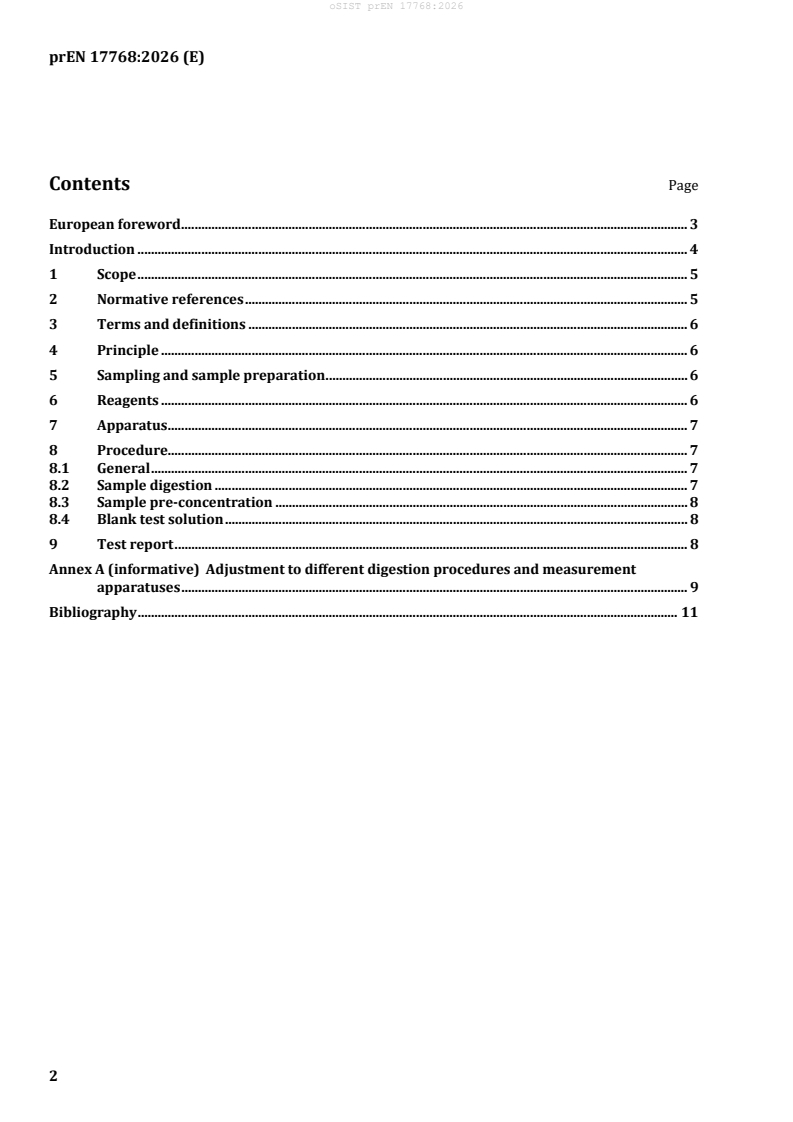
Contents
- Introduction
- 1 Scope
- 2 Normative references
- 3 Terms and definitions
- 3.1 digestion
- 3.2 blank test solution
- 4 Principle
- 5 Sampling and sample preparation
- 6 Reagents
- 7 Apparatus
- 8 Procedure
- 8.1 General
- 8.2 Sample digestion
- 8.3 Sample pre-concentration
- 8.4 Blank test solution
- 9 Test report
- Annex A
- Bibliography
Introduction
NOTE 1 Regulation (EU) 2019/1009 [1] specifies safety and quality requirements for component materials and component material categories (CMCs) of fertilizing products available on the EU market. NOTE 2 By-products within the meaning of Directive 2008/98/EC have been classified as CMC 11, thermal oxidation materials or derivatives as CMC 13 and recovered high purity materials as CMC 15 in Regulation (EU) 2019/1009 [1].
Aqua regia is applied to digest different matrices for the subsequent determination of many elements. For example, a multi-matrix standard for aqua regia extraction of soils, sludges and biowaste was prepared by CEN/TC 444 “Environmental characterization of solid matrices” [2, 3]. A similar procedure was applied for determination of aqua regia extractable contents of arsenic, mercury, cadmium, chromium, nickel and lead in fertilizers and liming materials [4, 5, 6], for extraction of micronutrients from mineral fertilizers [7] etc. CEN/TC 223 “Soil improvers and growing media” published a standard for a similar procedure for soil improvers and growing media [8]. CEN/TC 455 “Plant Biostimulants” published a standard for a similar procedure for plant biostimulants [9]. The interlaboratory study (ILS) for plant biostimulants included also fertilizing product blends of these fertilizing products with some organic and organo-mineral fertilizers. The ILS proved that the method is also suitable for these fertilizing product blends.
Wide use of the aqua regia digestion, availability of the instruments and the possibility to merge the standards for different matrices in future, were the main reasons for also applying this method of digestion for organic and organo-mineral fertilizers. A simple pre-concentration procedure is a part of this document to also cover the digestion of liquid samples with low dry matter content in the case that the measurement method is not sufficiently sensitive. Annex A describes in detail the calculation of the initial sample mass to be taken for the pre-concentration step to achieve concentrations of the individual elements above the limit of quantification (LOQ).
WARNING — Persons using this document should be familiar with usual laboratory practice. This document does not purport to address all of the safety issues, if any, associated with its use. It is the responsibility of the user to establish appropriate health and safety practices and to ensure compliance with any national regulatory conditions.
IMPORTANT — It is absolutely essential that tests conducted according to this document are carried out by suitably trained staff.
oSIST prEN 17768:2026 prEN 17768:2026 (E)
1 Scope
This document specifies the procedure for digestion of different organic and organo-mineral fertilizers with aqua regia to enable a subsequent determination of arsenic (As), cadmium (Cd), copper (Cu), chromium (Cr), lead (Pb), nickel (Ni), boron (B), cobalt (Co), iron (Fe), manganese (Mn), molybdenum (Mo), zinc (Zn), mercury (Hg), phosphorus (P), potassium (K), magnesium (Mg), calcium (Ca), sulfur (S) and sodium (Na)).
This document is applicable to the component materials “by-products”, when used as components of fertilizing products, as well as the fertilizing products blends where a blend is a mix of at least two of the following components: fertilizers, liming materials, soil improvers, growing media, inhibitors, plant biostimulants, and where the following category: organic fertilizers, organo-mineral fertilizers is the highest % in the blend by mass or volume, or in the case of liquid form by dry mass. If the organic fertilizer or the organo-mineral fertilizer is not the highest % in the blend, the European Standard for the highest % of the blend applies. In case a fertilizing product blend is composed of components in equal quantity, the user decides which standard to apply. Variations in analytical methods for fertilizing product blends can lead to differing results as some components or matrix interactions can affect the outcome. Validation procedures have shown that developed standard methods are robust and reliable across diverse product compositions, but possible interferences and unexpected results when analysing fertilizing product blends are possible.
1 2 The digests are suitable for analysis using prEN 17770 [11] and prEN 17769 [10]. This document is applicable and validated for several types of matrices as indicated in Annex A. NOTE 1 Digestates prepared by the procedure given in this document can also be applied for determination of other elements.
NOTE 2 Alternatively, inductively coupled plasma mass spectrometry (ICP-MS) can be used for the measurement if the user proves that the method gives the same results.
2 Normative references
The following documents are referred to in the text in such a way that some or all of their content constitutes requirements of this document. For dated references, only the edition cited applies. For undated references, the latest edition of the referenced document (including any amendments) applies.
prEN 17773, Organic and organo- mineral fertilizers — Determination of the dry matter content EN 12944-1, Fertilizers and liming materials — Vocabulary — Part 1: General terms EN 12944-2, Fertilizers and liming materials — Vocabulary — Part2: Terms relating to fertilizers EN 1482-2, Fertilizers, liming materials and inhibitors — Sampling and sample preparation — Part 2:
General sample preparation provisions
Under preparation
Under preparation
Under preparation
oSIST prEN 17768:2026 prEN 17768:2026 (E)
3 Terms and definitions
For the purposes of this document, the terms and definitions given in EN 12944-1 and EN 12944-2 and the following apply.
ISO and IEC maintain terminology databases for use in standardization at the following addresses:
- ISO Online browsing platform: available at https://www.iso.org/obp/
- IEC Electropedia: available at https://www.electropedia.org/
3.1 digestion
mineralization of the organic matter of a sample and dissolution of its mineral part, more or less completely, when reacting with a reagent mixture
3.2 blank test solution
solution prepared in the same way as the test sample solution but omitting the test portion
...