

FprEN 13587
(Main)Bitumens and bituminous binders - Determination of the tensile properties of bituminous binders by the tensile test method
- Abstract
This document specifies a method for determining the tensile properties of bituminous binders, unaged, aged, residual or recovered, in particular those of polymer-modified bitumens, by means of a tensile test.
NOTE 1 The tensile properties, more particularly the tensile stress, the elongation and energy, at the yield point and on fracture, are customarily used as a criterion for assessing the cohesion performance of these materials.
NOTE 2 The test method described in EN 13589 [1] is an alternate test method to determine the tensile properties of bituminous binders.
WARNING — The use of this document can involve hazardous materials, operations and equipment. This document does not purport to address all of the safety problems associated with its use. It is the responsibility of the user of this document to establish appropriate safety and health practices and to determine the applicability of regulatory limitations prior to use.
- Status
- Not Published
- Publication Date
- 09-Dec-2026
- Technical Committee
- CEN/TC 336 - Bituminous binders
- Drafting Committee
- CEN/TC 336/WG 1 - Bituminous binders for paving
- Current Stage
- 5020 - Submission to Vote - Formal Approval
- Start Date
- 20-Aug-2026
- Due Date
- 22-Feb-2027
- Completion Date
- 20-Aug-2026

FprEN 13587 is a CEN European Standard draft for determining the tensile properties of bituminous binders by a tensile test. It is aimed at laboratories, producers, and users of bitumens and bituminous binders, especially polymer-modified bitumens, where tensile stress, elongation, and energy are used to judge cohesion performance.
What does FprEN 13587 specify?
FprEN 13587 specifies a tensile test method for bituminous binders in unaged, aged, residual, or recovered form. The method is presented as a way to measure cohesion-related tensile behavior, and the scope points readers to EN 13589 as an alternate test method.
The document is organized into scope, normative references, terms and definitions, principle, apparatus, sample preparation and conservation, procedure, calculation, expression of results, precision, test report, and Annex A on cohesion specification criteria.
| Annex | What it covers |
|---|---|
| Annex A (normative) | Cohesion specification criteria and the reference cohesion value used for comparison with specification limits |
What are the key requirements of FprEN 13587?
Test setup and specimens
FprEN 13587 requires a tensile test machine complying with ISO 5893, a controlled chamber, force and elongation measurement, and a recorder for the tensile curve. This matters because the method depends on stable speed, temperature, and accurate force-elongation data.
The specimen attachment device must hold the specimen securely without tearing it, and pneumatic clamping jaws are recommended. The method also specifies a dumbbell-shaped H2 specimen and gives its dimensions in Figure 1 and Table 1.
For non-H2 specimens, EN ISO 527 series or ISO 5893 geometry may be used, but this must be stated in the test report. That allows testing when the standard specimen is difficult to prepare, while keeping the result traceable.
Sample preparation and procedure
Clause 6 requires laboratory sampling in accordance with EN 58 and test sample preparation in accordance with EN 12594. Specimens are poured with excess material, cooled at room temperature for at least 1 h and not more than 24 h, trimmed with a heated spatula, and then kept in a refrigerator at no more than 10 °C for no more than 1 h before testing.
Clause 7 requires the chamber to be at test temperature for at least 1 h, then the specimen is held at test temperature for 1 h to 3 h before the test starts. The method also requires measuring specimen thickness and width before testing, which matters because these dimensions are used in the energy calculation.
If a brittle break occurs before the flowing threshold, the test is repeated. After three brittle breaks in the thin part, the binder is recorded as brittle.
Clause 7 also lists common test temperatures from -20 °C to 20 °C and speeds from 1 mm/min to 500 mm/min. In practice, the user selects the condition that fits the binder and the specification being checked.
Calculation, result expression, and precision
Clause 8 calculates deformation energy from the area under the force-elongation curve and cohesion energy as deformation energy divided by initial cross section. The result for each parameter is the average of three determinations, so one-off readings are not used as the final value.
Clause 9 requires cohesion energy to be expressed in joules per square centimetre to two significant figures. Annex A then defines the reference cohesion value used for comparison with polymer modified bitumen specification limits at 400 % elongation.
Clause 10 gives repeatability and reproducibility information based on historical data from EN 13703:2003. Clause 11 requires the test report to identify the sample, specimen type, test temperature, elongation speed, extensometer type, rejected specimens, deviations, and unusual observations.
What terms does FprEN 13587 define?
- Tensile force (F) - the force acting on a specimen as it is extended.
- Elongation - the increase in length of a specimen, also expressible as a percentage of the initial length.
- Brittle break - a rupture that occurs early in the test before the flowing threshold while the curve is still linear.
- Flowing threshold - the first maximum on the stress-strain curve.
- Deformation energy (E) - the energy supplied to the test piece up to a given displacement.
- Cohesion energy - the deformation energy divided by the initial cross section of the specimen.
Who uses FprEN 13587?
FprEN 13587 is used by test laboratories, bitumen and binder producers, quality managers, and specification writers who need a tensile-based measure of binder cohesion. It is especially relevant for polymer-modified bitumens and for comparing test results against specification limits.
What changed in FprEN 13587 from the previous edition?
FprEN 13587 will supersede EN 13587:2016. The foreword states these changes relative to that edition:
- Pneumatic clamping jaws are recommended for specimen attachment.
- Specimens are cooled at room temperature for 1 h to 24 h and then kept in a refrigerator for not more than 1 h before testing.
- Width measurement is introduced, and the holding time at test temperature is set to 1 h to 3 h.
- The 5 min waiting time after temperature stabilization is withdrawn.
- The result is now the average of three determinations for each parameter.
- Cohesion energy results are expressed to two significant figures.
- Precision text is reworded.
- Keys are added to Figures A.1 and A.2.
Which standards are used with FprEN 13587?
| Standard | What it contributes |
|---|---|
| EN 58 | Sampling bituminous binders |
| EN 12594 | Preparation of test samples |
| EN 12597 | Terminology used in Clause 3 |
| EN ISO 527 (all parts) | Tensile-test framework and specimen-related guidance for some specimen types |
| ISO 5893 | Requirements for the tensile test machine |
| EN 13589 | Alternate tensile property test method named in the scope |
| EN 14023 | Specification limits used with the reference cohesion value |
| EN 13703:2003 | Historical precision data used in Clause 10 |
What does the FprEN 13587 document contain?
FprEN 13587 includes a specimen shape figure, a table of H2 mould dimensions, and precision data in Table 2. It also contains calculation formulas for deformation energy, cohesion energy, and the reference cohesion value in Annex A.
Two explanatory figures show the tensile force-elongation curve and how deformation energy is taken from the area under that curve. These parts support both testing practice and review of results in laboratories, audits, and specification work.
Relations
- Effective Date
- 19-Jan-2023
Get Certified
Connect with accredited certification bodies for this standard

DIBt (Deutsches Institut für Bautechnik)
German Institute for Building Technology.
DIN CERTCO
DIN Group product certification.

Element Materials Technology
Materials testing and product certification.
Sponsored listings
Frequently Asked Questions
FprEN 13587 is a draft published by the European Committee for Standardization (CEN). Its full title is "Bitumens and bituminous binders - Determination of the tensile properties of bituminous binders by the tensile test method". This standard covers: This document specifies a method for determining the tensile properties of bituminous binders, unaged, aged, residual or recovered, in particular those of polymer-modified bitumens, by means of a tensile test. NOTE 1 The tensile properties, more particularly the tensile stress, the elongation and energy, at the yield point and on fracture, are customarily used as a criterion for assessing the cohesion performance of these materials. NOTE 2 The test method described in EN 13589 [1] is an alternate test method to determine the tensile properties of bituminous binders. WARNING — The use of this document can involve hazardous materials, operations and equipment. This document does not purport to address all of the safety problems associated with its use. It is the responsibility of the user of this document to establish appropriate safety and health practices and to determine the applicability of regulatory limitations prior to use.
This document specifies a method for determining the tensile properties of bituminous binders, unaged, aged, residual or recovered, in particular those of polymer-modified bitumens, by means of a tensile test. NOTE 1 The tensile properties, more particularly the tensile stress, the elongation and energy, at the yield point and on fracture, are customarily used as a criterion for assessing the cohesion performance of these materials. NOTE 2 The test method described in EN 13589 [1] is an alternate test method to determine the tensile properties of bituminous binders. WARNING — The use of this document can involve hazardous materials, operations and equipment. This document does not purport to address all of the safety problems associated with its use. It is the responsibility of the user of this document to establish appropriate safety and health practices and to determine the applicability of regulatory limitations prior to use.
FprEN 13587 is classified under the following ICS (International Classification for Standards) categories: 75.140 - Waxes, bituminous materials and other petroleum products; 91.100.50 - Binders. Sealing materials. The ICS classification helps identify the subject area and facilitates finding related standards.
FprEN 13587 has the following relationships with other standards: It is inter standard links to EN 13587:2016. Understanding these relationships helps ensure you are using the most current and applicable version of the standard.
FprEN 13587 is available in PDF format for immediate download after purchase. The document can be added to your cart and obtained through the secure checkout process. Digital delivery ensures instant access to the complete standard document.
Standards Content (Sample)
SLOVENSKI STANDARD
oSIST prEN 13587:2026
01-marec-2026
Bitumen in bitumenska veziva - Določanje nateznih lastnosti bitumenskih veziv z
natezno preskusno metodo
Bitumens and bituminous binders - Determination of the tensile properties of bituminous
binders by the tensile test method
Bitumen und bitumenhaltige Bindemittel - Bestimmung der Streckeigenschaften von
bitumenhaltigen Bindemitteln mit dem Zugprüfverfahren
Bitumes et liants bitumineux - Détermination des caractéristiques de traction des liants
bitumineux par la méthode d'essai de traction
Ta slovenski standard je istoveten z: prEN 13587
ICS:
75.140 Voski, bitumni in drugi naftni Waxes, bituminous materials
proizvodi and other petroleum products
91.100.50 Veziva. Tesnilni materiali Binders. Sealing materials
oSIST prEN 13587:2026 en,fr,de
2003-01.Slovenski inštitut za standardizacijo. Razmnoževanje celote ali delov tega standarda ni dovoljeno.
oSIST prEN 13587:2026
oSIST prEN 13587:2026
DRAFT
EUROPEAN STANDARD
prEN 13587
NORME EUROPÉENNE
EUROPÄISCHE NORM
January 2026
ICS 75.140; 91.100.50 Will supersede EN 13587:2016
English Version
Bitumens and bituminous binders - Determination of the
tensile properties of bituminous binders by the tensile test
method
Bitumes et liants bitumineux - Détermination des Bitumen und bitumenhaltige Bindemittel -
caractéristiques de traction des liants bitumineux par Bestimmung der Streckeigenschaften von
la méthode d'essai de traction bitumenhaltigen Bindemitteln mit dem
Zugprüfverfahren
This draft European Standard is submitted to CEN members for enquiry. It has been drawn up by the Technical Committee
CEN/TC 336.
If this draft becomes a European Standard, CEN members are bound to comply with the CEN/CENELEC Internal Regulations
which stipulate the conditions for giving this European Standard the status of a national standard without any alteration.
This draft European Standard was established by CEN in three official versions (English, French, German). A version in any other
language made by translation under the responsibility of a CEN member into its own language and notified to the CEN-CENELEC
Management Centre has the same status as the official versions.
CEN members are the national standards bodies of Austria, Belgium, Bulgaria, Croatia, Cyprus, Czech Republic, Denmark, Estonia,
Finland, France, Germany, Greece, Hungary, Iceland, Ireland, Italy, Latvia, Lithuania, Luxembourg, Malta, Netherlands, Norway,
Poland, Portugal, Republic of North Macedonia, Romania, Serbia, Slovakia, Slovenia, Spain, Sweden, Switzerland, Türkiye and
United Kingdom.
Recipients of this draft are invited to submit, with their comments, notification of any relevant patent rights of which they are
aware and to provide supporting documentation.
Warning : This document is not a European Standard. It is distributed for review and comments. It is subject to change without
notice and shall not be referred to as a European Standard.
EUROPEAN COMMITTEE FOR STANDARDIZATION
COMITÉ EUROPÉEN DE NORMALISATION
EUROPÄISCHES KOMITEE FÜR NORMUNG
CEN-CENELEC Management Centre: Rue de la Science 23, B-1040 Brussels
© 2026 CEN All rights of exploitation in any form and by any means reserved Ref. No. prEN 13587:2026 E
worldwide for CEN national Members.
oSIST prEN 13587:2026
prEN 13587:2026 (E)
Contents Page
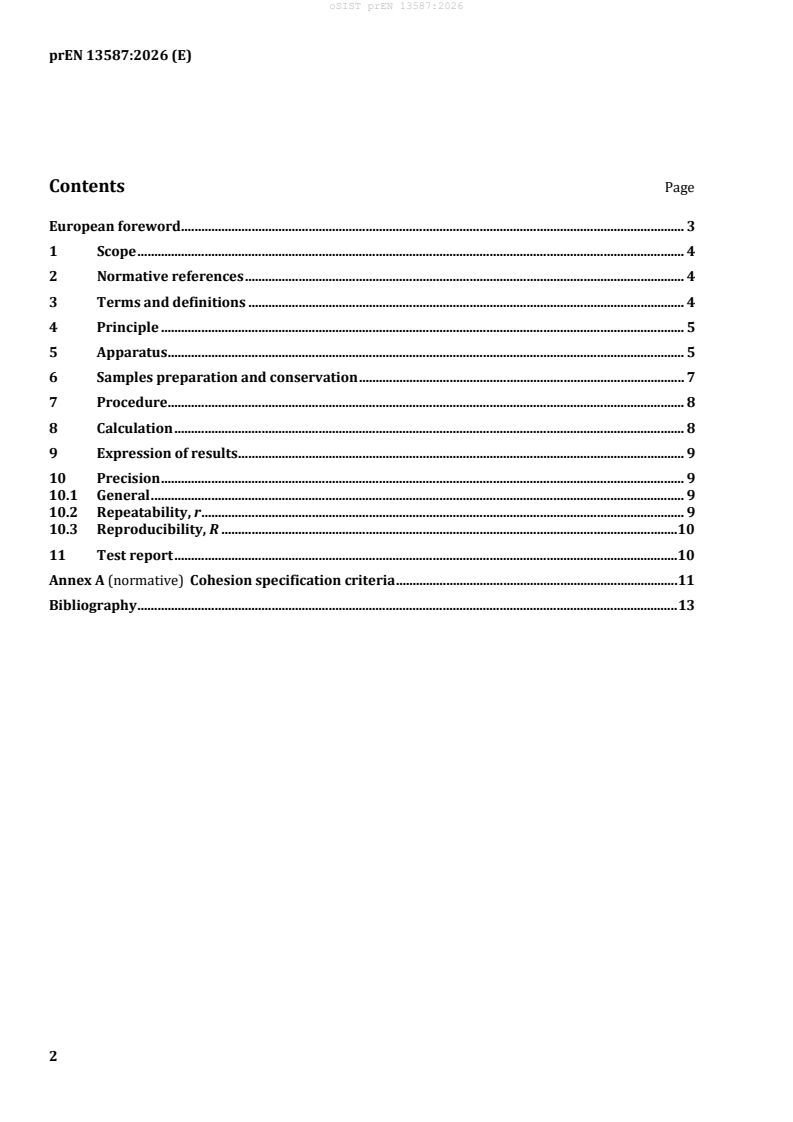
European foreword . 3
1 Scope . 4
2 Normative references . 4
3 Terms and definitions . 4
4 Principle . 5
5 Apparatus . 5
6 Samples preparation and conservation . 7
7 Procedure. 8
8 Calculation . 8
9 Expression of results . 9
10 Precision . 9
10.1 General . 9
10.2 Repeatability, r . 9
10.3 Reproducibility, R .10
11 Test report .10
Annex A (normative) Cohesion specification criteria .11
Bibliography .13
oSIST prEN 13587:2026
prEN 13587:2026 (E)
European foreword
This document (prEN 13587:2025) has been prepared by Technical Committee CEN/TC 336 “Bitumens and
bituminous binders”, the secretariat of which is held by AFNOR.
This document is currently submitted to the CEN Enquiry.
This document will supersede EN 13587:2016.
prEN 13587:2025 includes the following significant changes with respect to EN 13587:2016:
a) Clause 5, Apparatus: for the specimen attachment, the use of pneumatic clamping jaws has been
recommended (see 5.1.2);
b) Clause 6, Samples preparation and conservation: specimens are cooled down at room temperature
between 1 h and 24 h and then kept in a refrigerator for not more than 1 h before the test;
c) Clause 7, Procedure: the measurement of width B has been introduced, the duration of the holding time
of the specimen at the test temperature has been set to an interval of 1 h to 3 h and the requirement for a
waiting time of 5 min after temperature stabilization has been withdrawn;
d) Clause 8, Calculation: the result shall now be the average of three determinations for each parameter;
e) Clause 9, Expression of results: has been introduced requiring the cohesion energy results to be expressed
to two significant figures;
f) Clause 10, Precision: has been reworded;
g) Annex A, Cohesion specification criteria: keys have been added to Figures A.1 and A.2;
h) the document and its structure have been editorially reviewed.
oSIST prEN 13587:2026
prEN 13587:2026 (E)
1 Scope
This document specifies a method for determining the tensile properties of a bituminous binder, in particular
those of a polymer modified bitumen, by means of a tensile test.
NOTE 1 The tensile properties, more particularly the tensile stress, the elongation and energy, at the yield point and
on fracture, are customarily used as a criterion for assessing the quality of these materials.
NOTE 2 The test method described in EN 13589 [1] is an alternate test method to determine the tensile properties of
polymer modified bitumens.
WARNING — The use of this document can involve hazardous materials, operations and equipment. This
document does not purport to address all of the safety problems associated with its use. It is the responsibility
of the user of this document to establish appropriate safety and health practices and to determine the
applicability of regulatory limitations prior to use.
2 Normative references
The following documents are referred to in the text in such a way that some or all of their content constitutes
requirements of this document. For dated references, only the edition cited applies. For undated references,
the latest edition of the referenced document (including any amendments) applies.
EN 58, Bitumen and bituminous binders — Sampling bituminous binders
EN 12594, Bitumens and bituminous binders — Preparation of test samples
EN 12597, Bitumens and bituminous binders — Terminology
EN ISO 527 (all parts), Plastics — Determination of tensile properties(ISO 527)
ISO 5893, Rubber and plastics test equipment — Tensile, flexural and compression types (constant rate of
traverse) — Specification
3 Terms and definitions
For the purposes of this document, the terms and definitions given in EN 12597 and the following apply.
ISO and IEC maintain terminology databases for use in standardization at the following addresses:
— ISO Online browsing platform: available at https://www.iso.org/obp
— IEC Electropedia: available at https://www.electropedia.org
3.1
tensile force
F
force undergone by a specimen subjected to extension
Note 1 to entry: Tensile force is expressed in Newton (N).
3.2
Elongation
L
increase in length of a specimen
oSIST prEN 13587:2026
prEN 13587:2026 (E)
Note 1 to entry: Elongation is expressed in metres (m).
Note 2 to entry: Elongation can also be expressed in percentage (%) of the initial length. It is then calculated as [(new
length – initial length)/initial length] × 100.
3.3
brittle break
rupture happening at the beginning of the test before the flowing threshold when the stress-strain curve is
still linear
3.4
flowing threshold
first maximum of the stress-strain curve
3.5
deformation energy
E
i
energy supplied by test pieces, until displacement, i, of the moving element
Note 1 to entry: The deformation energy E is expressed in joules (J).
i
3.6
cohesion energy
*
E
i
quotient of the deformation energy, E (3.5) and the initial cross section of the test specimen
i
Note 1 to entry: The initial cross section of the test specimen is expressed in square centimetres (cm ) therefore the
*
cohesion energy E is expressed joules per square centimetres (J/cm ).
i
4 Principle
A specimen, held by its ends between two jaws, is extended in a chamber (5.2), regulated at the test
temperature, at a constant speed until a given elongation or fracture is achieved. In general, the stress and the
elongation are noted at the flowing thresholds: at an elongation of 400 % and at breaking.
The deformation energy, E , is determined from the recordings of the tensile curve (see Figures A.1) obtained,
i
in accordance with the procedure described in Clause 7, by calculating the area delimited by:
— the abscissa axes corresponding to elongations;
— the recorded curve (force versus elongation);
— a parallel to the ordinate axis which passes by a given elongation or the breaking point (see Figure A.2).
*
The cohesion energy, E , is obtained as the quotient of the deformation energy at 400 % elongation (250 mm
i
for H2 type specimen final length) and the initial cross section of the test specimen.
5 Apparatus
The usual laboratory apparatus and glassware, together with the following, shall be used.
5.1 T
...