

FprEN 1568-3:2026
(Main)Fire extinguishing media - Foam concentrates - Part 3: Specification for low expansion foam concentrates for surface application to water-immiscible liquids
- Abstract
This document specifies requirements for chemical and physical properties, and minimum performance requirements of low expansion foams suitable for surface application to water-immiscible liquids. Requirements are also given for marking.
WARNING - Any type approval according to this document is invalidated by any change in composition of the approved product.
NOTE 1 Some concentrates conforming to this document can also conform to other parts of the EN 1568 series and therefore can also be suitable for application as medium and/or high expansion foams, and for application at low expansion to water-miscible liquids.
NOTE 2 For national deviations, see Annex T.
- Status
- Not Published
- Publication Date
- 25-Apr-2027
- Technical Committee
- CEN/TC 191 - Fixed firefighting systems
- Drafting Committee
- CEN/TC 191/WG 3 - Fire extinguishing media - Foam
- Current Stage
- 4599 - Dispatch of FV draft to CMC - Finalization for Vote
- Start Date
- 23-Nov-2026
- Due Date
- 23-Nov-2026
- Completion Date
- 23-Nov-2026

FprEN 1568-3:2026 is a CEN European standard for low expansion foam concentrates used for surface application to water-immiscible liquids. It specifies chemical and physical requirements, minimum fire performance, and marking for foam concentrate manufacturers, test laboratories, and users who need to check whether a product is suitable for fire-fighting use. The standard also warns that any type approval becomes invalid if the approved product composition changes.
What does FprEN 1568-3:2026 specify?
FprEN 1568-3:2026 covers low expansion foam concentrates for application on water-immiscible liquids. It sets requirements for the concentrate itself, the foam it produces, the fire tests used to assess performance, and the information that has to appear on the container and in technical documents.
The document is organized into clauses 1 to 16 and annexes A to Q. The main body states the requirements and the annexes give the test methods, examples, and supporting information used to verify conformity.
| Annex | What it covers |
|---|---|
| A | Grades of foam concentrate and typical performance |
| B | Sampling of foam concentrates |
| C | Determination of percentage sediment |
| D | Freezing point determination |
| E | Viscosity determination for pseudo-plastic foam concentrates |
| F | Temperature conditioning of foam concentrates |
| G | Surface tension determination |
| H | Stability/separation test |
| I | Expansion and drainage time determination |
| J | Test fire performance |
| K | Occupational health and ecotoxicological testing |
| L | Radiation measurement method |
| M | Small-scale fire test |
| N | Annual foam quality check |
| O | Foam expansion sensitivity |
| P | Example technical information sheet |
| Q | A-deviations |
What are the key requirements of FprEN 1568-3:2026?
Sampling, sediment, and storage-related properties
Clause 4 requires the sampled concentrate to pass through a 180 μm sieve and limits the amount of sediment before and after ageing. In practice, this is a control on contamination, poor formulation stability, or unwanted solids that can interfere with proportioning equipment and foam quality.
Clause 5 requires the freezing point to be determined in accordance with Annex D. This matters because users need to know the lowest storage or operating temperature at which the concentrate can still be handled and mixed reliably.
Clause 6 sets how viscosity is measured across the manufacturer’s claimed use temperatures. Newtonian concentrates are checked with EN ISO 3104, while pseudo-plastic concentrates use Annex E. If the viscosity is high at the lowest use temperature, the container has to carry a warning that special proportioning equipment may be needed.
Foam solution behavior
Clause 7 sets a pH range of 6.0 to 9.5 at 20 °C. This is a practical compatibility and stability check, since pH can affect product handling, storage, and some materials in the fire-fighting system.
Clause 8 checks the surface tension of foam solutions made from the top and bottom half-samples after temperature conditioning. The result has to stay close to the value for the original sample. This helps show that the concentrate remains uniform after storage stress and still makes a foam solution with the expected wetting behavior.
Clause 9 requires the concentrate not to separate into distinct layers. It also limits how much solid deposit may increase after ageing, with different expectations for synthetic and protein foams. This is important because layered or unstable product can give uneven performance in service.
Clause 10 uses expansion and drainage tests before and after temperature conditioning. The foam made from top and bottom half-samples has to stay within defined variation limits, and the test can use simulated fresh water and, where claimed, simulated sea water. In practice, this checks both product robustness and whether the concentrate remains consistent throughout the container after storage and temperature cycling.
Fire performance and application type
Clause 11 requires the foam to achieve an extinguishing performance class and a burn-back resistance level when tested with the supplier’s recommended concentration. The document distinguishes gentle application and forceful application, and the fire test route depends on how the foam is intended to be used. For a buyer or engineer, this is the core suitability check for the actual fire hazard.
Clause 14 adds an expansion performance comparison test for F3 and or F3-AR foams in fire performance class I and II. Where the manufacturer claims suitability for fixed firefighting systems according to EN 13565, the document requires an additional test series. This matters because foam performance can change when the expansion ratio changes, especially in fixed system applications.
Quality information, annual checks, and marking
Clause 12 requires the manufacturer to provide occupational health and ecotoxicological information, with Annex K giving the test and data options. This supports REACH and CLP related documentation and helps users assess health and environmental information for the concentrate and the ready-to-use foam solution.
Clause 13 recommends an annual foam quality check and links it to Annex N. The check covers visual condition, density, pH, sediment, viscosity, refractive index, drainage and expansion, and resistance to isopropanol where relevant. In practice, this is a stored-product health check used to decide whether a concentrate should remain in service.
Clause 15 calls for a technical information sheet, and Clause 16 sets container marking. The label has to identify the product, the standard reference, recommended concentration, storage and use temperatures, sea water suitability, batch and manufacture data, and any warning about special proportioning equipment or low-temperature storage. That marking is what operators and warehouse staff rely on when choosing, storing, and installing the product.
What terms does FprEN 1568-3:2026 define?
- Low expansion foam - foam with an expansion ratio less than 20, which is the product type covered by this part.
- Expansion - the ratio of foam volume to the foam solution volume used to make it, which is a direct measure of how much the foam swells.
- Foam concentrate - the liquid product that is diluted with water to make foam solution.
- Foam solution - the homogeneous mixture of foam concentrate and water prepared at the manufacturer’s specified proportion.
- Premix - a batch-prepared foam solution made by adding a measured amount of concentrate to a known amount of water.
- Newtonian foam concentrate - a concentrate whose viscosity does not change with shear rate.
- Pseudo-plastic foam concentrate - a concentrate whose viscosity decreases as shear rate increases.
- Gentle application - foam applied indirectly to the fuel surface via a backboard in the fire test.
- Forceful application - foam applied directly onto the fuel surface in the fire test.
Who uses FprEN 1568-3:2026?
FprEN 1568-3:2026 is used by foam concentrate manufacturers, accredited test laboratories, fire protection system suppliers, and quality-control bodies. It is also used by engineers, specifiers, and buyers who need to select a foam concentrate for fixed or portable fire-fighting equipment.
In practice, these users rely on the standard when they sample product, run type tests, compare foam performance, prepare technical data sheets, and check container markings. It is most relevant where the fire hazard involves water-immiscible liquids and where low expansion foam is part of the fire protection strategy.
What changed in FprEN 1568-3:2026 from the previous edition?
FprEN 1568-3:2026 supersedes EN 1568-3:2018. The foreword states these significant technical changes:
- sediment determination for synthetic foams and protein foams has been clarified;
- the aqueous film formation evaluation has been removed;
- an optional annual foam quality check has been introduced;
- temperature and wind speed measurements for the performance fire test have been clarified;
- stainless steel has been added as an optional material for the small-scale fire test tray;
- a foam expansion performance test has been introduced;
- some test procedures have been clarified.
Which standards are used with FprEN 1568-3:2026?
- EN 13565 (all parts) - used when the manufacturer claims suitability for fixed firefighting systems, especially in Clause 14 and Annex O.
- EN ISO 2811-1 - provides the pycnometer density method used in the annual foam quality check.
- EN ISO 3104 - provides the viscosity method for Newtonian foam concentrates.
- EN ISO 3219-2:2021 - provides the rheometry principles used for pseudo-plastic viscosity in Annex E.
- EN ISO 3675 - provides the hydrometer density method used in the annual foam quality check.
- EN ISO 3696 - defines the water quality used for demineralized water.
- EN ISO 11348-2 and EN ISO 23753-1 - provide ecotoxicological test options for the information required in Clause 12 and Annex K.
- ISO 304 - provides the ring or plate method for surface tension.
- ISO 3310-1 - defines the 180 μm sieve used for sediment checks.
- OECD 201, 202, 203, 301, 404, 405, and 420 - provide the aquatic, biodegradation, and mammalian test methods referenced for occupational health and ecotoxicological information.
- EN 1568-1, EN 1568-2, and EN 1568-4 - the other parts of the EN 1568 series named in the foreword as related standards for medium expansion, high expansion, and low expansion foam concentrates for water-miscible liquids.
What does the FprEN 1568-3:2026 document contain?
The document contains test methods for sediment, freezing point, viscosity, pH, surface tension, stability/separation, expansion, drainage, and fire performance. It also includes procedures for temperature conditioning, sampling, annual quality checks, and the expansion sensitivity comparison test.
Several annexes give practical lab and fire-test details. Annex D includes an example temperature-time curve for freezing point evaluation, Annex E gives the shear-rate procedure and formula for pseudo-plastic viscosity, Annex I gives the collecting vessel and simulated fresh and sea water compositions, and Annex J gives the large-scale fire tray arrangements and test sequences.
Annex L describes a radiation measurement method for fire performance tests, Annex M gives a small-scale fire test for quality control, and Annex O provides the test series used to study how changing foam expansion affects fire performance. Annex P gives an example technical information sheet, so users can see the kind of product data expected without recreating the manufacturer’s own format.
Relations
- Effective Date
- 22-Dec-2021
Get Certified
Connect with accredited certification bodies for this standard

CIS Institut d.o.o.
Personal Protective Equipment (PPE) certification body. Notified Body NB-2890 for EU Regulation 2016/425 PPE.

Kiwa BDA Testing
Building and construction product certification.
Kmetijski inštitut Slovenije
Agricultural Institute of Slovenia. Soil testing, plant health, agricultural product analysis.
Sponsored listings
Frequently Asked Questions
FprEN 1568-3:2026 is a draft published by the European Committee for Standardization (CEN). Its full title is "Fire extinguishing media - Foam concentrates - Part 3: Specification for low expansion foam concentrates for surface application to water-immiscible liquids". This standard covers: This document specifies requirements for chemical and physical properties, and minimum performance requirements of low expansion foams suitable for surface application to water-immiscible liquids. Requirements are also given for marking. WARNING - Any type approval according to this document is invalidated by any change in composition of the approved product. NOTE 1 Some concentrates conforming to this document can also conform to other parts of the EN 1568 series and therefore can also be suitable for application as medium and/or high expansion foams, and for application at low expansion to water-miscible liquids. NOTE 2 For national deviations, see Annex T.
This document specifies requirements for chemical and physical properties, and minimum performance requirements of low expansion foams suitable for surface application to water-immiscible liquids. Requirements are also given for marking. WARNING - Any type approval according to this document is invalidated by any change in composition of the approved product. NOTE 1 Some concentrates conforming to this document can also conform to other parts of the EN 1568 series and therefore can also be suitable for application as medium and/or high expansion foams, and for application at low expansion to water-miscible liquids. NOTE 2 For national deviations, see Annex T.
FprEN 1568-3:2026 is classified under the following ICS (International Classification for Standards) categories: 13.220.10 - Fire-fighting. The ICS classification helps identify the subject area and facilitates finding related standards.
FprEN 1568-3:2026 has the following relationships with other standards: It is inter standard links to EN 1568-3:2018. Understanding these relationships helps ensure you are using the most current and applicable version of the standard.
FprEN 1568-3:2026 is available in PDF format for immediate download after purchase. The document can be added to your cart and obtained through the secure checkout process. Digital delivery ensures instant access to the complete standard document.
Standards Content (Sample)
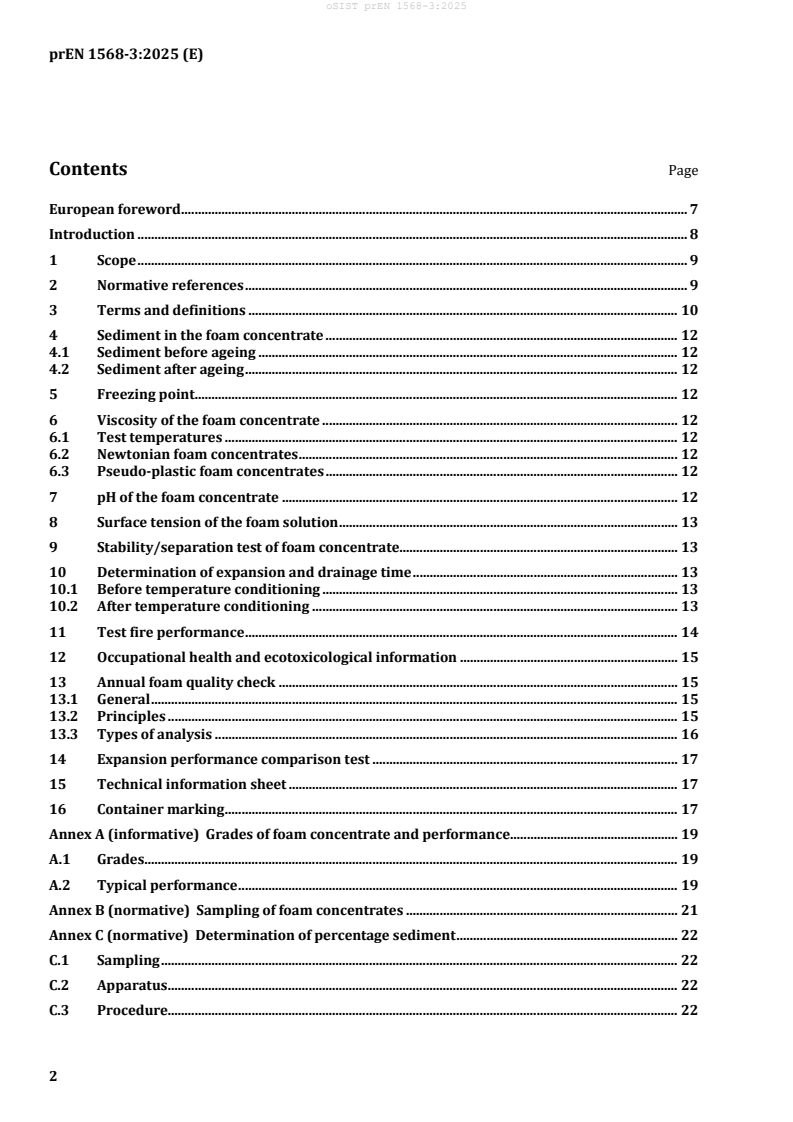
Contents
- Introduction
- 1 Scope
- 2 Normative references
- 3 Terms and definitions
- 3.1 25 %/50 % drainage time
- 3.2 expansion (E)
- 3.3 low expansion foam
- 3.4 medium expansion foam
- 3.5 high expansion foam
- 3.6 fire-fighting foam
- 3.7 foam concentrate
- 3.8 foam solution
- 3.9 premix
- 3.10 sediment
- 3.11 Newtonian foam concentrate
- 3.12 pseudo-plastic foam concentrate
- 3.13 surface tension
- 3.14 freezing point
- 3.15 designation
- 3.16 demineralized water
- 3.17 gentle application
- 3.18 forceful application
- 3.19 qualified personnel
- 4 Sediment in the foam concentrate
- 4.1 Sediment before ageing
- 4.2 Sediment after ageing
- 5 Freezing point
- 6 Viscosity of the foam concentrate
- 6.1 Test temperatures
- 6.2 Newtonian foam concentrates
- 6.3 Pseudo-plastic foam concentrates
- 8 Surface tension of the foam solution
- 9 Stability/separation test of foam concentrate
- 10 Determination of expansion and drainage time
- 10.1 Before temperature conditioning
- 10.2 After temperature conditioning
- 11 Test fire performance
- 12 Occupational health and ecotoxicological information
- 13 Annual foam quality check
- 13.1 General
- 13.2 Principles
- 13.3 Types of analysis
- 14 Expansion performance comparison test
- 15 Technical information sheet
- 16 Container marking
- Annex A
- Annex B
- Annex C
- Annex D
- Annex E
- Annex F
- Annex G
- Annex H
- Annex I
- Annex J
- Annex K
- Annex L
- Annex M
- 5 Venturi tube (see Figure M.7)
- 2 Knurled
- Annex N
- Annex O
- 11 T-piece 21 O-ring
- 1 Mounting bracket (example)
- Annex P
- Annex Q
- Bibliography
Introduction
As fire fighting foams are chemical agents or chemical preparations, Commission Directive 2000/60/CE and Regulations (EC) No 1272/2008 (CLP) and No 1907/2006 (REACH) apply and should be taken into account.
Classes of fire are defined in EN 2 as follows:
- Class A: fires involving solid materials, usually of an organic nature, in which combustion normally takes place with the formation of glowing embers;
- Class B: fires involving liquids or liquefiable solids;
- Class C: fires involving gases;
- Class D: fires involving metals;
- Class F: fires involving cooking media (vegetable or animal oils and fats) in cooking appliances. Fire-fighting foams are widely used to control and extinguish Class B fires and to inhibit re-ignition. These foams can also be used for prevention of ignition of flammable liquids and, in certain conditions, to extinguish Class A fires.
Foams can be used in combination with other extinguishing media, particularly gaseous media and powders, which are the subject of other European Standards (see European foreword). These specifications have been designed to ensure that fire extinguishing media have the minimum useful fire fighting capability. The user should ensure that the foam concentrates are used accurately at the concentration recommended by the manufacturer. Fire performances indicated by this standard cannot replicate practical fire situations.
Foam concentrates of different types and manufacture should not be mixed. It should be noted that some combinations of extinguishing powder and foam can lead to unacceptable loss of efficiency, caused by unfavourable interaction of the chosen media when applied simultaneously or successively to the fire.
It is extremely important that the foam concentrate after dilution with water to the recommended concentration should not in normal usage present a significant toxic hazard to life in relation to the environment. The current version of Commission Directive 2000/60/CE, Regulations (EC) No 1272/2008 (CLP) and No 1907/2006 (REACH) apply when considering the testing of ecotoxicological properties and safety in the work environment. A special quality characteristic is the type test conducted by an independent testing laboratory accredited to EN ISO/IEC 17025.
oSIST prEN 1568-3:2025 prEN 1568-3:2025 (E)
1 Scope
This document specifies requirements for chemical and physical properties, and minimum performance requirements of low expansion foams suitable for surface application to water-immiscible liquids. Requirements are also given for marking.
WARNING — Any type approval according to this document is invalidated by any change in composition of the approved product.
NOTE Some concentrates conforming to this document can also conform to other parts and therefore can also be suitable for application as medium and/or high expansion foams, and for application at low expansion to watermiscible liquids.
2 Normative references
The following documents are referred to in the text in such a way that some or all of their content constitutes requirements of this document. For dated references, only the edition cited applies. For undated references, the latest edition of the referenced document (including any amendments) applies. EN 13565 (all parts), Fixed firefighting systems — Foam systems EN ISO 2811-1, Paints and varnishes - Determination of density - Part 1: Pycnometer method (ISO 2811-1) EN ISO 3104, Petroleum products - Transparent and opaque liquids - Determination of kinematic viscosity and calculation of dynamic viscosity (ISO 3104) EN ISO 3219-2:2021, Rheology - Part 2: General principles of rotational and oscillatory rheometry (ISO 3219-2:2021) EN ISO 3675, Crude petroleum and liquid petroleum products - Laboratory determination of density - Hydrometer method (ISO 3675) EN ISO 3696, Water for analytical laboratory use - Specification and test methods (ISO 3696) EN ISO 11348-2, Water quality - Determination of the inhibitory effect of water samples on the light emission of Vibrio fischeri (Luminescent bacteria test) - Part 2: Method using liquid-dried bacteria (ISO 11348-2) EN ISO 23753-1, Soil quality - Determination of dehydrogenases activity in soils - Part 1: Method using triphenyltetrazolium chloride (TTC) (ISO 23753-1) ISO 304, Surface active agents — Determination of surface tension by drawing up liquid films ISO 3310-1, Test sieves — Technical requirements and testing — Part 1: Test sieves of metal wire cloth OECD 201, Test No. 201: Freshwater Alga and Cyanobacteria, Growth Inhibition Test OECD 202, Test No. 202: Daphnia sp. Acute Immobilisation Test OECD 203, Test No. 203: Fish, Acute Toxicity Test OECD 301, Test No. 301: Ready Biodegradability OECD 404, Test No. 404: Acute Dermal Irritation/Corrosion
oSIST prEN 1568-3:2025 prEN 1568-3:2025 (E) OECD 405, Test No. 405: Acute Eye Irritation/Corrosion OECD 420, Test No. 420: Acute Oral Toxicity - Fixed Dose Procedure
3 Terms and definitions
For the purposes of this document, the following terms and definitions apply. ISO and IEC maintain terminological databases for use in standardization at the following addresses:
- IEC Electropedia: available at http://www.electropedia.org/ ;
- ISO Online browsing platform: available at http://www.iso.org/obp .
3.1 25 %/50 % drainage time
time taken for 25 %/50 % of the volume of the original foam solution to drain out of the generated foam
3.2 expansion (E)
expansion value expansion ratio ratio of the volume of foam to the volume of the foam solution from which it was made
3.3 low expansion foam
foam which has an expansion ratio less than 20
3.4 medium expansion foam
foam which has an expansion ratio greater than or equal to 20 but less than 200
3.5 high expansion foam
foam which has an expansion ratio greater than or equal to 200
3.6 fire-fighting foam
aggregate of air filled bubbles formed from a foam solution used for fire-fighting
3.7 foam concentrate
liquid which is diluted with water to produce foam solution Note 1 to entry: Annex A gives information on grades of foam concentrate.
3.8 foam solution
homogeneous mixture of foam concentrate and water in the proportions as specified by the foam concentrate manufacturer
oSIST prEN 1568-3:2025 prEN 1568-3:2025 (E)
3.9 premix
foam solution prepared in a batch process by introducing a measured amount of foam concentrate into a given amount of water in a storage
3.10 sediment
insoluble particles in the foam concentrate
3.11 Newtonian foam concentrate
foam concentrate which has a viscosity which is independent of the shear rate
3.12 pseudo-plastic foam concentrate
foam concentrate which has a viscosity which decreases with increasing shear rate
3.13 surface tension
tension within the interface between a liquid and air
3.14 freezing point
temperature at which the first ingredient of a mixture starts to solidify or freeze
3.15 designation
identifying name name that corresponds to a chemical formulation and a specific production process Note 1 to entry: It guarantees consistency of the characteristics, performance and conditions of use of the foam concentrate.
3.16 demineralized water
−1 water conforming to EN ISO 3696 (Grade 3), or having a surface tension greater than 70 mN⋅m and a −1 conductivity of ≤ 5μS⋅cm Note 1 to entry: Surface tension tested in accordance with Clause G.2.
3.17 gentle application
application (of foam from the test nozzle) indirectly to the surface of the fuel via a backboard Note 1 to entry: This definition of gentle application relates to the fire test procedures used in EN 1568–3 and EN 1568–4. In practice fire-fighting systems foam can also be applied gently by fixed foam pourers or by indirect application via a tank wall or other surface.
3.18 forceful application
application (of foam from the test nozzle) directly onto the surface of the fuel
oSIST prEN 1568-3:2025 prEN 1568-3:2025 (E)
3.19 qualified personnel
designated individual, suitably trained, competent through knowledge and practical experience and with the necessary instruction to enable the tests and examinations to be carried out
4 Sediment in the foam concentrate
4.1 Sediment before ageing
Any sediment in the foam concentrate sampled in accordance with Annex B, but not aged in accordance with Clause C.1, shall be dispersible through a 180 μm sieve, and the percentage volume of sediment shall be not more than 0,25 % when tested in accordance with Annex C.
4.2 Sediment after ageing
Any sediment in the foam concentrate sampled in accordance with Annex B, and aged in accordance with Clause C.1, shall be dispersible through a 180 μm sieve and the percentage volume of sediment shall be not more than 1,0 % when tested in accordance with Annex C.
5 Freezing point
The freezing point of the foam concentrate sampled in accordance with Annex B shall be determined in accordance with Annex D.
6 Viscosity of the foam concentrate
6.1 Test temperatures
The viscosity of the foam concentrate shall be measured from 20 °C, to and including the lowest temperature for use claimed by the manufacturer in steps of 10 °C. Use a fresh sample for each temperature.
6.2 Newtonian foam concentrates
The viscosity of the foam concentrate shall be determined in accordance with EN ISO 3104. If the viscosity 2 –1 is > 200 mm s , the container shall be marked in accordance with Clause 15 k).
6.3 Pseudo-plastic foam concentrates
The viscosity of the foam concentrate shall be determined in accordance with Annex E. If the viscosity at −1 the lowest temperature for use is greater than or equal to 120 mPa·s at 375 s , the container shall be marked in accordance with Clause 15 l).
7 pH of the foam concentrate The pH of the foam concentrate sampled in accordance with Annex B shall be not less than 6,0 and not more than 9,5 at (20 ± 1) °C.
oSIST prEN 1568-3:2025 prEN 1568-3:2025 (E)
8 Surface tension of the foam solution
The surface tension (determined in accordance with Clause G.2) of the foam solutions prepared using top and bottom half-samples (see Clause F.4) of the foam concentrate sampled in accordance with Annex B and conditioned in accordance with Annex F shall be not less than 0,95 times and not more than 1,05 times the surface tension of the foam solution prepared using the sampled foam concentrate.
9 Stability/separation test of foam concentrate
The foam concentrate shall not separate, stratify or precipitate as indicated by two or more distinct layers when tested in accordance with Annex H.
The amount of solid deposits of the aged sample determined according to Annex C at 20 °C in synthetic foams shall not increase from the fresh sample.
The amount of solid deposits of the aged sample determined according to Annex C at 20 °C in protein foams shall not increase by more than 4 times the amount obtained from the fresh sample, and shall not exceed a volume fraction of 1 % in total.
10 Determination of expansion and drainage time
10.1 Before temperature conditioning
The foam produced from the foam solution prepared from the foam concentrate sampled in accordance with Annex B, at the supplier’s recommended concentration with simulated fresh water in accordance with Clause I.4 shall be tested in accordance with Annex I and give an expansion according to 3.3. If appropriate, a further sample for the same concentration made with the simulated sea water in accordance with Clause I.4 shall also be tested.
10.2 After temperature conditioning
The foams produced from the solutions prepared with simulated fresh water by using top and bottom half-samples (see Clause F.4) of foam concentrate, sampled in accordance with Annex B, at the supplier’s recommended concentration, when tested in accordance with Annex I, shall have the following; a) expansions which do not differ from each other or from the value obtained according to 10.1 using simulated fresh water (i.e. before temperature conditioning) by more than 20 % of the value obtained according to 10.1 using simulated fresh water; and b) 25 % drainage times which do not differ from each other or from the value obtained according to 10.1 using simulated fresh water (i.e. before temperature conditioning) by more than 20 % of the value obtained according to 10.1 using simulated fresh water.
If appropriate, the tests shall be repeated using top and bottom half-samples (see Clause F.4) of foam concentrate, sampled in accordance with Annex B, at the supplier’s recommended concentration, using foam solutions prepared with the simulated sea water in accordance with Clause I.4. These foam solutions shall have the following:
c) expansions which do not differ from each other or from the value obtained according to 10.1 using the simulated sea water (i.e. before temperature conditioning) by more than 20 % of the value obtained according to 10.1 using the simulated sea water in accordance with Clause I.4; and
oSIST prEN 1568-3:2025 prEN 1568-3:2025 (E) d) 25 % drainage times which do not differ from each other or from the value obtained according to 10.1 using the simulated sea water (i.e. before temperature conditioning) by more than 20 % of the value obtained according to 10.1 using the simulated sea water in accordance with Clause I.4. NOTE Expansion is dependent on the foam concentrate and the equipment used to make the foam.
11 Test fire performance
The foam produced from the foam solutions, prepared using the foam concentrate, sampled in accordance with Annex B at the supplier's recommended concentration with simulated fresh water and if appropriate at the same concentration with the simulated sea water in accordance with Clause I.4, shall have an extinguishing performance class and burn-back resistance level as specified in Table 1 when tested in accordance with Clause J.2 and Clause J.3 and/or Clause J.4 as appropriate. NOTE 1 The values obtained with sea water can differ from those obtained with simulated fresh water. NOTE 2 Annex M describes a small scale fire test which can be suitable for quality control purposes. NOTE 3 The lack of homogeneity of the premix can influence the firefighting performance of the foam generated from it.
Table 1 — Maximum extinction times and minimum burn-back times Times in minutes.
Extinguishing Burn-back Gentle application test Forceful application test performance resistance class level (see J.3) (see J.4) Extinction 25 % burn- Extinction 25 % burntime not more back time not time not more back time not than less than than less than A 1,5 10 B 15 1,5 I+ C 10 1,5 D 5 1,5 3 10 A B 15 3 I C 10 3 D 5 3 A 4 10 B 15 4 II C 10 4 D 5 4
oSIST prEN 1568-3:2025 prEN 1568-3:2025 (E) Times in minutes.
Extinguishing Burn-back Gentle application test Forceful application test performance resistance class level (see J.3) (see J.4) B 5 15 III C 5 10 D 5 5 NOTE 1 There is no burn-back resistance level A for class III. NOTE 2 Typical extinguishing performance classes and burn-back resistance levels for different types of foam concentrate are given in Annex A.
12 Occupational health and ecotoxicological information
The manufacturer shall provide information as specified in Annex K. If the toxicological/ecotoxicological data were generated by application of mathematical methodologies in accordance with Annex K the corresponding report shall be added to the report confirming conformity with this document.
If the toxicological/ecotoxicological data were generated by an independent third party the data may be added to the report confirming conformity to this document either as a report or as a reference to the report-ID given by the third party.
If the data for the ecotoxicological report was generated by a third party, this data may be added to the test report or may added as a reference. If the data for the ecotoxicological report was generated by mathematical means (or as a reference) it shall be added to the test report.
13 Annual foam quality check
13.1 General
Firefighting foam concentrates are recommended to be checked annually for their quality, indicating their functionality. The test program described in 13.2 is considered to be a collection of analytical methods which in its entirety is suitable to detect degradation or a declining function of a foam concentrate. The outcome of the annual foam quality check described in 13.2 is intended to be used to qualify or disqualify a foam concentrate for its further usability. Therefore, the quality of testing and evaluation of test data is a special quality characteristic of the body executing the foam quality check.
13.2 Principles
13.2.1 The sample of the foam concentrate(s) shall be collected in such a way, that the sample is
representative of the stored volume.
13.2.2 A full declaration of the foam product’s identity, hazards associated with it [see section 2 of the most recent material safety data sheet (MSDS)], as well as information on PFAS content, proportioning rate, age, storage condition and possible contaminations shall be given.
oSIST prEN 1568-3:2025 prEN 1568-3:2025 (E)
13.2.3 For foam concentrates which can be used as low, medium and high expansion foam the desired
testing expansion shall be specified as well as the water quality (simulated fresh or sea water) to be used. 13.2.4 Packing and labelling of foam concentrate samples is subject to European regulation on packaging and labelling of chemical mixtures (Regulation (EC) No 1272/2008, CLP, e.g. Article 35). 13.2.5 The equipment for testing shall be calibrated and maintained in full function. 13.2.6 The foam concentrate sample should be processed as it was received. If stratification, sedimentation or other inhomogeneities are visible, that sample shall not be homogenised prior to testing. Instead, the sample may be considered as a fail.
13.2.7 A comprehensive test report with all tested results should be provided. The report may include evaluation of the obtained results and further recommendations. If this is the case, this shall be indicated as an evaluation of the data based on the experience and knowledge of the body executing the foam quality test.
13.2.8 The test data shall be compared with the technical data of the respective foam concentrate given by the manufacturer.
13.3 Types of analysis
Table 2 indicates the type of analysis that should be run for a given type of foam concentrate. Annex N gives test descriptions and requirements.
Table 2 — Types of analysis AR non-AR medium high expansion expansion application application Visual examination X X X X Density at (20 ± 1) °C X X X X pH-value at (20 ± 1) °C X X X X Sediment at (20 ± 1) °C X X X X Viscosity at (20 ± 1) °C X X X X Refractive index at (20 ± 1) °C X X X X 25 %-drainage, low expansion X X — — foam 25 %-drainage, medium — — X — expansion foam 25 %-drainage, high expansion — — — X foam expansion, low expansion foam X X — —
oSIST prEN 1568-3:2025 prEN 1568-3:2025 (E) AR non-AR medium high expansion expansion application application expansion, medium expansion — — X — foam expansion, high expansion — — — X foam Resistance to isopropanol X — — —
14 Expansion performance comparison test
The extinguishing performance of foams is influenced by the foam expansion ratio. For foams of the type F3 and/or F3-AR (fire extinguishing performance class I and class II) fire extinguishing tests shall be performed according to Annex O, Table O.1 a) and b), to determine the degree of the performance impact caused by changing the expansion ratio. Foams that are claimed by the manufacturer to be suitable for use in fixed firefighting systems according to EN 13565 shall additionally be tested according to Annex O, Table O.1 c). The records of the tests (O.2.3) and the test results should be made available to the end user according to O.5.
...