


EN 13606-3:2008
(Main)Health informatics - Electronic health record communication - Part 3: Reference archetypes and term lists
Health informatics - Electronic health record communication - Part 3: Reference archetypes and term lists
This Standard addresses the communication of part or all of electronic health records (EHR) of a single identified subject of care between EHR systems, or between EHR systems and a centralised EHR data repository. It may also be used for EHR communication between an EHR system or repository and clinical applications or middleware components (such as decision support components) that need to access or provide EHR data, or as the representation of EHR data within a distributed (federated) record system.
This Standard, Part 3 of the 13606 EHR Communications Standard Series, defines term lists that each specify the set of values that particular attributes of the Reference Model defined in Part 1 of this Series may take. It also defines informative Reference Archetypes that correspond to ENTRY-level compound data structures within the Reference Models of openEHR and HL7 Version 3, to enable those instances to be represented within a consistent structure when communicated using this standard.
Medizinische Informatik - Kommunikation von Patientendaten in elektronischer Form - Teil 3: Referenzarchetypen und Begriffslisten
Informatique de la santé - Communication des dossiers de santé informatisés - Partie 3: Archétypes de référence et listes de termes
La présente norme traite de la communication de tout ou partie du dossier informatisé de santé (DIS) d'un seul sujet de soins identifié entre systèmes de DIS, ou entre des systèmes de DIS et un réceptacle de données de DIS centralisé. Elle peut également être utilisée pour la communication de DIS entre un système ou réceptacle de DIS et des applications médicales ou composants intergiciels (tels que des composants d'aide à la décision) nécessitant d'avoir d'accès aux ou de fournir des données de DIS, ou en tant que représentation de données de DIS au sein d'un système de dossiers répartis (fédérés).
La présente norme, Partie 3 de la série de normes EN 13606 relatives à la communication des DIS, définit des listes de termes spécifiant chacune l’ensemble des valeurs pouvant être prises par les différents attributs du Modèle de référence défini dans la Partie 1 de cette série. Elle définit également, à titre informatif, des Archétypes de référence correspondant aux structures de données composites de niveau ENTRY dans les Modèles de référence de openEHR et HL7 Version 3, pour permettre la représentation de ces instances au sein d'une structure cohérente lorsqu'elles sont communiquées selon la présente norme.
Zdravstvena informatika - Komunikacija z elektronskimi zapisi v zdravstvenem varstvu - 3. del: Referenčni arhetipi in seznami izrazov
General Information
- Status
- Withdrawn
- Publication Date
- 25-Mar-2008
- Withdrawal Date
- 08-Feb-2026
- Technical Committee
- CEN/TC 251 - Medical informatics
- Drafting Committee
- CEN/TC 251/WG 1 - Information models
- Current Stage
- 9960 - Withdrawal effective - Withdrawal
- Start Date
- 03-Jul-2019
- Completion Date
- 11-Feb-2026
Relations
- Effective Date
- 22-Dec-2008
- Effective Date
- 10-Jul-2019

Get Certified
Connect with accredited certification bodies for this standard

BSI Group
BSI (British Standards Institution) is the business standards company that helps organizations make excellence a habit.

NYCE
Mexican standards and certification body.
Sponsored listings
Frequently Asked Questions
EN 13606-3:2008 is a standard published by the European Committee for Standardization (CEN). Its full title is "Health informatics - Electronic health record communication - Part 3: Reference archetypes and term lists". This standard covers: This Standard addresses the communication of part or all of electronic health records (EHR) of a single identified subject of care between EHR systems, or between EHR systems and a centralised EHR data repository. It may also be used for EHR communication between an EHR system or repository and clinical applications or middleware components (such as decision support components) that need to access or provide EHR data, or as the representation of EHR data within a distributed (federated) record system. This Standard, Part 3 of the 13606 EHR Communications Standard Series, defines term lists that each specify the set of values that particular attributes of the Reference Model defined in Part 1 of this Series may take. It also defines informative Reference Archetypes that correspond to ENTRY-level compound data structures within the Reference Models of openEHR and HL7 Version 3, to enable those instances to be represented within a consistent structure when communicated using this standard.
This Standard addresses the communication of part or all of electronic health records (EHR) of a single identified subject of care between EHR systems, or between EHR systems and a centralised EHR data repository. It may also be used for EHR communication between an EHR system or repository and clinical applications or middleware components (such as decision support components) that need to access or provide EHR data, or as the representation of EHR data within a distributed (federated) record system. This Standard, Part 3 of the 13606 EHR Communications Standard Series, defines term lists that each specify the set of values that particular attributes of the Reference Model defined in Part 1 of this Series may take. It also defines informative Reference Archetypes that correspond to ENTRY-level compound data structures within the Reference Models of openEHR and HL7 Version 3, to enable those instances to be represented within a consistent structure when communicated using this standard.
EN 13606-3:2008 is classified under the following ICS (International Classification for Standards) categories: 35.240.80 - IT applications in health care technology. The ICS classification helps identify the subject area and facilitates finding related standards.
EN 13606-3:2008 has the following relationships with other standards: It is inter standard links to ENV 13606-3:2000, EN ISO 13606-3:2019. Understanding these relationships helps ensure you are using the most current and applicable version of the standard.
EN 13606-3:2008 is available in PDF format for immediate download after purchase. The document can be added to your cart and obtained through the secure checkout process. Digital delivery ensures instant access to the complete standard document.
Standards Content (Sample)
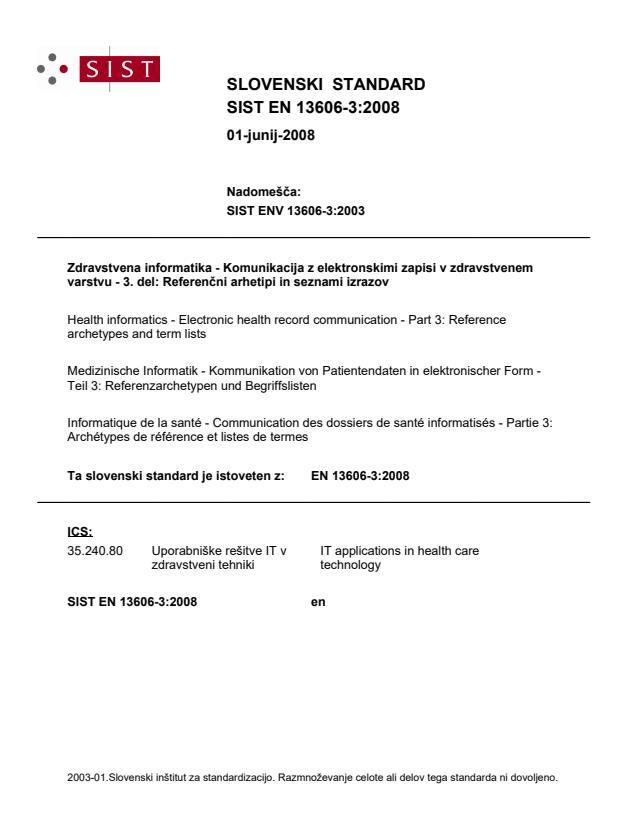
2003-01.Slovenski inštitut za standardizacijo. Razmnoževanje celote ali delov tega standarda ni dovoljeno.Health informatics - Electronic health record communication - Part 3: Reference archetypes and term listsGUDYVWYHQHPInformatique de la santé - Communication des dossiers de santé informatisés - Partie 3: Archétypes de référence et listes de termesMedizinische Informatik - Kommunikation von Patientendaten in elektronischer Form - Teil 3: Referenzarchetypen und Begriffslisten35.240.80Uporabniške rešitve IT v zdravstveni tehnikiIT applications in health care technologyICS:SIST EN 13606-3:2008enTa slovenski standard je istoveten z:EN 13606-3:200801-junij-2008SIST EN 13606-3:2008SLOVENSKI
STANDARDSIST ENV 13606-3:20031DGRPHãþD
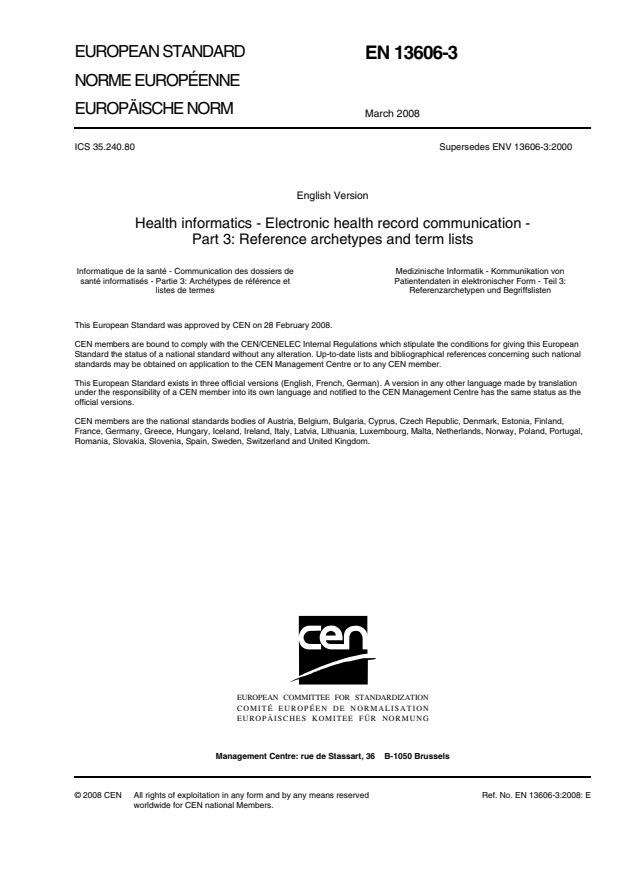
EUROPEAN STANDARDNORME EUROPÉENNEEUROPÄISCHE NORMEN 13606-3March 2008ICS 35.240.80Supersedes ENV 13606-3:2000
English VersionHealth informatics - Electronic health record communication -Part 3: Reference archetypes and term listsInformatique de la santé - Communication des dossiers desanté informatisés - Partie 3: Archétypes de référence etlistes de termesMedizinische Informatik - Kommunikation vonPatientendaten in elektronischer Form - Teil 3:Referenzarchetypen und BegriffslistenThis European Standard was approved by CEN on 28 February 2008.CEN members are bound to comply with the CEN/CENELEC Internal Regulations which stipulate the conditions for giving this EuropeanStandard the status of a national standard without any alteration. Up-to-date lists and bibliographical references concerning such nationalstandards may be obtained on application to the CEN Management Centre or to any CEN member.This European Standard exists in three official versions (English, French, German). A version in any other language made by translationunder the responsibility of a CEN member into its own language and notified to the CEN Management Centre has the same status as theofficial versions.CEN members are the national standards bodies of Austria, Belgium, Bulgaria, Cyprus, Czech Republic, Denmark, Estonia, Finland,France, Germany, Greece, Hungary, Iceland, Ireland, Italy, Latvia, Lithuania, Luxembourg, Malta, Netherlands, Norway, Poland, Portugal,Romania, Slovakia, Slovenia, Spain, Sweden, Switzerland and United Kingdom.EUROPEAN COMMITTEE FOR STANDARDIZATIONCOMITÉ EUROPÉEN DE NORMALISATIONEUROPÄISCHES KOMITEE FÜR NORMUNGManagement Centre: rue de Stassart, 36
B-1050 Brussels© 2008 CENAll rights of exploitation in any form and by any means reservedworldwide for CEN national Members.Ref. No. EN 13606-3:2008: E
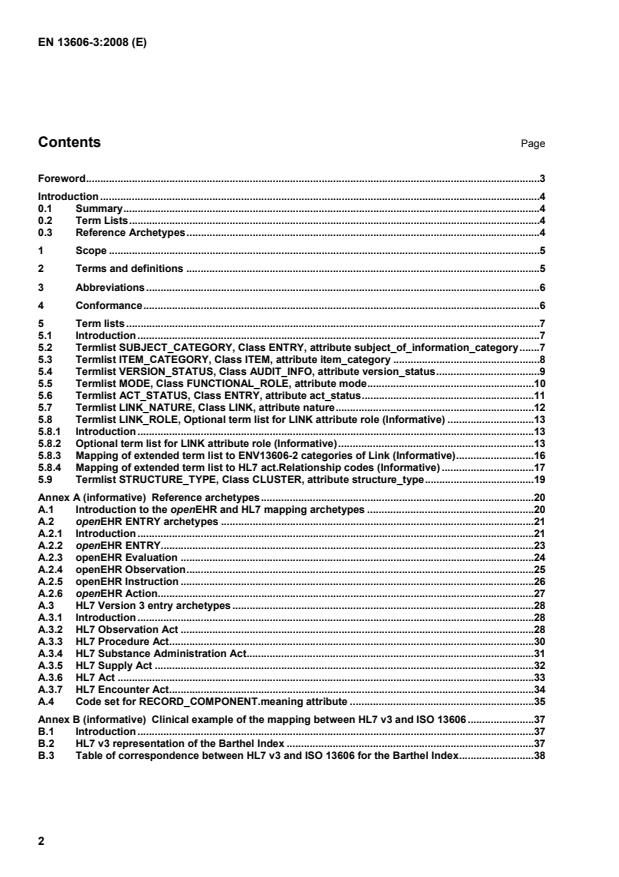
Reference archetypes.20 A.1 Introduction to the openEHR and HL7 mapping archetypes.20 A.2 openEHR ENTRY archetypes.21 A.2.1 Introduction.21 A.2.2 openEHR ENTRY.23 A.2.3 openEHR Evaluation.24 A.2.4 openEHR Observation.25 A.2.5 openEHR Instruction.26 A.2.6 openEHR Action.27 A.3 HL7 Version 3 entry archetypes.28 A.3.1 Introduction.28 A.3.2 HL7 Observation Act.28 A.3.3 HL7 Procedure Act.30 A.3.4 HL7 Substance Administration Act.31 A.3.5 HL7 Supply Act.32 A.3.6 HL7 Act.33 A.3.7 HL7 Encounter Act.34 A.4 Code set for RECORD_COMPONENT.meaning attribute.35 Annex B (informative)
Clinical example of the mapping between HL7 v3 and ISO 13606.37 B.1 Introduction.37 B.2 HL7 v3 representation of the Barthel Index.37 B.3 Table of correspondence between HL7 v3 and ISO 13606 for the Barthel Index.38
o set of HL7 version 3 Acts that form part of the Clinical Statement Domain Message Information Model; o specialisations of ENTRY that are defined in the openEHR Reference Model. 0.2 Term Lists Each term list is referenced by its corresponding attribute as an invariant constraint in Part 1 of this standard series, by referring to its term list name. For each term list, every code value is accompanied by a phrase and description; however, in each case it is the code that is to be used as the Reference Model attribute value. Language translations of the phrase and description will therefore not affect the instances of RECORD_COMPONENT that are communicated using this standard.
Should any future revision prove necessary for these term lists, a technical revision of this standard will be required. Such a revised standard shall specify an updated Reference Model identifier that shall then be used as the value of the rm_id of an EHR_EXTRACT, to inform the recipient of the version of this standard that was used in its creation.
A cross-mapping of the term list for LINK.role to HL7 actRelationship codes is also provided for the convenience of those wishing to adopt or interface this standard with HL7 version 3. This is part of a longer-term vocabulary harmonisation project between the health informatics standards development organizations (SDO’s), and might therefore be extended in the future via other publications, such as the planned HL7-13606 Implementation Guide (see below). It is therefore informative in this standard. 0.3 Reference Archetypes Each Reference Archetype is represented in this standard as a mapping correspondence table to indicate the way in which the ITEM structure within a 13606 Part 1 ENTRY is to be used to represent the classes and attributes of relevant HL7 v3 and openEHR classes. These two external models have been chosen for inclusion as these are the most likely internationally-used source models from which fine-grained clinical data may need to be transformed into this standard for communication. These Reference Archetypes are included as an aid to those adopting this standard and wishing to transform Electronic Health Record (her) data from existing HL7 v3 or openEHR instances or messages. It is recognised that full two-way interoperability between these various representations requires more detail, including rich vocabulary and data type harmonisation, and a corresponding set of technical artefacts such as eXtensible Markup Language (XML) Schemata and Extensible Stylesheet Language Transformation (XSLT) scripts. Such interoperability is very much the goal of current SDO harmonisation efforts, and will be published as an HL7-13606 Implementation Guide, possibly as an open-access and regularly updated resource. However, the outstanding work required to achieve this level of interoperability might take up to another year from when this standard is expected to be published. It has therefore been decided to offer what does exist towards harmonisation in an informative form within this standard, as an aid to those already needing to make such data transformations. A worked example of the HL7 v3 to ISO 13606 mapping is given in Annex B.
This Standard, Part 3 of the 13606 EHR Communications Standard Series, defines term lists that each specify the set of values that particular attributes of the Reference Model defined in Part 1 of this Series may take. It also defines informative Reference Archetypes that correspond to ENTRY-level compound data structures within the Reference Models of openEHR and HL7 Version 3, to enable those instances to be represented within a consistent structure when communicated using this standard. 2 Terms and definitions For the purposes of this document, the following terms and definitions apply. 3.1 archetype instance individual metadata class instance of an Archetype Model, specifying the clinical concept and the value constraints that apply to one class of Record Component instances in an electronic health record extract 3.2 clinical information information about a person, relevant to his or her health or health care 3.3 committed information that has been persisted within an electronic health record system and which constitutes part of the electronic health record for a subject of care 3.4 committer agent (party, device or software) whose direct actions have resulted in data being committed to an electronic health record 3.5 composer agent (party, device or software) responsible for creating, synthesising or organising information that is committed to an electronic health record 3.6 electronic health record extract part or all of the electronic health record for a subject of care, communicated in compliance with EN 13606 3.7 electronic health record system system for recording, retrieving and manipulating information in electronic health records
3.8 entries health record data in general (clinical observations, statements, reasoning, intentions, plans or actions) without particular specification of their formal representation, hierarchical organisation or of the particular Record Component class(es) that might be used to represent them 3.9 patient synonym for a subject of care
CEN/ TC 251 CEN Technical Committee 251
EHR Electronic Health Record
EU European Union
HISA Health Information Systems Architecture
HL7 Health Level Seven
ISO International Organization for Standardization
UML Unified Modelling Language
XML Extensible Mark-up Language 4 Conformance When electronic health record information is to be communicated using the 13606 Standard Series and where an attribute of the Reference Model defined in Part 1 of this series requires a value to be taken from a bounded set of codes from a named term list, the code shall be one of those defined in Clause 5 of this standard for the correspondingly-named term list.
NOTE If ENTRY.subject_of_information_category is null, the value DS00 is assumed.
5.3 Termlist ITEM_CATEGORY, Class ITEM, attribute item_category Some kinds of ENTRY might have a complex internal data structure, comprised of the main values of interest and other kinds of context. This optional attribute in the Reference Model permits the communication of the category of information for each ELEMENT or CLUSTER. This may be of value to a receiving EHR system, to enable easier processing of the data.
Code Meaning Description IC01 Principal or ‘core’ value The CLUSTERS or ELEMENTS that contain the main values that are the subject of the ENTRY IC02 Supplementary/complementary details about the value Contextual information that most users would regard as necessary to interpret the core values IC03 Patient state/circumstances Contextual information about the subject of care’s circumstances when an observation is made e.g. fasting, standing IC04 Method details Contextual information about the method of an observation, such as the technique or device used IC05 Clinical reasoning Any explanatory information provided by the author to explain a clinical decision or interpretation, other than a specific reference to a protocol of guideline or knowledge source IC06 Protocol/guideline A description, reference or explanation of any protocol or guideline that informed the ENTRY (e.g. to perform an observation, or initiate a plan of care) IC07 Knowledge source A reference to any external knowledge source, such as a web site or medical text, that explains or amplifies a clinical decision IC08 Presentation Any information about how the values in the ENTRY should be presented; image rendering information is one example
IC09 Assertion status To indicate that the ELEMENT contains a value that indicates the presence/absence, normality/abnormality of the core values (e.g. if the core value is a questionnaire question and the ELEMENT contains the yes/no answer)
5.4 Termlist VERSION_STATUS, Class AUDIT_INFO, attribute version_status This attribute is used to indicate the status of a particular version of a RECORD_COMPONENT. This attribute is optional, and if no value is provided it is to be assumed that the RECORD_COMPONENT is the first definitive version corresponding to code value VER01. In all cases, the new version of a RECORD_COMPONENT shall replace the former version, as specified in Part 1 of this series.
Code Meaning Description VER00 Draft The version is known at the time of committal to be incomplete (because additional information is expected later) or if the necessary authorisations have not been made, VER00 implies that the EHR_recipient might in future expect to receive a more definitive updated version of this RECORD_COMPONENT VER01 Finished The version is committed with the intention of being a final version, with no anticipated reason for revision
VER02 Update The version is an update of the previous version, usually by adding supplementary information that was not available at the time of committal NOTE 1 Revision is intended for additions usually to be made by the original author within a short time frame, and not for recoding an evolving clinical story VER03 Correction The version corrects errors made in the recording of the previous version VER04 Deletion The version logically deletes the previous version (e.g. if the RECORD_COMPONENT had been placed in the wrong patient’s EHR) NOTE 2 If AUDIT_INFO.version_status is null, the value VER01 is assumed.
5.5 Termlist MODE, Class FUNCTIONAL_ROLE, attribute mode This attribute is used to describe the physical or electronic means by which an entity has participated in the provision or documentation of health care. This term list is taken from the corresponding code set in EN 14822-2, for the attribute mode, except that codes have been added for use within an EHR Extract. Code Meaning Description EN14822-2 term MOD01 electronic data Participation by non-human-language based electronic signal ELECTRONIC MOD02 verbal Participation by voice communication VERBAL MOD03 dictated Participation by pre-recorded voice. Communication is limited to one direction (from the recorder to recipient) DICTATED MOD04 face-to-face Participation by voice communication where parties speak to each other directly FACE MOD05 telephone Participation by voice communication where the voices of the communicating parties are transported over an electronic medium PHONE MOD06 videoconferencing Participation by voice and visual communication where the voices and images of the communicating parties are transported over an electronic medium
VIDEOCONF MOD07 written Participation by human language recorded on a physical material WRITTEN MOD08 email Participation by text or diagrams transmitted over an electronic mail system EMAIL MOD09 telefax Participation by text or diagrams printed on paper that have been transmitted over a fax device FAX MOD10 handwritten Participation by text or diagrams printed on paper or other recording medium HANDWRITTEN MOD11 typewritten Participation by text or diagrams printed on paper or other recording medium where the recording was performed using a typewriter, typesetter, computer or similar mechanism
TYPEWRITTEN MOD12 physical presence Participation by direct action where subject and actor are in the same location. (The participation involves more than communication) PHYSICAL MOD13 remote presence Participation by direct action where subject and actor are in separate locations, and the actions of the actor are transmitted by electronic or mechanical means. (The participation
...
Questions, Comments and Discussion
Ask us and Technical Secretary will try to provide an answer. You can facilitate discussion about the standard in here.
Loading comments...