

ASTM D3546-05(2019)
(Test Method)Standard Test Method for Formic Acid in Glacial Acetic Acid
General Information
- Abstract
SIGNIFICANCE AND USE
4.1 This test method is useful for determining the formic acid content of glacial acetic acid by chemical means.
4.2 Low molecular weight organic acids (such as acetic and propionic), aldehydes (including formaldehyde and acetaldehyde), ketones, and alcohols (including methyl alcohol) do not interfere with the test.
4.3 Formic acid (and other reducing substances) may be present as a result of contamination during storage, distribution, and manufacture. This test method may be used in assessing compliance with a specification.
SCOPE
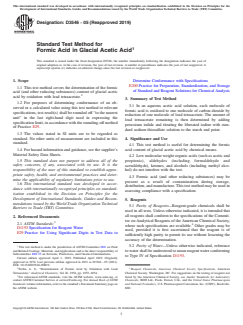
1.1 This test method covers the determination of the formic acid (and other reducing substances) content of glacial acetic acid by oxidation with lead tetraacetate.2
1.2 For purposes of determining conformance of an observed or a calculated value using this test method to relevant specifications, test result(s) shall be rounded off “to the nearest unit” in the last right-hand digit used in expressing the specification limit, in accordance with the rounding-off method of Practice E29.
1.3 The values stated in SI units are to be regarded as standard. No other units of measurement are included in this standard.
1.4 For hazard information and guidance, see the supplier's Material Safety Data Sheets.
1.5 This standard does not purport to address all of the safety concerns, if any, associated with its use. It is the responsibility of the user of this standard to establish appropriate safety, health, and environmental practices and determine the applicability of regulatory limitations prior to use.
1.6 This international standard was developed in accordance with internationally recognized principles on standardization established in the Decision on Principles for the Development of International Standards, Guides and Recommendations issued by the World Trade Organization Technical Barriers to Trade (TBT) Committee.
- Status
- Published
- Publication Date
- 31-Mar-2019
- Technical Committee
- D01 - Paint and Related Coatings, Materials, and Applications
- Drafting Committee
- D01.35 - Solvents, Plasticizers, and Chemical Intermediates


Overview
ASTM D3546-05(2019): Standard Test Method for Formic Acid in Glacial Acetic Acid establishes a reliable chemical procedure for the quantitative determination of formic acid content in glacial acetic acid. This standard is essential for quality control and specification compliance throughout the chemical manufacturing industry, ensuring product integrity and minimizing contamination. The test method is based on the oxidation of formic acid by lead tetraacetate, followed by the quantification of remaining oxidant via titration.
Key Topics
Purpose and Scope:
- Specifies a procedure for analyzing formic acid and other reducing substances in glacial acetic acid using a chemical oxidation method.
- Applicable for conformity assessment in manufacturing, storage, and distribution processes.
- Measurements are made using SI units as the standard.
Interference Considerations:
- The method is selective for formic acid; common organic acids (acetic, propionic), aldehydes (formaldehyde, acetaldehyde), ketones, and alcohols (like methyl alcohol) do not interfere with the results.
- Other reducing substances present may influence results, making the test also valuable for detecting general contamination.
Rounding and Reporting:
- Test results are rounded to the nearest unit in the last significant digit of the specification limit (as outlined in ASTM E29).
- Analytical accuracy and repeatability are addressed, ensuring reliable and consistent results.
Safety and Compliance:
- Users must follow standard laboratory safety practices, consult Material Safety Data Sheets for chemicals, and observe any regulatory limitations.
Applications
Quality Control in Chemical Manufacturing:
- Detects formic acid contamination that can occur during the production, storage, or shipping of glacial acetic acid.
- Ensures batches meet industry and regulatory specifications for purity and safety.
Specification Testing:
- Frequently used by laboratories to verify whether products conform to agreed purity standards.
- Supports specification- and compliance-driven processes in the solvents, coatings, or food additive supply chains.
Process Monitoring:
- Identifies contamination sources in supply chains, such as leaks or improper handling, through routine testing.
- Enables corrective actions to maintain product quality and safety.
Supplier Assessment:
- Provides end-users and quality assurance teams with a standardized method for evaluating raw material suppliers based on the purity of acetic acid delivered.
Related Standards
- ASTM D1193: Specification for reagent water essential for analytical testing.
- ASTM E29: Practice for using significant digits in test data, relevant for reporting and rounding results in compliance with this test method.
- ASTM E200: Practice for preparation, standardization, and storage of standard and reagent solutions in chemical analysis.
- International Guidelines: Developed in line with the World Trade Organization Technical Barriers to Trade (TBT) Committee’s recognized principles for international standards.
Keywords: ASTM D3546, formic acid determination, glacial acetic acid, chemical analysis, lead tetraacetate oxidation, contamination test, specification compliance, laboratory quality control, reducing substances quantification, chemical manufacturing standards.
Relations
- Effective Date
- 01-Apr-2019
- Effective Date
- 01-Oct-2008
- Effective Date
- 15-Nov-2006
- Effective Date
- 15-Sep-2006
- Effective Date
- 01-May-2006
- Effective Date
- 01-Mar-2006
- Effective Date
- 01-Dec-2004
- Effective Date
- 10-May-2002
- Effective Date
- 10-May-1999
- Effective Date
- 10-Feb-1999
- Effective Date
- 10-Feb-1999
- Effective Date
- 01-Apr-2019
Get Certified
Connect with accredited certification bodies for this standard

ECOCERT
Organic and sustainability certification.

Eurofins Food Testing Global
Global leader in food, environment, and pharmaceutical product testing.

Intertek Bangladesh
Intertek certification and testing services in Bangladesh.
Sponsored listings
Frequently Asked Questions
ASTM D3546-05(2019) is a standard published by ASTM International. Its full title is "Standard Test Method for Formic Acid in Glacial Acetic Acid". This standard covers: SIGNIFICANCE AND USE 4.1 This test method is useful for determining the formic acid content of glacial acetic acid by chemical means. 4.2 Low molecular weight organic acids (such as acetic and propionic), aldehydes (including formaldehyde and acetaldehyde), ketones, and alcohols (including methyl alcohol) do not interfere with the test. 4.3 Formic acid (and other reducing substances) may be present as a result of contamination during storage, distribution, and manufacture. This test method may be used in assessing compliance with a specification. SCOPE 1.1 This test method covers the determination of the formic acid (and other reducing substances) content of glacial acetic acid by oxidation with lead tetraacetate.2 1.2 For purposes of determining conformance of an observed or a calculated value using this test method to relevant specifications, test result(s) shall be rounded off “to the nearest unit” in the last right-hand digit used in expressing the specification limit, in accordance with the rounding-off method of Practice E29. 1.3 The values stated in SI units are to be regarded as standard. No other units of measurement are included in this standard. 1.4 For hazard information and guidance, see the supplier's Material Safety Data Sheets. 1.5 This standard does not purport to address all of the safety concerns, if any, associated with its use. It is the responsibility of the user of this standard to establish appropriate safety, health, and environmental practices and determine the applicability of regulatory limitations prior to use. 1.6 This international standard was developed in accordance with internationally recognized principles on standardization established in the Decision on Principles for the Development of International Standards, Guides and Recommendations issued by the World Trade Organization Technical Barriers to Trade (TBT) Committee.
SIGNIFICANCE AND USE 4.1 This test method is useful for determining the formic acid content of glacial acetic acid by chemical means. 4.2 Low molecular weight organic acids (such as acetic and propionic), aldehydes (including formaldehyde and acetaldehyde), ketones, and alcohols (including methyl alcohol) do not interfere with the test. 4.3 Formic acid (and other reducing substances) may be present as a result of contamination during storage, distribution, and manufacture. This test method may be used in assessing compliance with a specification. SCOPE 1.1 This test method covers the determination of the formic acid (and other reducing substances) content of glacial acetic acid by oxidation with lead tetraacetate.2 1.2 For purposes of determining conformance of an observed or a calculated value using this test method to relevant specifications, test result(s) shall be rounded off “to the nearest unit” in the last right-hand digit used in expressing the specification limit, in accordance with the rounding-off method of Practice E29. 1.3 The values stated in SI units are to be regarded as standard. No other units of measurement are included in this standard. 1.4 For hazard information and guidance, see the supplier's Material Safety Data Sheets. 1.5 This standard does not purport to address all of the safety concerns, if any, associated with its use. It is the responsibility of the user of this standard to establish appropriate safety, health, and environmental practices and determine the applicability of regulatory limitations prior to use. 1.6 This international standard was developed in accordance with internationally recognized principles on standardization established in the Decision on Principles for the Development of International Standards, Guides and Recommendations issued by the World Trade Organization Technical Barriers to Trade (TBT) Committee.
ASTM D3546-05(2019) is classified under the following ICS (International Classification for Standards) categories: 71.080.40 - Organic acids. The ICS classification helps identify the subject area and facilitates finding related standards.
ASTM D3546-05(2019) has the following relationships with other standards: It is inter standard links to ASTM D3546-05(2011), ASTM E29-08, ASTM E29-06b, ASTM E29-06a, ASTM E29-06, ASTM D1193-06, ASTM E29-04, ASTM E29-02e1, ASTM E29-93a(1999), ASTM D1193-99e1, ASTM D1193-99, ASTM D3620-04(2023). Understanding these relationships helps ensure you are using the most current and applicable version of the standard.
ASTM D3546-05(2019) is available in PDF format for immediate download after purchase. The document can be added to your cart and obtained through the secure checkout process. Digital delivery ensures instant access to the complete standard document.
Standards Content (Sample)
This international standard was developed in accordance with internationally recognized principles on standardization established in the Decision on Principles for the
Development of International Standards, Guides and Recommendations issued by the World Trade Organization Technical Barriers to Trade (TBT) Committee.
Designation: D3546 − 05 (Reapproved 2019)
Standard Test Method for
Formic Acid in Glacial Acetic Acid
This standard is issued under the fixed designation D3546; the number immediately following the designation indicates the year of
original adoption or, in the case of revision, the year of last revision. A number in parentheses indicates the year of last reapproval. A
superscript epsilon (´) indicates an editorial change since the last revision or reapproval.
1. Scope Determine Conformance with Specifications
E200 Practice for Preparation, Standardization, and Storage
1.1 This test method covers the determination of the formic
of Standard and Reagent Solutions for ChemicalAnalysis
acid (and other reducing substances) content of glacial acetic
acid by oxidation with lead tetraacetate.
3. Summary of Test Method
1.2 For purposes of determining conformance of an ob-
3.1 In an aqueous acetic acid solution, each molecule of
served or a calculated value using this test method to relevant
formic acid is oxidized to one molecule of carbon dioxide by
specifications, test result(s) shall be rounded off “to the nearest
reduction of one molecule of lead tetraacetate. The amount of
unit” in the last right-hand digit used in expressing the
lead tetraacetate remaining is then determined by adding
specification limit, in accordance with the rounding-off method
potassium iodide and titrating the liberated iodine with stan-
of Practice E29.
dard sodium thiosulfate solution to the starch end point.
1.3 The values stated in SI units are to be regarded as
standard. No other units of measurement are included in this 4. Significance and Use
standard.
4.1 This test method is useful for determining the formic
1.4 For hazard information and guidance, see the supplier’s acid content of glacial acetic acid by chemical means.
Material Safety Data Sheets.
4.2 Low molecular weight organic acids (such as acetic and
1.5 This standard does not purport to address all of the
propionic), aldehydes (including formaldehyde and
safety concerns, if any, associated with its use. It is the acetaldehyde), ketones, and alcohols (including methyl alco-
responsibility of the user of this standard to establish appro-
hol) do not interfere with the test.
priate safety, health, and environmental practices and deter-
4.3 Formic acid (and other reducing substances) may be
mine the applicability of regulatory limitations prior to use.
present as a result of contamination during storage,
1.6 This international standard was developed in accor-
distribution, and manufacture.This test method may be used in
dance with internationally recognized principles on standard-
assessing compliance with a specification.
ization established in the Decision on Principles for the
Development of International Standards, Guides and Recom-
5. Reagents
mendations issued by the World Trade Organization Technical
5.1 Purity of Reagents—Reagent-grade chemicals shall be
Barriers to Trade (TBT) Committee.
used in all tests. Unless otherwise indicated, it is intended that
all reagents shall conform to the specifications of the Commit-
2. Referenced Documents
tee onAnalytical Reagents of theAmerican Chemical Society,
2.1 ASTM Standards: 4
where such specifications are available. Other grades may be
D1193 Specification for Reagent Water
used, provided it is first ascertained that the reagent is of
E29 Practice for Using Significant Digits in Test Data to
sufficiently high purity to permit its use without lessening the
accuracy of the determination.
5.2 Purity of Water—Unless otherwise indicated, reference
This test method is under the jurisdiction of ASTM Committee D01 on Paint
and Related Coatings, Materials, andApplications and is the direct responsibility of
to water shall be understood to mean reagent water conforming
Subcommittee D01.35 on Solvents, Plasticizers, and Chemical Intermediates.
to Type IV of Specification D1193.
Current edition approved April 1, 2019. Published April 2019. Originally
approved in 1976. Last previous edition approved in 2011 as D3546 – 05 (2011).
DOI: 10.1520/D3546-05R19.
2 4
Perlin, A. S., “Determination of Formic Acid by Oxidation with Lead Reagent Chemicals, American Chemical Society Specifications, American
Tetraacetate,” Analytical Chemistry, Vol 26, 1954, pp. 1053–1054. Chemical Society, Washington, DC. For suggestions on the testing of reagents not
For referenced ASTM standards, visit the ASTM website, www.astm.org, or listed by the American Chemical Society, see Analar Standards for Laboratory
contact ASTM Customer Service at service@astm.org. For Annual Book of ASTM Chemicals, BDH Ltd., Poole, Dorset, U.K., and the United States Pharmacopeia
Standards volume information, refer to the standard’s Document Summary page on and National Formulary, U.S. Pharmacopeial Convention, Inc. (USPC), Rockville,
the ASTM
...