

ASTM D4168-95(2021)
(Test Method)Standard Test Methods for Transmitted Shock Characteristics of Foam-in-Place Cushioning Materials
General Information
- Abstract
SIGNIFICANCE AND USE
5.1 Data obtained by these methods may be used to determine the transmitted shock cushioning characteristics of foam-in-place packaging materials. These data allow design of cushioning systems that can provide adequate and efficient use of foam for protection of goods during a distribution life-cycle.
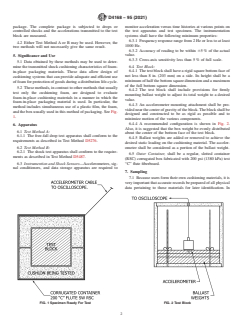
5.2 These methods, in contrast to other methods that usually test only the cushioning foam, are designed to evaluate foam-in-place cushioning materials in a manner in which the foam-in-place packaging material is used. In particular, the method includes simultaneous use of a plastic film, the foam, and the box usually used in this method of packaging. See Fig. 1.
FIG. 1 Specimen Ready For Test
SCOPE
1.1 These test methods determine the shock-absorbing characteristics of foam-in-place packaging materials.
1.2 Test Method A uses a free-fall package drop test apparatus.
1.3 Test Method B uses a shock-test apparatus.
1.4 The values stated in inch-pound units are to be regarded as standard. The values given in parentheses are mathematical conversions to SI units that are provided for information only and are not considered standard.
1.5 This standard does not purport to address all of the safety concerns, if any, associated with its use. It is the responsibility of the user of this standard to establish appropriate safety, health, and environmental practices and determine the applicability of regulatory limitations prior to use.
1.6 This international standard was developed in accordance with internationally recognized principles on standardization established in the Decision on Principles for the Development of International Standards, Guides and Recommendations issued by the World Trade Organization Technical Barriers to Trade (TBT) Committee.
- Status
- Published
- Publication Date
- 30-Sep-2021
- Technical Committee
- D10 - Packaging
- Drafting Committee
- D10.13 - Interior Packaging
Overview
ASTM D4168-95(2021): Standard Test Methods for Transmitted Shock Characteristics of Foam-in-Place Cushioning Materials is an international standard developed by ASTM International. This standard specifies reliable test methods for determining the shock-absorbing properties of foam-in-place packaging materials. By simulating how these materials perform during shipping and handling, the standard ensures that foam-in-place packaging can provide effective protection for goods throughout the distribution lifecycle.
Foam-in-place cushioning materials are widely used for custom packaging solutions. The methods in ASTM D4168 assess the cushioning system as it is actually used, including plastic film, foam, and the outer box, delivering realistic testing scenarios that support optimal packaging design.
Key Topics
- Test Methods:
- Test Method A: Utilizes a free-fall package drop test apparatus to evaluate packaging shock absorption.
- Test Method B: Employs a shock-test apparatus to simulate mechanical shocks experienced in transit.
- Measurement Units: Specifies inch-pound units as standard, with SI conversions provided for reference.
- Safety and Compliance: Highlights the importance of following appropriate safety, health, and environmental practices, and understanding regulatory limitations before use.
- Realistic Evaluation: Unlike methods that test foam alone, these methods examine the complete packaging system, including the foam-in-place material, film, and outer container.
- Terminology and Definitions: Provides standardized definitions relevant to packaging, distribution environments, and cushioning system characteristics, supporting consistency across applications.
Applications
ASTM D4168-95(2021) is essential in the packaging industry for several practical applications:
- Packaging System Design: Supplies reliable data for engineers and designers to develop foam-in-place cushioning systems that optimize material usage while ensuring product safety during shipping, handling, and warehousing.
- Quality Control: Assists manufacturers and packing companies in verifying that foam-in-place cushioning materials meet required shock-absorbing standards before deployment.
- Product Testing: Provides a standardized approach to simulate real-world distribution hazards, enabling accurate assessment of package integrity and product protection.
- Regulatory Compliance: Supports compliance with industry and international shipping regulations requiring standardized test data for protective packaging solutions.
- Research and Development: Used by materials scientists and researchers to compare the performance of different foam-in-place materials or to develop innovative cushioning technologies.
Related Standards
ASTM D4168 references and complements several important packaging standards:
- ASTM D5276 - Test Method for Drop Test of Loaded Containers by Free Fall
- ASTM D5487 - Test Method for Simulated Drop of Loaded Containers by Shock Machines
- ASTM D3332 - Test Methods for Mechanical-Shock Fragility of Products, Using Shock Machines
- ASTM D996 - Terminology of Packaging and Distribution Environments
When developing or testing foam-in-place packaging, these related standards may also be referenced to ensure comprehensive packaging performance evaluation.
Keywords: ASTM D4168, foam-in-place packaging materials, shock-absorbing characteristics, drop test, shock test, packaging standards, cushioning material, transmitted shock, protective packaging, packaging performance, distribution lifecycle, packaging system design, ASTM packaging standards.
Relations
- Effective Date
- 01-Oct-2023
- Effective Date
- 01-Oct-2023
- Effective Date
- 01-Sep-2017
- Effective Date
- 01-Apr-2016
- Effective Date
- 01-Dec-2010
- Effective Date
- 01-Jan-2010
- Effective Date
- 01-Mar-2009
- Refers
ASTM D5487-98(2008) - Standard Test Method for Simulated Drop of Loaded Containers by Shock Machines - Effective Date
- 01-Apr-2008
- Effective Date
- 01-Oct-2004
- Effective Date
- 01-Apr-2004
- Effective Date
- 10-Apr-2002
- Effective Date
- 10-Apr-2002
- Effective Date
- 10-Apr-1999
- Refers
ASTM D5487-98(2002) - Standard Test Method for Simulated Drop of Loaded Containers by Shock Machines - Effective Date
- 10-Oct-1998
- Effective Date
- 10-Apr-1998
Get Certified
Connect with accredited certification bodies for this standard

BRCGS (Brand Reputation Compliance Global Standards)
Global food safety and quality standards owner.
Sponsored listings
Frequently Asked Questions
ASTM D4168-95(2021) is a standard published by ASTM International. Its full title is "Standard Test Methods for Transmitted Shock Characteristics of Foam-in-Place Cushioning Materials". This standard covers: SIGNIFICANCE AND USE 5.1 Data obtained by these methods may be used to determine the transmitted shock cushioning characteristics of foam-in-place packaging materials. These data allow design of cushioning systems that can provide adequate and efficient use of foam for protection of goods during a distribution life-cycle. 5.2 These methods, in contrast to other methods that usually test only the cushioning foam, are designed to evaluate foam-in-place cushioning materials in a manner in which the foam-in-place packaging material is used. In particular, the method includes simultaneous use of a plastic film, the foam, and the box usually used in this method of packaging. See Fig. 1. FIG. 1 Specimen Ready For Test SCOPE 1.1 These test methods determine the shock-absorbing characteristics of foam-in-place packaging materials. 1.2 Test Method A uses a free-fall package drop test apparatus. 1.3 Test Method B uses a shock-test apparatus. 1.4 The values stated in inch-pound units are to be regarded as standard. The values given in parentheses are mathematical conversions to SI units that are provided for information only and are not considered standard. 1.5 This standard does not purport to address all of the safety concerns, if any, associated with its use. It is the responsibility of the user of this standard to establish appropriate safety, health, and environmental practices and determine the applicability of regulatory limitations prior to use. 1.6 This international standard was developed in accordance with internationally recognized principles on standardization established in the Decision on Principles for the Development of International Standards, Guides and Recommendations issued by the World Trade Organization Technical Barriers to Trade (TBT) Committee.
SIGNIFICANCE AND USE 5.1 Data obtained by these methods may be used to determine the transmitted shock cushioning characteristics of foam-in-place packaging materials. These data allow design of cushioning systems that can provide adequate and efficient use of foam for protection of goods during a distribution life-cycle. 5.2 These methods, in contrast to other methods that usually test only the cushioning foam, are designed to evaluate foam-in-place cushioning materials in a manner in which the foam-in-place packaging material is used. In particular, the method includes simultaneous use of a plastic film, the foam, and the box usually used in this method of packaging. See Fig. 1. FIG. 1 Specimen Ready For Test SCOPE 1.1 These test methods determine the shock-absorbing characteristics of foam-in-place packaging materials. 1.2 Test Method A uses a free-fall package drop test apparatus. 1.3 Test Method B uses a shock-test apparatus. 1.4 The values stated in inch-pound units are to be regarded as standard. The values given in parentheses are mathematical conversions to SI units that are provided for information only and are not considered standard. 1.5 This standard does not purport to address all of the safety concerns, if any, associated with its use. It is the responsibility of the user of this standard to establish appropriate safety, health, and environmental practices and determine the applicability of regulatory limitations prior to use. 1.6 This international standard was developed in accordance with internationally recognized principles on standardization established in the Decision on Principles for the Development of International Standards, Guides and Recommendations issued by the World Trade Organization Technical Barriers to Trade (TBT) Committee.
ASTM D4168-95(2021) is classified under the following ICS (International Classification for Standards) categories: 55.040 - Packaging materials and accessories. The ICS classification helps identify the subject area and facilitates finding related standards.
ASTM D4168-95(2021) has the following relationships with other standards: It is inter standard links to ASTM D3332-99(2023), ASTM D5276-19(2023), ASTM D5276-98(2017), ASTM D3332-99(2016), ASTM D996-10a, ASTM D3332-99(2010), ASTM D5276-98(2009), ASTM D5487-98(2008), ASTM D3332-99(2004), ASTM D996-04, ASTM D996-99, ASTM D996-02, ASTM D3332-99, ASTM D5487-98(2002), ASTM D5276-98. Understanding these relationships helps ensure you are using the most current and applicable version of the standard.
ASTM D4168-95(2021) is available in PDF format for immediate download after purchase. The document can be added to your cart and obtained through the secure checkout process. Digital delivery ensures instant access to the complete standard document.
Standards Content (Sample)
This international standard was developed in accordance with internationally recognized principles on standardization established in the Decision on Principles for the
Development of International Standards, Guides and Recommendations issued by the World Trade Organization Technical Barriers to Trade (TBT) Committee.
Designation: D4168 − 95 (Reapproved 2021)
Standard Test Methods for
Transmitted Shock Characteristics of Foam-in-Place
Cushioning Materials
This standard is issued under the fixed designation D4168; the number immediately following the designation indicates the year of
original adoption or, in the case of revision, the year of last revision. A number in parentheses indicates the year of last reapproval. A
superscript epsilon (´) indicates an editorial change since the last revision or reapproval.
1. Scope D5487 Test Method for Simulated Drop of Loaded Contain-
ers by Shock Machines
1.1 These test methods determine the shock-absorbing char-
acteristics of foam-in-place packaging materials.
3. Terminology
1.2 Test Method A uses a free-fall package drop test appa-
3.1 General definitions for packaging and distribution envi-
ratus.
ronments are found in Terminology D996.
1.3 Test Method B uses a shock-test apparatus.
3.2 Definitions:
1.4 The values stated in inch-pound units are to be regarded
3.2.1 acceleration, n—the rate of change of velocity of a
as standard. The values given in parentheses are mathematical
body with respect to time, measured in inches per second per
conversions to SI units that are provided for information only
second (metres per second per second).
and are not considered standard.
3.2.2 velocity, n—the rate of change of position of a body in
1.5 This standard does not purport to address all of the
a specified direction with respect to time, measured in inches
safety concerns, if any, associated with its use. It is the
per second (metres per second).
responsibility of the user of this standard to establish appro-
3.3 Definitions of Terms Specific to This Standard:
priate safety, health, and environmental practices and deter-
mine the applicability of regulatory limitations prior to use. 3.3.1 equivalent free-fall height, n—the calculated height of
1.6 This international standard was developed in accor- free fall in a vacuum required for a falling body to attain a
dance with internationally recognized principles on standard- measured or given impact velocity.
ization established in the Decision on Principles for the
3.3.2 foam-in-place cushioning material, n—a material that
Development of International Standards, Guides and Recom-
is formed by dispensing chemical components which react and
mendations issued by the World Trade Organization Technical
expand to produce a foam cushioning material in a container or
Barriers to Trade (TBT) Committee.
mold.
2. Referenced Documents 3.3.3 free rise core density, n—the density of a foam sample
2 takenfromtheinteriorofabunoffoam(withoutskin)thatwas
2.1 ASTM Standards:
produced under unrestricted (free-rise) conditions in pounds
D996 Terminology of Packaging and Distribution Environ-
per cubic foot (kilograms per cubic metre).
ments
D3332 Test Methods for Mechanical-Shock Fragility of 3.3.4 static loading, n—the applied mass in pounds (kilo-
Products, Using Shock Machines grams) divided by the area, measured in square inches (square
D5276 Test Method for Drop Test of Loaded Containers by metres) to which the mass is applied in pounds per squares
Free Fall inches (kilograms per square metre).
3.3.5 velocitychange,n—thesumoftheimpactvelocityand
any rebound velocity.
3.4 Symbols:
These test methods are under the jurisdiction of ASTM Committee D10 on
3.4.1 g—symbolfortheaccelerationduetotheeffectsofthe
Packaging and are the direct responsibility of Subcommittee D10.13 on Interior
Packaging. earth’s gravitational pull. While somewhat variable, it is
Current edition approved Oct. 1, 2021. Published November 2021. Originally
usually considered a constant of value 386 in./s/s (9.8 m/s/s).
approved in 1982. Last previous edition approved in 2015 as D4168 – 95(2015).
DOI: 10.1520/D4168-95R21.
4. Summary of Test Methods
For referenced ASTM standards, visit the ASTM website, www.astm.org, or
contact ASTM Customer Service at service@astm.org. For Annual Book of ASTM
4.1 The test methods consist of using the cushioning mate-
Standards volume information, refer to the standard’s Document Summary page on
the ASTM website. rial to be tested to support a weighted test block inside a
Copyright © ASTM International, 100 Barr Harbor Drive, PO Box C700, West Conshohocken, PA 19428-2959. United States
D4168 − 95 (2021)
package. The complete package is subjected to drops or monitor acceleration versus time histories at various points on
controlled shocks and the accelerations transmitted to the test the test apparatus and test specimen. The instrumentation
block are measured. systems shall have the following minimum properties:
6.3.1 Frequency response range from 2 Hz or less to at least
4.2 Either Test Method A or B may be used. However, the
1000 Hz.
two methods will not necessarily give the same result.
6.3.2 Accuracy of reading to be within 65 % of the actual
value.
5. Significance and Use
6.3.3 Cross-axis sensitivity less than 5 % of full scale.
5.1 Data obtained by these methods may be used to deter-
6.4 Test Block:
mine the transmitted shock cushioning characteristics of foam-
6.4.1 The test block shall have a rigid square bottom face of
in-place packaging materials. These data allow design of
not less than 8 in. (203 mm) on a side. Its height shall be a
cushioning systems that can provide adequate and efficient use
minimum of half the bottom square dimension and a maximum
of foam for protection of goods during a distribution life-cycle.
of the full bottom square dimension.
5.2 These methods, in contrast to other methods that usually
6.4.2 The test block shall include provisions for firmly
test only the cushioning foam, are designed to evaluate
mounting ballast weight to adjust its total weight to a desired
foam-in-place cushioning materials in a manner in which the
value.
foam-in-place packaging material is used. In particular, the
6.4.3 An accelerometer mounting attachment shall be pro-
method includes simultaneous use of a plastic film, the foam,
vidednearthecenterofgravityoftheblock.Theblockshallbe
and the box usually used in this method of packaging. See Fig.
designed and constructed to be as rigid as possible and to
1.
minimize motion of the various components.
6.4.4 A recommended configuration is shown in Fig. 2.
6. Apparatus
Also, it is suggested that the box weight be evenly distributed
6.1 Test Method A:
about the center of the bottom face of the test block.
6.1.1 The free-fall drop test apparatus shall conform to the
6.4.5 Ballast weights are added or removed to achieve the
requirements as described in Test Method D5276.
desired static loading on the cushioning material. The acceler-
6.2 Test Method B: ometer shall be considered as a portion of the ballast weight.
6.2.1 The shock test apparatus shall conform to the require-
6.5 Outer Container, shall be a regular, slotted container
ments as described in Test Method D5487.
(RSC) corrugated box fabricated with 200 psi (1380 kPa) test
6.3 Instrumention and Shock Sensors—Accelerometers, sig-
“C” flute fiberboard.
nal conditioners, and data storage apparatus are required to
7. Sampling
7.1 Because users form their own cushioning materials, it is
very important that accurate records be prepared of all physical
data pertaining to those materials for later identification. In
FIG. 1 Specimen Ready For Test FIG. 2 Test Block
D4168 − 95 (2021)
addition, the specific characteristics of the film used with the 9. Test Machine
cushion shall be recorded. Care must be taken to ensure that
9.1 Shock Test Apparatus Set-Up:
samples are of representative quality. It is recommended that
9.1.1 Calculate the required carriage velocity change using
all samples be allowed to cure and stabilize after being poured
the following equation:
for a minimum period of 24 h before they are tested.
∆V 5 =2 gh (1)
7.2 Specimens—IfanyoftherequirementsofSections7and
8 are not met, the container and cushioning material shall be
where:
discarded and the procedure repeated with new material. Fig. 1
∆V = required velocity change, in./s (m/s),
shows a typical specimen assembled and ready for test. 2 2
g = acceleration of gravity, in./s (m/s ), and
h = desired equivalent freefall drop height, in. (m).
8. Preparation of Test Specimens
9.1.2 Following the recommendations of the shock machine
8.1 Modified Free-Rise Bottom Cushion Fabrication (Op-
manufacturer, adjust the machine to produce a shock pulse of
tion 1):
notgreaterthan3mstotaldurationandavelocitychangeequal
8.1.1 Dispense a layer of the foam-in-place cushioning
to that calculated in 9.1.1.
material into the bottom of the box. Place the barrier film over
9.1.3 Rigidly mount an accelerometer or velocity-
the foam; then position the test block such that the foam will
measuring instrumentation such as optical sensors on the
rise to a depth equal to the thickness to be tested.Alternatively,
carriage to measure this velocity change.
a dummy test block jig referenced to the top of the box may be
9.1.4 Secure the test specimen to the shock table carriage in
used to ensure the correct position of the test block. The sides
such a way to ensure a flat impact of the test specimen.
of the foam cushion shall be 3 in. (76 mm) thick and should
come up about half of the depth of test block. Care must be
NOTE 1—Instrumentation to mesaure the velocity change of the shock
taken to dispense a proper amount of foam in order that the
table is req
...