

ASTM F641-09(2023)
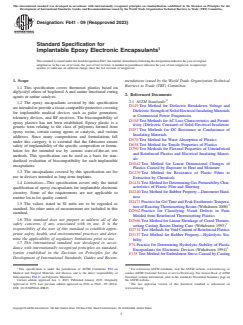
(Specification)Standard Specification for Implantable Epoxy Electronic Encapsulants
General Information
- Abstract
ABSTRACT
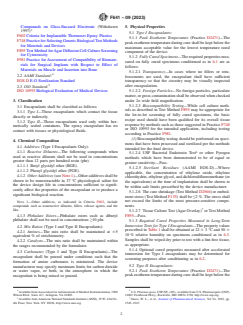
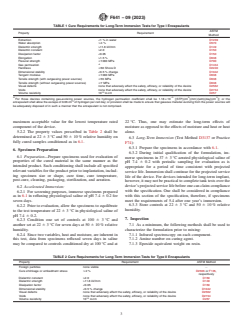
This specification covers thermoset plastics based on diglycidyl ethers of bisphenol A and amino functional curing agents or amine catalysts for implantable epoxy electronic encapsulants. Encapsulants shall be classified depending on contact with tissues or physiological fluids. Chemical composition requirements may include additives, phthalate esters, amines, catalysts, and carbonates. The material shall be tested for the following physical properties: peak exotherm temperature, transparency, foreign particles, USP biological test plastic containers, USP pyrogen test, sterilant residues, cure shrinkage, embedment stress, tissue culture test, long-term immersion test, and accelerated immersion test. The material shall also be inspected with infrared spectroscopy, amine number, epoxide equivalent weight, spectrographic analysis, and total nitrogen.
SCOPE
1.1 This specification covers thermoset plastics based on diglycidyl ethers of bisphenol A and amino functional curing agents or amine catalysts.
1.2 The epoxy encapsulants covered by this specification are intended to provide a tissue-compatible protective covering for implantable medical devices such as pulse generators, telemetry devices, and RF receivers. The biocompatibility of epoxy plastics has not been established. Epoxy plastic is a generic term relating to the class of polymers formed from epoxy resins, certain curing agents or catalysts, and various additives. Since many compositions and formulations fall under this category, it is essential that the fabricator ensure safety of implantability of the specific composition or formulation for the intended use by current state-of-the-art test methods. This specification can be used as a basis for standardized evaluation of biocompatibility for such implantable encapsulants.
1.3 The encapsulants covered by this specification are for use in devices intended as long-term implants.
1.4 Limitations—This specification covers only the initial qualification of epoxy encapsulants for implantable electronic circuitry. Some of the requirements are not applicable to routine lot-to-lot quality control.
1.5 The values stated in SI units are to be regarded as standard. No other units of measurement are included in this standard.
1.6 This standard does not purport to address all of the safety concerns, if any, associated with its use. It is the responsibility of the user of this standard to establish appropriate safety, health, and environmental practices and determine the applicability of regulatory limitations prior to use.
1.7 This international standard was developed in accordance with internationally recognized principles on standardization established in the Decision on Principles for the Development of International Standards, Guides and Recommendations issued by the World Trade Organization Technical Barriers to Trade (TBT) Committee.
- Status
- Published
- Publication Date
- 31-Dec-2022
- Technical Committee
- F04 - Medical and Surgical Materials and Devices
- Drafting Committee
- F04.11 - Polymeric Materials

Overview
ASTM F641-09(2023) - Standard Specification for Implantable Epoxy Electronic Encapsulants establishes requirements for epoxy encapsulant materials used in implantable electronic medical devices. These encapsulants are typically thermoset plastics based on diglycidyl ethers of bisphenol A combined with amino functional curing agents or amine catalysts. The specification addresses materials used as protective, tissue-compatible encapsulants for devices such as pulse generators, telemetry units, and RF receivers intended for long-term implantation. The standard lays out guidelines for classification, chemical composition, physical properties, and testing, ensuring minimum essential criteria for safe evaluation and use in medical applications.
Key Topics
- Material Classification: Epoxy encapsulants are classified as Type I (contacting tissue or physiological fluids) or Type II (used within hermetically sealed containers, with no direct tissue contact).
- Chemical Composition:
- Specifies allowable and non-allowable additives (e.g., restrictions on phthalate esters, reactive diluents, and other compounds).
- Requires mix ratios for curing agents and catalysts to ensure integrity and consistency.
- Physical Property Requirements:
- Criteria include peak exotherm temperature, transparency, foreign particles inspection, cure shrinkage, embedment stress, dimensional stability, and mechanical strength.
- Long-term and accelerated immersion testing in physiological saline to assess durability and stability.
- Dielectric, tensile, flexural, and resistivity properties are measured following ASTM methods.
- Biocompatibility and Safety Testing:
- Recommends biological testing per USP and ISO 10993, cytotoxicity (agar overlay or cell culture methods), and screening for pyrogenicity and tissue response.
- Emphasizes the need for specimen preparation and conditioning as per end-use requirements, including sterilization.
- Inspection and Characterization:
- Requirements for characterization of raw and cured polymers, including infrared spectroscopy, amine number, epoxide equivalent weight, spectrographic analysis, and nitrogen content.
Applications
Implantable Medical Devices: The primary application of ASTM F641 epoxy encapsulants is to provide a protective, biocompatible covering for electronics used inside medical implants. This includes:
- Cardiac pulse generators
- Neurostimulators
- Implantable telemetry and communication modules
- RF receivers
- Sensors and monitoring devices
Device Qualification and Compliance: Manufacturers use this standard during the initial qualification of encapsulant formulations. It helps ensure that selected epoxy compounds maintain stability, provide adequate insulation, and do not pose undue biological risk when used for long-term implants.
Material Verification and Selection: This specification serves as a benchmark for selecting and verifying epoxy materials suitable for medical device encapsulation, contributing to material traceability and regulatory compliance.
Related Standards
A number of test methods and related specifications are referenced and should be used in conjunction with ASTM F641:
- ASTM D149: Dielectric breakdown voltage and strength of insulating materials
- ASTM D570: Water absorption of plastics
- ASTM D638/D790: Tensile and flexural properties of plastics
- ASTM F748/ISO 10993: Biological evaluation and selection of biological test methods for medical devices
- ASTM F895: Cytotoxicity screening via agar diffusion cell culture
- ASTM D257: DC resistance or conductance of insulating materials
- ASTM D150: Loss characteristics and dielectric constant of solid insulation
- USP Biological and Pyrogen Tests: As referenced for biocompatibility assessment
Practical Value
Adopting ASTM F641-09(2023) for implantable epoxy electronic encapsulants helps ensure:
- Consistency in material quality and device safety
- Alignment with international testing and evaluation protocols
- Support for regulatory submissions and audits
- Enhanced device performance and longevity in clinical environments
By adhering to this standard, manufacturers reinforce their commitment to safety, efficacy, and regulatory compliance in medical device design and production involving epoxy encapsulant materials.
Relations
- Effective Date
- 01-Oct-2023
- Effective Date
- 01-Jan-2020
- Effective Date
- 01-Jul-2017
- Effective Date
- 01-Sep-2016
- Effective Date
- 01-Apr-2016
- Refers
ASTM F895-11(2016) - Standard Test Method for Agar Diffusion Cell Culture Screening for Cytotoxicity - Effective Date
- 01-Apr-2016
- Effective Date
- 01-Dec-2015
- Effective Date
- 01-Dec-2015
- Effective Date
- 01-Sep-2015
- Effective Date
- 15-Nov-2012
- Refers
ASTM F895-11 - Standard Test Method for Agar Diffusion Cell Culture Screening for Cytotoxicity - Effective Date
- 01-Oct-2011
- Effective Date
- 01-Jun-2010
- Effective Date
- 01-Jun-2010
- Effective Date
- 15-May-2010
- Effective Date
- 01-Sep-2009
Get Certified
Connect with accredited certification bodies for this standard

BSI Group
BSI (British Standards Institution) is the business standards company that helps organizations make excellence a habit.

TÜV Rheinland
TÜV Rheinland is a leading international provider of technical services.

TÜV SÜD
TÜV SÜD is a trusted partner of choice for safety, security and sustainability solutions.
Sponsored listings
Frequently Asked Questions
ASTM F641-09(2023) is a technical specification published by ASTM International. Its full title is "Standard Specification for Implantable Epoxy Electronic Encapsulants". This standard covers: ABSTRACT This specification covers thermoset plastics based on diglycidyl ethers of bisphenol A and amino functional curing agents or amine catalysts for implantable epoxy electronic encapsulants. Encapsulants shall be classified depending on contact with tissues or physiological fluids. Chemical composition requirements may include additives, phthalate esters, amines, catalysts, and carbonates. The material shall be tested for the following physical properties: peak exotherm temperature, transparency, foreign particles, USP biological test plastic containers, USP pyrogen test, sterilant residues, cure shrinkage, embedment stress, tissue culture test, long-term immersion test, and accelerated immersion test. The material shall also be inspected with infrared spectroscopy, amine number, epoxide equivalent weight, spectrographic analysis, and total nitrogen. SCOPE 1.1 This specification covers thermoset plastics based on diglycidyl ethers of bisphenol A and amino functional curing agents or amine catalysts. 1.2 The epoxy encapsulants covered by this specification are intended to provide a tissue-compatible protective covering for implantable medical devices such as pulse generators, telemetry devices, and RF receivers. The biocompatibility of epoxy plastics has not been established. Epoxy plastic is a generic term relating to the class of polymers formed from epoxy resins, certain curing agents or catalysts, and various additives. Since many compositions and formulations fall under this category, it is essential that the fabricator ensure safety of implantability of the specific composition or formulation for the intended use by current state-of-the-art test methods. This specification can be used as a basis for standardized evaluation of biocompatibility for such implantable encapsulants. 1.3 The encapsulants covered by this specification are for use in devices intended as long-term implants. 1.4 Limitations—This specification covers only the initial qualification of epoxy encapsulants for implantable electronic circuitry. Some of the requirements are not applicable to routine lot-to-lot quality control. 1.5 The values stated in SI units are to be regarded as standard. No other units of measurement are included in this standard. 1.6 This standard does not purport to address all of the safety concerns, if any, associated with its use. It is the responsibility of the user of this standard to establish appropriate safety, health, and environmental practices and determine the applicability of regulatory limitations prior to use. 1.7 This international standard was developed in accordance with internationally recognized principles on standardization established in the Decision on Principles for the Development of International Standards, Guides and Recommendations issued by the World Trade Organization Technical Barriers to Trade (TBT) Committee.
ABSTRACT This specification covers thermoset plastics based on diglycidyl ethers of bisphenol A and amino functional curing agents or amine catalysts for implantable epoxy electronic encapsulants. Encapsulants shall be classified depending on contact with tissues or physiological fluids. Chemical composition requirements may include additives, phthalate esters, amines, catalysts, and carbonates. The material shall be tested for the following physical properties: peak exotherm temperature, transparency, foreign particles, USP biological test plastic containers, USP pyrogen test, sterilant residues, cure shrinkage, embedment stress, tissue culture test, long-term immersion test, and accelerated immersion test. The material shall also be inspected with infrared spectroscopy, amine number, epoxide equivalent weight, spectrographic analysis, and total nitrogen. SCOPE 1.1 This specification covers thermoset plastics based on diglycidyl ethers of bisphenol A and amino functional curing agents or amine catalysts. 1.2 The epoxy encapsulants covered by this specification are intended to provide a tissue-compatible protective covering for implantable medical devices such as pulse generators, telemetry devices, and RF receivers. The biocompatibility of epoxy plastics has not been established. Epoxy plastic is a generic term relating to the class of polymers formed from epoxy resins, certain curing agents or catalysts, and various additives. Since many compositions and formulations fall under this category, it is essential that the fabricator ensure safety of implantability of the specific composition or formulation for the intended use by current state-of-the-art test methods. This specification can be used as a basis for standardized evaluation of biocompatibility for such implantable encapsulants. 1.3 The encapsulants covered by this specification are for use in devices intended as long-term implants. 1.4 Limitations—This specification covers only the initial qualification of epoxy encapsulants for implantable electronic circuitry. Some of the requirements are not applicable to routine lot-to-lot quality control. 1.5 The values stated in SI units are to be regarded as standard. No other units of measurement are included in this standard. 1.6 This standard does not purport to address all of the safety concerns, if any, associated with its use. It is the responsibility of the user of this standard to establish appropriate safety, health, and environmental practices and determine the applicability of regulatory limitations prior to use. 1.7 This international standard was developed in accordance with internationally recognized principles on standardization established in the Decision on Principles for the Development of International Standards, Guides and Recommendations issued by the World Trade Organization Technical Barriers to Trade (TBT) Committee.
ASTM F641-09(2023) is classified under the following ICS (International Classification for Standards) categories: 11.040.40 - Implants for surgery, prosthetics and orthotics. The ICS classification helps identify the subject area and facilitates finding related standards.
ASTM F641-09(2023) has the following relationships with other standards: It is inter standard links to ASTM D2734-23, ASTM D149-20, ASTM D790-17, ASTM D2734-16, ASTM F748-16, ASTM F895-11(2016), ASTM D790-15, ASTM D790-15e1, ASTM D2562-94(2015), ASTM D1042-12, ASTM F895-11, ASTM F748-06(2010), ASTM F981-04(2010), ASTM D638-10, ASTM D2734-09. Understanding these relationships helps ensure you are using the most current and applicable version of the standard.
ASTM F641-09(2023) is available in PDF format for immediate download after purchase. The document can be added to your cart and obtained through the secure checkout process. Digital delivery ensures instant access to the complete standard document.
Standards Content (Sample)
This international standard was developed in accordance with internationally recognized principles on standardization established in the Decision on Principles for the
Development of International Standards, Guides and Recommendations issued by the World Trade Organization Technical Barriers to Trade (TBT) Committee.
Designation: F641 −09 (Reapproved 2023)
Standard Specification for
Implantable Epoxy Electronic Encapsulants
ThisstandardisissuedunderthefixeddesignationF641;thenumberimmediatelyfollowingthedesignationindicatestheyearoforiginal
adoptionor,inthecaseofrevision,theyearoflastrevision.Anumberinparenthesesindicatestheyearoflastreapproval.Asuperscript
epsilon (´) indicates an editorial change since the last revision or reapproval.
1. Scope mendations issued by the World Trade Organization Technical
Barriers to Trade (TBT) Committee.
1.1 This specification covers thermoset plastics based on
diglycidyl ethers of bisphenol A and amino functional curing
2. Referenced Documents
agents or amine catalysts.
2.1 ASTM Standards:
1.2 The epoxy encapsulants covered by this specification
D149Test Method for Dielectric Breakdown Voltage and
areintendedtoprovideatissue-compatibleprotectivecovering
DielectricStrengthofSolidElectricalInsulatingMaterials
for implantable medical devices such as pulse generators,
at Commercial Power Frequencies
telemetry devices, and RF receivers. The biocompatibility of
D150Test Methods forAC Loss Characteristics and Permit-
epoxy plastics has not been established. Epoxy plastic is a
tivity (Dielectric Constant) of Solid Electrical Insulation
generic term relating to the class of polymers formed from
D257Test Methods for DC Resistance or Conductance of
epoxy resins, certain curing agents or catalysts, and various
Insulating Materials
additives. Since many compositions and formulations fall
D570Test Method for Water Absorption of Plastics
under this category, it is essential that the fabricator ensure
D638Test Method for Tensile Properties of Plastics
safety of implantability of the specific composition or formu-
D790Test Methods for Flexural Properties of Unreinforced
lation for the intended use by current state-of-the-art test
and Reinforced Plastics and Electrical Insulating Materi-
methods. This specification can be used as a basis for stan-
als
dardized evaluation of biocompatibility for such implantable
D1042Test Method for Linear Dimensional Changes of
encapsulants.
Plastics Caused by Exposure to Heat and Moisture
1.3 The encapsulants covered by this specification are for
D1239Test Method for Resistance of Plastic Films to
use in devices intended as long-term implants.
Extraction by Chemicals
D1434TestMethodforDeterminingGasPermeabilityChar-
1.4 Limitations—This specification covers only the initial
acteristics of Plastic Film and Sheeting
qualification of epoxy encapsulants for implantable electronic
D2240TestMethodforRubberProperty—DurometerHard-
circuitry. Some of the requirements are not applicable to
ness
routine lot-to-lot quality control.
D2471PracticeforGelTimeandPeakExothermicTempera-
1.5 The values stated in SI units are to be regarded as
tureofReactingThermosettingResins(Withdrawn2008)
standard. No other units of measurement are included in this
D2562Practice for Classifying Visual Defects in Parts
standard.
Molded from Reinforced Thermosetting Plastics
1.6 This standard does not purport to address all of the
D2566Test Method for Linear Shrinkage of CuredThermo-
safety concerns, if any, associated with its use. It is the
setting Casting Resins During Cure (Withdrawn 1993)
responsibility of the user of this standard to establish appro-
D2734TestMethodsforVoidContentofReinforcedPlastics
priate safety, health, and environmental practices and deter-
D3137Test Method for Rubber Property—Hydrolytic Sta-
mine the applicability of regulatory limitations prior to use.
bility
1.7 This international standard was developed in accor-
F74Practice for Determining Hydrolytic Stability of Plastic
dance with internationally recognized principles on standard-
Encapsulants for Electronic Devices (Withdrawn 1994)
ization established in the Decision on Principles for the
F135TestMethodforEmbedmentStressCausedbyCasting
Development of International Standards, Guides and Recom-
1 2
This specification is under the jurisdiction of ASTM Committee F04 on For referenced ASTM standards, visit the ASTM website, www.astm.org, or
Medical and Surgical Materials and Devices and is the direct responsibility of contact ASTM Customer Service at service@astm.org. For Annual Book of ASTM
Subcommittee F04.11 on Polymeric Materials. Standards volume information, refer to the standard’s Document Summary page on
Current edition approved Jan. 1, 2023. Published January 2023. Originally the ASTM website.
approved in 1979. Last previous edition approved in 2014 as F641–09 (2014). The last approved version of this historical standard is referenced on
DOI: 10.1520/F0641-09R23. www.astm.org.
Copyright © ASTM International, 100 Barr Harbor Drive, PO Box C700, West Conshohocken, PA 19428-2959. United States
F641 − 09 (2023)
Compounds on Glass-Encased Electronic (Withdrawn 5. Physical Properties
1997)
5.1 Type I Encapsulants:
F602Criteria for Implantable Thermoset Epoxy Plastics
5.1.1 Peak Exotherm Temperature (Practice D2471)—The
F748PracticeforSelectingGenericBiologicalTestMethods
peakexothermtemperatureduringcureshallbekeptbelowthe
for Materials and Devices
maximum acceptable value for the lowest temperature rated
F895TestMethodforAgarDiffusionCellCultureScreening
component of the device.
for Cytotoxicity
5.1.2 FullyCuredSpecimens—Therequiredpropertiesmea-
F981Practice for Assessment of Compatibility of Biomate-
sured on fully cured specimens conditioned as in 6.1 are as
rials for Surgical Implants with Respect to Effect of
follows:
Materials on Muscle and Insertion into Bone
5.1.2.1 Transparency—In cases where no fillers or rein-
2.2 AAMI Standard:
forcements are used, the encapsulant shall have sufficient
EOS-DE-O Sterilization Standard
transparency so that the circuitry may be visually inspected
after encapsulation.
2.3 ISO Standard:
5.1.2.2 Foreign Particles—No foreign particles, particulate
ISO 10993Biological Evaluation of Medical Devices
matter,orgrosscontaminationshallbeobservedwhenchecked
under 2× wide field magnification.
3. Classification
5.1.2.3 Biocompatibility Testing—While cell culture meth-
3.1 Encapsulants shall be classified as follows:
ods as described in Test Method F895 may be appropriate for
3.1.1 Type I—Those encapsulants which contact the tissue
the lot-to-lot screening of fully cured specimens, the basic
directly or indirectly.
recipe used should have been qualified for its overall tissue
3.1.2 Type II—Those encapsulants used only within her-
response by methods such as those suggested in Practice F748
metically sealed containers. The epoxy encapsulant has no
or ISO 10993 for the intended application, including testing
contact with tissues or physiological fluids.
according to Practice F981.
(1)Biocompatibility testing should be performed on speci-
4. Chemical Composition
mens that have been processed and sterilized per the methods
4.1 Additives (Type I Encapsulants Only):
intended for the final device.
4.1.1 Reactive Diluents—The following compounds when 6
5.1.2.4 USP Bacterial Endotoxin Test or other Pyrogen
used as reactive diluents shall not be used in concentrations
methods which have been demonstrated to be of equal or
greater than 12 parts per hundred resin (phr).
greater sensitivity—Pass.
4.1.1.1 Butyl glycidyl ether (BGE).
5.1.2.5 Sterilant Residues (AAMI EOS-D)—Where
4.1.1.2 Phenyl glycidyl ether (PGE).
applicable, the concentration of ethylene oxide, ethylene
4.1.2 OtherAdditives(seeNote1)—Otheradditivesshallbe
chlorohydrin,ethyleneglycol,anddichlorodifluoromethane(or
shown to be nonextractable in 37°C physiological saline for
the equivalents) at the time of implantation shall be shown to
the device design life in concentrations sufficient to signifi-
be within safe limits prescribed by the device manufacturer.
cantly affect the properties of the encapsulant or to produce a
5.1.2.6 The cure shrinkage (Test Method D2566) or embed-
significant biological reaction.
ment stress (Test Method F135) shall be≤2%.The stress shall
not exceed the limits of the most pressure-sensitive compo-
NOTE 1—Other additives, as indicated in Criteria F602, include
compounds such as nonreactive diluents, fillers, release agents, and the
nents.
like.
5.1.2.7 Tissue CultureTest (Agar Overlay) orTest Method
4.1.3 Phthalate Esters—Phthalate esters such as dibutyl
F895—Pass.
phthalate shall not be used in concentrations ≥10 phr.
5.1.3 Required Cured Properties Measured in Long-Term
Immersion Tests for Type I Encapsulants—Thepropertyvalues
4.2 Mix Ratios (Type I and Type II Encapsulants):
prescribed in Table 1 shall be obtained at 22 6 3°C and 50 6
4.2.1 Amines—The mix ratio shall be maintained at 65
10% relative humidity on specimens conditioned as in 6.3.
equivalent% of stoichiometry.
Samples shall be wiped dry prior to test with a lint-free tissue,
4.2.2 Catalysts—The mix ratio shall be maintained within
as appropriate.
the ranges recommended by the formulator.
5.1.4 Optional cured properties measured after accelerated
4.3 Carbonates (Type I and Type II Encapsulan
...