

ASTM F414-21
(Test Method)Standard Test Method for Energy Absorbed by a Tire When Deformed by Slow-Moving Plunger
General Information
- Abstract
SIGNIFICANCE AND USE
5.1 This test method establishes a standard procedure of test and provides data that can be related to tire strength, but does not measure tire performance or establish specification or tolerances.
SCOPE
1.1 This test method covers the determination of tire plunger energy required to completely penetrate the tread area of an inflated tire as indicated by a rupture, loss of inflation pressure, sudden drop in plunger force or bottom-out. The test requires utilization of a laboratory testing machine capable of slowly penetrating the tread surface of a tire with a plunger having a hemispherical end.
1.2 This test method is applicable to pneumatic tires for vehicles normally used on the road.
1.3 The values stated in SI units are to be regarded as the standard. The values given in parentheses are provided for information only.
1.4 This standard does not purport to address all of the safety concerns, if any, associated with its use. It is the responsibility of the user of this standard to establish appropriate safety, health, and environmental practices and determine the applicability of regulatory limitations prior to use.
1.5 This international standard was developed in accordance with internationally recognized principles on standardization established in the Decision on Principles for the Development of International Standards, Guides and Recommendations issued by the World Trade Organization Technical Barriers to Trade (TBT) Committee.
- Status
- Published
- Publication Date
- 31-Aug-2021
- Technical Committee
- F09 - Tires
- Drafting Committee
- F09.30 - Laboratory (Non-Vehicular) Testing
Buy Documents

ASTM F414-21 - Standard Test Method for Energy Absorbed by a Tire When Deformed by Slow-Moving Plunger
REDLINE ASTM F414-21 - Standard Test Method for Energy Absorbed by a Tire When Deformed by Slow-Moving Plunger
Overview
ASTM F414-21, titled Standard Test Method for Energy Absorbed by a Tire When Deformed by Slow-Moving Plunger, is an internationally recognized standard developed by ASTM International. This test method specifies a laboratory procedure to determine the energy required for a plunger with a hemispherical end to penetrate the tread of an inflated pneumatic tire. The resulting data is widely used to assess relative tire strength and is applicable to road-going vehicle tires.
While ASTM F414-21 does not measure tire performance or compliance with specifications, it provides a standardized approach to evaluate and compare the structural integrity of tires under puncture-like loading conditions.
Keywords: tire strength, tire plunger energy, ASTM F414, tire test method, slow-moving plunger, absorb energy, tread penetration
Key Topics
Purpose and Scope
- Measures the energy absorbed when a tire is penetrated by a slow-moving plunger.
- Applicable to all pneumatic tires used on road vehicles.
- Establishes a consistent method, using SI units as standard.
Test Procedure Highlights
- Mount the tire on a specified test rim, inflate to a controlled pressure, and allow conditioning.
- A hemispherical plunger is pressed into the tire’s tread at a slow, controlled rate using a testing machine.
- The test continues until the tire ruptures, loses inflation, shows a sudden force drop, or bottoms out.
- The maximum force and plunger travel are recorded to calculate the absorbed energy.
Precision and Reporting
- Requires recording of tire identification, rim details, test conditions, and results for rigorous data tracking.
- Recommends measures to confirm the accuracy and calibration of test equipment.
Safety Considerations
- Users must establish appropriate safety, health, and environmental practices.
- All regulatory and safety limitations must be evaluated by the user prior to test execution.
Applications
ASTM F414-21 is valued across the tire and automotive industries for its role in tire evaluation and quality assurance. Key use cases include:
Tire Manufacturing
- Helps manufacturers understand and benchmark the structural strength of different tire designs and materials.
- Used for product development and improvement in line with industry expectations for durability.
Quality Assurance
- Supports batch-to-batch consistency checks in tire production.
- Offers a methodology for verifying compliance with internal company standards for tire integrity.
Research and Development
- Used in R&D environments to compare prototypes or new compounds for enhanced puncture resistance.
- Assists in investigating the effects of varying inflation pressures or tread patterns on overall tire strength.
Regulatory and Standards Compliance
- Serves as a reference method for organizations and regulatory bodies needing standardized tire test results.
- Data from F414-21 tests can support safety documentation and dispute resolution.
Related Standards
ASTM F414-21 references several related industry standards and practices, including:
- ASTM D4483: Practice for Evaluating Precision for Test Method Standards in the Rubber and Carbon Black Manufacturing Industries
- ASTM E4: Practices for Force Calibration and Verification of Testing Machines
- ASTM F538: Terminology Relating to Characteristics and Performance of Tires
- IEEE/ASTM SI10: American National Standard for Use of the International System of Units (SI): The Modern Metric System
Adherence to these related standards ensures comprehensive and harmonized results in laboratory tire testing workflows.
For more information or access to the official ASTM F414-21 document, consult ASTM International, which houses the complete and authoritative text of this and other standards.
Relations
- Effective Date
- 01-Jun-2014
- Effective Date
- 01-Jun-2010
- Effective Date
- 01-Nov-2009
- Effective Date
- 15-Jun-2009
- Effective Date
- 01-Apr-2009
- Effective Date
- 01-Dec-2008
- Effective Date
- 01-Jan-2007
- Effective Date
- 01-Dec-2003
- Effective Date
- 10-Aug-2003
- Effective Date
- 10-Nov-2002
- Effective Date
- 10-Apr-2001
- Effective Date
- 10-Apr-2001
- Effective Date
- 10-May-2000
- Effective Date
- 10-Apr-1999
Buy Documents
ASTM F414-21 - Standard Test Method for Energy Absorbed by a Tire When Deformed by Slow-Moving Plunger
REDLINE ASTM F414-21 - Standard Test Method for Energy Absorbed by a Tire When Deformed by Slow-Moving Plunger
Get Certified
Connect with accredited certification bodies for this standard

DIN CERTCO
DIN Group product certification.

Smithers Quality Assessments
US management systems and product certification.
Sponsored listings
Frequently Asked Questions
ASTM F414-21 is a standard published by ASTM International. Its full title is "Standard Test Method for Energy Absorbed by a Tire When Deformed by Slow-Moving Plunger". This standard covers: SIGNIFICANCE AND USE 5.1 This test method establishes a standard procedure of test and provides data that can be related to tire strength, but does not measure tire performance or establish specification or tolerances. SCOPE 1.1 This test method covers the determination of tire plunger energy required to completely penetrate the tread area of an inflated tire as indicated by a rupture, loss of inflation pressure, sudden drop in plunger force or bottom-out. The test requires utilization of a laboratory testing machine capable of slowly penetrating the tread surface of a tire with a plunger having a hemispherical end. 1.2 This test method is applicable to pneumatic tires for vehicles normally used on the road. 1.3 The values stated in SI units are to be regarded as the standard. The values given in parentheses are provided for information only. 1.4 This standard does not purport to address all of the safety concerns, if any, associated with its use. It is the responsibility of the user of this standard to establish appropriate safety, health, and environmental practices and determine the applicability of regulatory limitations prior to use. 1.5 This international standard was developed in accordance with internationally recognized principles on standardization established in the Decision on Principles for the Development of International Standards, Guides and Recommendations issued by the World Trade Organization Technical Barriers to Trade (TBT) Committee.
SIGNIFICANCE AND USE 5.1 This test method establishes a standard procedure of test and provides data that can be related to tire strength, but does not measure tire performance or establish specification or tolerances. SCOPE 1.1 This test method covers the determination of tire plunger energy required to completely penetrate the tread area of an inflated tire as indicated by a rupture, loss of inflation pressure, sudden drop in plunger force or bottom-out. The test requires utilization of a laboratory testing machine capable of slowly penetrating the tread surface of a tire with a plunger having a hemispherical end. 1.2 This test method is applicable to pneumatic tires for vehicles normally used on the road. 1.3 The values stated in SI units are to be regarded as the standard. The values given in parentheses are provided for information only. 1.4 This standard does not purport to address all of the safety concerns, if any, associated with its use. It is the responsibility of the user of this standard to establish appropriate safety, health, and environmental practices and determine the applicability of regulatory limitations prior to use. 1.5 This international standard was developed in accordance with internationally recognized principles on standardization established in the Decision on Principles for the Development of International Standards, Guides and Recommendations issued by the World Trade Organization Technical Barriers to Trade (TBT) Committee.
ASTM F414-21 is classified under the following ICS (International Classification for Standards) categories: 83.160.10 - Road vehicle tyres. The ICS classification helps identify the subject area and facilitates finding related standards.
ASTM F414-21 has the following relationships with other standards: It is inter standard links to ASTM E4-14, ASTM E4-10, ASTM E4-09a, ASTM F538-09, ASTM E4-09, ASTM E4-08, ASTM E4-07, ASTM F538-03, ASTM E4-03, ASTM E4-02, ASTM E4-99, ASTM E4-01, ASTM F1082-00(2000), ASTM F538-99. Understanding these relationships helps ensure you are using the most current and applicable version of the standard.
ASTM F414-21 is available in PDF format for immediate download after purchase. The document can be added to your cart and obtained through the secure checkout process. Digital delivery ensures instant access to the complete standard document.
Standards Content (Sample)
This international standard was developed in accordance with internationally recognized principles on standardization established in the Decision on Principles for the
Development of International Standards, Guides and Recommendations issued by the World Trade Organization Technical Barriers to Trade (TBT) Committee.
Designation: F414 − 21
Standard Test Method for
Energy Absorbed by a Tire When Deformed by Slow-Moving
Plunger
ThisstandardisissuedunderthefixeddesignationF414;thenumberimmediatelyfollowingthedesignationindicatestheyearoforiginal
adoptionor,inthecaseofrevision,theyearoflastrevision.Anumberinparenthesesindicatestheyearoflastreapproval.Asuperscript
epsilon (´) indicates an editorial change since the last revision or reapproval.
1. Scope F538Terminology Relating to Characteristics and Perfor-
mance of Tires
1.1 This test method covers the determination of tire
F1082Practice for Tires—Determining Precision for Test
plunger energy required to completely penetrate the tread area
Method Standards (Withdrawn 2005)
of an inflated tire as indicated by a rupture, loss of inflation
IEEE/ASTM SI10-02American National Standard for Use
pressure, sudden drop in plunger force or bottom-out. The test
of the International System of Units (SI): The Modern
requires utilization of a laboratory testing machine capable of
Metric System
slowly penetrating the tread surface of a tire with a plunger
having a hemispherical end.
3. Terminology
1.2 This test method is applicable to pneumatic tires for
3.1 Definitions:
vehicles normally used on the road.
3.1.1 bottom out, v—to deform a tire by radial load on the
1.3 The values stated in SI units are to be regarded as the
tread until radial movement of the inside surface is stopped by
standard. The values given in parentheses are provided for
the rim or other tire inside surface. F538
information only.
3.1.2 groove, n—a void that is relatively narrow compared
1.4 This standard does not purport to address all of the
to its length. F538
safety concerns, if any, associated with its use. It is the
3.1.3 load range, n—aletterdesignation(A,B,C,D)or,for
responsibility of the user of this standard to establish appro-
P-metrictires,standardload(SL),lightload(LL),orextraload
priate safety, health, and environmental practices and deter-
(XL), used to identify a given size tire with its load and
mine the applicability of regulatory limitations prior to use.
inflation limits when used in a specific type of service. F538
1.5 This international standard was developed in accor-
dance with internationally recognized principles on standard-
3.1.4 load rating [M], n—the maximum load a tire is rated
ization established in the Decision on Principles for the
to carry for a given usage at a specific cold inflation pressure.
Development of International Standards, Guides and Recom-
F538
mendations issued by the World Trade Organization Technical
3.1.5 maximum load rating [M], n—of a passenger tire, the
Barriers to Trade (TBT) Committee.
load rating at the maximum permissible cold inflation pressure
for that tire. F538
2. Referenced Documents
3.1.6 maximum plunger travel [L], n—in tire testing, the
2.1 ASTM Standards:
relative displacement of tread surface by a plunger, measured
D4483Practice for Evaluating Precision for Test Method
from the point of initial contact of the plunger with the tread
StandardsintheRubberandCarbonBlackManufacturing
surface to the point of maximum force at rupture or at the
Industries
bottom-out point. F538
E4Practices for Force Calibration and Verification of Test-
ing Machines 3.1.7 nominal plunger energy,W=(F× P)/2, n—in tire
testing, one half of the product of a peak force (required to
rupture the tire structure in tread area) and maximum plunger
This test method is under the jurisdiction of ASTM Committee F09 on Tires
travel into a tire at the time of rupture. F538
and is the direct responsibility of Subcommittee F09.30 on Laboratory (Non-
Vehicular) Testing.
3.1.8 plunger, n—in tire testing, a cylindrical rod with a
Current edition approved Sept. 1, 2021. Published October 2021. Originally
hemispherical end. F538
approved in 1975. Last previous edition approved in 2015 as F414–15. DOI:
10.1520/F0414-21.
For referenced ASTM standards, visit the ASTM website, www.astm.org, or
contact ASTM Customer Service at service@astm.org. For Annual Book of ASTM
Standards volume information, refer to the standard’s Document Summary page on The last approved version of this historical standard is referenced on
the ASTM website. www.astm.org.
Copyright © ASTM International, 100 Barr Harbor Drive, PO Box C700, West Conshohocken, PA 19428-2959. United States
F414 − 21
TABLE 1 Plunger Diameter
3.1.9 void, n—a volume (in the tread band) defined by the
A
lack of rubber; the depth dimension of this volume may vary Tire Load Identification Tire Characteristics Plunger Diameter, mm (in.)
from point to point in (on) the tread band. F538 A, B, C Motorcycle 7.9 ± 0.1 (0.313 ± 0.005)
A, B, C, D, SL, XL, All 12 rim diameter 19.0 ± 0.1 (0.750 ± 0.005)
E, F code or smaller,
4. Summary of Test Method
except motorcycle
B, C, D, SL, LL, XL, T Passenger car 19.0 ± 0.1 (0.750 ± 0.005)
4.1 This test method measures tire plunger energy required
B, C, D, E, F, G, Light truck 19.0 ± 0.1 (0.750 ± 0.005)
toforceacylindricalplungerwithahemisphericalendintothe H
B, C, D, E, F, G, 17.5 rim diameter 19.0 ± 0.1 (0.750 ± 0.005)
tread of the tire to produce a rupture of the carcass or a
H code or smaller,
bottom-out condition.
tubeless
C, D, E, F Larger than 17.5 rim 31.8 ± 0.1 (1.250 ± 0.005)
diameter code,
5. Significance and Use
tubeless
C, D, E, F Larger than 17.5 rim 31.8 ± 0.1 (1.250 ± 0.005)
5.1 Thistestmethodestablishesastandardprocedureoftest
diameter code, tube
and provides data that can be related to tire strength, but does
type
not measure tire performance or establish specification or G, H, J, L, M, N Larger than 17.5 rim 38.1 ± 0.1 (1.500 ± 0.005)
diameter code,
tolerances.
tubeless
G, H, J Larger than 17.5 rim 38.1 ± 0.1 (1.500 ± 0.005)
diameter code, tube
6. Apparatus
type
6.1 Testing Machine that incorporates a cylindrical plunger,
A
Temporary use 60-psi tires and standard load, light load, and extra load “P
whichcanbeforced,at50.8 61.58mm/min(2.0 60.0625in-
metric” tires are described as T, SL, LL, and XL.All other letter designations refer
to load range.
.⁄min)radiallyintoatreadofatire,whiletheforceandplunger
motion are indicated or recorded.
6.1.1 The force-indicating device shall have an accuracy of
61% of the indicated force and shall reflect an instantaneous
change in force from zero to full scale in no more than 3.0 s.
7. Sampling
6.1.2 Relative plunger travel distance shall be indicated to
7.1 A sample is one or more tires taken from a lot as
an accuracy of 61% of the distance from the original
directed in any applicable specification, or as taken from a
undeformed tire tread surface, taking into account any motion
shippingunit,orasagreeduponbetweenthepurchaserandthe
or deflection of the force-measuring mechanism or supporting
seller.
devices.
7.2 Record the manufacturer’s identification, brand name,
6.2 Means for Calibration of the Testing Machine, for
tire identification number, tire outside diameter, rim diameter,
plunger force, plunger travel, and rate of plunger travel is
size, load range, fabric type, and type of tire. Visually inspect
necessary.
the tire completely for excessive mold lubricant and for any
6.3 Calibrating Weights or Other Calibrating Devices, con-
obvious faults or conditions that could affect the test.
forming to Practices E4, are required for verification of
calibration.
8. Conditioning
6.4 Means for Mounting a Tire on a Test Rim,andmounting
8.1 Theambienttemperaturefortireconditioningandinthe
the test assembly on the testing machine is necessary.
testareashallbeanyknowntemperaturebetween18and40°C
6.5 TestRims,withdimensionsasshowninthecurrentissue (65 and 105°F).
4 5 6
of Tire and RimAssociationYear Books, ETRTO, JATMA,
8.2 The test tire, after being mounted on a test rim and
or as listed in a publication by the tire manufacturer, are
inflated to the applicable test pressure, shall remain at the
necessary.
ambient temperature of the test room for at least 3 h prior to
6.6 Plunger (Circular Cylinder), having a diameter as testing.
shown in Table 1 for the tire being tested, and having the
working end in the shape of a hemisphere, hardened to a 9. Procedure
minimum Rockwell hardness 35 HRC, and polished to a
9.1 Mount the tire on a test rim and inflate the tire with air
0.50-µm (16-µin.) finish or better with no visible tool marks, is
to the pressure as specified in Table 2 when testing passenger
required. It must be long enough to penetrate from the
car tires or corresponding to the maximum load or maximum
undeformed tire tread surface to the bottom-out condition.
dual load where there is both a single and dual load marked on
the tire for all other type tires. The inflation pressure tolerance
shall be 63.5 kPa (0.5 psi). Condition the mounted tire in
accordance with 8.1 and 8.2.
Available from Tire and Rim Association, Inc., 4000 Embassy Parkway, Suite
390, Akron, OH 44333.
9.1.1 Table 2 provides the inflation pressure to use when
Available from the European Tyre and Rim Technical Organization, 78/80, rue
testing various passenger car tire sizes. There are three com-
Defacqz, B-1060, Brussels, Belgium.
mon styles for tire size designators in current use; each style is
AvailablefromtheJapanAutomobileTireManufacturersAssociation,Inc.,No.
th
33 Mori BLDG, 8 Floor, 3-8-21Toranomon, Minato-KU,Tokyo, Japan 105-001J. listed in separate sections of the table.
F414 − 21
TABLE 2 Passenger Car Tire Plunger Energy Test Inflation
Record the maximum plunger force and plunger travel into the
A
Pressure
tire at five test points or at three test points for t
...
This document is not an ASTM standard and is intended only to provide the user of an ASTM standard an indication of what changes have been made to the previous version. Because
it may not be technically possible to adequately depict all changes accurately, ASTM recommends that users consult prior editions as appropriate. In all cases only the current version
of the standard as published by ASTM is to be considered the official document.
Designation: F414 − 15 F414 − 21
Standard Test Method for
Energy Absorbed by a Tire When Deformed by Slow-Moving
Plunger
This standard is issued under the fixed designation F414; the number immediately following the designation indicates the year of original
adoption or, in the case of revision, the year of last revision. A number in parentheses indicates the year of last reapproval. A superscript
epsilon (´) indicates an editorial change since the last revision or reapproval.
1. Scope
1.1 This test method covers the determination of tire plunger energy required to completely penetrate the tread area of an inflated
tire as indicated by a rupture, loss of inflation pressure, sudden drop in plunger force or bottom-out. The test requires utilization
of a laboratory testing machine capable of slowly penetrating the tread surface of a tire with a plunger having a hemispherical end.
1.2 This test method is applicable to pneumatic tires for vehicles normally used on the road.
1.3 The values stated in SI units are to be regarded as the standard. The values given in parentheses are provided for information
only.
1.4 This standard does not purport to address all of the safety concerns, if any, associated with its use. It is the responsibility
of the user of this standard to establish appropriate safety safety, health, and healthenvironmental practices and determine the
applicability of regulatory limitations prior to use.
1.5 This international standard was developed in accordance with internationally recognized principles on standardization
established in the Decision on Principles for the Development of International Standards, Guides and Recommendations issued
by the World Trade Organization Technical Barriers to Trade (TBT) Committee.
2. Referenced Documents
2.1 ASTM Standards:
D4483 Practice for Evaluating Precision for Test Method Standards in the Rubber and Carbon Black Manufacturing Industries
E4 Practices for Force Calibration and Verification of Testing Machines
F538 Terminology Relating to Characteristics and Performance of Tires
F1082 Practice for Tires—Determining Precision for Test Method Standards (Withdrawn 2005)
IEEE/ASTM SI10-02 American National Standard for Use of the International System of Units (SI): The Modern Metric System
3. Terminology
3.1 Definitions:
3.1.1 bottom out, v—to deform a tire by radial load on the tread until radial movement of the inside surface is stopped by the rim
or other tire inside surface. F538
This test method is under the jurisdiction of ASTM Committee F09 on Tires and is the direct responsibility of Subcommittee F09.30 on Laboratory (Non-Vehicular)
Testing.
Current edition approved June 1, 2015Sept. 1, 2021. Published August 2015October 2021. Originally approved in 1975. Last previous edition approved in 20092015 as
F414 – 09.F414 – 15. DOI: 10.1520/F0414-15.10.1520/F0414-21.
For referenced ASTM standards, visit the ASTM website, www.astm.org, or contact ASTM Customer Service at service@astm.org. For Annual Book of ASTM Standards
volume information, refer to the standard’s Document Summary page on the ASTM website.
The last approved version of this historical standard is referenced on www.astm.org.
Copyright © ASTM International, 100 Barr Harbor Drive, PO Box C700, West Conshohocken, PA 19428-2959. United States
F414 − 21
3.1.2 groove, n—a void that is relatively narrow compared to its length. F538
3.1.3 load range, n—a letter designation (A, B, C, D) or, for P-metric tires, standard load (SL), light load (LL), or extra load (XL),
used to identify a given size tire with its load and inflation limits when used in a specific type of service. F538
3.1.4 load rating [M], n—the maximum load a tire is rated to carry for a given usage at a specific cold inflation pressure. F538
3.1.5 maximum load rating [M], n—of a passenger tire, the load rating at the maximum permissible cold inflation pressure for
that tire. F538
3.1.6 maximum plunger travel [L], n—in tire testing, the relative displacement of tread surface by a plunger, measured from the
point of initial contact of the plunger with the tread surface to the point of maximum force at rupture or at the bottom-out point.
F538
3.1.7 nominal plunger energy, W = (F × P)/2, n—in tire testing, one half of the product of a peak force (required to rupture the
tire structure in tread area) and maximum plunger travel into a tire at the time of rupture. F538
3.1.8 plunger, n—in tire testing, a cylindrical rod with a hemispherical end. F538
3.1.9 void, n—a volume (in the annular tread band) defined by the lack of rubber; the depth dimension of this volume may vary
from point to point in (on) the tread band. F538
4. Summary of Test Method
4.1 This test method measures tire plunger energy required to force a cylindrical plunger with a hemispherical end into the tread
of the tire to produce a rupture of the carcass or a bottom-out condition.
5. Significance and Use
5.1 This test method establishes a standard procedure of test and provides data that can be related to tire strength, but does not
measure tire performance or establish specification or tolerances.
6. Apparatus
6.1 Testing Machine that incorporates a cylindrical plunger, which can be forced, at 50.8 6 1.58 mm/min (2.0 6 0.0625 in. ⁄min)
radially into a tread of a tire, while the force and plunger motion are indicated or recorded.
6.1.1 The force-indicating device shall have an accuracy of 61 % of the indicated force and shall reflect an instantaneous change
in force from zero to full scale in no more than 3.0 s.
6.1.2 Relative plunger travel distance shall be indicated to an accuracy of 61 % of the distance from the original undeformed tire
tread surface, taking into account any motion or deflection of the force-measuring mechanism or supporting devices.
6.2 Means for Calibration of the Testing Machine, for plunger force, plunger travel, and rate of plunger travel is necessary.
6.3 Calibrating Weights or Other Calibrating Devices, conforming to Practices E4, are required for verification of calibration.
6.4 Means for Mounting a Tire on a Test Rim, and mounting the test assembly on the testing machine is necessary.
4 5 6
6.5 Test Rims, with dimensions as shown in the current issue of Tire and Rim Association Year Books, ETRTO, JATMA, or
as listed in a publication by the tire manufacturer, are necessary.
Available from Tire and Rim Association, Inc. 175 Montrose West Ave., Copley, OH 44321.Inc., 4000 Embassy Parkway, Suite 390, Akron, OH 44333.
Available from the European Tyre and Rim Technical Organization, 32/2, Avenue Brugmann, B-106078/80, rue Defacqz, B-1060, Brussels, Belgium.
th
Available from the Japan Automobile Tire Manufacturers Association, Inc., No. 33 Mori BLDG, 8 Floor, 3-8-21 Toranomon, Minato-KU, Tokyo, Japan 105-001J.
F414 − 21
TABLE 1 Plunger Diameter
A
Tire Load Identification Tire Characteristics Plunger Diameter, mm (in.)
A, B, C Motorcycle 7.9 ± 0.1 (0.313 ± 0.005)
A, B, C, D, SL, XL, All 12 rim diameter 19.0 ± 0.1 (0.750 ± 0.005)
E, F code or smaller,
except motorcycle
B, C, D, SL, LL, XL, T Passenger car 19.0 ± 0.1 (0.750 ± 0.005)
B, C, D, E, F, G, Light truck 19.0 ± 0.1 (0.750 ± 0.005)
H
B, C, D, E, F, G, 17.5 rim diameter 19.0 ± 0.1 (0.750 ± 0.005)
H code or smaller,
tubeless
C, D, E, F Larger than 17.5 rim 31.8 ± 0.1 (1.250 ± 0.005)
diameter code,
tubeless
C, D, E, F Larger than 17.5 rim 31.8 ± 0.1 (1.250 ± 0.005)
diameter code, tube
type
G, H, J, L, M, N Larger than 17.5 rim 38.1 ± 0.1 (1.500 ± 0.005)
diameter code,
tubeless
G, H, J Larger than 17.5 rim 38.1 ± 0.1 (1.500 ± 0.005)
diameter code, tube
type
A
Temporary use 60-psi tires and standard load, light load, and extra load “P
metric” tires are described as T, SL, LL, and XL. All other letter designations refer
to load range.
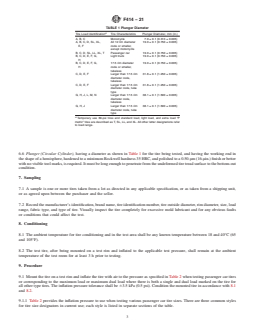
6.6 Plunger (Circular Cylinder), having a diameter as shown in Table 1 for the tire being tested, and having the working end in
the shape of a hemisphere, hardened to a minimum Rockwell hardness 35 HRC, and polished to a 0.50-μm (16-μin.) finish or better
with no visible tool marks, is required. It must be long enough to penetrate from the undeformed tire tread surface to the bottom-out
condition.
7. Sampling
7.1 A sample is one or more tires taken from a lot as directed in any applicable specification, or as taken from a shipping unit,
or as agreed upon between the purchaser and the seller.
7.2 Record the manufacturer’s identification, brand name, tire identification number, tire outside diameter, rim diameter, size, load
range, fabric type, and type of tire. Visually inspect the tire completely for excessive mold lubricant and for any obvious faults
or conditions that could affect the test.
8. Conditioning
8.1 The ambient temperature for tire conditioning and in the test area shall be any known temperature between 18 and 40°C (65
and 105°F).
8.2 The test tire, after being mounted on a test rim and inflated to the applicable test pressure, shall remain at the ambient
temperature of the test room for at least 3 h prior to testing.
9. Procedure
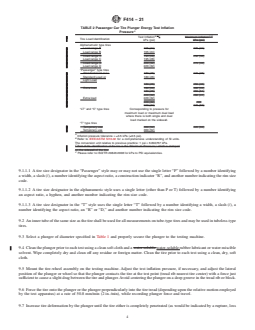
9.1 Mount the tire on a test rim and inflate the tire with air to the pressure as specified in Table 2 when testing passenger car tires
or corresponding to the maximum load or maximum dual load where there is both a single and dual load marked on the tire for
all other type tires. The inflation pressure tolerance shall be 63.5 kPa (0.5 psi). Condition the mounted tire in accordance with 8.1
and 8.2.
9.1.1 Table 2 provides the inflation pressure to use when testing various passenger car tire sizes. There are three common styles
for tire size designators in current use; each style is listed in separate sections of the table.
F414 − 21
TABLE 2 Passenger Car Tire Plunger Energy Test Inflation
A
Pressure
B,DC C,D
Test Inflation Maximum Inflation
Tire Load Identification
kPa (psi) kPa (psi)
Alphanumeric type tires
Load range B 165 (24) 220 (32)
Load range B 165 (24)
Load range C 195 (28) 250 (36)
Load range C 195 (28
...