

ASTM F408-21
(Test Method)Standard Test Method for Tires for Wet Traction in Straight-Ahead Braking, Using a Towed Trailer
General Information
- Abstract
SIGNIFICANCE AND USE
5.1 The measured values are traction properties of tires obtained with the towed trailer described here on a given road surface, under given environmental conditions (ambient and road surface temperature, humidity, wind speed and direction, purity and film depth of water used to wet the road surface). They are carried out in accordance with the stated test procedures and reflect the performance of the total tire-vehicle environmental system. A change in any of these factors may change the measurements on a subsequent run of the test.
5.2 These test methods are suitable for research and development purposes, where tires are compared during a single series of tests. They may not be suitable for regulatory statutes or specification acceptance, because the values obtained may not necessarily agree or correlate either in rank order or absolute traction performance level with those obtained on other road surfaces (or the same surface after additional wear), under other environmental conditions, or other towed trailers, or other test devices, or with results obtained with other test procedures.
SCOPE
1.1 This test method covers the measurement of braking traction of tires designed for passenger cars or light trucks. Such braking traction measurements are applicable to conditions wherein the vehicle is traveling straight ahead on a wet, paved surface.
1.2 The values stated in SI units are to be regarded as the standard. The values given in parentheses are for information only.
1.3 This standard does not purport to address all of the safety concerns, if any, associated with its use. It is the responsibility of the user of this standard to establish appropriate safety, health, and environmental practices and determine the applicability of regulatory limitations prior to use.
1.4 This international standard was developed in accordance with internationally recognized principles on standardization established in the Decision on Principles for the Development of International Standards, Guides and Recommendations issued by the World Trade Organization Technical Barriers to Trade (TBT) Committee.
- Status
- Published
- Publication Date
- 31-Aug-2021
- Technical Committee
- F09 - Tires
- Drafting Committee
- F09.20 - Vehicular Testing
Buy Documents
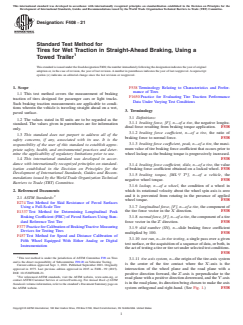
ASTM F408-21 - Standard Test Method for Tires for Wet Traction in Straight-Ahead Braking, Using a Towed Trailer
REDLINE ASTM F408-21 - Standard Test Method for Tires for Wet Traction in Straight-Ahead Braking, Using a Towed Trailer
Overview
ASTM F408-21 is the internationally recognized standard test method for measuring the wet traction performance of tires designed for passenger cars and light trucks. Using a towed trailer apparatus on wet, paved surfaces, this standard provides methodologies for evaluating tire braking traction in straight-ahead motion. The results reflect the real-world response of the total tire-vehicle-environment system under specific environmental and road conditions. ASTM F408-21 is essential for research and development in tire performance testing, supporting comparative studies and innovation in wet traction capabilities.
Key Topics
- Wet Traction Measurement: The standard specifies procedures to determine the braking traction of passenger vehicle and light truck tires using a trailer towed at controlled speeds over a uniformly wetted surface.
- Test Procedure: Brakes are applied firmly on the test tires mounted to the trailer until lockup, and traction properties such as peak and sliding tire braking force coefficients are recorded using calibrated transducers and instrumentation.
- Environmental Factors: Accuracy depends on controlling variables such as road and ambient temperature, humidity, wind, and the quantity and quality of water on the road surface.
- Apparatus Requirements: Detailed requirements for the tow vehicle, trailer, wheel instrumentation, water application system, and calibration protocols ensure repeatable and reliable results.
- Test Limitations: Outcomes are most appropriate for comparing tires within a single test series. Due to sensitivity to test variables, results may not correlate across different road surfaces, surfaces with additional wear, various environmental conditions, or alternative test devices.
Applications
- Tire Development: ASTM F408-21 is widely used by tire manufacturers and researchers to compare and improve wet traction performance in new product lines for passenger cars and light trucks.
- Comparative Performance Studies: The method enables reliable, side-by-side comparison of multiple tires under uniform conditions, providing data essential for product differentiation and performance claims.
- Quality Assurance: Test results can validate design changes, assess consistency in manufacturing, and support internal quality benchmarks.
- Academic Research: Universities and research institutions apply this standard in studying tire-road interaction and advancing tire technology.
- Safety Research: Allows for in-depth analysis of tire braking performance under wet conditions, contributing to improved vehicle safety features.
It is important to note that while ASTM F408-21 supplies valuable traction data for research and product development, it may not be suitable for regulatory or compliance testing due to the inherent sensitivity of the test results to specific environmental and apparatus configurations.
Related Standards
- ASTM E274: Test Method for Skid Resistance of Paved Surfaces Using a Full-Scale Tire; provides additional guidelines for surface skid testing referenced in F408-21.
- ASTM E1337: Test Method for Determining Longitudinal Peak Braking Coefficient of Paved Surfaces Using Standard Reference Test Tire.
- ASTM F377: Practice for Calibration of Braking/Tractive Measuring Devices for Testing Tires; supports accurate calibration required for F408-21.
- ASTM F457: Test Method for Speed and Distance Calibration of Fifth Wheel Equipped With Either Analog or Digital Instrumentation.
- ASTM F538: Terminology Relating to Characteristics and Performance of Tires; provides consistent terminology for use across tire performance standards.
- ASTM F1650: Practice for Evaluating Tire Traction Performance Data Under Varying Test Conditions; used for calculating corrected traction performance and interpreting results from F408-21.
Practical Value
Implementing ASTM F408-21 helps organizations ensure measurement consistency in wet traction testing for passenger and light truck tires. The standard fosters the development of safer, higher-performing tire products and facilitates competitive benchmarking, supporting the continued advancement of tire technologies and road safety initiatives. By adhering to its methodologies and using referenced standards, users can increase the comparability and validity of their tire traction research.
Relations
- Effective Date
- 01-May-2017
- Effective Date
- 01-Jan-2014
- Effective Date
- 01-Feb-2010
- Effective Date
- 01-Nov-2009
- Effective Date
- 15-Jun-2009
- Effective Date
- 01-Nov-2005
- Effective Date
- 01-Dec-2004
- Effective Date
- 01-Dec-2003
- Effective Date
- 01-Dec-2003
- Effective Date
- 10-Sep-1999
- Effective Date
- 10-Sep-1999
- Effective Date
- 10-Apr-1999
- Effective Date
- 10-Jun-1998
Buy Documents
ASTM F408-21 - Standard Test Method for Tires for Wet Traction in Straight-Ahead Braking, Using a Towed Trailer
REDLINE ASTM F408-21 - Standard Test Method for Tires for Wet Traction in Straight-Ahead Braking, Using a Towed Trailer
Get Certified
Connect with accredited certification bodies for this standard

DIN CERTCO
DIN Group product certification.

Smithers Quality Assessments
US management systems and product certification.
Sponsored listings
Frequently Asked Questions
ASTM F408-21 is a standard published by ASTM International. Its full title is "Standard Test Method for Tires for Wet Traction in Straight-Ahead Braking, Using a Towed Trailer". This standard covers: SIGNIFICANCE AND USE 5.1 The measured values are traction properties of tires obtained with the towed trailer described here on a given road surface, under given environmental conditions (ambient and road surface temperature, humidity, wind speed and direction, purity and film depth of water used to wet the road surface). They are carried out in accordance with the stated test procedures and reflect the performance of the total tire-vehicle environmental system. A change in any of these factors may change the measurements on a subsequent run of the test. 5.2 These test methods are suitable for research and development purposes, where tires are compared during a single series of tests. They may not be suitable for regulatory statutes or specification acceptance, because the values obtained may not necessarily agree or correlate either in rank order or absolute traction performance level with those obtained on other road surfaces (or the same surface after additional wear), under other environmental conditions, or other towed trailers, or other test devices, or with results obtained with other test procedures. SCOPE 1.1 This test method covers the measurement of braking traction of tires designed for passenger cars or light trucks. Such braking traction measurements are applicable to conditions wherein the vehicle is traveling straight ahead on a wet, paved surface. 1.2 The values stated in SI units are to be regarded as the standard. The values given in parentheses are for information only. 1.3 This standard does not purport to address all of the safety concerns, if any, associated with its use. It is the responsibility of the user of this standard to establish appropriate safety, health, and environmental practices and determine the applicability of regulatory limitations prior to use. 1.4 This international standard was developed in accordance with internationally recognized principles on standardization established in the Decision on Principles for the Development of International Standards, Guides and Recommendations issued by the World Trade Organization Technical Barriers to Trade (TBT) Committee.
SIGNIFICANCE AND USE 5.1 The measured values are traction properties of tires obtained with the towed trailer described here on a given road surface, under given environmental conditions (ambient and road surface temperature, humidity, wind speed and direction, purity and film depth of water used to wet the road surface). They are carried out in accordance with the stated test procedures and reflect the performance of the total tire-vehicle environmental system. A change in any of these factors may change the measurements on a subsequent run of the test. 5.2 These test methods are suitable for research and development purposes, where tires are compared during a single series of tests. They may not be suitable for regulatory statutes or specification acceptance, because the values obtained may not necessarily agree or correlate either in rank order or absolute traction performance level with those obtained on other road surfaces (or the same surface after additional wear), under other environmental conditions, or other towed trailers, or other test devices, or with results obtained with other test procedures. SCOPE 1.1 This test method covers the measurement of braking traction of tires designed for passenger cars or light trucks. Such braking traction measurements are applicable to conditions wherein the vehicle is traveling straight ahead on a wet, paved surface. 1.2 The values stated in SI units are to be regarded as the standard. The values given in parentheses are for information only. 1.3 This standard does not purport to address all of the safety concerns, if any, associated with its use. It is the responsibility of the user of this standard to establish appropriate safety, health, and environmental practices and determine the applicability of regulatory limitations prior to use. 1.4 This international standard was developed in accordance with internationally recognized principles on standardization established in the Decision on Principles for the Development of International Standards, Guides and Recommendations issued by the World Trade Organization Technical Barriers to Trade (TBT) Committee.
ASTM F408-21 is classified under the following ICS (International Classification for Standards) categories: 83.160.10 - Road vehicle tyres. The ICS classification helps identify the subject area and facilitates finding related standards.
ASTM F408-21 has the following relationships with other standards: It is inter standard links to ASTM F457-04(2017), ASTM F1650-98(2014), ASTM F457-04(2010), ASTM F377-03(2009), ASTM F538-09, ASTM F1650-98(2005), ASTM F457-04, ASTM F538-03, ASTM F377-03, ASTM F377-94a(1999), ASTM F457-94(1999), ASTM F538-99, ASTM F1650-98. Understanding these relationships helps ensure you are using the most current and applicable version of the standard.
ASTM F408-21 is available in PDF format for immediate download after purchase. The document can be added to your cart and obtained through the secure checkout process. Digital delivery ensures instant access to the complete standard document.
Standards Content (Sample)
This international standard was developed in accordance with internationally recognized principles on standardization established in the Decision on Principles for the
Development of International Standards, Guides and Recommendations issued by the World Trade Organization Technical Barriers to Trade (TBT) Committee.
Designation: F408 − 21
Standard Test Method for
Tires for Wet Traction in Straight-Ahead Braking, Using a
Towed Trailer
ThisstandardisissuedunderthefixeddesignationF408;thenumberimmediatelyfollowingthedesignationindicatestheyearoforiginal
adoptionor,inthecaseofrevision,theyearoflastrevision.Anumberinparenthesesindicatestheyearoflastreapproval.Asuperscript
epsilon (´) indicates an editorial change since the last revision or reapproval.
1. Scope F538Terminology Relating to Characteristics and Perfor-
mance of Tires
1.1 This test method covers the measurement of braking
F1650Practice for Evaluating Tire Traction Performance
traction of tires designed for passenger cars or light trucks.
Data Under Varying Test Conditions
Such braking traction measurements are applicable to condi-
tions wherein the vehicle is traveling straight ahead on a wet,
3. Terminology
paved surface.
3.1 Definitions:
1.2 The values stated in SI units are to be regarded as the
3.1.1 braking force, [F], n—of a tire, the negative longitu-
standard. The values given in parentheses are for information
dinal force resulting from braking torque application. F538
only.
3.1.2 braking force coeffıcient, n—of a tire, the ratio of
1.3 This standard does not purport to address all of the
braking force to normal force. F538
safety concerns, if any, associated with its use. It is the
3.1.3 braking force coeffıcient, peak, n—of a tire, the maxi-
responsibility of the user of this standard to establish appro-
mum value of tire braking force coefficient that occurs prior to
priate safety, health, and environmental practices and deter-
wheel lockup as the braking torque is progressively increased.
mine the applicability of regulatory limitations prior to use.
F538
1.4 This international standard was developed in accor-
dance with internationally recognized principles on standard-
3.1.4 braking force coeffıcient, slide, n—of a tire, the value
ization established in the Decision on Principles for the
of braking force coefficient obtained on a locked wheel. F538
Development of International Standards, Guides and Recom- 2 2
3.1.5 braking torque, [ML /T ], n—of a vehicle, the
mendations issued by the World Trade Organization Technical
negative wheel torque. F538
Barriers to Trade (TBT) Committee.
3.1.6 lockup, n—of a wheel, the condition of a wheel in
which its rotational velocity about the wheel spin axis is zero
2. Referenced Documents
and it is prevented from rotating in the presence of applied
2.1 ASTM Standards:
wheel torque. F538
E274Test Method for Skid Resistance of Paved Surfaces
3.1.7 longitudinal force, [F], n—of a tire, the component of
Using a Full-Scale Tire
the tire force vector in the X' direction. F538
E1337Test Method for Determining Longitudinal Peak
Braking Coefficient (PBC) of Paved Surfaces Using Stan-
3.1.8 normal force, [F], n—of a tire,thecomponentofatire
dard Reference Test Tire
force vector in the Z' direction. F538
F377PracticeforCalibrationofBraking/TractiveMeasuring
3.1.9 skid number (SN), n—slide braking force coefficient
Devices for Testing Tires
multiplied by 100. F538
F457Test Method for Speed and Distance Calibration of
3.1.10 test run, n—in tire testing, a single pass over a given
Fifth Wheel Equipped With Either Analog or Digital
testsurface,ortheacquisitionofasequenceofdata,orboth,in
Instrumentation
theactoftestingatireortiresetunderselectedtestconditions.
F538
This test method is under the jurisdiction of ASTM Committee F09 on Tires
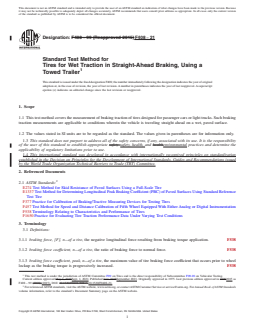
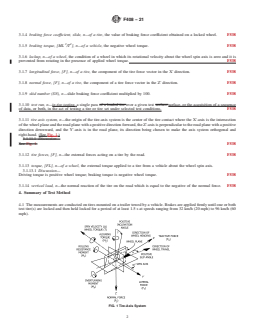
3.1.11 tire axis system, n—the origin of the tire-axis system
and is the direct responsibility of Subcommittee F09.20 on Vehicular Testing.
is the center of the tire contact where the X'-axis is the
Current edition approved Sept. 1, 2021. Published September 2021. Originally
intersection of the wheel plane and the road plane with a
approved in 1975. Last previous edition approved in 2015 as F408–99 (2015).
DOI: 10.1520/F0408-21.
positive direction forward, the Z'-axis is perpendicular to the
For referenced ASTM standards, visit the ASTM website, www.astm.org, or
road plane with a positive direction downward, and theY'-axis
contact ASTM Customer Service at service@astm.org. For Annual Book of ASTM
isintheroadplane,itsdirectionbeingchosentomaketheaxis
Standards volume information, refer to the standard’s Document Summary page on
the ASTM website. system orthogonal and right-hand. (See Fig. 1.) F538
Copyright © ASTM International, 100 Barr Harbor Drive, PO Box C700, West Conshohocken, PA 19428-2959. United States
F408 − 21
under other environmental conditions, or other towed trailers,
or other test devices, or with results obtained with other test
procedures.
6. Apparatus
6.1 The apparatus consists of tow vehicle and trailer. Ve-
hicle and trailer must comply with all applicable state and
federal laws when operated on public roads.
6.2 Tow Vehicle:
6.2.1 Thetowvehicleshallhavethecapabilityoftowingthe
trailer at specified speeds in the range from 32 to 96 km/h (20
to 60 mph), which are to be kept constant to within 0.8 km/h
(0.5 mph), even at maximum level of application of braking
forces.
6.2.2 The tow vehicle shall be equipped with the following
accessories:
6.2.2.1 Equipment to actuate brakes on towed trailer,
FIG. 1 Tire-Axis System
6.2.2.2 A water tank to store sufficient water to supply the
watering system unless external watering is used,
6.2.2.3 Recording equipment to record signals from trans-
3.1.12 tire forces, [F], n—theexternalforcesactingonatire ducers installed on the towed trailer,
by the road. F538
6.2.2.4 Hitch with adjustable height for towing the trailer,
and
3.1.13 torque, [FL], n—of a wheel, the external torque
6.2.2.5 Optionalequipmenttomonitorandcontrolbrakeline
applied to a tire from a vehicle about the wheel spin axis.
pressure, brake application rate, and water application rate.
3.1.13.1 Discussion—Driving torque is positive wheel
torque; braking torque is negative wheel torque. F538
6.3 Towed Trailer—The trailer shall be equipped with a tow
3.1.14 vertical load, n—the normal reaction of the tire on hitch and one or two test wheels which shall be instrumented
the road which is equal to the negative of the normal force.
as described. A self-watering system is optional (see 6.3.6).
F538 Trailers shall be designed to accommodate the range of
passenger car and light truck rim sizes to be tested.
4. Summary of Test Method
6.3.1 Thehitchheightshallbenohigherthantheloadedtire
radius, and the distance from hitch ball to axle centerline shall
4.1 The measurements are conducted on tires mounted on a
be no less than ten times the hitch height. For external
trailer towed by a vehicle. Brakes are applied firmly until one
watering, the trailer hitch on the tow vehicle shall be so
or both test tire(s) are locked and then held locked for a period
arranged that the trailer tires will run in tracks separate from
ofatleast1.5satspeedsrangingfrom32km/h(20mph)to96
the tire tracks of the tow vehicle. The minimum track offset of
km/h (60 mph).
the test tire(s) with respect to the track of the tow vehicles
4.2 Recommended vehicle test speeds are: 32, 64, and 96
should be 0.3 m (12 in.).
km/h (20, 40, and 60 mph).
6.3.2 The trailer shall have provisions for adjustment of
vertical load from 65 to 110% of the appropriate maximum
5. Significance and Use
load as specified in the current yearbook of the appropriate tire
5.1 The measured values are traction properties of tires
and rim standards organization. To meet this requirement for
obtained with the towed trailer described here on a given road
all rim sizes, two or more trailers designed for different load
surface, under given environmental conditions (ambient and
ranges and equipped with appropriate wheel adaptors may be
road surface temperature, humidity, wind speed and direction,
necessary.
purity and film depth of water used to wet the road surface).
6.3.3 Each of the test wheels shall be equipped with a
They are carried out in accordance with the stated test
typicalorspecialautomotivehydraulicbrakesystemwhichcan
procedures and reflect the performance of the total tire-vehicle
apply sufficient braking torque to initiate and maintain lockup
environmental system. A change in any of these factors may
of the test wheel(s) for the duration of the test.
change the measurements on a subsequent run of the test.
6.3.4 Each of the test wheels shall have a suspension
5.2 These test methods are suitable for research and devel- capableoflimitingchangeoftoeandcambertowithin 60.05°
opment purposes, where tires are compared during a single with maximum vertical suspension displacements. Suspension
series of tests.They may not be suitable for regulatory statutes arms and bushings shall have sufficient rigidity necessary to
or specification acceptance, because the values obtained may minimize free play and compliance under application of
not necessarily agree or correlate either in rank order or maximumbrakingforces.Thesuspensionsystemshallprovide
absolute traction performance level with those obtained on adequate load-carrying capacity and be of such a design as to
other road surfaces (or the same surface after additional wear), isolate suspension resonance.
F408 − 21
6.3.5 The brake application system shall be able to control speedometer used to measure vehicle speed shall have speci-
the time interval between initial brake application and wheel fications in accordance with Test Method F457.
lockup within a range of 0.2 to 0.5 s with a repeatability of
6.4.3 Braking Forces—The braking force-measuring trans-
60.1 s. ducers shall measure longitudinal force generated at the
tire-road interface as a result of brake application within a
6.3.6 The trailer may be optionally equipped with a
range from 0 to at least 125% of the applied vertical load.The
pavement-wetting system, less the storage tank, which is
transducer design and location shall minimize inertial effects
mounted on the tow vehicle. The water being applied to the
and vibration induced mechanical resonance. The transducer
pavement ahead of the test tires shall be supplied by a nozzle
shall have an output directly proportional to the force with less
suitably designed to ensure the water layer encountered by the
than1%hysteresisandlessthan1%nonlinearityatfullscale.
test tire has a uniform cross section at all test speeds with a
It shall have less than 2% cross-axis sensitivity at full scale.
minimum splash and over-spray (see Note 1). The nozzle
The transducer shall be installed in such a manner as to
configuration and position shall ensure that the water jets shall
experience less than 1° angular rotation with respect to its
be directed toward the test tire and pointed toward the
measuring axes at a maximum expected braking torque.
pavement at an angle of 20 to 30°. The water shall strike the
6.4.4 Vertical Load—The vertical load-measuring trans-
pavement 0.25 to 0.46 m (10 to 18 in.) ahead of the center of
ducer shall measure the vertical load at each test wheel during
tire contact. The nozzle shall be located 25 mm (1 in.) above
brake application. The transducer shall have the same specifi-
the pavement or the minimum height required to clear ob-
cations as those described in 6.4.3.
stacleswhichthetesterisexpectedtoencounter,butinnocase
6.4.5 Signal Conditioning and Recording System—All sig-
morethan100mm(4in.)abovethepavement.Thewaterlayer
shall be at least 25 mm (1 in.) wider than the test tire tread and nal conditioning and recording equipment shall provide linear
output with necessary gain and data reading resolution to meet
applied so the tire is centrally located between the edges. The
volume of water per unit of wetted width shall be directly the requirements of 6.4.1. Additionally, it shall have the
proportional to the test speed. The quantity of water applied at following specifications:
32 km/h (20 mph) shall be 300 mL/min per mm of width (2.0 6.4.5.1 Minimum Frequency Response—d-c flat (61%)to
gal/min per inch of width) of wetted surface.The rate of water
30 Hz full scale,
application at speeds of 64 and 96 km/h (40 and 60 mph) shall
6.4.5.2 Tire vertical load, braking force, vehicle and wheel
be 600 and 900 mL/min per mm of width (4.0 and 6.0 gal/min
speeds and a time base must be recorded in phase (0 to 30 Hz
perinchofwidth)ofwettedsurface,respectively.Thenominal
65°),
values of rate of water application shall be maintained within
6.4.5.3 Signal-to-Noise Ratio—at least 20/1,
610%. The water shall be reasonably clean and contain no
6.4.5.4 Gain shall be sufficient to permit full-scale display
chemicals such as wetting agents or detergents.
for full-scale input signal level,
6.4.5.5 Input impedance shall be at least ten times larger
NOTE 1—Asuitable nozzle design is described in detail inTest Method
than the output impedance of the signal source,
E274.
6.4.5.6 Itmustbeinsensitivetovibrations,acceleration,and
6.4 Instrumentation—Each test wheel position on the trailer
changes in ambient temperature. The error in reading shall not
shall be equipped with a wheel rotational velocity measuring
exceed 1% full scale when subjected to vibrational accelera-
system and with transducers to measure the braking force and
tion of 49.0 m/s (5 g’s) in the 0.5 to 40-Hz frequency range
vertical load at the test wheel.
and operating temperature range from 0°C (32°F) to 43°C
6.4.1 General R
...
This document is not an ASTM standard and is intended only to provide the user of an ASTM standard an indication of what changes have been made to the previous version. Because
it may not be technically possible to adequately depict all changes accurately, ASTM recommends that users consult prior editions as appropriate. In all cases only the current version
of the standard as published by ASTM is to be considered the official document.
Designation: F408 − 99 (Reapproved 2015) F408 − 21
Standard Test Method for
Tires for Wet Traction in Straight-Ahead Braking, Using a
Towed Trailer
This standard is issued under the fixed designation F408; the number immediately following the designation indicates the year of original
adoption or, in the case of revision, the year of last revision. A number in parentheses indicates the year of last reapproval. A superscript
epsilon (´) indicates an editorial change since the last revision or reapproval.
1. Scope
1.1 This test method covers the measurement of braking traction of tires designed for passenger cars or light trucks. Such braking
traction measurements are applicable to conditions wherein the vehicle is traveling straight ahead on a wet, paved surface.
1.2 The values stated in SI units are to be regarded as the standard. The values given in parentheses are for information only.
1.3 This standard does not purport to address all of the safety concerns, if any, associated with its use. It is the responsibility
of the user of this standard to establish appropriate safety safety, health, and healthenvironmental practices and determine the
applicability of regulatory limitations prior to use.
1.4 This international standard was developed in accordance with internationally recognized principles on standardization
established in the Decision on Principles for the Development of International Standards, Guides and Recommendations issued
by the World Trade Organization Technical Barriers to Trade (TBT) Committee.
2. Referenced Documents
2.1 ASTM Standards:
E274 Test Method for Skid Resistance of Paved Surfaces Using a Full-Scale Tire
E1337 Test Method for Determining Longitudinal Peak Braking Coefficient (PBC) of Paved Surfaces Using Standard Reference
Test Tire
F377 Practice for Calibration of Braking/Tractive Measuring Devices for Testing Tires
F457 Test Method for Speed and Distance Calibration of Fifth Wheel Equipped With Either Analog or Digital Instrumentation
F538 Terminology Relating to Characteristics and Performance of Tires
F1650 Practice for Evaluating Tire Traction Performance Data Under Varying Test Conditions
3. Terminology
3.1 Definitions:
3.1.1 braking force, [F], n—of a tire, the negative longitudinal force resulting from braking torque application. F538
3.1.2 braking force coeffıcient, n—of a tire, the ratio of braking force to normal force. F538
3.1.3 braking force coeffıcient, peak, n—of a tire, the maximum value of tire braking force coefficient that occurs prior to wheel
lockup as the braking torque is progressively increased. F538
This test method is under the jurisdiction of ASTM Committee F09 on Tires and is the direct responsibility of Subcommittee F09.20 on Vehicular Testing.
Current edition approved May 1, 2015Sept. 1, 2021. Published June 2015September 2021. Originally approved in 1975. Last previous edition approved in 20082015 as
F408 – 99 (2008).(2015). DOI: 10.1520/F0408-99R15.10.1520/F0408-21.
For referenced ASTM standards, visit the ASTM website, www.astm.org, or contact ASTM Customer Service at service@astm.org. For Annual Book of ASTM Standards
volume information, refer to the standard’s Document Summary page on the ASTM website.
Copyright © ASTM International, 100 Barr Harbor Drive, PO Box C700, West Conshohocken, PA 19428-2959. United States
F408 − 21
3.1.4 braking force coeffıcient, slide, n—of a tire, the value of braking force coefficient obtained on a locked wheel. F538
2 2
3.1.5 braking torque, [ML /T ], n—of a vehicle, the negative wheel torque. F538
3.1.6 lockup, n—of a wheel, the condition of a wheel in which its rotational velocity about the wheel spin axis is zero and it is
prevented from rotating in the presence of applied wheel torque. F538
3.1.7 longitudinal force, [F], n—of a tire, the component of the tire force vector in the X' direction. F538
3.1.8 normal force, [F], n—of a tire, the component of a tire force vector in the Z' direction. F538
3.1.9 skid number (SN), n—slide braking force coefficient multiplied by 100. F538
3.1.10 test run, n—in tire testing, a single pass of a loaded tire over a given test surface.surface, or the acquisition of a sequence
of data, or both, in the act of testing a tire or tire set under selected test conditions. F538
3.1.11 tire axis system, n—the origin of the tire-axis system is the center of the tire contact where the X'-axis is the intersection
of the wheel plane and the road plane with a positive direction forward, the Z'-axis is perpendicular to the road plane with a positive
direction downward, and the Y'-axis is in the road plane, its direction being chosen to make the axis system orthogonal and
right-hand. (See Fig. 1.)
3.1.11.1 Discussion—
See Fig. 1. F538
3.1.12 tire forces, [F], n—the external forces acting on a tire by the road. F538
3.1.13 torque, [FL], n—of a wheel, the external torque applied to a tire from a vehicle about the wheel spin axis.
3.1.13.1 Discussion—
Driving torque is positive wheel torque; braking torque is negative wheel torque. F538
3.1.14 vertical load, n—the normal reaction of the tire on the road which is equal to the negative of the normal force. F538
4. Summary of Test Method
4.1 The measurements are conducted on tires mounted on a trailer towed by a vehicle. Brakes are applied firmly until one or both
test tire(s) are locked and then held locked for a period of at least 1.5 s at speeds ranging from 32 km/h (20 mph) to 96 km/h (60
mph).
FIG. 1 Tire-Axis System
F408 − 21
4.2 Recommended vehicle test speeds are: 32, 64, and 96 km/h (20, 40, and 60 mph).
5. Significance and Use
5.1 The measured values are traction properties of tires obtained with the towed trailer described here on a given road surface,
under given environmental conditions (ambient and road surface temperature, humidity, wind speed and direction, purity and film
depth of water used to wet the road surface). They are carried out in accordance with the stated test procedures and reflect the
performance of the total tire-vehicle environmental system. A change in any of these factors may change the measurements on a
subsequent run of the test.
5.2 These test methods are suitable for research and development purposes, where tires are compared during a single series of
tests. They may not be suitable for regulatory statutes or specification acceptance, because the values obtained may not necessarily
agree or correlate either in rank order or absolute traction performance level with those obtained on other road surfaces (or the same
surface after additional wear), under other environmental conditions, or other towed trailers, or other test devices, or with results
obtained with other test procedures.
6. Apparatus
6.1 The apparatus consists of tow vehicle and trailer. Vehicle and trailer must comply with all applicable state and federal laws
when operated on public roads.
6.2 Tow Vehicle:
6.2.1 The tow vehicle shall have the capability of towing the trailer at specified speeds in the range from 32 to 96 km/h (20 to
60 mph), which are to be kept constant to within 0.8 km/h (0.5 mph), even at maximum level of application of braking forces.
6.2.2 The tow vehicle shall be equipped with the following accessories:
6.2.2.1 Equipment to actuate brakes on towed trailer,
6.2.2.2 A water tank to store sufficient water to supply the watering system unless external watering is used,
6.2.2.3 Recording equipment to record signals from transducers installed on the towed trailer,
6.2.2.4 Hitch with adjustable height for towing the trailer, and
6.2.2.5 Optional equipment to monitor and control brakeline pressure, brake application rate, and water application rate.
6.3 Towed Trailer—The trailer shall be equipped with a tow hitch and one or two test wheels which shall be instrumented as
described. A self-watering system is optional (see 6.3.6). Trailers shall be designed to accommodate the range of passenger car and
light truck rim sizes to be tested.
6.3.1 The hitch height shall be no higher than the loaded tire radius, and the distance from hitch ball to axle centerline shall be
no less than ten times the hitch height. For external watering, the trailer hitch on the tow vehicle shall be so arranged that the trailer
tires will run in tracks separate from the tire tracks of the tow vehicle. The minimum track offset of the test tire(s) with respect
to the track of the tow vehicles should be 0.3 m (12 in.).
6.3.2 The trailer shall have provisions for adjustment of vertical load from 65 to 110 % of the appropriate maximum load as
specified in the current yearbook of the appropriate tire and rim standards organization. To meet this requirement for all rim sizes,
two or more trailers designed for different load ranges and equipped with appropriate wheel adaptors may be necessary.
6.3.3 Each of the test wheels shall be equipped with a typical or special automotive hydraulic brake system which can apply
sufficient braking torque to initiate and maintain lockup of the test wheel(s) for the duration of the test.
6.3.4 Each of the test wheels shall have a suspension capable of limiting change of toe and camber to within 60.05° with
maximum vertical suspension displacements. Suspension arms and bushings shall have sufficient rigidity necessary to minimize
F408 − 21
free play and compliance under application of maximum braking forces. The suspension system shall provide adequate
load-carrying capacity and be of such a design as to isolate suspension resonance.
6.3.5 The brake application system shall be able to control the time interval between initial brake application and wheel lockup
within a range of 0.2 to 0.5 s with a repeatability of 60.1 s.
6.3.6 The trailer may be optionally equipped with a pavement-wetting system, less the storage tank, which is mounted on the tow
vehicle. The water being applied to the pavement ahead of the test tires shall be supplied by a nozzle suitably designed to ensure
the water layer encountered by the test tire has a uniform cross section at all test speeds with a minimum splash and over-spray
(see Note 1). The nozzle configuration and position shall ensure that the water jets shall be directed toward the test tire and pointed
toward the pavement at an angle of 20 to 30°. The water shall strike the pavement 0.25 to 0.46 m (10 to 18 in.) ahead of the center
of tire contact. The nozzle shall be located 25 mm (1 in.) above the pavement or the minimum height required to clear obstacles
which the tester is expected to encounter, but in no case more than 100 mm (4 in.) above the pavement. The water layer shall be
at least 25 mm (1 in.) wider than the test tire tread and applied so the tire is centrally located between the edges. The volume of
water per unit of wetted width shall be directly proportional to the test speed. The quantity of water applied at 32 km/h (20 mph)
shall be 300 mL/min per mm of width (2.0 gal/min per inch of width) of wetted surface. The rate of water application at speeds
of 64 and 96 km/h (40 and 60 mph) shall be 600 and 900 mL/min per mm of width (4.0 and 6.0 gal/min per inch of width) of
wetted surface, respectively. The nominal values of rate of water application shall be maintained within 610 %. The water shall
be reasonably clean and contain no chemicals such as wetting agents or detergents.
NOTE 1—A suitable nozzle design is described in detail in Test Method E274.
6.4 Instrumentation—Each test wheel position on the trailer shall be equipped with a wheel rotational velocity measuring system
and with transducers to measure the braking force and vertical load at the test wheel.
6.4.1 General Requirements for Measurement System—The instrumentation system shall conform to the following overall
requirements at ambient temperatures between 0 and 43°C (32 and 110°F):
6.4.1.1 Overall system accuracy, force: 61.5 % of vertical load or traction force from 450 N (100 lbf) to full scale,
6.4.1.2 Overall system accuracy, speed: 61.5 % of speed or 60.8 km/h (60.5 mph), whichever is greater,
6.4.1.3 Shunt Calibration—All strain-gage transducers shall be equipped with shunt calibration resistors that can be connected
before or after test sequences. The calibration signal shall be at least 50 % of the full scale for the transducer, and
6.4.1.4 Ruggedness—The exposed portions of the system shall tolerate 100 % relative humidity (rain or spray) and all other
adverse conditions such as dust, shock, and vibrations which may be encountered in regular operation.
6.4.2 Vehicle Speed—To measure vehicle speed, a fifth wheel or non-contact precision speed-measuring system should be used.
Output shall be directly visable to the driver and shall be simultaneously recorded. The fifth wheel or precision speedometer used
to measure vehicle speed shall have specifications in accordance with Test Method F457.
6.4.3 Braking Forces—The braking force-measuring transducers shall measure longitudinal force generated at the tire-road
interface as a result of brake application within a range from 0 to at least 125 % of the applied vertical load. The transducer design
and location shall minimize inertial effects and vibration induced mechanical resonance. The transducer shall have an output
directly proportional to the force with less than 1 % hysteresis and less than 1 % nonlinearity at full scale. It shall have less than
2 % cross-axis sensitivity at full scale. The transducer shall be installed in such a manner as to experience less than 1° angular
rotation with respect to its measuring axes at a maximum expected braking torque.
6.
...